
AI Confidence Scores Explained: Why a Confident Answer Is Not a Probability
AI confidence scores can help route an answer to use, verification, human review, or abstention—but only when the score has a precise meaning and has been tested against real outcomes. This guide separates confident language from calibrated evidence.

AI Confidence Scores: The Quick Answer
AI confidence scores are measurements intended to estimate how much trust a system should place in a prediction, answer, retrieved passage, classification, or action. The crucial word is intended. A number such as 0.91 is not automatically a 91% chance that the answer is true. It might be a token probability, a model’s self-reported feeling, agreement across repeated samples, similarity between a query and a retrieved document, or the output of a separate verifier. Those signals answer different questions.
A useful confidence score must name its target. Does it predict that a label is correct? That a citation supports a claim? That a retrieved passage is relevant? That an agent action will succeed? That a human reviewer will accept the answer? Until the target is defined, the number is just a score. It becomes a probability-like decision tool only after the same measurement procedure is compared with known outcomes on representative data.
This distinction matters because language models are optimized to produce plausible continuations. Fluent, direct prose can make an answer feel certain even when the underlying evidence is thin. The Nature Machine Intelligence study on what language models know and what people think they know found a gap between model confidence and the confidence people inferred from ordinary explanations. Presentation is therefore part of the risk: users may read confidence into tone even when no reliable confidence estimate was provided.
The goal is not to eliminate uncertainty. That is impossible in open-ended language tasks. The goal is to make uncertainty operational: identify weak evidence, measure error on known examples, set thresholds, and choose a safe response such as answer, verify, retrieve more information, ask a clarifying question, route to a person, or abstain.
Why Confident Language Is Not a Confidence Score
Suppose an assistant replies, “The policy definitely took effect on March 14.” The adverb definitely is linguistic behavior. It may reflect learned writing patterns, an instruction to sound decisive, or an attempt to satisfy the user. It does not reveal a calibrated probability that the date is correct. The model can produce exactly the same tone when the date is well supported, weakly remembered, inferred from a nearby event, or invented.
This is one reason hallucinations are difficult for readers to detect. An incorrect answer may not contain a visible warning. It can be grammatically clean, detailed, and internally coherent. Singularity Journey’s guide to AI hallucinations explains why plausible generation and factual verification are different processes. Confidence adds a second distinction: even if a model can sometimes detect that it is likely to be wrong, its everyday wording may not communicate that uncertainty faithfully.
Four things people commonly confuse
A score can discriminate well without being calibrated. Imagine correct answers usually receive 0.80 and incorrect answers 0.60. The ranking is helpful because higher tends to be better. But if the 0.80 group is correct only 65% of the time, the values are overconfident. Conversely, a system can appear calibrated in aggregate while hiding serious failure in an important subgroup. If easy questions dominate the dataset, good average calibration can conceal poor performance on rare languages, new products, safety-sensitive requests, or out-of-distribution cases.
That is why “the model says it is 90% confident” should never end the conversation. The number must be interpreted through a measurement protocol and a deployment context. A calibrated 90% score on a fixed product-classification task can be useful. A casually generated “90%” on an obscure medical, legal, or financial question should not be treated as permission to act.
The Five Main Signals Behind AI Confidence Scores
There is no single universal confidence mechanism for generative AI. Real systems often combine several signals. Each can contribute useful information, but each has a different failure mode.
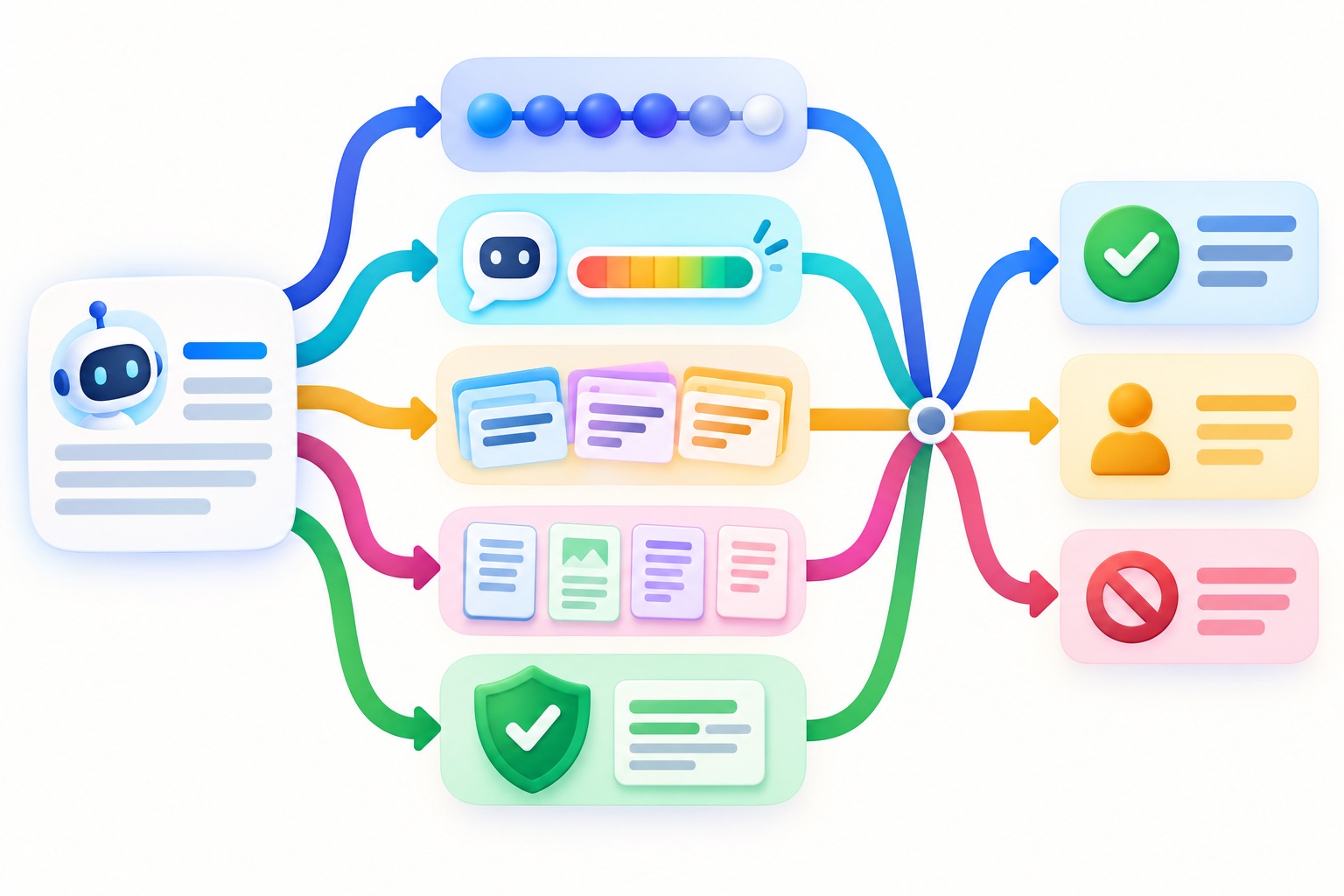 A confidence architecture is usually a collection of signals, not one magical truth meter.
| Signal | What it measures | Where it helps | Main trap |
|---|---|---|---|
| Token or sequence probability | How likely the generated tokens are under the model | Constrained classification, ranking candidate answers, detecting unusual generations | Likely wording is not the same as correct meaning; length and phrasing distort sequence probability |
| Verbalized confidence | A confidence value the model writes in its answer | Easy to request through an API; can work when the prompt and task are calibrated | The number is generated text and can inherit instruction, style, and reward biases |
| Repeated-sample agreement | How consistently multiple runs reach the same answer or meaning | Open-ended questions, reasoning tasks, semantic uncertainty estimates | Many samples can repeat the same misconception or shared blind spot |
| Retrieval and evidence signals | Similarity, ranking, coverage, or support from retrieved sources | RAG systems, citation workflows, enterprise knowledge assistants | A relevant passage may not answer the question, and a supported citation may still be misinterpreted |
| Verifier or judge score | A second model or deterministic test evaluates the answer | Structured checks, groundedness, policy compliance, code tests, claim verification | The verifier can share the generator’s blind spots or become unreliable under domain shift |
1. Token probabilities
A language model chooses tokens from a probability distribution. If an API exposes log probabilities, a builder can inspect how strongly the model preferred one token over alternatives. This is most interpretable when the output space is small and known—for example, choosing approve, review, or reject. It becomes harder for long-form prose. There are many correct ways to say the same thing, and the probability of a full token sequence shrinks with length. A low probability for one wording may simply mean that the model could have phrased the same correct idea differently.
Token probability is therefore not a universal fact-confidence score. It is a model-generation signal. If you want to use it, define the output choices, keep the prompt stable, and validate the mapping from log probability to correctness on examples from the real task.
2. Verbalized confidence
You can ask a model, “Give the answer and a confidence from 0 to 100.” This is attractive because it works even when internal probabilities are unavailable. It is not automatically useless. The EMNLP paper Just Ask for Calibration reported that verbalized confidence from several human-feedback-tuned models could be better calibrated than their conditional probabilities on the studied question-answering benchmarks. The lesson is not that self-reports are trustworthy everywhere. The lesson is that the elicitation method matters and must be evaluated.
A self-report can change when you alter the prompt, request a rationale, supply examples, change the model, or switch domains. Treat it as a feature to calibrate, not a fact to display untested.
3. Consistency and semantic uncertainty
If you ask the same question several times and receive contradictory answers, uncertainty is visible. But exact wording disagreement is noisy: two sentences can express the same meaning. Research published in Nature on detecting hallucinations with semantic entropy groups generations by meaning before measuring their uncertainty. In the reported experiments, meaning-level uncertainty was more effective than naive token-level entropy at detecting a subset of false, arbitrary generations.
This approach is powerful because it focuses on what the answers mean. It also costs more: the system must sample multiple outputs, compare meanings, and choose a threshold. Agreement is not proof. Five runs may reproduce one memorized error. Consistency becomes stronger when combined with evidence and verification.
4. Retrieval confidence
Retrieval-augmented generation systems often expose similarity scores or ranks. Those values describe the relationship between a query and stored documents. They do not directly say that the final answer is correct. A highly similar document may be outdated, ambiguous, incomplete, or about an adjacent product. The generation can also misread the retrieved text.
A stronger RAG confidence design separates at least three checks: retrieval relevance, evidence sufficiency, and answer groundedness. The RAG hallucinations guide covers why having sources does not guarantee faithful use of those sources. Confidence should drop or trigger review when the evidence is missing, conflicting, stale, or insufficient for the requested specificity.
5. Verifiers and deterministic checks
A second model can assess whether an answer is supported, consistent, safe, or complete. Deterministic tools can validate JSON, recalculate arithmetic, execute tests, check a database, or confirm that a citation contains the claim. These checks are often more useful than asking the original model to “be more confident.”
Still, a verifier score is not infallible. Model judges can favor particular styles, miss shared errors, and drift when inputs differ from their evaluation set. Deterministic validation proves only the property tested. Valid JSON does not prove a correct business decision—a distinction explained in the guide to AI structured outputs.
What AI Calibration Actually Means
Calibration is a relationship between predicted confidence and observed frequency. If a system assigns 0.70 confidence to 1,000 comparable cases, perfect calibration would mean that roughly 700 are correct. You cannot determine calibration from one answer. A single prediction is either correct or incorrect; calibration appears across a set.
This batch-level idea is the most important mental model in the article. A confidence score should not be evaluated by whether one 90% prediction failed. Even a perfectly calibrated 90% bucket will contain errors. The correct question is whether about 90% of many representative 90% predictions are correct, and whether that relationship remains stable in the slices that matter.
 Calibration is tested across groups of predictions and outcomes, not judged from a single impressive answer.
A simple calibration example
Imagine a customer-support assistant that predicts whether its proposed resolution is safe to send automatically. Over a labeled evaluation set, you collect 200 cases scored near 0.80. Human reviewers judge 120 of those resolutions correct and complete. The observed success rate is 60%, not 80%. The system is overconfident in that range. If 190 were correct, it would be underconfident.
Now split the same data by product. Perhaps billing answers are well calibrated but identity-recovery answers are not. The average can hide the dangerous slice. Split again by question novelty, language, document age, and whether the relevant policy was retrieved. Calibration is a property of a defined system under defined conditions—not a permanent personality trait of the base model.
Calibration does not create knowledge
A calibration method can map a raw score to a better probability estimate. It cannot add missing evidence. If the model has no reliable signal that distinguishes right from wrong, a smooth calibration curve cannot rescue the task. Likewise, a system can be calibrated but not useful. A model that always predicts the base rate may be statistically calibrated while providing little discrimination between individual cases.
You normally want both:
- Discrimination: higher scores reliably rank better cases above worse ones.
- Calibration: the numerical values match observed frequencies closely enough for the decision.
- Coverage: the system can handle a useful share of cases instead of abstaining on everything.
- Stability: performance holds across time, domains, languages, prompt versions, and important risk slices.
How to Evaluate an AI Confidence Score
No single metric captures every requirement. Choose metrics based on the decision you are trying to support.
| Metric or curve | Plain-English question | Useful for | Caution |
|---|---|---|---|
| Reliability diagram | When the system says 70%, how often is it right? | Seeing overconfidence and underconfidence across score buckets | Results depend on binning and sample size |
| Expected Calibration Error | On average, how far are confidence buckets from observed accuracy? | Compact calibration tracking | Averages can hide rare but serious slices |
| Brier score | How close are probability forecasts to binary outcomes? | Comparing probabilistic predictions while penalizing confident errors | Mixes calibration and discrimination; interpret with other views |
| AUROC | How well does the score rank correct cases above incorrect ones? | Measuring discrimination across thresholds | Does not tell you whether 0.8 really means 80% |
| Risk–coverage curve | As the system answers fewer cases, how quickly does error fall? | Choosing abstention or review thresholds | Must reflect the real cost of errors and abstentions |
| Slice metrics | Does performance hold for the groups and conditions that matter? | Languages, products, user types, novelty, high-risk actions | Small slices need uncertainty intervals and ongoing monitoring |
Why a threshold is a policy decision
A confidence threshold is not discovered from mathematics alone. It encodes the relative cost of a wrong answer, a delayed answer, a human review, and a refusal. A marketing tag suggestion may be safe to automate at a lower threshold because an error is cheap and reversible. A bank-account change, medication instruction, destructive tool call, or access-control decision needs stronger evidence and human authority.
The same score may therefore lead to different actions. At 0.82, a low-risk FAQ may be sent automatically, a refund explanation may be reviewed, and an account deletion may be blocked pending explicit approval. The human approval gates guide shows how action risk—not model confidence alone—should determine oversight.
Abstention is a feature, not a failure
An abstaining system says, in effect, “I do not have enough evidence to meet the required risk threshold.” That can mean asking a clarifying question, retrieving more sources, presenting several possibilities, escalating to a person, or refusing to perform an action. OpenAI’s research article Why language models hallucinate argues that many common evaluations reward guessing and penalize honest uncertainty. If the scoreboard gives the same penalty to an abstention and a fabricated answer, a system has an incentive to guess.
Production policy should reverse that incentive when errors are costly. An incorrect confident answer and an honest “I need more information” response should not have equal consequences. The correct reward depends on the use case, but high-confidence errors usually deserve special attention because they are most likely to bypass review.
A Practical AI Confidence Calibration Workflow
You do not need to solve uncertainty quantification in the abstract. You need a repeatable workflow for one task, one decision, and one deployment.
Define the prediction target
Write one sentence: “This score estimates the probability that…” Finish it with a measurable outcome. Examples include “the assigned ticket category matches the approved label,” “every factual claim is supported by the supplied documents,” or “the proposed action completes without violating a policy.” Avoid vague targets such as “the answer is good.”
Choose candidate signals
Start with the cheapest meaningful signals: constrained output probabilities, retrieval coverage, deterministic validation, self-reported confidence, repeated-sample agreement, or a verifier. Do not combine them into one score until you have evaluated each separately. A simple deterministic check may outperform an elaborate model judge for a narrow property.
Build a representative labeled set
Use real task examples, not only clean benchmark questions. Include common cases, ambiguous cases, adversarial inputs, missing information, outdated documents, rare classes, multiple languages, and known failure modes. Preserve a separate test set so that threshold tuning does not become accidental memorization.
Measure ranking and calibration
Check whether the signal separates correct from incorrect cases, then inspect reliability by score range. Use a reliability diagram, Brier score, and a ranking measure such as AUROC where appropriate. For systems that may abstain, inspect risk–coverage: how error changes as the system answers fewer cases.
Calibrate without leaking test data
If raw values are systematically too high or too low, fit a mapping on a calibration set. Common approaches include temperature scaling, logistic or Platt-style scaling, and isotonic regression. The method matters less than honest separation between fitting and final evaluation. Recheck after changing prompts, models, retrieval, or instructions.
Map score ranges to actions
Create an explicit policy: answer automatically, answer with evidence, run verification, ask a question, route to human review, or abstain. Include action risk, reversibility, permissions, and user impact. A high score should never override a rule that requires human approval.
Monitor drift and confident errors
Track score distributions, actual outcomes, coverage, overrides, review outcomes, and changes by slice. Sample high-confidence outputs for audit because confident errors reveal where the signal is blind. Connect this monitoring to an AI agent failure taxonomy so teams can separate model, context, retrieval, memory, tool, and handoff problems.
The older paper Language Models (Mostly) Know What They Know provides encouraging evidence that models can sometimes evaluate whether answers are likely correct, especially in controlled formats. It also reports limits when confidence must generalize to new tasks. That qualification is operationally important: a confidence method validated on trivia does not automatically transfer to tax, security, medical, or proprietary enterprise questions.
NIST’s Generative AI Profile emphasizes empirical evaluation, documented limitations, monitoring, and appropriate human-AI configurations. A calibration workflow turns those broad risk-management ideas into a concrete question: under which observed conditions is this system reliable enough for this action?
AI Confidence-to-Action Decision Helper
This interactive helper does not calculate a probability. It shows how risk, evidence, calibration, and reversibility should influence the action attached to a score. A numeric value without these conditions should not unlock autonomy.
The helper deliberately does not ask for a confidence percentage. If a score is uncalibrated, an impressive number should carry little weight. If an action is high impact and irreversible, even strong calibration may not justify automation. Confidence contributes to the policy; it does not replace the policy.
How AI Confidence Should Work in Real Systems
Customer support
A support assistant may classify intent, retrieve policy, draft a response, and decide whether it can send. Use separate checks: classification confidence, document freshness, whether the evidence covers every claim, and whether the requested action is permitted. Low-risk shipping questions may be automated after calibration. Refund exceptions, identity recovery, or account closure should require approval regardless of a high generated score.
Retrieval-augmented answers
Do not use vector similarity as the final answer confidence. Test whether the retrieved passages are relevant, sufficient, current, and mutually consistent. Then verify that each important claim is supported. If sources conflict, the system should expose the disagreement rather than average it into false certainty.
AI agents and tool use
An agent may be confident about the next action but wrong about the environment. Tool state can change between planning and execution. Pair model confidence with permissions, idempotency, state checks, budgets, stop conditions, and approval gates. The article on AI agent autonomy levels explains why greater autonomy requires stronger control, not merely a more capable model.
Code generation
For code, execution is often a better verifier than self-confidence. Compile the code, run tests, inspect security constraints, and review the diff. A model’s confidence can prioritize attention, but passing a targeted test is evidence about a defined behavior. Even then, tests cover only what they assert.
High-stakes advice
Medical, legal, financial, employment, and access-control contexts demand caution. A confidence score should not be presented as clinical probability or professional assurance unless the complete system was designed and validated for that use. Prefer authoritative sources, uncertainty disclosure, human professionals, and clearly limited assistance. A general-purpose model’s self-reported certainty is not a substitute for regulated validation.
Common Misconceptions and Design Mistakes
| Misconception | Why it fails | Better approach |
|---|---|---|
| “The model said 95%, so the answer is probably correct.” | The value may be uncalibrated generated text. | Define the target and validate the same elicitation method against labeled outcomes. |
| “High token probability means factual truth.” | Token likelihood reflects expected wording, not external verification. | Use constrained choices where suitable and pair with evidence or tests. |
| “The samples agree, so the answer is true.” | Repeated runs can share the same learned error. | Combine agreement with independent evidence and adversarial cases. |
| “A citation makes the answer reliable.” | The source can be irrelevant, stale, or misread. | Check relevance, sufficiency, freshness, and claim-level support. |
| “One global threshold works everywhere.” | Costs, base rates, and error patterns vary by slice and action. | Set risk-aware thresholds and monitor subgroup performance. |
| “A calibrated model can be trusted permanently.” | Models, prompts, tools, documents, and user populations change. | Version the scoring pipeline and recalibrate after material changes. |
| “Abstention means the system is weak.” | Forced answers turn uncertainty into confident error. | Measure risk against coverage and reward appropriate escalation. |
Do not calibrate on the same data you report
If you tune thresholds until an evaluation set looks good and then report the same set as final evidence, you have optimized to the test. Keep training, calibration, and test data separate. For small datasets, use careful resampling and uncertainty intervals, but preserve a genuinely untouched final evaluation whenever possible.
Do not hide low coverage
A system can achieve impressive accuracy by answering only the easiest 5% of questions. That may be acceptable for a narrow automation feature, but users and operators need to know the coverage. Report how often the system answers, reviews, and abstains alongside its error rate.
Do not let confidence bypass authority
Confidence answers an epistemic question: how reliable might this output be? Authorization answers a governance question: is the system allowed to do this? They are independent. A highly confident agent should still be unable to exceed permissions, spend beyond a budget, disclose protected information, or perform a destructive action without the required approval.
This is also why AI output review should focus on evidence and decision ownership rather than asking a reviewer to rubber-stamp an impressive score.
A Production Checklist for AI Confidence Scores
- The score has a one-sentence definition with a measurable outcome.
- The input, prompt, model, tools, and scoring method are versioned.
- The score is tested on representative real-world examples.
- Evaluation includes ambiguous, missing-evidence, adversarial, and out-of-scope cases.
- Calibration and discrimination are measured separately.
- Risk–coverage tradeoffs are reported when the system can abstain.
- Important slices are evaluated, not only the overall average.
- Thresholds reflect the cost of errors, review, delay, and abstention.
- High-impact or irreversible actions retain mandatory approval.
- Retrieval relevance is not confused with answer correctness.
- Verifier models are evaluated against human or deterministic ground truth.
- Confident errors are sampled and investigated as a special failure class.
- Coverage, override rates, review outcomes, and drift are monitored after launch.
- Material changes trigger re-evaluation and, when necessary, recalibration.
- User-facing language communicates limitations without pretending to provide certainty.
For a broader measurement program, connect this checklist to the AI agent evaluation metrics guide. Confidence is one layer of evaluation, alongside task success, groundedness, safety, latency, cost, robustness, and recovery behavior.
Final Takeaway: Treat Confidence as Measured Evidence
AI confidence scores are useful when they are specific, empirical, and connected to action. They are misleading when they are treated as a model’s inner truthfulness meter. Fluent language is not probability. Token likelihood is not factuality. Retrieval similarity is not answer support. Repeated agreement is not independent confirmation. A verifier score is not trustworthy until the verifier itself is evaluated.
The practical standard is demanding but clear: define what the score predicts, collect representative labeled outcomes, measure ranking and calibration, inspect important slices, set risk-aware thresholds, and monitor drift. Then use the result to route work—not to manufacture certainty.
When evidence is strong and the action is low risk, the system may answer. When evidence is partial, it should verify or ask. When stakes are high, it should escalate. When the required confidence cannot be justified, it should abstain. That is not an admission that AI has failed. It is what reliable decision-making looks like under uncertainty.
FAQ About AI Confidence Scores
Can an AI model know when it is wrong?
Sometimes it can produce signals that correlate with correctness, such as self-evaluation, token probabilities, disagreement across samples, or verifier scores. Research shows promise in controlled settings, but the signals do not generalize perfectly. They must be tested on the exact task and system. “Knowing” is therefore best treated as measurable error prediction, not human-like self-awareness.
Is a model-generated confidence percentage meaningful?
It can become meaningful if the prompt, model, task, and scoring method are fixed and the values are calibrated against representative labeled outcomes. Without that validation, a generated percentage is another piece of text and should not be treated as a probability of truth.
Are token probabilities the same as confidence?
No. Token probabilities describe how likely particular text is under the model. They can support confidence estimation, especially for constrained choices, but likely wording is not automatically a correct answer. For long-form generation, phrasing and length make direct interpretation more difficult.
What does it mean for an AI confidence score to be calibrated?
It means predicted probabilities match observed frequencies across many cases. If predictions assigned about 80% confidence are correct about 80% of the time, that range is calibrated. Calibration should also be checked across important subgroups and after system changes.
Is 90% confidence safe enough to automate an action?
Not by itself. The answer depends on whether the score is calibrated, the evidence is strong, the action is authorized, the consequence of error is acceptable, and the result is reversible. High-impact actions may always require human approval even when the score is high.
How should a RAG system calculate confidence?
Use multiple layers: retrieval relevance, evidence sufficiency, source quality and freshness, claim-level groundedness, and task-specific outcome evaluation. Do not use vector similarity alone as the final answer confidence. Conflicting or incomplete evidence should trigger clarification, review, or abstention.
What is semantic uncertainty?
Semantic uncertainty measures disagreement across meanings rather than exact strings. A system samples multiple answers, groups expressions that mean the same thing, and estimates how dispersed the meanings are. High disagreement can signal possible confabulation, although agreement still does not prove truth.
What is the difference between confidence and calibration?
Confidence is a score attached to an individual prediction. Calibration is a property measured across many predictions: whether groups assigned a given confidence are correct at the corresponding frequency. A system can rank cases well while its numeric confidence remains overconfident.
When should an AI abstain?
An AI should abstain, ask, retrieve, or escalate when evidence is insufficient, inputs are ambiguous, sources conflict, the case is outside validated scope, the score falls below a risk-aware threshold, or the action requires authority the AI does not have.

