
Human-in-the-Loop AI Agents: Approval Patterns for Safe Autonomy
A practical guide to approval patterns, risk tiers, escalation rules, audit logs, and rollback paths for teams building autonomous AI agents that still need accountable human control.
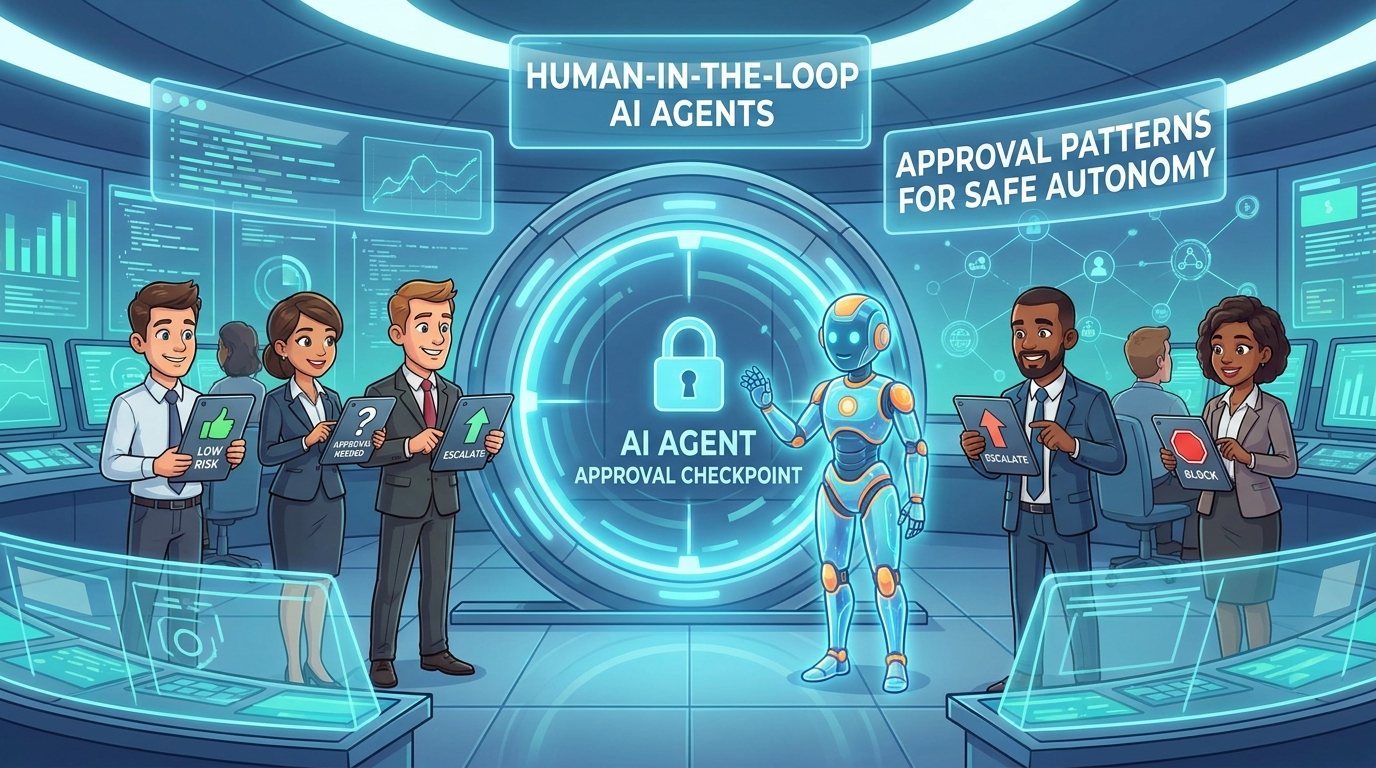
Quick Answer: Human-in-the-Loop AI Agents Need Designed Friction
Human-in-the-loop AI agents are not agents that ask a person about everything. They are agents that know when to stop. The point is to let safe, reversible, low-impact work move quickly while forcing explicit approval before actions that could expose data, spend money, change production systems, contact customers, delete records, violate policy, or create legal and reputational risk.
This cluster article supports the broader pillar guide on autonomous AI agents and human control. The pillar explains the governance blueprint. This article zooms into one operational layer: approval design. If an autonomous agent can use tools, remember context, call APIs, write messages, modify records, or coordinate with other systems, then human oversight cannot be a vague slogan. It has to be a product workflow with risk tiers, approval messages, audit logs, escalation paths, and rollback plans.
The search gap is clear: many resources define AI agents or talk about high-level governance, but fewer show the actual approval patterns teams can use. That is the useful middle ground: serious enough for risk leaders, concrete enough for builders, and calm enough to avoid both agent hype and agent panic.
Why Human Approval Is Becoming the Control Layer for Autonomous Agents
AI agents are different from ordinary chatbots because they can pursue goals through steps. They may retrieve information, call tools, update systems, generate drafts, ask other agents for help, and retry after failure. That makes them useful, but it also changes the risk profile. A chatbot answer can be wrong. An agent action can be wrong and already executed.
Official and industry sources increasingly describe AI risk as a management problem, not only a model problem. The NIST AI Risk Management Framework organizes responsible AI around governance, mapping, measurement, and management. ISO/IEC 42001 frames AI governance as a management system. The EU AI Act uses risk-based obligations. IBM and Google Cloud explain AI agents as systems that combine reasoning, planning, memory, tools, and action. None of those sources says “just trust the model.” The direction is toward structured controls.
Human approval is one of those controls, but only when it is specific. A generic “review before launch” gate will not work for agents that make many small decisions. A generic “human oversight required” policy will not help a support agent decide whether it can refund a customer. The oversight has to be translated into rules the agent and the operating team can follow.
| Agent capability | Why it creates risk | Approval implication |
|---|---|---|
| Tool use | The agent can affect real systems, not only text. | Require approval for high-impact tools and dangerous parameters. |
| Memory | The agent may use stored context that is outdated, sensitive, or wrong. | Ask for review before using sensitive memory in external action. |
| Planning | The agent can chain steps and create unintended consequences. | Approve plans before execution when the chain crosses risk boundaries. |
| External communication | The agent can represent the organization to users, vendors, or regulators. | Approve messages involving commitments, disputes, legal claims, or exceptions. |
| Autonomous retries | The agent may repeatedly attempt a failing action. | Escalate after thresholds instead of letting loops continue. |
The Four Risk Tiers for Human-in-the-Loop AI Agents
The simplest way to design approval is to classify actions before you classify prompts. Prompts are messy. Actions are easier to govern. A customer-support agent, finance agent, coding agent, compliance agent, and research agent may all use different language, but their actions usually fall into a few risk tiers.
Tier 1: Low-risk actions that do not need approval
These are reversible, internal, low-impact actions. Examples include summarizing a document for internal use, drafting a private note, tagging a low-sensitivity ticket, searching approved knowledge bases, or preparing a task list. Logging still matters, but approval would create unnecessary friction.
Tier 2: Reviewable actions that need lightweight confirmation
These actions are visible or meaningful but still easy to review. Examples include sending a routine internal update, changing a non-critical field, suggesting a refund within policy, or creating a draft response. The approval can be one-click, time-boxed, and routed to the task owner.
Tier 3: High-risk actions that need explicit approval
These actions can affect customers, revenue, compliance, production systems, privacy, or brand trust. Examples include sending external messages, modifying customer records, making purchasing recommendations, changing access permissions, updating production configuration, or using sensitive personal data. Approval should include evidence, alternatives, and rollback details.
Tier 4: Critical actions that should usually be blocked or escalated
Some actions are not suitable for normal agent autonomy. Deleting production data, bypassing security controls, making legal commitments, approving financial transactions above threshold, changing medical or safety-critical instructions, or contacting regulators should be blocked, escalated, or handled by a controlled workflow outside the agent.
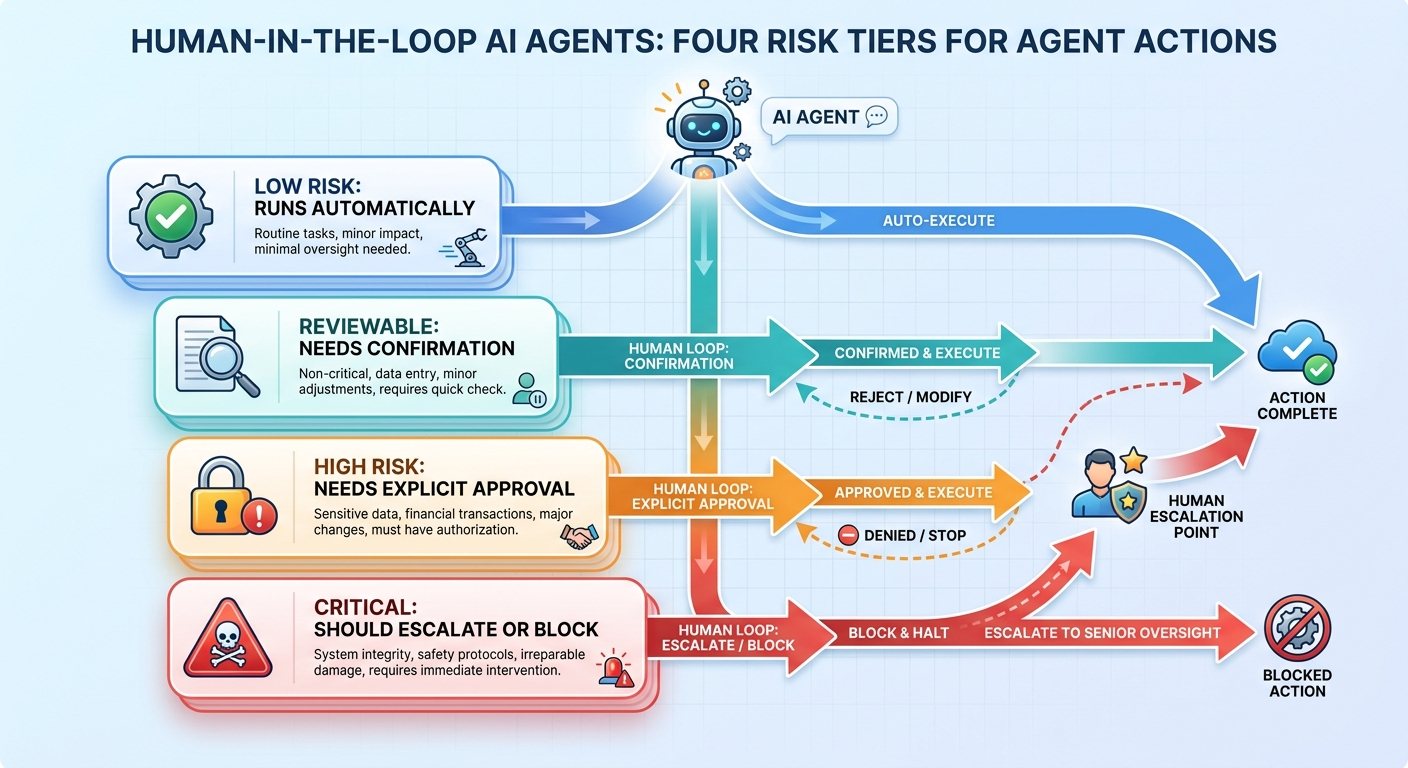
This tier model also helps teams avoid the most common mistake: treating all autonomy as equally risky. If every step needs a human, the agent becomes a slow form. If no step needs a human, the agent becomes a governance liability. Tiers give the system room to move and boundaries to respect.
Seven Approval Patterns That Work Better Than a Generic Review Button
A useful approval workflow is not a single button. Different agent actions need different kinds of human involvement. The best pattern depends on reversibility, urgency, uncertainty, audience, and impact.
These patterns can be combined. A coding agent might require pre-flight plan approval for a production migration, tool-call approval before running database changes, parameter approval for file deletion paths, and post-action audit for formatting edits. A support agent might handle routine refund drafts automatically, require manager approval above a threshold, and escalate abuse or legal complaints.
What a Good AI Agent Approval Request Should Include
Bad approval requests create rubber-stamping. They say, “Approve action?” and force the human to reconstruct the situation. Good approval requests are decision packets. They tell the approver what the agent wants to do, why, what evidence it used, what could go wrong, and how to undo it.
| Field | What it should answer | Example |
|---|---|---|
| Goal | What is the agent trying to accomplish? | Resolve a billing ticket by issuing a partial refund. |
| Proposed action | What exactly will happen if approved? | Issue a ₹2,000 refund to invoice #4821 and send the prepared email. |
| Risk tier | How risky is the action? | Tier 3 because money and external communication are involved. |
| Evidence | What facts support the action? | Customer paid twice; logs show duplicate transaction IDs. |
| Policy basis | Which rule allows it? | Refund policy section 2.1: duplicate payment reversal. |
| Alternatives | What else could be done? | Offer credit instead of refund; ask finance for manual review. |
| Rollback | Can it be undone? | Email can be corrected; refund reversal requires finance workflow. |
| Deadline | Is this urgent? | Customer SLA expires in three hours. |
Notice that the agent is not only asking permission. It is explaining its reasoning in a compact operational format. This is where approval becomes an EEAT signal inside the organization: experience, expertise, authority, and trust are expressed through evidence, policy, accountability, and review.
A Practical Human-in-the-Loop Workflow for Agent Teams
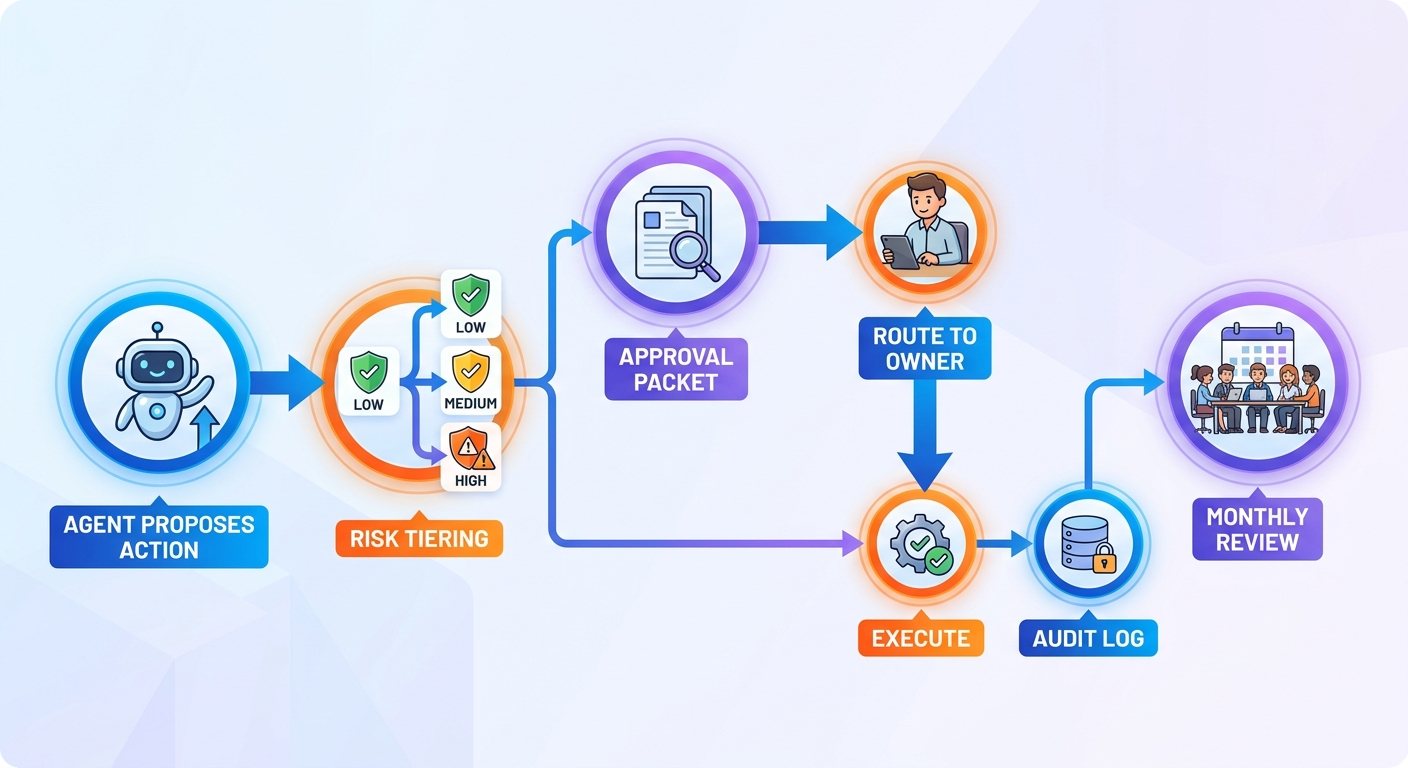
Here is a simple workflow that works across many agent systems. It is intentionally boring. Boring controls are easier to test, teach, audit, and improve.
Step 1: Map agent actions, not just agent goals
List what the agent can actually do: read files, search documents, send email, update CRM records, create pull requests, change permissions, call payment APIs, summarize meetings, or trigger workflows. Goals sound harmless until you see the tools behind them.
Step 2: Assign a risk tier to every action
Classify each action as low, reviewable, high-risk, or critical. If the tier depends on amount, recipient, data type, or environment, write that condition down. For example, “refund under ₹500 can be drafted automatically; refund above ₹500 needs approval; refund above ₹10,000 needs finance escalation.”
Step 3: Define allowed autonomy for each tier
Low-risk actions can run with logs. Reviewable actions can use lightweight confirmation. High-risk actions need explicit approval with evidence. Critical actions are blocked or escalated. This turns ethics language into runtime behavior.
Step 4: Build the approval packet
Create a template that agents must fill before pausing. Include goal, action, risk, evidence, affected systems, source links, alternatives, and rollback. Make it short enough for humans to read, but complete enough for accountability.
Step 5: Route approval to the right person
The right approver is not always the manager. It may be a system owner, data owner, security reviewer, finance approver, product owner, legal specialist, or on-call engineer. Route by action type and risk, not by org chart alone.
Step 6: Record the decision and outcome
Log who approved, what they approved, when, why, and what happened after execution. If the agent changed its plan after approval, require a new approval. If the action failed, record the failure and next step.
Step 7: Review approval patterns monthly
Approval logs are a source of product intelligence. They reveal where policies are unclear, where agents ask too often, where humans rubber-stamp, and where automation can safely expand. Human-in-the-loop should improve over time, not freeze the system forever.
Examples by Agent Type
Customer support agent
A support agent can summarize tickets, retrieve policy, draft replies, and suggest next steps automatically. It should ask for approval before sending an external message involving refunds, account termination, legal threats, public complaints, safety issues, or policy exceptions. The approval packet should include customer history, policy citation, proposed wording, and possible escalation.
Finance operations agent
A finance agent can match invoices, flag anomalies, and prepare payment batches. It should not move money without thresholds and approvals. Parameter approval is especially important: the vendor, amount, account, currency, and due date matter more than the generic “pay invoice” action.
Software development agent
A coding agent can inspect logs, draft tests, propose patches, and open pull requests. It should ask before deleting files, changing production configuration, touching secrets, migrating databases, modifying authentication logic, or running destructive commands. For production changes, pre-flight plan approval is usually safer than approving each tiny edit later.
Research or analyst agent
A research agent can collect sources, summarize documents, and build a briefing. It should ask before sending claims externally, using confidential material, making investment recommendations, or presenting uncertain information as fact. Human review should focus on source quality and claim strength, not only grammar.
HR or recruiting agent
An HR agent can draft job descriptions, summarize interview notes, and schedule meetings. It should ask before rejecting candidates, sending offers, changing compensation, storing sensitive candidate attributes, or making inferences about protected characteristics. In some HR contexts, approval is not enough; the agent may need to be blocked from certain decisions entirely.
The Audit Log Is the Memory of Human Oversight
If human approval is not logged, it is hard to prove later. The log does not have to expose every token or private detail, but it should capture the decision trail. This is where the human-in-the-loop design connects back to governance frameworks and incident response.
| Log item | Why it matters |
|---|---|
| Agent goal and task ID | Connects the approval to the original business purpose. |
| Risk tier and trigger | Shows why approval was required. |
| Context sources used | Helps diagnose wrong, stale, or unauthorized context. |
| Proposed tool/action | Records the exact action the human approved. |
| Approver and timestamp | Creates accountability and supports audits. |
| Decision and notes | Explains why the action was approved, rejected, or changed. |
| Execution result | Shows whether the approved action succeeded or failed. |
| Rollback or follow-up | Connects approval to operational recovery. |
For small teams, this can start as structured records in the agent platform or workflow tool. For larger organizations, it should connect with access management, ticketing, observability, incident management, and compliance systems. The point is not bureaucracy. The point is making the agent’s autonomy legible.
Common Mistakes in Human-in-the-Loop Agent Design
Better patterns
- Approve risky actions, not every prompt.
- Use risk tiers and thresholds.
- Show evidence and rollback options.
- Route approval to system owners.
- Review logs to reduce unnecessary friction.
- Block actions that should not be delegated.
Risky patterns
- One generic approval button for everything.
- Approvers seeing only the agent’s conclusion.
- No record of what changed after approval.
- Humans approving outside their authority.
- Agents retrying after rejection without escalation.
- Using approval as a substitute for permissions and testing.
The most dangerous pattern is approval theater: a human clicks yes because the interface gives them no real information, no time, and no alternative. That may satisfy a checkbox, but it will not protect users, teams, or the organization when the agent makes a consequential mistake.
Metrics That Show Whether Human Oversight Is Working
Human-in-the-loop systems should be measured. Otherwise, teams cannot tell whether approvals are reducing risk or only slowing work. Useful metrics include approval rate, rejection rate, escalation rate, time to approve, override frequency, post-approval incidents, repeated policy exceptions, and agent uncertainty triggers.
| Metric | What it can reveal |
|---|---|
| Approval volume by risk tier | Whether the agent is asking too often or in the wrong places. |
| Rejection rate | Whether the agent frequently proposes bad or poorly justified actions. |
| Average approval time | Whether human bottlenecks are blocking useful automation. |
| Escalation frequency | Whether policies or authority boundaries are unclear. |
| Incidents after approval | Whether approval packets hide important risk. |
| Repeated exception types | Where the policy, product, or agent instructions need improvement. |
These metrics create a feedback loop. If low-risk actions are constantly approved, automate more. If high-risk actions are constantly rejected, improve the agent’s policy reasoning before expanding autonomy. If approvals are slow but rarely rejected, simplify the packet or change routing. Oversight should be adaptive.
Implementation Checklist for Safe Agent Approval
Use this checklist before putting an AI agent into a workflow where it can act beyond text generation.
- List every tool the agent can call and mark read, write, external, financial, destructive, or sensitive.
- Define risk tiers for actions and parameters.
- Set explicit thresholds for money, data volume, recipients, production access, and customer impact.
- Create approval packet templates for each high-risk workflow.
- Route approvals by ownership and authority.
- Require fresh approval when an agent changes action, scope, or parameters.
- Log approvals, rejections, execution results, and rollback steps.
- Block actions that should never be delegated to the agent.
- Test refusal, timeout, escalation, and rollback paths before launch.
- Review approval data regularly and update policies.
This checklist is intentionally practical. It can be used by a startup building an internal agent, an enterprise evaluating an agent platform, or a product team adding autonomy to an existing workflow.
How This Fits the Singularity Journey Cluster
This article is a supporting cluster for Autonomous AI Agents and Human Control. Read that pillar next if you want the wider governance blueprint: autonomy levels, control layers, risk ownership, monitoring, and institutional readiness.
It also connects naturally with Singularity Journey’s related agent-control topics, especially AI agent memory, observability, tool permissions, MCP tool risk tiers, and enterprise AI agent control planes. The larger theme is simple: the path toward more autonomous systems is not only about model capability. It is about whether humans can still understand, steer, audit, and stop the systems they deploy.
Conclusion: The Best Human Loop Is Specific, Not Constant
Human-in-the-loop AI agents are often misunderstood. The goal is not to keep humans manually approving every harmless action. The goal is to preserve human judgment where judgment actually matters. Safe autonomy requires a clean separation between actions that can run, actions that need review, actions that need explicit approval, and actions that should be blocked or escalated.
The organizations that get this right will not be the ones with the most dramatic agent demos. They will be the ones with boring, reliable control systems: risk tiers, approval packets, routing rules, audit logs, metrics, and rollback paths. That is what turns autonomous agents from impressive prototypes into systems people can responsibly use.
Sources and References
- NIST AI Risk Management Framework
- ISO/IEC 42001 AI management systems
- EU Artificial Intelligence Act high-level summary
- IBM: What are AI agents?
- Google Cloud: What are AI agents?
- World Economic Forum: The Future of Jobs Report
This article is educational and operational guidance, not legal, security, financial, HR, or compliance advice. High-risk AI deployments should be reviewed by qualified domain experts.
FAQ: Human-in-the-Loop AI Agents
What are human-in-the-loop AI agents?
Human-in-the-loop AI agents are autonomous or semi-autonomous systems that pause for a person before high-impact decisions, risky tool use, policy exceptions, irreversible actions, or uncertain handoffs.
When should an AI agent ask for human approval?
An agent should ask for approval when the action is irreversible, externally visible, financially meaningful, privacy-sensitive, legally sensitive, destructive, or outside its normal confidence and policy boundaries.
What is the difference between human-in-the-loop and human-on-the-loop?
Human-in-the-loop means a person must approve before the agent acts. Human-on-the-loop means the agent may act while a person monitors, audits, interrupts, or reviews later.
Do human approval workflows make AI agents less useful?
They can slow trivial tasks if designed poorly, but good approval workflows reserve friction for high-risk steps and let low-risk actions run automatically.
What should an AI agent approval request include?
It should include the goal, proposed action, affected systems or data, evidence used, risk tier, alternatives, rollback plan, deadline, and a concise reason for why approval is needed.
How do you audit human-in-the-loop AI agents?
Capture the agent goal, prompt or policy trigger, context sources, tool call, approver identity, decision, timestamp, result, exception notes, and rollback or incident follow-up.
Can human approval prevent all AI agent failures?
No. Human approval reduces specific categories of risk, but it must be combined with permissions, evaluations, logging, monitoring, testing, and incident response.
What is the best first step for adding human oversight?
Start by mapping agent actions into low, medium, high, and critical risk tiers, then require explicit approval only for the tiers where failure would materially matter.
