
AI Hallucinations Explained: Why Models Make Things Up and How to Reduce Risk
AI hallucinations are not magic, mystery, or proof that AI is useless. They are a predictable failure mode of systems that generate plausible answers from patterns, context, and probability. This guide explains what hallucinations are, why they happen, where they become risky, and how to reduce them with better context, retrieval, citations, evaluation, and human judgment.
AI Hallucinations: Quick Answer
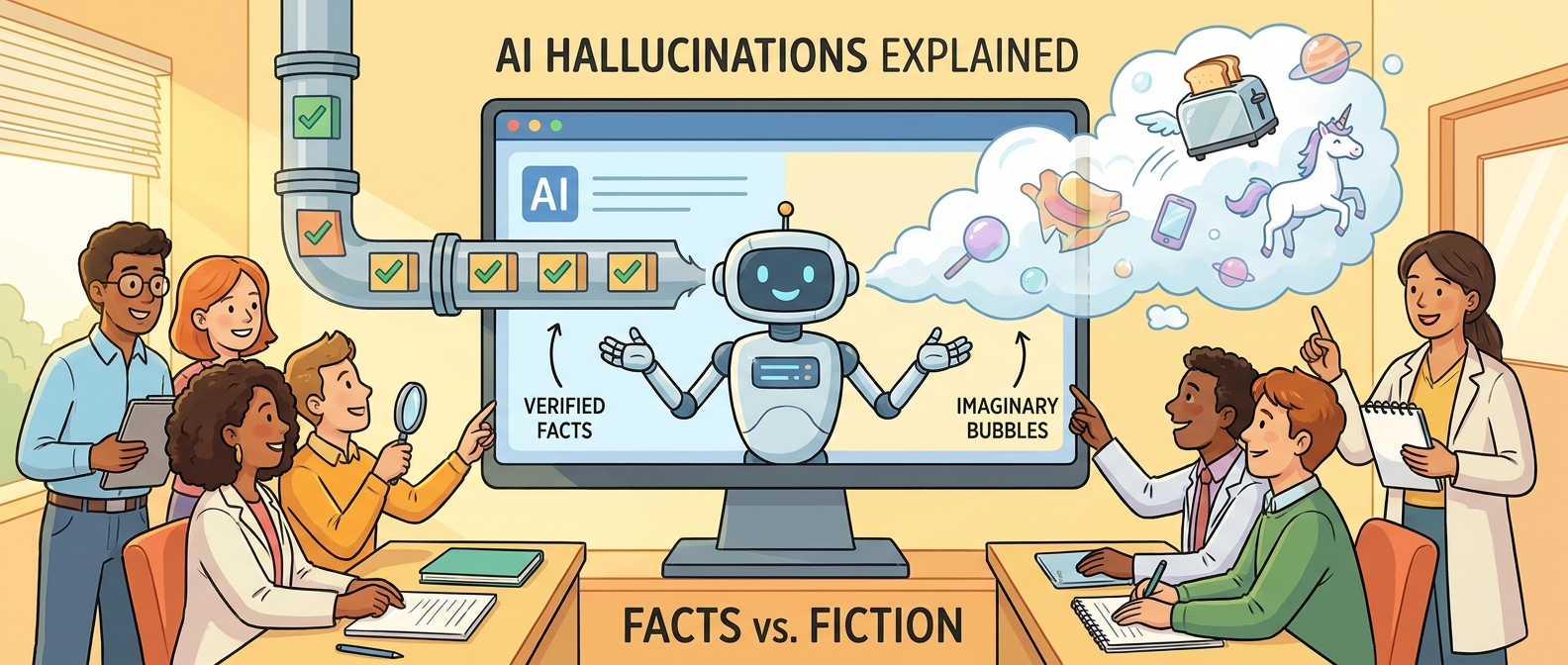
AI hallucinations are outputs that sound confident and useful but are false, unsupported, irrelevant, fabricated, or misleading. A chatbot might invent a citation, summarize a policy that does not exist, give an outdated answer as if it were current, misread retrieved documents, or confidently explain a topic using details that are not grounded in evidence.
The most important thing to understand is that hallucination is not one single bug. It is a family of reliability failures. Sometimes the model lacks the right information. Sometimes the prompt is vague. Sometimes the model has seen conflicting patterns in training data. Sometimes a retrieval system gives the model the wrong document. Sometimes the answer is technically grammatical but not faithful to the source. And sometimes the user asks for certainty when the system should answer, “I do not know.”
That balanced view matters. Fear-based explanations make hallucinations sound like supernatural machine deception. Overconfident AI marketing makes them sound like a solved prompt-engineering nuisance. The truth sits between those extremes. Hallucinations are a normal risk of generative systems, and serious users handle them the way engineers handle any reliability problem: classify the failure, lower the probability, limit the blast radius, and verify before trust.
What Is an AI Hallucination?
An AI hallucination is an answer produced by an AI system that appears plausible but is wrong, invented, unsupported, or disconnected from the provided evidence. IBM describes AI hallucinations as outputs that sound plausible but are factually wrong, irrelevant, or fabricated. That definition is useful because it focuses on the reader’s real problem: the answer can look polished even when the underlying claim is not true.
Hallucinations are most visible in large language models because text can hide uncertainty. A fluent paragraph feels authoritative. A neat bullet list feels organized. A confident explanation feels like knowledge. But language models are not databases. They generate likely continuations based on patterns, instructions, context, and learned representations. If the system is not grounded in reliable information, it may produce the shape of an answer without the truth behind it.
It is also worth separating hallucination from ordinary imperfection. A typo is not necessarily a hallucination. A reasonable interpretation of an ambiguous question may not be a hallucination. A model refusing to answer because it lacks information is not a hallucination; it is often the safer behavior. A hallucination is more dangerous because it gives the user the impression that a claim is backed by reality when it is not.
| Output problem | What it means | Example pattern |
|---|---|---|
| Fabricated fact | The model states something that is not true. | It says a company launched a product that never existed. |
| Fake citation | The model invents a source, paper, author, URL, or quote. | It cites a realistic-sounding report with no real page behind it. |
| Wrong source use | The model had a source but misrepresented it. | It turns a cautious research conclusion into a universal claim. |
| Stale answer | The model gives outdated information as if current. | It describes an old API limit without checking current docs. |
| Misplaced context | The model blends details from one case into another. | It applies a policy from one country, product, or company to another. |
| Overconfident reasoning | The conclusion sounds logical but rests on false assumptions. | It explains why a medical, legal, or financial result must be true without evidence. |
The word “hallucination” can be controversial because it borrows a human term for a machine process. You do not need to anthropomorphize the model to use the term. In practical AI work, hallucination simply means the output is not reliably grounded in truth, evidence, or the supplied context.
Why Do AI Models Make Things Up?
AI models hallucinate because they are optimized to generate useful-looking outputs, not because they contain a perfect map of reality. A language model learns statistical patterns across huge amounts of text. During generation, it predicts likely next tokens given the prompt and context. That process can produce excellent explanations, but it can also produce confident nonsense when the system lacks grounding.
The easiest mistake is assuming that if an answer is well written, the model must “know” it. Fluency and truth are different capabilities. A model can be fluent because it learned the style of expert writing. That does not guarantee that each claim is verified. This is why hallucinations often appear more convincing than normal search mistakes: the prose is polished even when the facts are not.
TruthfulQA, a benchmark introduced by Stephanie Lin, Jacob Hilton, and Owain Evans, is a useful example of how researchers study truthfulness. The benchmark contains 817 questions across 38 categories and was designed to test whether models mimic common human falsehoods. The key lesson for everyday readers is not that one benchmark gives a universal hallucination rate. It is that truthfulness has to be measured deliberately because a model can produce answers that match familiar misconceptions.
Another cause is the pressure to be helpful. Many AI assistants are designed to answer quickly and smoothly. If the interface rewards confident completion more than careful uncertainty, users can receive polished guesses. Better systems are now more willing to ask follow-up questions, cite sources, show uncertainty, or refuse unsupported claims. But the user still needs to know when the situation demands verification.
The Main Types of AI Hallucinations
Classifying hallucinations helps you respond correctly. If a model invents a citation, the fix is not the same as a model misreading a real document. If the issue is stale knowledge, the fix is not simply “write a better prompt.” You need the right control for the specific failure mode.
Factual hallucinations
A factual hallucination happens when the AI states an incorrect fact. This can be as simple as the wrong date, the wrong product feature, or the wrong definition. The risk increases when users ask about current events, prices, policies, medical guidance, legal rules, or technical documentation that changes frequently.
Source and citation hallucinations
These are especially dangerous because they give a false sense of credibility. The model may invent a paper title, attribute a quote to a real person, create a nonexistent URL, or cite a real source for a claim the source does not support. The solution is simple but non-negotiable: open the source, verify that it exists, and confirm that it actually says what the AI claims.
Reasoning hallucinations
Sometimes the final answer is wrong because the chain of reasoning contains false assumptions. The model may connect unrelated facts, overgeneralize from a small example, or produce a neat explanation for a causal relationship that has not been proven. These hallucinations are harder to catch because the answer may sound logical.
Context hallucinations
Context hallucinations happen when the AI uses the wrong context or blends multiple contexts together. In a workplace, this might mean summarizing the wrong customer policy, mixing two projects, or applying a rule from an old document to a new process. In RAG systems, this often indicates retrieval, chunking, ranking, or prompt-grounding problems.
Code hallucinations
For developers, hallucinations can appear as nonexistent libraries, wrong API methods, fake parameters, insecure shortcuts, or code that compiles in the model’s imagination but not in the real environment. This is why AI coding workflows need tests, linters, dependency checks, and human review, not only better prompts.
Boundary hallucinations
A boundary hallucination happens when the AI answers outside the scope it should respect. It might provide a diagnosis instead of suggesting professional review, give legal certainty without jurisdiction, or make a business forecast sound inevitable. These are governance failures as much as model failures.
AI Hallucination Risk Matrix: When Should You Worry?
Not every hallucination has the same cost. If a model invents a harmless example in a brainstorming session, the damage may be tiny. If it invents a medical instruction, a legal requirement, a financial claim, or a security configuration, the damage can be serious. The practical question is not “Can this AI hallucinate?” The answer is yes. The question is “What happens if this answer is wrong?”
| Use case | Hallucination risk | Minimum control |
|---|---|---|
| Brainstorming names, outlines, metaphors, or first drafts | Low | Human taste and common-sense review. |
| Explaining a concept for learning | Low to medium | Cross-check with reputable sources before treating it as fact. |
| Writing public content | Medium | Verify sources, quotes, numbers, and claims before publishing. |
| Internal business decisions | Medium to high | Use source-grounded answers, document assumptions, and require owner review. |
| Code generation | Medium to high | Run tests, inspect dependencies, review security, and check docs. |
| Legal, medical, safety, finance, hiring, or compliance decisions | High | Require qualified expert review, policy controls, traceability, and audit logs. |
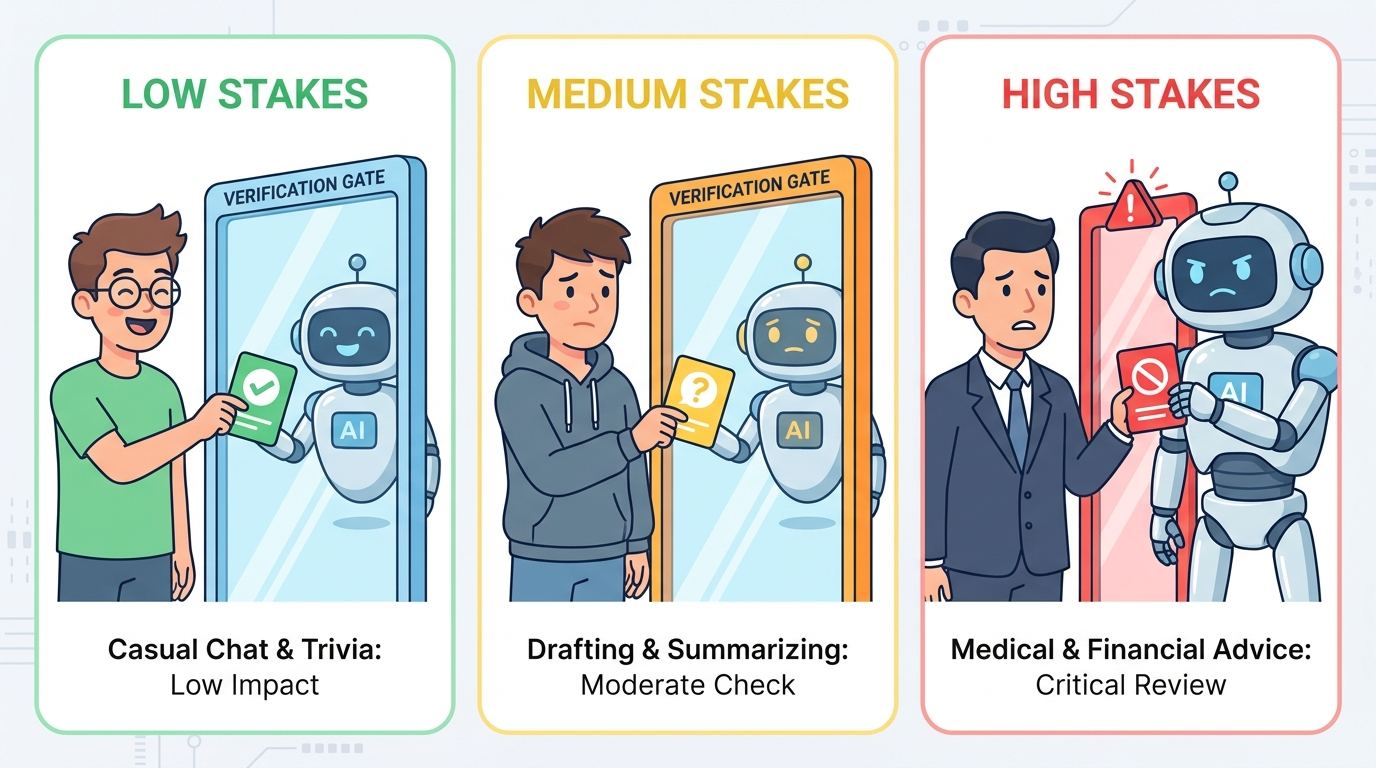
NIST’s AI Risk Management Framework is useful here because it frames AI risk around validity, reliability, transparency, accountability, and human oversight. Hallucination is not only a content problem. It is an AI risk-management problem. If an organization uses AI in a process where wrong answers can harm people, money, rights, or security, it needs controls that are stronger than “the prompt looked good.”
How to Reduce AI Hallucinations
Reducing hallucinations is a layered process. No single trick solves the problem. Better prompts help, but they are not enough. Retrieval helps, but it can fail. Citations help, but citations can be fake or misused. Evaluation helps, but benchmarks do not cover every real situation. Human review helps, but humans need enough traceability to review efficiently. The best approach is a prevention stack.
| Layer | What it does | Practical move |
|---|---|---|
| Task clarity | Reduces ambiguity before generation starts. | State the audience, goal, scope, and evidence standard. |
| Reliable context | Gives the model something real to ground the answer in. | Provide official docs, selected excerpts, current policies, or verified notes. |
| Retrieval | Pulls relevant documents into the answer process. | Use RAG for knowledge bases, but evaluate retrieval quality. |
| Citation discipline | Forces claims to connect to source material. | Ask for citations only from provided or verified sources, then open them. |
| Uncertainty | Prevents fake confidence. | Require “unknown,” “not in the source,” or “needs verification” when evidence is missing. |
| Evaluation | Finds repeated failure patterns. | Test answer faithfulness, factuality, retrieval relevance, and edge cases. |
| Human review | Limits impact when errors remain. | Use expert approval for high-stakes outputs. |
For individual users, the most powerful habit is to ask the AI to separate claims from evidence. Instead of “Explain this topic,” try: “Explain this topic using only the sources below. If the sources do not support a claim, say so. List any claims that need external verification.” This changes the model’s job from sounding smart to staying grounded.
For teams, the strongest habit is to define an AI output review checklist. That checklist should include source existence, source relevance, claim support, date sensitivity, jurisdiction or product version, privacy concerns, and human owner approval. Singularity Journey has a related AI output review checklist that is a natural next step if you want a portfolio-friendly process for proving human judgment.
Developers should also connect hallucination control with observability. If an AI agent uses tools, memory, or retrieval, you need logs that show what it saw and why it answered. A trace can reveal whether the failure came from the model, the prompt, the retrieved document, a stale memory, or a tool result. That connects this AI CORE topic with more advanced DEV ZONE work such as AI agent observability.
Interactive Hallucination Risk Checker
Use this quick checker before trusting an AI answer. It is not a scientific score and does not replace expert review. It is a practical way to slow down and decide how much verification the answer needs.
The point of this widget is behavioral. Hallucinations become dangerous when people skip the moment of verification because the answer looks polished. A small pause can prevent a public error, a bad business decision, or a broken workflow.
Does RAG Stop AI Hallucinations?
Retrieval-augmented generation, usually called RAG, can reduce hallucination risk by giving a model relevant documents before it answers. Instead of relying only on training patterns, the system retrieves source material from a knowledge base, documentation site, database, or vector index. The model then uses that context to generate an answer.
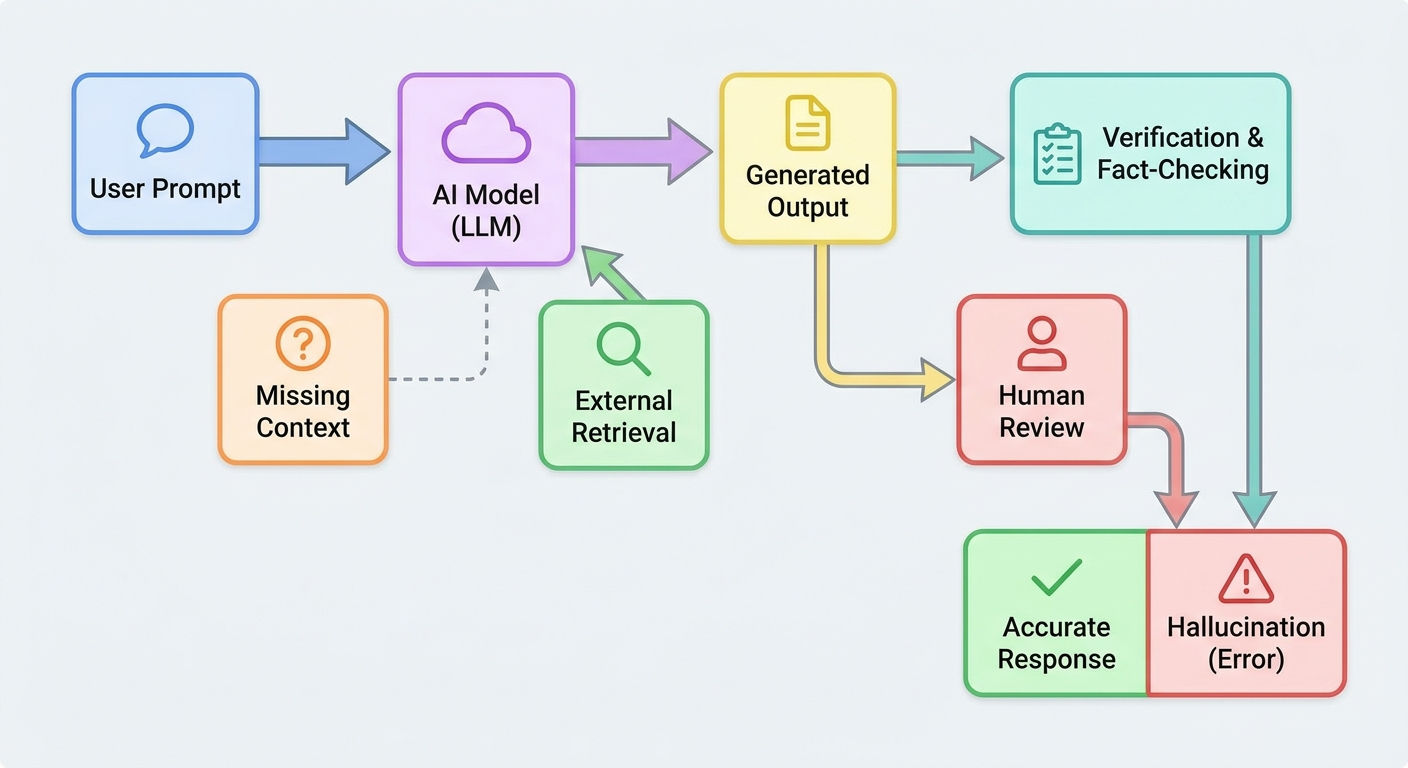
RAG is powerful, but it is not a truth machine. It can retrieve the wrong document. It can miss the best document. It can retrieve a correct document but the model can still misread it. It can include conflicting sources without explaining the conflict. It can cite a passage that is related but not sufficient to support the answer. That is why RAG systems need evaluation.
The Ragas paper is a useful source here because it frames RAG evaluation across retrieval and generation quality. In practice, teams should test whether the retrieved context is relevant, whether the answer is faithful to the context, whether the response answers the user’s question, and whether unsupported claims are avoided. If a RAG system cannot show what it retrieved and why, debugging hallucinations becomes much harder.
| RAG belief | Reality | Better practice |
|---|---|---|
| “RAG eliminates hallucinations.” | RAG reduces some hallucinations but introduces retrieval failure modes. | Evaluate retrieval relevance and answer faithfulness. |
| “If there is a citation, it is safe.” | Citations can be wrong, weak, or misused. | Open the cited source and verify the exact claim. |
| “More documents means better answers.” | Too much context can add noise and conflict. | Retrieve fewer, more relevant chunks with metadata. |
| “The model should answer every question.” | Some questions are not supported by the knowledge base. | Teach the system to say when evidence is missing. |
If you are new to context and retrieval, read AI agent context explained. The same principle applies to hallucinations: the answer quality depends heavily on what the model sees, what it is allowed to use, and how the system handles missing information.
Practical Workflows for Safer AI Answers
Different users need different hallucination controls. A student learning a concept, a marketer writing a blog post, a developer building an agent, and a manager using AI for decisions should not use the same trust level. Here are practical workflows you can adapt.
For everyday learners
Use AI as a tutor, but ask it to show uncertainty. A good prompt is: “Explain this in simple terms. Then list three claims I should verify from an external source.” This keeps the learning benefit while reminding you that fluency is not proof.
For writers and creators
Use AI for structure, examples, drafts, and alternative explanations. Do not use it as the final source of facts. Before publishing, verify names, dates, numbers, links, quotes, legal claims, scientific claims, and product details. If a source link is broken, suspicious, irrelevant, or cannot be verified, exclude it.
For developers
Use AI to draft code, explain errors, generate tests, and compare designs. Then run the code. Check package names, method signatures, version-specific behavior, security assumptions, and edge cases. Code hallucinations are often easy to expose with tests, but only if you actually run them.
For teams building AI agents
Add guardrails, approval steps, and monitoring. Guardrails define allowed behavior. Human approval controls high-impact actions. Observability shows the prompt, retrieved context, tool calls, and final answer. Evaluation tracks failure patterns over time. These ideas connect with AI guardrails explained and human approval for AI agents.
For leaders and organizations
Treat hallucinations as operational risk. Define where AI can assist, where it cannot decide, which outputs need review, how sources are stored, and who owns final approval. The Stanford HAI AI Index is a useful broad reference for the larger context: AI capabilities are improving quickly, but evaluation, reliability, and governance remain central challenges. Better models reduce some errors, but better process is still required.
Good trust habits
- Ask for source-grounded answers.
- Require uncertainty when evidence is missing.
- Verify citations before publishing.
- Use tests and logs for AI-generated code.
- Keep humans responsible for high-stakes decisions.
Risky trust habits
- Assuming fluency means truth.
- Copying citations without opening them.
- Using AI for current facts without checking dates.
- Letting agents act without audit trails.
- Replacing expert review with a confident paragraph.
Examples of AI Hallucinations and Better Responses
Example one: you ask for “three recent studies proving a supplement improves memory,” and the AI provides polished citations. The bad response is to copy them into an article. The better response is to open each citation, verify that the paper exists, read whether it actually supports the claim, and soften the wording if the evidence is mixed.
Example two: you ask an AI coding assistant for a function using a library. The answer imports a package and calls a method that does not exist. The bad response is to keep prompting until the code looks convincing. The better response is to check official documentation, run a minimal test, and ask the assistant to adjust based on the actual error message.
Example three: a RAG chatbot answers a policy question from an old document. The bad response is to blame the model only. The better response is to inspect retrieval logs, update the document index, add document dates to the prompt, and require the model to cite the policy version used.
Example four: a team asks AI to summarize customer feedback and the output overstates a trend. The bad response is to treat the summary as research. The better response is to link each insight back to actual quotes, counts, segments, or support tickets, and label interpretations separately from evidence.
These examples show why hallucination reduction is not just about model choice. Stronger models help, but workflows decide whether errors are caught or amplified.
The Right Mental Model: Draft, Evidence, Decision
A practical way to use AI safely is to separate three layers: draft, evidence, and decision. AI is excellent at drafts. It can organize ideas, explain concepts, propose checklists, and generate first versions. Evidence is different. Evidence must come from trusted sources, measured data, documents, tests, or expert review. Decisions are different again. Decisions require accountability, context, tradeoffs, and responsibility.
Most hallucination problems happen when people treat a draft as evidence or treat an AI answer as a decision. The safer workflow is: let AI draft, make the evidence visible, then let a responsible human decide. This is not anti-AI. It is how AI becomes useful in real work.
For Singularity Journey readers, this mental model is important because AI systems are becoming more capable and more agentic. As agents gain tools, memory, and autonomy, hallucinations can move from text errors into workflow errors. A wrong answer can trigger a bad email, wrong code change, poor recommendation, or unsafe action. That is why AI CORE concepts like hallucination connect directly to future-facing topics such as AI safety levels and frontier AI risk.
If you remember one sentence from this guide, make it this: trust AI outputs in proportion to their evidence, not their confidence.
Keep Learning on Singularity Journey
- AI Guardrails Explained — how systems keep AI behavior inside safer boundaries.
- AI Output Review Checklist — a practical way to show human judgment over AI-assisted work.
- AI Agent Context Explained — why what the model sees changes what it says.
- Human Approval for AI Agents — when humans should approve AI actions.
- AI Safety Levels Explained — how stronger AI systems require stronger safeguards.
Sources and References
- IBM Think: What Are AI Hallucinations?
- TruthfulQA: Measuring How Models Mimic Human Falsehoods
- Ragas: Automated Evaluation of Retrieval Augmented Generation
- NIST AI Risk Management Framework
- Stanford HAI AI Index Report
Source note: hallucination rates vary by task, model, benchmark, and evaluation method. This article avoids universal rate claims and uses sources for definitions, benchmark context, RAG evaluation framing, and AI risk-management principles.
FAQ: AI Hallucinations Explained
What are AI hallucinations?
AI hallucinations are outputs that sound plausible but are false, unsupported, irrelevant, fabricated, or misleading. They can include fake facts, fake citations, wrong summaries, outdated claims, or answers that are not grounded in the provided context.
Why do AI models hallucinate?
AI models hallucinate because they generate likely answers from patterns and context rather than consulting a perfect database of truth. Hallucinations become more likely when the prompt is ambiguous, information is missing, retrieval is weak, or the system is not designed to admit uncertainty.
Can AI hallucinations be eliminated?
No practical system can guarantee that hallucinations will never occur. They can be reduced with better context, retrieval, citations, uncertainty handling, evaluations, guardrails, monitoring, and human review.
Does RAG stop hallucinations?
RAG can reduce hallucination risk by grounding answers in retrieved documents, but it does not eliminate hallucinations. Retrieval can fail, sources can be stale, and the model can still misread or overstate the evidence.
How do I fact-check an AI answer?
Identify factual claims, open every cited source, confirm that the source exists, check whether it supports the exact claim, verify dates and scope, and ask a qualified human to review high-stakes outputs.
Are AI hallucinations dangerous?
They can be harmless in brainstorming, but dangerous in medicine, law, finance, security, compliance, hiring, public content, and autonomous workflows. Risk depends on what happens if the answer is wrong.
What is the difference between a hallucination and a normal mistake?
A normal mistake may be a typo, ambiguity, or minor error. A hallucination is specifically an output that presents unsupported or false information as if it were grounded and reliable.
How can developers reduce code hallucinations?
Use official documentation, run tests, verify package names and method signatures, inspect generated code, check security assumptions, and keep logs for AI agent tool use and context.
