
The AI Agent Oversight Tax: Why Bot-Sitting Eats Into Automation ROI
AI agent oversight cost is the human time, operating expense, and opportunity cost required to turn an agent’s output into a verified outcome. This guide explains why that hidden work grows, how to measure it honestly, and how to reduce low-value bot-sitting without removing safeguards that matter.

AI Agent Oversight Cost: The Quick Answer
AI agent oversight cost is everything people and systems must spend after an agent begins work but before the organization can safely count the result. It includes reviewing outputs, correcting errors, approving consequential actions, handling exceptions, recovering from failures, investigating incidents, maintaining policies, and proving that a completed action really happened. Informally, the repetitive portion is often called bot-sitting.
The central mistake in many automation business cases is measuring generated work instead of verified outcomes. An agent may draft 1,000 responses, classify 10,000 records, or attempt 500 tool actions. None of those numbers alone tells you whether the work was correct, accepted, recoverable, or valuable. If employees must inspect nearly every result, repair a large fraction, or remain continuously available for exceptions, the workflow may still be useful—but its economics are different from the headline.
This is not an argument against human oversight. Oversight is often the control that makes automation acceptable. The goal is to distinguish high-value judgment from low-value supervision. A specialist reviewing a rare, consequential exception may protect customers and the business. The same specialist clicking “approve” on thousands of obvious cases because the workflow cannot express confidence, risk, or completion evidence is paying an avoidable oversight tax.
What Changed: AI Agents Moved From Demo Costs to Operating Costs
The AI agent conversation is shifting. The early question was whether agents could plan, use tools, and complete multi-step work. The harder question now is whether organizations can operate them at scale while keeping reliability, security, and cost under control. That shift matters because an impressive demonstration usually hides the messy middle: incomplete data, changing policies, ambiguous requests, tool failures, permission boundaries, customer-specific exceptions, and the need to prove that an action completed.
A newly published G2 AI Agents Insight Report makes the hidden labor unusually visible. Its July survey covered 1,019 B2B decision-makers across North America, EMEA, and APAC, and the report also referenced more than 2,500 software reviews. G2 found that 31% of responding organizations said employees spend six or more hours per week overseeing agents. Forty-five percent said oversight and rework consumed more than a quarter of expected productivity gains, while 46% reported higher-than-expected agent operating costs. Those are survey results from a commercial research publisher, not universal laws, but they are a strong signal that agent economics cannot stop at model or platform fees.
The same report found that the most time-consuming oversight activities were reviewing outputs, fixing errors, and approving actions. It also reported that oversight pressure rises at enterprise scale, where there are more systems, permissions, owners, and risk surfaces. This aligns with the practical lesson in our guide to the AI agent capability–reliability gap: a system can perform a task impressively and still fail to deliver predictable, repeatable work in a real operating environment.
Microsoft’s Work Trend Index, based on a survey of 20,000 AI-using workers and product telemetry, adds an important nuance. It treats human intensity and agent intensity as independent dimensions. A sophisticated agent can perform a great deal of backend work while the human also invests substantial effort directing, reviewing, and refining it. More agent activity does not automatically mean less human activity.
That is the trend worth watching. The market is not simply moving from humans to agents. It is moving toward mixed operating systems in which human direction, machine execution, automated verification, sampled review, escalation, and accountability must fit together. Organizations that measure only license fees and generated outputs will misunderstand this transition.
What Bot-Sitting Is—and What It Is Not
Bot-sitting is a useful informal term for the repetitive human work required to keep an AI system on task: supplying missing context, watching execution, checking routine outputs, correcting recurring mistakes, restarting failed runs, resolving ambiguous states, and repeatedly approving actions that rarely deserve judgment. It feels like supervision without leverage.
Not every human intervention is bot-sitting. Good oversight is selective and consequential. It places qualified judgment where a decision is hard to reverse, affects rights or money, carries material safety or security risk, or falls outside the agent’s validated operating envelope. It gives the reviewer enough evidence, authority, and time to make a meaningful decision. It also records why the decision was made.
| Human activity | Usually valuable oversight | Possible oversight tax | Design question |
|---|---|---|---|
| Reviewing outputs | Sampling quality or inspecting high-risk cases | Reading every low-risk output because confidence and evidence are unavailable | Can the workflow verify format, grounding, policy, and completion automatically? |
| Approving actions | Authorizing irreversible, regulated, or high-impact steps | Clicking through routine reversible actions with near-zero rejection yield | Does the approval gate match consequence and reversibility? |
| Correcting errors | Resolving genuinely novel exceptions | Fixing the same known failure repeatedly | Should this become a rule, test, tool constraint, or product fix? |
| Providing context | Supplying case-specific facts the system cannot know | Re-entering stable policies, schemas, or preferences on every run | Can durable context be versioned and retrieved automatically? |
| Recovering failures | Containing a rare consequential incident | Manually untangling routine timeouts, duplicates, or ambiguous tool results | Does the system have checkpoints, idempotency, and reconciliation? |
| Escalating decisions | Routing uncertainty to a qualified owner | Sending too many low-information alerts to a general queue | Are escalation thresholds calibrated to risk and reviewer capacity? |
The distinction matters because “remove humans from the loop” is the wrong universal target. If a workflow creates financial commitments, changes access, communicates sensitive advice, or affects an individual, removing review can transfer an obvious labor cost into a much larger error or incident cost. The better target is the smallest sufficient human intervention: the least review that still keeps expected harm, uncertainty, and accountability within acceptable limits.
The Seven-Layer AI Agent Cost Stack
Most agent cost discussions begin with tokens and end with a monthly platform bill. That is useful for infrastructure management but incomplete for business decisions. A reliable cost model follows the workflow from initial design to verified outcome and counts who performs each activity.
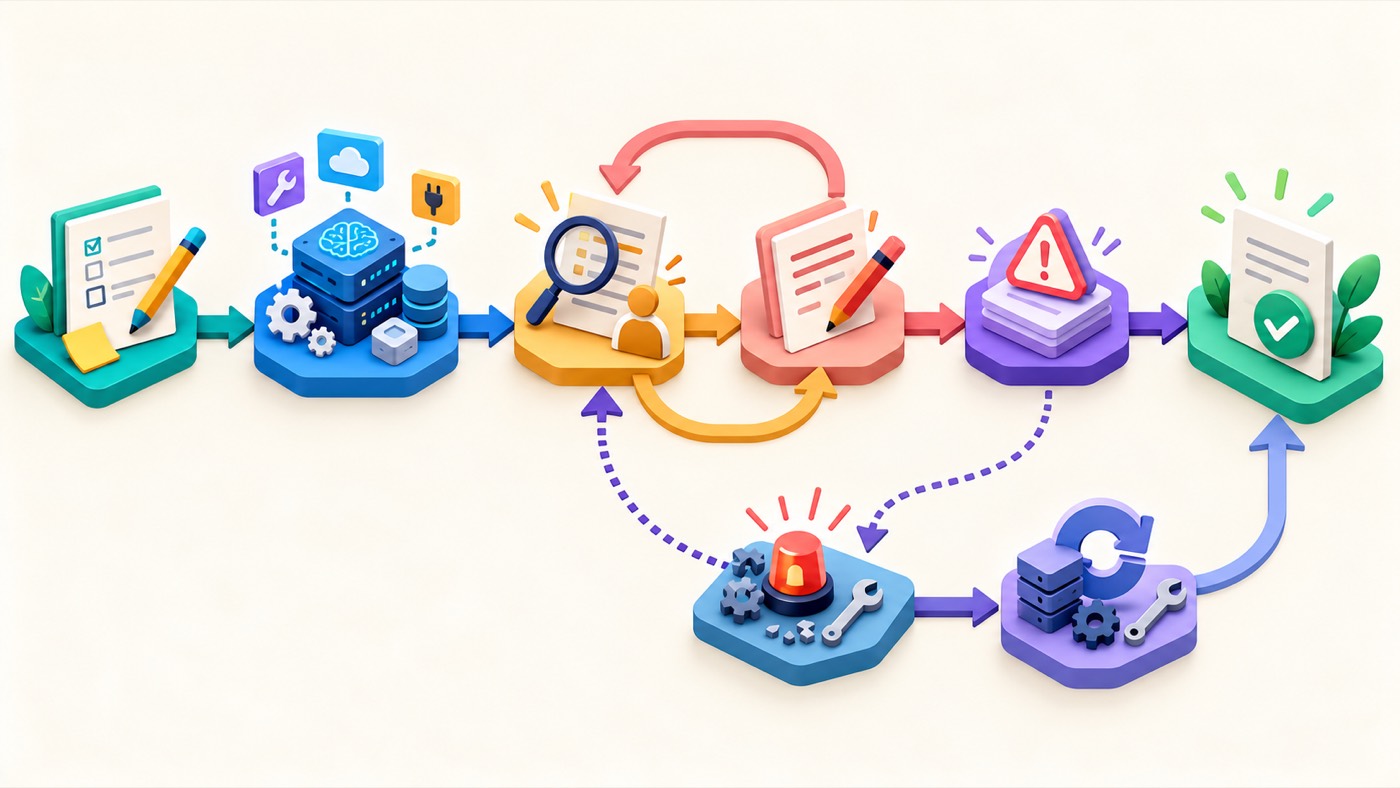 The visible agent run is only one stage. Reviews, correction loops, exceptions, and recovery determine the real cost of a verified outcome.
1. Build and integration cost
This includes workflow design, data preparation, tool integration, permission design, testing, evaluation datasets, security review, and change management. It is often treated as a one-time project expense, but agent behavior changes when models, prompts, tools, policies, or data change. Some build cost becomes continuing maintenance.
2. Compute and service cost
Count model usage, retrieval, vector storage, databases, external APIs, browser or sandbox execution, observability, queues, and orchestration. Attribute costs per agent and workflow where possible. A total AI bill cannot reveal which workflow creates value and which quietly burns budget.
3. Review and approval cost
Measure the minutes people spend inspecting outputs, comparing evidence, approving actions, rejecting work, or requesting more information. Use loaded labor cost when making financial comparisons, but also record the reviewer’s role. Ten minutes from a scarce compliance specialist is operationally different from ten minutes in a pooled service desk.
4. Correction and rework cost
Count edits to agent output, repeated prompts, manual completion of abandoned tasks, corrections downstream teams make later, and work recreated because the first result could not be trusted. Correction time is easy to hide because it appears inside normal employee activity rather than on the AI invoice.
5. Exception and escalation cost
Exceptions include missing information, tool refusals, policy conflicts, unusual customer cases, ambiguous requests, low-confidence evidence, and cases outside the agent’s authority. A good design routes exceptions with context. A poor design creates a mystery queue in which humans must reconstruct what happened before they can act.
6. Failure and recovery cost
Include incident triage, duplicated side effects, refunds, customer communication, access revocation, forensic review, rollback, reconciliation, and follow-up testing. The importance of durable AI workflows, agent observability, and a tested incident response runbook becomes visible here. Reliability engineering is not a technical luxury; it changes the economics of recovery.
7. Opportunity and coordination cost
Review work interrupts other responsibilities. Managers coordinate new ownership. Subject-matter experts attend calibration sessions. Teams wait for approvals. Employees may save minutes on drafting yet lose focus through fragmented supervision. These costs are harder to price, so report them separately instead of pretending they do not exist.
Gross Automation ROI vs Net Verified-Outcome ROI
A basic automation case often multiplies time saved per task by task volume and labor cost. That produces a gross estimate. An honest agent case adjusts for whether the task was completed correctly, whether saved time was actually redeployed, and what the organization spent to verify and operate the workflow.
A practical monthly model is:
Each term should be based on a defined workflow, not an abstract “AI program.” Start with a baseline: how long the task takes without the agent, what completion means, how often errors occur, and what those errors cost. Then measure the agent-assisted version using the same outcome boundary. If the old process ends when a case is resolved but the new process is measured when the agent produces a draft, the comparison is invalid.
Use verified outcomes as the denominator
Cost per generated output rewards volume even when outputs are rejected. Cost per agent run hides retries. Cost per successful API call ignores whether the business task completed. Prefer cost per verified outcome: total workflow cost divided by outcomes that meet defined quality, policy, and completion requirements.
For an email-support agent, a verified outcome might require correct policy use, an accepted reply, no reopen within a defined period, and no required correction. For a procurement agent, it might require a properly authorized request, correct supplier and amount, an external receipt, and a reconciled record. Completion evidence should live outside the model’s self-report.
Discount time that is not truly reclaimed
If a workflow saves ten minutes but employees spend those minutes waiting, context-switching, or performing unmeasured cleanup, the organization did not gain the full ten minutes. Use a redeployment factor: the share of saved time that becomes more valuable output, reduced backlog, faster service, or avoided hiring. This prevents a spreadsheet from converting every theoretical minute into cash.
Keep benefit and risk separate
Do not hide safety inside a blended ROI score. Report net value alongside escaped-error rate, incident severity, customer impact, and policy compliance. A high-return workflow with unacceptable harm is not a success. A low-return workflow may still be justified when it provides resilience, access, or service quality, but that should be an explicit decision.
Interactive AI Agent Oversight Cost Calculator
This planning calculator estimates monthly gross time savings, human oversight burden, operating cost, and net labor value for one bounded workflow. It is not a financial forecast. Use measured inputs from a representative sample, document what “task complete” means, and validate the result with finance and the workflow owner.
The calculator makes one pattern easy to see: a workflow can look excellent when comparing human-only time with agent runtime, then become ordinary after review and exception work. That does not automatically make it a bad investment. It tells you where to improve. If routine review dominates, strengthen automated checks and sampling. If exceptions dominate, improve scope, inputs, routing, and tool reliability. If platform cost dominates, adjust models, caching, context, or task volume.
Right-Size Oversight Instead of Reviewing Everything
Oversight should depend on consequence, reversibility, uncertainty, and evidence—not on a vague preference for either autonomy or control. Our guide to AI agent autonomy levels provides the broader ladder. For cost design, use four operating lanes.
 Different tasks deserve different oversight. Low-risk reversible work can flow; consequential or uncertain cases should pause, escalate, or recover.
| Lane | Best fit | Human pattern | Evidence required | Optimization goal |
|---|---|---|---|---|
| Automatic | Low-impact, reversible, well-tested tasks inside narrow permissions | No routine review; alerts for anomalies | Automated validation, action receipt, trace, rollback path | High straight-through completion without increased escaped errors |
| Sampled review | Moderate-volume work with measurable quality and limited consequence | Random and risk-weighted sampling | Representative sample, defect taxonomy, calibration record | Detect drift at lower review cost |
| Conditional approval | Cases with uncertainty, policy exceptions, unusual amounts, or sensitive data | Review only when thresholds trigger | Decision context, cited evidence, uncertainty, proposed action | High intervention yield and fast decisions |
| Mandatory human decision | Irreversible, rights-affecting, legally consequential, or high-severity actions | Qualified person makes the decision | Complete case file, authority, alternatives, record, appeal or rollback | Meaningful oversight, not throughput at any cost |
PwC’s agent workforce governance guidance similarly argues that identity, role, permissions, task scope, auditability, autonomy, and consequence should shape controls. The idea is simple: an agent should not receive the same freedom for summarizing an internal document and approving a payment.
A useful approval gate must also be feasible. The reviewer needs context, authority, time, and a real choice. If a queue presents hundreds of low-information requests, employees will rubber-stamp, delay, or work around it. Our articles on human approval for AI agents and human-in-the-loop approval patterns show how to place gates at meaningful decision boundaries rather than after every step.
The Metrics That Expose Hidden Agent Labor
A single accuracy number cannot explain oversight cost. Teams need a compact operational scorecard that connects quality, labor, autonomy, and recovery. Define every metric with a numerator, denominator, time window, owner, and data source.
| Metric | Definition | What it reveals | Common trap |
|---|---|---|---|
| Cost per verified outcome | Total workflow cost divided by accepted outcomes meeting completion criteria | The real unit economics | Using generated outputs as completed outcomes |
| Straight-through completion rate | Share completed without human intervention or retry | How much work truly flows automatically | Ignoring low-quality completions that later reopen |
| Human minutes per outcome | Review, correction, exception, and recovery minutes divided by verified outcomes | Direct oversight burden | Tracking only formal approval time |
| Intervention yield | Share of reviews that change, reject, escalate, or materially improve the outcome | Whether a review gate earns its cost | Removing review before confirming low yield is safe |
| Exception rate | Share routed outside the normal automatic path | Scope and input problems | Grouping all exceptions into one bucket |
| Rework rate | Share requiring correction after initial completion | Hidden downstream labor | Counting only corrections made by the agent team |
| Escaped-error rate | Defects discovered after the workflow declared completion | Whether reduced review is creating risk | Celebrating faster throughput while errors move downstream |
| Recovery minutes per incident | Total containment, reconciliation, communication, and restoration time | Failure blast radius and recoverability | Counting only engineering repair time |
Pair these measures with the broader AI agent evaluation metrics appropriate to the task. Quality, tool selection, argument correctness, policy compliance, latency, and cost interact. For example, a cheaper model may increase correction time; a stricter approval policy may reduce incidents but create queue delay; a wider tool scope may raise completion while increasing security exposure.
Deloitte’s State of AI in the Enterprise reports that only one in five surveyed companies has a mature governance model for autonomous agents. That maturity gap helps explain why teams can have impressive models but weak operational data. The NIST AI Risk Management Framework offers a useful discipline: govern the system, map context and impact, measure behavior, and manage risks over time. It does not supply one universal ROI equation, but it reinforces the need to connect measurement with ownership and action.
How to Reduce the Oversight Tax Without Removing Safety
The highest-value improvements usually come from workflow design, not from telling reviewers to work faster. Use the following sequence.
Define a narrower completion contract
Write what the agent may do, which inputs it can trust, what output is required, what evidence proves completion, which conditions require escalation, and which actions it must never attempt. Ambiguous authority creates both errors and supervision. A narrow contract makes evaluation and automation possible.
Move deterministic checks into software
Validate schemas, required fields, permissions, totals, citations, duplicate actions, policy rules, and external receipts automatically. Do not ask a person to repeatedly detect errors that code can express. Reserve human judgment for context, ambiguity, tradeoffs, and consequence.
Turn recurring corrections into evaluation cases
Tag every material intervention with a reason. Promote common failures into a regression set, then test prompt, tool, model, and policy changes against it. This converts reviewer frustration into product improvement. Keep a golden set, but also maintain edge cases and failure scenarios.
Improve the evidence shown to reviewers
A reviewer should not reconstruct the agent’s work from raw logs. Present the proposed action, material facts, sources, uncertainty, violated or satisfied policy checks, previous attempts, and rollback options. Better review interfaces reduce time and improve decisions without lowering control.
Use risk-weighted sampling
Review all high-consequence cases, more cases from new or changed workflows, and fewer stable low-risk cases. Increase sampling when drift, exceptions, overrides, or complaints rise. Sampling policy should be explicit and reversible, not a silent shortcut.
Engineer safe retry and recovery
Checkpoint workflow state, use idempotency keys, separate intent from side effects, reconcile ambiguous results, and define compensation where reversal is possible. Durable execution reduces the manual work of figuring out whether a failed-looking action actually happened.
Make stopping a valid outcome
An agent should be able to abstain, ask for missing information, or escalate before causing harm. Well-designed agent stop conditions may raise the visible exception rate while reducing expensive downstream correction. Optimize for total outcome cost, not the appearance of autonomy.
Assign one operational owner
Someone must own scope, quality, cost, incidents, and improvement. Shared contributors are necessary, but diffuse accountability makes bot-sitting invisible. The owner should review the scorecard, approve material changes, and decide whether the workflow should scale, narrow, pause, or retire.
Gartner’s guidance on managing AI agent sprawl reinforces the inventory problem: organizations cannot govern or optimize agents they cannot identify. As fleets grow, record each agent’s owner, purpose, permissions, dependencies, review policy, cost center, evaluation status, and retirement condition.
A 30-Day Plan to Find Your Hidden Oversight Cost
Days 1–7: Choose one workflow and establish the baseline
Select a bounded, repeated workflow with an identifiable owner and measurable completion. Document human-only cycle time, labor minutes, backlog, error categories, reopen or correction rate, and outcome quality. Do not begin with the organization’s entire AI estate. A narrow workflow produces decisions faster.
Days 8–14: Instrument every intervention
Add simple reason codes for review, correction, approval, exception, escalation, retry, and recovery. Capture start and end times. Link the intervention to an agent run and an external outcome receipt. Sample enough cases to represent normal work, busy periods, edge cases, and different users.
Days 15–21: Separate necessary judgment from design debt
Review the most expensive categories. Mark interventions that are legally, ethically, or operationally necessary. For the rest, identify causes: missing input, unclear task, weak tool, poor retrieval, invalid format, broad permission, unreliable integration, absent stop condition, or confusing review interface. Choose the top two causes rather than redesigning everything.
Days 22–27: Run one controlled improvement
Automate a deterministic check, improve reviewer evidence, narrow agent scope, revise a tool contract, or change a review threshold. Test against historical cases and a live canary. Compare human minutes, intervention yield, escaped errors, and cost per verified outcome. Do not declare success based only on fewer approvals.
Days 28–30: Make a scale, redesign, or stop decision
Scale when outcome quality holds, oversight is proportionate, recovery works, and net value is positive under conservative assumptions. Redesign when the value is promising but one or two intervention classes dominate. Stop or narrow when recurring correction, incident risk, or coordination cost overwhelms the benefit. A stopped automation can be a successful governance decision.
- Workflow boundary and named owner
- Human-only baseline and agent-assisted comparison
- Definition of a verified outcome
- Intervention taxonomy with minutes and labor roles
- Platform, model, tool, and maintenance cost
- Quality, exception, rework, and escaped-error metrics
- Approval and sampling policy
- Incident and recovery evidence
- Known limitations and unmeasured costs
- Decision, threshold, and next review date
Change management matters here. Employees may fear that reporting correction work will be interpreted as resistance, or that successful automation will eliminate their role. Leaders should explain that the goal is to improve workflow design and protect scarce judgment. Our AI agent change-management guide covers the ownership, communication, training, and feedback patterns needed to make this measurement credible.
What to Watch Next
Three market shifts will determine whether the oversight tax falls.
First, agent vendors will be pressured to show outcome economics rather than task demonstrations. Buyers will ask for cost attribution, completion evidence, exception behavior, and review burden. Claims such as “hours saved” will need a clearer baseline and an explanation of what happened to review and correction work.
Second, control planes will become part of the normal agent stack. Registries, identity, policy, observability, evaluation, budgets, and recovery will move closer together. This can reduce fragmented supervision, but only if the control layer produces actionable evidence rather than another dashboard employees must watch.
Third, human oversight will become more specialized. Routine checks should increasingly move into automated validation and sampling. Human attention will concentrate on exceptions, conflicts, high-impact actions, and policy decisions. That raises the value of judgment and domain expertise even as it reduces repetitive bot-sitting.
The healthiest organizations will resist two extremes: pretending agents are autonomous employees with no support cost, and forcing people to approve every action forever. They will design an evidence-based operating model in which autonomy is earned by bounded performance, controls are proportionate, and human attention is treated as a scarce resource.
Final Insight: The Unit of Value Is the Verified Outcome
AI agents can create real speed, reach, and capacity. The emerging oversight-cost evidence does not cancel that potential. It clarifies the work required to realize it. Models, tools, and orchestration produce candidate actions. Organizations still need to define authority, prove completion, handle exceptions, learn from corrections, and remain accountable for outcomes.
The oversight tax becomes dangerous when it is invisible. Once teams measure human minutes, intervention reasons, exception rates, recovery burden, and cost per verified outcome, they can improve the system rationally. Some review should remain. Some should be automated. Some agent tasks should be narrowed or stopped. The goal is neither maximum autonomy nor maximum control. It is dependable value with the smallest sufficient burden.
Frequently Asked Questions About AI Agent Oversight Cost
What does bot-sitting mean?
Bot-sitting is the repetitive human labor required to keep an AI system useful: watching runs, supplying missing context, checking routine outputs, correcting recurring errors, approving low-value steps, restarting failures, and resolving ambiguous states. The term is informal. It should not be used to dismiss necessary professional judgment or high-impact review.
Does human oversight mean an AI agent has failed?
No. Oversight can be a deliberate part of a safe operating model. An agent may execute routine work while a person handles ambiguity or consequential decisions. The problem is unplanned or low-value oversight: review that was omitted from the business case, repeated correction that never improves the system, or approval work with almost no meaningful decisions.
How do you calculate AI agent oversight cost?
Add the labor cost of review, approval, correction, exception handling, escalation, incident response, and recovery. Include the roles involved and their loaded hourly cost. Report opportunity and coordination costs separately when they cannot be estimated credibly. Divide total workflow cost by verified outcomes, not by prompts, runs, or generated outputs.
What is the best metric for AI agent ROI?
No single metric is sufficient, but cost per verified outcome is a strong anchor. Pair it with net value, straight-through completion, human minutes per outcome, intervention yield, exception rate, rework rate, escaped errors, and recovery burden. Keep safety and customer impact visible instead of hiding them inside a blended score.
Should teams automate all human review?
No. Automate deterministic checks and reduce low-yield routine review. Keep qualified human decisions for high-impact, irreversible, uncertain, or rights-affecting cases. The review policy should consider consequence, reversibility, confidence, evidence, and reviewer capacity. Changes should be validated through sampling and monitoring.
How much autonomy should an AI agent have?
Enough to complete bounded work inside tested permissions, but not more than the workflow’s evidence and recovery capability can support. Low-risk reversible tasks may run automatically. Moderate-risk work may use sampled or conditional review. Consequential decisions may require explicit human authorization. Autonomy should increase only when quality, controls, and recovery remain stable.
Who should own AI agent ROI?
A named operational owner should be accountable for the workflow’s scope, outcome definition, quality, cost, incidents, and improvement. Finance, engineering, security, legal, risk, and domain teams may contribute, but diffuse shared ownership makes hidden labor easy to ignore. The owner should have authority to scale, narrow, pause, or retire the workflow.
How can a small team measure oversight without expensive tooling?
Start with a spreadsheet or simple event log. Record the workflow, run ID, outcome, intervention type, minutes, reviewer role, reason, and whether the intervention changed the result. Measure a representative sample for one or two weeks. Consistent definitions matter more than a sophisticated dashboard at the beginning.
What is the fastest way to reduce bot-sitting?
Find the largest recurring intervention category. If people repeatedly fix missing fields, add validation. If they reconstruct context, improve the review packet. If they resolve duplicate or ambiguous tool actions, add idempotency and reconciliation. If they approve nearly everything, reassess the risk threshold. Make one controlled change and confirm that escaped errors do not rise.

