
AI Hallucination Evaluation Checklist: How to Test Answers Before Users Trust Them
A practical, source-aware checklist for testing AI answers before they become reports, product responses, research notes, support replies, or business decisions.
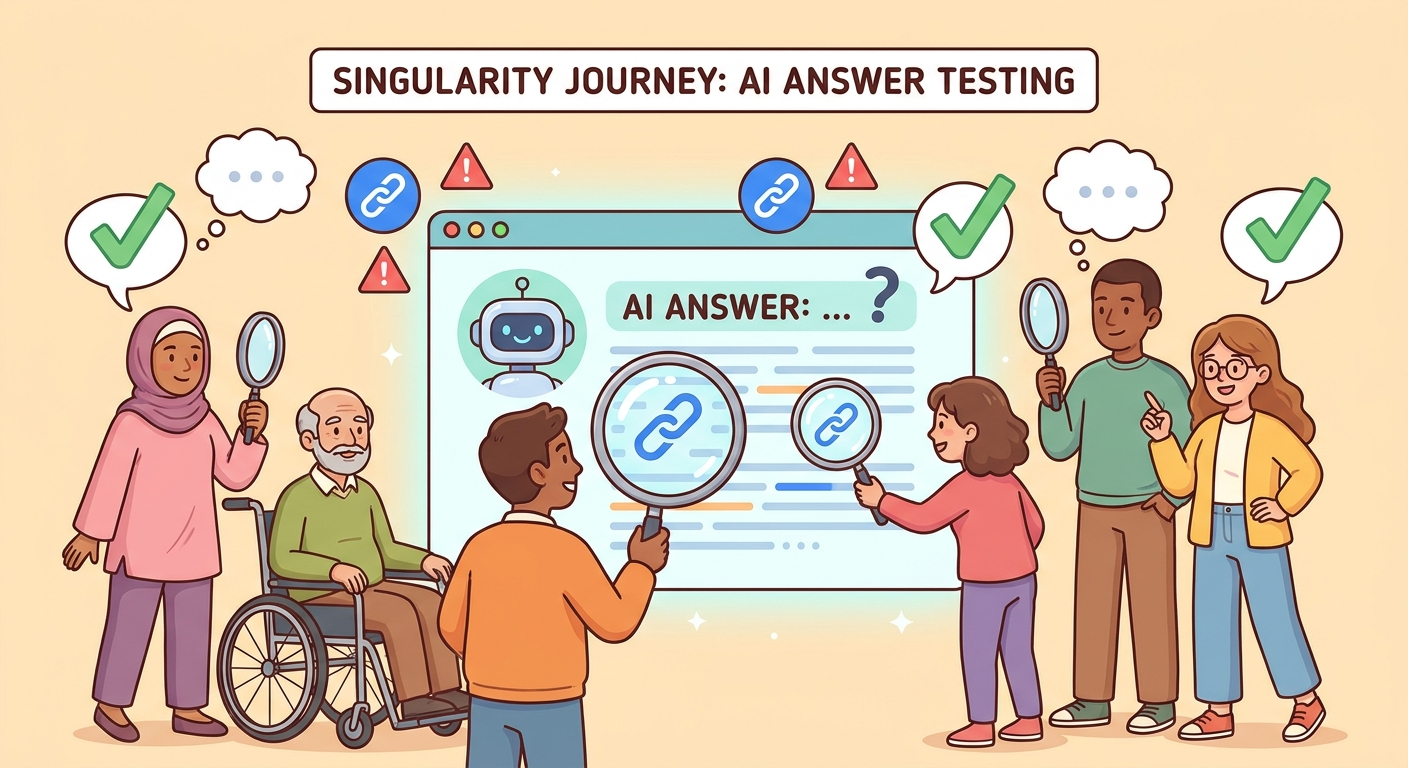
AI Hallucination Evaluation: Quick Answer
AI hallucination evaluation is the process of checking whether an AI answer is factually accurate, supported by the available context, honest about uncertainty, and safe enough for the situation where it will be used. A good evaluation does not ask, “Does this sound smart?” It asks, “Which claims can we verify, which claims depend on missing evidence, which claims are outside the model’s context, and what should a human review before anyone relies on it?”
The simplest reliable method is claim-level review. Break the answer into individual factual claims. Mark each claim as verified, unsupported, contradicted, outdated, ambiguous, or not important. Then test the answer against the user’s original question, the provided context, trusted outside sources, and the risk level of the decision. If the answer affects money, health, law, security, reputation, or user safety, evaluation should include human review and a documented source trail.
This article supports the broader Singularity Journey pillar, AI Hallucinations Explained: Why Models Make Things Up and How to Reduce Risk. The pillar explains why hallucinations happen. This cluster article turns the mitigation idea into a repeatable checklist you can use for everyday AI answers, RAG systems, customer-facing bots, internal copilots, and agent workflows.
Why Hallucination Evaluation Matters More Than “Looks Correct”
Hallucinations are dangerous because they often arrive in the style of truth. The answer may be fluent, organized, and persuasive while still containing a fabricated citation, a wrong date, a distorted summary, a fake product feature, or a confident answer to a question that lacks enough evidence. IBM describes AI hallucinations as outputs that sound plausible but are factually wrong, irrelevant, or fabricated. The major practical lesson is that presentation quality and factual quality are different signals.
Evaluation is also necessary because hallucination risk is not limited to one tool. A chat assistant can invent a statistic. A summarizer can overstate what a document says. A RAG system can cite the wrong passage. An AI agent can take an action based on an incorrect interpretation. A meeting-notes assistant can turn uncertainty into a decision. The surface looks different, but the evaluation question is the same: did the system produce a claim that is justified by evidence?
The research literature treats hallucination as an active reliability challenge for large language models. A major survey on hallucination in LLMs describes the problem as plausible nonfactual generation and highlights detection, mitigation, and evaluation as open areas of work. That means a responsible checklist should avoid fake certainty. You are not proving that a model can never hallucinate. You are reducing the chance that a bad answer slips into a place where people trust it.
There is also a workflow reason to evaluate early. It is cheaper and calmer to catch hallucinations before they spread into slides, customer emails, code comments, legal summaries, support macros, or executive decisions. Once a fabricated detail is copied into another system, people start treating it as a source. A small review habit at the first answer can prevent a much larger correction later.
The AI Hallucination Evaluation Checklist
Use this checklist whenever an AI answer will influence a real decision, be published, be sent to another person, or be used as an input for another workflow. You do not need every step for every casual answer. The point is to match review depth to risk.
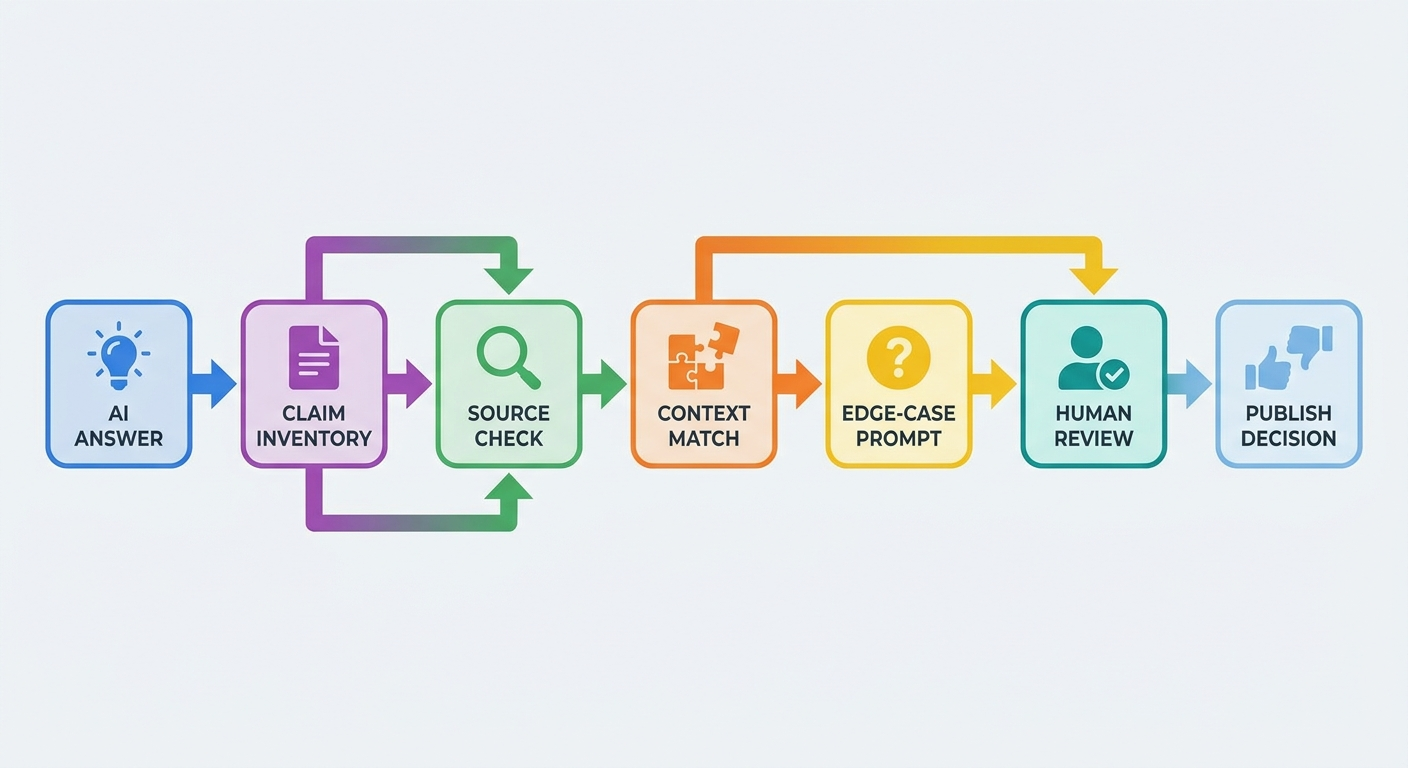
A strong hallucination review starts with a boring but powerful question: “What exactly did the AI claim?” Many people skip this and try to verify the answer as one blob. That fails because an answer can be partly correct and partly wrong. The introduction may be fine, the definition may be acceptable, and one statistic may be invented. Claim-level review gives you a way to keep the useful part while rejecting the risky part.
For content work, claims include statistics, expert quotes, report names, product details, study conclusions, and examples. For software work, claims include API behavior, package names, security advice, compatibility notes, and code assumptions. For research work, claims include paper summaries, causal explanations, and whether a source actually says what the AI says it says. For customer support, claims include refund rules, plan limits, account status, troubleshooting steps, and promises about what will happen next.
A Simple Hallucination Risk Scorecard
Not every answer deserves the same level of review. A poem, a brainstorming list, or a low-stakes draft can tolerate more uncertainty. A medical explanation, legal claim, security recommendation, financial analysis, hiring decision, or customer-facing answer cannot. The scorecard below helps you choose the right review depth without pretending there is one universal threshold.
| Risk signal | Low concern | Higher concern | Evaluation action |
|---|---|---|---|
| Consequence | Personal learning or brainstorming | Money, health, law, security, reputation, employment, or customer commitments | Require human review and source evidence before use. |
| Source trail | Claims are grounded in documents you provided | Claims cite vague sources, nonexistent links, or no source at all | Verify source existence and whether the source supports the exact claim. |
| Specificity | General explanation with few factual details | Precise numbers, dates, names, quotes, regulations, or benchmarks | Check each specific claim independently. |
| Context dependency | Answer applies broadly | Answer depends on local policy, region, product version, dataset, or account state | Compare against the actual context, not generic web knowledge. |
| Actionability | Answer helps think | Answer tells a person or agent what to do next | Add approval gates before the action is taken. |
A useful rule is to treat risk as the product of confidence and consequence. A low-confidence answer in a low-stakes setting is annoying. A high-confidence wrong answer in a high-stakes setting is dangerous. Your review process should become stricter when the answer is both specific and consequential.
This is where NIST’s AI Risk Management Framework is helpful as a mental model. NIST frames AI risk management around mapping, measuring, managing, and governing risk. You do not need a full enterprise governance program for every AI answer, but the same pattern applies at a smaller scale. Map where the answer will be used. Measure whether it is supported. Manage the risk with checks and rewrites. Govern high-risk use with a human approval rule.
Five Test Types That Catch Different Hallucinations
One test will not catch every hallucination. Citation checks catch fake sources. Groundedness checks catch claims unsupported by provided context. Consistency checks catch contradictions. Refusal checks catch situations where the model should not answer confidently. Edge-case checks catch overgeneralization. A good evaluation plan combines several small tests rather than relying on one giant prompt.
1. Claim extraction test
Ask the reviewer, or a separate AI pass, to list factual claims from the answer. Then review the list manually. This makes invisible assumptions visible. For example, “The policy changed last month,” “The model supports function calling,” and “The customer is eligible for a refund” are separate claims. Each requires different evidence.
2. Source existence and source support test
Checking whether a source exists is not enough. A real source can be misrepresented. The test should ask two questions: does the cited page, paper, or document exist, and does it support the exact claim being made? This is why the existing Singularity Journey article on AI citation verification pairs naturally with this checklist.
3. Groundedness test
For RAG or document-based workflows, groundedness means the answer stays faithful to retrieved or provided context. Ragas describes faithfulness as factual consistency between a response and retrieved context, where claims should be supported by that context. That is a practical way to think: if the answer cannot be inferred from the context, it should not be presented as context-grounded.
4. Contradiction and boundary test
Ask whether the answer contradicts the provided document, the user’s instruction, known policy, or a trusted reference. Then ask whether the model answered outside the boundary of what it could know. Boundary failures are common when the model fills in missing account details, claims to know real-time status, or assumes a local rule that was never provided.
5. Refusal and uncertainty test
A reliable AI system should sometimes say, “I do not have enough information.” Test whether the answer admits uncertainty when evidence is missing. Over-refusal can be unhelpful, but under-refusal is a hallucination risk. This is especially important for legal, medical, financial, security, and personal-data questions.
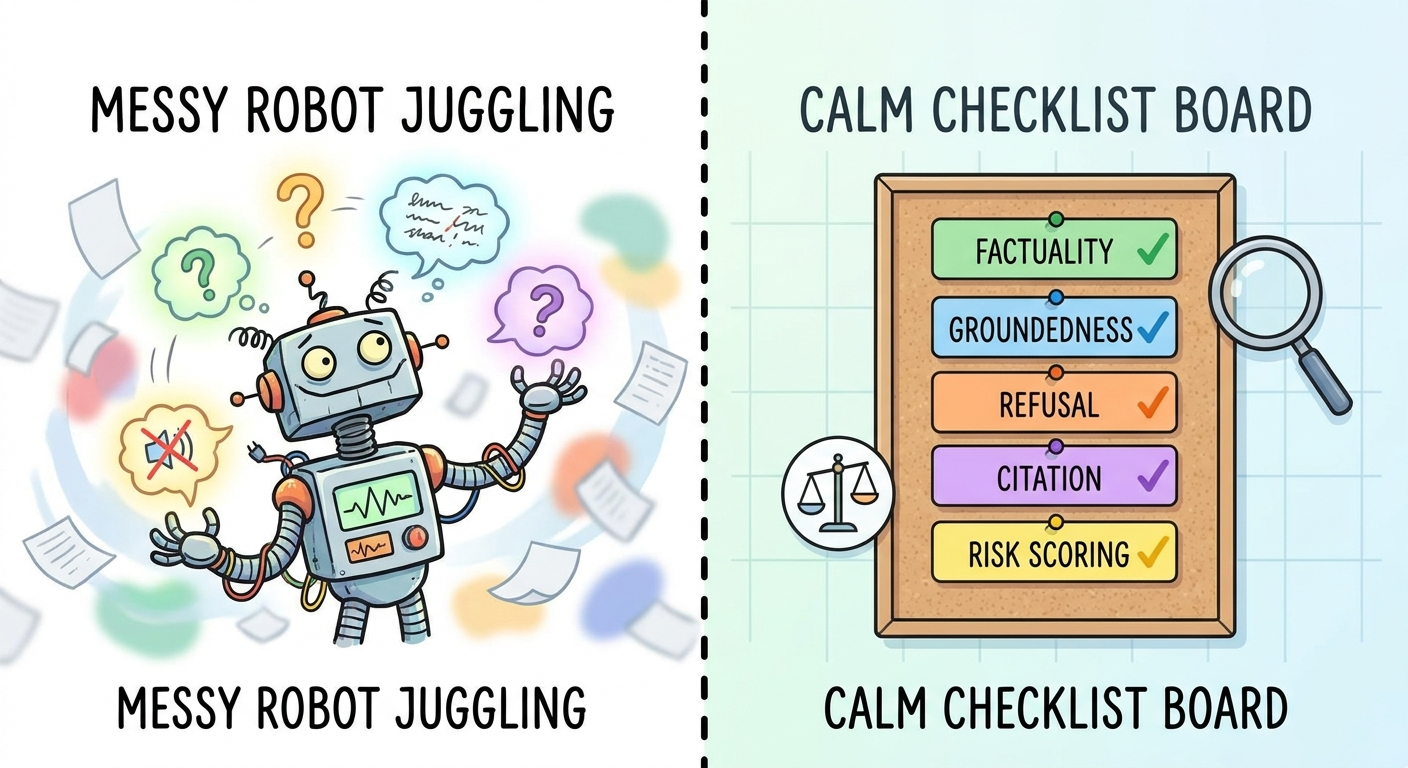
Examples: How the Checklist Works in Real Tasks
Example 1: Research summary
Suppose an AI summarizes a report and says, “The study found that most companies already deploy autonomous agents in production.” The claim is specific and trend-shaped. Do not accept it because it sounds plausible. Extract the claim, open the report, check the sample, verify the wording, and see whether “autonomous agents” was actually measured. If the report says companies are piloting AI assistants, the AI answer overstated the finding. The fix is to rewrite the sentence with narrower language and cite the report accurately.
Example 2: Customer support answer
A support copilot says a customer can receive a refund within ten business days. The answer might be correct, but it depends on plan, region, purchase channel, time since purchase, and company policy. Evaluation means checking the actual support policy and customer context. If the model cannot access account state, the response should avoid promises and route the case to a human or policy-backed workflow.
Example 3: RAG answer
A document assistant quotes a contract and gives a confident interpretation. The source exists, but the quote is from the wrong section and ignores an exception later in the document. A source link alone did not solve the problem. The groundedness test needs to check whether the retrieved passage supports the answer and whether the retrieval missed a more relevant passage. For a deeper look, read RAG Hallucinations Explained.
Example 4: Developer help
An AI coding assistant recommends a library method that existed in an older version but not the version used in your project. The answer is not random; it is version-confused. Evaluation means checking your package version, official docs, type errors, and tests. The output should be treated as a hypothesis until the code runs in your environment.
Example 5: Meeting notes
An AI meeting summary says, “The team decided to launch next week.” The transcript may show only that someone proposed launching next week. That is a decision hallucination: the model turned discussion into commitment. Evaluation means comparing decision language against the transcript and marking unresolved items as open questions.
A Repeatable Workflow for Teams
Teams need a process that is simple enough to use and strong enough to matter. Start by classifying the AI output. Is it internal brainstorming, internal knowledge work, customer-facing content, automated action, or high-stakes advice? Then choose the review depth. Low-risk outputs can use a quick claim scan. Medium-risk outputs need source verification and rewrite rules. High-risk outputs need a human owner, documented evidence, and a release gate.
Next, build a small evaluation dataset. It does not have to be large. Collect common questions, risky edge cases, known wrong answers, policy-sensitive scenarios, and examples where the model previously hallucinated. OpenAI’s evaluation guidance describes evals as tests that compare model outputs against criteria you specify. The practical idea is useful even outside one vendor: write down what good behavior means before you trust the system.
For RAG systems, include questions where the answer is present in the context, absent from the context, contradicted by the context, and split across multiple documents. Track faithfulness, context relevance, citation quality, and refusal behavior. Google Cloud and Ragas both provide useful language around generative AI evaluation and context-based metrics, but the key product habit is simpler: measure whether the answer is supported by the material the system actually used.
For agentic systems, add action risk. Anthropic’s agent guidance emphasizes simple, composable patterns and knowing when agents are appropriate. That matters for hallucination evaluation because an agent can turn a wrong belief into a tool call. If an answer could trigger email, database updates, payments, permissions, file changes, or customer messaging, require an approval gate before the action.
| Output type | Minimum review | Release rule |
|---|---|---|
| Brainstorming draft | Check obvious false claims and remove fake specifics. | Use as inspiration only. |
| Internal research note | Claim extraction plus source support for key facts. | Label uncertainty and keep citations. |
| Published article or report | Source verification, contradiction check, and editorial review. | No unsupported statistics, quotes, or citations. |
| Customer-facing answer | Policy check, account-context check, and escalation rule. | Do not promise actions without system-backed evidence. |
| Automated agent action | Groundedness, permission, side-effect, and human approval checks. | Block high-impact actions until approved. |
Common Evaluation Mistakes to Avoid
Better habits
- Separate each factual claim before review.
- Verify whether citations support the exact sentence.
- Use stricter checks when consequences are higher.
- Ask for uncertainty when context is missing.
- Keep a small test set of known risky prompts.
- Link hallucination review to human approval for agent actions.
Risky habits
- Trusting answers because they are well written.
- Assuming RAG or citations automatically solve hallucinations.
- Checking only the first source and ignoring the rest.
- Letting AI summarize policies without version or region context.
- Using one generic accuracy score for every use case.
- Allowing agents to act on unverified assumptions.
The most subtle mistake is treating hallucination evaluation as a tool purchase rather than a judgment workflow. Tools can help extract claims, run evals, compare context, and track metrics. They cannot decide your risk tolerance by themselves. A classroom explainer, a product recommendation, a compliance memo, and a password-reset workflow require different thresholds.
Another mistake is demanding impossible certainty. The goal is not to make AI perfect. The goal is to prevent unsupported confidence from entering decisions without review. If a model is uncertain, says what evidence it used, and points out what still needs confirmation, that is often safer than a polished answer that pretends every detail is settled.
Reusable Review Prompts and Documentation Templates
A checklist becomes much more useful when it creates a small paper trail. You do not need a heavy compliance system for every AI interaction, but you do need enough structure that another person can understand why an answer was trusted, changed, or rejected. The easiest template has five fields: original question, AI answer version, important claims, sources checked, and final decision. That record turns evaluation from a vague feeling into a repeatable habit.
For a low-risk answer, the decision might be short: “Used as brainstorming only; no factual claims retained.” For a medium-risk answer, the decision should name the sources that supported the key claims and the claims that were removed. For a high-risk answer, the decision should name the human reviewer, the reason the output was approved, and the boundaries that still apply. This matters because many hallucination incidents are not caused by one bad model output. They happen when a draft answer is copied forward without anyone remembering which details were verified.
Here is a practical reviewer prompt you can adapt: “Extract every factual claim from this answer. Put claims in a table with columns for claim, source needed, source provided, risk level, and recommended action. Do not verify the claims yourself unless a source is included. Mark unsupported claims clearly.” This prompt is not a final authority, but it helps a human reviewer see the answer’s moving parts.
For RAG applications, use a second prompt: “Compare each answer claim with the retrieved context. Mark each claim as supported, partially supported, contradicted, or not found. Quote the shortest context passage that supports the claim.” The important phrase is “not found.” A RAG answer should be allowed to say that the context does not contain enough evidence. That is safer than inventing a bridge between weak passages.
For customer-facing workflows, document escalation rules before launch. If the answer mentions refunds, cancellations, account access, legal rights, safety instructions, financial decisions, or personal data, route to a policy-backed answer or a human. This is not about slowing down every conversation. It is about preventing the AI from creating commitments that the organization cannot honor or verify.
For editorial work, keep a “no naked numbers” rule. Any statistic, benchmark, survey finding, percentage, quote, or report conclusion must travel with a source link and a note explaining exactly what the source says. If the source does not support the exact wording, change the wording. If the source is promotional, unclear, or inaccessible, replace it with a better source or remove the claim.
How Strict Should Your Hallucination Evaluation Be?
The right threshold depends on the audience and the consequence. A student using AI to understand a concept can accept a lighter review if they are not submitting the answer as fact. A founder preparing investor materials needs stronger verification. A developer shipping an AI feature needs test cases. A healthcare, legal, finance, or security team needs professional review and formal controls. The same model output can be harmless in one context and unacceptable in another.
Use three release levels. Level one is “draft only”: the output can inspire ideas, but factual claims are not trusted. Level two is “verified with sources”: important claims have been checked, weak wording has been softened, and uncertainty is visible. Level three is “approved for consequence”: the answer has source evidence, context checks, human review, and a clear owner. Most everyday work lives between level one and level two. Customer-facing, automated, or high-impact work should move toward level three.
This tiered approach also helps teams avoid two bad extremes. The first extreme is blind trust, where every fluent AI answer becomes accepted truth. The second extreme is process paralysis, where people create so many rules that nobody evaluates anything consistently. A small set of risk-based gates is better than a giant checklist that people ignore. Make the safe path easy: extract claims, verify sources, mark uncertainty, and escalate when consequences rise.
Keep Learning on Singularity Journey
- AI Hallucinations Explained — the source pillar for understanding why models make things up and how risk can be reduced.
- AI Citation Verification Checklist — a narrower checklist for checking whether sources and links are real.
- RAG Hallucinations Explained — why retrieved sources reduce risk but do not eliminate it.
- AI Agent Evaluation Metrics — metrics for production agents and tool-using workflows.
- AI Agent Test Cases — how to build golden tests for agent behavior.
Sources and References
- IBM: What are AI hallucinations?
- A Survey on Hallucination in Large Language Models
- OpenAI documentation: Working with evals
- Google Cloud documentation: Gen AI evaluation service
- Ragas documentation: Faithfulness metric
- NIST AI Risk Management Framework
- OWASP Top 10 for Large Language Model Applications
Source note: external links were checked for relevance and credibility before inclusion. Pricing, documentation, and framework pages can change, so verify the source directly before making high-stakes operational decisions.
FAQ: AI Hallucination Evaluation Checklist
What is AI hallucination evaluation?
AI hallucination evaluation is the process of checking whether an AI answer is factual, source-supported, context-grounded, appropriately uncertain, and safe enough for its intended use.
How do you test an AI answer for hallucinations?
Break the answer into factual claims, verify important claims against trusted sources or provided context, look for contradictions, check whether citations support the exact claims, and require human review for high-risk use.
What is groundedness in AI evaluation?
Groundedness means the answer is supported by the context the system used, such as retrieved documents in a RAG workflow. If a claim cannot be inferred from the context, it should not be presented as grounded.
Do citations prove an AI answer is true?
No. Citations can be fake, irrelevant, outdated, or real but misrepresented. You need to check both source existence and source support.
Can RAG eliminate hallucinations?
No. RAG can reduce hallucination risk by grounding answers in retrieved sources, but retrieval can miss relevant material, retrieve weak context, or cite passages that do not support the answer.
When should a human review AI output?
Human review is needed when the answer affects money, health, law, security, reputation, employment, customer commitments, or an automated action with meaningful consequences.
What is a good hallucination metric?
There is no single universal metric. Useful signals include claim accuracy, faithfulness to context, citation support, contradiction rate, refusal quality, and severity-weighted failure rate.
Should I use another AI model to check hallucinations?
A second model can help find issues, but it should not be the only judge. Use it as an assistant for claim extraction or review suggestions, then verify important claims with trusted sources and human judgment.
