
AI Governance Portfolio Projects: 7 Artifacts That Prove You Can Do the Work
Build a credible AI governance portfolio around decisions, controls, tests, and evidence—not a folder of copied policy templates. This guide shows what to make, how the pieces connect, and how to present honest work that hiring teams can inspect.

AI Governance Portfolio Projects: The Quick Answer
AI governance portfolio projects should demonstrate that you can turn an AI use case into an accountable operating decision. A strong portfolio does not merely summarize the EU AI Act, quote the NIST AI Risk Management Framework, or list ethical principles. It shows how you identify a system, understand its context, assess its risks, design controls, assign owners, verify that controls work, respond when something fails, and communicate what should happen next.
The most convincing format is one fictional but realistic case that produces seven connected artifacts: an AI system inventory record, a use-case risk assessment, a system card, a risk-control-evidence crosswalk, a human-oversight plan, an incident and near-miss pack, and a monitoring brief. Each artifact should be small enough to inspect yet detailed enough to expose your reasoning. Together they show governance as a lifecycle rather than a policy document.
This distinction matters because AI governance is multidisciplinary. The NIST AI RMF Core organizes work around Govern, Map, Measure, and Manage, with governance operating across the lifecycle. The European Commission’s AI literacy guidance emphasizes that people dealing with AI systems need knowledge suited to their context, technical experience, education, and training. A portfolio should make those capabilities visible through work products.
Why an AI Governance Portfolio Matters
AI governance job titles are inconsistent. Similar work can sit in responsible AI, enterprise risk, model risk, privacy, cybersecurity, internal audit, compliance, legal operations, data governance, product assurance, or an AI center of excellence. That makes a certificate-only strategy fragile. A hiring manager may not recognize every course, but they can inspect a clear risk assessment, ask how you chose a control, and challenge the evidence behind a recommendation.
The labor evidence supports a blended skill strategy rather than a narrow title chase. The World Economic Forum’s skills outlook places AI and big data, networks and cybersecurity, and technological literacy among the fastest-growing skills, while analytical thinking, leadership, resilience, and collaboration remain important. An OECD review of skills in the AI age likewise separates rare advanced AI skills from the broader foundational, digital, critical-thinking, creative, and collaborative abilities people need to work effectively with AI.
Governance work lives in that overlap. You must understand enough technology to question a system boundary, enough risk to prioritize consequences, enough operations to define a repeatable control, and enough communication to get decisions made. A portfolio is useful because it can reveal all four layers in one place.
A project also gives you material for interviews. Instead of saying, “I know NIST AI RMF,” you can say, “I mapped a customer-support agent using the Map function, chose two measurable risks, designed approval and citation controls, specified evidence, then revised the recommendation after a simulated near miss.” That statement invites a substantive discussion.
The Evidence Chain Every Project Should Show
The easiest way to make a governance portfolio coherent is to use one repeated chain: context → risk → owner → control → test → evidence → decision. If any link is missing, the project becomes harder to trust. A risk with no owner is an observation. A control with no test is a promise. A test with no retained evidence cannot support assurance. Evidence with no decision becomes reporting theater.
| Link | Question your artifact must answer | Weak example | Stronger example |
|---|---|---|---|
| Context | What is the system for, who uses it, and where does it operate? | “AI chatbot.” | “Internal support assistant that retrieves approved policy pages and drafts answers for agents; it cannot send messages directly.” |
| Risk | What could go wrong, for whom, and why does it matter? | “Hallucination risk.” | “An unsupported leave-policy answer could cause an employee to miss a deadline or receive incorrect benefit guidance.” |
| Owner | Who is accountable for prevention, review, escalation, and acceptance? | “The AI team.” | Named role families for product ownership, policy content, technical operations, human review, and final risk acceptance. |
| Control | What mechanism reduces likelihood or impact? | “Add guardrails.” | Retrieve only approved documents, require citations, abstain below an evidence threshold, and route sensitive topics to a specialist. |
| Test | How will you know the control works? | “Monitor quality.” | Run a versioned test set by policy topic, check citation support, review abstention errors, and sample escalations weekly. |
| Evidence | What record proves the activity occurred? | “Logs exist.” | Test report, trace ID, reviewer decision, exception ticket, version, owner, timestamp, and remediation status. |
| Decision | What action follows from the evidence? | “Be careful.” | Approve only for low-risk topics, block direct sending, add a 30-day review, and reopen approval if the knowledge base or model changes. |
NIST’s AI RMF Playbook is useful here because it offers suggested actions aligned to framework outcomes while explicitly warning that it is not a universal checklist. That is a valuable portfolio lesson: do not paste every possible control into every case. Choose controls that fit the use, risk, people, and organizational capacity, then explain why.
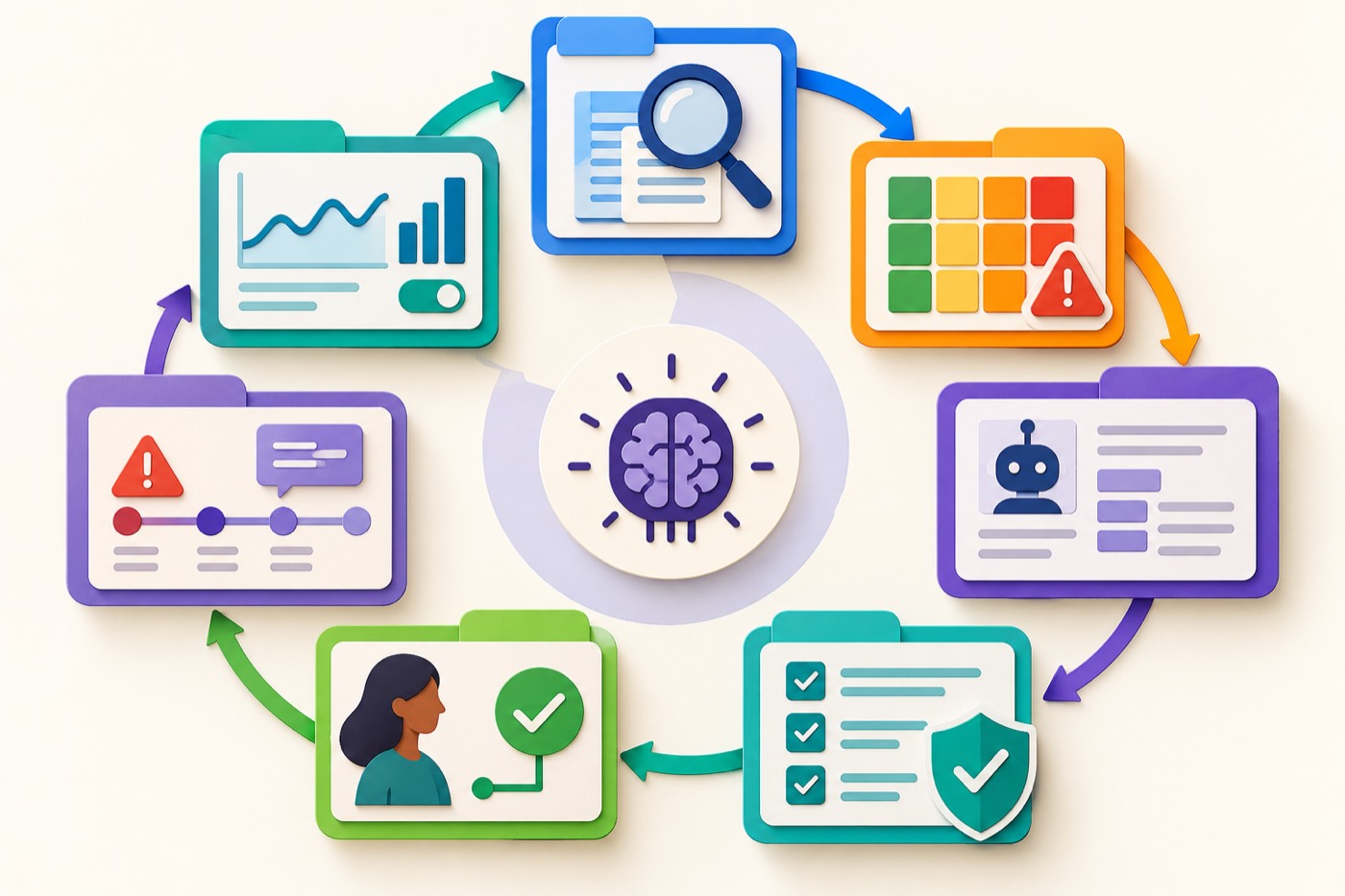 The portfolio works best as a connected lifecycle: discovery, assessment, documentation, controls, oversight, incident learning, and monitoring.
Seven AI Governance Portfolio Projects to Build
You can build these artifacts for one fictional system or several smaller cases. One connected case is usually stronger because it reveals whether your decisions remain consistent. Use public or synthetic information. State clearly that the project is educational, scenario-based, and not a legal opinion, conformity assessment, audit, certification, or production deployment.
Project 1: AI system inventory and use-case intake
Start with an inventory record because governance cannot operate on systems nobody has identified. Choose a realistic use case, such as an internal knowledge assistant, customer-support drafting tool, hiring workflow assistant, claims triage system, or tool-using procurement agent. Define its purpose, owner, users, affected people, lifecycle stage, model or service dependency, data categories, integrations, autonomy, geography, and decision impact.
Include a boundary diagram showing inputs, retrieval sources, model calls, tools, outputs, human touchpoints, and stored records. Add an “out of scope” box. If your support assistant drafts answers but never sends them, that is a meaningful boundary. If it can open a refund ticket but cannot issue money, document the separation. Governance begins with knowing what the system does and does not do.
Your deliverable should include a one-page intake form, a system context diagram, an initial risk tier with rationale, unanswered questions, and a named review route. Show change triggers: adding a new data source, enabling autonomous action, changing the user population, or moving into a regulated decision should cause reassessment.
This project demonstrates discovery, technical translation, scoping, data awareness, and stakeholder questioning. Connect it to Singularity Journey’s guide to an AI agent registry to see why ownership, permissions, versioning, and retirement belong in the record.
Project 2: Contextual AI risk and impact assessment
A risk assessment should move beyond a generic list of bias, privacy, security, and accuracy. Describe credible failure scenarios for your specific use. For each scenario, identify affected people, impact type, severity, likelihood assumptions, detectability, existing safeguards, residual uncertainty, and escalation path. Include benefits and alternatives so the assessment does not assume that AI is automatically the right solution.
For a hiring assistant, distinguish drafting a job description from ranking applicants. For an internal policy assistant, distinguish a harmless formatting error from an unsupported answer about compensation or leave. For a tool-using agent, distinguish a reversible draft action from an external payment. This context is what turns a risk register into decision support.
Use a modest scoring approach and explain its limitations. A colored heat map is not evidence by itself. If you assign a score, define the scale, show the rationale, avoid false precision, and make room for qualitative concerns. Include at least one risk that remains uncertain because required data is unavailable. Then recommend whether to proceed, narrow the scope, add controls, conduct further testing, or stop.
This project demonstrates structured reasoning and balanced judgment. The NIST Map guidance emphasizes intended purpose, users, context, impacts, assumptions, limitations, and the possibility that systems will be repurposed. Use those ideas to deepen the assessment, not to decorate it with framework labels.
Project 3: AI system card and limitations sheet
Create a concise system card that a product owner, reviewer, operator, or auditor can understand. Include intended use, prohibited or unsupported uses, users, model and data dependencies, evaluation scope, performance boundaries, human oversight, security and privacy considerations, known limitations, change history, and contact roles. The goal is not to disclose proprietary detail; it is to make important operating facts inspectable.
Pair the card with three scenario walkthroughs: one normal case, one edge case, and one case the system must refuse or escalate. Show the evidence trail for each. If you cite a metric, define the dataset and what the metric does not prove. If you describe “human oversight,” explain when the person sees the output, what information they receive, whether they have authority and time to intervene, and what happens after disagreement.
A good limitations section is a hiring signal. State where the project relies on assumptions, synthetic data, public documentation, or a simulated workflow. Do not claim production validation. Honest scope shows that you understand assurance depends on evidence quality.
Project 4: Risk-control-test-evidence crosswalk
This is the portfolio’s central artifact. Build a table that connects each priority risk to a preventive, detective, or corrective control; control owner; execution frequency; test method; acceptance condition; retained evidence; exception path; and review trigger. Choose a manageable set—perhaps eight to twelve controls—so you can explain every row.
For the unsupported-answer risk, a preventive control might restrict retrieval to approved sources. A detective control might measure citation support on a versioned test set. A corrective control might route uncertain answers to a specialist and update the knowledge base after verified errors. Evidence could include source versions, test results, sampled traces, reviewer decisions, and issue tickets.
Then test two controls. Create sample evidence and deliberately include a failure. Perhaps the citation checker passes a response that cites a relevant page but does not support the claim. Explain how you discovered the weakness, what changed, and which risks remain. This separates control design from checkbox compliance.
Project 5: Human oversight and decision-rights plan
“Human in the loop” is too vague for governance. Build a plan that says which decisions the system may make, recommend, draft, or never perform; which events require approval; who is qualified to review; what evidence appears in the review interface; how much time is available; how conflicts are resolved; and how overrides are recorded and audited.
Use an authority matrix. Low-impact reversible actions may run automatically. Medium-impact actions may require review when confidence or evidence is weak. High-impact, irreversible, rights-affecting, or financially consequential actions may always require an authorized person. Add a capacity estimate: a review gate that sends hundreds of low-value alerts to one person is not meaningful oversight.
Create three mock decision records. One should approve, one should reject, and one should request more evidence. Each record should show the proposed action, reason, relevant sources, risk flags, reviewer role, decision, and follow-up. Link the plan to the site’s AI agent autonomy levels and human-in-the-loop approval patterns.
Project 6: AI incident and near-miss response pack
Create an incident taxonomy, severity matrix, reporting form, triage workflow, evidence-preservation checklist, communication plan, corrective-action log, and post-incident review. Then run a tabletop scenario. For example, the assistant provides an unsupported policy answer, a human reviewer catches it before sending, and investigation finds that an approved source was outdated. That is a near miss with useful learning value.
Your response should separate facts, hypotheses, decisions, and unknowns. Record the model and knowledge versions, prompt or request, retrieved evidence, output, human actions, timestamps, affected users, containment, and owner. Avoid placing sensitive personal data into a public portfolio. Use synthetic records and state what a real organization would protect.
Explain how the incident changes the system. Perhaps the team corrects the source, improves stale-document detection, adds a high-risk topic route, refreshes evaluation cases, and changes the monitoring threshold. Governance becomes credible when learning loops back into controls. See the guides to AI incident reporting and AI near-miss reporting for deeper structure.
Project 7: Monitoring, change, and executive decision brief
Finish with an operating brief that defines what gets monitored, why it matters, who reviews it, how often, what triggers action, and how changes are approved. Include a small dashboard or table, but do not invent impressive production numbers. Use clearly labeled scenario data or describe the measurement design without claiming results.
Choose indicators from several layers: system quality, severe failures, human overrides, abstention, complaints, incidents, control execution, unresolved exceptions, access changes, data or model version changes, vendor notices, and review backlog. For each indicator, specify the numerator, denominator, data source, limitations, owner, threshold, and required response. A metric without a response owner is only observation.
NIST’s Measure guidance emphasizes selecting and documenting appropriate methods and metrics, while its Manage guidance connects assessment output to prioritization and response. Your executive brief should do the same: summarize material evidence, open gaps, accepted risk, and a clear recommendation such as continue, narrow, pause, remediate, or reassess.
How to Turn Seven Artifacts Into One Coherent Case Study
Seven unrelated templates can look like coursework. One connected system tells a story. Start with a fictional company and use case simple enough to understand but complex enough to reveal governance choices. An internal HR policy assistant is useful because it includes retrieval, sensitive topics, human review, document ownership, and plausible harm without requiring you to simulate a medical or financial decision.
Write a one-paragraph scenario contract: what the system does, what it cannot do, who uses it, which data it accesses, whether it acts or only recommends, and what success means. Freeze that version. Every artifact should refer to the same system identifier, version, owners, and boundary. When the scenario changes, record the change rather than silently editing history.
Define the use case and evidence rules
Choose public or synthetic data, list assumptions, label the work as scenario-based, and decide which claims need a source. Create a folder index and version log before writing the artifacts.
Map the system and stakeholders
Draw the data and decision flow. Identify system owners, content owners, users, reviewers, affected people, security and privacy partners, risk acceptance authority, and incident responders.
Select three priority risks
Use clear scenarios. One might involve unsupported policy guidance, another unauthorized access to restricted documents, and a third excessive reliance by a rushed employee. Explain why these outrank other plausible risks.
Design and test controls
Map controls to each risk, define the evidence, and simulate normal and failing cases. Preserve the initial result and the revision so reviewers can see how you respond to findings.
Run a near-miss tabletop
Walk through detection, triage, containment, evidence preservation, communication, root cause, remediation, and monitoring changes. Note where your process is slow or ambiguous.
Write a decision brief
Summarize benefits, priority risks, evidence, gaps, conditions, owners, review date, and recommendation in two pages or fewer. Link every conclusion to a supporting artifact.
 A hiring-ready case lets a reviewer trace every recommendation back through risks, owners, controls, tests, and retained evidence.
Skills Your AI Governance Portfolio Should Demonstrate
Do not organize the portfolio around tools alone. Organize it around capabilities and use tools only where they make the work more reviewable. A spreadsheet is sufficient for a small inventory. A diagram tool is sufficient for a system map. Version control is valuable because it shows change history. A notebook or lightweight script is useful when you can reproduce a test or summarize evidence, but code is not mandatory for every governance role.
| Capability | Portfolio evidence | Questions you should be ready to answer |
|---|---|---|
| AI system literacy | Context diagram, system card, dependency and limitation notes. | Where can behavior change? Which inputs, tools, data, and people shape the outcome? |
| Risk assessment | Scenario-based risk register with prioritization and uncertainty. | Why is this risk material? Who is affected? What evidence would change the score? |
| Governance frameworks | Selective mapping to NIST AI RMF or another relevant framework. | Why did you choose these outcomes? What did you intentionally omit? |
| Control design | Risk-control-test-evidence crosswalk and exception workflow. | Is the control preventive, detective, or corrective? Who owns it? How is effectiveness tested? |
| Human oversight | Decision-rights matrix, review records, capacity and escalation plan. | Can the reviewer understand, challenge, and stop the action in time? |
| Measurement | Defined indicators, test cases, thresholds, limitations, and response rules. | What does the metric fail to capture? What happens after a threshold breach? |
| Incident learning | Tabletop timeline, evidence pack, causal analysis, actions, and retest. | How did the process contain harm and improve the system? |
| Communication | Executive brief, user-facing disclosure, technical appendix, and concise presentation. | Can different audiences reach the same accountable decision from the evidence? |
The portfolio should also demonstrate collaboration. AI governance is rarely owned by one function. The World Economic Forum’s discussion of governance-team skills highlights technical understanding, translation, and cross-functional capability. Show this by assigning realistic roles and documenting where product, engineering, legal, privacy, security, operations, audit, and affected-user perspectives enter the workflow.
If you come from compliance or audit, strengthen the technical context and testing. If you come from engineering or data science, strengthen impact analysis, decision rights, and communication. If you come from product or program management, deepen control evidence and measurement. If you come from law or policy, show how a requirement becomes an operational activity with an owner, test, and record.
Choose Your Best First Governance Portfolio Project
Use this selector to turn your current background and target direction into a practical first artifact. It does not predict hiring outcomes; it gives you a defensible starting point that uses what you already know.
How to Present the Portfolio to Hiring Teams
A hiring manager should be able to understand the case in five minutes and inspect the evidence for thirty. Use a landing page or repository readme with the use case, system boundary, artifact index, key decision, limitations, and links. Keep source files accessible. Exporting polished PDFs is useful, but reviewers should also see structured tables, version history, and supporting evidence.
Use a clear artifact structure
- Start here: scenario, purpose, audience, system boundary, and educational-use disclaimer.
- Decision brief: the current recommendation, conditions, open risks, owners, and review date.
- Artifact index: seven work products in lifecycle order, each with a one-sentence purpose.
- Evidence register: source, date, version, artifact supported, trust level, and limitations.
- Change log: what changed, why, who approved it in the scenario, and which artifacts were reassessed.
- Reflection: the hardest judgment, a control that failed, remaining uncertainty, and what you would need in a real organization.
Label evidence honestly
Separate four evidence types: official or primary sources, public secondary research, scenario assumptions, and synthetic results. Do not make a fictional dashboard look like production data. Label simulated metrics. Do not use a company logo or imply endorsement. Do not publish private job-description datasets, customer traces, personal data, or confidential templates.
If you adapt a framework, cite it and explain the selection. If you use the NIST AI RMF, say which outcomes guided the artifact and why. If you discuss the EU AI Act, link to official European Commission material and avoid presenting yourself as legal counsel. Laws and guidance change; date your interpretation and include a review note.
Prepare a ten-minute interview walkthrough
Use this sequence: intended use, most important risk, surprising uncertainty, chosen control, test result, failed assumption, remediation, residual risk, and decision. Keep the narrative concrete. An interviewer can then probe your reasoning rather than listening to a framework lecture.
Prepare for challenges: Why did you prioritize this risk? Who can accept it? How would you validate a vendor claim? What would you monitor? What happens when the model changes? How do affected users contest an outcome? What evidence would make you reverse the decision? A useful portfolio contains enough detail for those questions to have real answers.
A Practical Roadmap for Building the Portfolio
Build depth before volume. One coherent case with tested controls is more credible than ten empty templates. The stages below are milestones rather than promises about time or employability. Move faster or slower based on your background, and seek feedback from practitioners where possible.
| Stage | Work to complete | Quality gate | Career evidence |
|---|---|---|---|
| Foundation | Study AI system basics, lifecycle risk, NIST AI RMF, relevant official regulation, and one domain. | You can explain the framework without treating it as a universal checklist. | Glossary, annotated framework map, source register. |
| System understanding | Build the inventory, context diagram, stakeholder map, and system card. | A technical and non-technical reviewer can agree on the system boundary. | Inventory record, diagram, limitations sheet. |
| Risk judgment | Create scenarios, prioritize risks, document assumptions, and recommend a direction. | Every priority risk names affected people, consequence, rationale, owner, and uncertainty. | Risk assessment and decision memo. |
| Controls and assurance | Design controls, tests, evidence, exceptions, and review triggers. | At least two controls are tested and one finding changes the design or decision. | Crosswalk, test evidence, remediation record. |
| Operational governance | Add human oversight, monitoring, change control, incident response, and near-miss learning. | The lifecycle remains accountable after deployment and after changes. | Oversight plan, incident pack, monitoring brief. |
| Hiring narrative | Publish the index, executive summary, reflection, and walkthrough. | Claims are source-backed, scenario data is labeled, and limitations are easy to find. | Portfolio site or repository, presentation, resume bullets. |
Translate the work into resume evidence. A weak bullet says, “Created AI governance policies using NIST.” A stronger bullet says, “Designed a scenario-based governance pack for a retrieval assistant, mapping three priority risks to owners, controls, tests, evidence, escalation, and lifecycle review; revised the release recommendation after a simulated citation-control failure.” The second version shows the problem, method, and decision.
For broader positioning, connect this portfolio with the site’s guides to AI agent careers, an AI evaluation engineer roadmap, and an AI portfolio case study template. Governance becomes stronger when you can collaborate with builders and evaluators while preserving independent judgment.
Mistakes That Make an AI Governance Portfolio Look Weak
1. Copying frameworks without making choices
A framework map can show literacy, but a portfolio must show selection and judgment. Explain which outcomes matter for the scenario, which controls you chose, what you omitted, and what evidence supports the decision.
2. Treating governance as documentation after development
Show how governance changes system scope, product requirements, approval design, evaluation, access, monitoring, incident response, and retirement. If every artifact merely describes a finished system, you miss governance as an operating capability.
3. Using vague controls
“Human review,” “monitor bias,” and “ensure transparency” are goals. Define the activity, trigger, owner, input, qualification, acceptance condition, evidence, exception, and response. Ask whether another person could perform and test the control from your description.
4. Inventing data or overstating experience
Do not present simulated metrics as live results, a personal exercise as an audit, or a framework mapping as certification. Honest labels protect credibility. You can demonstrate strong reasoning without pretending to have access to a production system.
5. Ignoring affected people and recourse
Enterprise owners are not the only stakeholders. Identify who experiences the outcome, how they learn that AI is involved when appropriate, how they correct errors, how they contest consequential decisions, and how complaints become monitoring or incident evidence.
6. Building a dashboard with no decision path
Every indicator needs a purpose, owner, threshold or review rule, and action. Avoid colorful charts that cannot answer what happens next. Include the limitations of the measurement and the conditions that trigger reassessment.
7. Treating regulation as static
Date legal and policy sources, prefer official pages, record jurisdiction and scope, and add a change-review trigger. The European Commission’s AI Act governance information illustrates why governance includes institutions, supervision, enforcement, and evolving implementation—not just a one-time compliance table.
8. Hiding uncertainty
A strong practitioner distinguishes fact, assumption, inference, and unknown. Include an open-questions register. State what data, testing, stakeholder input, or authority would be needed before a real decision. Governance is not certainty theater; it is disciplined action under incomplete information.
AI governance careers will continue to use different titles and organizational homes. The durable opportunity is becoming useful wherever people must decide whether an AI system should be built, bought, deployed, changed, monitored, constrained, or retired. Seven connected artifacts make that usefulness visible.
FAQ About AI Governance Portfolio Projects
What should an AI governance portfolio include?
Include a clear use case and boundary, an AI inventory record, a contextual risk assessment, a system card, a risk-control-test-evidence crosswalk, a human-oversight plan, an incident or near-miss exercise, and a monitoring and decision brief. Also include sources, assumptions, limitations, versions, and an honest label for synthetic or scenario-based evidence.
Do I need to code to work in AI governance?
Not every role requires software engineering, but technical literacy is important. You should understand how models, data, retrieval, tools, integrations, access, monitoring, and changes affect risk. Coding can strengthen testing and evidence automation, while policy, risk, audit, legal, product, domain, and communication skills remain valuable.
Can I build a governance portfolio without professional AI experience?
Yes, if you label the work accurately. Use a fictional but realistic scenario, public or synthetic data, official sources, explicit assumptions, and clear limitations. Do not present the project as a production audit, legal opinion, certification, or real deployment. The purpose is to demonstrate reasoning and transferable skills.
Which framework should I use for a portfolio project?
NIST AI RMF is a practical starting point because it covers governance, context mapping, measurement, and management, but it is not a universal checklist. Choose frameworks and regulatory sources based on the use case, industry, jurisdiction, and intended audience. Explain why each mapping is relevant and what it does not prove.
Should I include the EU AI Act in my portfolio?
Include it when the scenario has a credible EU connection or when the project specifically demonstrates regulatory analysis. Use official European Commission sources, date your review, distinguish legal requirements from voluntary practices, and avoid presenting educational work as legal advice or a compliance determination.
What is the best first AI governance project?
An inventory and contextual risk assessment for a bounded system is usually the best start. It forces you to understand purpose, users, affected people, data, dependencies, autonomy, owners, benefits, failures, and decision scope before you jump to controls or policy language.
How do I make a fictional project credible?
Use consistent system facts across every artifact, cite reliable sources, label assumptions and synthetic results, preserve version history, test controls, include a failed finding, and show how evidence changes the recommendation. Credibility comes from transparent method and limitations, not from pretending the scenario is real.
How many projects do I need before applying for roles?
There is no universal number. One deep, coherent case can provide more interview evidence than many shallow templates. Apply when you can explain the system boundary, defend risk priorities, map controls to tests and evidence, describe human oversight and incident learning, and state what you still do not know.
What job titles can this portfolio support?
Depending on your background, the evidence may support conversations about AI governance analyst, responsible AI specialist, AI risk analyst, model risk or validation, AI assurance, technology risk, compliance, audit, privacy, policy operations, governance program management, or related product and security roles. Always tailor the portfolio to actual job requirements.

