
Trustworthy AI Agents Explained: What Makes an Agent Worth Trusting?
Trustworthy AI agents are not agents that sound confident or pass one impressive demo. They are systems whose behavior, boundaries, evidence, oversight, and recovery mechanisms justify a specific level of trust for a specific task.

Trustworthy AI Agents: The Quick Answer
Trustworthy AI agents are AI systems that deserve a clearly limited amount of confidence because their performance has been tested in the intended setting, their permissions match the task, their actions can be observed and interrupted, failures are contained, and accountable people remain able to review and correct outcomes. Trust is not a personality trait of the model. It is a judgment about the entire socio-technical system: model, prompts, tools, data, memory, interfaces, policies, operators, and affected people.
The word trustworthy is easy to misuse. A fluent agent can feel dependable because it explains itself smoothly, remembers preferences, and takes initiative. None of those qualities proves that it will select the right tool, respect a spending limit, preserve private data, resist manipulated instructions, or recover safely after a partial failure. Conversational confidence may influence human trust, but it is not evidence that the system merits that trust.
This distinction matters because agents do more than produce text. They can search records, update files, call APIs, contact customers, schedule work, run code, create purchases, or coordinate other agents. The moment an AI can change the world outside its chat window, a wrong answer can become an unauthorized action. Trust must therefore grow more slowly than capability and shrink as the consequence of error increases.
What “Trustworthy” Means for an AI Agent
A useful starting point is the NIST AI Risk Management Framework. NIST describes trustworthy AI through several connected characteristics: validity and reliability, safety, security and resilience, accountability and transparency, explainability and interpretability, privacy enhancement, and fairness with harmful bias managed. It also makes an important point: trustworthiness is contextual and depends on tradeoffs. Excelling at one characteristic does not cancel a severe weakness in another.
For AI agents, that framework needs an action layer. An ordinary model may recommend a refund; an agent may issue it. A chatbot may summarize a medical form; an agent may route the case or update a record. An assistant may suggest a calendar change; an agent may invite twenty people. The quality of the output still matters, but so do authorization, tool behavior, state, side effects, rollback, and accountability.
The Australian Government’s agentic AI guidance defines an agent around perception, internal state, decisions, and actions taken through tools within permissions and constraints. Its technical addendum emphasizes oversight, assigned human accountability, monitoring, intervention, controlled shutdown, recovery, and auditable records. That is a useful shift from “Does the model seem intelligent?” to “Can the operating system around the model keep action bounded and reviewable?”
Trust is earned for a use, not granted to a product
The same agent can be trustworthy for one role and untrustworthy for another. A research assistant might be good enough to collect candidate sources when a human checks every citation. That does not mean it should independently publish legal advice. An email triage agent may safely label messages but should not automatically send sensitive replies. A purchasing agent may be allowed to reorder low-cost supplies from an approved catalog while requiring approval for a new vendor or a higher amount.
This is why trust should be represented as a scope, not a badge. Scope includes the task, environment, users, data, tools, time horizon, maximum impact, supervision mode, and fallback path. When any of those change, the evidence must be reconsidered. A test result from a sandbox does not automatically justify production access. A model upgrade does not inherit the old model’s trust. A successful month on common cases does not establish safety on rare, high-impact exceptions.
Trust and reliance are different
People often rely on systems they do not deeply trust because checking every detail is expensive. They may also trust a friendly system more than its evidence warrants. Good design tries to align perceived trust with deserved trust. It makes uncertainty, limitations, authority, and review status visible. It avoids human-like cues that imply judgment or responsibility the system does not possess. It gives people a meaningful way to pause, question, override, appeal, or choose a non-AI route.
The OECD AI Principles connect trustworthy AI with human rights, democratic values, transparency, robustness, safety, accountability, and human agency. For an agent, human agency is not satisfied by placing a nominal reviewer somewhere in a diagram. The reviewer needs enough time, information, authority, and interface support to intervene effectively.
The Trust Evidence Stack for AI Agents
Trustworthy AI agents need evidence at several layers. Teams often over-invest in one layer—usually model benchmarks or prompt tests—and assume the rest will follow. They do not. A highly capable model can be connected to an unsafe tool. A secure system can still produce unfair decisions. A well-governed pilot can become unreliable after a workflow change. Trust emerges from the chain, and the chain is only as useful as its weakest consequential link.
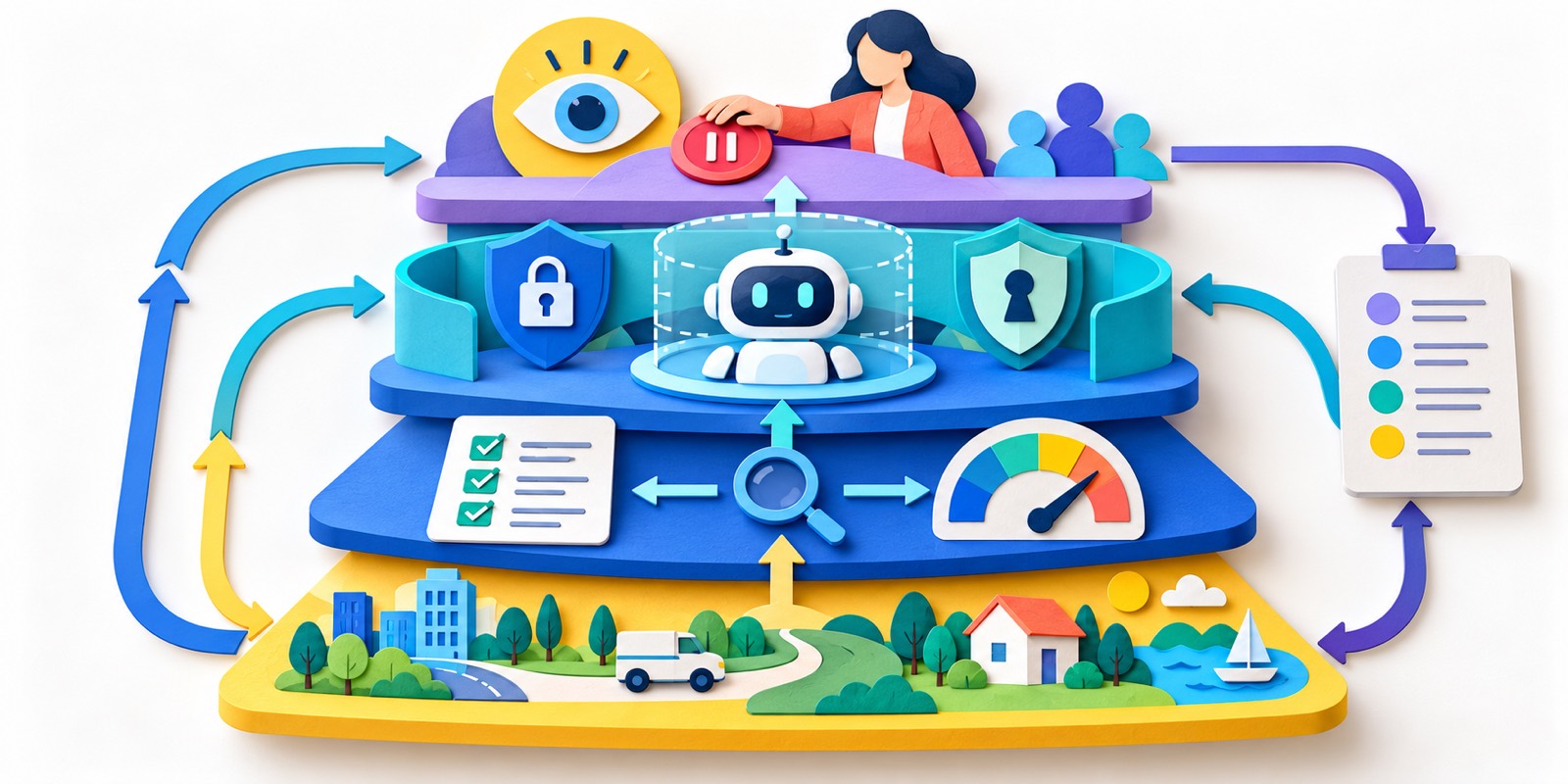
A trustworthy agent needs evidence from real outcomes upward—not only a convincing model response.
These layers are deliberately broader than a model score. Microsoft’s current agent evaluation overview separates task completion, tool use, boundary adherence, quality, and consistency, while noting that evaluation does not replace responsible-AI review, security testing, user research, or performance testing. That is the right mental model: evaluation is a component of trust, not a substitute for the rest of the system.
Evidence should also match the deployment environment. If an agent acts on noisy customer emails, tests should include ambiguous, incomplete, emotional, multilingual, and malicious messages—not only clean benchmark prompts. If it can spend money, tests should include duplicate events, timeouts, partial success, currency errors, vendor changes, and attempts to exceed limits. If it uses memory, the team should test stale facts, conflicting facts, deletion requests, poisoning, leakage, and identity confusion.
Seven Dimensions of Trustworthy AI Agents
The following dimensions turn broad trustworthy-AI principles into questions that can be answered for an acting system. They overlap by design. A privacy failure can also be a security and accountability failure; an unreliable tool call can become a safety event; weak observability can make every other assurance claim difficult to prove.
| Dimension | Question to answer | Evidence worth collecting | Warning sign |
|---|---|---|---|
| Validity and reliability | Does it achieve the intended outcome across realistic conditions? | Scenario tests, repeated-run consistency, task completion, tool accuracy, field outcomes | One average score hides catastrophic edge cases |
| Safety | Can it avoid or contain unacceptable harm? | Hazard analysis, stop tests, impact limits, red-team cases, recovery drills | The only safeguard is “the model was told not to” |
| Security and resilience | Can it resist manipulation and continue safely through failure? | Prompt-injection tests, least privilege, isolation, secret handling, failover evidence | Broad credentials shared across agents or tools |
| Privacy | Does it use, retain, expose, and delete data appropriately? | Data maps, access tests, retention controls, consent and deletion verification | Memory grows indefinitely without ownership or review |
| Transparency | Can users and operators understand what happened? | Action receipts, tool traces, source provenance, status, limitations, disclosure | Polished explanations cannot be matched to actual actions |
| Accountability | Who owns the system, decision, exception, incident, and remedy? | Named owners, approval records, escalation paths, audits, redress outcomes | Responsibility is assigned to “the AI” |
| Fairness and human agency | Are impacts monitored across affected groups, with meaningful choice and recourse? | Impact analysis, subgroup evaluation, accessibility tests, appeals, alternative channels | People can be affected but cannot challenge or escape the process |
1. Validity and reliability
Reliability means more than producing a correct-looking answer. For an agent, the unit of quality is often the completed outcome: the right record changed, the right recipient contacted, the right tool selected, and the right constraints preserved. Teams should measure the whole trajectory, including planning, retrieval, tool inputs, tool outputs, retries, handoffs, and final state.
Repeated-run testing matters because agents can vary even when given similar inputs. A trustworthy system needs bounded variability: multiple acceptable ways to complete a low-risk task may be fine, while a regulated or financial action may require deterministic checks around the agent. High average success is insufficient when the remaining failures are expensive, irreversible, or concentrated among vulnerable users.
2. Safety
Safety asks what happens when the agent is wrong, confused, compromised, or asked to operate outside its competence. A safe system limits the blast radius. It separates reversible from irreversible actions, uses previews and confirmations, caps transaction size, prevents dangerous combinations, and shifts to a safe state when evidence is missing.
A stop control must work under stress. It should halt new actions, contain in-flight work, preserve evidence, and prevent automatic restart. Recovery must distinguish between “the request was attempted” and “the effect definitely occurred.” Otherwise a retry can repeat a payment, message, deletion, or booking. These operational details are part of trustworthiness because users experience outcomes, not architecture slides.
3. Security and resilience
Agents introduce attack surfaces because they consume untrusted content and can act through trusted tools. The OWASP agentic AI security work highlights risks such as tool misuse, access-control violations, memory poisoning, and compromised interactions. Defenses should include narrow identities, allowlisted tools, input isolation, egress controls, policy enforcement outside the model, and monitoring for unexpected action sequences.
Resilience means the system can degrade safely. If a model provider is unavailable, an agent should not silently switch to an untested path. If a retrieval source fails, it should disclose the missing evidence rather than inventing it. If an external tool returns an ambiguous status, the system should reconcile state before retrying. Trustworthy behavior includes knowing when not to continue.
4. Privacy
An agent may assemble more sensitive context than any single application previously held: messages, files, calendars, identity, preferences, transactions, and long-term memory. Privacy therefore requires data minimization at each step. The agent should receive only the data needed for the current task, and memories should have purpose, provenance, retention rules, correction paths, and deletion mechanisms.
Users need understandable controls. “Personalization enabled” is too vague. A trustworthy design explains what is stored, why, for how long, who can access it, whether it affects future actions, and how to review or remove it. Sensitive data should not appear in explanations, logs, or model traces merely because those artifacts are useful to developers.
5. Transparency and explainability
For agents, useful transparency is usually operational. People need to know that an agent is involved, what it is authorized to do, which sources and tools it used, what action it took, what remains pending, and how certain or reviewable the result is. A natural-language rationale can help, but it should not be confused with a verified record of internal reasoning.
Action receipts are often more valuable than persuasive explanations. A receipt can show inputs, relevant policy, tool call, approval, time, result, and next step. This allows a reviewer to reconstruct the event without asking the agent to narrate a plausible story afterward.
6. Accountability
An AI agent cannot hold organizational responsibility. People and institutions choose the model, task, permissions, controls, vendors, review process, and deployment context. The Australian agentic AI lifecycle guidance explicitly calls for human accountability to be assigned for agent behavior, decisions, and outcomes, including multi-agent settings.
Accountability should exist before an incident. Name the product owner, technical owner, risk owner, data owner, on-call responder, approval authority, and redress owner. Record who accepted residual risk and under what assumptions. When scope changes, revisit that acceptance. A generic governance committee cannot replace an identifiable decision-maker with authority to stop deployment.
7. Fairness and human agency
Fairness cannot be reduced to a single bias score. Agentic systems may affect people through prioritization, recommendations, routing, access, pricing, communication style, or unequal error correction. Teams should examine who benefits, who bears errors, which groups receive more escalation, and whether the system behaves differently when data quality varies.
Human agency means affected people have real options. They can recognize the system, obtain a human review, correct relevant data, contest an outcome, and use an accessible alternative channel. The alternative must work in practice; a buried appeal link or overloaded reviewer is not meaningful recourse.
Why Trust Must Change With Context and Consequence
Trust is conditional. A useful way to calibrate it is to combine consequence, reversibility, data sensitivity, uncertainty, and oversight. Low-stakes, reversible, well-observed actions can tolerate more automation. High-stakes, irreversible, private, or difficult-to-detect actions require stronger evidence and tighter human control.

The same agent can deserve different authority for research, business actions, and sensitive transactions.
Example: research assistant
A research agent that gathers candidate sources for a writer may operate with broad search access but no publication authority. Trust can be supported by source provenance, quotation checks, duplicate detection, date filters, and human editorial review. Its errors are usually reversible before publication, so the appropriate control is verification rather than constant pre-approval of every search.
Example: customer support agent
A support agent may classify tickets, retrieve policies, draft replies, and resolve common cases. The trust boundary should vary by action. Sending a password-reset link through an approved flow may be allowed; changing account ownership should require identity verification and human approval. The system should log policy versions, detect repeated complaints, escalate uncertainty, and allow customers to reach a person.
Example: purchasing agent
A purchasing agent can be trustworthy within an approved catalog, budget, vendor list, and quantity range. New vendors, unusual shipping addresses, price spikes, sensitive goods, or large totals should trigger review. The system should use idempotency controls so retries do not create duplicate orders and should reconcile an ambiguous payment status before acting again.
Conditions that support more autonomy
- Effects are reversible and easy to inspect.
- Permissions are narrow and short-lived.
- Success and failure are clearly measurable.
- Similar cases have strong test and field evidence.
- Monitoring detects problems quickly.
- A safe fallback is available.
Conditions that demand less autonomy
- Consequences are high or difficult to undo.
- Private, financial, legal, or safety-critical data is involved.
- The environment is novel or adversarial.
- Failures can cascade across tools or agents.
- Affected people cannot easily appeal.
- Operators cannot confidently reconstruct events.
Interactive AI Agent Trust-Scope Helper
This decision helper does not certify an agent. It turns the core principle into a practical starting point: as consequence, sensitivity, and action power rise, justified autonomy should usually fall until stronger evidence and controls exist.
The result is intentionally conservative. A simple sum cannot capture every domain, affected group, legal duty, or threat. Use it to start a conversation, then conduct a use-case-specific assessment with domain experts, security, privacy, legal, operations, and people affected by the system.
What Proof Should You Require Before Trusting an AI Agent?
A trustworthy deployment makes claims that can be checked. “The agent is safe” is too broad. “In 2,000 representative test scenarios, it never executed a payment above the configured limit; independent policy enforcement blocked every attempted bypass; production monitoring alerts on all denied actions; and operators rehearsed rollback” is narrower and more useful. The proof should be proportional to impact.
Before a pilot
- Define the intended task, excluded tasks, users, affected people, tools, data, permissions, and maximum impact.
- Map foreseeable failure modes, adversarial inputs, cascading effects, and unsafe combinations.
- Establish measurable acceptance criteria for outcomes, tool use, boundary adherence, safety, privacy, and fairness.
- Place critical controls outside the model: authorization, validation, spending limits, allowlists, isolation, and immutable audit events.
- Assign owners for product, engineering, risk, security, data, incidents, and remedies.
Before production
- Test realistic workflows end to end, including ambiguous, rare, multilingual, malformed, malicious, and partial-failure cases.
- Verify that approval gates, stop controls, expiration, revocation, rollback, and recovery work—not merely that they exist.
- Evaluate repeated runs and worst consequential failures, not only average scores.
- Conduct privacy, security, accessibility, and impact reviews appropriate to the context.
- Train operators and reviewers using actual traces, exception examples, and escalation exercises.
- Tell users when an agent is involved, what it can do, what review exists, and how to contest an outcome.
After launch
- Monitor task success, boundary violations, overrides, corrections, complaints, near misses, incidents, drift, cost, and recovery time.
- Segment results by workflow, tool, risk tier, user group, geography, and model version where appropriate.
- Review samples of successful cases as well as failures; silent errors may look operationally smooth.
- Revalidate after model, prompt, tool, policy, data, memory, vendor, or interface changes.
- Reduce authority when evidence weakens. Trust should be reversible.
- Maintain a secure decommissioning plan that revokes credentials, stops scheduled work, preserves required records, and removes unnecessary data.
The strongest trust claim is not that the agent never fails. No meaningful system can promise that. It is that the organization knows which failures matter, has evidence about their frequency and shape, constrains their impact, detects them promptly, restores safe operation, and provides remedy to people harmed.
Common Misconceptions About Trustworthy AI Agents
“A powerful model makes a trustworthy agent.”
Model capability helps but does not establish appropriate behavior in a real workflow. Trust depends on the surrounding tools, data, permissions, controls, operators, and consequences. A stronger model with broader access can increase both usefulness and potential impact.
“If the agent explains its reasoning, it is transparent.”
An explanation may be useful, but it can be incomplete or persuasive without accurately representing the causal path. Operational transparency requires verifiable sources, tool traces, policy decisions, approvals, results, and timestamps. Avoid exposing private internal traces merely to create an appearance of openness.
“Human in the loop automatically makes it safe.”
Human review can fail when reviewers are overloaded, rushed, poorly trained, unable to see the relevant evidence, or discouraged from overriding automation. The design must specify what the human reviews, when, with which information, under what time pressure, and with what authority.
“A high benchmark score means production readiness.”
Benchmarks are evidence for a particular test distribution. Production contains different users, tools, incentives, data quality, and adversaries. Teams need scenario-specific and field evidence, plus monitoring for changes after launch.
“Security is enough.”
A secure agent can still be unreliable, unfair, opaque, or harmful within its authorized permissions. Conversely, a useful and fair agent can still be exploited. Trustworthiness is multidimensional; improving one dimension does not erase the others.
“Trust should grow as users become familiar with the agent.”
Familiarity may increase comfort without improving the system. Trust should grow when evidence improves and controls prove effective. It should decline after unexplained drift, near misses, control failures, or scope changes—even if the interface remains friendly.
Final Takeaway: Trust Is an Evidence-Based Permission
Trustworthy AI agents are not defined by warmth, fluency, intelligence, or vendor reputation. They are defined by whether the evidence and controls justify a bounded role in a particular context. Reliability establishes that the agent can do the work. Safety and security limit what happens when it cannot. Privacy, fairness, and human agency protect the people around the workflow. Transparency makes behavior reviewable. Accountability ensures responsibility does not disappear inside automation.
The most mature question is not whether agents will become capable enough to trust. It is whether organizations will become disciplined enough to grant only the authority that current evidence supports. That means treating trust as a reversible permission: earned through realistic testing and observed outcomes, limited through technical and organizational controls, monitored in operation, and withdrawn when assumptions stop holding.
Start small. Keep consequential boundaries explicit. Measure outcomes rather than impressions. Preserve meaningful human control. Design for failure and remedy. An agent does not need unlimited autonomy to be valuable; it needs a role in which people can explain why reliance is justified.
FAQ About Trustworthy AI Agents
What is a trustworthy AI agent?
A trustworthy AI agent is an AI system whose tested performance, permissions, controls, monitoring, oversight, and accountability justify a limited level of reliance for a defined task and context.
Can an AI agent ever be completely trustworthy?
No practical system is perfectly reliable or risk-free. The goal is justified and proportionate trust: understand important failures, reduce their likelihood, limit their impact, detect them, recover, and provide remedy.
What is the difference between a reliable and a trustworthy AI agent?
Reliability concerns consistent performance. Trustworthiness is broader: it also includes safety, security, privacy, transparency, accountability, fairness, resilience, human agency, and context-appropriate controls.
Does human approval make an AI agent trustworthy?
Not by itself. Approval helps only when reviewers have time, relevant evidence, competence, independence, accessible interfaces, and genuine authority to reject, stop, or change the action.
How should a company measure trust in an AI agent?
Measure end-to-end outcomes, tool accuracy, boundary adherence, serious failure rates, overrides, corrections, complaints, near misses, incidents, recovery, privacy and security events, subgroup impact, and recourse effectiveness.
Should users trust an AI agent that cites sources?
Citations improve verifiability, but users should still check whether the sources exist, support the claim, are current, and were used correctly. Citation behavior does not prove safe tool use or appropriate authority.
What permissions should a trustworthy agent have?
Only the minimum permissions needed for its approved task, ideally scoped by tool, data, action, amount, time, environment, and user. High-impact or unusual actions should require stronger confirmation or approval.
When should an AI agent be stopped?
Stop or restrict it when monitoring is unavailable, identity or state is ambiguous, boundaries are repeatedly tested, performance drifts, a serious near miss occurs, evidence becomes stale, or safe recovery cannot be guaranteed.
What is an AI agent trust contract?
It is a concise operating agreement that defines permitted outcomes, prohibited actions, evidence thresholds, permissions, approvals, monitoring, stop conditions, owners, incident handling, and recourse for a specific agent use case.

