
AI Agent Evaluation Metrics: What to Measure Before Production Agents Scale
Production AI agents do not become reliable because a dashboard says “looks good.” They become reliable when teams measure the right behavior: task success, tool choice, retrieval quality, unsafe actions, latency, cost, human overrides, and regressions after every change.
AI Agent Evaluation Metrics: Quick Answer for Builders
AI agent evaluation metrics are the measurements developers use to decide whether an agent is doing useful work safely, consistently, and economically. For a production agent, the core metrics are task success rate, tool-call accuracy, argument validity, retrieval relevance, grounded answer quality, safety violation rate, human override rate, latency, cost per successful task, escalation quality, and regression rate after changes.
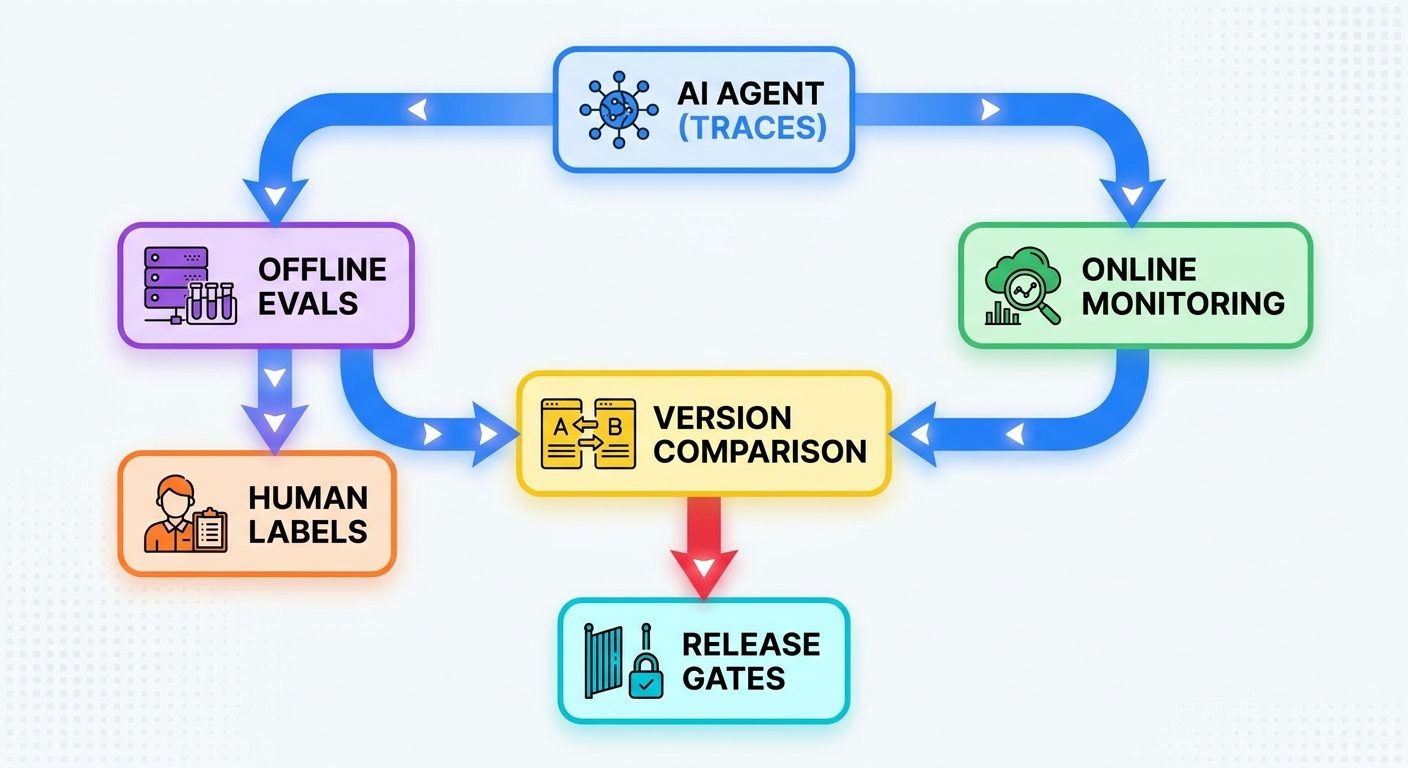
The most important point is that agent metrics must measure the whole run, not only the final text. A chatbot can be judged mostly by the response it gives. An agent takes actions. It may choose tools, call APIs, search documents, update records, request approval, retry after failure, and hand work back to a human. A final answer can look confident while the trajectory behind it was wasteful, unsafe, or wrong. That is why a production scorecard needs traces, eval datasets, online monitoring, and human labels working together.
This article is a cluster guide supporting the broader Singularity Journey pillar on AI agent observability. The pillar explains how to trace, evaluate, and debug production agents. This guide narrows in on the metric layer: what to measure, how to interpret it, and which numbers should block a release before agent usage scales.
Why AI Agents Need Different Evaluation Metrics Than Normal LLM Apps
Traditional software evaluation often starts with deterministic checks: unit tests pass, API responses match schemas, latency stays below a threshold, and error rates remain acceptable. LLM applications add non-determinism. Agentic systems add something more difficult: multi-step decision paths. The agent might be correct at one step and wrong later. It might choose the right tool with the wrong arguments. It might retrieve the right source and still summarize it badly. It might ask a human for approval when it should, or skip approval when the action is sensitive.
That means a single “accuracy” number is not enough. Accuracy of what? The final answer? The selected tool? The JSON arguments? The retrieved evidence? The safety classifier? The human handoff? The completed business outcome? In production, all of those can matter. A support-ticket agent that answers accurately but fails to escalate billing disputes is not reliable. A research agent that cites relevant sources but leaks private notes into a prompt is not safe. A coding agent that fixes a test but rewrites unrelated files is not controlled.
Good agent evaluation is therefore layered. At the bottom, you measure system health: latency, token use, model errors, timeout rates, retry rates, and cost. In the middle, you measure trajectory quality: planning steps, tool selection, argument validity, retrieval quality, memory use, approval behavior, and recovery from failed calls. At the top, you measure outcome quality: did the user’s job get done, was it correct, was it safe, and did a human need to repair it?
OpenTelemetry’s GenAI semantic conventions are useful because they push teams toward structured telemetry for model and agent activity instead of random console logs. LangSmith’s evaluation concepts make a practical distinction between offline evaluations on curated examples and online evaluations on production runs. Arize Phoenix describes the same operating need from an observability angle: traces show what happened, evals score quality, and experiments compare changes. NIST’s AI Risk Management Framework reinforces the governance side: measurement and monitoring are part of managing AI risk, not an optional dashboard decoration.
The data gap in many agent articles is that they jump from “use evals” to “monitor traces” without giving teams a scorecard. This guide fills that gap with a concrete taxonomy you can adapt to your own agent.
The Production AI Agent Evaluation Scorecard
Use this table as a starting point. Do not copy thresholds blindly. The right target depends on risk, domain, user expectations, and the cost of a wrong action. A scheduling assistant, medical triage assistant, coding agent, finance workflow agent, and internal knowledge-base agent should not share the same release bar. Still, the metric categories are surprisingly reusable.
| Metric | What it measures | How to collect it | Release question |
|---|---|---|---|
| Task success rate | Whether the full agent run solved the intended user job. | Golden datasets, human labels, production feedback, outcome checks. | Does the agent complete enough real tasks to justify scaling? |
| Tool-call accuracy | Whether the agent chose the correct tool at the correct step. | Trace review, labeled trajectories, expected-tool assertions. | Does the agent know when to search, write, escalate, or stop? |
| Argument validity | Whether tool inputs follow schema and contain correct values. | Schema validation, API errors, test fixtures, trace attributes. | Can the agent call tools without breaking workflows? |
| Grounding score | Whether answers are supported by retrieved or provided evidence. | Retrieval evals, citation checks, human review, LLM-as-judge with calibration. | Is the agent inventing facts or staying anchored? |
| Safety violation rate | Unsafe, disallowed, privacy-risky, or policy-breaking behavior. | Safety classifiers, red-team sets, human audits, incident reports. | Is the failure rate acceptable for the risk level? |
| Human override rate | How often reviewers reject, edit, or reverse agent decisions. | Approval queues, reviewer labels, diff audits. | Is the agent reducing work or moving work to cleanup? |
| Escalation quality | Whether the agent asks for human help at the right time with useful context. | Handoff reviews, missing-approval incidents, reviewer surveys. | Does the agent know its limits? |
| Latency to useful result | How long it takes to produce a usable answer or completed action. | Traces, spans, model timings, queue metrics. | Is the agent fast enough for the user workflow? |
| Cost per successful task | Total model/tool cost divided by completed useful outcomes. | Token usage, provider billing, trace metadata, business outcome labels. | Is automation economically better than manual work? |
| Regression rate | How often a new prompt, model, tool, or retrieval change breaks old behavior. | Offline eval suites, canary monitoring, version comparisons. | Can the team ship changes without silent quality loss? |
The table matters because it prevents metric theater. A team can show a low API error rate while the agent still chooses the wrong tool. It can show a high answer-quality score while human reviewers quietly rewrite half the outputs. It can show strong offline results while online production traffic exposes edge cases the dataset never captured. A good scorecard forces the team to compare system reliability, user value, safety, and economics together.
Offline Evals vs Online Monitoring: Use Both or You Will Miss Failures
Offline evaluations are tests you run before deployment. They use curated examples: prompts, documents, expected tool calls, reference answers, expected refusal cases, and known failure scenarios. They are excellent for regression testing. If you change the system prompt, swap a model, modify a tool schema, update a retrieval index, or alter memory behavior, offline evals tell you whether old behavior broke before users are exposed.
Online monitoring watches production runs. It answers different questions: which real inputs are failing, where latency spikes, which tools produce errors, where users abandon the flow, where human reviewers override the agent, and whether drift is appearing in new traffic. Online evals can use automated scoring, human feedback, sampling, and anomaly detection. They are less controlled than offline tests but much closer to reality.
The mistake is choosing only one. Offline evals without online monitoring create a lab illusion: the agent performs well on examples the team already imagined. Online monitoring without offline evals creates a firefighting loop: the team sees failures after release but lacks a stable gate to prevent recurrence. The mature loop is simple: production failures become labeled examples; labeled examples become offline evals; offline evals become release gates; release gates are checked again after deployment with online monitoring.
For agent teams, every important incident should leave behind a reusable eval. If an agent selected the wrong CRM action, add that trajectory to the dataset. If it hallucinated a policy detail, add the document and expected grounded answer. If it skipped approval for a risky refund, add the scenario and require the approval span. This is how observability turns into engineering memory.
Tool-Call Metrics: The Agent-Specific Layer Most Teams Undermeasure
Tool use is where agents become useful and dangerous. A tool call can read private data, send a message, change a database record, create a pull request, charge a customer, or trigger an external workflow. Measuring final answer quality is not enough because the agent’s action path can create damage before the final answer appears.
Start with tool selection accuracy. Given the user request and available tools, did the agent choose the correct tool? This can be measured with labeled trajectories in offline evals and sampled production reviews. Next measure argument validity. Did the tool input follow schema? Were required fields present? Did dates, IDs, amounts, email addresses, paths, and filters match the user request? Schema validation catches format errors, but semantic validation catches wrong values.
Then measure tool outcome quality. A successful HTTP response does not mean the action was appropriate. A CRM update might return 200 while changing the wrong contact. A code search might return results while missing the relevant file. A calendar tool might create an event with the wrong timezone. Your eval should distinguish transport success from task success.
| Tool metric | Bad version | Better version |
|---|---|---|
| API success rate | “The endpoint returned 200.” | “The endpoint returned 200 and the updated object matched the intended user-approved change.” |
| Tool selection | “The agent used a tool.” | “The agent used the least-privileged correct tool and did not call unrelated tools.” |
| Arguments | “JSON parsed.” | “JSON parsed, schema passed, values matched the request, and sensitive fields were redacted where required.” |
| Retries | “The agent recovered eventually.” | “The agent retried within a limit, changed strategy appropriately, and escalated when uncertainty remained.” |
Also track unnecessary tool calls. Agents that over-search, over-read, or over-edit increase cost and risk. In many systems, the quality target is not “use more tools”; it is “use the smallest safe action path that completes the job.” This is where cost per successful task becomes a quality metric, not only a finance metric.
Retrieval, Memory, and Grounding Metrics
Many production agents rely on retrieval or memory. They search policy documents, support tickets, knowledge bases, code repositories, vector stores, customer records, or prior conversation history. If retrieval is weak, the model may answer from stale context or invent missing facts. If memory is weak, the agent may personalize incorrectly, leak information between users, or carry old assumptions into a new task.
Measure retrieval at three levels. First, retrieval relevance: did the system fetch documents that actually support the task? Second, answer grounding: did the final output use those documents correctly? Third, citation usefulness: can a human reviewer inspect the cited evidence and confirm the claim quickly? These metrics are related but not identical. A retriever can return the right document while the model ignores it. A model can cite a document while making a claim the document does not support.
Memory metrics need a slightly different mindset. Useful memory should improve continuity without becoming uncontrolled hidden context. Track memory hit rate, memory precision, stale-memory incidents, privacy boundary violations, and user correction rate. If users frequently say “that is not what I meant” or reviewers find the agent relying on old state, the memory layer needs evaluation, not just more storage.
For grounded agents, hallucination rate should be defined narrowly. Do not only ask whether the prose sounds factual. Ask whether each operational claim is supported by approved context. In high-risk workflows, require the answer to include source IDs, retrieved document versions, or a traceable evidence span. That lets reviewers debug failures without reconstructing the entire run from memory.
Safety, Cost, and Latency Are Product Metrics Too
Some teams treat safety, cost, and latency as secondary engineering concerns after accuracy. For agents, that is risky. A highly accurate agent that takes too long will not fit the workflow. A cheap agent that requires constant human cleanup is not actually cheap. A fast agent that occasionally takes unsafe actions should not be trusted with more autonomy.
Safety metrics should be specific to the agent’s permissions. If the agent can only summarize public documents, safety measurement may focus on hallucination, misleading advice, or policy-violating content. If the agent can send emails, update systems, or trigger workflows, safety measurement must include unauthorized action attempts, missing approvals, privacy leaks, prompt injection susceptibility, and least-privilege tool behavior.
Cost metrics should be outcome-based. Token cost per run is useful, but cost per successful task is better. If one model costs twice as much but cuts human review time by 70 percent, it may be the cheaper system overall. If a cheaper model creates more retries and escalations, the apparent savings disappear. Track model cost, tool cost, review time, failure recovery time, and user abandonment together.
Latency also needs context. A background research agent may be allowed to take minutes. A customer-support agent may need a useful first response in seconds. A coding agent may be acceptable if it takes longer but produces a clean patch and test plan. Measure latency to first useful result, total task duration, queue time, model time, tool time, and human approval waiting time separately. That separation tells you what to optimize.
Human Review Metrics: Measure Judgment, Not Just Approval Volume
Human-in-the-loop systems often produce misleading metrics. A high approval rate might mean the agent is excellent. It might also mean reviewers are rubber-stamping. A low approval rate might mean the agent is bad. It might also mean the agent is correctly escalating difficult cases. You need review metrics that capture judgment quality.
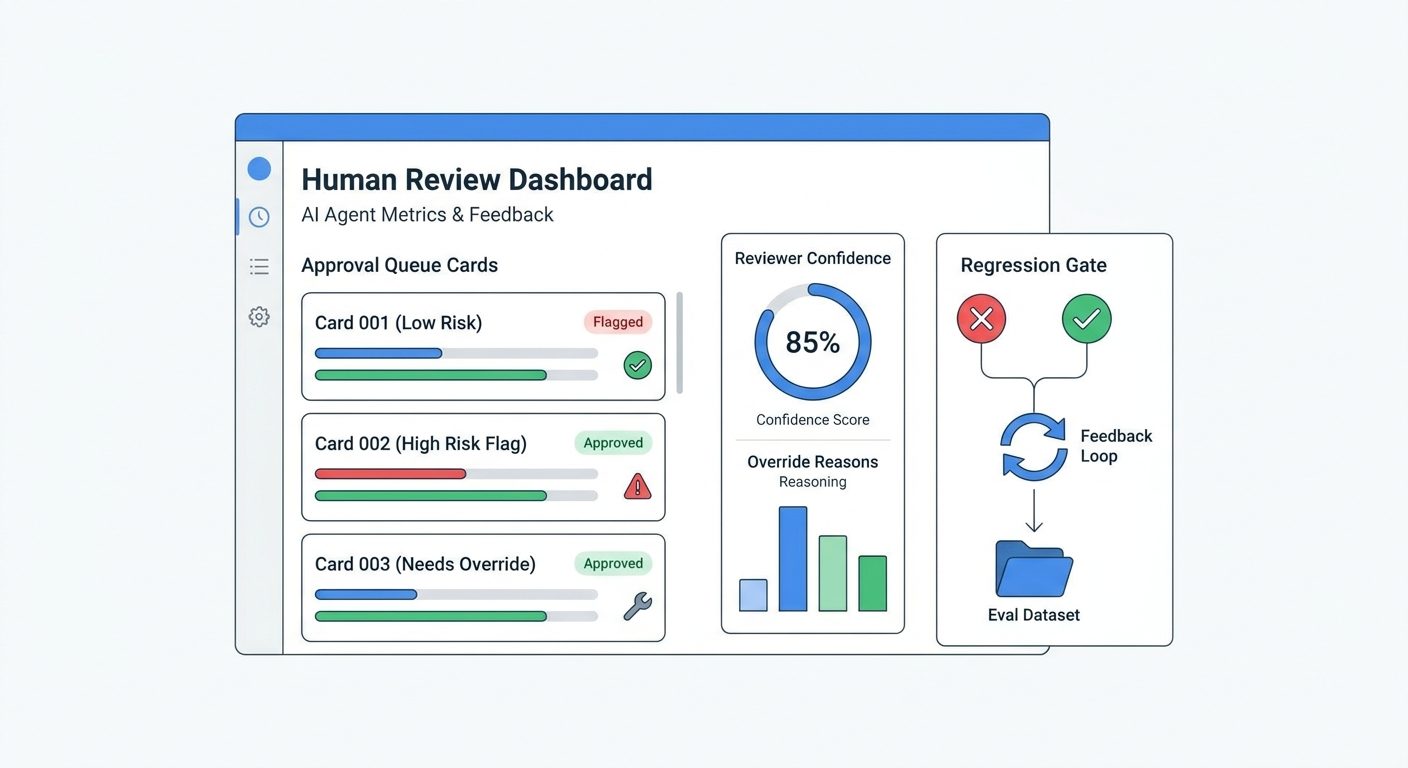
Track approval rate, edit distance, override reason, reviewer confidence, disagreement between reviewers, time to review, and post-approval incident rate. If reviewers approve outputs quickly but incidents still happen, the approval UI may be hiding important trace context. If reviewers spend too long on every item, the agent may not be packaging decisions well. If reviewers disagree often, the policy itself may be ambiguous.
A useful human review queue should show the task, agent plan, key evidence, tool calls, risk flags, suggested action, and the exact decision requested from the reviewer. The evaluation metric is not merely whether a human clicked approve. It is whether the handoff helped a human make a better decision faster.
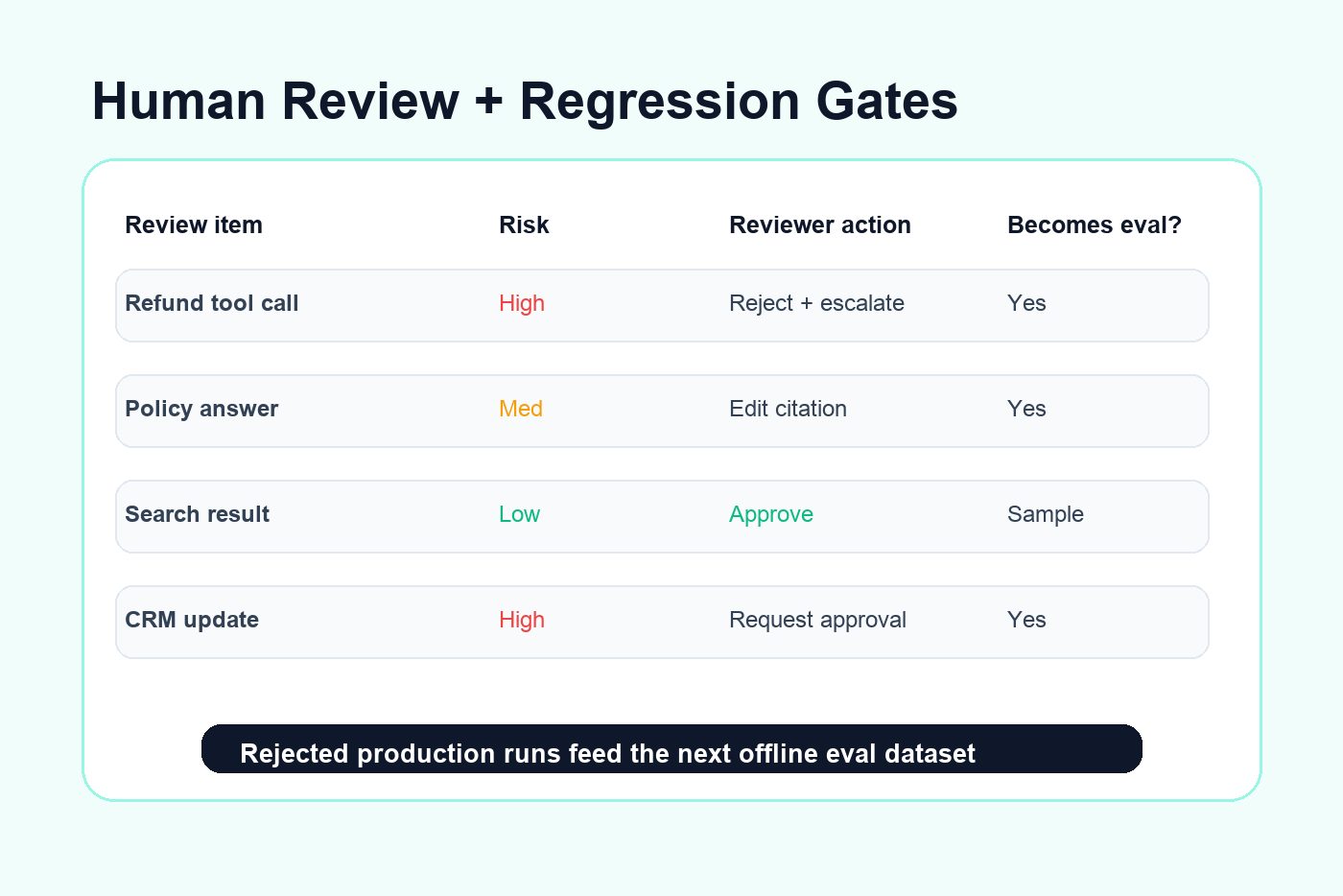
Over time, human review should feed the eval dataset. Every rejected output should become a training signal for the evaluation process: wrong tool, missing evidence, risky action, bad tone, policy ambiguity, stale memory, or unclear handoff. The goal is not to remove humans from the loop as fast as possible. The goal is to learn which parts of the loop can safely become more automated and which parts still need human judgment.
Release Gates: Which Metrics Should Block an Agent Change?
An agent release gate is a rule that says a change cannot ship unless key metrics stay within acceptable bounds. The change might be a new prompt, model, tool, retrieval index, memory policy, routing rule, or UI workflow. Without release gates, agent teams rely on vibes: the demo looked better, the new model felt smarter, or a few examples passed. That is not enough for production.
A practical release gate combines offline eval results, safety checks, performance metrics, and manual review of sampled traces. For low-risk internal agents, the gate can be lightweight. For agents with external actions or sensitive data, the gate should be strict. The key is to define the gate before the team is excited about a new change.
| Gate | Example release rule | Why it matters |
|---|---|---|
| Regression gate | No critical eval category drops below the previous production version. | Prevents silent breakage of known important behaviors. |
| Safety gate | Zero critical policy violations in red-team and approval-bypass tests. | Blocks changes that increase unacceptable risk. |
| Tool gate | Tool selection and argument validity remain above the team-defined threshold. | Protects external actions from sloppy autonomy. |
| Grounding gate | Claims in evidence-required tasks must be supported by retrieved sources. | Reduces hallucinated operational guidance. |
| Cost gate | Cost per successful task cannot rise beyond an approved budget band. | Prevents quality improvements that are economically unsustainable. |
| Latency gate | Latency to useful result stays within the workflow’s user expectation. | Keeps the agent usable in context. |
These gates should not be universal constants. A tiny internal documentation assistant may tolerate lower precision if it never takes action and clearly cites sources. A refund-processing agent needs strict approval, audit, and tool constraints. A coding agent may require test-pass rate, diff size, touched-file limits, and security scan checks. Evaluation metrics should follow permission level.
After release, use canary monitoring. Send a small slice of traffic to the new version, compare outcomes against the old version, review traces, watch human overrides, and roll back quickly if key metrics degrade. Agents are too dynamic for “ship and forget.” Release is the beginning of evaluation, not the end.
How to Implement AI Agent Evaluation Metrics Without Freezing Development
You do not need a perfect eval platform on day one. Start with the smallest loop that creates evidence. Instrument traces for model calls, tool calls, retrieval, approvals, errors, latency, and token usage. Create a spreadsheet or dataset with twenty representative tasks. Label expected outcome, expected tool behavior, safety constraints, and unacceptable failure modes. Run every agent change against that set before release.
Next, add production sampling. Review a small percentage of real runs each week. Label failures by category: instruction misunderstanding, retrieval miss, wrong tool, bad arguments, unsafe action, poor escalation, latency, cost spike, memory issue, or unclear UI. Turn the most important failures into offline eval examples. This creates the feedback loop that many teams skip.
Then connect metrics to ownership. Each metric needs a person or team that cares. Tool-call errors may belong to the platform team. Retrieval relevance may belong to the knowledge team. Safety violations may belong to product and governance. Human review friction may belong to operations. If every metric is everyone’s job, the scorecard becomes a museum.
Finally, keep the scorecard visible but not bloated. Ten reliable metrics are better than fifty ignored ones. Every metric should help answer a release, debugging, or investment question. If no one will act on a metric, remove it or downgrade it to an exploratory report.
Good evaluation habits
- Trace every important step, not only the final response.
- Separate task success from tool success and API success.
- Convert production failures into offline evals.
- Use human labels for subtle judgment calls.
- Version prompts, tools, models, and datasets together.
Evaluation traps
- Optimizing for a single LLM-as-judge score.
- Ignoring human override reasons.
- Measuring cost per run instead of cost per successful task.
- Letting eval datasets grow stale.
- Shipping prompt changes without regression checks.
Build the Rest of the Agent Reliability Loop
Evaluation metrics work best when they are connected to the rest of your production observability system. Start with the broader guide to AI agent observability, then use the supporting Singularity Journey guides below to strengthen specific parts of the loop.
- AI Agent Test Cases — build golden datasets, rubrics, and failure scenarios.
- AI Agent Failure Taxonomy — classify tool, context, model, memory, and handoff bugs.
- AI Agent Tool Context — design schemas, results, and approvals that keep agents reliable.
- Human Approval for AI Agents — decide when to ask, what to review, and how to escalate.
Sources and References
- OpenTelemetry: Generative AI semantic conventions
- OpenTelemetry GenAI semantic conventions repository
- LangSmith: Evaluation concepts
- Arize Phoenix: AI observability and evaluation
- NIST AI Risk Management Framework
- OpenAI: Working with evals
External sources were used for concepts, terminology, and implementation context. This article avoids unsupported benchmark claims and treats example thresholds as patterns teams must calibrate for their own risk level.
FAQ: AI Agent Evaluation Metrics
What are the most important AI agent evaluation metrics?
The most important metrics are task success rate, tool-call accuracy, argument validity, retrieval relevance, grounded answer quality, safety violation rate, human override rate, latency, cost per successful task, and regression rate after changes.
How are AI agent metrics different from chatbot metrics?
Chatbot metrics often focus on answer quality. Agent metrics must also evaluate the action path: tool choice, arguments, retrieval, memory, approvals, retries, escalation, and whether the completed workflow was safe and useful.
What is the difference between offline and online evals?
Offline evals test curated examples before release. Online evals monitor real production traces, user behavior, human overrides, and new edge cases after deployment. Production teams need both.
How do you measure tool-call accuracy?
Label expected tools for representative tasks, compare the agent’s chosen tools and arguments against those labels, validate schema and semantic correctness, and review sampled production traces for unnecessary or unsafe calls.
Can LLM-as-judge metrics be trusted?
They can help, especially for scalable review, but they should be calibrated with human labels, tested for bias, and combined with deterministic checks, trace evidence, and outcome metrics. Do not rely on one judge score alone.
Which metrics should block an AI agent release?
Critical safety violations, major regression drops, poor tool argument validity, unacceptable grounding failures, missing approval behavior, unsustainable cost increases, and latency outside the workflow’s tolerance should block release until investigated.
How often should an eval dataset be updated?
Update it whenever production failures, new tools, new policies, new user intents, or model changes reveal important gaps. A stale eval dataset gives false confidence.
What is cost per successful task?
It is the total cost of model calls, tools, retries, and review effort divided by tasks that were actually completed successfully. It is more useful than cost per run because failed runs still consume resources.
