
AI Agent Canary Rollout Checklist: Release Safely With Evals, Traces, and Rollbacks
A practical release-room checklist for shipping AI agents in controlled canary stages, using eval evidence, production traces, cohort limits, rollback triggers, and human approval before broader rollout.
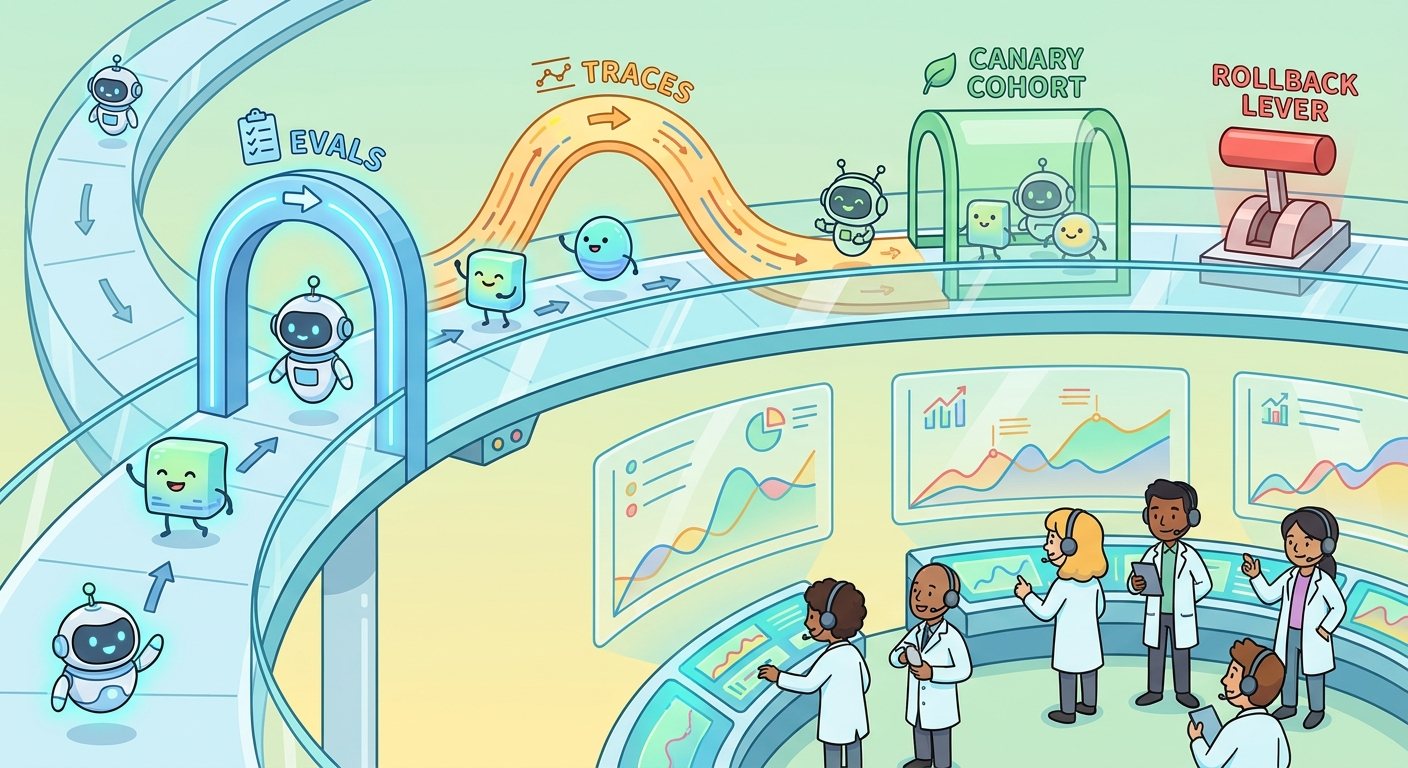
AI Agent Canary Rollout: The Quick Answer
An AI agent canary rollout is a staged release where a new or changed agent is exposed to a limited, monitored slice of real work before it is allowed to serve everyone. The goal is not simply to copy a normal software canary. AI agents are probabilistic, tool-using systems. They can pass unit tests and still fail because a user asks an unexpected question, a tool returns messy data, a prompt creates a risky action, or a model upgrade changes behavior in a subtle way.
The safest version of the rollout is evidence driven. Before the canary starts, the team agrees on eval gates, trace requirements, cohort limits, alert thresholds, and rollback owners. During the canary, the team watches both product metrics and agent-specific signals: task completion, tool-call accuracy, refusal behavior, retrieval grounding, latency, cost, policy hits, handoff rate, and user complaints. After the canary, the team either expands exposure, pauses for investigation, or rolls back to the previous stable agent.
This cluster guide supports the broader AI agent deployment pipeline pillar. The pillar explains the whole path from evals to tracing to rollback. This article goes narrower: it gives the practical checklist for the release window itself, where a team decides whether a new agent earns more traffic or gets stopped before it causes real damage.
Why AI Agent Canary Releases Are Different From Normal Software Canaries
Traditional canary deployment is already a mature software release pattern. You ship a new version to a small group, compare metrics against the old version, then expand or roll back. That logic still applies, but AI agents add new failure modes. A normal service usually fails through exceptions, latency, bad state, or incorrect deterministic logic. An AI agent can fail while still looking conversationally confident. It may choose the wrong tool, skip a needed confirmation, cite irrelevant context, over-compress instructions, or complete the wrong task beautifully.
That is why an agent canary needs more than uptime. You need quality signals, safety signals, trace evidence, and reviewer judgment. Official platform documentation points in this direction. OpenAI describes evals as a way to test model outputs against specified criteria and improve from results. LangSmith describes traces as records of what agents did in production and a basis for debugging, monitoring, and evaluation datasets. Microsoft Foundry describes generative AI observability as a lifecycle capability that connects evaluation, tracing, monitoring, logs, model outputs, safety, and operational health. Those are not separate chores. In a real release, they become one decision system.
The practical shift is simple: the canary is not just “send five percent of traffic.” It is “send a controlled amount of suitable work, collect enough evidence, and stop automatically or manually when predefined signals cross the line.” For AI agents, a clean rollback is not a failure of engineering pride. It is proof that the release system works.
| Release concern | Normal software canary | AI agent canary |
|---|---|---|
| Primary correctness signal | Errors, latency, request success, business metrics. | Task success, tool accuracy, grounded answers, policy compliance, human review outcomes, plus normal service metrics. |
| Failure visibility | Often visible in logs, exceptions, alerts, or broken UI. | May hide inside plausible language, partial task completion, silent tool misuse, or low-quality reasoning. |
| Rollback reason | Crash, regression, poor performance, high error rate. | Unsafe autonomy, low answer quality, wrong tool use, high escalation, bad traces, cost spike, policy violations, or user harm risk. |
| Human role | Approves deployment and reviews incidents. | Approves risky actions, samples traces, reviews ambiguous outputs, and owns rollback decisions. |
Pre-Canary Entry Gates: What Must Be True Before Any User Sees the Agent
The easiest mistake is starting a canary because the code merged and the demo looked good. For an AI agent, the entry gate should be stricter. The team should prove that the agent is eligible for exposure before it touches live users or production tasks. Eligibility does not mean the system is perfect. It means the team has enough offline evidence, observability, and controls to learn safely from a limited release.
Start with a written release note. It should say what changed, which model or prompt version is being shipped, which tools are enabled, what data the agent can access, what autonomy level is allowed, and what user cohort will see it. If no one can describe the change in plain language, the rollout is not ready. Vague changes create vague monitoring, and vague monitoring creates delayed rollback.
Next, require an evaluation baseline. The baseline should include golden tasks, adversarial or edge-case prompts, regression cases from previous incidents, and domain-specific success criteria. Do not invent a universal passing score. A customer-support triage agent, code-review assistant, research agent, and finance workflow agent need different thresholds. What matters is that the team defines the threshold before seeing canary results. Moving the goalposts during release is how weak launches become “probably fine.”
Finally, check observability. Every canary task should have trace IDs, prompt and response versioning, tool-call records, latency, cost, selected model, retrieved context when relevant, policy events, escalation state, and final outcome. If the agent can act without a trace, it should not be in a canary. You cannot roll back intelligently from evidence you did not collect.
How to Design the Canary Cohort Without Pretending One Percentage Fits Every Agent
Many teams look for a magic rollout percentage. That is understandable, but it is the wrong first question. A safe AI agent canary is not only about how many users are exposed. It is about which tasks are exposed, how risky those tasks are, whether actions are reversible, and how quickly reviewers can inspect traces. A tiny cohort doing high-impact work can be riskier than a larger cohort using the agent for low-risk suggestions.
Design the cohort around risk tiers. Tier one is read-only assistance: summarization, classification suggestions, draft responses, research notes, or recommendations that a human must approve. Tier two is bounded action: the agent can update low-risk records, create tickets, route tasks, or call tools inside tight limits. Tier three is consequential action: money movement, account changes, legal claims, medical advice, infrastructure changes, security decisions, or anything that can harm a user if wrong. Most new agents should prove themselves in tier one before moving upward.
The cohort should also match the agent’s likely real workload. If you only test friendly internal users, the canary may miss confusing language, messy inputs, unusual edge cases, and impatient behavior. But if you start with your most complex users, you may learn too violently. A good cohort is representative enough to reveal real behavior and contained enough to survive mistakes.
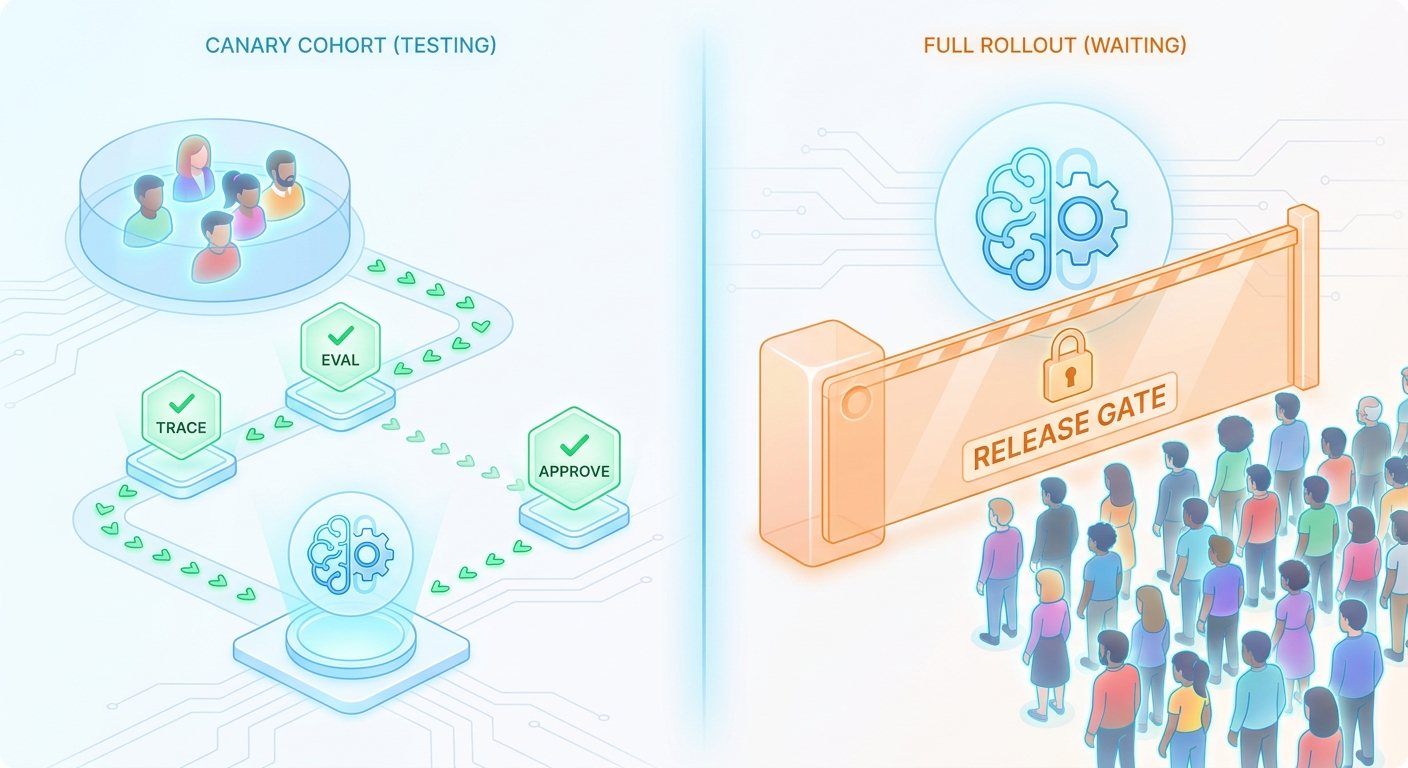
One practical pattern is a three-ring release. Ring one is internal or staff-supervised use. Ring two is a small external cohort with low-impact tasks and visible support paths. Ring three is broader exposure after the first two rings show stable metrics, clean traces, and acceptable reviewer outcomes. The rings do not need fixed percentages. They need explicit promotion rules. For example: expand only when task success is stable, severe policy hits are zero, rollback triggers are quiet, sampled traces show no repeated failure mode, and the release owner signs off.
The AI Agent Canary Evidence Package
A canary produces lots of noise unless the team decides what evidence matters. The evidence package is the release-room artifact that turns scattered dashboards into a decision. It should be small enough to review quickly and complete enough to defend the decision later. If the agent expands and something breaks, the package shows why the expansion looked reasonable. If the team rolls back, it shows which signal triggered the stop.
The evidence package should contain four layers. The first layer is offline evidence: eval results, known limitations, prompt/model diffs, and test coverage notes. The second layer is live telemetry: traces, tool calls, latency, cost, model errors, retrieval results, and operational health. The third layer is quality review: human sample ratings, failed task summaries, policy or safety events, and customer-impact notes. The fourth layer is release judgment: continue, pause, roll back, or expand, with the named owner and timestamp.
| Evidence item | Why it matters | Decision question |
|---|---|---|
| Eval baseline and canary comparison | Shows whether live behavior matches the test suite or exposes a gap. | Did production reveal a failure that offline evals missed? |
| Trace samples | Shows how the agent reasoned, which tools it called, and where it drifted. | Can reviewers explain the agent’s action path? |
| Tool-call accuracy | Captures whether the agent chose correct tools, arguments, and sequence. | Are bad outputs coming from reasoning, retrieval, tools, or permissions? |
| Human review outcomes | Separates automatic metrics from expert judgment. | Would a responsible reviewer approve these actions? |
| User and support signals | Finds confusion or harm that dashboards may miss. | Are users correcting, abandoning, escalating, or complaining more than expected? |
| Cost and latency | Confirms the agent is operationally sustainable. | Is the new behavior too slow or expensive for the value it creates? |
This artifact also helps future eval design. Every canary failure should become a new test case, a stronger policy check, a clearer tool schema, or a better trace dashboard. That is how teams move from launch anxiety to release learning.
Rollback Triggers: When to Stop an AI Agent Release
Rollback triggers must be written before launch. If they are negotiated during an incident, optimism and politics will blur the line. The release owner should know exactly which signals stop expansion, which signals pause for investigation, and which signals require immediate rollback. For high-impact agents, some triggers should be automatic: disable a tool, reduce autonomy, route to human review, or revert the prompt/model version.
The most serious triggers are safety and authority failures. If the agent takes an action outside its allowed scope, skips a required approval, exposes sensitive data, invents a policy, or gives dangerous instructions in a context where users may rely on it, the rollout should stop. Do not wait for statistical significance when the failure mode is severe. Statistical thinking is useful for product metrics; it is not a permission slip for preventable harm.
Quality triggers are more nuanced. A single low-quality answer may not justify rollback if the task is low impact and easy to correct. A repeated pattern does. Watch for clusters: the agent repeatedly misreads a tool result, retrieves irrelevant context, refuses valid tasks, completes partial work without saying so, or asks users for information it already has. Trace clusters are especially valuable because they reveal mechanism, not just outcome.
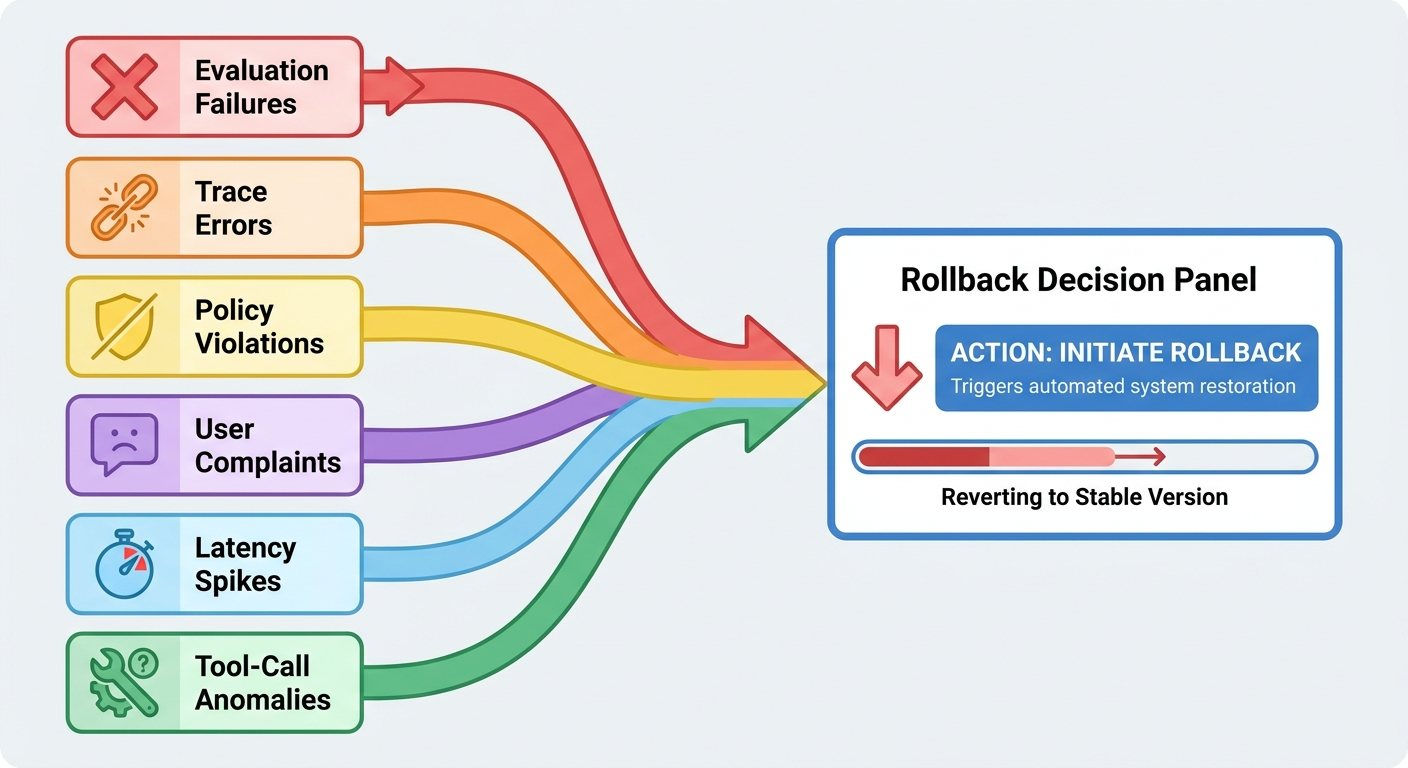
| Signal | Pause | Rollback |
|---|---|---|
| Eval regression | One important scenario drops below threshold but is contained. | Core task family regresses or previous incident cases fail again. |
| Trace anomaly | Unclear reasoning path or unexplained tool sequence appears in samples. | Repeated wrong tool use, missing approval, or hidden action path. |
| Policy event | Recoverable policy warning with no user impact. | Severe policy violation, unsafe instruction, data exposure, or scope breach. |
| User friction | Higher confusion, correction, or escalation than expected. | Clear user harm, repeated abandonment, or support load spike tied to the agent. |
| Operational health | Latency or cost rises but remains within temporary tolerance. | Timeouts, runaway loops, tool retries, or cost spikes threaten reliability. |
| Human review | Reviewers disagree on a small set of ambiguous outputs. | Reviewers consistently reject or rewrite the agent’s work. |
Run the Canary Like a Release Room, Not a Background Experiment
For important agents, the first canary window deserves an explicit release room. That does not mean everyone sits in a war room all day. It means the team knows who is watching what, how decisions are made, and where evidence is recorded. A release room can be a lightweight shared doc, dashboard, chat channel, and owner list. The point is to prevent diffusion of responsibility.
The release owner should watch the decision dashboard. An engineer should watch traces and tool failures. A product or domain reviewer should sample task quality. A support or operations person should watch user complaints and escalations. Security or compliance should be on call if the agent touches sensitive data, permissions, regulated content, or consequential actions. Everyone should know the rollback path and the exact command, feature flag, prompt version, or model setting that restores the previous stable state.
Keep the canary window short enough to learn and long enough to see real behavior. If the agent runs only during a quiet hour, it may not see realistic input. If the canary runs unattended for days, problems may accumulate. The right window depends on traffic and risk, but the habit is universal: schedule check-ins around evidence, not around vibes. The release question is not “does anyone feel nervous?” It is “what does the evidence say against our prewritten gate criteria?”
AI Agent Canary Rollout Checklist
Use this checklist as a practical starting point. Adapt it to your risk level, domain, and platform. A low-risk internal writing assistant does not need the same gate as an agent that updates customer records or executes infrastructure actions. The checklist is intentionally evidence-oriented so it works across stacks.
Before launch
- Define the change: model, prompt, tools, permissions, data sources, autonomy level, and expected user impact.
- Confirm the source deployment pipeline has passed build, security, eval, and trace instrumentation gates.
- Run golden-task evals, regression tests from previous incidents, and edge-case prompts relevant to the agent’s domain.
- Set written thresholds for continue, pause, rollback, and expansion.
- Verify that all agent runs include trace IDs, tool-call logs, prompt/model version, latency, cost, policy events, and outcome status.
- Limit the canary to suitable users, low-risk tasks, or reversible actions first.
- Name a release owner with authority to pause or roll back.
- Verify the previous stable version can be restored quickly.
During launch
- Watch task completion, tool-call accuracy, refusals, policy hits, handoffs, latency, cost, and user reports.
- Sample traces manually, especially for failed, escalated, expensive, or unusually long sessions.
- Compare live behavior with offline eval assumptions.
- Record every pause, mitigation, and reviewer decision in the evidence package.
- Do not expand exposure until the prewritten promotion criteria are met.
After launch
- Convert canary failures into new eval cases.
- Update prompts, tool schemas, permission boundaries, or review policies based on trace evidence.
- Decide whether to expand, hold, or roll back with a written reason.
- Link the release decision back to the broader deployment record so future teams can learn from it.
Canary Decision Helper
This simple helper is not a substitute for your release process. It is a thinking aid for deciding whether a canary should expand, pause, or roll back based on risk indicators. Use it during planning to make sure the team is not ignoring obvious warning signs.
Common Mistakes That Make AI Agent Canaries Unsafe
The first mistake is relying on offline evals alone. Evals are essential, but they are not the same as production reality. Real users bring messy instructions, unexpected context, stale records, tool errors, emotional pressure, and domain ambiguity. A canary exists because offline testing is incomplete. If your team treats evals as a launch certificate rather than a release input, the canary will be under-monitored.
The second mistake is watching only aggregate metrics. Averages hide catastrophic edge cases. If task success looks fine but trace samples reveal the agent sometimes skips approval, that is a rollback-class issue. For AI agents, qualitative trace review is not optional. It is how teams catch plausible but wrong behavior before it becomes normalized.
The third mistake is expanding because no one complained. Users often do not know when an AI system is subtly wrong. They may accept a confident answer, manually fix the output without reporting it, or abandon the workflow. Combine explicit feedback with indirect signals: correction rate, manual override rate, escalation rate, repeat prompts, session length, and reviewer rejection.
The fourth mistake is lacking a rollback owner. If everyone can raise concerns but no one can stop the release, the process is theater. The release owner should be named, present for the critical window, and empowered to act.
Where This Fits in the Singularity Journey Agent Deployment Cluster
This article is intentionally narrow. It does not replace a full deployment process; it gives the canary execution layer. Use the AI agent deployment pipeline article as the hub for the full lifecycle: evals, traces, release gates, canaries, monitoring, and rollback. Then use the supporting articles below when you need deeper pieces of the system.
- AI Agent Evaluation Metrics — choose quality, safety, and operational metrics before release.
- OpenTelemetry for AI Agent Tracing — standardize telemetry so traces remain useful across tools.
- AI Agent Debugging Runbook — investigate failed tasks and trace anomalies after launch.
- Human Approval Gates for AI Agents — decide which actions need human sign-off before execution.
- Prompt Injection Guardrails for AI Agents — reduce tool and instruction hijacking risk.
Conclusion: A Good Canary Makes Rollback Boring
The purpose of an AI agent canary rollout is not to prove that the team was right. It is to learn safely before exposure gets large. Good canaries make rollback boring because the stop conditions are already written, the evidence is already visible, the owner is already named, and the previous version is already ready. That discipline matters more for agents than for many normal software releases because agent failures can be fluent, intermittent, and hard to notice from aggregate dashboards alone.
If you are building a production agent, start small. Define the change. Run evals. Instrument traces. Limit the cohort. Sample real sessions. Watch safety, quality, and operational signals together. Expand only when the evidence supports it. When the evidence does not support it, roll back quickly and turn the failure into a better eval, stronger guardrail, clearer tool contract, or more useful review policy.
That is the real promise of an AI agent deployment pipeline: not fearless automation, but disciplined automation. The team ships faster because it can see what the agent is doing, decide when it is safe, and stop the rollout before a small warning becomes a large incident.
Sources and References
- OpenAI documentation: Working with evals
- LangSmith documentation: Observability
- Microsoft Foundry documentation: Observability in Generative AI
- OpenTelemetry: Generative AI semantic conventions
- Google Cloud documentation: Gen AI evaluation service overview
Source links were selected from official or reputable documentation. No shortened URLs, suspicious redirects, or unrelated promotional links were included.
FAQ: AI Agent Canary Rollouts
What is an AI agent canary rollout?
An AI agent canary rollout is a staged release where a new or changed agent is exposed to a limited, monitored slice of real work before broader rollout. The team uses evals, traces, human review, and rollback triggers to decide whether to expand or stop.
Do evals replace canary releases for AI agents?
No. Evals are a pre-launch and regression signal, but production users create scenarios that offline tests miss. A canary tests the agent under controlled real-world conditions.
What should trigger rollback for an AI agent?
Severe policy violations, skipped approvals, sensitive data exposure, repeated wrong tool use, core eval regression, unsafe outputs, high reviewer rejection, or operational instability should trigger rollback or reduced autonomy.
How large should the first AI agent canary cohort be?
There is no universal percentage. Choose a cohort based on task risk, reversibility, reviewer capacity, and trace readiness. Start with low-impact or supervised work before expanding to higher-impact tasks.
Who should own an AI agent canary release?
One named release owner should have authority to expand, pause, or roll back. Engineers, domain reviewers, support, security, and compliance may contribute evidence, but decision authority must be clear.
What metrics matter during an AI agent canary?
Track task completion, tool-call accuracy, groundedness, refusals, policy hits, handoff rate, reviewer rejection, latency, cost, trace anomalies, user complaints, and normal service health.
