
AI Agent Failure Taxonomy: Classify Tool, Context, Model, Memory, and Handoff Bugs
Learn a practical AI agent failure taxonomy for classifying tool, context, model, memory, policy, cost, and human-handoff bugs from production traces.
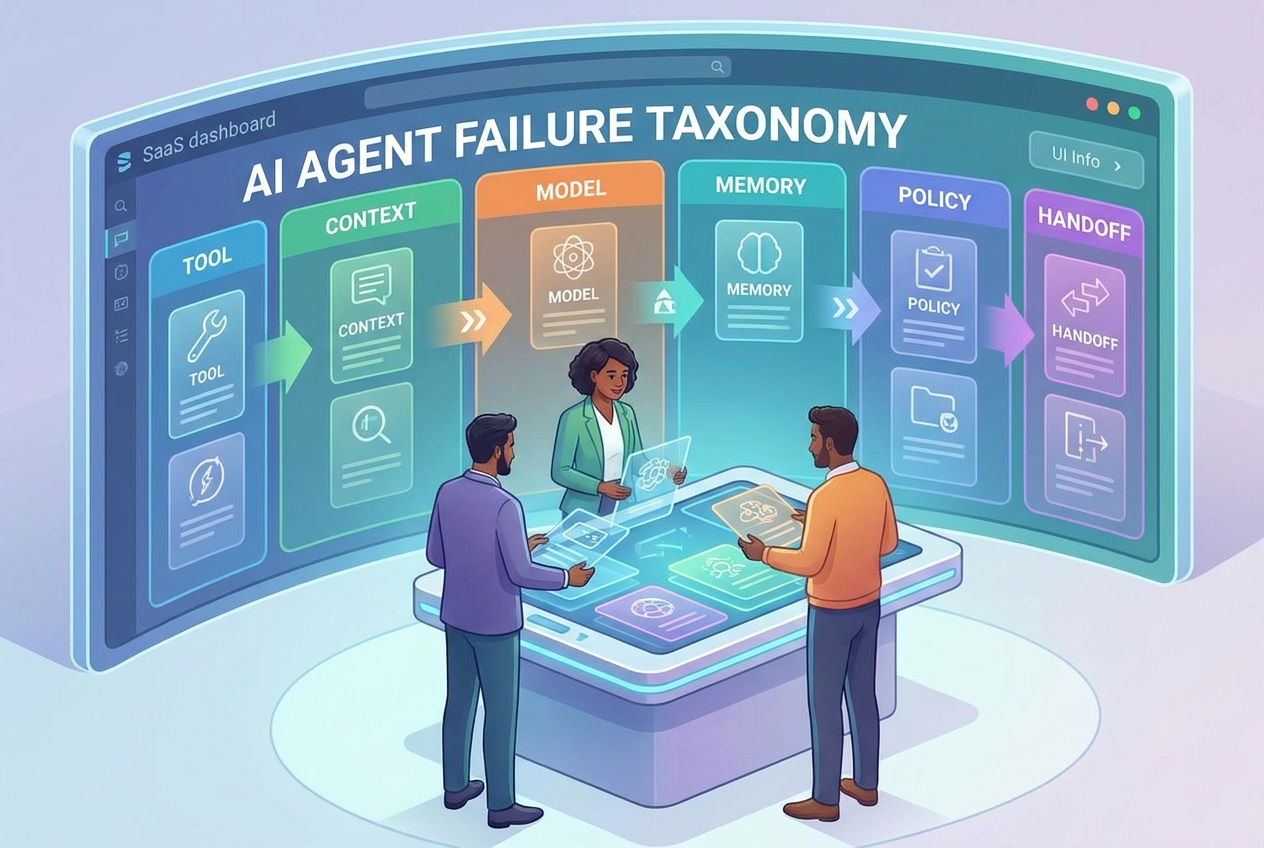
Quick Answer: What Is an AI Agent Failure Taxonomy?
An AI agent failure taxonomy is a shared set of labels developers use to classify why an agent run went wrong. It turns a messy trace into an actionable diagnosis: was the problem caused by the tool contract, the retrieved context, the model output, memory, policy, cost controls, orchestration, or a missing human handoff?
The source pillar on AI agent observability explains how to trace tool calls, costs, failures, and quality. This cluster article goes one level narrower. It assumes you already collect traces. The question now is: when a trace shows a bad run, what exact failure label should your team assign so the bug gets fixed by the right owner?
A good taxonomy helps teams avoid three expensive habits: arguing about vague incidents, fixing the wrong layer, and repeating the same failure because it never became an eval. The taxonomy below is designed for builders shipping agents that call tools, retrieve context, remember state, follow policies, and sometimes ask humans for approval.
Why Agent Failures Need Their Own Taxonomy
Traditional application monitoring usually starts with logs, metrics, errors, and traces. That still matters. But AI agents add a second layer of uncertainty. They do not only execute deterministic code. They interpret goals, choose tools, format arguments, read retrieved context, reason over partial state, and decide whether to continue, stop, retry, or escalate.
That means the same user-visible symptom can have several root causes. A support agent that gives the wrong refund answer may have misunderstood a policy, retrieved an old document, called the billing API with a wrong account ID, ignored a failed tool response, or remembered stale context from an earlier conversation. Without taxonomy labels, the team sees “wrong answer.” With taxonomy labels, the team sees “context freshness failure” or “tool result interpretation failure.”
Observability platforms increasingly expose traces, token usage, exceptions, retrieved documents, prompts, parameters, and feedback. LangSmith describes observability as visibility from individual traces to production metrics, while Phoenix explains tracing as a way to capture the sequence of retrieval, model invocation, and response generation. OpenTelemetry’s GenAI work pushes the ecosystem toward common semantic conventions for AI spans. Those sources are useful, but instrumentation alone does not choose the failure class for you.
The taxonomy is the missing operational layer between telemetry and improvement. It lets product, engineering, security, support, and evaluation teams agree on what happened. That shared language makes dashboards more useful because each spike points toward a fix pattern instead of a vague pool of bad examples.
The Practical AI Agent Failure Taxonomy
Use this table as a starting point. The categories are intentionally plain. Your production system can add subclasses, but if the top-level labels are too clever, nobody will apply them consistently during incident review.
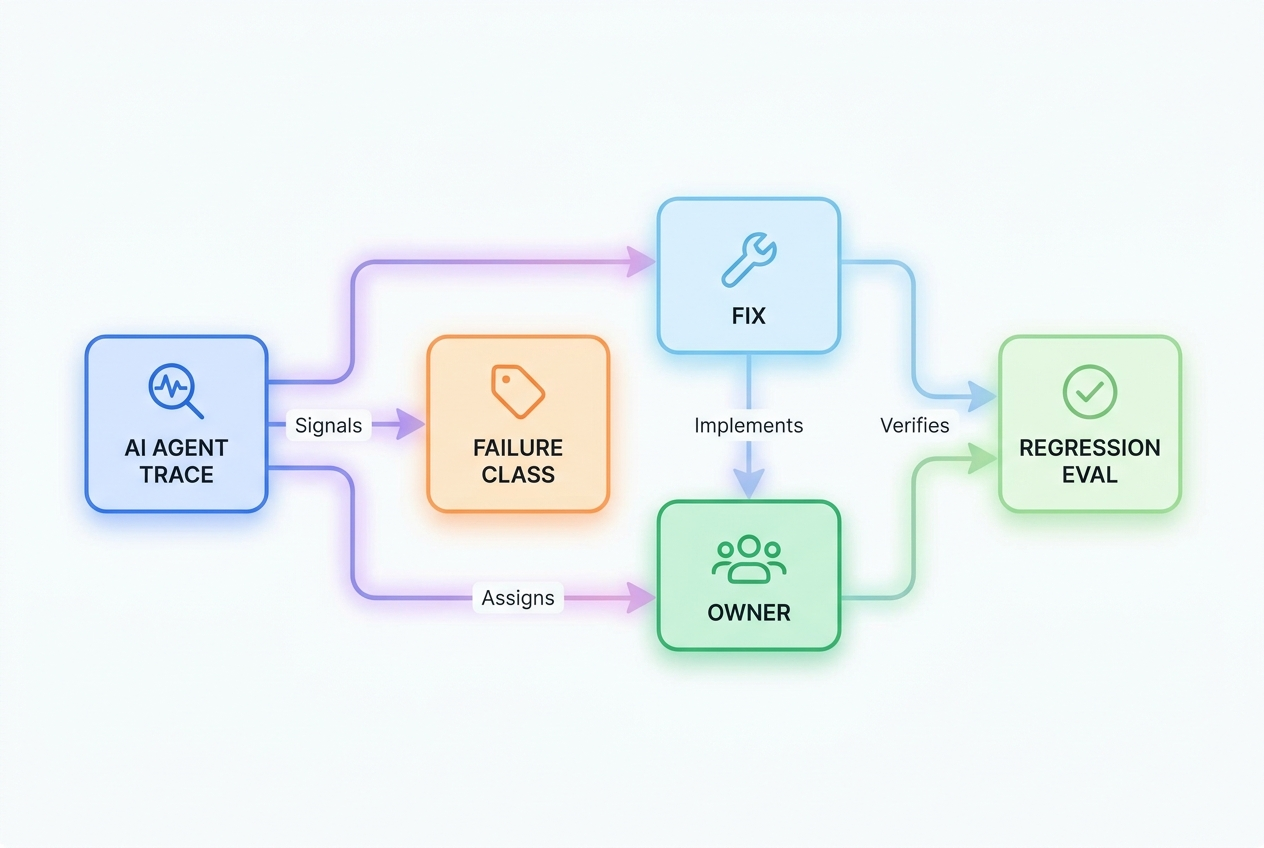
| Failure class | Typical trace signal | Likely owner | Best next fix |
|---|---|---|---|
| Tool contract failure | Invalid arguments, schema mismatch, unexpected nulls, permission denied, brittle response parsing. | Integration or platform owner | Tighten schema, validate arguments, version tool contracts, add replay tests. |
| Tool choice failure | Agent chooses the wrong tool, skips a required tool, or calls tools in the wrong order. | Agent workflow owner | Improve tool descriptions, add routing rules, create examples, evaluate tool selection. |
| Context failure | Retrieved document is stale, irrelevant, missing, duplicated, low ranking, or contradicted by another source. | Retrieval or knowledge owner | Fix indexing, chunking, metadata, freshness rules, reranking, or source precedence. |
| Instruction failure | Agent ignores constraints, uses wrong format, violates workflow order, or confuses priority. | Prompt/workflow owner | Simplify instructions, separate policy from style, add refusal and format tests. |
| Model reasoning failure | All inputs are correct, but the model draws the wrong conclusion or fabricates a step. | Model/application owner | Use stronger model, decompose task, add verification, require citations or calculations. |
| Memory failure | Agent remembers stale, irrelevant, sensitive, or conflicting state and applies it to the current task. | Memory/system owner | Add memory scopes, expiration, review, redaction, and retrieval thresholds. |
| Policy failure | Agent takes an action that should have been blocked, approved, logged, or escalated. | Governance/security owner | Convert policy into executable checks and approval gates. |
| Handoff failure | Agent escalates too late, sends the wrong summary, loses context, or asks a human an unreviewable question. | Operations/product owner | Define handoff triggers, reviewer payloads, and escalation SLAs. |
| Cost or loop failure | Excessive retries, repeated tool calls, long context, runaway planning, or high token usage without progress. | Platform/agent owner | Add budgets, step limits, cache checks, stop rules, and progress scoring. |
| Evaluation failure | A known bad behavior passes tests, or production feedback never becomes a regression case. | Evaluation owner | Add labeled examples, rubrics, adversarial cases, and release gates. |
This table also clarifies why “agent reliability” is not one team’s job. Tool failures belong near integrations. Context failures belong near retrieval and content operations. Policy failures belong near governance. Evaluation failures belong near quality infrastructure. A taxonomy makes that handoff explicit.
Tool Failures: Contract, Choice, Execution, and Interpretation
Tool failures deserve special attention because agents often look intelligent until they touch the outside world. A model can write a confident plan, but production reliability depends on whether it calls the right tool with valid arguments, interprets the response correctly, and handles errors without inventing success.
Tool contract failure
This happens when the interface between the agent and the tool is unclear or unstable. Common signals include missing required fields, enum values the tool rejects, unhandled nulls, undocumented status codes, or a schema that changed without the agent instructions changing. The fix is usually not “better prompting.” It is contract discipline: strict schemas, examples, versioning, validation, and typed error responses.
Tool choice failure
Here the tool works, but the agent chooses badly. It may search a public knowledge base when it should check the customer account. It may send an email before creating a draft. It may call a write tool before asking for approval. Look for traces where the wrong tool appears early in the run. Better tool names, descriptions, routing rules, and few-shot examples often help.
Tool execution failure
This is the ordinary engineering layer: timeouts, rate limits, authentication errors, permission denials, unavailable services, and network errors. Good agents should expose these failures instead of hiding them. A trace should show the exact tool status, retry count, latency, and whether the user saw a degraded response.
Tool result interpretation failure
The tool returns valid data, but the agent reads it incorrectly. This is common when APIs return nested objects, partial success statuses, multiple candidates, or warnings. The fix may be a clearer response schema, a summarizing adapter, or a post-tool verification step before the agent acts.
Context and Memory Failures: When the Agent Reads the Wrong Reality
Many agent bugs are not caused by the model being incapable. They are caused by the model being shown the wrong reality. Context and memory decide what the agent believes is true. If that layer is wrong, even a strong model can produce a polished mistake.
A context failure usually comes from retrieval, prompt assembly, or source freshness. The agent may receive an outdated policy document, an irrelevant chunk, two contradictory snippets, or a user message without the previous constraint that made it meaningful. The trace should record retrieved document IDs, scores, timestamps, source types, and the final context bundle used by the model.
A memory failure is different. Memory is state that persists across turns, tasks, users, or sessions. It can help personalization, but it can also leak irrelevant assumptions into the current task. Examples include remembering an old project preference after the user changed their mind, applying one customer’s state to another customer, or storing sensitive data that should have been forgotten.
Good fixes include source precedence rules, freshness windows, metadata filters, memory scopes, expiration policies, human review for durable memories, and evals that deliberately include stale or conflicting context. These connect directly to AI agent memory architecture and the broader observability pillar.
Instruction and Model Reasoning Failures: When the Brain Layer Actually Breaks
Some failures really are model or instruction failures. The trick is to separate them from upstream data problems. If the trace shows the right tool outputs, current context, clean memory, and clear policy, but the model still makes a bad inference, then a reasoning label is fair.
Instruction failures happen when your prompt or system instructions are ambiguous, overloaded, conflicting, or too distant from the decision point. The model may ignore a JSON format, skip a required citation, forget a “never perform destructive action” rule, or blend two workflow modes. A good trace should store the instruction version so failures can be compared across prompt releases.
Model reasoning failures happen when the model has adequate inputs and instructions but still draws a bad conclusion. Examples include flawed arithmetic, unsupported causality, hallucinated constraints, weak planning, or failure to notice contradiction. Fixes include task decomposition, verification calls, stronger model choice for hard branches, answer constraints, or a separate judge/evaluator.
A useful distinction is ownership. Instruction failures often need product and prompt design. Model reasoning failures may need model selection, decomposition, or eval gates. Both should become examples in the AI agent evaluation framework, but they should not be mixed with tool outages or bad retrieval.
Policy and Human-Handoff Failures
AI agents do not fail only by answering incorrectly. They also fail by acting at the wrong autonomy level. A technically correct action can still be unacceptable if it bypasses approval, lacks audit evidence, exposes private data, or leaves a human reviewer without enough context to decide.
Policy failures show up when an agent violates a rule that should have been enforced outside the model. If an action is high risk, the guardrail should not depend only on the model remembering a sentence in the prompt. The trace should show the policy check, decision, confidence if relevant, approver, and reason for allow/block/escalate.
Human-handoff failures happen when the agent asks for help badly. It may escalate too late, omit the evidence a reviewer needs, ask a vague question, or dump a giant trace on a busy human. The fix is not just “add human approval.” It is to design review queues with concise summaries, diff previews, risk labels, recommended actions, and reject/approve paths. The existing guide on human approval for AI agents is the natural supporting read here.
For serious systems, connect this class to NIST-style risk management thinking: map where risk appears, measure whether controls work, manage the response, and govern ownership. A failure taxonomy makes those steps concrete for agent runs.
Add Severity: Not Every Agent Bug Deserves the Same Response
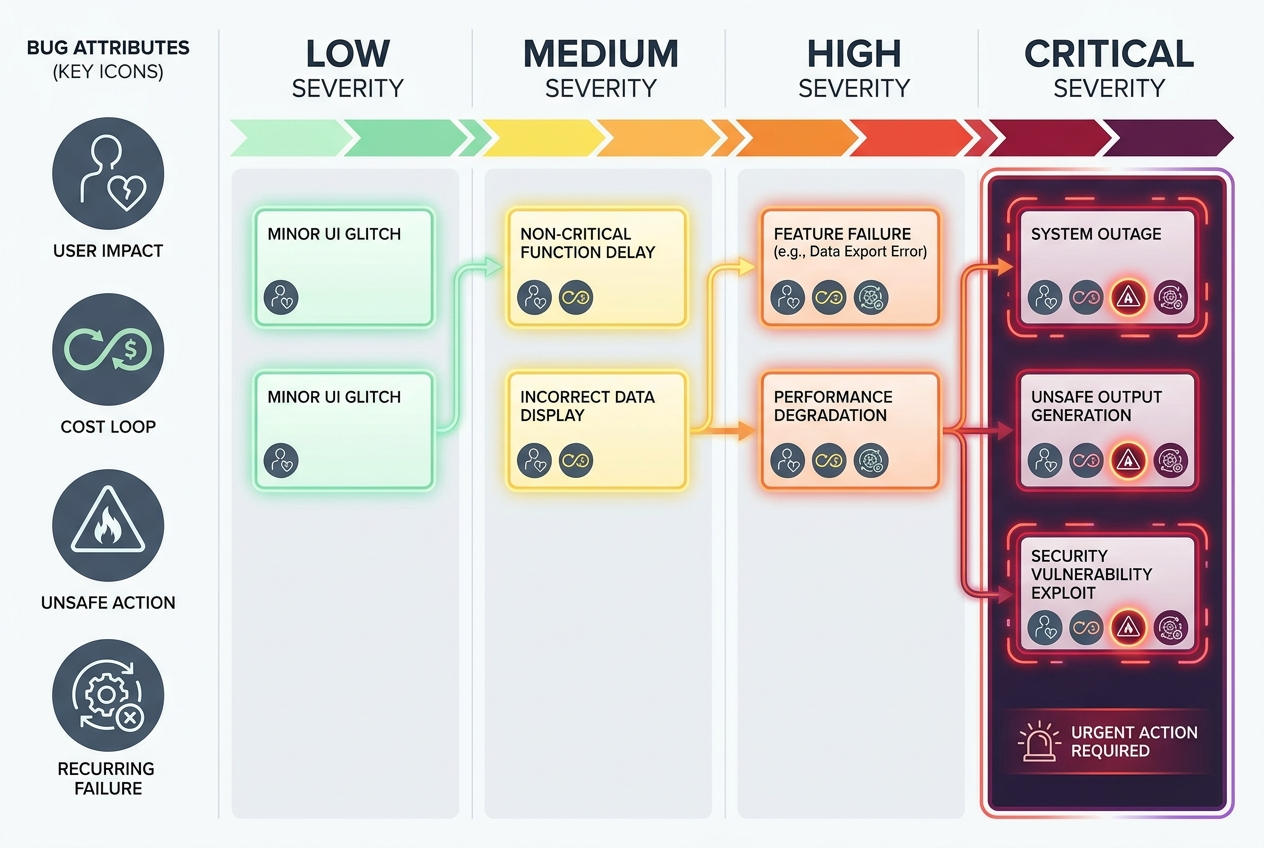
Failure class tells you what broke. Severity tells you how urgently to respond. Without severity, teams either panic over harmless oddities or ignore quiet failures that accumulate real risk.
| Severity | Meaning | Response |
|---|---|---|
| Low | Minor quality issue, no user harm, easy recovery, low recurrence. | Label, sample, and review during normal quality work. |
| Medium | User-visible issue, repeated annoyance, cost increase, or workflow slowdown. | Create a ticket, add eval coverage, and monitor trend. |
| High | Incorrect action, material user impact, repeated production failures, or approval bypass. | Open incident, assign owner, patch control, and add release gate. |
| Critical | Security, privacy, financial, legal, safety, or destructive-action risk. | Stop or restrict the agent path, investigate, notify stakeholders as required, and require explicit approval before resuming. |
Severity should be based on impact, not embarrassment. A silly response in a sandbox is low severity. A silent wrong tool call that changes customer data can be high or critical even if the model output looked calm.
Trace Fields to Add for Failure Classification
If taxonomy labels live only in a spreadsheet, they will decay. Add them to your traces, feedback records, eval runs, and incident tickets. Start with a small set of fields that engineers will actually fill in.
| Field | Purpose | Example |
|---|---|---|
failure_class | Top-level taxonomy bucket. | tool_contract_failure |
failure_subclass | More specific cause. | missing_required_argument |
severity | Impact level. | medium |
owner_team | Who should fix it. | integrations |
user_visible | Whether the user saw the failure. | true |
retry_count | Loop and cost signal. | 4 |
policy_decision | Allow, block, warn, or escalate. | escalate |
regression_test_id | Links production failure to eval coverage. | agent-refund-042 |
These fields pair well with OpenTelemetry-style spans and vendor-specific tools. The important design principle is portability: keep the failure labels independent from any one observability vendor so your taxonomy survives tooling changes.
A Debugging Workflow for Classifying Agent Failures
Use this workflow during incident review, weekly quality review, or eval triage.
1. Start with the user-visible symptom
Write what happened in plain language. “Agent refunded the wrong order,” “agent spent too many retries,” or “agent gave an outdated policy answer.” Do not assign blame yet.
2. Reconstruct the trace timeline
List the user input, plan step, retrieved context, model call, tool call, tool result, policy check, memory read/write, retry loop, and final response. If a step is missing from the trace, that is itself an observability gap.
3. Identify the first bad step
The first bad step is more useful than the final bad answer. If retrieval returned the wrong policy before the model answered, classify context first. If the model called the wrong API before the tool failed, classify tool choice first.
4. Assign one primary failure class
Incidents often involve multiple failures, but every ticket needs one primary class. Add secondary labels if helpful, but do not let multi-labeling hide ownership.
5. Connect the failure to a fix and an eval
A taxonomy is only useful if it changes future behavior. Every medium, high, or critical production failure should produce either a code fix, policy fix, retrieval fix, prompt fix, or evaluation case. For test design, use the related guide on AI agent test cases.
Failure Classification Examples
Example 1: The agent says a customer is eligible for a refund when they are not
The trace shows the model retrieved an old refund policy from the knowledge base. The billing tool was never called. Classify this as context failure, not model reasoning failure. Fix freshness metadata, source precedence, and retrieval tests for policy updates.
Example 2: The agent calls the right tool with the wrong ID
The trace shows the model selected the correct account lookup tool but passed an order ID into the customer ID field. Classify this as tool contract failure or tool argument failure. Fix schema descriptions, add validation, and include negative examples.
Example 3: The agent keeps retrying a rate-limited API
The trace shows the same failed tool call repeated six times with no new information. Classify this as cost or loop failure, with a secondary execution failure. Add retry budgets, exponential backoff, and a stop rule that asks a human or returns a degraded answer.
Example 4: The agent asks a human reviewer, “Should I do this?”
The trace includes a handoff, but the reviewer receives no user request, proposed action, risk label, or evidence. Classify this as handoff failure. Fix the approval payload and require a decision-ready summary.
Example 5: The agent follows all inputs but makes a bad inference
The trace shows current context, valid tool results, and clear instructions. The model still invents a constraint. Classify this as model reasoning failure. Add a verification step, stronger model branch, or rubric-based eval for that reasoning pattern.
How to Show the Taxonomy in an Observability Dashboard
The pillar article covers broad dashboard design. For this cluster, keep the dashboard focused on failure classification. The most useful views are:
- Failure count by class and severity.
- Failure rate by agent, workflow, tool, model, and release version.
- Top recurring subclasses over the last release window.
- Cost impact by failure class, especially retries and long context runs.
- Human-handoff quality: approval latency, missing evidence, rejection rate, and escalation accuracy.
- Regression coverage: percentage of medium/high/critical failures converted into evals.
The final metric is the most important. If production failures do not become tests, observability becomes a museum of pain. The goal is not only to explain what happened. It is to make the same failure harder to ship again.
Rollout Plan: Start Small Before You Taxonomize Everything
Do not begin by asking every engineer to classify every trace. Start with a narrow production workflow where agent failures already cost time: customer support, internal operations, code automation, research assistance, sales qualification, or data entry. Pick one agent, one review cadence, and one owner for the first month.
During the first week, label only failed or manually corrected runs. During the second week, add near misses: runs where the agent recovered, retried too much, or needed a human to rescue the task. During the third week, convert the most common medium and high severity cases into eval examples. By the fourth week, the dashboard should show whether failures are clustering around tools, retrieval, instructions, policy, memory, or handoff design.
The taxonomy should evolve slowly. If reviewers keep choosing “other,” add a subclass, not a new top-level bucket. If two labels are constantly confused, rewrite their definitions and add examples. If a label never changes an owner or a fix, remove it. The best taxonomy is not the longest one. It is the one that reliably turns production evidence into better prompts, safer tools, cleaner context, stronger approvals, and more useful regression tests.
Finally, make classification part of release review. Before an agent workflow expands to more users or broader permissions, check whether recent failures have owners, severity labels, and regression coverage. That habit keeps observability connected to shipping decisions instead of becoming a passive dashboard nobody trusts.
Sources and References
FAQ: AI Agent Failure Taxonomy
What is an AI agent failure taxonomy?
It is a shared set of labels for classifying why an agent run failed, such as tool failure, context failure, model reasoning failure, memory failure, policy failure, handoff failure, or cost-loop failure.
How is a tool failure different from a model failure?
A tool failure happens at the integration layer: wrong arguments, schema mismatch, permission denial, timeout, or misread tool response. A model failure happens when the model has good inputs and instructions but still reasons incorrectly.
Which agent failures should trigger human review?
Human review is appropriate for high-risk actions, policy uncertainty, privacy or security exposure, financial changes, destructive operations, repeated failures, and cases where the agent cannot produce enough evidence for a safe decision.
How do you label failures in traces?
Add fields such as failure_class, failure_subclass, severity, owner_team, user_visible, retry_count, policy_decision, and regression_test_id to trace metadata, feedback records, or incident tickets.
How does a taxonomy improve AI agent evals?
It turns production incidents into labeled regression cases. Instead of a generic “bad answer” dataset, you can build eval slices for tool choice, context freshness, memory scope, policy enforcement, handoff quality, and loop control.
Should every failure have only one label?
Use one primary label for ownership and reporting. Add secondary labels when needed, but avoid making every incident multi-label because that weakens accountability.
