
RAG Hallucinations Explained: Why Source-Grounded AI Still Gets Answers Wrong
RAG is one of the best ways to ground AI answers in sources, but source-grounded does not mean automatically true. This practical guide explains where retrieval-augmented generation still fails, how to spot cited-but-wrong answers, and how to reduce risk with better retrieval, faithfulness checks, evaluation, and human review.
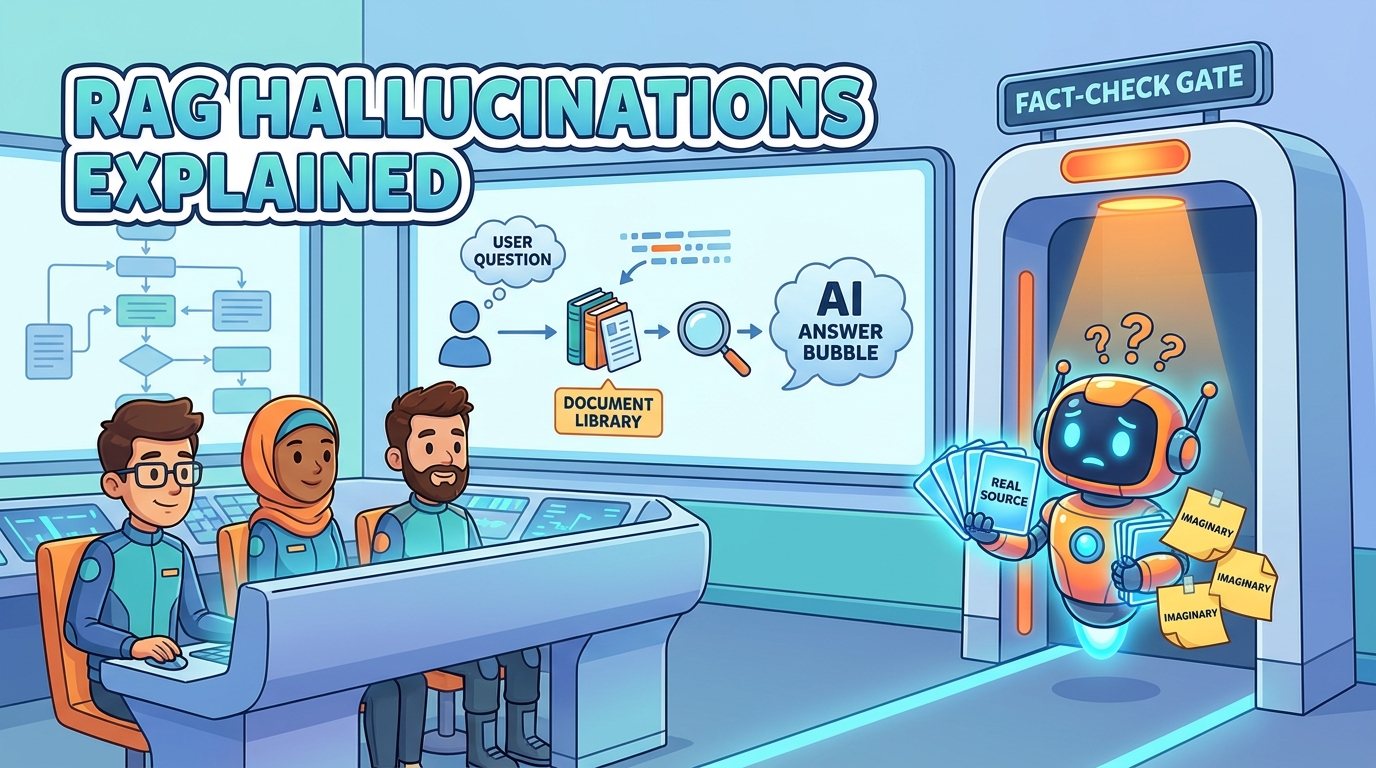
RAG Hallucinations: Quick Answer
RAG hallucinations are wrong, unsupported, stale, or misleading answers produced by an AI system even though that system uses retrieval-augmented generation. In plain English: the AI looked at sources, or seemed to look at sources, but the final answer still was not fully grounded in the evidence.
This surprises people because RAG is often introduced as the fix for hallucinations. The reality is more careful. RAG can reduce hallucination risk by giving a model current or domain-specific context before it answers. But RAG is not a truth machine. It is a pipeline made of retrieval, ranking, chunking, prompt assembly, generation, citation, and review. Any one of those steps can fail.
This article is a focused cluster guide for our pillar article, AI Hallucinations Explained. The pillar explains why models make things up in general. This guide goes narrower: why source-grounded systems can still fail, how to recognize RAG-specific hallucinations, and what practical checks reduce the risk.
What RAG Actually Does
Retrieval-augmented generation, usually shortened to RAG, adds a retrieval step before generation. Instead of asking a language model to answer only from its training patterns, the system searches a document collection, selects relevant passages, passes those passages into the prompt, and asks the model to answer using that context.
That design helps with two common hallucination causes. First, it gives the AI access to information that may not have been in the model's training data. Second, it can ground the answer in a known document set, such as a help center, research library, product manual, policy archive, or company knowledge base.
But a RAG system is still not the same as a database query. A normal database query returns a stored value. A RAG system retrieves text and then asks a generative model to synthesize an answer. The final sentence is newly generated. That generation step is useful because it can explain, summarize, compare, and adapt to the question. It is risky because the model can still overstate, blend, omit, or invent.
The safest mental model is this: RAG gives the model evidence to work with, but it does not force every word of the answer to be true. Good RAG needs evidence, instructions, evaluation, and human review in the right places.
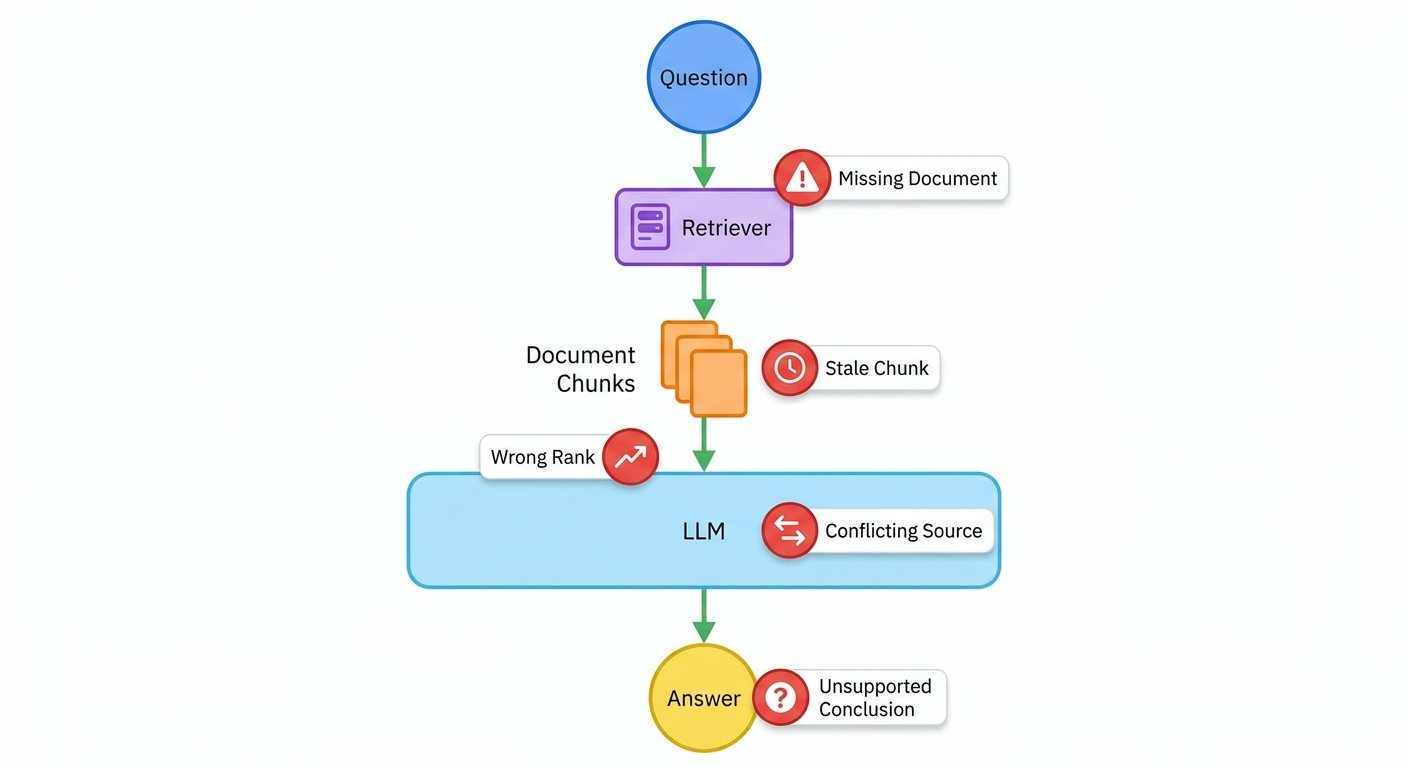
Why RAG Systems Still Hallucinate
RAG hallucinations happen because retrieval and generation are different problems. You can retrieve the right document and still generate the wrong answer. You can retrieve the wrong document and generate a fluent answer from bad evidence. You can retrieve several good documents and still fail to explain conflicts between them.
The Ragas evaluation paper is helpful because it separates RAG quality into dimensions: whether the retrieval system identifies relevant and focused context passages, whether the LLM uses those passages faithfully, and whether the generated answer is good. That distinction matters. If you only ask, “Did the answer sound useful?” you will miss the most dangerous failures.
The paper “Seven Failure Points When Engineering a Retrieval Augmented Generation System” makes a similar practical point from engineering experience: RAG systems aim to reduce hallucinated responses and link sources, but they still suffer from information-retrieval limitations and LLM limitations. The authors emphasize that validation is feasible during operation and that robustness evolves rather than being designed perfectly at the start.
The Main Types of RAG Hallucinations
1. Unsupported synthesis
Unsupported synthesis is the classic RAG hallucination. The retrieved source says one thing, but the answer adds a stronger claim. For example, a document says a feature is available in beta for selected accounts. The answer says the feature is available for all customers. The answer is not source-free, but it is not faithful.
2. Wrong-source confidence
This happens when the system cites a real source that is only loosely related. A user asks about refund policy. The chatbot retrieves a pricing page, finds a sentence about billing, and answers as if it found the refund rule. The citation makes the answer look credible even though it is not the right evidence.
3. Stale-source answers
RAG can make current-information problems better only if the knowledge base is current. If the index contains old policies, old API docs, old safety guidance, or old product pages, the model can produce a source-grounded answer that is still wrong today.
4. Multi-document blending
Many RAG systems retrieve several chunks. The model may blend details from different products, regions, versions, or customer types into one smooth answer. This can create a claim that no single source actually supports.
5. Missing abstention
Sometimes the correct answer is, “The provided sources do not say.” A RAG system hallucinates when it answers anyway. This is a workflow problem as much as a model problem: the prompt, evaluation set, or product design rewarded answer completion more than careful uncertainty.
6. Citation decoration
A citation should be evidence. In weak systems, a citation becomes decoration. The model attaches a source because the interface expects a source, not because that source supports the sentence. This is why our related AI Citation Verification Checklist is a useful next step.
RAG Hallucination Risk Matrix
Not every RAG mistake has the same cost. If a hobby chatbot gives a weak book recommendation, the risk is low. If an enterprise assistant gives a wrong compliance answer, the risk is high. Use this matrix to decide how much verification is needed.
| Scenario | Likely failure | Minimum control |
|---|---|---|
| Learning assistant summarizing public concepts | Oversimplification or weak source fit | Cross-check important claims with reputable sources. |
| Customer support chatbot | Wrong policy, stale document, overconfident answer | Versioned source retrieval, escalation path, answer logging. |
| Internal company knowledge bot | Old process, wrong department, access-control confusion | Fresh index, permissions, source dates, owner review. |
| Developer documentation assistant | Wrong API method, version mismatch, fake parameter | Official docs, version metadata, runnable examples, tests. |
| Legal, medical, finance, security, or compliance assistant | High-impact unsupported advice | Expert review, strict abstention, audit logs, source traceability. |
NIST's AI Risk Management Framework is useful here because it reminds teams to think about validity, reliability, transparency, accountability, and oversight. RAG hallucinations are not only writing errors. They are operational AI risk signals.
How to Evaluate RAG Hallucinations
To evaluate RAG properly, do not score only the final answer. Score the pipeline. A practical evaluation should ask at least six questions.
| Evaluation question | What it catches | Simple test |
|---|---|---|
| Was the retrieved context relevant? | Wrong or loosely related sources | Would a human use this passage to answer the question? |
| Was the context focused? | Noisy retrieval and distracting chunks | Does the passage contain the needed evidence without too much unrelated text? |
| Was the answer faithful? | Unsupported synthesis | Can every factual claim be traced to source text? |
| Was the answer complete? | Partial answers and missing caveats | Did it answer the user's actual question and mention important limits? |
| Were citations correct? | Citation decoration | Does the cited source prove the specific sentence? |
| Did the system abstain when needed? | False confidence | When sources are insufficient, did it say so? |
For builders, these map closely to common RAG evaluation terms such as context relevance, context precision, answer relevance, answer faithfulness, and citation support. For non-builders, the same idea is simpler: check what the AI saw, check what it said, and check whether the first truly supports the second.
If you are building agents or enterprise assistants, connect this evaluation with observability. Logs should show the user question, retrieval query, retrieved chunks, source metadata, prompt, final answer, tool calls, and reviewer outcome. Without traces, RAG debugging becomes guesswork. For deeper implementation context, see our guide on AI agent observability.
How to Reduce RAG Hallucinations
Reducing RAG hallucinations takes layered controls. A better prompt helps, but prompt wording alone cannot fix a stale index, bad chunking, weak ranking, missing metadata, or an interface that rewards confident answers over careful ones.
Use better source hygiene
The knowledge base should have clear owners, dates, versions, and removal rules. If old documents remain in the index without metadata, the system may retrieve them confidently. A good answer should know whether a source is current enough for the question.
Chunk documents carefully
Chunking sounds technical, but the idea is simple: the system breaks documents into pieces before retrieval. If chunks are too small, they lose context. If chunks are too large, they add noise. Good chunking preserves the meaning needed to answer questions.
Retrieve for the question, not only similar words
Semantic similarity can find related text, but related text may not answer the question. Hybrid search, metadata filtering, reranking, and query rewriting can help, especially when users ask about product versions, regions, dates, or exact policies.
Force grounded answers
The model should be instructed to answer only from retrieved sources when that is the product promise. It should also be allowed to say, “The provided sources do not contain enough information.” If the system must always answer, it will sometimes make things up.
Separate evidence from interpretation
A safer RAG answer can say: “The source says X. My interpretation is Y. This does not confirm Z.” That structure is slower than a one-line answer, but it is much safer for decisions.
Review high-stakes outputs
Human review is still necessary when errors can affect health, money, rights, security, compliance, employment, or customer trust. RAG should make review easier by showing sources, not remove responsibility from humans.
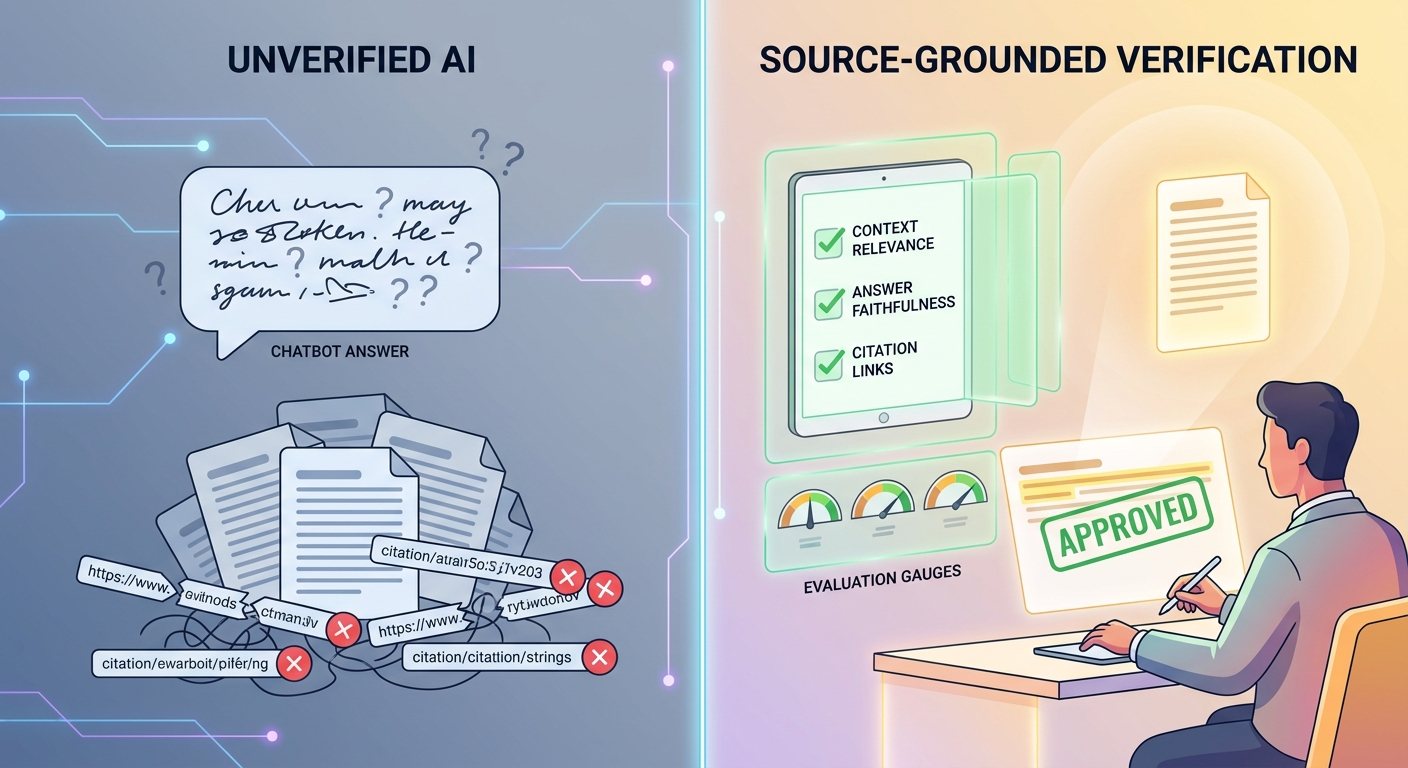
RAG Hallucination Checklist
Use this checklist before trusting a source-grounded AI answer. It works for users, content teams, support teams, and product teams.
The most important line is “claim is supported.” A link next to a paragraph is not proof. Proof means the source supports the specific claim in context.
Practical Examples of RAG Hallucinations
Example: customer policy chatbot
A customer asks whether they can cancel within 30 days. The bot retrieves a general billing page that says subscriptions renew monthly. It answers, “Yes, you can cancel within 30 days for a refund.” The source exists, but it does not support the refund claim. The fix is to retrieve the refund policy, include policy dates, and force the bot to say when refund terms are not found.
Example: developer docs assistant
A developer asks for the correct parameter in the latest SDK. The assistant retrieves an old documentation chunk and gives a deprecated method. The answer is grounded in a real source but wrong for the current version. The fix is version metadata, official-doc priority, and a runnable example check.
Example: research assistant
A user asks whether a study proves an intervention works. The assistant retrieves an abstract showing a limited association and writes that the intervention is proven effective. The model overstates the source. The fix is faithful summarization, uncertainty language, and a requirement to separate source wording from interpretation.
Example: internal HR assistant
An employee asks about remote-work eligibility. The assistant retrieves a policy from another country office. The answer is polished but applies the wrong jurisdiction. The fix is metadata filters for location, employee type, and policy owner.
Advice for Users vs Builders
If you are a normal user of AI search or chat tools, your job is not to debug embeddings. Your job is to slow down when the answer matters. Open the source. Check the exact claim. Look for dates. Ask the AI what part of the source supports its answer. If it cannot show support, treat the answer as a draft.
If you are a builder, your job is to make that verification easy. Show source titles, dates, passages, and confidence boundaries. Log retrieval. Evaluate faithfulness. Design for abstention. Give reviewers a way to flag wrong answers and feed that back into the system. RAG quality improves through operation, measurement, and maintenance.
If you are a manager or leader, your job is to define where RAG answers can be used directly and where they require approval. A low-stakes knowledge assistant can tolerate occasional weak answers. A compliance assistant cannot. The same technology needs different governance depending on the consequence of error.
How This Supports the Bigger Hallucination Problem
RAG is one of the most important practical tools for reducing hallucinations, but it works best when people understand its limits. The broad hallucination problem is about fluent systems producing unsupported claims. RAG narrows the problem by adding evidence. Then it creates a new question: did the system retrieve the right evidence and use it faithfully?
That is why this topic belongs inside the AI hallucination cluster. The pillar article explains what hallucinations are and why they happen. The citation checklist explains how to check visible sources. This article sits between them: it explains why even source-grounded systems can fail and how to evaluate them.
The right standard is not “the AI had sources.” The right standard is “the answer is supported by the right sources, used in the right context, with the right level of uncertainty.”
Conclusion: Source-Grounded Does Not Mean Automatically True
RAG is valuable. It can reduce hallucinations, improve freshness, connect answers to documents, and make AI systems more useful in real work. But it does not remove the need for judgment. Retrieval can miss. Sources can be stale. Chunks can be incomplete. Models can overstate. Citations can decorate instead of prove.
The practical rule is simple: trust RAG answers in proportion to their evidence, not their confidence. If the answer matters, inspect the source, verify the exact claim, check freshness, and require human review where the stakes are high.
For the broader mental model, read the source pillar: AI Hallucinations Explained: Why Models Make Things Up and How to Reduce Risk.
Keep Learning on Singularity Journey
- AI Hallucinations Explained — the source pillar for this cluster article.
- AI Citation Verification Checklist — how to check sources before trusting an answer.
- AI Agent Context Explained — why context changes what an AI system says.
- AI Agent Evaluation Metrics — what to measure before production agents scale.
- AI Guardrails Explained — how safer systems constrain behavior.
Sources and References
- Ragas: Automated Evaluation of Retrieval Augmented Generation
- Seven Failure Points When Engineering a Retrieval Augmented Generation System
- IBM Think: What is retrieval augmented generation?
- Pinecone: Retrieval-Augmented Generation
- NIST AI Risk Management Framework
Source note: this article avoids universal hallucination-rate claims because RAG failure rates vary by task, corpus, model, retriever, prompt, domain, and evaluation method.
FAQ: RAG Hallucinations
Does RAG eliminate hallucinations?
No. RAG can reduce hallucination risk by grounding answers in retrieved sources, but retrieval can fail and the model can still misread, overstate, or invent unsupported conclusions.
What is a RAG hallucination?
A RAG hallucination is a wrong, unsupported, stale, or misleading answer produced by a retrieval-augmented AI system. It can happen even when the answer includes citations.
Why can cited AI answers still be wrong?
A citation can be real but irrelevant, outdated, incomplete, or insufficient to support the exact claim. The citation must prove the sentence in context.
What is answer faithfulness in RAG?
Answer faithfulness means the generated answer accurately reflects the retrieved context and does not add unsupported claims beyond the evidence.
How do you reduce RAG hallucinations?
Improve source hygiene, metadata, chunking, retrieval, reranking, grounded prompting, abstention behavior, evaluation, logging, and human review for high-stakes outputs.
What is the difference between retrieval failure and generation failure?
Retrieval failure means the system did not fetch the right evidence. Generation failure means the system had useful evidence but produced an answer that was not faithful to it.
Should users trust AI search answers with sources?
They should treat them as helpful starting points, not automatic truth. Open the source and verify that it supports the exact claim, especially for important decisions.
