
AI Agent Autonomy Levels: A Practical Model for Human Oversight
A practical model for classifying AI agent autonomy levels, matching each level to human oversight, approvals, permissions, logs, and rollback controls.
Quick answer: autonomy is the amount of delegated action an AI agent can take
AI agent autonomy levels are a practical way to describe how much freedom an AI agent has to move from advice to action. A low-autonomy agent can explain, summarize, or recommend. A moderate-autonomy agent can prepare drafts and wait for approval. A higher-autonomy agent can execute bounded tasks across tools. A high-impact agent can affect money, access, safety, legal exposure, reputation, or production systems and therefore needs strict human oversight.
This matters because teams often ask the wrong question. They ask, “Is this AI agent safe?” as if safety is a yes-or-no property. The better question is: what level of autonomy is appropriate for this task, this tool, this data, this user, and this consequence? The same model may be safe as a read-only research assistant and unsafe as an unsupervised payments agent.
This cluster article supports the broader pillar, Autonomous AI Agents and Human Control: The Governance Blueprint for the Singularity Path, by zooming in on one governance decision that every agent program needs: how to classify and control autonomy before it quietly expands.
Why autonomy levels matter for human control
Autonomous AI agents are not only chat interfaces. They are systems that can receive a goal, use context, select tools, call APIs, write outputs, update records, open tickets, prepare code changes, or coordinate multi-step workflows. Once an agent can act, governance is no longer about content moderation alone. It becomes an authority problem.
Authority is easy to underestimate because autonomy often arrives gradually. A team first asks an assistant to summarize documents. Then it lets the assistant draft emails. Then it allows ticket tagging. Then it connects a calendar, CRM, repository, or billing system. Nothing may feel dramatic at the moment, but the authority boundary has moved several times.
Autonomy levels make those boundary shifts visible. They help product teams, security teams, leaders, and users agree on what the agent may do. They also prevent a common mistake: treating all tool-using agents as equal. A read-only agent, a draft-only agent, and a production-deploying agent should not share the same review process.
Recent Singularity Journey analytics point in the same direction. GA4 top-page activity clusters around enterprise AI agents, MCP tool risk tiers, AI agent observability, trace debugging, memory controls, alignment, and human approval. Search Console data is still early for the site, but the pages gaining impressions are practical governance pages rather than vague AI futurism. That is the opportunity: readers need control models they can use.
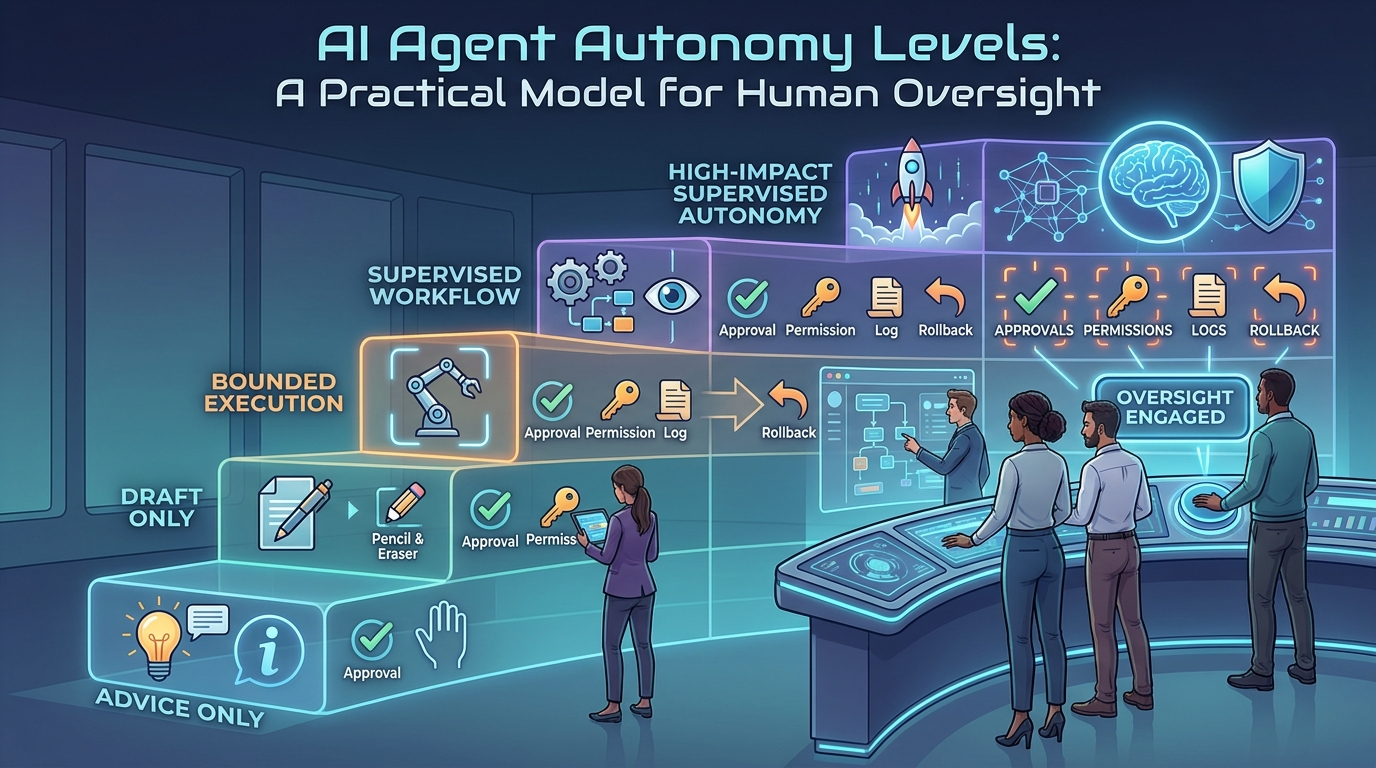
The five-level AI agent autonomy model
The model below is intentionally simple. It is not a legal classification system. It is an operating model for teams deciding how much independence an AI agent should receive.
| Level | What the agent can do | Example | Default oversight |
|---|---|---|---|
| Level 0: advice only | Answer, explain, summarize, classify, or recommend without taking action. | Summarize a policy, explain a support issue, suggest next steps. | User reviews output before acting. |
| Level 1: draft only | Prepare an action but cannot send, publish, merge, update, or execute it. | Draft an email, pull request, report, customer reply, or workflow plan. | Human approval before any external or system effect. |
| Level 2: bounded execution | Execute narrow, reversible, low-impact actions inside a defined scope. | Tag tickets, create internal tasks, update non-sensitive fields, format documents. | Least privilege, logs, sampling review, rollback. |
| Level 3: supervised workflow autonomy | Coordinate multiple steps or tools, with checkpoints at risk boundaries. | Research vendors, update a spreadsheet, draft outreach, and ask before sending. | Policy gates, approval routing, trace logs, exception escalation. |
| Level 4: high-impact supervised autonomy | Assist with actions that may affect rights, money, access, safety, production, legal commitments, or reputation. | Prepare payment approvals, recommend access changes, draft compliance actions, propose production deployment. | Strict human authority, formal evaluation, audit trail, monitoring, rollback, legal/security review where needed. |
The level is not only about the model. It is about the whole system: tools, data, memory, identity, user role, environment, and consequence. A powerful model with no tools may remain Level 0. A weaker model connected to dangerous tools may become Level 4 because the consequence is high.
Autonomy level is not the same as risk level
Autonomy and risk are related, but they are not identical. Autonomy describes how much action the agent can take. Risk describes the consequence if the action is wrong, unauthorized, biased, insecure, or misunderstood.
A Level 2 agent can still be high risk if its “bounded” action affects sensitive medical, financial, employment, or legal data. A Level 3 workflow agent may be low risk if it works only in a sandbox with fake records. This is why the model should be used together with risk tiers from the source pillar, not as a replacement for them.
The cleanest governance pattern is two-dimensional: first classify the autonomy level, then classify the impact risk. A Level 1 high-risk draft may need careful expert review. A Level 2 low-risk action may only need sampling review. A Level 4 high-risk workflow should require explicit human authority and documented controls.
Controls required at each autonomy level
Controls should become stronger as autonomy increases. The goal is not to slow every agent down. The goal is to match friction to consequence.
| Control | Level 0 | Level 1 | Level 2 | Level 3 | Level 4 |
|---|---|---|---|---|---|
| Tool access | None or read-only | Draft creation only | Narrow write tools | Multiple scoped tools | Restricted, reviewed, and often separated by role |
| Human approval | User judgment | Before action | For exceptions or samples | At checkpoints | Before every high-impact action |
| Logging | Prompt and output | Draft, sources, reviewer | Tool calls and changes | Trace, plan, tools, approvals | Full audit trail and evidence package |
| Rollback | Not usually needed | Discard draft | Undo action | Workflow rollback plan | Incident response and formal recovery |
| Evaluation | Accuracy and usefulness | Edit/reject rate | Error rate and reversal rate | Task success, safety, escalation quality | Formal validation and continuous monitoring |
This table turns the broader governance guidance from the autonomous AI agents pillar into an operational checklist. Instead of saying “add human oversight,” it asks what kind of oversight is appropriate for the level.
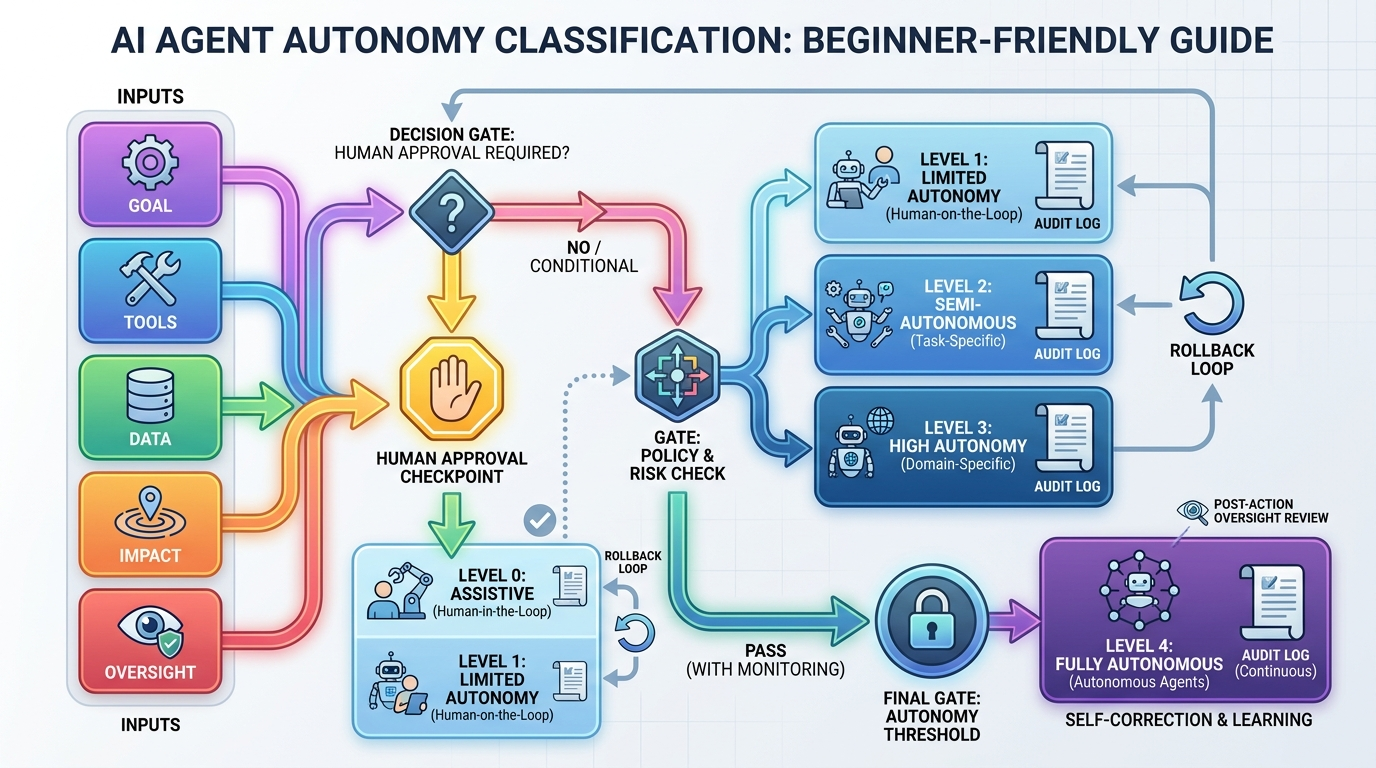
Practical examples by workflow
Customer support agent
A support summarizer may be Level 0 if it only explains ticket history to a human. It becomes Level 1 when it drafts replies. It becomes Level 2 when it tags cases or updates internal notes. It becomes Level 3 when it coordinates refunds, shipping updates, and customer messages. It may become Level 4 if it can commit to compensation, make legal statements, or change account access.
Software engineering agent
A coding assistant explaining a stack trace is Level 0. A pull request drafter is Level 1. An agent that applies lint fixes or updates tests in a branch may be Level 2. A multi-step agent that opens issues, edits several files, runs tests, and prepares a deployment plan is Level 3. Anything that can merge to main, deploy production, rotate secrets, or modify access policies is Level 4 unless tightly constrained.
Research agent
A research assistant that summarizes public sources is Level 0. If it drafts a briefing for review, it is Level 1. If it updates an internal research database with source notes, it may be Level 2. If it schedules interviews, sends outreach drafts, and updates project trackers, it becomes Level 3. If it can publish claims externally or influence regulated decisions, the oversight level rises quickly.
Finance or procurement agent
A finance assistant that explains invoices is Level 0. A draft purchase order is Level 1. Updating an internal category field may be Level 2. Coordinating vendor comparisons and routing approvals may be Level 3. Approving payment, changing bank details, or committing spend belongs in Level 4 with strong human authority and fraud controls.
These examples show why autonomy levels should be assigned per workflow, not per product brand. The same “AI agent platform” may host several autonomy levels at once.
How to promote an AI agent to more autonomy
Promotion means increasing what the agent is allowed to do. It should be evidence-based. A team should not jump from draft-only to broad workflow execution because early demos looked impressive.
Before promotion, ask six questions. First, has the agent performed reliably on real tasks and edge cases? Second, do users understand what it can and cannot do? Third, are logs good enough to investigate failures? Fourth, can actions be reversed? Fifth, are approval gates clear and usable? Sixth, does a named owner accept responsibility for monitoring the workflow?
A practical promotion path looks like this: begin with Level 0 advice in a sandbox; move to Level 1 drafts with human edits measured; allow Level 2 bounded writes only for reversible actions; introduce Level 3 supervised workflows after trace quality and rollback are proven; reserve Level 4 for formal review.
| Promotion evidence | Why it matters |
|---|---|
| High task-success rate with representative cases | Prevents demo-only confidence. |
| Low human correction rate | Shows the agent is not creating hidden review burden. |
| Complete trace logs | Makes failures investigable. |
| Working rollback path | Contains bad actions. |
| Clear user-facing boundary | Prevents people from assuming the agent has more authority than it does. |
| Owner and review cadence | Turns autonomy into an operating responsibility. |
When to reduce AI agent autonomy
Good governance does not only promote agents. It also demotes them. Reducing autonomy is not failure; it is control working as designed.
Demote an agent when tool errors increase, users begin overriding outputs frequently, approvals become rubber stamps, sensitive data appears in unexpected places, the agent relies on stale memory, logs are incomplete, or rollback fails. Demotion can mean moving from Level 3 to Level 1, turning off write tools, requiring approval for more actions, narrowing the data scope, or pausing the workflow entirely.
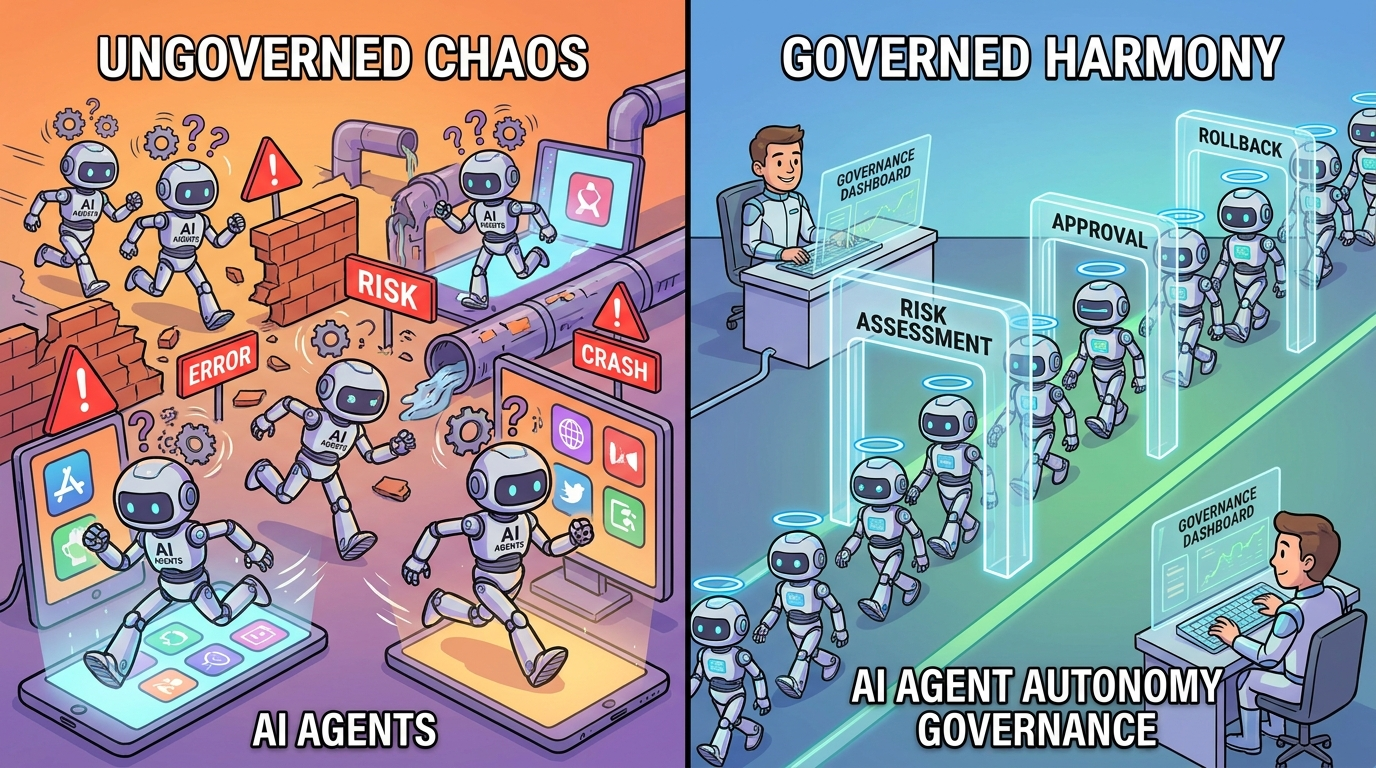
The most dangerous agent programs are not the ones that start cautiously. They are the ones that only move in one direction: more tools, more memory, more actions, more users, more confidence. Mature programs treat autonomy as adjustable.
How public AI governance frameworks support this model
The autonomy-level model is practical, but it fits well with established governance thinking. The NIST AI Risk Management Framework emphasizes governance, mapping, measuring, and managing AI risk. In autonomy terms, that means defining the context of use, mapping who or what can be affected, measuring reliability and security, and managing the agent through controls that can be monitored.
The EU AI Act reinforces risk-based thinking. Even when a specific agent workflow is not a regulated high-risk AI system, the logic is useful: higher impact requires stronger oversight, transparency, documentation, and human control.
ISO/IEC 42001 adds management-system discipline. Autonomy should not live only in a prompt or a dashboard toggle. It should be part of roles, procedures, policies, evaluation, documentation, incident review, and continuous improvement.
OWASP’s GenAI Security Project is especially relevant for agentic systems because security failures become more consequential when models can use tools. Prompt injection, excessive agency, sensitive information disclosure, insecure plugins, weak permissions, and poor monitoring all become autonomy problems once an agent can act.
Implementation checklist for AI agent autonomy levels
Use this checklist before releasing a tool-using agent:
- Name the workflow, not just the agent product.
- Assign an autonomy level from 0 to 4.
- List every tool the agent can access.
- Separate read, draft, write, destructive, and high-impact actions.
- Classify impact risk separately from autonomy level.
- Define approval triggers in plain language.
- Set least-privilege permissions for each tool.
- Decide what memory the agent can use, save, correct, and forget.
- Log the goal, context, sources, memory, tool calls, approvals, outputs, and rollback events.
- Define promotion criteria before increasing autonomy.
- Define demotion criteria before incidents happen.
- Review failures and update the autonomy level when evidence changes.
Common mistakes to avoid
Risky patterns
- Calling an agent “autonomous” without naming what it can actually do.
- Using the same approval flow for drafts, low-risk writes, and high-impact actions.
- Letting tool permissions expand because a demo worked once.
- Logging final answers but not tool calls, sources, memory, or approvals.
- Assuming human-in-the-loop works even when reviewers lack context.
- Never demoting agents after errors or near misses.
Better patterns
- Classify autonomy per workflow.
- Use least privilege by default.
- Match approval friction to impact.
- Keep visible traces and audit logs.
- Test failures, prompt injection, and stale-memory scenarios.
- Make autonomy reversible and reviewable.
Final recommendation: make autonomy explicit before agents scale
AI agent autonomy is not a magic product feature. It is delegated authority. Once you see it that way, the governance question becomes clearer: how much authority should this system have, what evidence justifies that authority, and how can humans reduce it when conditions change?
Start with low autonomy. Let agents advise, then draft, then execute narrow reversible tasks, then coordinate supervised workflows. Treat high-impact autonomy as a special case, not a default endpoint. As the broader autonomous AI agents governance blueprint argues, human control is an architecture. Autonomy levels are one of the simplest ways to build that architecture before convenience quietly becomes uncontrolled power.
Keep learning on Singularity Journey
- Autonomous AI Agents and Human Control: The Governance Blueprint for the Singularity Path — the source pillar for governing autonomous AI agents.
- Human Approval for AI Agents — when to ask, what to review, and how to escalate.
- MCP Tool Risk Tiers — classify read, write, and destructive agent actions.
- AI Agent Observability — trace, evaluate, and debug production agents.
- AI Agent Memory Controls — decide what agents should store, forget, and review.
Sources and references
- NIST AI Risk Management Framework
- EU AI Act high-level summary
- ISO/IEC 42001 AI management system standard
- OWASP Top 10 for Large Language Model Applications and GenAI Security Project
- Singularity Journey: Autonomous AI Agents and Human Control
This article uses public frameworks, site analytics, and operational examples. It avoids fabricated statistics and does not provide legal advice. High-impact AI deployments need security, legal, compliance, and domain expert review.
FAQ: AI agent autonomy levels
What are AI agent autonomy levels?
AI agent autonomy levels classify how much delegated action an AI agent can take, from advice-only output to high-impact supervised workflows that require strict human control.
How many autonomy levels should a team use?
Five practical levels are enough for many teams: advice only, draft only, bounded execution, supervised workflow autonomy, and high-impact supervised autonomy.
Is autonomy level the same as risk level?
No. Autonomy describes how much action the agent can take. Risk describes the consequence if that action is wrong, unauthorized, insecure, or harmful.
When should humans approve AI agent actions?
Humans should approve external, irreversible, sensitive, financial, legal, safety-related, reputational, production, or uncertain actions. Low-risk reversible actions may use sampling review instead.
How do you reduce AI agent autonomy after failures?
Remove write tools, require more approvals, narrow data access, disable memory, move the workflow back to draft-only, or pause the agent until logs, tests, and rollback paths improve.
Can a low-autonomy agent still be risky?
Yes. A draft-only agent can still be high risk if it drafts legal, medical, financial, employment, or safety-sensitive content that humans may over-trust.
