
AI Output Review Checklist: Prove Human Judgment in Your Career Portfolio
Use this AI output review checklist to prove human judgment, source verification, risk control, and quality review inside an AI career portfolio case study.
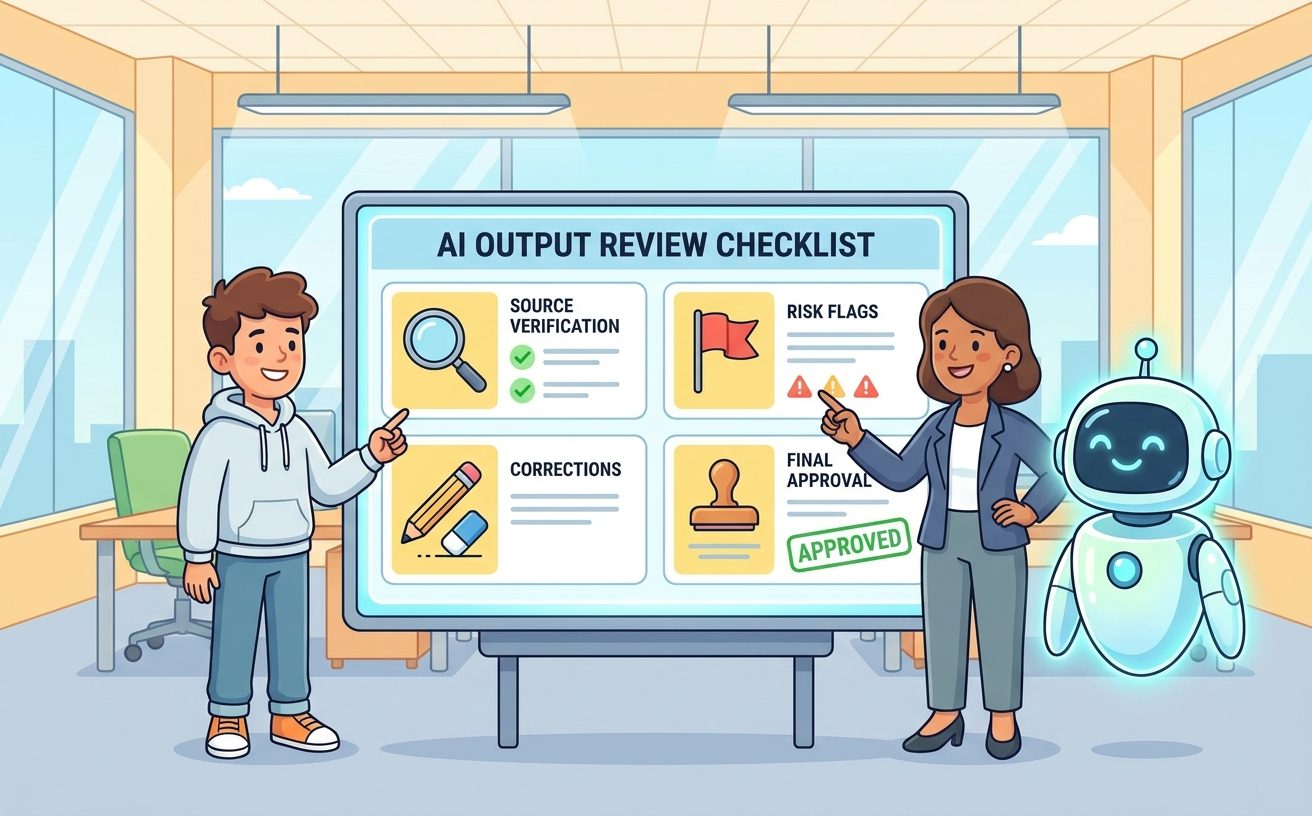
AI Output Review Checklist: Quick Answer
An AI output review checklist is a simple quality-control system for checking AI-generated work before you put it in a portfolio, resume case study, or professional artifact. It helps you prove that you did not merely prompt a model and paste the result. You defined the task, reviewed the output, corrected errors, protected sensitive information, made a human decision, and documented the reasoning behind that decision.
This cluster article supports the broader Singularity Journey pillar on human-AI workflow skills and career portfolios. The pillar explains the full career strategy: choosing projects, documenting baselines, designing human-AI workflows, measuring results, and turning proof into resume bullets. This article goes deeper on one narrow but important subtopic: how to review AI outputs in a way that becomes credible portfolio evidence.
The key idea is that review is not a boring final step. Review is the career signal. Anyone can say they used ChatGPT, Claude, Gemini, Copilot, or an automation tool. Fewer people can show a clean review log, source checks, correction notes, rejected outputs, risk decisions, and a final approval rule. That evidence tells employers something valuable: you can use AI without outsourcing judgment.
Use this checklist whenever an AI system drafts text, summarizes sources, classifies items, writes code comments, analyzes feedback, creates a plan, recommends actions, edits a resume, or produces an artifact you might show publicly. The checklist is intentionally practical. It is not a research lab evaluation suite. It is a portfolio-ready workflow for students, career switchers, analysts, marketers, operations professionals, support teams, product managers, and early AI builders who need to prove responsible AI-assisted work.
Why Review Proof Matters More Than Prompt Screenshots
Prompt screenshots are weak evidence by themselves. They show that you interacted with a model, but they do not prove that the result was accurate, useful, ethical, or work-ready. A hiring manager may glance at a prompt and wonder: did the candidate verify the facts, remove hallucinations, check privacy, evaluate tone, test edge cases, or understand the limitations? If your portfolio cannot answer those questions, the AI work may look generic even if the final artifact is polished.
Review proof solves this problem. It changes the story from “AI made this” to “I used AI inside a controlled workflow, then applied human judgment.” That distinction matters because modern workplaces are not only buying AI output. They are trying to reduce repetitive work while preserving quality, accountability, privacy, and trust. Your portfolio should show you understand that tradeoff.
External signals point in the same direction. IBM describes human-in-the-loop AI as a process where humans participate in operation, supervision, or decision-making to support accuracy, safety, accountability, and ethical choices. NIST’s AI Risk Management Framework emphasizes structured governance, mapping, measuring, and managing of AI risks. Microsoft WorkLab’s AI-at-work coverage increasingly discusses agents together with human agency. The World Economic Forum’s Future of Jobs work frames technology change and skill transformation as central labor-market forces. None of these sources say a portfolio should be a pile of prompt screenshots. The stronger signal is controlled, reviewed, explainable work.
Search and analytics context also support this article angle. Singularity Journey’s recent GA4 data shows engagement with career, portfolio, workflow, and AI agent content. Search Console data is still early and sparse, but existing pages around AI automation portfolios and workflow skills are already part of the site’s topical footprint. That makes a focused article on output review useful as a supporting cluster page: it strengthens the human-AI workflow pillar while giving readers a copyable artifact they can use immediately.
The data gap in many AI career articles is practical evidence. They tell readers to build projects, learn tools, or add AI to a resume, but they rarely explain how to show human review. This article fills that gap with a checklist, review loop, evidence matrix, red-flag guide, examples, and portfolio packaging language.
The AI Output Review Checklist
Use the checklist below after the AI system produces a draft and before you treat that draft as a portfolio artifact. You can copy it into a spreadsheet, Notion page, GitHub README, case-study PDF, or portfolio template. For small projects, a short table is enough. For serious projects, keep a review log with dated notes.
| Review area | Question to ask | Portfolio evidence to save |
|---|---|---|
| Task fit | Does the output answer the exact task, or did it drift into a broader answer? | Original task brief and final acceptance note |
| Source accuracy | Can factual claims be traced back to reliable sources or original data? | Source links, claim-check notes, citations corrected |
| Missing context | What important constraint, exception, audience need, or edge case is absent? | Reviewer comments and added context |
| Hallucination risk | Did the model invent names, numbers, sources, policies, features, quotes, or results? | Rejected claims and correction log |
| Privacy and confidentiality | Does the artifact expose private, sensitive, client, employer, or personal data? | Anonymization note or synthetic-data explanation |
| Bias and fairness | Could the output unfairly stereotype, exclude, rank, or recommend based on weak assumptions? | Bias review note and wording changes |
| Tone and audience | Does the output match the target reader, business context, and level of seriousness? | Before-after excerpt showing edits |
| Human decision | Did a person approve, revise, escalate, or reject the output? | Approval status and reason |
| Result | What became better after review: clarity, speed, quality, safety, or usefulness? | Final artifact plus measured or qualitative outcome |
Do not treat every row as equally heavy. A resume-tailoring workflow needs strong truthfulness and hallucination checks because false experience is dangerous. A customer-feedback workflow needs source traceability, privacy review, and category consistency. A research brief needs citation checks. A code-assistant workflow needs tests, security review, and diff inspection. The checklist should flex around the risk of the task.
The Review Loop: From AI Draft to Trusted Artifact
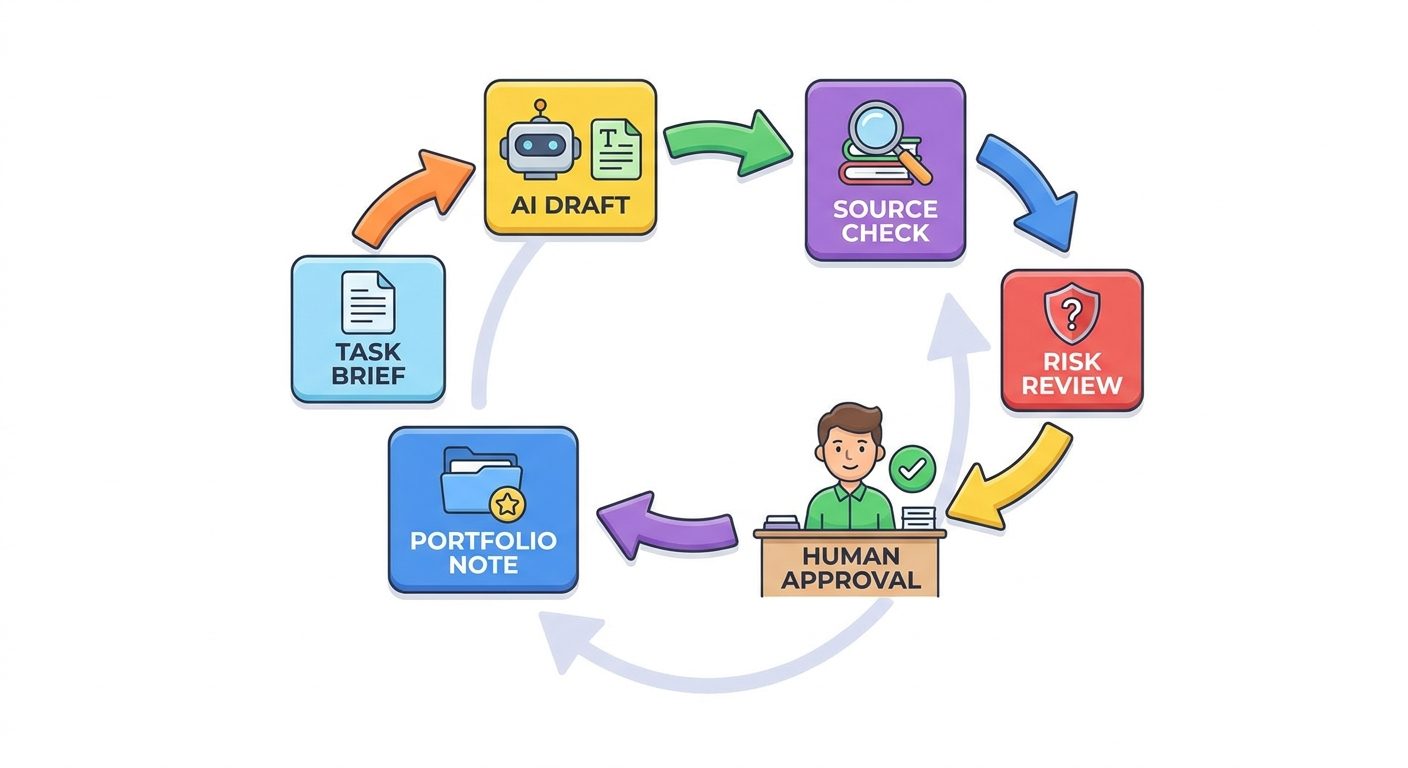
A strong review workflow has six stages. First, keep the original task brief. The brief should include the audience, goal, constraints, data source, and definition of done. Without a task boundary, you cannot fairly evaluate the output. Second, generate the AI draft. Save either the prompt, the instruction summary, or a short description of the AI step. You do not need to publish every prompt, but you should be able to explain what the model was asked to do.
Third, run a source check. This is where you compare factual claims against the original documents, links, dataset, meeting notes, or source material. Mark unsupported claims clearly. Do not hide hallucinations; show that you caught them. Fourth, run a risk review. Look for privacy leaks, overconfident recommendations, bias, missing caveats, or decisions that should not be automated. Fifth, make a human approval decision. Approve, revise, escalate, or reject. Sixth, write a short portfolio note explaining what changed after review.
This loop is useful because it turns invisible judgment into visible evidence. A recruiter may not read your entire prompt log, but they can understand a short review note: “The AI draft missed two source limitations and invented one unsupported metric. I removed the metric, added the source limitation, and marked the final brief as suitable only for internal planning.” That note is far more convincing than a polished final PDF with no explanation.
The loop also protects you from overclaiming. If the AI draft was messy, your portfolio can still be strong because the value is in the workflow. Many real AI projects work this way. The first output is not the final product. The final product is the result of AI assistance plus human review, domain context, editing, verification, and decision-making.
Portfolio Evidence Matrix: What to Show Employers
A portfolio should be easy to audit without exposing private details. Use the matrix below to decide what evidence to include. You rarely need all of it. Choose the artifacts that prove the highest-risk parts of the workflow.
| Artifact | What it proves | Best for | What to avoid |
|---|---|---|---|
| Task brief | You defined the problem and scope before using AI | All portfolio case studies | Vague goals like “make it better” |
| Prompt summary | You can instruct AI clearly without making prompts the whole project | Writing, analysis, coding, automation | Publishing sensitive internal prompts |
| Review checklist | You checked facts, context, risk, and quality | Any public or career artifact | Checkboxes with no notes |
| Correction log | You caught and fixed AI mistakes | Research, summaries, resume tailoring, code comments | Embarrassing private data or client content |
| Before-after excerpt | Human editing improved the output | Writing, reports, customer communications | Cherry-picking only flattering examples |
| Risk note | You understand limits and approval boundaries | Automation, triage, recommendations, career tools | Fear-based language or fake certainty |
| Final artifact | The workflow produced a useful result | Every case study | Artifact with no method explanation |
| Reflection | You can evaluate what you would improve next | Student and career-switcher portfolios | Claiming production readiness from a tiny test |
The strongest combination for most portfolios is simple: task brief, AI step summary, review checklist, correction log, final artifact, and reflection. That is enough to show the workflow without overwhelming the reader. If your case study involves code, add tests and a diff review. If it involves research, add source links. If it involves private data, add an anonymization note.
Weak vs Strong AI Portfolio Evidence
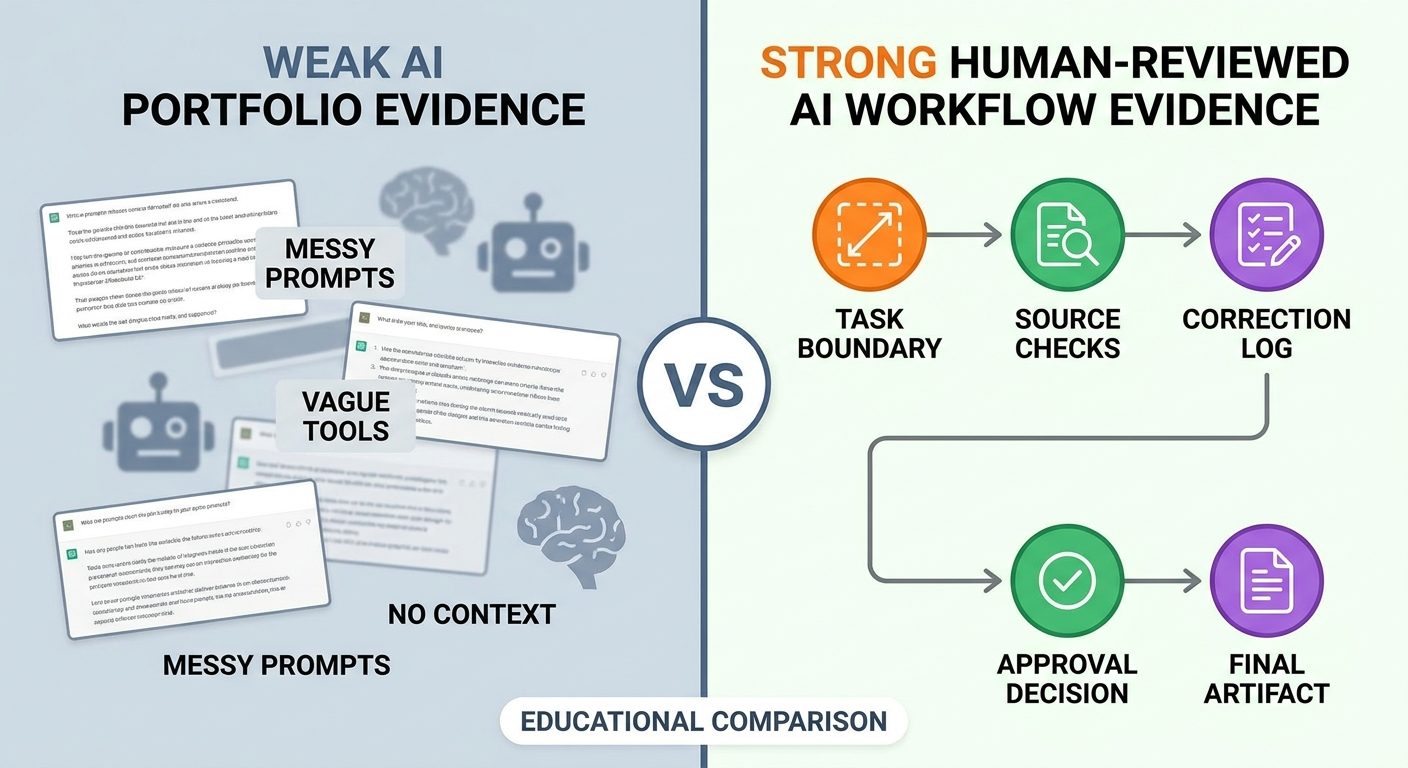
Weak AI portfolio evidence often looks impressive for five seconds and then becomes hard to trust. It may include tool logos, prompt screenshots, polished outputs, and claims like “saved hours” or “automated research.” The problem is not that those elements are always bad. The problem is that they do not answer the deeper employer question: what did the human actually contribute?
Strong evidence shows task boundaries, source checks, before-after notes, mistakes caught, approval decisions, and what the candidate would improve next. It is more specific and less flashy. It is also more believable. If you can show a rejected output and explain why you rejected it, you demonstrate judgment. If you can show a privacy risk you removed, you demonstrate responsibility. If you can show a source claim you corrected, you demonstrate verification.
Weak evidence
- “I used AI to write reports” with no samples.
- Only screenshots of prompts and tool interfaces.
- No baseline task or definition of done.
- No mention of hallucinations or corrections.
- Broad productivity claims without scope.
- Private data shown for dramatic proof.
Strong evidence
- Clear task brief and workflow map.
- AI draft compared with final human-reviewed output.
- Source verification and correction notes.
- Privacy or synthetic-data explanation.
- Approval rule and escalation boundary.
- Specific reflection on limits and next improvement.
A useful portfolio line might read: “I used an AI assistant to draft a customer-feedback summary, then checked every theme against anonymized source comments, corrected unsupported categories, removed identifying details, and published the final summary with a review log.” That sentence shows workflow, human review, privacy awareness, and final output. It is much stronger than “Built an AI customer feedback analyzer.”
Three Examples of the Checklist in Action
Example 1: AI-assisted research brief
The task is to create a one-page research brief from five public sources. The weak portfolio version shows the final brief and says AI helped summarize the links. The strong version includes the original question, the list of source URLs, an AI draft summary, a claim-check table, and notes on two unsupported claims removed from the final version. The review checklist focuses on source accuracy, missing context, and hallucination risk.
The portfolio note could say: “The AI draft was useful for structure, but it overstated one source and introduced a statistic that did not appear in the original report. I removed the unsupported statistic, added source-specific caveats, and marked the final brief as a decision-support artifact rather than a definitive market estimate.” That note proves critical thinking.
Example 2: Resume tailoring workflow
The task is to tailor a resume summary to a job description without inventing experience. This is high-risk because AI can easily exaggerate. The review checklist should focus on truthfulness, source alignment, and unsupported claims. Save the job-description requirements, the candidate’s actual project evidence, the AI draft, and a correction log showing any exaggerated language removed.
The portfolio note could say: “The model initially turned a portfolio prototype into production-sounding experience. I changed the wording to make the scope accurate, linked the claim to a real project artifact, and added a rule that every resume bullet must map to evidence I can show.” This demonstrates ethics and professional judgment.
Example 3: Support-ticket triage prototype
The task is to classify synthetic support tickets by category and urgency. The review checklist should focus on category fit, edge cases, escalation rules, and bias. A strong portfolio includes the sample dataset, category rubric, AI classification output, human corrections, and examples of tickets routed to manual review. The goal is not to claim the prototype is production-ready. The goal is to show that you understand automation boundaries.
The portfolio note could say: “The AI classifier handled routine billing and login examples but struggled with mixed complaints. I added an uncertainty rule: any ticket with more than one issue or a possible account-security concern goes to manual review.” That is exactly the kind of boundary employers want to see.
How to Package the Checklist Inside a Portfolio Case Study
Put the review checklist near the middle of the case study, after the workflow diagram and before the final result. A simple structure works well: problem, baseline, AI-assisted workflow, review checklist, corrections, final artifact, result, limitations, next improvement. This order tells a clean story. The AI step is important, but it is not the whole story. The review step is where your professional value becomes visible.
Keep the checklist short on the public page. You can show a summary table with five to seven rows and link to a longer artifact if needed. A hiring manager should understand the review system in less than a minute. If the page is too dense, they may miss the point. Use plain language: “What I checked,” “What I changed,” “What I approved,” and “What I would improve next.”
Protect confidentiality. If the project came from work, do not publish employer data, customer text, internal prompts, proprietary documents, or private screenshots. Recreate the workflow with synthetic data or anonymized examples. A privacy note is not a weakness. It is part of the proof. It shows that your AI workflow skills include judgment about what should not be shared.
If you want the checklist to support your resume, turn it into a bullet that combines workflow, review, and result. For example: “Built an AI-assisted research brief workflow with source verification, hallucination checks, and human approval notes, producing a reusable portfolio artifact for evidence-based decision support.” Another version: “Designed a resume-tailoring workflow that maps every AI-suggested claim to verified project evidence and rejects unsupported experience.” These bullets sound stronger because they describe responsibility, not just tool use.
Common Mistakes When Reviewing AI Outputs
The first mistake is reviewing only grammar. Grammar matters, but it is the easiest layer. AI-generated writing can be fluent and wrong. Review facts, source support, audience fit, privacy, bias, and task alignment before polishing language. The second mistake is accepting confident specificity. If the model gives a number, source name, quote, feature, policy, or date, verify it. Do not publish claims just because they sound plausible.
The third mistake is hiding failed outputs. You do not need to publish messy drafts in full, but you should document what went wrong and how you fixed it. Mistakes caught by review are evidence of skill. The fourth mistake is showing private data. Some candidates try to prove realism by including workplace screenshots or customer examples. That can backfire quickly. Use synthetic data or anonymized excerpts instead.
The fifth mistake is pretending a small portfolio test is production-ready. A student project, mock workflow, or prototype can still be valuable, but label it honestly. Say what the sample proves and what it does not prove. A credible limitation is better than a grand claim. The sixth mistake is making the prompt the star. Prompts are useful, but employers are more interested in whether you can define a workflow, review output, and make decisions.
How This Checklist Supports the Human-AI Workflow Skills Pillar
This article is intentionally narrower than the source pillar. The pillar guide, Human-AI Workflow Skills: Build a Career Portfolio Employers Can Trust, explains the whole career portfolio system. This cluster article gives you one practical component of that system: a repeatable review checklist that turns AI-assisted work into auditable evidence.
Use the two articles together. Start with the pillar to choose a meaningful workflow project. Use the related guide on AI workflow portfolio metrics to decide what to measure. Then use this checklist to review the AI output before you publish the artifact. If you already have a case-study page, compare it with the AI portfolio case study template and strengthen the section where you explain human judgment.
Sources and Evidence Signals Used
- IBM Think: What is human-in-the-loop? — used for the concept that humans participate in supervision, decision-making, accuracy, safety, accountability, and ethical review.
- NIST AI Risk Management Framework — used for risk-management framing around governance, mapping, measuring, and managing AI risk.
- World Economic Forum: Future of Jobs Report — used for broad labor-market and skill-transformation context.
- Microsoft WorkLab — used for broader context on agents, AI at work, and human agency.
- Stanford HAI AI Index — used as broader AI adoption and capability context.
These sources provide context for human oversight, risk, and AI-at-work skill demand. Your own portfolio claims should come from your own task evidence, review notes, and measured results.
Conclusion: Make Human Judgment Visible
The best AI career portfolios do not pretend that AI output is automatically trustworthy. They show the opposite: useful AI work becomes trustworthy when a human defines the task, reviews the result, catches mistakes, protects sensitive information, and makes a clear decision. That is the skill employers need.
If you are building a portfolio case study now, choose one artifact and run it through this checklist. Save the original task brief, AI draft, source checks, correction notes, approval decision, and final version. Then write a short reflection: what did the AI help with, what did it get wrong, what did you change, and what would you improve next? That reflection may be the most valuable part of the whole page.
Your next step is simple: open one existing AI-assisted project and add a review section. Do not rewrite the entire portfolio. Add the proof that was missing. A modest project with visible human judgment is stronger than a flashy AI demo that nobody can audit.
FAQ: AI Output Review Checklist
What is an AI output review checklist?
An AI output review checklist is a structured way to inspect AI-generated work for task fit, source accuracy, missing context, hallucinations, privacy risk, bias, tone, human approval, and final usefulness before publishing or using it.
How does an AI output review checklist help my career portfolio?
It makes human judgment visible. Instead of only showing that you used an AI tool, you show what you checked, what you corrected, what you rejected, and why the final artifact was trustworthy.
Should I show prompts in my portfolio?
You can show a prompt summary or sanitized prompt when it helps, but prompts should not be the main proof. The stronger evidence is the task brief, review checklist, correction log, final artifact, and reflection.
What should I do if the AI output contains hallucinations?
Mark the unsupported claims, verify against sources, remove or correct the false information, and save a short correction note. A caught hallucination can become useful evidence of your review skill.
Can I use workplace examples in my AI portfolio?
Only if you have permission and can avoid exposing private or proprietary information. In most cases, use synthetic data, anonymized excerpts, or a recreated sample workflow.
How detailed should my review log be?
Keep it detailed enough that another person can understand what changed and why. For most portfolios, a short table with issue, risk, correction, and approval status is enough.
Is this checklist only for writing projects?
No. It works for research briefs, resume tailoring, support-ticket triage, customer-feedback analysis, documentation, code-assistant workflows, and any AI-assisted artifact where quality and accountability matter.
