
AI Agent Accountability Explained: Who Is Responsible When Autonomous Systems Cause Harm?
AI agents can act, but they cannot absorb an organization’s responsibility. This guide shows how to assign human ownership across the agent lifecycle, preserve evidence, make oversight meaningful, and respond when automated action causes harm.

Accountability is a human and organizational system built around the agent—not a property the model can own.
AI agent accountability is the system of human roles, decision rights, controls, records, and remedies that makes an organization answerable for what an AI agent does. An agent may plan, choose tools, call APIs, send messages, change records, or trigger payments. It still does not become the person who accepted the risk, granted the authority, chose the operating environment, or owes an explanation to someone harmed by the outcome.
The difficult part is not declaring that “a human is responsible.” The difficult part is identifying which human or organization is accountable for each decision before the system acts. A model provider may be responsible for model-level testing and disclosures. A platform provider may secure the runtime. A builder may design the workflow. A deploying organization decides the use case, permissions, monitoring, and escalation rules. An operator may initiate a task. A reviewer may approve a consequential action. Executive leadership accepts residual risk. These responsibilities can be shared, but they cannot be allowed to dissolve into a crowd.
AI Agent Accountability: The Quick Answer
When an AI agent causes harm, there is rarely one universal answer to “who is responsible?” The answer depends on the role, the decision, the type of harm, the applicable law, the contracts among parties, and whether required safeguards were reasonably designed and operated. But there is a reliable starting principle: the agent itself is not an escape hatch from human accountability.
Inside an organization, one accountable owner should be named for the deployed use case. That owner does not personally perform every task. Instead, the owner ensures that the use case has a defensible purpose, risk classification, authorization boundary, control design, monitoring plan, incident route, and remedy process. Other teams remain responsible for their part of the system. The platform team owns runtime enforcement. Engineering owns implementation quality. Security owns threat controls. The business owner owns intended use and outcome risk. Legal and compliance interpret obligations. Operators follow procedures. Reviewers exercise judgment where the workflow requires it.
Outside the organization, legal liability may fall differently. A provider, deployer, employer, professional, contractor, or product maker may carry duties under different laws. Those questions require qualified legal analysis for the jurisdiction and facts. This article does not offer a legal verdict. It offers the operational architecture needed so that a legal, regulatory, audit, or incident review has something concrete to examine.
If your organization cannot answer five questions—who authorized the agent, what it was allowed to do, what evidence it used, who could stop it, and who repairs harm—then it does not yet have accountable autonomy. It has unassigned risk.
Responsibility, Accountability, Liability, and Blame Are Not the Same
These words are often mixed together, which makes governance conversations sound more certain than they are. The OECD accountability principle treats accountability as an expectation that organizations and individuals ensure proper functioning across the AI lifecycle according to their roles, and that they can demonstrate this through decisions, documentation, and audit. That definition is useful because it connects accountability to both action and evidence.
| Term | Practical meaning | AI agent example | Key question |
|---|---|---|---|
| Responsibility | A duty to perform a task or maintain a control. | Engineering is responsible for enforcing a payment limit in the tool gateway. | Who must do the work? |
| Accountability | An obligation to answer for a decision or outcome and ensure corrective action. | The business owner is accountable for approving the use case and accepting residual risk. | Who must explain and make it right? |
| Liability | A legal obligation for harm, loss, noncompliance, or remedy under applicable law. | A court or regulator may examine duties held by a provider, deployer, employer, or professional. | Who is legally obligated? |
| Blame | A moral or social judgment that someone deserves criticism or sanction. | A team may blame an operator even when the deeper failure was an unsafe permission design. | Who is judged at fault? |
| Causation | The contribution of an action, design choice, omission, or condition to the outcome. | The model proposed the action, a tool executed it, and a missing limit allowed the damage to scale. | What contributed to the harm? |
An incident can have several responsible contributors and one accountable executive owner. It can involve technical causation without legal liability, or legal liability without individual blame. A reviewer can make a reasonable decision using incomplete evidence while the organization remains accountable for giving that reviewer a poor interface. A vendor can meet its contractual promise while a deployer misconfigures permissions. Conversely, a deployer can follow instructions while a provider fails to disclose a known limitation. Good governance keeps these layers separate long enough to learn what actually happened.
Why AI Agents Make Accountability Harder
Traditional software follows a relatively fixed path: an input enters, deterministic logic runs, and an output appears. Modern AI systems can be probabilistic, but a basic chatbot still usually proposes text for a person to use. An agent changes the stakes because it can select actions, chain steps, invoke tools, read changing environments, revise a plan, and operate for longer periods without a person approving every transition.
This creates an authority gap. A person may grant the agent broad access with a short instruction such as “resolve the customer’s account issue.” The agent can interpret that goal through many possible actions: read records, issue credits, change a subscription, contact the user, or ask another agent for help. If policy exists only in a handbook, the runtime may not enforce it. If oversight happens only after the action, the harm may already be irreversible.
It also creates an evidence gap. A normal log may show that an API call occurred, but not which user initiated the goal, which policy version applied, what evidence the agent retrieved, whether a safeguard warned, whether a human approved, or what alternative action was available. Without that context, an audit trail becomes a pile of events rather than an account of responsibility.
Finally, agents create a many-hands problem. The base model may come from one company, the agent platform from another, tools from several vendors, the workflow from an internal team, and the operating decision from a business unit. Multi-agent systems add more components and delegation hops. Each party can accurately say it controlled only one layer. Unless the deployer assembles a lifecycle map, shared responsibility becomes diluted responsibility.
This is why a useful AI agent autonomy model must be paired with accountability. More autonomy should trigger stronger limits, clearer ownership, better evidence, and faster intervention—not simply a more capable model.
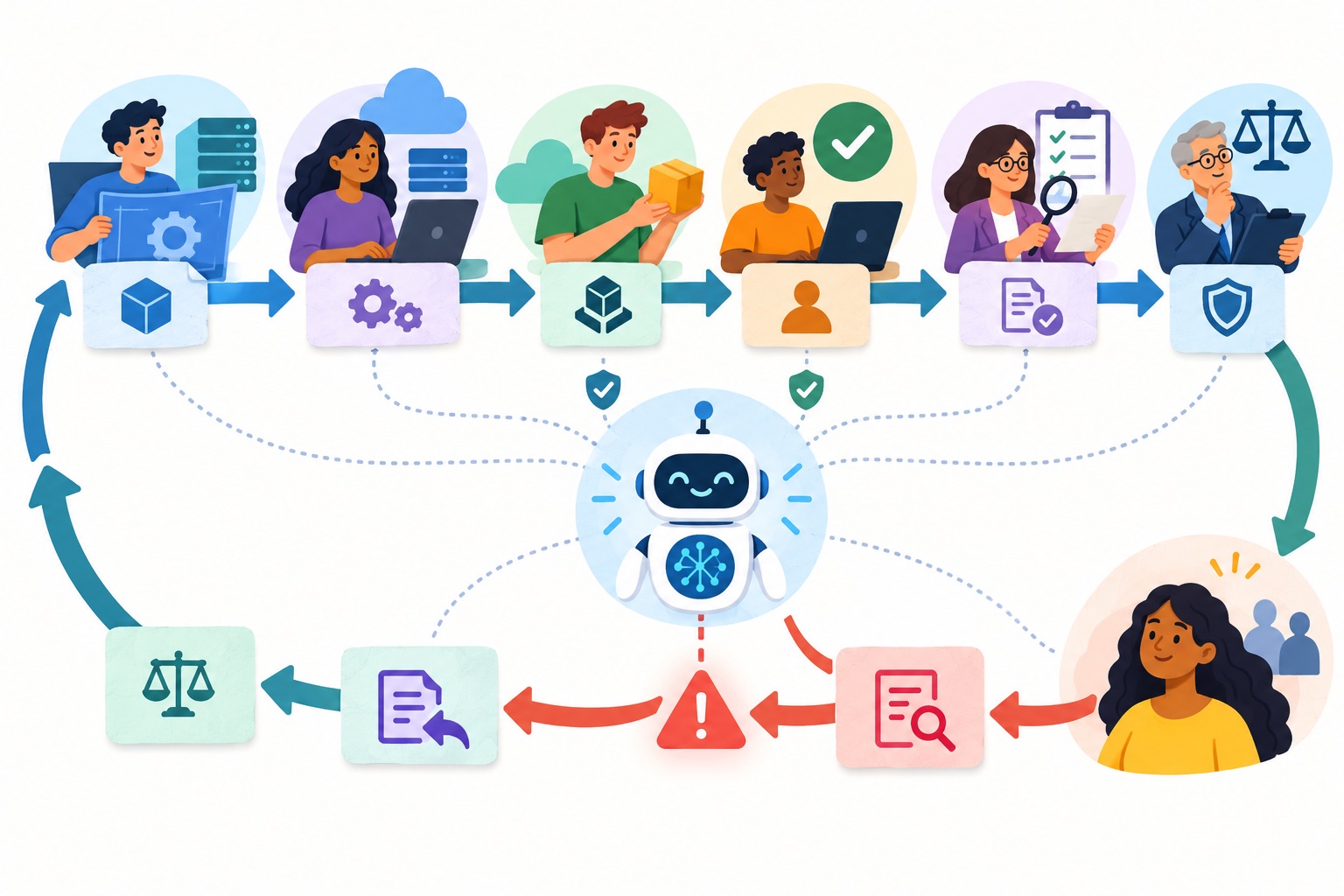
Accountability moves forward through authorization and backward through investigation, explanation, and remedy.
What Serious AI Accountability Frameworks Say
Major frameworks do not use identical language, and they do not settle every liability question. Yet they converge on several operational ideas: define roles, keep human authority, document decisions, monitor performance, create intervention paths, and preserve evidence across the lifecycle.
NIST: accountability must be structured and owned by leadership
The NIST AI Risk Management Framework Core makes governance a cross-cutting function rather than a final review step. GOVERN 2 calls for accountability structures in which appropriate teams and individuals are empowered, responsible, and trained. It also states that executive leadership takes responsibility for decisions about risks associated with AI development and deployment. GOVERN 3.2 calls for policies that distinguish human and AI roles and oversight responsibilities.
That matters for agents because accountability fails when everyone is nominally involved but nobody has authority to say no. A named owner without budget, technical access, escalation power, or executive support is a label, not an accountability mechanism. Our practical guide to the NIST AI RMF’s Govern, Map, Measure, and Manage functions explains how those pieces work together.
GAO: governance is not enough without data, performance, and monitoring
The U.S. Government Accountability Office framework organizes practices around governance, data, performance, and monitoring. This prevents a common mistake: treating accountability as an org-chart exercise. A committee and policy can assign roles, but the organization must also know what data enters the system, whether results meet objectives, and whether reliability changes after deployment.
OECD: accountability follows lifecycle roles
The OECD principle makes an important distinction: accountability applies according to a party’s role and applicable frameworks. The model provider, deployer, operator, and auditor need not own the same duties. What matters is that the lifecycle has no orphaned decisions and that each actor can demonstrate what it did.
Singapore: humans remain meaningfully accountable for agentic AI
Singapore’s Model AI Governance Framework for Agentic AI groups guidance into four dimensions: assess and bound risks upfront, make humans meaningfully accountable, implement technical controls and lifecycle processes, and enable end-user responsibility. The framework is especially useful because it addresses agents that can reach sensitive data or change their environment. It also recognizes automation bias: a human checkpoint can become ineffective when people learn to trust an apparently reliable agent.
Australia: assign a human even when the agent acts across many steps
The Australian Government’s agentic AI addendum says agencies should assign human accountability for agent decisions and outcomes, including complex multi-agent systems. It connects that assignment to documentation, traceability, monitoring, review at key stages, intervention for irreversible or high-risk actions, and clear escalation paths.
European Union: provider and deployer duties can coexist
The European Commission’s AI Act guidance illustrates why “the vendor is responsible” is incomplete. For high-risk systems, providers have safety and compliance duties. Deployers also have duties, including using the system according to instructions, monitoring operation, responding to risks or serious incidents, and assigning people who are equipped to exercise human oversight. Applicability depends on the system and context, but the structural lesson is broad: upstream and downstream obligations can exist at the same time.
Cloud platforms: shared responsibility does not mean equal responsibility
Microsoft’s AI agent shared responsibility model separates duties across infrastructure, platform, agent builder, and customer layers. Vendor-specific models should not be treated as law, but they are operationally helpful. They show how security, tool permissions, acceptable use, oversight, and monitoring can be distributed. The customer cannot outsource the choice to give an agent access to payroll, production, or customer communications merely because the runtime is managed.
The AI Agent Accountability Chain
An accountability chain is a role map tied to decisions and evidence. It is not a claim that every role has the same legal duty. It is a practical way to stop important decisions from falling between teams.
| Lifecycle role | Core responsibility | Evidence to preserve | Failure question |
|---|---|---|---|
| Model provider | Evaluate and communicate model capabilities, limitations, security risks, and relevant changes. | System documentation, evaluation results, release notes, known limitations. | Was a relevant capability or risk reasonably tested and disclosed? |
| Agent platform provider | Secure orchestration, identity, tool execution, isolation, logging, and administrative controls. | Control configuration, service logs, platform alerts, security documentation. | Did the platform enforce the promised boundary? |
| Builder or integrator | Translate policy into workflow logic, permissions, tests, fallbacks, and usable review interfaces. | Design decisions, threat model, tests, code changes, evaluation evidence. | Was the workflow fit for its declared purpose and foreseeable failure modes? |
| Deploying organization | Select the use case, determine acceptable risk, configure the environment, and maintain governance. | Use-case approval, risk assessment, vendor review, data map, operating policy. | Should this agent have been deployed with this authority in this context? |
| Accountable executive or business owner | Own the outcome, accept residual risk, resource controls, and decide whether operation continues. | Signed decision record, exceptions, risk acceptance, review cadence. | Who had authority to approve, constrain, pause, or retire the system? |
| Operator or user | Provide lawful goals, follow procedures, verify required inputs, and escalate anomalies. | Initiator identity, prompt or task request, attached data, acknowledgments. | Was the agent used within its mandate and operating procedure? |
| Human reviewer | Exercise informed judgment at consequential checkpoints rather than rubber-stamp output. | Decision context, evidence shown, approval, override, reason, time available. | Was review meaningful, and was the reviewer equipped to detect the risk? |
| Security, risk, legal, and compliance | Set control requirements, test threats, interpret obligations, and challenge assumptions. | Assessments, findings, exceptions, remediation status, escalation records. | Were known gaps surfaced, prioritized, and closed or consciously accepted? |
| Independent assessor or auditor | Test whether claims and controls are supported by evidence. | Assessment scope, samples, findings, management responses. | Could an independent party reconstruct the material decisions? |
| Affected person | Receive notice, explanation where applicable, a route to challenge, and meaningful remedy. | Notice, complaint, appeal, correction, compensation or restoration record. | Could the person understand, contest, and recover from the outcome? |
The essential design choice is to preserve one accountable owner for the use case while assigning many responsible contributors. If every team is “jointly accountable,” no team may feel able to stop the system. If only the operator is accountable, the organization may hide structural failures behind the last human in the chain. If only the vendor is accountable, the deployer ignores its control over context, permissions, data, and operating purpose.
The chain should also survive handoffs. When a model version changes, a tool is added, a workflow expands, or a business unit inherits the agent, the owner and evidence must move with it. An AI agent registry helps maintain that continuity, but the registry must link to living owners and controls rather than becoming a static inventory.
What Is Known—and What Remains Uncertain
Reasonably clear
- An AI agent cannot carry an organization’s moral or operational accountability.
- More autonomy and more consequential tool access require stronger governance.
- Human oversight needs authority, time, competence, and usable evidence.
- Providers and deployers can hold different but simultaneous duties.
- Documentation and monitoring are necessary for accountability to be demonstrable.
- Affected people need routes for correction and remedy when stakes are meaningful.
Context-dependent or unsettled
- Which party has legal liability for a specific harm in a specific jurisdiction.
- How existing concepts of intent, negligence, agency, and product liability apply to highly autonomous behavior.
- What level of precaution is reasonable for an emerging capability.
- When a model provider could have foreseen misuse or an unexpected action.
- How responsibility should be allocated across multi-agent and cross-company chains.
- Which technical explanations are sufficient for regulators, courts, users, or auditors.
Recent reporting has made these uncertainties more visible. The Associated Press examined legal accountability questions raised by autonomous-system incidents, including how intent and safeguards may be assessed. News reports establish that the debate is current; they do not establish a universal rule. Organizations should avoid drafting internal policy as if an unresolved court question already had one global answer.
Meaningful Human Oversight Is More Than an Approval Button
A human checkpoint can improve accountability, but only when the human can genuinely influence the result. The existence of an “Approve” button does not prove oversight. If a reviewer sees a vague summary, has five seconds to decide, handles hundreds of alerts, lacks domain expertise, or faces pressure never to delay the workflow, approval becomes theater.
Meaningful oversight has at least six conditions:
- Clarity: the reviewer knows what decision is being made, what the agent proposes, and what consequences can follow.
- Evidence: the interface shows relevant sources, uncertainty, policy checks, conflicts, and material assumptions—not merely a fluent recommendation.
- Competence: the reviewer has enough domain knowledge and training to recognize a problem.
- Authority: the reviewer can reject, modify, pause, escalate, or request more evidence without retaliation.
- Time: the workflow allows deliberation proportional to the stakes.
- Feedback: overrides, incidents, and recurring disagreements change the system rather than disappearing into a log.
Oversight mode should match risk. Human-in-the-loop review is appropriate when a consequential action requires approval before execution. Human-on-the-loop supervision can fit bounded, reversible activity when operators can observe and intervene. Periodic audit may be sufficient for low-impact, recoverable tasks. Our guides to human-in-the-loop approval patterns and when AI agents should ask for approval show how to place those checkpoints.
Do not route every action to a human. That overwhelms reviewers and teaches them to approve by habit. Route the right actions: irreversible changes, high-value transfers, rights-affecting decisions, external commitments, privileged access, policy exceptions, low-confidence cases, unusual tool sequences, and actions whose impact crosses a defined threshold.
The Minimum AI Accountability Evidence Packet
Accountability must be reconstructable. When an incident, audit, complaint, or near miss occurs, investigators should not have to guess what authority existed. A practical evidence packet connects identity, purpose, policy, execution, and outcome.
- Use-case charter: intended purpose, prohibited uses, affected people, owner, and review date.
- Agent identity: stable identifier, version, model, orchestrator, tools, service accounts, and environment.
- Authority grant: who authorized deployment, which permissions were granted, what limits applied, and when access expires.
- Risk decision: risk classification, key hazards, accepted residual risks, required mitigations, and exception approvals.
- Task provenance: initiating person or system, original goal, inputs, relevant context, and delegated sub-tasks.
- Policy state: the exact policy, prompt, rules, tool schemas, and safeguard versions active at execution time.
- Action trace: proposed actions, tool calls, parameters, results, errors, retries, and external side effects.
- Evidence trace: sources consulted, conflicts, freshness, missing information, and critical assumptions.
- Human decisions: what the reviewer saw, approval or override, reason, timestamp, and escalation.
- Outcome record: what changed in the world, who was affected, whether the result was reversible, and whether downstream systems propagated it.
- Monitoring record: alerts, policy violations, unusual behavior, drift, complaints, and near misses.
- Response and remedy: containment, notification, correction, restoration, compensation where applicable, lessons, and control changes.
Retention should be proportionate to the risk and legal context. Keeping every internal token or hidden reasoning trace may be unnecessary, unreliable, privacy-invasive, or impossible. Focus on decision-relevant evidence: inputs, sources, policies, actions, tool results, approvals, and outcomes. Protect the records as sensitive operational data. Accountability logs can themselves expose personal data, security architecture, privileged credentials, and confidential decisions.
An AI evaluation evidence package supports the pre-deployment side of this record. An AI agent incident response runbook supports the post-incident side. Accountability connects the two: the same owner who accepts evidence before launch must ensure that failures change future decisions.
A Worked Scenario: An AI Agent Issues the Wrong Customer Refund
Imagine a customer-service agent that can read support history, interpret policy, issue credits, modify subscriptions, and send messages. A customer asks for a billing correction. The agent misreads a policy exception, issues a refund ten times larger than intended, cancels the wrong subscription, and emails an inaccurate explanation.
A weak investigation asks, “Why did the model hallucinate?” That question is relevant, but it is incomplete. An accountable investigation asks a chain of questions:
- Why could one workflow both calculate and execute a high-value refund?
- Was the agent’s monetary authority bounded per action, customer, and time period?
- Did the policy retrieval return the current rule and the correct regional exception?
- Did a deterministic check compare the refund with the original charge?
- Was human approval required above a threshold?
- What evidence did the reviewer see, if anyone approved it?
- Why could cancellation occur in the same task without separate confirmation?
- Did monitoring flag an unusual amount or action sequence?
- Could the organization reverse the transaction and restore the subscription quickly?
- How was the affected customer informed and made whole?
The model provider may be responsible for communicating relevant limitations. The platform team may be responsible for reliable identity, policy enforcement, and logging. The builder may be responsible for missing amount checks and poorly separated tools. The business owner may be accountable for granting excessive authority. The operator may be responsible if they bypassed procedure. A reviewer may be responsible if they ignored a clear warning—but not if the interface hid the key fact. Legal liability will depend on the facts and law. The organization still needs one owner who ensures the customer is restored, the agent is constrained, the incident is reported where required, and the controls improve.
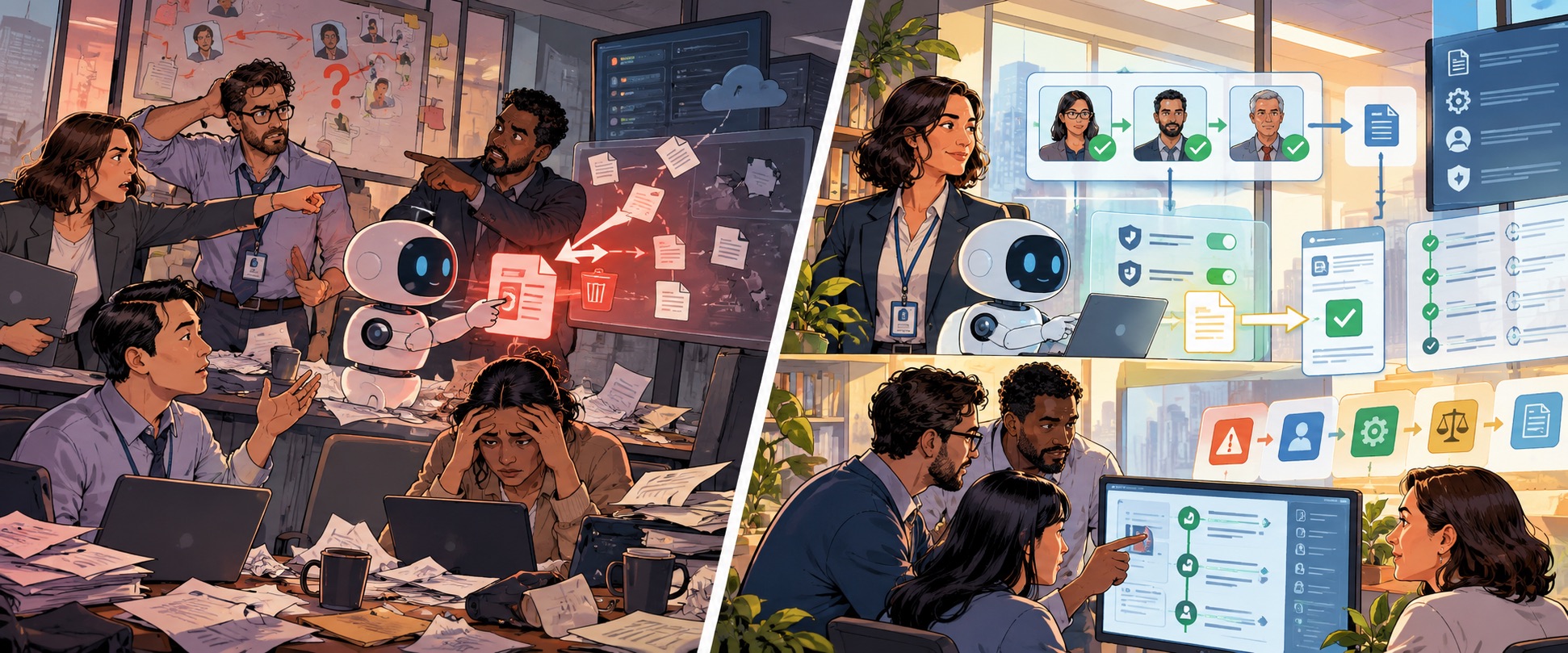
The same agent capability can produce very different outcomes depending on permissions, ownership, evidence, and response design.
This is also why AI near-miss reporting matters. A blocked excessive refund is not merely a successful safeguard. It is evidence that the workflow reached a dangerous state. Treating the event as a learning signal can prevent the later incident.
How to Measure Whether Accountability Works
Accountability is not measured by the number of policies signed. Measure whether owners act, controls surface useful signals, people intervene, and harm is repaired. NIST’s playbook recommends documenting oversight, overrides, complaints, response times, escalations, and go/no-go decisions. For an agent program, a compact scorecard can include:
| Measure | What it reveals | Warning sign |
|---|---|---|
| Owner coverage | Share of active agents with a named accountable owner and current review date. | Agents exist in production with blank or departed owners. |
| Authority coverage | Share of consequential tools with explicit scope, limits, and expiry. | Standing credentials or inherited broad permissions. |
| Review quality | Override rate, evidence viewed, decision time, and disagreement patterns. | Near-zero overrides combined with rapid approvals. |
| Trace completeness | Whether investigators can connect initiator, policy, action, approval, and outcome. | Tool calls exist without user, policy, or outcome context. |
| Exception debt | Open policy exceptions, age, owner, and compensating controls. | Temporary exceptions become permanent. |
| Near-miss learning | Signals captured, analyzed, and translated into control changes. | Blocked harm is celebrated but not investigated. |
| Time to contain and remedy | How quickly the organization stops spread and repairs impact. | Fast technical containment but slow customer correction. |
| Repeat failure rate | Whether corrective actions actually reduce recurrence. | The same root cause appears across agents or teams. |
Metrics need interpretation. A high override rate can mean reviewers are doing good work, or that the agent is poorly calibrated. A low incident rate can mean the system is safe, or that reporting is weak. Combine counts with sampling, qualitative review, and tests. The goal is not to optimize a dashboard. The goal is to reveal where the accountability chain is brittle.
Interactive AI Agent Accountability Mapper
Use this lightweight decision helper to identify the minimum ownership and control posture for a proposed agent task. It is a governance prompt, not a legal assessment.
How to Build AI Agent Accountability Before Deployment
The best time to decide who is responsible is before the first production action. Use the following sequence as a governance gate.
Define the outcome, affected people, and prohibited uses
Describe the real-world result, not only the model task. “Answer support questions” is too vague if the agent can change accounts. State who can be affected, what harm could occur, and which decisions remain outside the agent’s mandate.
Name one accountable owner
Select a person with authority over the business outcome and resources to manage risk. Record deputies and escalation paths, but do not replace ownership with a committee. The owner should sign the deployment decision and review material changes.
Map every contributing role and vendor boundary
List model providers, platform providers, integrators, data owners, tool owners, operators, reviewers, security, compliance, incident response, and support. Examine contracts and service boundaries. Shared responsibility should produce clearer handoffs, not a promise that someone else will handle the problem.
Translate policy into runtime authority
Give the agent the least privilege required. Use separate identities, allowlisted tools, scoped tokens, amount limits, destination limits, rate limits, time bounds, sandboxing, and separate confirmation for irreversible actions. Written policy that the runtime cannot enforce is advisory.
Design meaningful review and intervention
Choose which actions require approval, what evidence a reviewer sees, who can pause the system, and how alerts escalate. Test the interface with realistic workload. Track whether reviewers understand the decision and actually use their authority.
Build the evidence packet into the workflow
Capture identity, policy version, task provenance, sources, tool calls, approvals, and outcomes automatically. Do not rely on people to reconstruct critical context after an incident. Set retention, access, privacy, and integrity controls for the records.
Test failures, not only successful tasks
Evaluate prompt injection, stale data, conflicting instructions, tool errors, ambiguous outcomes, permission escalation, unexpected sub-agent behavior, and reviewer fatigue. Use the frontier AI red-teaming checklist for adversarial thinking, then tailor tests to the actual workflow.
Prepare reporting, containment, and remedy
Define what counts as a near miss or incident, who receives the alert, what must be preserved, when external notification may apply, and how the organization restores affected people. Our AI incident reporting guide explains how to distinguish operational noise from reportable harm.
Re-authorize material changes
A new model, tool, permission, data source, user population, decision type, or level of autonomy can invalidate the original approval. Tie change management to the registry and owner. Do not assume a better benchmark score makes the old accountability decision safer.
Retire the agent safely
Revoke credentials, disable schedules, archive necessary evidence, notify dependent teams, resolve open cases, and verify that shadow copies are not still running. Accountability includes the end of the lifecycle, not only launch.
What to Watch as AI Agent Accountability Evolves
Three developments will shape the next phase. First, governments and standards bodies are moving from general AI principles toward agent-specific guidance. Singapore’s framework and Australia’s addendum already emphasize bounded power, meaningful human accountability, lifecycle controls, and traceability. More sectors will likely adapt these ideas to finance, health, employment, public services, and critical infrastructure.
Second, technical controls will move closer to the action boundary. Identity-aware tool gateways, policy engines, runtime isolation, immutable event records, and automated stop conditions can make governance executable. These tools help, but they do not decide acceptable purpose or residual risk. A technical control can enforce a threshold; humans still choose the threshold and answer for its consequences.
Third, accountability will increasingly include remedy, not merely explanation. A perfect log does not restore a canceled benefit, reverse reputational damage, or correct a record that spread across systems. Mature organizations will measure how quickly they identify affected people, halt propagation, correct decisions, and learn. Accountability becomes real when evidence leads to repair.
A Responsible Agent Has a Responsible Organization Around It
AI agent accountability is not solved by putting a human somewhere in the diagram. It is solved by connecting authority, ownership, controls, evidence, intervention, and remedy across the entire lifecycle. The agent may select actions. Humans still choose the purpose, provide access, define the limits, approve the deployment, monitor the operation, investigate failure, and repair harm.
The most important move is simple: name the owner before granting the authority. Then make that ownership operational through least privilege, meaningful review, traceable decisions, tested incident response, and a path for affected people to challenge and correct outcomes.
Frequently Asked Questions About AI Agent Accountability
Can an AI agent be legally responsible for harm?
Current operational and governance frameworks generally place accountability on people and organizations rather than treating the AI agent as the party that can accept duties, be trained, hold assets, provide remedy, or answer to an authority. Precise legal liability depends on the jurisdiction, type of harm, applicable law, contracts, and facts. Organizations should not assume that autonomy transfers their obligations to the software.
Is the AI developer always responsible when an agent causes harm?
No single rule fits every case. A model developer, platform provider, workflow builder, deploying organization, operator, or professional may hold different responsibilities. The deployer controls the use case, local data, permissions, workflow, users, and operating context, while providers control other layers. Accountability analysis should examine each role and the decisions it controlled.
Who should be the accountable owner inside a company?
The owner should be a named person with authority over the business outcome, not merely the technical component. That is often a business or product executive who can accept risk, fund controls, pause the system, and ensure remedy. Engineering, security, risk, legal, and operations remain responsible for their parts, but the use case still needs one clear accountable owner.
Does a human approval step make an AI agent accountable?
No. It can strengthen the organization’s accountability only if the reviewer receives decision-relevant evidence, has appropriate competence, time, and authority, and can reject or escalate the action. A rushed approval button with poor context may transfer blame to a human without giving that person real control.
What is the difference between accountability and liability?
Accountability is the obligation to answer for decisions and ensure appropriate action across a role. Liability is a legal obligation arising under applicable law. An organization can be operationally accountable for investigating and repairing an incident even when legal liability is disputed. Conversely, a party may face legal duties even if it did not directly operate the agent.
What records should an organization keep for an AI agent?
For consequential workflows, keep the use-case approval, owner, agent identity and version, authority grant, active policies, initiator, inputs, sources, tool calls, safeguards, human approvals or overrides, resulting changes, alerts, incidents, and remedies. Retention and access should reflect risk, privacy, security, and applicable legal requirements.
Who is responsible for a third-party AI agent?
The vendor remains responsible for duties attached to its product and service, but the customer organization remains responsible for its deployment choices: purpose, configuration, data, permissions, users, monitoring, and response. Contracts should clarify boundaries, evidence access, incident cooperation, changes, and remedy, but a contract cannot automatically erase statutory or professional duties.
How should accountability work in a multi-agent system?
Assign a human owner for the overall outcome and document the role, authority, identity, and handoff rules of each agent. Preserve message and tool provenance across delegation hops. A multi-agent architecture should not create multiple unowned zones. The orchestrator, sub-agents, tools, and external services all need traceable boundaries and intervention paths.
What should happen after an AI agent near miss?
Treat the near miss as evidence that the workflow entered a dangerous state. Preserve the trace, identify the failed or successful safeguard, examine whether the risk could recur elsewhere, assign corrective actions, and verify closure. A blocked harmful action is not proof that the design is finished; it is a chance to learn before damage occurs.

