
TRENDS & INSIGHTS
Agentic AI Trends 2026: The Enterprise Shift From Chatbots to Governed AI Agents
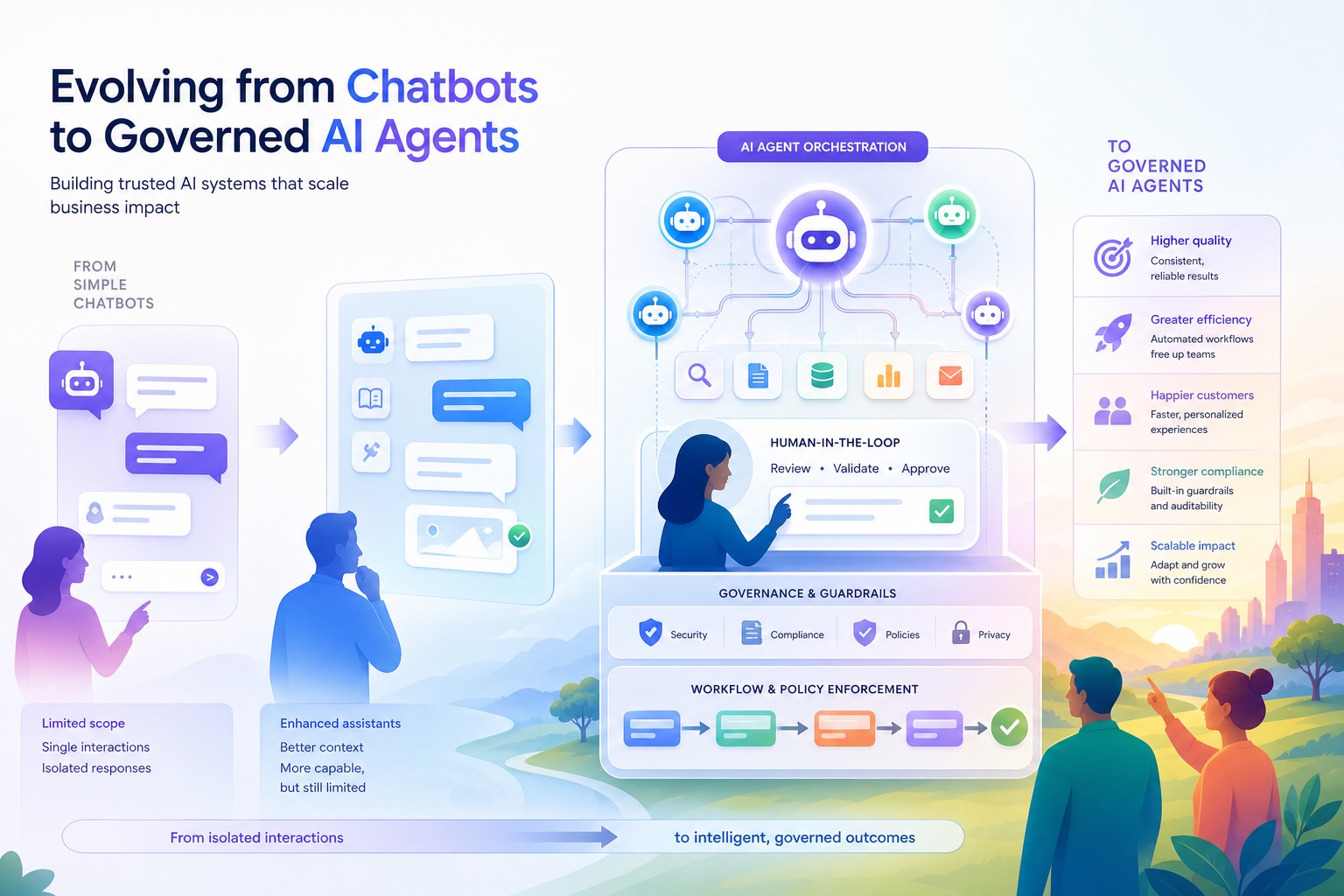
Agentic AI trends 2026 are not just about smarter chatbots. The real enterprise shift is toward governed AI agents that can act, use tools, coordinate work, escalate risk, and leave an audit trail that humans can trust.

Quick answer: agentic AI trends 2026 are about governed action
The simplest way to understand the 2026 agentic AI shift is this: enterprises are moving from systems that answer to systems that act. A chatbot can summarize a policy. A copilot can help a worker draft a response. An AI agent can inspect a ticket, retrieve customer context, choose a tool, update a record, draft a message, request approval for a risky action, and log what happened.
That does not mean every workflow should become autonomous. In fact, the strongest trend is more disciplined autonomy. The winning organizations are likely to be the ones that give agents narrow authority, clear success criteria, strong observability, and human escalation rules. This is why the discussion is shifting from model capability alone to operating-model questions: who owns the workflow, which actions are reversible, what data is trusted, when must a human approve, and how do leaders prove the system is helping rather than quietly adding risk?
From prompts to processes
The question changes from “Can AI answer?” to “Can AI complete a workflow safely?”
From review to control
Human review is useful only when escalation rules, logs, and authority boundaries are clear.
From pilots to proof
Teams need measurable outcomes, not vague claims that agents are “transformational.”
What changed: AI agents moved from demo language into enterprise architecture
For most of the generative AI boom, the default interface was a chat box. That shaped how leaders thought about AI: write better prompts, paste better context, and ask better questions. Agentic systems change the unit of design. Instead of building around a conversation, teams build around a goal, a set of tools, a policy boundary, and a feedback loop.
The OECD’s 2026 report on agentic AI is useful because it separates basic AI agents from broader agentic AI systems. In the report’s framing, agents can perceive, use tools, act in an environment, and adapt to changing inputs. Agentic AI puts more emphasis on coordinated agents, task decomposition, delegation, longer time horizons, and more open-ended environments. That distinction matters because a customer-service bot, a coding assistant, and a multi-agent operations workflow should not be governed the same way.
At the same time, enterprise reports are converging around a similar message. Microsoft’s 2025 Work Trend Index describes “Frontier Firms” organized around human-agent teams and a new “agent boss” role. Salesforce’s Agentic Enterprise Index reports rapid early growth in agent creation and agent-led service conversations among active Agentforce customers. Stanford’s 2026 AI Index shows capability gains, but it also warns that responsible AI practices and incident tracking remain serious concerns.
Those signals should be read carefully. Vendor usage data can show real product momentum, but it is not the same as economy-wide adoption. Survey data can show executive intent, but it does not prove production reliability. Benchmark gains can show technical progress, but a benchmark is not a live enterprise workflow with messy data, legacy systems, privacy constraints, and customers waiting for a correct answer. The practical conclusion is balanced: agentic AI is real, but production value depends on governance, workflow design, and operational discipline.
Evidence from reports: what is fact, what is signal, and what is interpretation
| Source | What it says | How to use it | Caution |
|---|---|---|---|
| Microsoft Work Trend Index 2025 | Frames the rise of Frontier Firms, human-agent teams, and agent bosses. | Use as evidence that large enterprises are planning operating-model changes around agents. | It is a Microsoft report, so separate strategic framing from neutral measurement. |
| Salesforce Agentic Enterprise Index H1 2025 | Reports strong early growth in agent creation and agent-led customer-service conversations among active users. | Use as a signal that agents are moving into customer-facing workflows. | It reflects Salesforce customers and product usage, not the whole market. |
| Stanford AI Index 2026 | Shows broad capability progress and continued responsible AI concerns. | Use to ground the “capability up, governance lagging” story. | Benchmarks do not guarantee reliability inside messy workflows. |
| OECD Agentic AI Report 2026 | Clarifies definitions and autonomy levels for AI agents and agentic AI. | Use to define terms and avoid hype. | Conceptual clarity does not equal deployment guidance by itself. |
| McKinsey State of AI 2025 | Public snippets and secondary references indicate enterprise experimentation and scaling of agentic AI. | Use as supporting market signal, especially for business adoption context. | Do not overstate specific numbers unless verified directly from the source page or report. |
The pattern across these sources is not “agents will replace everyone.” It is more specific: organizations are testing whether AI can move from assistance into delegated work. That delegated work requires a system of trust. Trust is not only about model accuracy. It includes identity, permission scope, reliable context, source freshness, human escalation, rollback, monitoring, and accountability.
Community research reinforces the same hidden intent. Reddit and developer discussions are full of practical questions: Are companies actually deploying agents or just rebranding chatbots? How do we stop an agent from taking a sequence of individually reasonable actions that becomes dangerous? Is human-in-the-loop real governance if the AI decides what to show the human? These are demand signals, not authoritative evidence, but they reveal the questions a good trend article must answer.
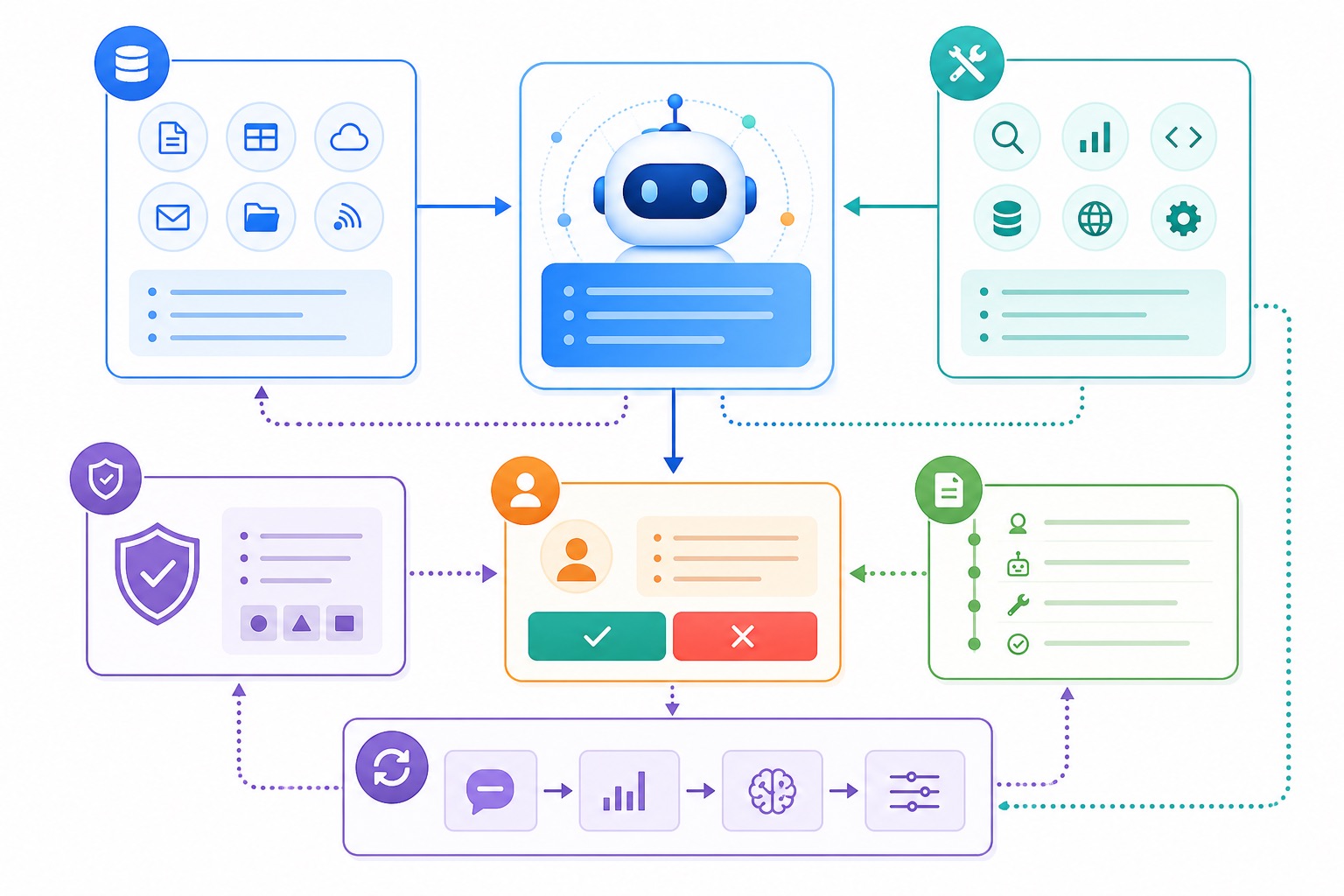
The 9 agentic AI trends enterprise teams should watch
1. The chatbot-to-agent distinction becomes a buying requirement
In 2026, serious buyers will ask vendors to prove whether a system is a chatbot, copilot, task agent, or agentic workflow. The distinction is not cosmetic. A chatbot needs content quality and retrieval accuracy. A copilot needs user experience and productivity measurement. A task agent needs tool permissions, error handling, and logs. A multi-agent workflow needs orchestration, observability, and conflict resolution.
This matters for SEO, product marketing, and procurement because “AI agent” is becoming a broad label. Leaders should define agent capabilities in plain language: what goal can it pursue, what tools can it call, what data can it read, what actions can it take, how does it stop, and when does it ask for help?
2. Control planes become the enterprise layer everyone discovers late
The control-plane trend is simple: if agents can act, someone must govern action. A control plane is the layer where policies, identities, tools, approvals, logs, and observability come together. Singularity Journey has already covered this in AI Agent Control Plane: Identity, Permissions, Logs, and Human Review, and the need is becoming more obvious as agents move from experiments to workflows.
The old AI stack was often model plus prompt plus retrieval. The agentic stack adds runtime policy. It asks whether a tool call is allowed, whether a user has authority, whether the action is reversible, whether the system has enough fresh context, and whether an approval should be mandatory. This is where many demos fail: they show a successful happy path but hide the operational layer that production requires.
3. Human-in-the-loop matures into human-governed autonomy
Human-in-the-loop is too often used as a comfort phrase. A human approving a final summary is not enough if the risky step happened earlier, the source data was stale, or the escalation decision was made by the same system being governed. The 2026 pattern is more precise: humans define autonomy zones, mandatory escalation rules, policy exceptions, and rollback requirements.
A good approval design does not ask humans to review everything. It asks humans to review the right things. Low-risk, reversible, well-bounded actions can be automated. Medium-risk actions can be constrained, sampled, or batched for review. High-risk or irreversible actions should require approval before execution. For a deeper implementation view, see Human Approval for AI Agents.
4. Observability moves from “nice to have” to agent safety infrastructure
Traditional software observability tracks uptime, latency, errors, traces, and logs. Agent observability must also track intent, tool calls, memory changes, context sources, escalation decisions, refusals, retries, and near misses. If an agent took ten small steps before making a bad decision, the audit trail must show the sequence.
This is not only a debugging need. It is a trust need. A leader cannot responsibly expand autonomy if no one can answer: What did the agent see? What did it infer? Which tool did it call? What policy allowed the action? Did it ignore contradictory context? Did a human approve? Could the action be reversed?
5. Enterprise adoption concentrates in bounded workflows first
The best early agent workflows share practical constraints: high volume, clear success criteria, recoverable errors, available data, and a human escalation path. Customer support triage, internal knowledge research, sales follow-up, software development assistance, IT ticket handling, and document processing all fit this pattern better than open-ended executive decision-making.
That is why trend hype should be filtered through workflow quality. “Can an agent do this?” is less useful than “Is this workflow ready for an agent?” A workflow with unclear ownership, messy data, irreversible consequences, and political exceptions is not a good first use case, even if the model can sound competent.
6. Agent security expands beyond prompt injection
Prompt injection remains important, but agents introduce additional failure modes: tool misuse, overbroad credentials, memory poisoning, insecure delegation, hidden data exfiltration, and approval laundering. A compromised agent can look legitimate because it uses allowed tools in allowed formats. The problem is often the sequence, context, or authority behind the action.
Security teams should think in terms of least privilege, per-action authorization, session-level risk scoring, tamper-evident logs, sandboxing, output validation, and emergency stop mechanisms. Related Singularity Journey guides such as AI Agent Evaluation and AI Agent Governance Framework can support this cluster.
7. Human-agent teams change skills and management
Microsoft’s “agent boss” framing may sound provocative, but the underlying skill shift is real. Workers who use agents well will need to break goals into tasks, define acceptance criteria, check outputs, monitor exceptions, and decide when a process should not be delegated. That is closer to workflow management than prompt writing.
For individuals, this connects to career strategy. The useful skill is not “I can ask ChatGPT questions.” It is “I can design, test, govern, and improve a human-agent workflow.” Singularity Journey’s AI Agent Careers and AI Skills to Learn in 2026 are natural next reads for that angle.
8. Evaluation shifts from answer quality to task success
Agent evaluation must include more than “Was the response good?” Teams need to measure task completion, tool-call correctness, recovery from bad inputs, cost, latency, approval burden, incident rate, user satisfaction, and whether the agent actually reduced work. For production reliability, retries and idempotency matter. See Durable AI Agent Workflows and AI Agent Idempotency for implementation detail.
The trend is toward evaluation harnesses that simulate the workflow, not only the model. A model can pass a benchmark and still fail because the tool schema is vague, the memory is stale, the retrieval source is wrong, or the action was not reversible.
9. The winning narrative becomes “trusted autonomy,” not “full autonomy”
The most credible 2026 agentic AI narrative is not that agents should be unleashed everywhere. It is that some work can become more autonomous when the system is bounded, observable, and accountable. The word “trusted” matters because trust is earned through controls, not claimed through demos.
That is the difference between trend-following and strategy. Trend-following says, “Everyone is deploying agents, so we need agents.” Strategy says, “Which workflow deserves delegated action, what control plane do we need, and what evidence would prove this system is safer and more valuable than the current process?”
An enterprise readiness framework for agentic AI trends 2026
Use this framework before you expand an agent from pilot to production. It is intentionally practical because the largest gap in agentic AI content is not imagination; it is operational readiness.
| Readiness area | Ask this question | Green light | Red flag |
|---|---|---|---|
| Workflow fit | Does the task have clear success criteria? | Output can be checked objectively. | Success depends on politics, taste, or hidden exceptions. |
| Data quality | Does the agent see reliable, current context? | Sources are fresh, owned, and traceable. | Data is stale, duplicated, or contradictory. |
| Authority | Who is allowed to take this action? | Permissions are scoped by user, tool, and action. | The agent inherits broad credentials. |
| Reversibility | Can bad actions be undone? | Rollback is tested and logged. | Actions affect money, safety, compliance, or customers permanently. |
| Approval | When must a human approve? | High-risk actions trigger mandatory approval. | The agent decides alone what deserves escalation. |
| Observability | Can you reconstruct what happened? | Tool calls, context, decisions, approvals, and outcomes are logged. | Only final answers are visible. |
| Measurement | How will value be proven? | Cost, task success, cycle time, quality, and incident rate are tracked. | ROI is assumed from usage alone. |
Interactive: should this workflow use an AI agent now?
Select the statements that are true. This is a decision helper, not a compliance assessment.
What builders and leaders should do next
For business leaders
Start by choosing one workflow where autonomy can be bounded. Do not begin with the most strategic, exception-heavy process in the company. Pick a repetitive workflow where the current cost of delay is visible and the risk of a wrong action can be contained. Write a one-page autonomy charter: what the agent may do, what it may never do, which actions require approval, how success is measured, and who owns incidents.
For technical teams
Build the runtime before the showcase. A useful proof of concept should include tool schemas, scoped credentials, logging, retry logic, evaluation cases, and an approval path. If the demo cannot explain why an action was allowed, it is not ready for production. If the system cannot stop safely, it should not act autonomously.
Agent readiness checklist:
1. Define the goal and stop condition.
2. Map every tool the agent can call.
3. Assign risk tiers to each action.
4. Require approval for irreversible or sensitive actions.
5. Log context, tool call, policy decision, approval, and outcome.
6. Test happy paths, edge cases, stale data, and malicious inputs.
7. Compare against a human or existing workflow baseline.
For SEO and content teams
The search opportunity around agentic AI trends is crowded but still fragmented. Many results are vendor-led predictions. A stronger content strategy should create a topic cluster around definitions, implementation, evaluation, security, governance, and careers. Internally, this article should link toward AI Agents Explained, How to Build AI Agents in 2026, and AI Agent Tools Explained.
Final insight: the agentic AI winners will be boring in the right places
The most durable agentic AI trend in 2026 will not be the flashiest demo. It will be the quiet operational work that makes delegated action safe: scoped tools, reliable context, mandatory approvals, observability, evaluation, rollback, and clear accountability. The more powerful agents become, the more important these boring layers become.
This is good news for serious builders. The market does not need more vague claims that agents will transform everything. It needs practical systems that transform specific workflows without hiding risk. The organizations that win will not simply adopt agents faster. They will learn where agents belong, where humans must stay in control, and how to prove the difference.
FAQ: agentic AI trends 2026
What are the biggest agentic AI trends in 2026?
The biggest trend is the shift from chat-style AI to governed agents that can plan, use tools, trigger workflows, and work with humans. The supporting trends are enterprise control planes, human-agent teams, observability, agent security, and more careful selection of workflows where autonomy is actually appropriate.
Are enterprises really using AI agents in production?
Some are, especially in service, sales, software, IT operations, and knowledge workflows, but adoption is uneven. Reports from Microsoft, Salesforce, McKinsey, and Stanford suggest growing usage, while community signals show many teams are still sorting out the difference between demos, copilots, and production agents.
How is agentic AI different from a chatbot?
A chatbot mainly responds to prompts. An AI agent can use tools, make plans, and take actions toward a goal. Agentic AI usually refers to a more coordinated system of one or more agents that can decompose tasks, collaborate, and operate with more autonomy over longer workflows.
Why do AI agents need a control plane?
A control plane gives enterprises a place to manage identity, permissions, policy, approvals, tool access, logs, observability, and rollback. Without it, agents can look productive while acting through unclear authority boundaries.
Should humans approve every AI-agent action?
No. Reviewing every action does not scale. The better pattern is risk-tiered approval: low-risk reversible actions can run automatically, medium-risk actions can be constrained or sampled, and high-risk or irreversible actions should require mandatory human approval.
What should teams do first in 2026?
Start with one workflow that has clear success criteria, recoverable errors, reliable data, and obvious business value. Build logging, approval, testing, and rollback before expanding autonomy.
