
AI Capability Evaluations Explained: How Frontier Models Are Tested Before Release
Capability evaluations are becoming one of the most important control points on the path to more autonomous AI. This guide explains what evaluators test, how red teams look for dangerous behavior, why benchmark scores are not enough, and how human oversight turns test results into safer deployment decisions.
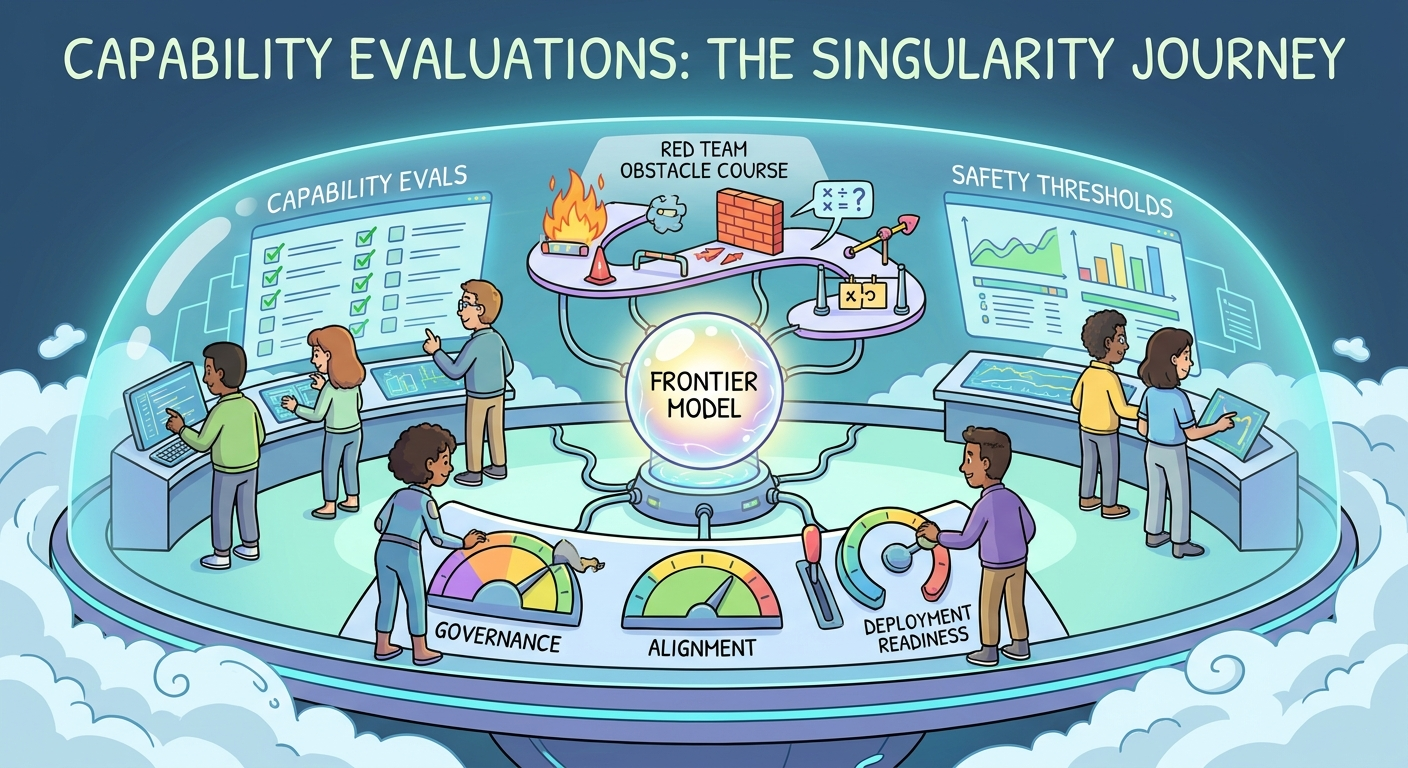
Quick Answer: What Are AI Capability Evaluations?
AI capability evaluations are structured tests used to understand what an AI model can do before it is released, connected to tools, or deployed into sensitive workflows. They can measure ordinary usefulness, such as coding ability or reasoning quality, but the most important frontier evaluations ask a sharper question: could this system enable harm, behave unreliably under pressure, deceive users, misuse tools, or exceed the safety assumptions of the team deploying it?
The simplest mental model is this: a benchmark asks, “How well did the model perform on this task?” A safety evaluation asks, “What could go wrong if this capability appears in the real world?” A governance process asks, “What should humans change before release because of the evaluation result?” Those are related, but they are not the same thing. A model can score well on a benchmark and still be risky in a tool-using workflow. A model can pass a controlled test and still fail after a product team gives it memory, browser access, code execution, or authority over a business process.
This distinction matters because the AI industry is moving from chatbots toward agents: systems that can plan, call tools, write code, browse information, operate software, and act across many steps. The more agency a system receives, the less useful it is to ask only whether the base model answered a test question correctly. We also need to ask how the system behaves when it has incentives, tools, incomplete instructions, adversarial prompts, and users who may misunderstand its limits.
Why Capability Evaluations Matter on the Singularity Path
The path toward more capable AI is not a clean staircase where every new model is only a little better than the previous one. Capabilities can appear unevenly. A model may become much better at long-horizon planning, code generation, persuasion, biological reasoning, cybersecurity tasks, or tool use without every downstream team immediately understanding what that means. Capability evaluations are a way to slow down that uncertainty and make it visible.
For everyday products, evaluations help teams avoid embarrassing failures: hallucinated answers, broken code, poor reasoning, biased responses, or unreliable task completion. For frontier AI, the stakes widen. Evaluators may look for cyber misuse potential, autonomous replication attempts in controlled environments, chemical or biological assistance risk, manipulation, deception, privacy leakage, jailbreak susceptibility, and the ability to defeat safeguards. The goal is not to create panic. The goal is to make deployment decisions proportional to capability.
This is why modern AI governance documents increasingly connect evaluation with risk management. The NIST AI Risk Management Framework describes AI risk management as a way to improve the ability to incorporate trustworthiness considerations into the design, development, use, and evaluation of AI systems. ISO/IEC 42001 frames AI governance through a management-system lens. Lab policies such as Anthropic’s Responsible Scaling Policy and Google DeepMind’s Frontier Safety Framework connect stronger capabilities with stronger safeguards. OpenAI’s public safety materials describe teaching, testing, expert review, and real-world feedback as parts of an ongoing safety process.
The practical meaning for readers is straightforward: if an organization wants to deploy powerful AI responsibly, it cannot rely on a product demo, a leaderboard score, or a press release. It needs a repeatable evaluation process, a record of what was tested, a threshold for what counts as unacceptable risk, and people with authority to delay or limit deployment when the evidence is not good enough.
Analytics for Singularity Journey also support this direction. Recent engagement is strongest around AI agent controls, AI safety frameworks, agent evaluation, memory, and human approval. That pattern suggests readers are not only curious about what AI can do; they want to understand how humans can keep increasingly capable systems bounded, observable, and accountable.
What Frontier AI Evaluations Actually Test
There is no single universal evaluation that answers every safety question. A serious evaluation program is a stack of tests. Some are automated. Some are manual. Some measure performance on known tasks. Others ask experts to actively search for failures. The mix depends on the model, the domain, the deployment context, and the harm that would matter most if the system failed.
A useful evaluation program also separates “can do” from “will do.” A model might be capable of producing dangerous instructions if directly asked, but product safeguards may prevent that behavior in normal use. Conversely, a model might appear harmless in a narrow benchmark but become risky after a developer wraps it inside an agent with memory, file access, and autonomous execution. Evaluations need to examine both the model and the system around the model.
That system context is increasingly important. Many public discussions still treat AI evaluation as if the model sits alone in a test room answering questions. Real deployments are messier. The model may retrieve documents, write shell commands, edit code, send messages, operate a browser, or coordinate with other agents. Each extra tool changes the risk profile. A harmless answer becomes more consequential when the system can act on it.
| Evaluation area | Core question | Decision it should influence |
|---|---|---|
| Reasoning and planning | Can the model solve multi-step tasks without losing track of constraints? | How much autonomy, task length, and supervision it should receive. |
| Cyber capability | Can the model materially assist exploitation, vulnerability discovery, or evasion? | Whether access must be limited, monitored, or blocked for risky workflows. |
| Biological or chemical assistance | Can the model provide operationally useful guidance that lowers barriers to harm? | Whether stronger refusal, expert review, or deployment restriction is needed. |
| Persuasion and manipulation | Can the model tailor deceptive or coercive messages at scale? | Whether product surfaces need restrictions, watermarking, audits, or abuse controls. |
| Tool use and agency | Does the system obey tool scopes, approval gates, and rollback rules? | Whether the agent can act independently or must remain human-in-the-loop. |
| Monitoring and incident response | Can misuse or unexpected behavior be detected quickly? | Whether staged rollout is safe enough and what telemetry is required. |
The Evaluation Pipeline: From Model Lab to Real Users
A mature evaluation process is not a single exam taken the night before launch. It is a pipeline. The model is tested during development, after safety training, before deployment, during staged release, and after real-world use begins. Each stage catches different problems.
Early evaluations help researchers understand raw capability. This can reveal surprising strengths, gaps, or risk areas before product teams build around the model. Pre-release evaluations test the trained system with safeguards in place. Red-team exercises then invite specialists to break those safeguards. Deployment reviews translate results into launch conditions. Post-launch monitoring watches for misuse, drift, new jailbreaks, and unexpected patterns that controlled tests missed.
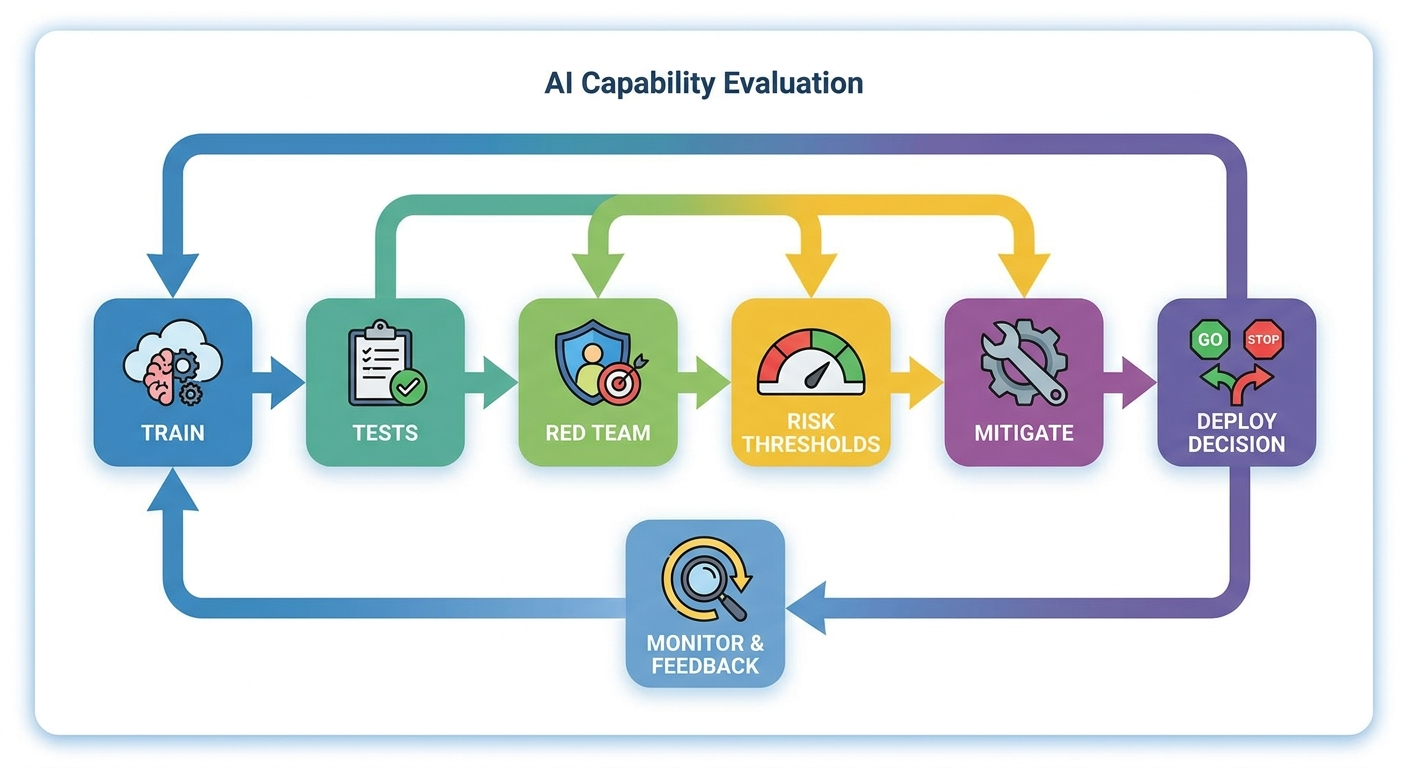
One of the most important steps is the handoff between evaluators and decision makers. A test result by itself is only information. It becomes governance when somebody has the authority and responsibility to act on it. If cyber evaluations cross a threshold, what changes? If red teams find a jailbreak path, who decides whether the fix is enough? If the model performs well in English but poorly in another language, how does that affect deployment? Without decision rules, evaluations can become paperwork instead of safety infrastructure.
Good teams write those rules before the pressure of launch. They define risk categories, thresholds, escalation paths, sign-off requirements, and rollback procedures. They also record the assumptions behind each decision. This matters because AI products change. A model that is safe enough as a chat assistant may not be safe enough as a coding agent. A model that is acceptable for internal research may not be acceptable for public release. A model that passes tests today may need retesting after new tools, memory, plugins, or retrieval systems are added.
Red Teaming Is Not the Same as Benchmarking
Benchmarking and red teaming are often mentioned together, but they answer different questions. Benchmarks are usually standardized tasks. They help compare performance across models, versions, or configurations. Red teaming is adversarial exploration. It asks skilled testers to find ways the system fails, refuses incorrectly, follows malicious instructions, leaks information, ignores policy, or behaves in ways the designers did not expect.
A benchmark is useful because it is repeatable. A red-team exercise is useful because reality is creative. Attackers, confused users, and edge cases do not always follow benchmark format. They combine instructions, hide malicious content in documents, exploit tool permissions, use social engineering, or chain small weaknesses into a bigger failure. Red teaming helps uncover those combinations before the public does.
For frontier systems, red teams may include cybersecurity experts, domain specialists, policy experts, safety researchers, product engineers, and external reviewers. The best red-team findings are not merely screenshots of bad outputs. They include the path to failure, the conditions that made failure possible, the likely real-world harm, and a recommendation for mitigation. That mitigation might be safety fine-tuning, access restriction, user verification, tool permission changes, rate limits, monitoring, or even choosing not to release a feature.
Red teaming also has limits. A red team can miss failures. A model can behave differently after deployment. A safeguard that blocks one prompt may fail against another. A system may become riskier when paired with new tools or incentives. That is why red teaming should sit inside a broader evaluation and monitoring program rather than being treated as a ceremonial final check.
Why Evaluations Cannot Prove an AI Model Is Safe
Capability evaluations are necessary, but they are not magic. They sample behavior. They do not exhaust every possible prompt, tool call, context window, user goal, language, domain, or deployment environment. This is especially true for frontier models because their behavior can be sensitive to context and because new uses appear after release.
There are five limits worth remembering. First, evaluations can overfit. If a model or training process is optimized too tightly around known tests, the score may rise without equivalent real-world safety. Second, evaluations can be incomplete. A test suite may miss a dangerous interaction between tools, memory, and user incentives. Third, evaluations can be gamed unintentionally. A model may learn patterns that look safe in test conditions but fail under novel pressure. Fourth, evaluators may lack domain coverage. A safety team cannot deeply test every language, culture, profession, and misuse scenario. Fifth, deployment changes the system. Real users bring strange goals, noisy data, and creative attacks.
This does not make evaluations useless. It means responsible teams should treat evaluation results as evidence, not permission slips. A strong result supports a decision; it does not end the decision. A weak result should trigger investigation; it should not be smoothed over with marketing language. The safest organizations build feedback loops: evaluate, mitigate, deploy cautiously, monitor, learn, and evaluate again.
What evaluations are good at
- Finding known failure modes before release.
- Comparing model versions and safeguards.
- Making deployment decisions more evidence-based.
- Creating a record that auditors and governance teams can review.
- Turning vague safety concerns into concrete risk questions.
What evaluations cannot guarantee
- They cannot test every future use case.
- They cannot prove the absence of deception or misuse.
- They cannot replace human accountability.
- They cannot make risky deployment safe by themselves.
- They cannot remain valid after major system changes without review.
Interactive Decision Helper: What Should an Evaluation Result Trigger?
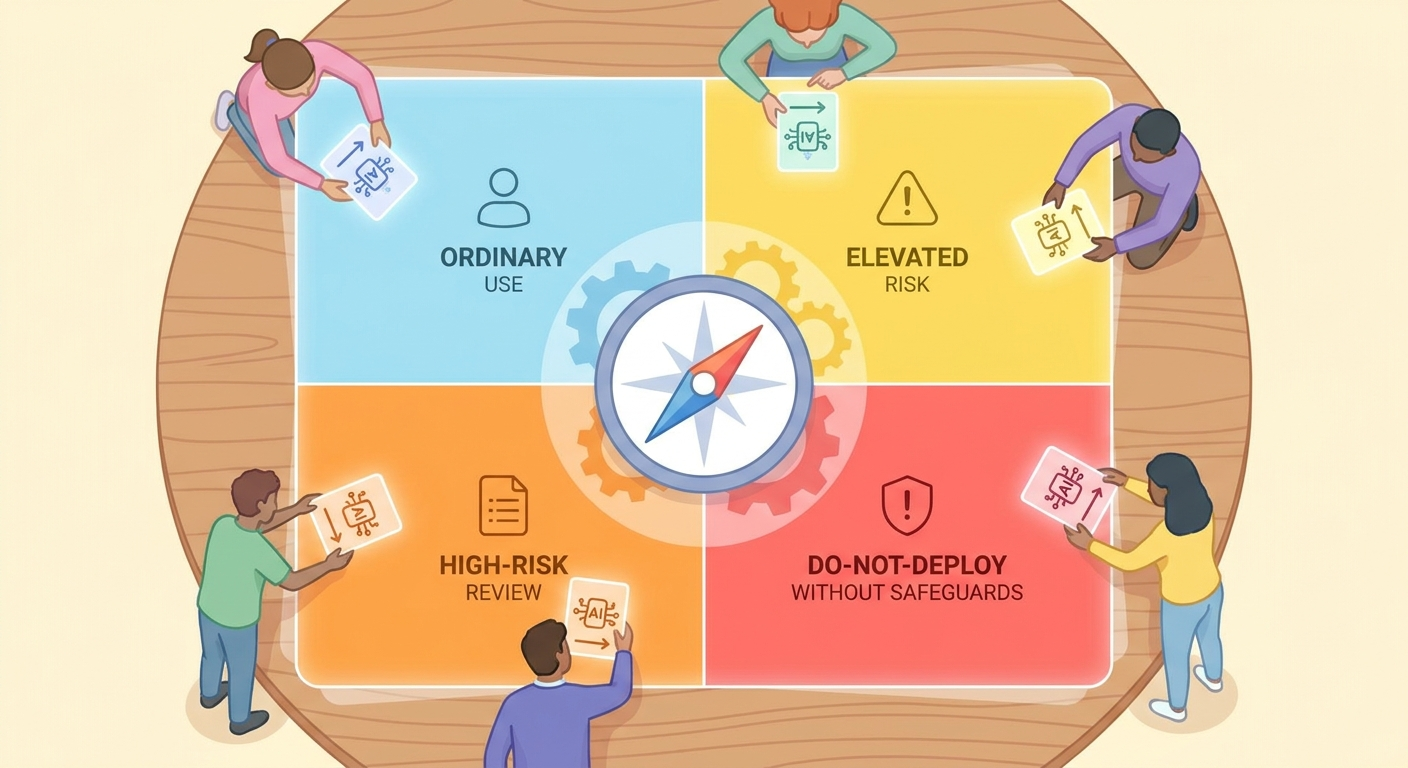
Use this simple helper as a thinking tool. It is not a compliance system, but it shows the logic that mature AI governance teams need: the stronger the capability, the more sensitive the deployment, and the weaker the monitoring, the more cautious the release decision should be.
The key lesson is that evaluations should not end in a PDF that nobody uses. They should feed a decision system. If a model crosses a risk threshold, the next step should be obvious. If nobody knows what the threshold means, the organization does not have an evaluation process; it has a measurement ritual.
How Public Frameworks Fit Together
Readers often ask which AI safety framework “wins.” That is the wrong question. These documents serve different roles. NIST AI RMF gives a broad risk-management vocabulary. ISO/IEC 42001 gives organizations a management-system structure. The EU AI Act uses a risk-based regulatory approach. Lab-specific policies such as Anthropic’s Responsible Scaling Policy or Google DeepMind’s Frontier Safety Framework describe how frontier developers connect capabilities, thresholds, and safeguards. OpenAI’s safety materials and system cards show how a lab communicates evaluation and deployment information to the public.
A practical organization can learn from all of them without pretending they are interchangeable. The common pattern is what matters: identify risk, measure capability, document evidence, apply safeguards, assign accountability, and revisit the decision as the system changes.
| Framework or source | What it contributes | How to use it in an evaluation program |
|---|---|---|
| NIST AI Risk Management Framework | Trustworthiness and risk-management language for AI systems. | Use it to structure risk identification, measurement, management, and governance. |
| ISO/IEC 42001 | Management-system approach for organizations building or using AI. | Use it to connect evaluations with roles, policies, process control, and continual improvement. |
| EU AI Act risk logic | Risk-based view of AI obligations and high-risk systems. | Use it to think about context, user impact, transparency, and governance duties. |
| Responsible scaling policies | Capability-triggered safeguards for increasingly powerful models. | Use them as examples of thresholds, escalation, and deployment restriction. |
| System cards and safety reports | Public communication of model behavior, limits, evaluations, and mitigations. | Use them to demand evidence, not just marketing claims, from model providers. |
The best evaluation culture borrows the seriousness of safety engineering without pretending AI is exactly like aviation, medicine, or cybersecurity. AI systems are probabilistic, general-purpose, and context-sensitive. That makes them hard to certify once and forget. Governance has to be continuous.
A Practical Checklist for Evaluating AI Systems Before Deployment
If you are a founder, developer, product lead, or policy-minded reader, the following checklist translates the frontier-lab conversation into practical deployment questions. You may not run a frontier model lab, but you may still deploy AI agents, assistants, copilots, RAG systems, automation tools, or decision-support products. The same basic logic applies at smaller scale.
1. Define the system boundary
Write down what is being evaluated: base model, fine-tuned model, retrieval system, agent, tool wrapper, user interface, or full deployment environment. A test of the base model is not automatically a test of the entire product.
2. Identify the risky capabilities
List the capabilities that would matter if they appeared: external tool use, private data access, code execution, persuasion, regulated advice, security analysis, autonomous purchasing, or critical workflow control.
3. Select evaluation methods
Combine automated tests, human review, red teaming, domain expert review, adversarial prompts, simulated user journeys, and post-deployment monitoring. Do not rely on one leaderboard.
4. Define thresholds before launch pressure
Decide in advance what result triggers more testing, escalation, narrower release, approval gates, or no deployment. Thresholds invented after a bad result are too easy to rationalize.
5. Connect mitigations to evidence
If the eval reveals a failure, document the mitigation and retest. A policy statement is not enough. Show what changed and why it reduces risk.
6. Plan monitoring and rollback
Real-world monitoring should include logs, abuse signals, user reports, model refusals, tool-call anomalies, incident severity levels, and a way to disable risky features quickly.
This checklist is intentionally conservative. The point is not to slow every harmless AI feature into bureaucracy. The point is to match process to consequence. A grammar assistant does not need the same review as an autonomous cyber tool. A public agent with external actions needs more oversight than a private research demo. Capability evaluations help draw those lines with evidence.
For teams that are early in their AI governance journey, the most useful first step is not buying a complicated tool. It is writing down the decision path. Who owns the evaluation? Which risks matter for this product? What evidence is required before rollout? Who can say no? How will incidents be reviewed? Once those questions are clear, tooling, dashboards, and external audits become easier to choose because they serve a defined process rather than replacing judgment.
Keep Learning on Singularity Journey
- AI Agent Evaluation Framework — a practical DEV ZONE guide to traces, tool calls, memory, and production behavior.
- AI Safety Frameworks Explained — how frontier labs decide when powerful AI is too risky.
- Autonomous AI Agents and Human Control — governance blueprint for agency and oversight.
- AI Agent Alignment Explained — keeping autonomous AI under human control.
- AI Agent Controls Explained — tools, memory, permissions, and human approval.
- Enterprise AI Agent Control Plane — a business governance blueprint for agentic systems.
Sources and References
- NIST AI Risk Management Framework
- ISO/IEC 42001: AI management systems
- OpenAI safety and responsibility hub
- Google DeepMind Frontier Safety Framework
- Anthropic Responsible Scaling Policy
- High-level summary of the EU AI Act
This article explains public evaluation and governance concepts. It does not claim that any specific lab’s private testing is complete, sufficient, or independently verified unless that evidence is publicly available.
FAQ: AI Capability Evaluations
What is an AI capability evaluation?
An AI capability evaluation is a structured test or review used to understand what an AI model or AI system can do. In safety contexts, the goal is to identify capabilities that could create risk if deployed without enough safeguards.
Are capability evaluations the same as benchmarks?
No. Benchmarks are usually standardized performance tests. Capability evaluations can include benchmarks, but they also include risk-specific tests, red teaming, tool-use review, deployment simulations, and expert judgment.
Can evaluations prove that a frontier AI model is safe?
No. Evaluations reduce uncertainty, but they cannot test every future prompt, tool, user, language, or deployment context. Safety depends on evaluation, safeguards, monitoring, human accountability, and willingness to restrict deployment when needed.
What is red teaming in AI safety?
Red teaming is adversarial testing where people try to make an AI system fail, bypass safeguards, produce harmful outputs, misuse tools, or behave in unexpected ways. It complements benchmarks by exploring creative failure paths.
Who should review evaluation results?
Review should include technical evaluators, product owners, safety or risk leaders, domain experts for sensitive areas, legal or compliance teams when relevant, and decision makers with authority to change or stop deployment.
What should happen after a model fails an evaluation?
The team should document the failure, assess likely harm, apply mitigations, retest, and decide whether to narrow, delay, monitor, or block deployment. A failed evaluation should never be treated as a public-relations inconvenience.
Do smaller AI products need capability evaluations?
Yes, but the process should be proportional. A simple internal writing assistant needs lighter testing than an autonomous agent with external actions, private data access, or high-stakes decision support.
How often should AI systems be reevaluated?
They should be reevaluated when the model changes, tools are added, permissions expand, new user groups are introduced, incidents occur, or monitoring shows unexpected behavior. Frontier systems also need periodic review as new failure modes become known.
