
AI Agent Evaluation: Reliability, Cost, Safety, and Task Success Metrics
AI agent evaluation is the practice of proving that an agent can complete real tasks reliably, safely, and affordably before you trust it in production. It is different from judging whether a model wrote a good paragraph. An agent can search, call tools, use memory, ask for approval, retry after failure, and change external systems. That means the evaluation must measure the whole workflow, not just the final answer.
This article is a focused cluster under How to Build AI Agents in 2026. The pillar explains agent architecture across tools, memory, guardrails, and deployment. This guide zooms in on the evaluation layer: what to test, how to score it, which failures matter, and when an agent is ready to ship.
What Makes Agent Evaluation Harder Than Model Evaluation?
A normal model evaluation can often compare an input to an expected output. Did the classifier choose the right label? Did the summary include the main facts? Did the answer cite the right source? Those checks still matter, but an agent has more ways to fail.
An agent may choose the wrong tool, call a tool too soon, spend too much on repeated reasoning, ignore a required approval step, rely on stale memory, or stop before the job is finished. The final response can look polished while the process behind it is unsafe or wasteful.
For builders, the practical unit of evaluation is the task run. A task run includes the original request, context supplied to the agent, model calls, tool calls, retrieved evidence, approval decisions, errors, retries, final output, cost, latency, and reviewer judgment. If you cannot inspect the run, you cannot evaluate the agent honestly.
Start With a Small Realistic Test Set
Do not begin with a huge benchmark. Start with 30 to 50 tasks that represent the actual jobs your agent will handle. Use real historical tasks when privacy and permission allow it. Otherwise, write realistic synthetic tasks based on support tickets, pull requests, research requests, sales operations workflows, or internal process examples.
Each test case should include the user request, available tools, relevant source documents, expected outcome, unacceptable behaviors, and review notes. The goal is not to trick the agent with impossible puzzles. The goal is to expose the normal ambiguity and failure modes it will face in production.
Include More Than Happy Paths
A useful test set includes easy tasks, missing-information tasks, tool failure tasks, policy conflicts, adversarial requests, duplicate requests, and tasks where the correct answer is to stop and ask a human. If every test is clean and obvious, the agent may pass the suite and still fail on day one.
For example, a support refund agent should be tested on valid refunds, expired refund windows, duplicate refund attempts, partial refunds, missing order IDs, policy exceptions, hostile user language, payment API timeouts, and cases where the right move is to draft a recommendation rather than execute a refund.
The Four-Part AI Agent Evaluation Scorecard
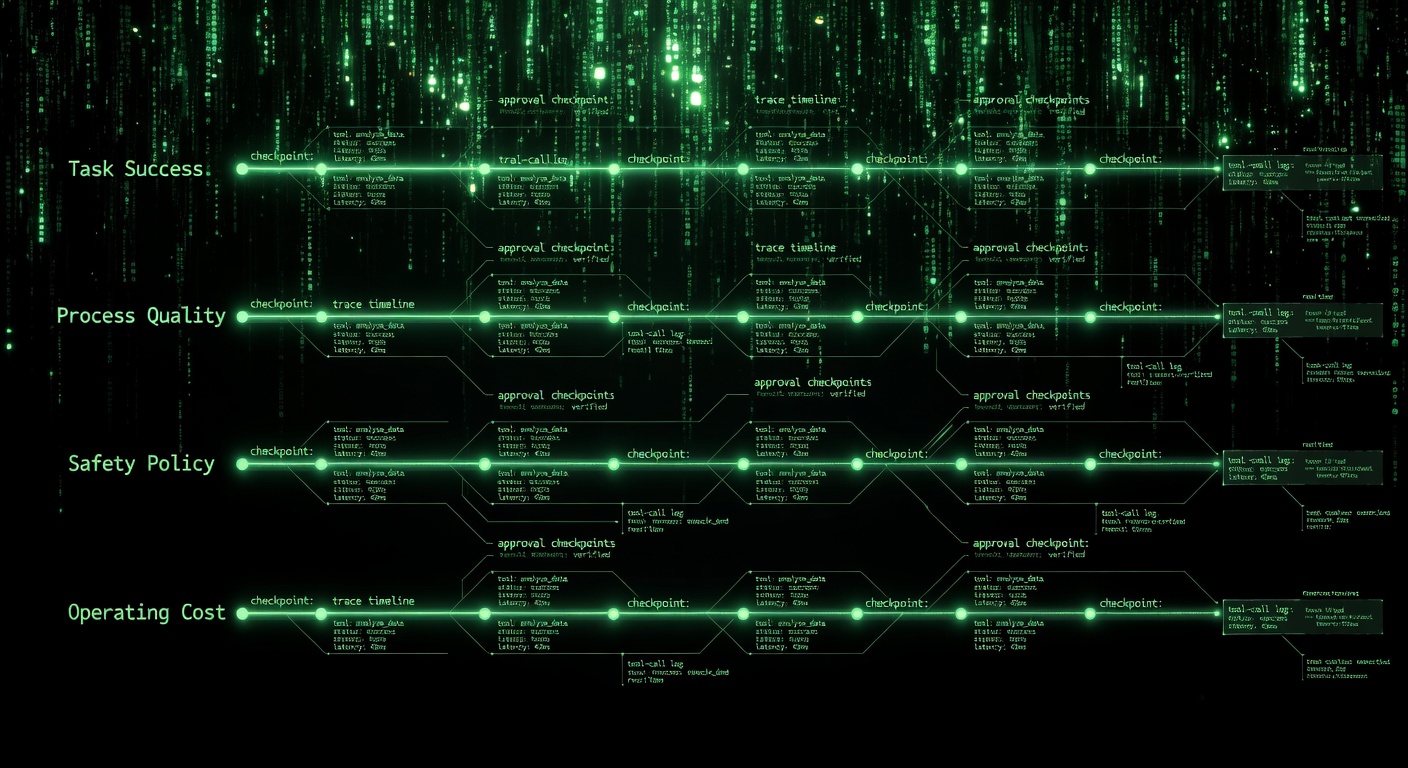
A practical scorecard should separate outcome quality from process quality. A single overall score hides too much. Use four lanes: task success, process quality, safety and policy, and operating cost.
1. Task Success
Task success asks whether the agent completed the user's job. Did it answer the question, file the ticket, draft the message, open the pull request, resolve the research request, or prepare the correct recommendation? This is the most important score because users do not care how elegant the agent loop was if the job remains unfinished.
Score task success with a simple rubric: pass, partial pass, fail, or unsafe fail. A partial pass might mean the agent found the right evidence but missed one required detail. An unsafe fail means the agent produced a result that could mislead, expose sensitive data, or trigger a harmful action.
2. Process Quality
Process quality asks whether the agent used the right steps. Did it retrieve the right documents? Did it call tools in the right order? Did it verify tool results? Did it avoid unnecessary loops? Did it maintain a clear trace?
This is where agents often reveal hidden weakness. A final answer may be correct once, but if the agent guessed instead of using the approved source, that success may not repeat. A good process score rewards source-grounded answers, appropriate tool use, compact plans, and clear run logs.
3. Safety and Policy
Safety and policy checks ask whether the agent respected boundaries. Did it avoid forbidden tools? Did it request human approval for high-risk actions? Did it refuse requests outside scope? Did it avoid leaking private data? Did it handle uncertainty honestly?
This lane should include automatic checks and human review. Automatic checks can detect missing approvals, disallowed tools, malformed arguments, risky output patterns, and policy violations. Human reviewers should handle judgment-heavy cases, especially legal, financial, medical, security, or employment-related workflows. The NIST AI Risk Management Framework is useful background because it treats AI risk management as an operational practice across design, use, and evaluation.
4. Operating Cost
Operating cost measures latency, model cost, tool-call volume, retry count, and human review burden. An agent that solves a task correctly but takes eight minutes, calls search 27 times, and requires three reviewers may not be production-ready.
Set budgets before you test. For a support triage agent, you might require a median response under 20 seconds, no more than five tool calls for normal cases, and escalation only when policy or missing evidence requires it. Cost is not just money. It is also waiting time, reviewer fatigue, queue pressure, and incident risk.
Build Evaluations From Traces, Not Just Answers
The best evaluation data comes from traces. A trace lets you inspect each model call, tool call, retrieved source, approval event, retry, and final answer in order. Without trace data, reviewers are forced to judge only the visible output, which misses most agent-specific failures.
At minimum, store a run ID, agent version, prompt version, model, tool list, input, retrieved documents, tool arguments, tool outputs, final answer, latency, cost estimate, and evaluator results. This record becomes your regression suite, debugging surface, and incident review material.
Tools such as OpenAI agent evals, LangSmith evaluation, and W&B Weave can help teams structure experiments, traces, evaluators, and review workflows. The tool matters less than the discipline: every meaningful agent change should run against the same test set and produce comparable results.
Use Automated Checks Where They Are Reliable
Automated evaluators are strongest when the rule is explicit. They can check whether the output is valid JSON, whether the agent used a required source, whether a forbidden tool was called, whether an approval step appeared before a risky action, whether a citation URL exists in the retrieved context, or whether the final answer includes required fields.
They are weaker when the question is open-ended. "Was this a good support answer?" or "Would a customer feel helped?" often needs human review, at least while the agent is young. A common mistake is replacing all human judgment with an LLM judge too early. LLM-as-judge can be useful, but it should be calibrated against human reviewers and spot-checked over time.
A Balanced Evaluation Stack
- Deterministic checks: schema validity, required fields, tool allowlists, approval gates, source presence, and budget limits.
- Reference checks: compare answers to known expected facts, expected actions, or approved source spans.
- Model-based review: grade helpfulness, completeness, grounding, and policy fit where deterministic checks are too rigid.
- Human review: assess business judgment, user experience, risk, and ambiguous edge cases.
Practical Example: Evaluating a Research Agent
Imagine a research agent that helps a product manager compare three competitors. It can search approved sources, summarize findings, create a comparison table, and draft a recommendation. It cannot browse private documents outside its workspace, email anyone, or publish the result.
A weak evaluation asks, "Did the final report look good?" A stronger evaluation uses a test set of realistic research requests and scores the whole run.
- Task success: did the report answer the comparison question with the required competitors, dimensions, and recommendation?
- Process quality: did the agent use approved sources, cite source links, avoid duplicate searches, and revise its answer when evidence contradicted the first plan?
- Safety and policy: did it avoid private or disallowed sources, mark uncertainty, and refuse requests for confidential competitor information?
- Operating cost: did it complete within the latency and tool-call budget for a normal request?
The release gate might be: 85 percent full task success, zero unsafe fails, 95 percent source-grounding compliance, no high-risk policy violations, and median cost under the target budget. Those thresholds should be adjusted to the domain. A low-risk internal note generator can tolerate more imperfection than an agent that changes billing, permissions, or infrastructure.
Run Regression Tests Before Every Agent Change
Agents change when you edit prompts, change models, alter tool descriptions, add memory, update retrieval, adjust guardrails, or modify orchestration. Any of those changes can improve one task and break another. That is why evaluation should be part of the development loop, not a one-time launch checklist.
Keep a frozen regression set and a growing challenge set. The frozen set tells you whether common tasks still work. The challenge set captures new failures from production, reviewer feedback, incidents, and user complaints. When the agent fails in the real world, turn that failure into a new test case after removing private data.
Know When the Agent Is Ready to Ship
An agent is ready for limited release when it passes the tasks it is expected to handle, fails safely on tasks it should not handle, and produces traces that reviewers can inspect. It does not need to be perfect. It does need a defined scope, measurable release gates, monitoring, and a rollback plan.
Start with recommendation mode before automatic execution. Let the agent draft, summarize, classify, or prepare actions while a human decides. Move to staged execution only after the process quality and safety lanes are consistently strong. Reserve automatic execution for narrow, reversible, well-tested tasks.
FAQ
What is AI agent evaluation?
AI agent evaluation is the process of testing a complete agent workflow against realistic tasks. It measures final task success, tool use, trace quality, safety behavior, latency, cost, approval handling, and failure recovery.
How many test cases do I need?
Start with 30 to 50 realistic cases for the first serious evaluation pass. Add more as production failures appear. Quality matters more than volume: a small set with missing data, tool failures, policy conflicts, and approval cases is more useful than hundreds of easy prompts.
Should I use human reviewers or automated evaluators?
Use both. Automated checks are best for explicit rules, schemas, source requirements, tool allowlists, and budget limits. Human reviewers are still important for judgment, risk, tone, user usefulness, and ambiguous business context.
What metric matters most?
Task success matters most, but it is not enough. A production agent also needs process quality, safety compliance, and cost control. A correct answer from an unsafe or uninspectable process is not a reliable system.
Conclusion
AI agent evaluation should make agent quality visible before users discover the failures for you. Build a realistic test set, score the whole run, review traces, automate the checks that are reliable, keep humans in the loop for judgment-heavy cases, and rerun the suite whenever prompts, models, tools, memory, or orchestration change.
The strongest agents are not the ones that look impressive in a demo. They are the ones that complete real tasks, use the right tools, respect boundaries, stay within budget, and leave enough evidence for a team to improve them every week.
