
AGI Warning Signs: A Practical Checklist for Reading Frontier AI Capability Signals
AGI warning signs are not magic countdown numbers. They are observable shifts in capability, autonomy, reliability, misuse potential, infrastructure pressure, and governance readiness. This cluster guide turns the broader AGI readiness framework into a practical checklist for reading frontier AI news without hype.
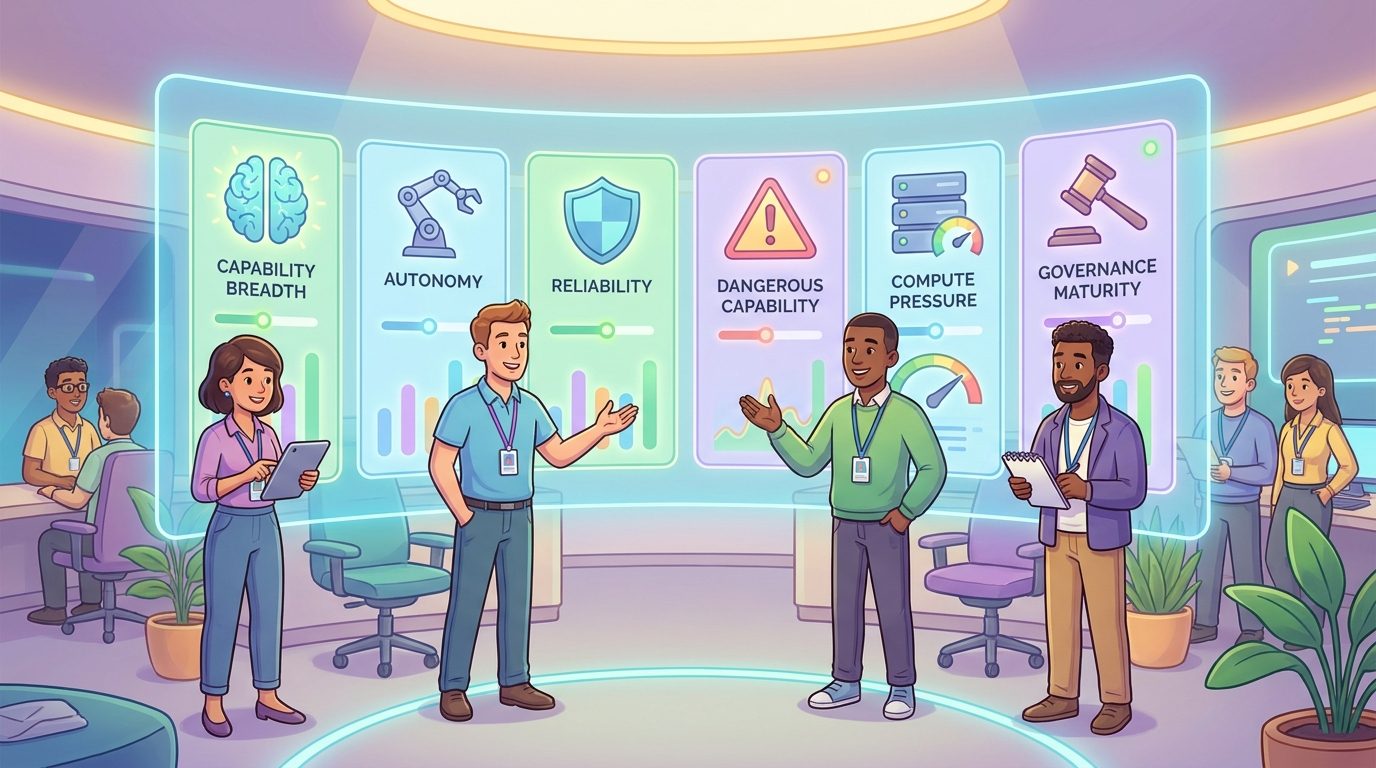
AGI Warning Signs: Quick Answer
AGI warning signs are practical indicators that frontier AI systems may be moving from impressive tools toward systems that need stronger evaluation, access control, public accountability, and institutional readiness. A useful warning sign is not just a benchmark jump or a viral demo. It is a repeated pattern that changes what the system can do, how independently it can pursue goals, how reliably it behaves under messy conditions, or how much harm could occur if the system were misused or deployed carelessly.
The most important signs to track are: broad capability across many domains, autonomous task completion over longer horizons, reliability under uncertainty, dangerous capability evidence, scaling and deployment pressure, and governance maturity. These signs matter most when they appear together. A model that writes good essays is not an AGI warning by itself. A model that can plan, use tools, recover from errors, operate across domains, pass independent dangerous-capability evaluations, and gets deployed before oversight catches up deserves a very different level of attention.
This article supports our pillar article, AGI Readiness Framework: How to Read the Signals Before AI Gets Too Powerful. The pillar gives the big map. This cluster article gives the field checklist: how to read individual signals, how to avoid false alarms, and when a signal should trigger stronger human oversight.
Why an AGI Warning-Sign Checklist Beats Timeline Guessing
AGI timeline predictions are emotionally sticky because they compress uncertainty into a date. They are also fragile. One new benchmark result can make the timeline feel shorter. One visible model failure can make it feel longer. The real world does not move that cleanly. Frontier AI progress appears as uneven capability: a system may be brilliant in one domain, brittle in another, dangerous in a narrow misuse context, and still unreliable as an autonomous worker.
A warning-sign checklist is better because it keeps attention on evidence. It asks what changed, whether the change is repeatable, who verified it, what environment the system operated in, and what controls were in place. That is closer to how risk management works in aviation, cybersecurity, public health, and finance. Serious institutions do not wait for a philosophical definition to be settled before preparing. They watch indicators, define thresholds, and attach responses to those thresholds.
The International AI Safety Report frames the issue in a similarly practical way by focusing on what general-purpose AI systems can do, what emerging risks they pose, and how those risks can be mitigated. NIST’s AI Risk Management Framework also moves the conversation away from vibes and toward governance, mapping, measurement, and management. Those are not AGI prophecies. They are operating habits for uncertainty.
For readers, this matters because public AI discourse rewards drama. A lab announcement may highlight a polished demo. Critics may highlight one embarrassing failure. Investors may emphasize market inevitability. Skeptics may dismiss all risk because current models still make obvious mistakes. A checklist lets you hold two truths at once: today’s systems are limited, and some signals may still justify serious preparation.
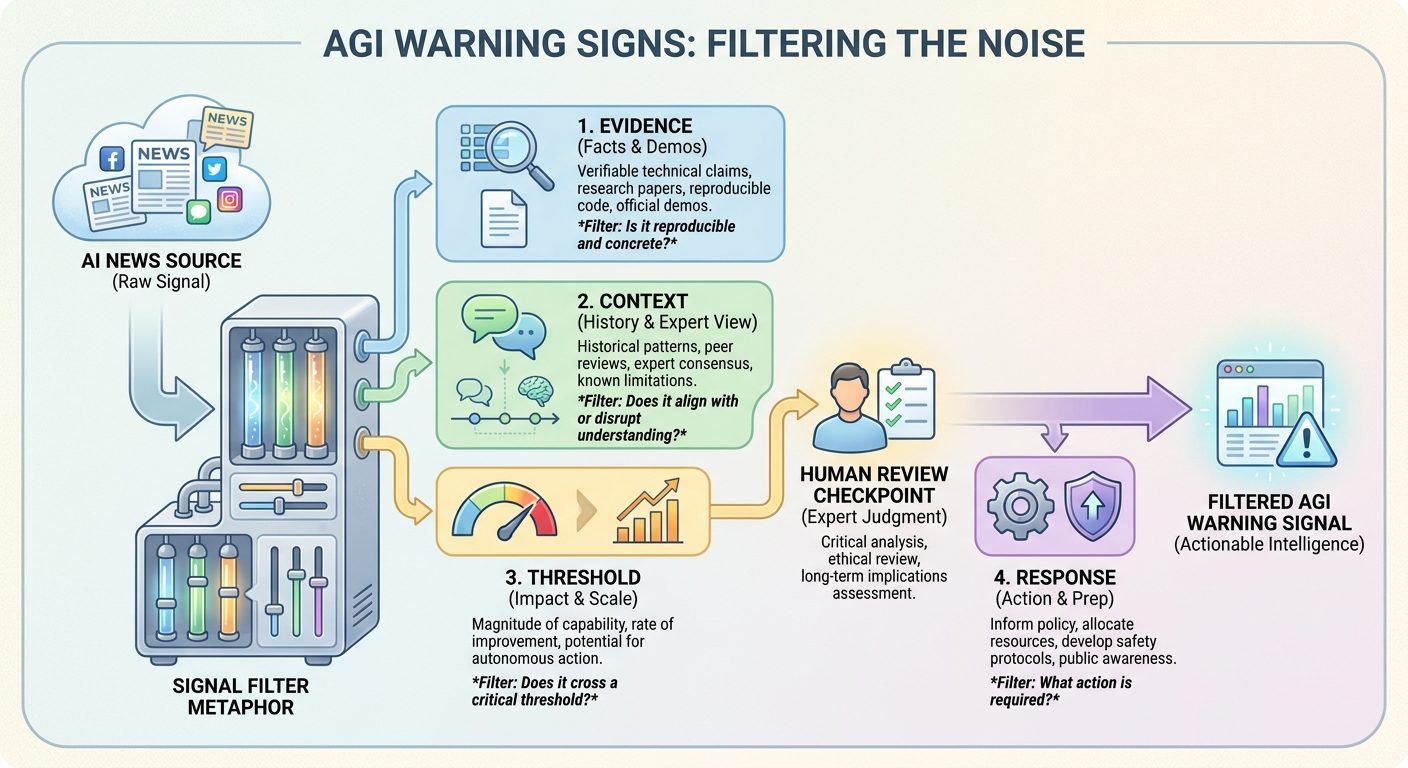
The Practical AGI Warning-Sign Checklist
Use this checklist when a new frontier model, agent platform, benchmark result, safety paper, or policy announcement appears. The goal is not to score everything perfectly. The goal is to slow down, separate evidence from theater, and decide what kind of response is appropriate.
| Warning sign | Weak evidence | Stronger evidence | Practical response |
|---|---|---|---|
| Capability breadth | One impressive demo or narrow benchmark jump. | Independent evaluations show strong performance across reasoning, coding, science, multimodal tasks, tool use, and unfamiliar problems. | Update capability maps and test domain transfer before expanding deployment. |
| Autonomy horizon | The system follows short instructions or completes toy tasks. | The system completes longer tasks with planning, tool use, error recovery, and limited human guidance. | Add human checkpoints, task boundaries, logs, and approval gates. |
| Reliability under uncertainty | The model succeeds in curated examples. | It handles ambiguous goals, messy inputs, adversarial prompts, and distribution shifts without unsafe behavior. | Require red-team testing, staged rollout, and fallback procedures. |
| Dangerous capability | Speculative concern or generic dual-use potential. | Evaluations show meaningful uplift in cyber, bio, persuasion, deception, or autonomous misuse workflows. | Restrict access, strengthen monitoring, and escalate safety review. |
| Scaling pressure | Marketing claims about bigger models. | Visible investment in compute, data, agent infrastructure, deployment pipelines, and product integration. | Track speed of capability diffusion and prepare governance before broad release. |
| Governance gap | Safety language exists but is vague. | Capabilities outrun evaluations, incident reporting, deployment rules, auditability, and public accountability. | Pause expansion or require stronger evidence before deployment. |
The table is intentionally practical. A warning sign becomes meaningful when it connects to a decision: test more, restrict more, monitor more, disclose more, or slow down. A checklist that only produces anxiety is not useful. A checklist that changes behavior is.
Use an Evidence Scale: Noise, Signal, Strong Signal, Trigger
Not all AGI-related evidence deserves the same reaction. A useful reading habit is to place every claim on a four-level evidence scale. This prevents two common errors: panicking over weak signals and ignoring strong signals because earlier weak signals were overhyped.
This scale is useful because frontier AI evidence is often mixed. For example, METR’s work on measuring AI ability to complete long software tasks is relevant because it shifts attention from isolated answers to task duration and reliability. But METR itself notes methodology updates and caveats. That is exactly how serious signal reading should work: treat the work as useful evidence, not as an automatic countdown clock.
A strong AGI warning sign should survive basic questions. Was the evaluation public enough to inspect? Did the task require real planning or just pattern matching? Was success measured at one attempt or across repeated attempts? Did the model have tools, memory, browsing, code execution, or human hints? Were failures reported? Were dangerous capability tests adversarial enough? If these details are missing, you may have a signal, but not yet a trigger.
The Six AGI Warning Signs to Track Closely
1. Capability breadth across unrelated domains
The first sign is not merely that a model gets better at one task. It is that improvement transfers across domains that normally require different skills: coding, math, scientific reasoning, multimodal understanding, long-form planning, tool use, writing, and real-world problem solving. Broad capability matters because generality is part of what makes frontier systems economically and socially disruptive.
Weak evidence is a leaderboard jump in a narrow area. Stronger evidence is consistent performance across independent evaluations and tasks the developers did not tune for directly. The most important question is transfer: does improvement in one domain make the system meaningfully better in another, or is it a collection of narrow tricks?
2. Longer autonomy horizons
Autonomy is one of the most important warning signs because it changes the risk surface. A chatbot answers. An agent acts. A longer-horizon agent plans, calls tools, writes files, navigates interfaces, corrects mistakes, and pursues goals over time. Even if each step is imperfect, longer autonomy can multiply both usefulness and risk.
This is where time-horizon research is especially relevant. Measuring the length of tasks AI agents can complete gives a more practical view than asking whether a model “understands” in the abstract. A system that can independently complete tasks that used to require a human professional for hours or days deserves more oversight than a system that only answers short prompts. The warning sign is not autonomy in a demo. It is reliable autonomy under realistic constraints.
3. Reliability in messy, adversarial, or unfamiliar conditions
Capability without reliability is still important, but it is not deployment readiness. A model that succeeds in clean examples may fail when goals are ambiguous, inputs are incomplete, users are malicious, tools return errors, or the environment changes. AGI risk does not require perfect reliability; however, readiness claims should be discounted when reliability has only been shown in curated conditions.
Look for evaluations that include uncertainty, adversarial pressure, distribution shifts, and recovery from failed actions. Also look for calibration: does the system know when it is uncertain, ask for help, and stop safely? A model that is powerful but poorly calibrated can be more dangerous than a less capable system, because users may overtrust it.
4. Dangerous capability uplift
Dangerous capability does not mean “the model could say something bad.” It means the system materially increases a user’s ability to cause harm compared with existing baselines. Safety frameworks often focus on areas such as cyber misuse, biological or chemical assistance, persuasion, deception, and autonomous operations. The practical question is whether the system provides meaningful uplift in planning, execution, troubleshooting, or scaling harmful workflows.
Anthropic’s Responsible Scaling Policy and similar lab frameworks are relevant because they connect capability thresholds with required safety and security measures. OpenAI’s preparedness work and Google DeepMind’s frontier safety work also point toward the same principle: as dangerous capability evidence grows, deployment should require stronger mitigations. The warning sign is strongest when dangerous capability evidence is independently tested, not merely asserted.
5. Infrastructure and deployment pressure
AGI readiness is not only about model weights. It is also about the surrounding system: compute, data pipelines, tool ecosystems, agent scaffolding, product distribution, enterprise integration, and developer access. A model with broad distribution can create more real-world impact than a stronger model locked inside a lab. A weaker model connected to tools, memory, APIs, and automated workflows can sometimes pose more practical risk than a stronger model used only for chat.
Watch for changes in how systems are packaged. Are agents moving from experiments into default product flows? Are models gaining persistent memory, browser control, code execution, or autonomous task delegation? Are enterprises deploying them into finance, healthcare, security, hiring, education, or infrastructure? These deployment signals determine how quickly capability becomes consequence.
6. Governance maturity lag
The final warning sign is a gap between capability and governance. If model ability rises faster than evaluation, incident reporting, human oversight, auditability, access control, and institutional accountability, the risk level rises even if the model is not “AGI” by anyone’s strict definition. Governance lag is boring compared with benchmark records, but it is one of the most practical signs to track.
NIST’s AI Risk Management Framework is useful here because it treats governance as a continuous function, not a press-release claim. Responsible deployment requires mapping context, measuring risk, managing risk, and assigning governance responsibilities. A lab, company, or government that cannot explain who is accountable, what evidence is required, what happens after incidents, and when deployment should stop is not ready for stronger systems.
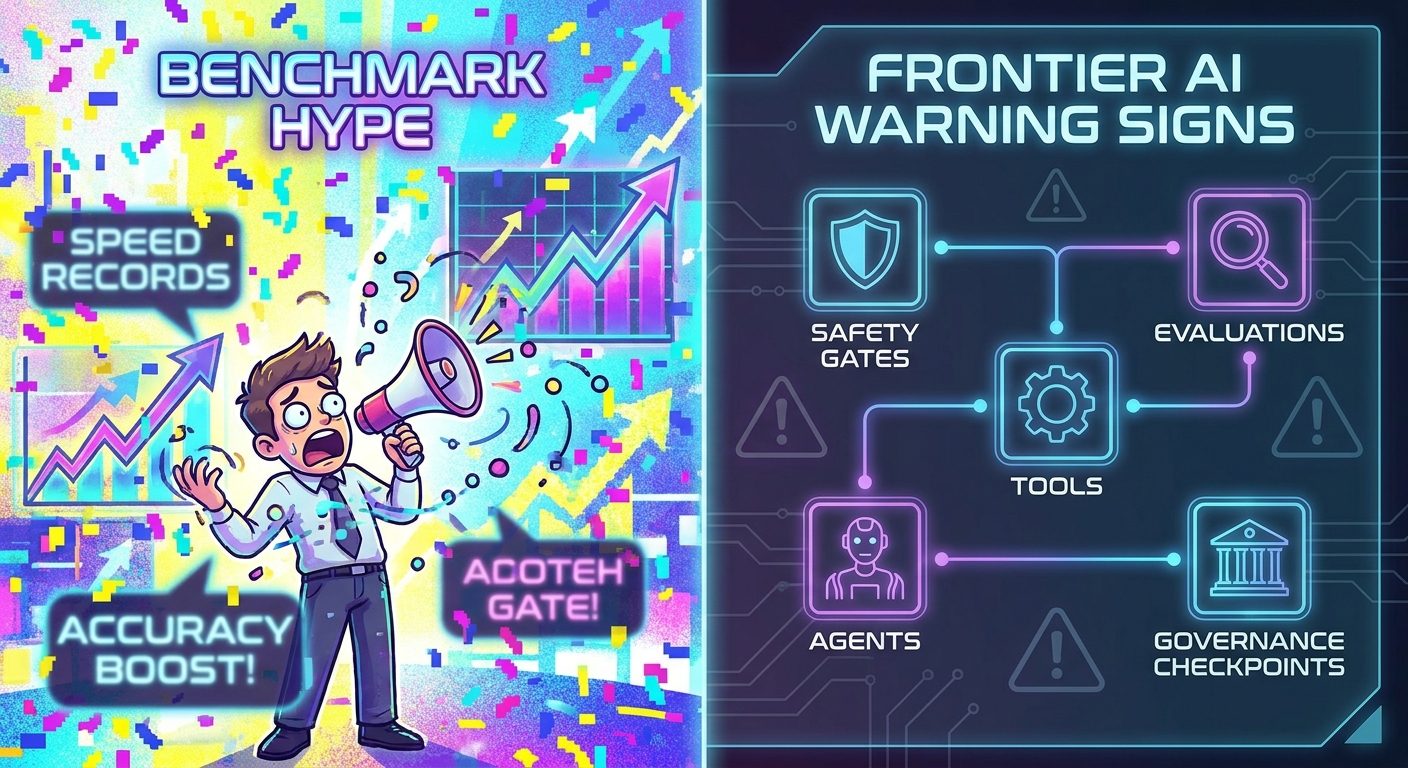
Turn Warning Signs Into Response Triggers
The biggest weakness in many AGI discussions is that they stop at interpretation. A warning-sign checklist should lead to response triggers. If a signal gets stronger, what changes? Who decides? What evidence is needed? What is paused, restricted, disclosed, audited, or monitored?
| Signal pattern | Reason it matters | Reasonable response trigger |
|---|---|---|
| Agent completes longer multi-step tasks with tools and little oversight. | Autonomy increases speed, scale, and error propagation. | Require approval checkpoints, bounded tool permissions, trace logging, and kill switches. |
| Dangerous capability evaluations show meaningful uplift. | The model may lower barriers for harmful actors. | Restrict access, conduct external red-team review, and delay broad release until mitigations are tested. |
| System performs well in benchmarks but fails under adversarial prompts. | Public claims may exceed real-world safety. | Do not expand sensitive deployment; improve evaluation coverage and publish limitations. |
| Product rollout outpaces evaluation transparency. | Users and institutions cannot calibrate trust. | Require system cards, incident reporting, model behavior disclosures, and opt-out or access controls. |
| Governance owners are unclear. | No one is accountable when the system fails. | Assign accountable owners, escalation paths, and review cadence before further deployment. |
For companies, response triggers should be written before the next model launch, not improvised during a public controversy. For policymakers, triggers should avoid freezing innovation while still requiring evidence when systems enter high-impact contexts. For readers, triggers can be personal: trust less when evidence is thin, trust more when independent evaluation is available, and pay special attention when capability, autonomy, and weak governance appear together.
How to Read Common Frontier AI Announcements
A new benchmark record
Ask whether the benchmark measures a real-world capability, whether the model was tuned for it, whether independent evaluators can reproduce it, and whether performance transfers to messy tasks. A benchmark record is often a signal. It becomes a stronger signal when it connects to real task completion, reliability, and deployment impact.
A viral autonomous agent demo
Ask how many hidden human interventions occurred, how long the task took, what tools were available, how failures were handled, and whether the same system works on a suite of unseen tasks. Demos are useful for imagination, but they are weak evidence unless repeated under transparent conditions.
A lab safety framework update
Read the thresholds, not only the values statement. Does the framework define capability levels? Does it say what happens when a threshold is crossed? Does it include external evaluation, security requirements, deployment limits, or board-level accountability? A safety framework without triggers is much weaker than one tied to operational decisions.
A model release into a popular product
Deployment can matter as much as raw capability. Ask what permissions the system has, how users can audit actions, whether sensitive tasks require approval, and what happens after incidents. Broad release turns model behavior into social infrastructure, especially when the system touches work, education, healthcare, security, or public communication.
Common Mistakes When Reading AGI Warning Signs
Better habits
- Look for repeated evidence across independent evaluations.
- Separate capability from deployment readiness.
- Track autonomy, tools, and permissions, not only model scores.
- Ask what response a signal should trigger.
- Update gradually when evidence improves or weakens.
Bad habits
- Treating one demo as proof of AGI.
- Dismissing all risk because current models still fail.
- Confusing safety marketing with tested safeguards.
- Ignoring how agent scaffolding changes risk.
- Demanding exact timelines before taking preparation seriously.
The healthiest stance is neither panic nor complacency. It is disciplined attention. Frontier AI progress can be real even when hype is excessive. Current limitations can be real even when preparation is necessary. A warning-sign checklist helps you stay in that middle lane.
Keep Learning on Singularity Journey
- AGI Readiness Framework — the source pillar for this cluster article and the broader map behind these signals.
- AI Capability Evaluations Explained — how evals test model strengths and failure modes.
- AI Safety Frameworks Explained — how frontier labs decide when powerful AI is too risky.
- Autonomous AI Agents and Human Control — why oversight matters as agents become more capable.
Sources and References
- International AI Safety Report
- NIST AI Risk Management Framework
- OpenAI Preparedness Framework update
- Anthropic Responsible Scaling Policy
- Google DeepMind Frontier Safety Framework
- METR: Measuring AI Ability to Complete Long Software Tasks
This article avoids unsupported AGI timelines. It uses public frameworks and evaluation research as signal-reading tools, not as proof that AGI has arrived.
FAQ: AGI Warning Signs and Frontier AI Signals
What are AGI warning signs?
AGI warning signs are observable shifts that suggest frontier AI systems may require stronger oversight: broader capabilities, longer autonomy, better reliability, dangerous capability uplift, rapid deployment pressure, and governance gaps.
Are benchmark scores enough to predict AGI?
No. Benchmarks can be useful signals, but they are not enough by themselves. Stronger evidence includes independent evaluation, transfer to unfamiliar tasks, reliability under uncertainty, and practical deployment impact.
Which warning sign matters most?
Autonomy combined with broad capability and weak governance is especially important. A system that can act through tools over long tasks creates a different risk surface than a system that only answers prompts.
Does a warning-sign checklist mean AGI is near?
No. The checklist is not a timeline. It is a preparation tool for reading evidence, reducing hype, and attaching practical responses to stronger signals.
How should organizations respond to strong AGI warning signs?
They should increase evaluation, restrict risky access, add human approval checkpoints, improve logging, define escalation owners, publish limitations, and delay high-impact deployment when evidence is insufficient.
How is this different from an AGI readiness framework?
The readiness framework is the broad map. This article is the narrow checklist for reading individual warning signs and deciding when stronger oversight is needed.
