
AI Career Moat: How to Build Skills That Stay Valuable as AI Agents Improve
AI agents are changing what work looks like. This practical pillar guide shows how to build a durable career moat with domain expertise, workflow design, human judgment, trust, and portfolio proof.
Quick Answer: What Is an AI Career Moat?
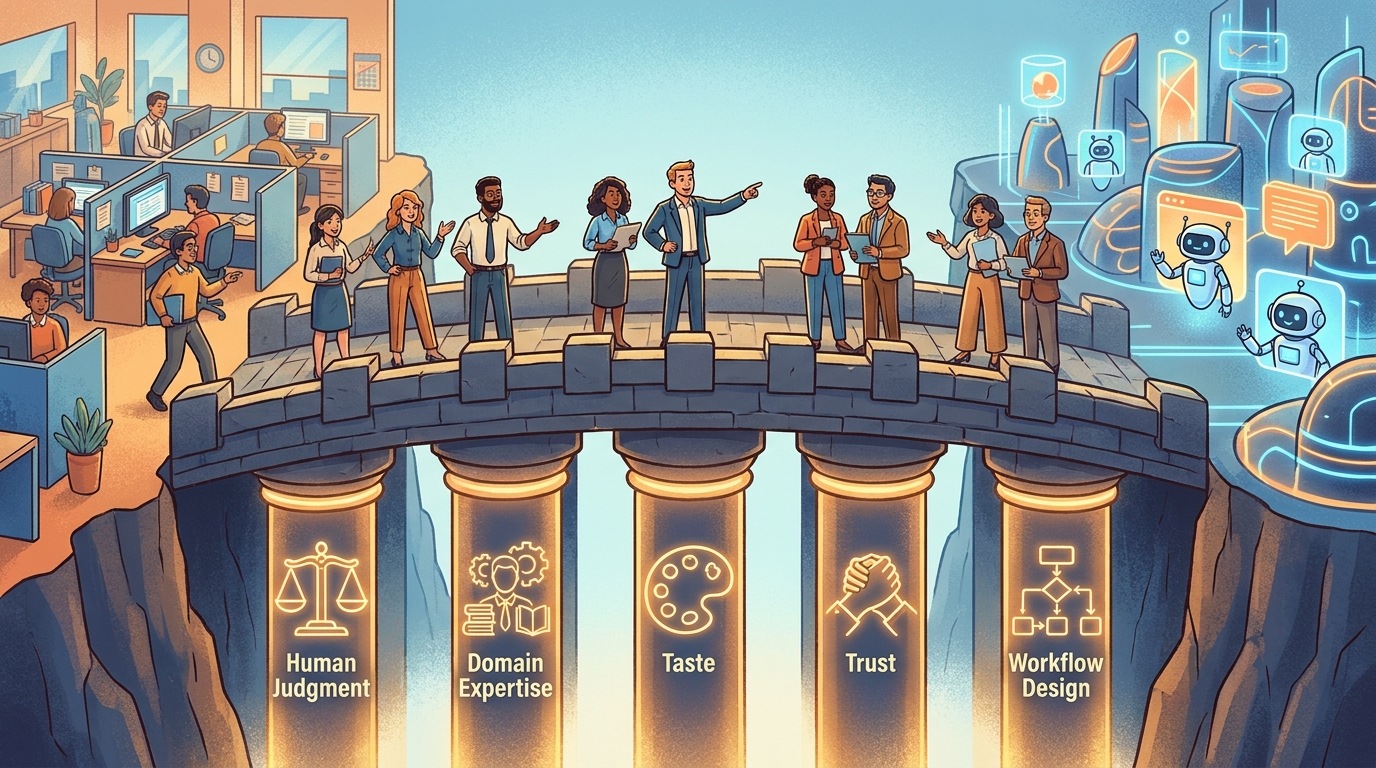
An AI career moat is the combination of skills, proof, relationships, and judgment that makes your work more valuable as AI tools improve instead of less valuable. It is not one tool, one certificate, or one prompt template. It is a defensible way of working: you understand a real domain, frame problems clearly, use AI agents to accelerate execution, check the output with human judgment, and show measurable results.
The important shift is this: careers are no longer protected by doing repeatable information work slightly faster than other people. AI agents are becoming very good at drafting, summarizing, coding, researching, analyzing, and coordinating routine tasks. The safer career move is to become the person who decides what should be done, knows why it matters, designs the workflow, evaluates the tradeoffs, and turns AI output into trusted business outcomes.
This guide is for professionals, students, managers, creators, analysts, operators, marketers, founders, and career switchers who want a practical strategy. You do not need to become a machine-learning researcher. You do need to stop treating AI as a shortcut for isolated tasks and start treating it as a new operating layer for work.
That means the best question is not “Which AI tool should I learn?” The better question is “What valuable result can I produce more reliably because I know how to combine human judgment with AI systems?” The difference sounds small, but it changes the whole career strategy.
Why Career Moats Matter More as AI Agents Improve
For the first wave of generative AI, many people focused on prompting. That made sense because chat interfaces were new and people needed to learn how to ask better questions. But the center of gravity is moving from prompts to workflows. AI agents can now inspect context, use tools, write code, draft documents, compare options, and complete multi-step tasks with human supervision. In that world, the valuable worker is not simply the person who can type a clever prompt. It is the person who can design the task, choose the right level of autonomy, review the result, and connect the work to a real goal.
Labor-market research supports this direction without needing hype. The World Economic Forum’s Future of Jobs research says employers expect AI and information processing to be among the most transformative technologies, and it reports that a large share of workers’ skill sets will be transformed or become outdated over the 2025–2030 period. It also identifies AI and big data, technological literacy, analytical thinking, resilience, creativity, and lifelong learning as rising skill areas. The useful interpretation is not that every job disappears. The useful interpretation is that tasks inside jobs change, and the people who redesign their work around AI have an advantage.
Microsoft’s Work Trend Index has been pushing a related idea: agents can expand human agency when organizations redesign work instead of merely adding chatbots on top of old processes. Anthropic’s Economic Index also frames AI impact around real work tasks, not only job titles. That distinction matters for your career. You are not defending a job title. You are building capability across tasks that employers, clients, and collaborators still need solved.
The scary version of the AI career story says “AI will replace you.” The lazy version says “just learn prompts.” The realistic version is more useful: AI will compress some tasks, create new workflows, expose weak skills, and reward people who can combine domain understanding with AI-enabled execution. A career moat is how you move from fear to strategy.
Fragile AI Skills vs Durable AI Career Moats
Not every AI skill compounds. Some skills are useful today but fragile because tools absorb them quickly. Other skills become more valuable because better AI gives you more leverage. The trick is to use fragile skills for speed while investing most of your learning energy in durable moats.
| Fragile advantage | Why it weakens | Durable moat to build instead |
|---|---|---|
| Knowing one trendy AI tool | Interfaces change, features copy each other, and tools get bundled into larger platforms. | Workflow design: knowing how to turn a messy business problem into repeatable AI-assisted steps. |
| Prompt tricks | Models become better at understanding weak prompts, and products add templates. | Problem framing: defining constraints, success criteria, context, risks, and evaluation methods. |
| Fast first drafts | Almost everyone can generate drafts quickly. | Editorial taste and judgment: selecting what is true, useful, differentiated, and appropriate. |
| Basic automation demos | Simple automations become commodities. | Operational reliability: building workflows with checks, approvals, logs, fallback plans, and measurable results. |
| Generic AI certificates | Certificates are easy to copy and hard to verify. | Portfolio proof: case studies showing before-and-after outcomes, metrics, decisions, and tradeoffs. |
This does not mean prompt skills are useless. Clear communication with AI systems is still valuable. But if your whole career plan is “I am good at prompts,” you are standing on thin ice. A stronger plan is “I understand a domain, I can map work, I can use AI to create leverage, and I can prove the result.”

The most durable moats are human in the best sense: judgment under uncertainty, responsibility for outcomes, trust with stakeholders, deep context, ethical awareness, taste, and the ability to decide what matters. AI can assist all of these, but it does not automatically own them.
The Seven-Part AI Career Moat Framework
A strong AI career moat usually has seven layers. You do not need to master all seven immediately, but you should know where you are strong and where you are exposed.
Notice what is missing: “be the best at one AI app.” Tools matter, but they are not the moat. The moat is the pattern you carry across tools. If your favorite assistant disappears tomorrow, can you still define the problem, build a workflow in another system, evaluate the output, and deliver the result? If yes, you have a moat. If no, you have tool dependency.
The New Career Proof: Show Workflows, Not Just Skills
Employers and clients are becoming skeptical of vague AI claims. “I use ChatGPT” is not proof. “I know prompt engineering” is not proof. “I built a workflow that reduced weekly reporting time, improved consistency, and added a review checklist” is proof. Your moat gets stronger when it becomes visible.
A practical AI career portfolio should show four things: the problem, the workflow, the human judgment, and the outcome. This is why Singularity Journey already emphasizes workflow portfolios. If you have not read it yet, pair this guide with AI Workflow Portfolio: How to Prove You Can Work With AI Agents. A portfolio turns your AI skill from a claim into evidence.
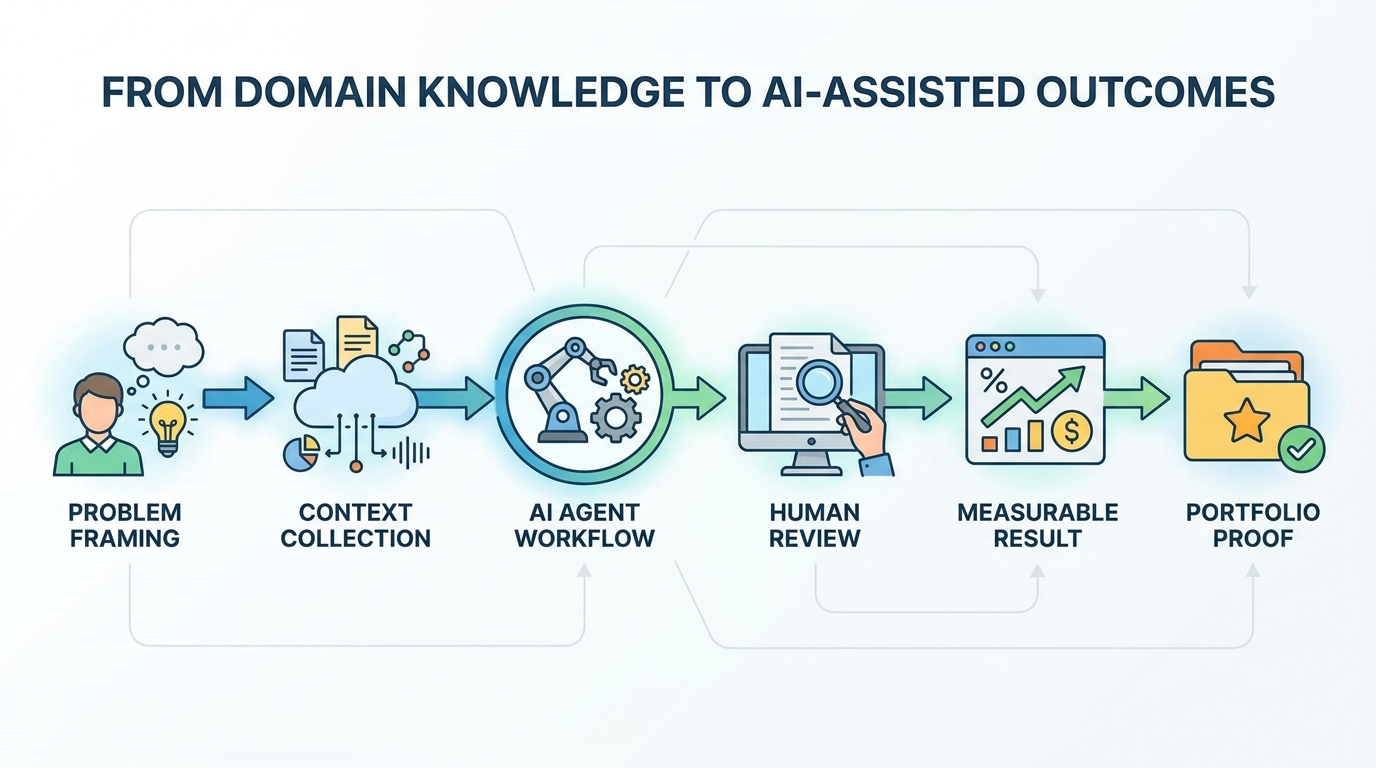
Here is a simple structure for a portfolio case study:
| Portfolio element | What to include | Why it matters |
|---|---|---|
| Problem | The recurring task, decision, or bottleneck you improved. | Shows business context, not just tool usage. |
| Baseline | Time spent, error rate, cost, delay, or quality issue before the workflow. | Creates a measurable before state. |
| AI workflow | Tools used, prompts or instructions, data sources, review steps, and handoff points. | Shows repeatability and systems thinking. |
| Human review | How you checked claims, protected privacy, verified outputs, and made final decisions. | Builds trust and EEAT. |
| Result | Time saved, quality improvement, faster turnaround, better consistency, or clearer decision-making. | Turns AI usage into career value. |
For example, a marketer could show an AI-assisted content research workflow with source verification and brand review. An analyst could show a weekly insight dashboard workflow that uses AI to summarize anomalies but keeps human validation. A project manager could show a meeting-to-action workflow that turns messy notes into owners, dates, risks, and escalation rules. A teacher could show lesson planning support with adaptation for different student levels. None of these require a machine-learning degree. They require ownership.
How Different Professionals Can Build an AI Career Moat
The right moat depends on your role. A developer, recruiter, designer, analyst, teacher, and operations manager should not all build the same AI skill stack. The shared principle is to combine domain expertise with AI-enabled workflows and measurable proof.
For non-coders
Do not assume your only path is learning Python. Coding helps in many roles, but non-coders can build strong moats through workflow mapping, research quality, stakeholder communication, process design, and AI-assisted operations. Start with daily repetitive work: reports, customer summaries, SOPs, proposals, training material, meeting follow-ups, lead research, or quality checks. Map the workflow, add AI assistance, add human review, measure the improvement, and document it.
For developers
Your moat is not simply writing code faster. AI agents are already good at boilerplate. Build around architecture judgment, code review, security thinking, debugging, observability, product understanding, and safe automation. If you work with agents, learn evaluation, logs, human-in-the-loop approvals, and MCP-style tool boundaries. Related guides such as How to Build an MCP Server for AI Agents and AI Agent Observability support that path.
For managers and team leads
Your moat is work redesign. Managers who merely tell teams to “use AI” will not create much value. Strong managers identify workflow bottlenecks, set AI usage policies, create review standards, protect sensitive data, and choose metrics. They also know when not to automate. Human trust becomes more important, not less, when AI enters more workflows.
For students and early-career professionals
Your moat is proof before credentials. Build three practical projects that show you can use AI responsibly in a real domain. For inspiration, use AI Automation Portfolio Projects. A clear case study can beat a generic certificate because it shows how you think.
For career switchers
Your existing domain experience is not wasted. In many cases it is your moat. A nurse who understands patient workflows, a finance professional who understands compliance, a teacher who understands learning gaps, or a logistics operator who understands delays can use AI more effectively than a generic technologist entering the domain cold. Pair your old domain with new workflow literacy.
A Practical 30-Day Plan to Build Your AI Career Moat
You can start building a moat in one month. The goal is not mastery. The goal is visible progress and one proof artifact.
| Week | Focus | Action | Output |
|---|---|---|---|
| Week 1 | Map your work | List recurring tasks, decisions, delays, and quality problems. Pick one workflow that matters. | A simple workflow map with pain points. |
| Week 2 | Add AI assistance | Use AI to help with one part of the workflow: research, drafting, classification, summarization, checking, or planning. | A repeatable prompt or agent instruction with context rules. |
| Week 3 | Add review and metrics | Create a checklist for accuracy, privacy, tone, completeness, and risk. Measure time or quality before and after. | A safer workflow with evidence. |
| Week 4 | Publish portfolio proof | Write a case study showing problem, workflow, human review, result, and next improvement. | One portfolio artifact you can share privately or publicly. |
If you want a more complete learning path, connect this plan with AI Skills Roadmap and AI Workflow Mapping Template. The sequence is simple: learn the concepts, map real work, build workflow proof, then expand.
Common Mistakes That Weaken Your AI Career Moat
The fastest way to weaken your career moat is to confuse activity with advantage. Many people are busy trying every tool, saving prompt packs, and collecting certificates while producing no durable proof. That feels productive, but it often creates shallow familiarity instead of capability.
Build these habits
- Choose one real workflow and improve it deeply.
- Document before-and-after outcomes.
- Keep human review visible.
- Learn concepts that transfer across tools.
- Develop domain expertise alongside AI literacy.
Avoid these traps
- Chasing every new AI app without a use case.
- Depending on unverified AI output.
- Using AI secretly in high-trust settings.
- Building demos with no measurable result.
- Assuming one certificate proves readiness.
Another mistake is hiding AI usage. In some environments, disclosure is sensitive and must follow policy. But as a career strategy, your goal should be trustworthy AI use, not invisible AI use. The strongest professionals can explain where AI helped, where humans reviewed, what risks were controlled, and what value was created.
AI Career Moat Scorecard
Use this quick scorecard to find your weakest layer. Rate each area from 1 to 5. A score below 3 is a learning priority.
| Moat layer | Question | Low-score fix |
|---|---|---|
| Domain depth | Can you explain the real-world constraints and failure modes in your field? | Interview practitioners, read industry sources, and document workflows. |
| Problem framing | Can you turn vague requests into clear outcomes and constraints? | Practice writing briefs with goals, inputs, risks, and success criteria. |
| AI workflow design | Can you build repeatable AI-assisted processes, not just one-off prompts? | Create templates, checklists, and handoff steps. |
| Evaluation | Can you detect bad AI output before it reaches users or leaders? | Build verification checklists and source review habits. |
| Trust | Do people rely on your judgment when AI output is uncertain? | Communicate assumptions, risks, and confidence levels clearly. |
| Portfolio proof | Can you show evidence that your AI workflow improved something? | Write one case study with metrics and screenshots. |
| Learning velocity | Can you adapt to new tools without losing strategic focus? | Schedule monthly tool reviews, but keep projects outcome-driven. |
The Deeper Strategy: Become the Human Control Layer
The phrase “human control layer” sounds technical, but it is a useful career idea. As AI systems do more execution, someone still has to define objectives, interpret context, set boundaries, approve risky actions, communicate with stakeholders, and take responsibility when the answer is uncertain. That person is not protected because they are anti-AI. They are protected because they make AI useful in the real world.
In many organizations, the biggest barrier to AI value is not model capability. It is messy process. Data lives in different places. Teams disagree about what quality means. Leaders ask vague questions. Customers use language that does not match internal categories. Compliance rules are unclear. Old workflows contain exceptions nobody documented. AI can help with all of this, but only if a human understands the process well enough to guide it.
This is why domain expertise matters so much. A generic AI assistant can draft a sales email, but a strong sales professional knows which customer objections matter, which promises are dangerous, which proof points are credible, and which deal context changes the tone. A generic AI assistant can summarize a legal document, but a lawyer knows what risk is material. A generic assistant can produce code, but an engineer knows how the system fails at scale. Your moat grows where generic intelligence meets specific responsibility.
The practical career move is to look for places where AI output needs ownership. Who decides whether the generated analysis is good enough? Who knows which source is credible? Who can explain the tradeoff to a non-technical leader? Who can design the approval step? Who can identify when the agent is confidently wrong? Who can turn a one-off prompt into a repeatable operating procedure? Each of those questions points to a moat.
Over time, the market will not reward people for merely touching AI. It will reward people who can show that their AI-enabled work is faster, safer, clearer, more creative, or more reliable than the old way. That is why your moat should be measured in outcomes, not enthusiasm.
Final Takeaway
Your moat is built through repeated evidence: choose meaningful problems, use AI to accelerate the workflow, review the result with care, and communicate the value clearly. The more AI improves, the more valuable this operating discipline becomes because organizations need people who can turn capability into trusted outcomes.
Your moat is built through repeated evidence: choose meaningful problems, use AI to accelerate the workflow, review the result with care, and communicate the value clearly. The more AI improves, the more valuable this operating discipline becomes because organizations need people who can turn capability into trusted outcomes.
Your moat is built through repeated evidence: choose meaningful problems, use AI to accelerate the workflow, review the result with care, and communicate the value clearly. The more AI improves, the more valuable this operating discipline becomes because organizations need people who can turn capability into trusted outcomes.
Your moat is built through repeated evidence: choose meaningful problems, use AI to accelerate the workflow, review the result with care, and communicate the value clearly. The more AI improves, the more valuable this operating discipline becomes because organizations need people who can turn capability into trusted outcomes.
Your moat is built through repeated evidence: choose meaningful problems, use AI to accelerate the workflow, review the result with care, and communicate the value clearly. The more AI improves, the more valuable this operating discipline becomes because organizations need people who can turn capability into trusted outcomes.
Your moat is built through repeated evidence: choose meaningful problems, use AI to accelerate the workflow, review the result with care, and communicate the value clearly. The more AI improves, the more valuable this operating discipline becomes because organizations need people who can turn capability into trusted outcomes.
Your moat is built through repeated evidence: choose meaningful problems, use AI to accelerate the workflow, review the result with care, and communicate the value clearly. The more AI improves, the more valuable this operating discipline becomes because organizations need people who can turn capability into trusted outcomes.
Your moat is built through repeated evidence: choose meaningful problems, use AI to accelerate the workflow, review the result with care, and communicate the value clearly. The more AI improves, the more valuable this operating discipline becomes because organizations need people who can turn capability into trusted outcomes.
Sources and Further Reading
FAQ: AI Career Moats
What is an AI career moat?
An AI career moat is a durable advantage that keeps your work valuable as AI improves. It includes domain expertise, problem framing, workflow design, judgment, trust, and proof of outcomes.
Is prompt engineering a career moat?
Prompting is useful, but by itself it is fragile. A stronger moat is knowing how to design workflows, evaluate output, and create measurable value in a real domain.
Do I need to learn coding to stay relevant?
Coding helps in many roles, especially technical and automation-heavy work, but it is not mandatory for every career. Non-coders can build strong moats through workflow design, domain expertise, AI-assisted operations, and portfolio proof.
Which skills are hardest for AI to replace?
Skills involving judgment, trust, context, accountability, leadership, domain nuance, ethics, taste, and cross-functional decision-making are harder to automate fully.
How do I prove AI skills to employers?
Create portfolio case studies that show the problem, baseline, AI workflow, human review process, and measurable result. Evidence beats vague claims.
What should I stop learning?
Stop over-investing in tool-specific tricks that have no connection to real outcomes. Learn tools, but focus on transferable patterns such as workflow mapping, evaluation, and domain problem solving.
