
AI Risk Register: A Practical NIST AI RMF Checklist for Frontier AI
An AI risk register is the practical bridge between AI safety frameworks and day-to-day governance. Use it to document what can go wrong, who owns the risk, what evidence supports the rating, and when a frontier or high-impact AI system must be reviewed again.

AI risk register: the quick answer
An AI risk register is a living record of the risks attached to an AI system. It usually tracks the use case, affected people, likely harms, severity, likelihood, mitigations, accountable owners, evidence, review dates, open issues, and escalation triggers. The point is not to create paperwork for its own sake. The point is to make AI risk visible enough that a real person can decide whether the system should be built, restricted, changed, delayed, or stopped.
The register is especially useful when a team wants to apply the NIST AI Risk Management Framework in practical work. NIST describes the AI RMF as voluntary guidance for managing AI risks across design, development, use, and evaluation. The framework’s functions—Govern, Map, Measure, and Manage—are excellent ideas, but teams still need an operational artifact. The risk register is that artifact.
Think of it as the memory layer for AI governance. A meeting may produce a concern. A red-team test may expose a failure mode. A user complaint may reveal an edge case. A new model release may change capability. Without a register, those signals scatter across Slack threads, documents, tickets, and inboxes. With a register, they become an accountable system of record.
Why AI risk registers matter for frontier AI governance
AI governance becomes harder when systems move from passive content generation to action. A chatbot that drafts text has one risk profile. An agent that can search files, call APIs, make recommendations, route support tickets, update records, write code, or trigger workflows has a larger one. Capability, permissions, context, and user dependency all change the risk calculation.
The International AI Safety Report 2026 notes that general-purpose AI capabilities have continued to improve in areas such as coding, mathematics, and autonomous operation, while reliable pre-deployment safety testing has become harder as systems and deployment contexts change. That is exactly why a register should not be a launch-day document. It should survive deployment.
A useful AI risk register also helps separate three things that often get mixed together: safety, compliance, and organizational accountability. Safety asks what harm could occur and how to reduce it. Compliance asks which rules, obligations, or standards apply. Accountability asks who has the authority to decide and who must act when conditions change. A mature register gives each one a place.
This does not replace legal advice, security review, model evaluation, or product judgment. It coordinates them. If the broader pillar article explains the map of AI safety frameworks, this article shows how one artifact can connect that map to daily decisions.
The AI risk register columns that actually matter
Many risk registers fail because they only list abstract hazards: bias, privacy, hallucination, misuse, safety, compliance. Those labels are too broad to govern. A practical register should describe risks in context: who is affected, what the system can do, how harm appears, what evidence supports the rating, and what mitigation changes the decision.
| Register column | What to capture | Why it matters |
|---|---|---|
| Use case and system boundary | What the AI system does, where it is deployed, what tools or data it can access, and what it is not allowed to do. | Risk depends on context. A model summary tool and an autonomous action system should not share the same rating. |
| Affected people or assets | Users, customers, employees, patients, students, infrastructure, data, brand trust, or public interest. | Risk cannot be judged without knowing who or what can be harmed. |
| Risk statement | A specific sentence: “The system may [do X] causing [harm Y] for [group Z] under [condition].” | Specific statements are easier to test, assign, and mitigate than generic labels. |
| Severity and likelihood | Use simple levels such as low, medium, high, and critical, with notes explaining the rating. | Ratings guide priority, but explanations prevent fake precision. |
| Evidence | Evaluation results, incident logs, red-team notes, user research, data-quality checks, access reviews, or expert review. | Without evidence, a register becomes opinion management. |
| Mitigation and control | Human approval, access limits, fallback paths, model constraints, monitoring, testing, data minimization, logging, or rollout limits. | Every meaningful risk needs an action or a decision to accept it. |
| Owner and escalation path | Named team, accountable person, reviewer, and escalation route for unresolved or rising risks. | Unowned risk is unmanaged risk. |
| Review cadence and trigger | Next review date plus event-based triggers such as model upgrade, new tool access, incident, regulation change, or use-case expansion. | Frontier AI risk changes over time; the register must change with it. |
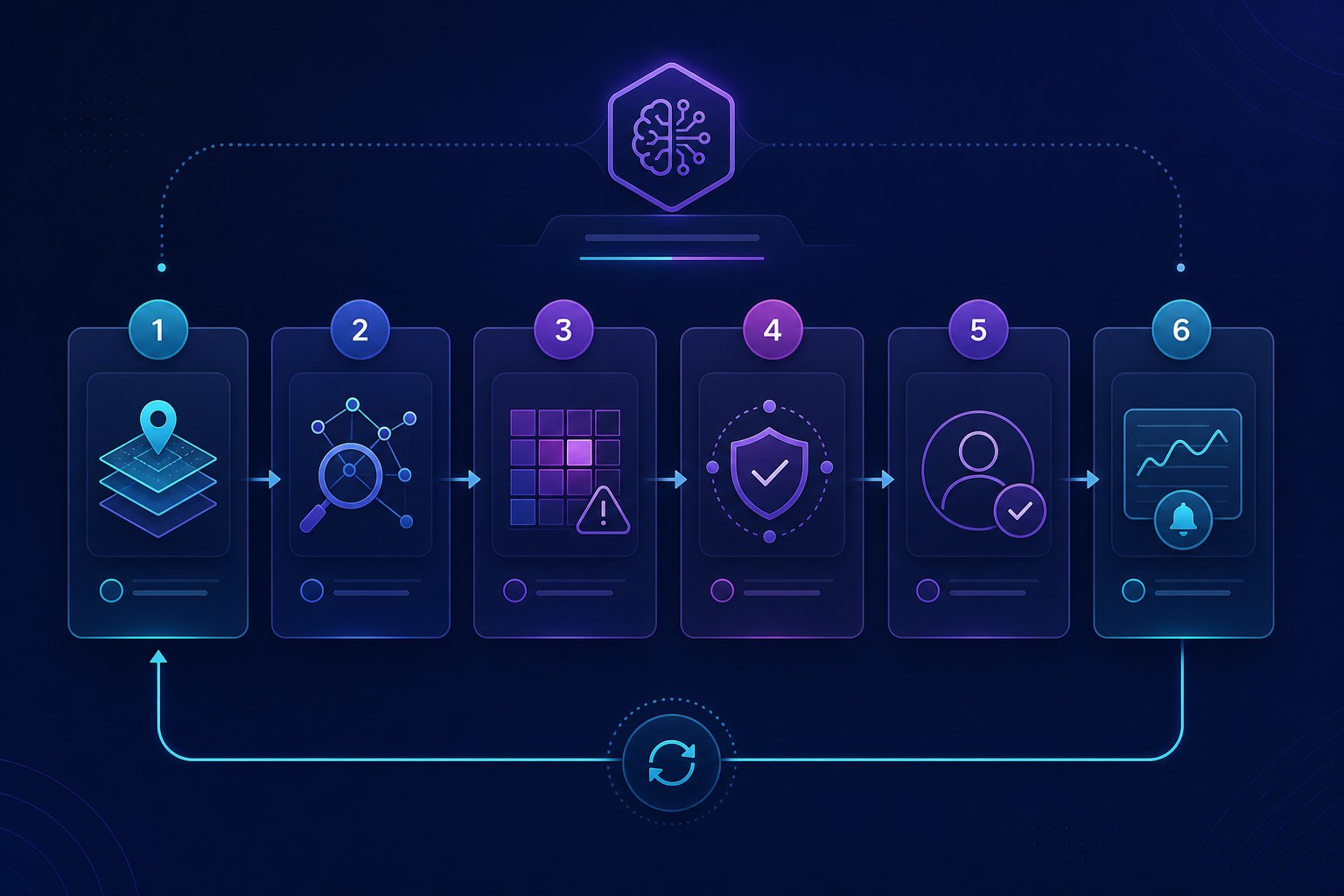
How to map NIST AI RMF into a risk register workflow
The NIST AI RMF Playbook describes suggested actions and guidance for the four AI RMF functions: Govern, Map, Measure, and Manage. For a blog-friendly implementation, you can translate those functions into a repeatable register workflow.
Govern: decide who is accountable
Before listing risks, define ownership. Who can approve deployment? Who can block it? Who maintains the register? Who reviews high-risk changes? Governance is not a steering committee name; it is a decision system.
Map: understand context
Map the use case, users, data, tools, permissions, affected groups, dependencies, and foreseeable misuse. This is where many AI risk registers improve immediately: they stop rating “the model” and start rating the system in context.
Measure: collect evidence
Measure with evaluations, red-team tests, data-quality checks, privacy reviews, monitoring metrics, user feedback, and incident patterns. The goal is not perfect certainty. It is enough evidence to make the decision defensible.
Manage: reduce, accept, or escalate
Controls should change the risk. If a mitigation does not affect severity, likelihood, detectability, reversibility, or accountability, it may be decorative. High risks need escalation, stronger controls, or a no-go decision.
This workflow keeps the register close to the spirit of the NIST AI RMF without pretending that a short article can implement the full framework. It is a starting pattern. Teams working in regulated domains or high-impact contexts should adapt it with legal, security, compliance, and domain experts.
Evidence, review cadence, and escalation triggers
The most common weakness in AI governance artifacts is not lack of vocabulary. It is lack of evidence. A risk register entry that says “hallucination risk: medium” is not very useful. A stronger entry says which task was tested, what failure appeared, how often it appeared in the sample, what mitigation was added, what residual risk remains, and who approved the decision.
Evidence can come from several places. Technical evidence includes offline evaluations, adversarial testing, regression tests, model comparison notes, latency and reliability measurements, tool-call logs, and monitoring dashboards. Operational evidence includes support tickets, user complaints, approval overrides, incident reviews, and post-launch drift signals. Governance evidence includes access reviews, policy exceptions, sign-off records, training records, and vendor assessments.
Review cadence should combine calendar-based and event-based triggers. Calendar reviews are simple: monthly for high-risk pilots, quarterly for mature moderate-risk systems, and after every major governance milestone. Event triggers matter more for frontier systems. Review the register when the model changes, the system gains a new tool, the user group expands, a new regulation or policy applies, a severe incident occurs, monitoring detects drift, or human reviewers begin overriding the system more often than expected.
Interactive risk-priority selector
Use this quick selector to decide which risk register area deserves attention first. It is not legal advice; it is a practical triage tool for early governance discussions.
Which condition best describes your AI system?
Common AI risk register mistakes to avoid
The first mistake is treating the register as a compliance trophy. If nobody reviews it after launch, it is not a governance system. The second mistake is rating risks without evidence. A severity score may help prioritization, but it should never hide uncertainty. The third mistake is assigning every risk to a committee instead of a person or team with decision rights.
The fourth mistake is confusing human review with meaningful oversight. Community discussions around AI governance often reveal a practical concern: if the AI system itself decides what to escalate, then human review may only see the cases the system recognized as risky. For higher-impact systems, define mandatory escalation triggers that do not depend entirely on model self-reporting. Examples include protected-domain use, irreversible action, unusually low confidence, policy conflict, tool permission change, or user appeal.
The fifth mistake is ignoring system boundaries. Many AI failures are not purely model failures. They come from stale data, missing context, bad permissions, weak logging, ambiguous policy, poor UI, or incentives that pressure humans to approve too quickly. Your register should capture system-level risks, not only model behavior.

A practical AI risk register checklist
- Define the AI system boundary, including model, data, tools, permissions, interfaces, and users.
- Write each risk as a specific scenario, not a generic label.
- Identify affected people, assets, rights, workflows, and operational dependencies.
- Rate severity and likelihood, but explain uncertainty in plain language.
- Attach evidence: tests, evaluations, red-team notes, logs, user research, incident reports, or expert review.
- Assign an owner with decision rights, not just a department name.
- Document controls that actually reduce risk: access limits, human approval, monitoring, fallback, sandboxing, or rollback.
- Define residual risk and the person or group that accepted it.
- Add review dates and event-based triggers, especially for model upgrades and new tool access.
- Use the register to decide: proceed, restrict, redesign, escalate, pause, or retire.
If you are building agentic systems, connect this checklist with more technical controls such as identity, permissions, logs, and approval queues. Singularity Journey’s DEV ZONE guides on AI agent governance, AI agent evaluation, and human approval for AI agents go deeper on implementation patterns. For the broader future context, read The Real Path to AGI.
Final takeaway
The best AI risk register is not the most complicated one. It is the one your team actually updates when the system changes. It should be simple enough to maintain, specific enough to guide decisions, and serious enough to show what evidence supports deployment. In a frontier AI environment, the register is less like a static spreadsheet and more like a governance memory: it records what the team believed, why it believed it, what changed, and who is responsible now.
FAQ: AI risk registers and NIST AI RMF
What is an AI risk register?
An AI risk register is a living record of risks connected to an AI system. It documents risk scenarios, affected people or assets, severity, likelihood, evidence, controls, owners, review dates, and escalation triggers.
How does an AI risk register relate to the NIST AI RMF?
The NIST AI RMF gives a risk-management structure through functions such as Govern, Map, Measure, and Manage. A risk register turns those ideas into a practical artifact that teams can update and review.
Is an AI risk register legally required?
Not automatically. Requirements depend on jurisdiction, use case, sector, and role in the AI value chain. A register can support governance and compliance thinking, but it is not a substitute for legal advice.
Who should own the AI risk register?
Ownership should sit with a team that has real decision rights, often involving product, engineering, security, legal, compliance, and domain experts. Each high-priority risk should have a named accountable owner.
How often should an AI risk register be reviewed?
Review frequency depends on risk level. High-risk pilots may need monthly review, while stable lower-risk systems may be reviewed quarterly. Event triggers such as model upgrades, new tool access, incidents, or use-case expansion should prompt immediate review.
Can a risk register prove an AI system is safe?
No. A risk register makes assumptions, evidence, controls, owners, and residual risk visible. It reduces governance blind spots, but it cannot guarantee that every failure mode has been found or eliminated.
