
TRENDS & INSIGHTS
AI Agent Observability: The Control Layer Enterprise Agents Need in Production
AI agent observability is becoming the practical difference between a useful enterprise agent and a risky automation nobody can explain. This guide shows what teams should trace, measure, approve, and audit before agentic AI moves beyond pilots.
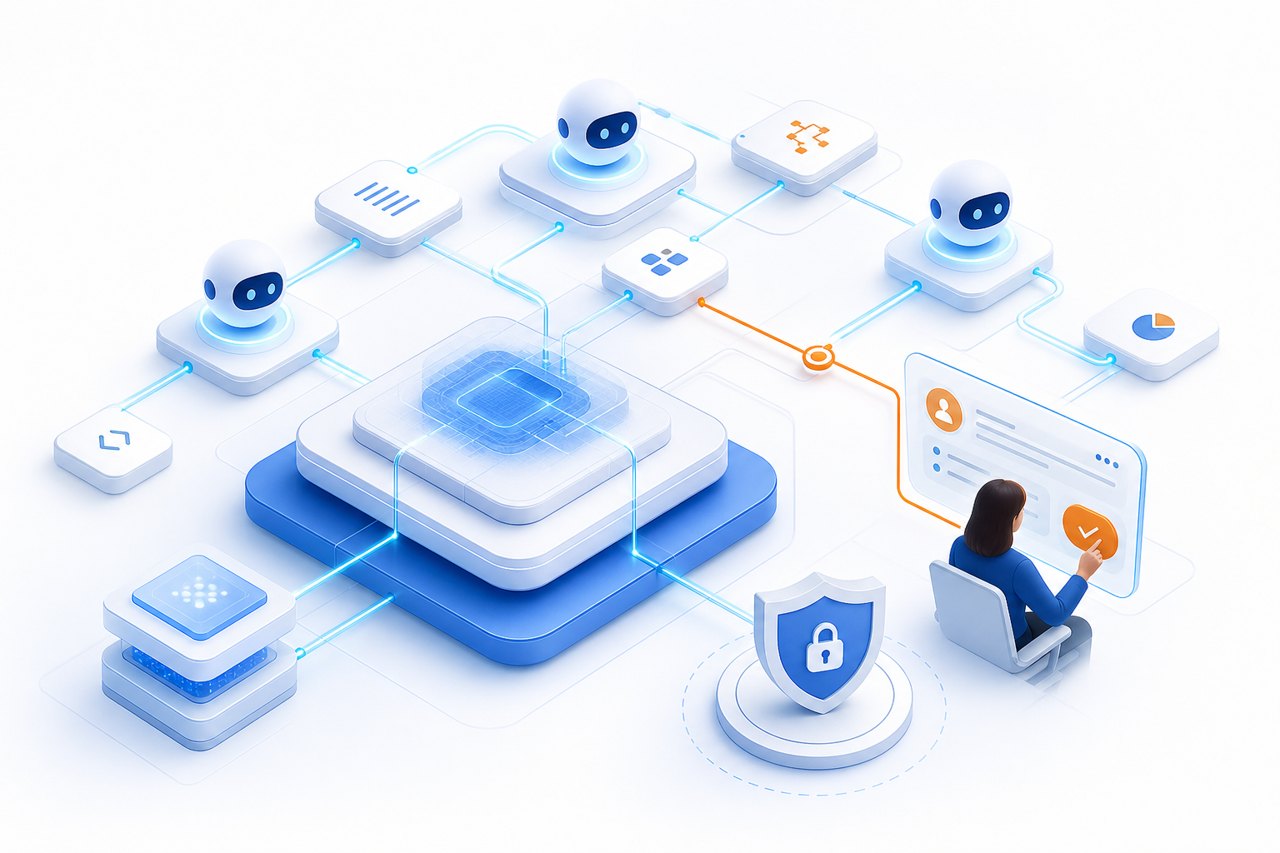
Quick answer: AI agent observability is not just monitoring
AI agent observability is the ability to reconstruct what an agent did, why it did it, which tools and data it touched, what policy decisions were applied, when humans approved or overrode it, and whether the final outcome was safe, useful, and cost-effective. Traditional monitoring asks whether a service is up. Agent observability asks whether a non-deterministic system took the right path through a multi-step workflow.
This difference matters because production agents are not single prompts. They may plan, call tools, retrieve context, write files, update tickets, query databases, trigger emails, ask other agents for help, and retry after errors. A final answer can look polished while the path behind it includes stale context, overbroad permissions, unnecessary tool calls, or an approval that was treated as a rubber stamp. If a team cannot inspect that path, it cannot responsibly scale agentic AI.
Follow each run across prompts, model calls, tools, memory, retrieval, policy checks, approvals, and outputs.
Measure task success, groundedness, unsafe actions, latency, cost, and human review quality.
Connect traces to identity, permissions, risk tiers, audit evidence, incident response, and improvement loops.
Why AI agent observability became a 2026 enterprise priority
The latest agentic AI conversation is no longer only about model capability. The more important question is whether organizations can let agents act inside real workflows without losing accountability. The source pillar argues that the enterprise shift from chatbots to governed agents depends on control planes, approval, evaluation, and observability. Observability is the layer that makes the rest visible.
Recent governance work points in the same direction. The IMDA Model AI Governance Framework for Agentic AI emphasizes technical controls, logging, monitoring, meaningful human accountability, override rates, and response times. The OECD agentic AI landscape paper describes agentic systems as more autonomous, adaptive, and tool-using than ordinary software. The NIST AI Risk Management Framework gives teams a broader risk-management vocabulary for mapping, measuring, managing, and governing AI risk.
Community discussions echo the operational pain. Builders ask how to attribute cost across agents and retries, how to find silent data leakage, how to preserve audit trails, and how to prove that an autonomous agent avoided unsafe actions. These are not cosmetic dashboard questions. They are trust, security, finance, and compliance questions. Reddit and forums should not be treated as factual proof, but they are useful demand signals: practitioners are trying to move from “the demo worked” to “we can explain this system under pressure.”
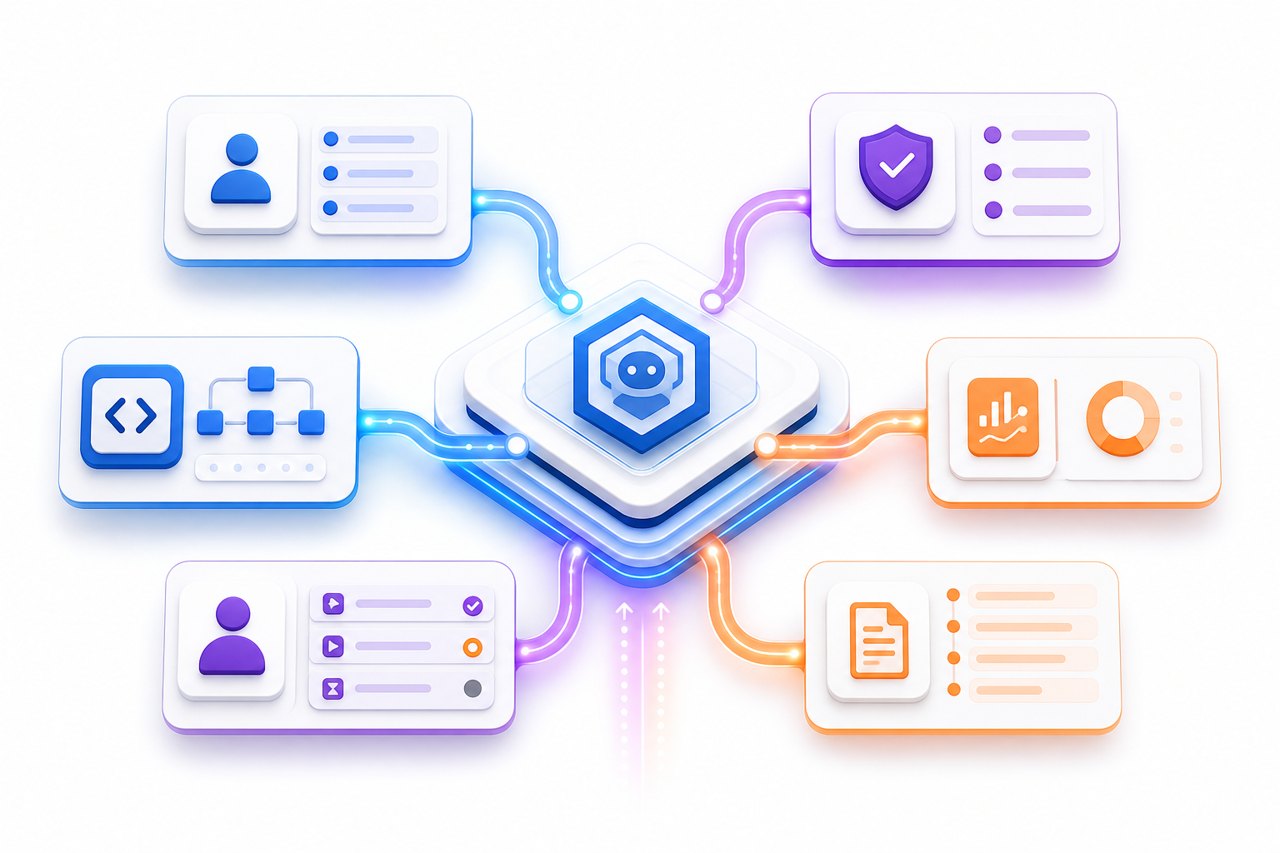
A useful observability layer connects technical traces to human decisions, not just infrastructure metrics.
The AI agent observability signals every team should capture
Good observability starts with a clear run record. A run record is the story of one agent attempt from goal to outcome. For a simple chatbot, the record might be prompt, response, latency, and token usage. For an enterprise agent, that is not enough. The record needs to describe the task, the user, the policy context, the model choices, the tool calls, the retrieved evidence, the approvals, the failure handling, and the final business result.
| Signal | What to capture | Why it matters | Action it should trigger |
|---|---|---|---|
| Identity and scope | User, team, tenant, agent version, permission set, connected systems. | Prevents anonymous automation and overbroad access. | Block if identity or scope is missing. |
| Goal and risk tier | Requested outcome, allowed actions, reversibility, sensitivity, impact level. | Different workflows need different oversight. | Route high-risk runs to approval or sandbox. |
| Prompt and context | System instructions, user request, retrieved documents, memory references. | Explains whether the agent acted on relevant and current information. | Alert on stale, missing, or policy-conflicting context. |
| Tool calls | Tool name, input, output, timestamp, retries, errors, data touched. | Tool use is where agents affect the world. | Require policy checks before sensitive tools execute. |
| Evaluation results | Task success, groundedness, safety flags, policy verdict, reviewer score. | Outcome quality cannot be inferred from a confident answer. | Compare against release thresholds before scaling. |
| Human decisions | Approval, rejection, edit, override reason, reviewer role, response time. | Human-in-the-loop only works if the human has context and authority. | Track rubber-stamp patterns and escalation delays. |
| Cost and latency | Tokens, model calls, tool costs, retries, queue time, end-to-end duration. | Agents can hide expensive loops behind one user request. | Set budget limits and investigate runaway sessions. |
| Incident evidence | Failed run packet, screenshots if appropriate, trace, owner, mitigation, follow-up. | Incidents are learning opportunities only if evidence is preserved. | Create postmortem and update policy or tests. |
This table is intentionally broader than a tool comparison. Platforms matter, but the first decision is what evidence the organization must preserve. A small team can begin with structured logs and a review queue. A regulated enterprise may need centralized telemetry, model evaluation, policy enforcement, data lineage, and searchable audit records. The principle is the same: capture enough detail to debug, govern, and improve the agent.
A practical framework for production AI agent observability
1. Start with risk tiers, not dashboards
Dashboards are useful after the team knows which decisions matter. Start by classifying workflows into low, medium, and high risk. A draft summarization agent may need lightweight review. An agent that updates customer records, changes cloud infrastructure, sends money, or writes to production databases needs stricter controls. The risk tier should decide which tools are available, whether approval is mandatory, what logs are retained, and which metrics block release.
2. Treat every tool call as a control point
Agent observability becomes valuable when it is close to action. A tool call is not only a technical event; it is a governance event. The record should show who initiated the run, what permission allowed the tool, what data the tool accessed, what input was sent, what output came back, and whether the action was reversible. This is also where internal links to your broader architecture matter. If you are designing the surrounding layer, read Singularity Journey’s guide to an AI agent control plane for identity, permissions, and audit logs.
3. Connect observability with evaluation
Observability tells you what happened. Evaluation tells you whether it was good enough. Production agent teams need both. Use traces to sample failed and successful runs, then evaluate task completion, source quality, policy compliance, human review accuracy, and cost. For a deeper companion topic, see AI agent evaluation for reliability, cost, and safety.
4. Design human approval as data, not ceremony
Human approval can become theater if reviewers lack context, authority, or time. Observability should capture the approval prompt, the evidence shown to the reviewer, the reviewer’s decision, any edits, the reason code, and the outcome after approval. IMDA’s emphasis on meaningful human accountability is important here: the human should not be a decorative checkbox. Approval data should reveal whether humans are catching risks, rubber-stamping everything, or becoming a bottleneck. Related implementation guidance is available in Singularity Journey’s article on human approval for AI agents.
5. Build incident review into the loop
Agents will fail in ways that normal software does not. They may choose a plausible but wrong tool, retrieve outdated context, skip a step, loop through retries, or produce a correct-looking answer with weak evidence. The observability system should make incidents easy to reconstruct. A useful incident packet includes the run trace, user goal, policy tier, model and prompt version, context sources, tool calls, approval decisions, evaluation results, customer or internal impact, and follow-up action.

What to measure before an AI agent moves from pilot to production
A pilot can succeed because the team babysits it. Production succeeds only when the system behaves reliably across ordinary work, edge cases, and organizational pressure. Before expanding a pilot, review these metrics as a group rather than treating any single number as proof.
| Readiness area | Minimum question | Healthy signal | Warning signal |
|---|---|---|---|
| Task success | Does the agent complete the intended workflow? | Clear success criteria and stable performance across sampled runs. | High “looks good” rate but unclear business outcome. |
| Grounding | Does the agent use current, authorized sources? | Trace links outputs to approved context. | Answers depend on memory or unknown sources. |
| Tool safety | Are tool calls permitted, bounded, and reversible where needed? | High-risk tools require policy checks and approval. | Broad tokens, hidden tools, or missing input/output logs. |
| Human review | Do reviewers have enough context to decide? | Override reasons and response times are tracked. | Nearly all approvals happen instantly with no rationale. |
| Cost control | Can spend be attributed to workflow and agent version? | Costs visible by model, retry, tool, and tenant. | Only aggregate monthly spend is available. |
| Incident learning | Can failures improve tests and policy? | Postmortems update evals, prompts, permissions, or rollout scope. | Failures are discussed in chat but not recorded in the system. |
Interactive: AI agent observability maturity checker
Use this quick checklist before promoting an agent from prototype to production. It is not a compliance assessment; it is a practical readiness signal.
Score: 0/6 : Prototype visibility only.
Common mistakes that weaken AI agent observability
Mistake 1: logging only the final answer
The final answer is often the least useful part of the trace. A bad path can produce a plausible answer, and a good path can fail because a downstream system rejected the action. Keep the path, not just the output.
Mistake 2: separating governance from engineering telemetry
If the compliance team has policies in documents and engineers have traces in another system, nobody has a full picture. A practical observability layer should connect telemetry to policy decisions, approvals, owners, and risk tiers.
Mistake 3: treating observability tools as a substitute for workflow design
No dashboard can fix an agent that has vague goals, excessive permissions, no stop condition, or no owner. Start with bounded workflows. If you are still defining the system, the broader Singularity Journey guide on how to build AI agents in 2026 is a better first step.
Mistake 4: ignoring quiet failures
Some agent failures are obvious: an error, a timeout, a refused tool call. Others are quiet: weak evidence, unnecessary retries, outdated context, subtle policy drift, or a reviewer who approves too quickly. Observability should look for both.
Mistake 5: collecting everything without deciding what matters
More logs do not automatically create more trust. Decide which fields support debugging, governance, user trust, security, and cost control. Keep what you need, protect sensitive data, and define retention rules before traces become another unmanaged data lake.
Final insight: observability is how agentic AI becomes accountable
Enterprise AI agents will not earn trust simply because models improve. They will earn trust when organizations can explain their actions, constrain their tools, evaluate their results, and learn from failures. That is why AI agent observability is more than a technical feature. It is a control layer for the agentic AI era.
The best teams will not wait until a failed agent run forces the issue. They will instrument early, start with bounded workflows, use human approval where risk demands it, and turn every important run into evidence. In that sense, observability is not only about watching agents. It is about making agentic AI governable enough to use.
FAQ: AI agent observability
Is AI agent observability the same as LLM observability?
No. LLM observability usually tracks model calls, prompts, responses, tokens, latency, and quality signals. AI agent observability includes those signals but also tracks tool calls, task steps, permissions, memory, retrieved context, policy checks, approvals, outcomes, and incident evidence across a full agent run.
What is the most important signal to log for production AI agents?
The most important signal is the full run trace: goal, user, agent version, context, model calls, tool calls, approvals, errors, evaluation results, and final outcome. Without the full trace, teams may know that something happened but not why it happened.
Do small teams need AI agent observability?
Yes, but the implementation can be lightweight. A small team can start with structured logs, run IDs, tool-call records, approval notes, and manual review samples. The goal is not to buy a large platform on day one; it is to preserve enough evidence to debug and improve the agent.
How does observability reduce AI agent risk?
Observability reduces risk by making hidden behavior visible. It helps teams detect unsafe tool calls, stale context, excessive retries, policy violations, review bottlenecks, rising costs, and repeated failure patterns. It also creates audit evidence when decisions need to be reviewed later.
What should trigger human approval in an AI agent workflow?
Human approval should be required for irreversible actions, sensitive data access, external communications, financial transactions, production changes, legal or compliance-sensitive decisions, and any workflow where a wrong action could create material harm. The approval screen should include the relevant trace evidence, not just a yes/no button.
Which internal Singularity Journey articles should I read next?
Start with the pillar article on agentic AI trends 2026, then read the guides on AI agent control planes, AI agent evaluation, and human approval for AI agents.
