
Human-AI Workflow Skills: Build a Career Portfolio Employers Can Trust
The strongest AI career signal is no longer “I know how to prompt.” It is proof that you can redesign work with AI, measure the result, control the risk, and explain where human judgment made the outcome better.

Human-AI Workflow Skills: Quick Answer
Human-AI workflow skills are the practical abilities that let you use AI systems inside real work without turning the work into a black box. They include choosing the right task for AI, giving useful context, checking outputs, protecting private data, measuring before-and-after results, and knowing when a human should approve or override the system.
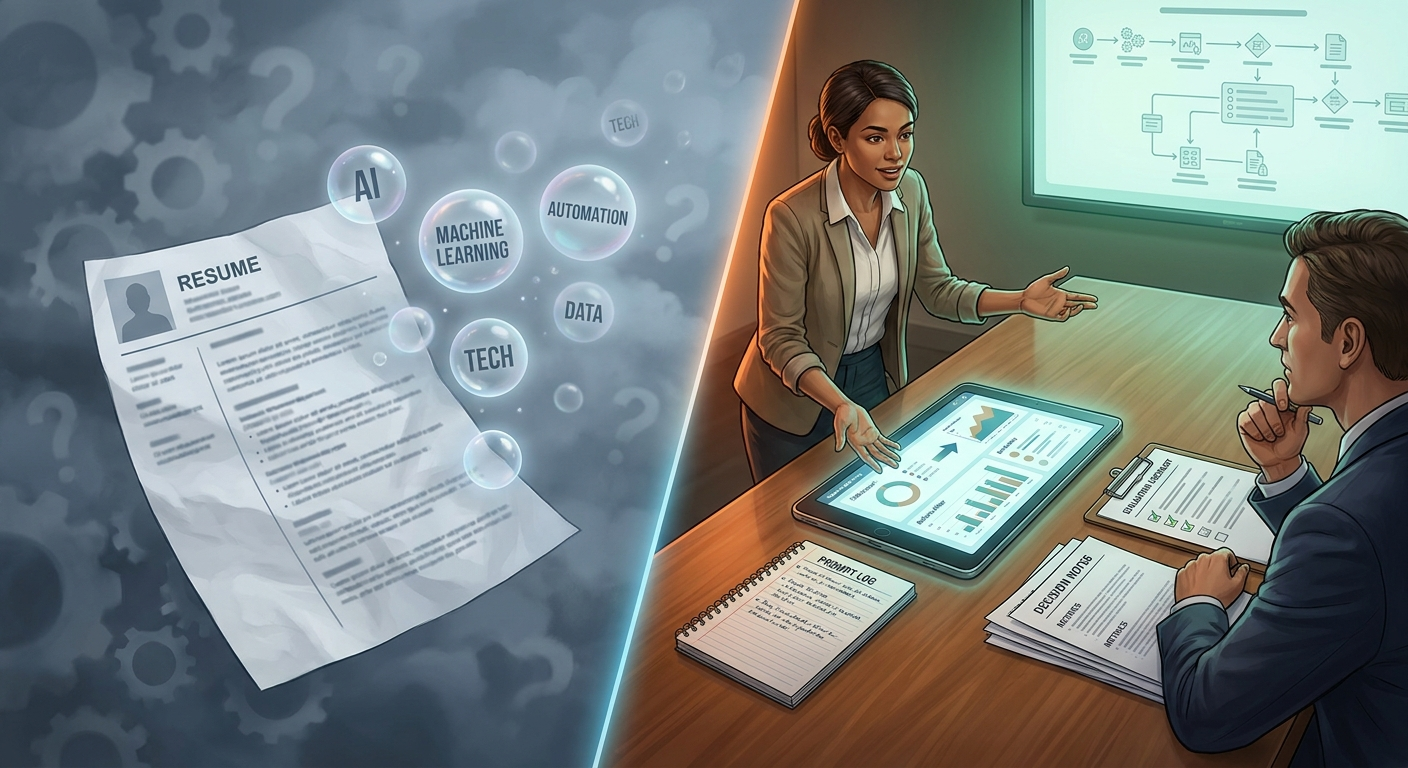
Employers cannot evaluate those skills from a buzzword list. A resume line that says “used ChatGPT” or “knows prompt engineering” is too thin. A trusted portfolio shows the work: the original problem, the workflow you designed, the AI tools or agents you used, the human checkpoints you added, the evidence that quality improved, and the limitations you noticed.
This article gives you a complete system for building that proof. It is designed for analysts, developers, marketers, operations people, product managers, founders, students, and career switchers who want to prove they can work with AI responsibly. It also gives hiring managers a clearer way to evaluate AI fluency without being impressed by shallow tool name-dropping.
Why Human-AI Workflow Skills Matter More Than Tool Lists
The labour market is moving from “can you use an AI tool?” to “can you improve a workflow with AI while keeping quality, accountability, and judgment intact?” That is a very different bar. A tool list is easy to copy. A workflow improvement is harder to fake because it leaves artifacts: inputs, decisions, versions, evaluation notes, results, and lessons learned.
Recent labour-market and workplace research points in the same direction. The World Economic Forum’s Future of Jobs research frames technological change and skills transformation as major forces shaping work, using employer input across many economies and industries. Microsoft’s Work Trend Index describes firms moving toward human-led, AI-operated workflows where agents become part of team execution. Anthropic’s Economic Index found real-world AI usage leaning toward augmentation more than pure automation in its initial Claude.ai analysis. PwC’s AI Jobs Barometer argues that AI-exposed jobs are changing quickly and that judgment, leadership, creativity, and strategic thinking are increasingly important in exposed roles.
Those signals do not mean every job becomes an AI job overnight. They mean the proof of value changes. If AI can draft, summarize, classify, code, search, reconcile, and generate options, then the human advantage shifts toward choosing good problems, supplying context, reviewing outputs, designing controls, communicating tradeoffs, and turning machine assistance into a reliable result.
That is why Singularity Journey has been building a cluster around career moats, AI portfolios, workflow case studies, and resume proof. Existing articles such as AI Career Moat, AI Portfolio Projects That Prove You Can Work With Agents, and AI Resume Skills all point to the same conclusion: careers will reward people who can show useful collaboration between humans and AI systems, not people who merely collect tool badges.
Search data also supports this direction. Google Search Console for Singularity Journey is still sparse, but a portfolio-related page already appeared around average position five with impressions and no clicks. GA4 shows engagement on Future Careers and portfolio articles. That combination suggests a practical opportunity: build a stronger pillar page that connects portfolio projects, resume language, human judgment, workflow evidence, and employer trust.
The Human-AI Workflow Skills Matrix
A useful AI career portfolio should not be a random gallery of outputs. It should prove specific capabilities. Use the matrix below as your foundation. Each row is a skill employers can care about, paired with evidence you can show without exposing private information.
| Skill | What it means in real work | Portfolio evidence |
|---|---|---|
| Problem selection | You choose tasks where AI can reduce effort, improve coverage, or create useful options. | Problem brief, baseline workflow, reason AI was appropriate, scope boundaries. |
| Context design | You give the AI enough useful context without dumping irrelevant or sensitive material. | Context checklist, redacted prompt, source pack, assumptions list. |
| Workflow design | You turn AI assistance into repeatable steps rather than one-off magic. | Workflow map, tool sequence, handoff notes, screenshots, process diagram. |
| Evaluation | You test output against quality criteria instead of accepting confident answers blindly. | Rubric, sample test cases, before/after comparisons, error log. |
| Human judgment | You decide what to approve, reject, escalate, or rewrite. | Review notes, decision log, examples of AI suggestions you did not use. |
| Risk control | You protect privacy, accuracy, safety, brand voice, legal constraints, and user trust. | Risk checklist, approval rules, data-handling note, escalation path. |
| Measurement | You connect the workflow to time saved, quality improved, errors reduced, or output expanded. | Baseline metric, result metric, confidence level, limitations. |
| Communication | You explain the workflow clearly to non-technical teammates or managers. | One-page case study, demo video, README, manager summary. |
The most important row is human judgment. A portfolio that only shows final AI-generated assets can accidentally weaken your case because it makes the employer wonder what you actually contributed. Your job is to make your contribution visible. Show where you framed the problem, constrained the system, caught errors, improved the result, and made decisions the model could not responsibly make alone.
The Career Portfolio System Employers Can Trust
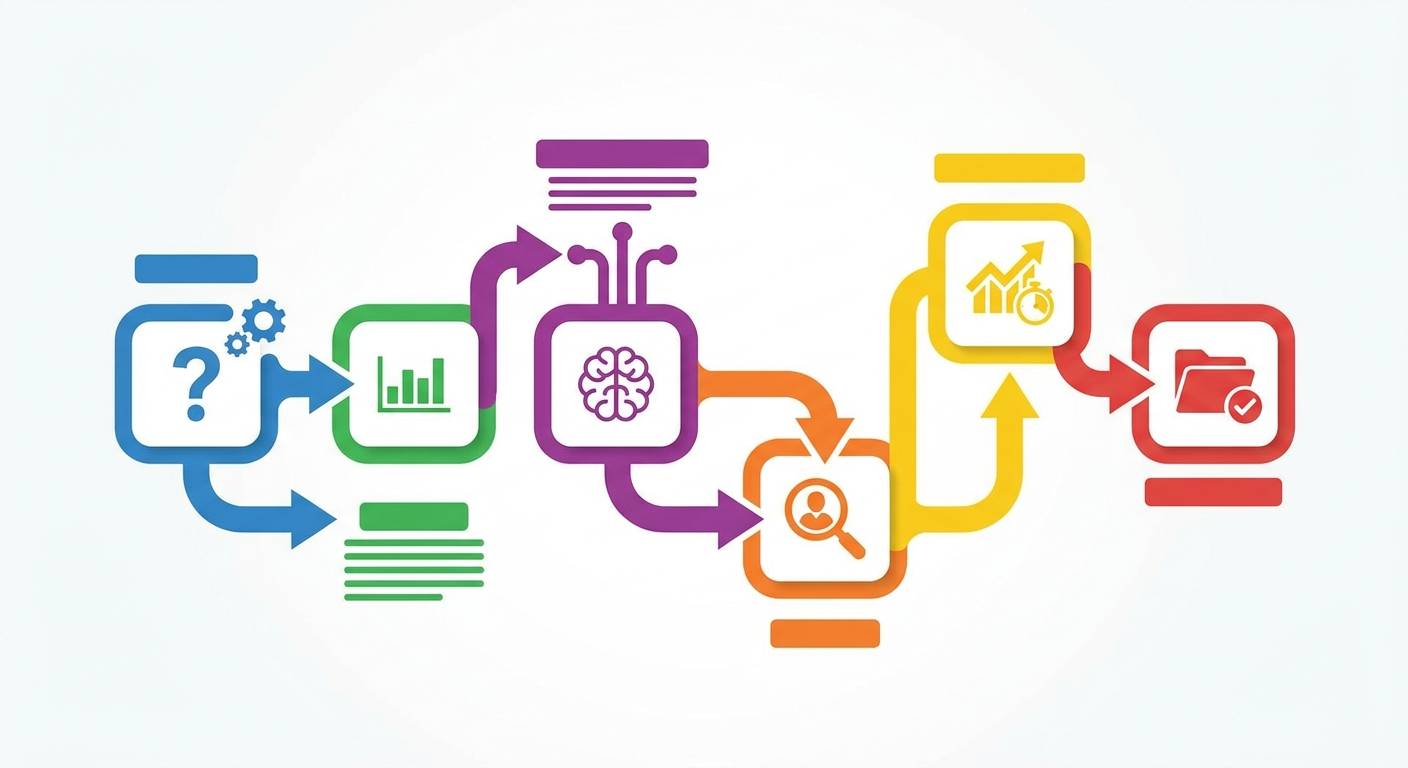
A trusted AI portfolio has five layers: problem, workflow, evidence, judgment, and transferability. If one layer is missing, the portfolio feels weaker. A beautiful demo without measurement is hard to evaluate. A metric without process looks accidental. A prompt without a business problem looks like a hobby exercise. The system works because it connects everything.
1. Start with a real problem
Do not begin with “I want to use an AI agent.” Begin with a problem someone would pay to solve. Examples: customer support replies take too long to draft, weekly reporting is inconsistent, sales research is repetitive, product feedback is scattered, onboarding documents are out of date, code reviews miss recurring issues, or job applications are not tailored enough. A real problem gives your project relevance.
2. Document the baseline
Before you add AI, record what the workflow looked like. How many steps did it take? Where did quality fail? How long did it take? What was confusing? What output was expected? Even a rough baseline is better than none. A portfolio with no baseline cannot prove improvement; it can only show activity.
3. Design the human-AI workflow
Map the workflow as steps. For example: collect inputs, remove sensitive information, ask AI to classify the material, review uncertain cases, ask AI to draft a summary, compare it with the rubric, rewrite the final recommendation, and store the result. The map proves you can turn AI into a process. It also makes your work easier to discuss in interviews.
4. Add checkpoints
Every serious AI workflow needs checkpoints. The checkpoint might be a human approval before sending an email, a citation check before publishing a research summary, a test suite before merging code, or a privacy screen before uploading documents. Checkpoints tell employers you understand that AI outputs can be useful and unreliable at the same time.
5. Measure the result
Measurement does not need to be perfect, but it should be honest. You can measure time saved, defect reduction, review coverage, number of outputs produced, consistency score, or stakeholder satisfaction. If you cannot measure the result quantitatively, use a structured qualitative rubric and explain the limitation.
6. Package the artifact
The final portfolio artifact should be easy to inspect. Use a one-page case study, a GitHub README, a Notion page, a short Loom video, or a simple PDF. Include screenshots only when they are safe and useful. Redact private data. Use diagrams. Make the story readable in five minutes.
Project Ideas That Prove Human-AI Workflow Skills
The best project is not always the flashiest one. It is the one that proves a job-relevant workflow. Choose a project that fits your target role and produces evidence a hiring manager can understand.
For deeper implementation examples, connect this pillar with AI Portfolio Case Study Template, AI Workflow Portfolio, and AI Automation Portfolio Projects. Those articles can become supporting cluster pieces around this larger career system.
One warning: avoid projects that are only output galleries. A folder of AI images, AI blog drafts, or chatbot screenshots is not enough. The employer wants to know whether you can create reliable value. Add the process, the evaluation, the risk controls, and the business context.
A Simple Rubric for Scoring Your AI Career Portfolio
Use this rubric before you publish a portfolio case study. Score each item from 0 to 2. A strong project usually scores at least 12 out of 16. A project under 8 probably needs more evidence before it can help your job search.
| Criterion | 0 points | 1 point | 2 points |
|---|---|---|---|
| Problem clarity | Vague or toy problem. | Some real-world relevance. | Specific job-relevant pain point with clear user or stakeholder. |
| Baseline | No starting point. | Rough description. | Clear before-state with time, quality, cost, or friction measure. |
| Workflow map | Only final output shown. | Some steps explained. | Repeatable human-AI workflow with roles and checkpoints. |
| AI use | Tool use is hidden or generic. | Prompt/tool summary included. | Context, prompts, agent instructions, and constraints are explained safely. |
| Evaluation | No quality check. | Manual review mentioned. | Rubric, tests, examples, or comparison table included. |
| Risk control | No risk thinking. | One risk mentioned. | Privacy, accuracy, bias, security, approval, or escalation controls included. |
| Result | No outcome. | Qualitative result only. | Honest before/after metric or structured impact estimate. |
| Communication | Hard to scan. | Understandable with effort. | Readable five-minute case study with visuals and clear takeaway. |
How to Translate Portfolio Proof Into Resume Bullets
Once you have portfolio evidence, your resume becomes much stronger. Instead of saying “experienced with AI tools,” describe the workflow and the result. The formula is simple: redesigned [workflow] using [AI role] with [human control] to improve [measured outcome].
| Weak resume claim | Stronger human-AI workflow proof |
|---|---|
| Used ChatGPT for marketing. | Built a human-reviewed AI content repurposing workflow that turned long-form briefs into draft newsletter, social, and landing-page variants while preserving brand checklist compliance. |
| Prompt engineering experience. | Created reusable prompt and context templates for support-ticket triage, then reviewed uncertain classifications and documented failure cases for escalation. |
| AI automation skills. | Mapped a weekly reporting process, automated first-draft summaries with AI, added human approval checkpoints, and reduced manual consolidation time in a test workflow. |
| Built AI chatbot. | Designed a retrieval-backed assistant prototype with source constraints, answer-quality rubric, fallback behavior, and sample evaluations for incorrect responses. |
For more resume-specific guidance, link your project to AI Resume Bullet Examples. The important principle is that the resume should point to proof. If a recruiter asks “can I see it?” you should be able to open a case study that backs up the line. if you want generate AI video resume use portfolio video
A Practical Build Plan for Your First Human-AI Workflow Case Study
Here is a simple build plan you can complete without needing a perfect job title, expensive software, or private company data. The goal is to create one high-trust case study, not a giant portfolio.
Step 1: Pick a workflow you understand
Choose something familiar enough that you can judge the output. If you do not understand the task, you cannot evaluate whether AI helped. Good first workflows include research summaries, meeting-note action extraction, spreadsheet cleanup, support reply drafting, content repurposing, code test generation, competitive analysis, or onboarding checklist creation.
Step 2: Create safe sample data
Use public data, synthetic data, your own notes, or redacted examples. Do not upload employer secrets, customer records, confidential code, or private documents. A portfolio should increase trust, not create a privacy problem.
Step 3: Record the baseline
Run the workflow manually once. Time it. Note what was frustrating. Save the original output. Write down the quality criteria. This gives you something to compare against when AI enters the process.
Step 4: Add AI assistance
Use AI for a specific role: classify, draft, summarize, check, generate alternatives, explain code, create tests, or find inconsistencies. Avoid asking AI to own the whole project. The more specific the role, the easier it is to evaluate.
Step 5: Review and improve
Compare the AI-assisted output against your rubric. Mark false positives, omissions, tone problems, hallucinations, security concerns, or unclear reasoning. Then improve the workflow. This revision loop is the career signal. It proves you can supervise AI rather than merely consume it.
Step 6: Publish a clean case study
Your final case study should include: problem, baseline, workflow map, AI role, human checkpoints, result, limitations, and what you would do next. Keep it short enough to read quickly. A hiring manager does not need every prompt; they need enough evidence to trust your thinking.
If you are already using AI agents, add an agent-specific section: tool permissions, memory or context policy, approval gates, logs, cost awareness, and fallback behavior. Internal articles such as Human Approval for AI Agents and AI Agent Evaluation Framework can help you make that section more rigorous.
Common Mistakes That Make AI Portfolios Look Weak
What builds trust
- A concrete workflow tied to a real job problem.
- Safe sample data and clear privacy boundaries.
- Visible human review and decision notes.
- Before/after metrics or a transparent quality rubric.
- Limitations and next-step improvements.
What weakens trust
- Generic tool badges with no evidence.
- Unreviewed AI outputs presented as finished work.
- Private or copyrighted material used carelessly.
- Inflated claims about time saved or accuracy.
- No explanation of what the human contributed.
The biggest mistake is treating AI as the star of the portfolio. The star should be your judgment. AI is the lever. Your portfolio should make the lever visible, but it should make your thinking even more visible.
One more practical detail: keep your portfolio narrow enough to be trusted. A hiring manager should be able to understand the case study quickly, reproduce the logic, and see why the workflow would matter inside a team. Do not hide behind dozens of screenshots. Choose one strong example, explain the decision points, and show where the AI helped versus where your human review changed the outcome. That clarity is especially useful for early-career workers because it replaces vague confidence with observable competence. It also helps experienced workers reposition existing domain knowledge as an AI-era advantage rather than pretending to become a completely different professional.
Sources and References
- World Economic Forum: Future of Jobs Report
- Microsoft Work Trend Index: Frontier Firm report
- Anthropic Economic Index
- PwC AI Jobs Barometer
These sources provide labour-market and workplace context. They do not guarantee hiring outcomes. Use them to understand directional demand, then prove your own skill with concrete portfolio evidence.
FAQ: Human-AI Workflow Skills and Career Portfolios
What are human-AI workflow skills?
They are the skills used to combine AI assistance with human judgment in a repeatable work process. They include problem framing, context design, AI tool use, evaluation, risk control, measurement, and communication.
How do I prove AI skills without an AI job?
Create a safe portfolio case study using public or synthetic data. Show the baseline, AI-assisted workflow, review checklist, outcome, and limitations. The proof matters more than the job title.
Is prompt engineering enough for a career portfolio?
No. Prompts are useful evidence, but they are not enough by themselves. Employers also need to see workflow design, quality control, judgment, privacy awareness, and measurable results.
What should an AI career portfolio include?
Include a problem brief, workflow map, AI role, sample prompts or instructions, human checkpoints, evaluation rubric, before/after results, risk notes, and a concise reflection.
Which AI portfolio project is best for non-developers?
Pick a workflow from your target role: research synthesis, content repurposing, customer support triage, meeting-note extraction, spreadsheet cleanup, market analysis, or operations reporting. Show process and judgment, not just output.
Can I use private work projects in my portfolio?
Be careful. Do not expose employer data, customer information, confidential documents, or proprietary workflows. Use redacted, synthetic, or public examples unless you have explicit permission.
