
AI Resume Bullet Examples: Prove Human-AI Workflow Skills
A practical library of AI resume bullets that show workflow design, human judgment, evidence, and role-specific outcomes—not vague tool familiarity.
AI Resume Bullet Examples: Quick Answer
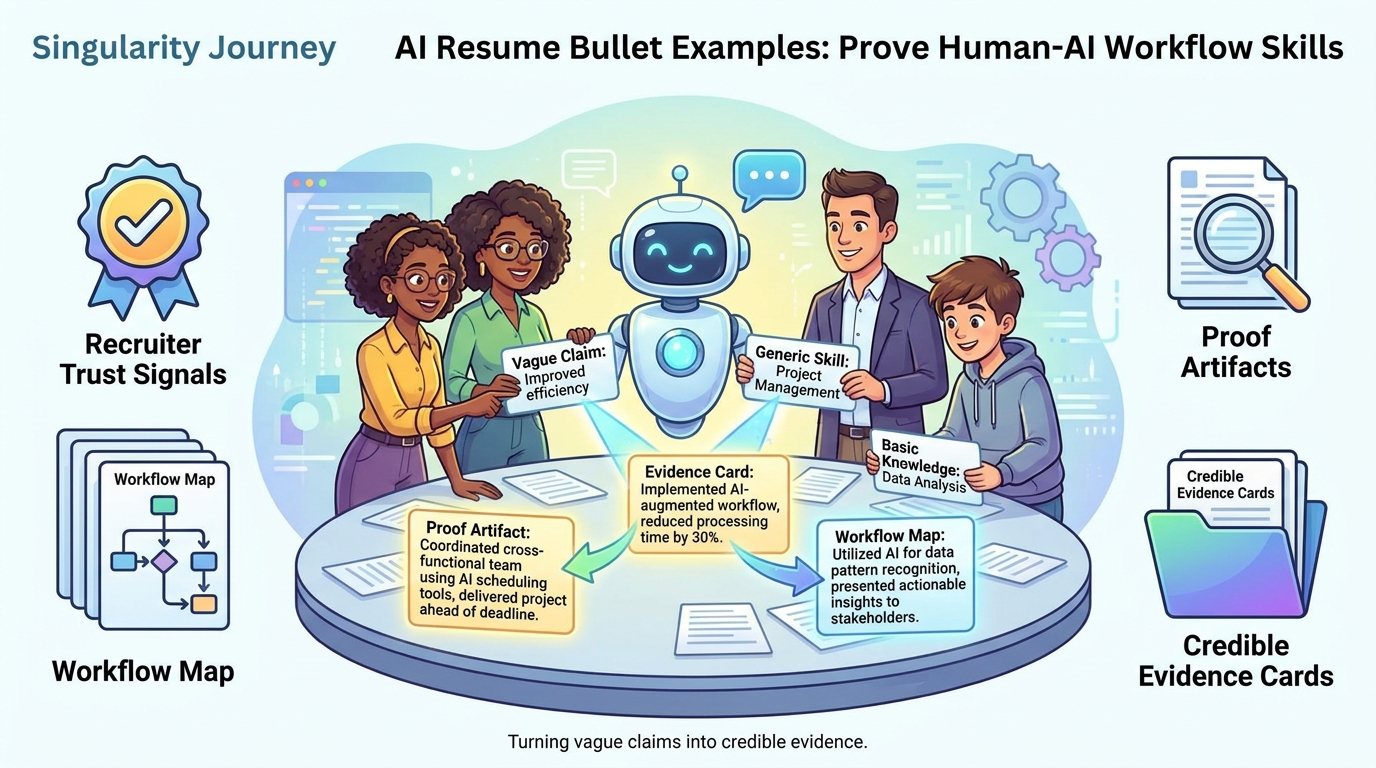
AI resume bullet examples work best when they prove a human-AI workflow, not casual tool familiarity. A credible bullet explains the business task, where AI helped, what you personally reviewed or decided, and what changed because of the work. The strongest version also points to proof: a workflow map, dashboard, portfolio case study, quality checklist, before-and-after sample, or documented metric.
That is the narrow job of this cluster article. The source pillar, AI Resume Skills: How to Show Human-AI Workflow Experience Employers Trust, explains the broader framework for resume skills, proof artifacts, interviews, and mistakes. This guide goes deeper on one practical subtopic: turning that framework into resume bullets that sound specific, honest, and useful to recruiters.
For example, “Used ChatGPT for marketing” is weak because it tells the employer almost nothing. “Built a human-reviewed AI drafting workflow for weekly product emails, reducing first-draft time while preserving brand review and source checks” is stronger because it describes the workflow, the human control, and the business outcome. The second bullet does not pretend the tool did everything; it shows that you designed a useful process.
Why AI Resume Bullets Need a Different Standard
Traditional resume bullets often focus on tasks and results: managed a project, analyzed data, supported customers, shipped a feature, reduced turnaround time. AI changes the wording problem because “used AI” can mean almost anything. One person may have pasted a prompt into a chatbot once. Another may have redesigned a workflow with retrieval, human approval, evaluation checks, and privacy rules. If both write “proficient with AI tools,” the employer cannot tell who has real capability.
That is why the current search results around AI skills are crowded with generic lists but still leave a useful gap. Many pages name skills such as prompt engineering, AI fluency, workflow automation, data literacy, and tool proficiency. Those lists are helpful, but they do not always show how to convert the skill into evidence. A recruiter does not hire a keyword; they evaluate whether your experience lowers risk and increases performance.
Public labor-market sources support the broader reason this matters. The World Economic Forum’s Future of Jobs reporting highlights technological change and skill transformation as major workforce forces, while Microsoft’s Work Trend Index frames AI agents and human agency as a workplace shift. NACE’s career readiness model also reminds candidates that employers care about communication, critical thinking, professionalism, technology, and career management. An AI resume bullet should connect AI use to those durable competencies.
The most trustworthy AI resume bullets therefore answer four quiet questions: What real work was improved? What did the AI system do? What did the human still control? What proof exists? If you cannot answer those questions, keep the bullet out of the resume until you can.
The Human-AI Resume Bullet Formula
Use this formula as a starting point, not a script you copy blindly:
[Action verb] + [workflow/task] + [AI-assisted method] + [human review or decision] + [outcome/proof].The reason this formula works is that it separates tool use from responsibility. Employers do not only want to know that you can prompt an AI system. They want to know whether you can choose a task, provide context, judge outputs, protect sensitive information, and measure whether the workflow actually helped.
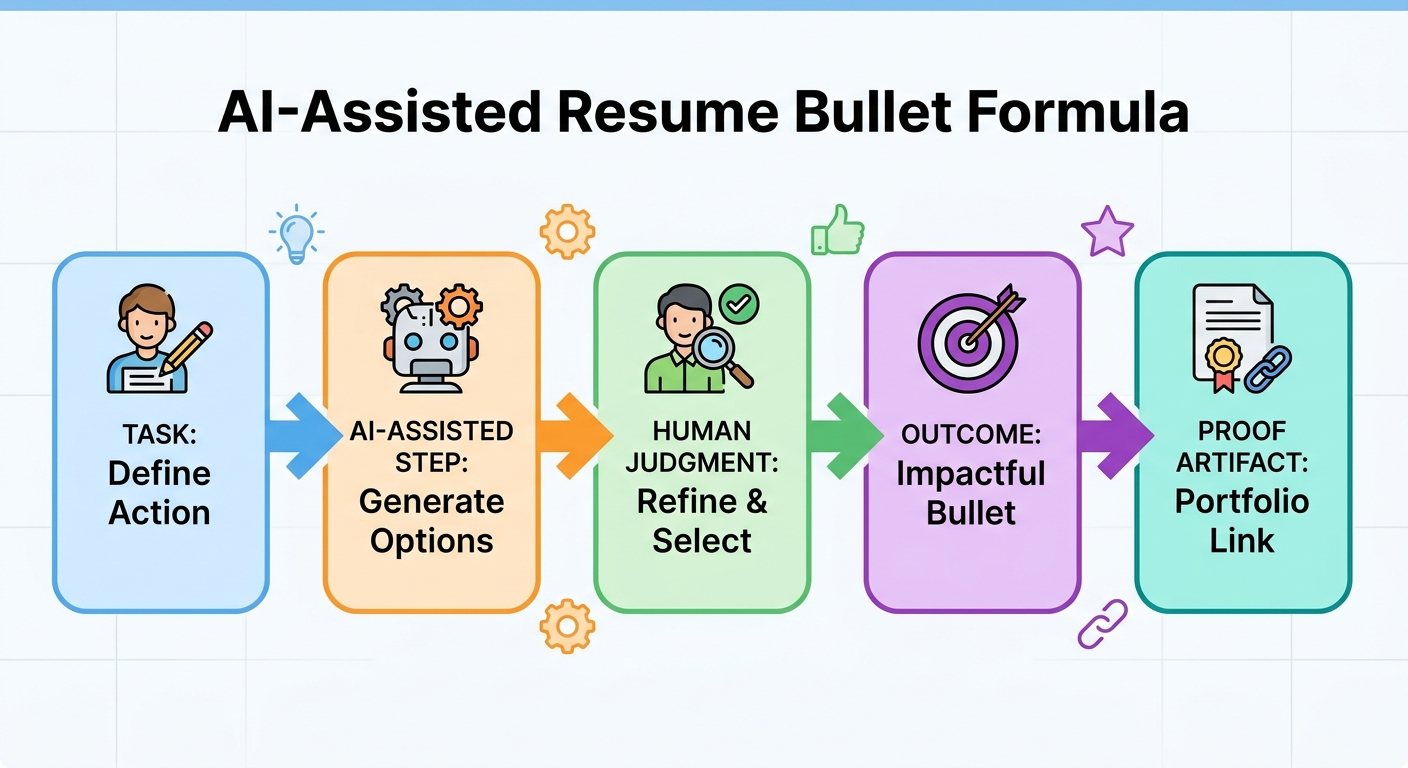
| Formula part | What it proves | Weak wording | Stronger wording |
|---|---|---|---|
| Action verb | You owned the work instead of passively using a tool. | Used AI | Designed, audited, mapped, automated, evaluated, documented |
| Workflow/task | The work was tied to a real business process. | for content | for weekly product email drafts, support triage, invoice review, lead research, or sprint notes |
| AI-assisted method | You understand where AI fits in the process. | with ChatGPT | with AI-assisted classification, summarization, first-draft generation, or checklist extraction |
| Human judgment | You managed risk and quality. | automatically | with manual review of edge cases, source checks, privacy filtering, or manager approval |
| Outcome/proof | The bullet has evidence. | improved productivity | reduced draft time, improved response consistency, created a reusable template, or documented a QA process |
You do not need a perfect metric for every bullet. Some early-career candidates, freelancers, students, and career switchers may not have access to company analytics. In that case, use observable proof: number of workflows mapped, documents created, test cases written, reviewers involved, examples shipped, or portfolio artifacts published. Just do not invent numbers. A modest honest proof point beats a fake metric.
Before-and-After AI Resume Bullet Examples
The easiest way to learn the pattern is to rewrite weak bullets. Each example below keeps the claim realistic and avoids pretending AI replaced the candidate’s judgment.
| Weak bullet | Stronger AI resume bullet | Why it works |
|---|---|---|
| Used ChatGPT to write content. | Created a human-reviewed AI drafting workflow for product update emails, combining audience notes, source links, brand checks, and final editorial approval before publishing. | Shows workflow design, quality control, and human ownership. |
| Automated reports with AI. | Built an AI-assisted reporting checklist that summarized weekly sales notes, flagged missing fields for manual review, and helped the team prepare cleaner manager updates. | Specific task, AI role, and review step. |
| Good at prompt engineering. | Developed reusable prompt templates for customer-support summary drafts, including tone rules, escalation triggers, and a human approval step for sensitive cases. | Turns a buzzword into a documented work artifact. |
| Used AI for research. | Designed an AI-assisted research workflow that grouped competitor notes by theme, then manually verified sources and converted findings into a launch-planning brief. | Separates AI sorting from human verification. |
| Improved productivity with AI tools. | Mapped a recurring operations workflow, identified repeatable handoff points, and introduced AI-assisted first drafts for internal status updates while preserving owner review. | Shows process thinking rather than vague productivity language. |
| Used AI to analyze data. | Used AI-assisted data exploration to generate initial hypotheses from survey comments, then validated themes manually and summarized findings for the product team. | Respects the difference between exploration and validated analysis. |
Notice that the stronger bullets do not overclaim. They avoid “fully automated,” “revolutionized,” and “expert in all AI tools.” They sound believable because they include constraints. That credibility matters, especially when many applicants are now adding AI terms to resumes without showing how they used them.
AI Resume Bullet Examples by Role
Good AI resume bullets depend on the job you want. A marketer, operations analyst, support specialist, project manager, and developer should not use the same bullet. The common pattern is the same, but the workflow evidence changes.
Marketing and content
- Built a human-reviewed AI content briefing workflow that converted product notes, customer pain points, and source links into first-draft outlines for campaign pages.
- Created prompt templates for repurposing webinar transcripts into social post drafts, then edited outputs for brand voice, claims accuracy, and compliance-sensitive wording.
- Used AI-assisted clustering to group customer feedback themes before writing final messaging recommendations for a product launch.
Operations and administration
- Mapped a recurring vendor follow-up workflow and introduced AI-assisted email drafts with manual checks for dates, amounts, and approval status.
- Designed an AI-supported meeting-summary process that captured action items, owners, and blockers, then verified final notes before sharing with stakeholders.
- Created a reusable checklist for AI-assisted document intake, including privacy screening, exception handling, and escalation rules.
Customer support
- Developed AI-assisted support response templates for common troubleshooting cases, with human review for account-specific, refund, and safety-sensitive issues.
- Analyzed support tickets with AI-assisted theme grouping, then manually validated patterns and proposed help-center updates for repeated questions.
- Built a response-quality checklist covering tone, source accuracy, escalation, and customer context before sending AI-drafted replies.
Sales and customer success
- Used AI-assisted account research to summarize public company context, then verified key details and prepared personalized discovery-call notes.
- Created a human-reviewed follow-up email workflow that turned call notes into draft next steps, risks, and stakeholder-specific summaries.
- Developed objection-handling notes from CRM patterns and sales calls, then reviewed outputs with the team before adding them to enablement material.
Data, product, and project work
- Used AI-assisted synthesis to group open-ended survey responses, then manually checked representative examples and prepared a product-priority summary.
- Built a sprint-retrospective workflow that summarized team notes, identified repeated blockers, and preserved final decisions in a project tracker.
- Created a product-research brief using AI-assisted source organization, manual citation review, and stakeholder-ready recommendation tables.
Software and technical roles
- Used AI coding assistance to draft unit-test cases for edge conditions, then reviewed generated tests manually and adjusted coverage based on project behavior.
- Designed a developer documentation workflow that converted implementation notes into draft docs, then verified commands, parameters, and warnings before publishing.
- Created an AI-assisted bug-triage process that summarized logs and reproduction steps while preserving engineer review for root-cause decisions.
What Proof Should Sit Behind Each Bullet?
A resume bullet is stronger when you can defend it in an interview. Before adding an AI bullet, ask what proof you could show or describe. The proof does not always need to be public, especially if the work involved confidential company data. But you should be able to explain the process without exposing private material.
If you need a deeper guide to proof artifacts, use the related Singularity Journey article on AI portfolio projects that prove you can work with agents. If you want a structure for presenting one project, use the AI portfolio case study template. This bullet-focused article should sit between those resources and the resume-skills pillar: it gives you the exact wording layer.
The Recruiter Trust Test for AI Resume Bullets
Before you keep a bullet, run it through a simple trust test. Imagine a recruiter asks, “What exactly did you do?” If your answer is only “I used an AI tool,” the bullet is not ready. If you can explain the workflow, decision points, risks, review process, and output, the bullet is much stronger.
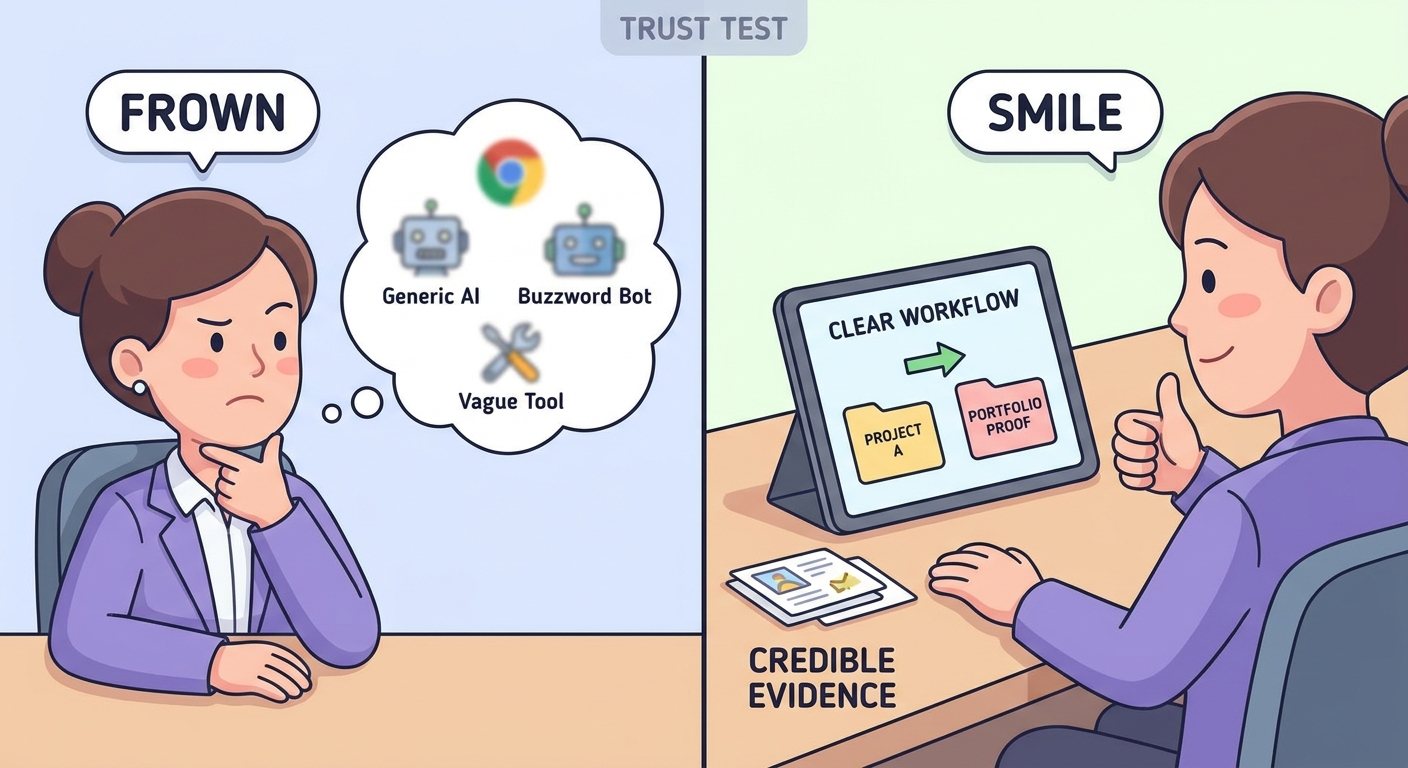
| Trust question | Green flag answer | Red flag answer |
|---|---|---|
| What was the business task? | A named workflow such as support triage, research synthesis, content briefs, reporting, or QA. | “AI stuff” or “general productivity.” |
| Where did AI help? | Drafting, summarizing, classifying, extracting, ideating, testing, or formatting. | No clear AI role. |
| What did you control? | Prompt context, source checks, privacy filtering, final approval, exception handling, or metrics. | The candidate implies the tool handled everything. |
| What proof exists? | Workflow map, prompt template, checklist, redacted example, dashboard, or portfolio case study. | No evidence beyond tool names. |
| What did you learn? | Clear tradeoffs, limits, mistakes, and improvements. | Only hype about speed. |
This test also helps you avoid confidentiality mistakes. You can describe the type of workflow and the controls you used without revealing private prompts, customer data, internal documents, or unreleased product details. A resume should prove judgment, not leak information.
AI Resume Bullet Quality Checker
Use this simple checker before adding a bullet to your resume. A strong bullet should name the workflow, explain where AI helped, show human review, and include proof or an outcome.
The checker is intentionally simple. It reflects the same editorial rule used throughout this article: do not list AI as a magic skill. Show the work system you built around AI.
Common Mistakes in AI Resume Bullets
1. Naming tools without explaining work
Tool names can help if they are relevant to the job description, but they are not enough. “ChatGPT, Claude, Gemini, Copilot” is a tool list. It does not show task design, review quality, or business judgment. Use tool names only when they clarify the workflow.
2. Claiming automation without control
“Automated customer replies with AI” may sound efficient, but it can also sound risky. A better bullet explains approval steps, escalation rules, and quality checks. Employers want to know you understand when AI should ask, stop, or hand off to a human.
3. Inventing metrics
Do not add “saved 40% time” unless you can defend how it was measured. If you do not have exact numbers, use honest proof: “created a reusable checklist,” “summarized weekly notes,” “reduced manual rework in draft preparation,” or “supported faster first-pass review.”
4. Using AI to write a bullet that sounds unlike you
Ironically, many AI resume bullets fail because they sound generated. Remove inflated adjectives, vague productivity claims, and unnatural phrasing. Use clear verbs and concrete workflow nouns. If you cannot explain the bullet comfortably in an interview, rewrite it.
5. Ignoring ethics, privacy, and source checks
For many roles, the strongest AI skill is not prompt cleverness; it is judgment. Mention privacy filtering, source verification, human approval, and redacted portfolio proof where relevant. Those details signal maturity.
Copy, Adapt, and Customize: AI Resume Bullet Bank
Do not paste these bullets unchanged. Use them as patterns and replace the workflow, tools, audience, and proof with your actual experience.
| Use case | Adaptable bullet |
|---|---|
| Workflow mapping | Mapped a recurring [workflow] process and introduced AI-assisted [drafting/summarization/classification] with human review checkpoints for [risk/quality/privacy]. |
| Prompt templates | Created reusable prompt templates for [task], including context rules, source requirements, tone constraints, and final approval criteria. |
| Research synthesis | Used AI-assisted synthesis to organize [research/customer notes/interviews], then manually verified sources and converted findings into [brief/report/roadmap]. |
| Support operations | Designed AI-assisted support triage notes for [ticket type], preserving human escalation for [sensitive cases/refunds/security/account issues]. |
| Content production | Built a first-draft AI workflow for [content type], combining source notes, audience context, brand review, and final human editing before publication. |
| Project management | Implemented an AI-assisted meeting-summary process that captured decisions, owners, blockers, and next steps for review in [project tool]. |
| Data analysis | Used AI-assisted exploration to identify themes in [dataset/comments/logs], then validated findings manually and documented limitations for stakeholders. |
| Developer work | Used AI coding assistance to draft [tests/docs/refactor plan], then reviewed output against project behavior, security constraints, and team standards. |
The strongest bullet is usually not the longest one. It is the one that makes the reader think, “This person knows how to use AI inside a real workflow without losing accountability.”
How This Supports Your Broader AI Resume Strategy
This article is deliberately narrower than the source pillar. The pillar explains what AI skills belong on a resume, how to avoid vague claims, how to prepare interview stories, and how portfolio proof works. This cluster article gives you the example layer: the actual bullet patterns that translate AI work into employer-readable evidence.
Use the pillar first if you are still deciding which skills to claim. Use this article when you are rewriting the experience section. Then use the AI workflow mapping template to document proof behind the bullet. If your target role involves agents, also read the article on AI portfolio projects that prove you can work with agents.
Sources and References
- World Economic Forum: The Future of Jobs Report 2025
- NACE: Career Readiness Competencies
- Microsoft Work Trend Index
- Columbia CCE: Resumes with Impact
Use these sources for labor-market and resume-writing context. Do not treat any single report as a guarantee that one keyword will get interviews; resumes still need role fit, truthful evidence, and strong experience.
FAQ: AI Resume Bullet Examples
What is a good AI resume bullet example?
A good AI resume bullet names a real workflow, explains where AI helped, shows human review or judgment, and includes a result or proof artifact. For example: “Created a human-reviewed AI drafting workflow for customer-support replies, including escalation rules and quality checks for sensitive cases.”
Should I mention ChatGPT on my resume?
Mention ChatGPT only when the tool name is relevant to the role or job description. In most cases, the workflow matters more than the brand name. “Used AI-assisted summarization with source checks” is often stronger than simply listing ChatGPT.
How do I write AI skills if I do not have official AI job experience?
Use honest project or workflow evidence. You can describe AI-assisted research, documentation, operations, support, content, analysis, or portfolio work if you actually did it and can explain your process.
What AI skills should not go on a resume?
Avoid vague skills such as “AI expert,” “prompt guru,” or long lists of tools you barely used. Also avoid confidential claims, fake metrics, and bullets that imply AI made decisions you did not verify.
How many AI resume bullets should I include?
Use only the bullets that fit the target role. One or two strong AI workflow bullets are better than filling the resume with generic AI language.
Can AI write my resume bullets for me?
AI can help draft and rewrite bullets, but you must provide true context, verify every claim, remove inflated language, and make sure the final wording reflects work you can defend in an interview.
What proof should I prepare for an AI resume bullet?
Prepare a workflow map, prompt template, quality checklist, redacted before-and-after sample, metric note, or portfolio case study. The proof should show your human judgment, not just the AI output.
