
AI Workflow Portfolio Metrics: Prove Time Saved, Quality, and Human Judgment
Learn the AI workflow portfolio metrics employers trust: time saved, quality, human review, cost, risk controls, and before-after evidence for career case studies.
AI Workflow Portfolio Metrics: Quick Answer
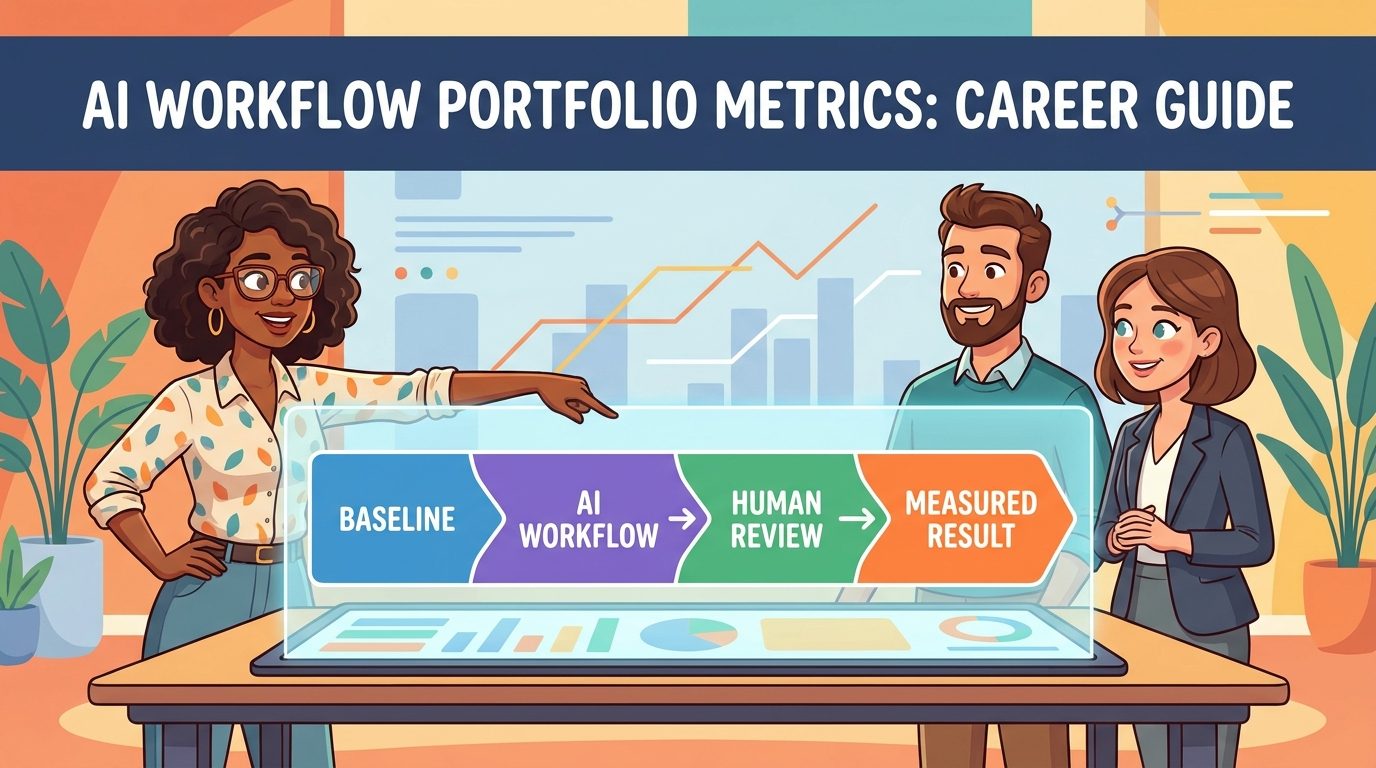
AI workflow portfolio metrics are the proof points that turn an AI project from a nice demo into career evidence. Instead of saying you used ChatGPT, Claude, Copilot, Gemini, or an automation tool, you show what changed in the workflow: how long the task took before, how the AI-assisted version worked, where a human reviewed the output, what quality checks caught mistakes, and what result improved after the change.
This cluster article supports the broader pillar guide on human-AI workflow skills by going deeper on one narrow question: how do you measure an AI workflow case study so employers can trust it? The answer is not a single magic number. A credible portfolio uses a small set of practical metrics: baseline time, cycle time after AI assistance, error rate, rework rate, review coverage, cost per task, risk controls, handoff clarity, and the business outcome the workflow supported.
The most important principle is simple: evidence beats tool name-dropping. A hiring manager does not need another list of AI tools. They need to see that you can define a real problem, design a safer workflow, use AI where it helps, keep human judgment in the loop, and measure the result honestly. If your case study can show that pattern, it becomes stronger than a generic certificate or a screenshot of prompts.
A good AI workflow portfolio metric should be understandable, repeatable, and modest. Avoid inflated claims like “10x productivity” unless you have a clean baseline and a clear scope. It is better to say “reduced first-draft research time from 90 minutes to 42 minutes across five sample briefs, while adding a human fact-check step” than to claim a vague transformation. The first version sounds trustworthy because it includes scope, method, and limits.
Why Metrics Matter More Than AI Tool Lists
Tool lists age quickly. Workflow evidence ages more slowly. The tool that dominates one month can be replaced by a better model, a cheaper API, a new agent framework, or a feature built into a workplace suite. Employers know this. What they are really trying to evaluate is whether you can learn tools, apply judgment, protect quality, and improve a process without turning AI into a black box.
That is why portfolio metrics are so useful. Metrics force you to describe the work in observable terms. What was the original task? What took time? What errors happened? Which handoffs were slow? What did the AI system do? What did the human still own? How was the output reviewed? What changed after the workflow was redesigned? These questions create a case study that a recruiter, manager, or team lead can understand even if they do not use the same tools.
Analytics from Singularity Journey also support this angle. Recent GA4 page activity shows that career and portfolio articles attract real reader interest, including traffic to articles about AI career moats, portfolio projects, automation roadmaps, and workflow case-study templates. Search Console volume is still early for the site, but already shows impressions around AI agents, AI automation portfolio pages, and practical implementation topics. That makes a focused metrics article useful as a cluster page: it strengthens the latest career pillar while giving readers a concrete next step.
The data gap in many AI career articles is that they tell readers to “build projects” without explaining how to prove that the project mattered. Search results often include project ideas, tool recommendations, and resume advice. Fewer articles give a practical measurement system for before-after evidence, review checkpoints, cost tracking, and risk controls. This article fills that gap by giving you a compact but serious portfolio measurement model.
The Portfolio Measurement Model
Think of an AI workflow case study as a small experiment, not a performance boast. You begin with a baseline, redesign the workflow, run the new workflow on comparable tasks, review the output, and report what changed. The goal is not to pretend your sample project has the statistical rigor of a scientific trial. The goal is to show enough discipline that an employer can trust your thinking.
The model has five parts. First, define the task boundary. A task boundary states what is included and excluded: “summarize customer feedback into themes,” “draft a first version of a product FAQ,” “classify support tickets,” “create a research brief,” or “turn a meeting transcript into action items.” Second, measure the baseline. Record how long the task takes without AI assistance and what quality problems appear. Third, design the AI-assisted workflow. Describe the prompt, retrieval source, automation step, or agent action, but do not let the tool become the whole story.
Fourth, add human review. This is where many weak portfolios fail. If AI writes, summarizes, classifies, or recommends, a human should inspect the high-risk parts. Show the checklist you used: factual accuracy, missing context, bias risk, privacy risk, tone, completeness, and final approval. Fifth, report the outcome. The outcome can be speed, quality, consistency, cost, risk reduction, or stakeholder usefulness. The strongest case studies usually combine one efficiency metric with one quality metric and one control metric.
For example, imagine a student building a portfolio project around AI-assisted customer feedback analysis. A weak version says, “I used AI to analyze reviews.” A strong version says, “I collected 100 anonymized sample reviews, manually tagged 25 as a baseline, used an AI-assisted workflow to propose themes, reviewed every theme against the original text, corrected 14 labels, and reduced draft analysis time while improving theme consistency.” The strong version proves judgment. It also shows the person understands that AI output needs verification.
Core AI Workflow Portfolio Metrics to Track
You do not need twenty metrics. In fact, too many metrics can make a small portfolio project look inflated. Use a small set that matches the task. For most career case studies, six categories are enough: time, quality, review, cost, risk, and value. Each category answers a different employer question.
Time metrics answer: did the workflow reduce cycle time or remove repetitive work? Track baseline minutes, AI-assisted minutes, number of iterations, and handoff delays. Be careful with time saved claims. If you spent four hours designing the workflow and saved ten minutes on one task, be honest. A fair case study might say the workflow requires setup time but becomes useful for repeated work. That kind of honesty is more credible than pretending every prototype is instantly efficient.
Quality metrics answer: did the output get better, worse, or more consistent? Track error rate, missing fields, hallucinated claims, reviewer corrections, rubric score, or acceptance rate. Quality is especially important because AI can make weak work faster. Employers do not want speed alone. They want speed with safeguards. If your workflow saves time but increases errors, your case study should say so and explain how you would improve it.
Review metrics answer: where did human judgment enter the loop? Track review coverage, approval steps, escalation rules, and examples of mistakes caught by review. A portfolio that includes human review signals maturity. It tells employers you are not outsourcing responsibility to a model. You are using the model as part of a controlled process.
Cost metrics answer: is the workflow practical? Track subscriptions, API usage, compute cost, manual review time, and maintenance effort. You do not need perfect accounting for a student project, but you should show cost awareness. If a workflow saves ten minutes but requires a premium model, multiple long prompts, and manual cleanup, that tradeoff belongs in the case study.
Risk metrics answer: what could go wrong? Track privacy exposure, source reliability, bias, over-automation, hallucination, and approval risk. A simple risk table can make a beginner portfolio look much more professional because it shows you understand operational reality. AI projects fail not only because prompts are bad, but because the workflow lacks boundaries.
Value metrics answer: why does the task matter? Track the business or user outcome. Did the workflow create clearer reports, faster triage, more consistent summaries, better documentation, shorter response time, or easier handoff? Value metrics connect your project to work that organizations actually care about.
A Simple Metrics Table You Can Copy
| Metric | What to measure | Portfolio evidence | Why employers care |
|---|---|---|---|
| Baseline time | Minutes or steps before AI assistance | Timer notes, process map, sample task log | Shows the problem was real |
| AI-assisted cycle time | Time after adding AI plus review | Before-after table across similar tasks | Shows realistic efficiency |
| Reviewer corrections | Errors, missing fields, unsupported claims | Marked-up sample output or checklist | Shows quality awareness |
| Human approval coverage | Which outputs need review before use | Approval rules and escalation examples | Shows responsible judgment |
| Cost per task | Tool cost, API usage, and review time | Simple cost note or estimate | Shows operational thinking |
| Business value | What became faster, clearer, safer, or easier | Short outcome summary | Connects the project to real work |
Use a table like this inside your portfolio case study. Keep it short, specific, and tied to evidence you can show. Replace the example values with your own measured results.
How to Measure Before and After Without Faking Precision
Before-after measurement is powerful, but it is easy to misuse. The cleanest method is to run the same type of task several times under similar conditions. For example, use five comparable research briefs, ten sample support tickets, or three similar document summaries. Measure the manual process first, then measure the AI-assisted process. Do not compare a hard baseline task with an easy AI task. That makes the result look better than it really is.
If you cannot run a perfect comparison, say so. A transparent limitation does not weaken your portfolio; it strengthens trust. You can write, “This was a small portfolio test using synthetic sample data, so the results should be treated as directional rather than production proof.” That sentence shows maturity. It also protects you from making claims that a real employer would challenge.
Use ranges when exact numbers would be misleading. If one task takes 20 minutes and another takes 80 minutes, reporting only the average can hide important variation. You might report median time, range, and the reason for outliers. For quality, show examples of corrected mistakes rather than only a percentage. A screenshot or short excerpt showing how human review changed the final answer can be more persuasive than a polished chart.
The right level of precision depends on the project. A small personal project does not need enterprise analytics. It does need a clear baseline, repeatable method, and honest interpretation. If you can explain how you measured the result in two or three sentences, the metric is probably useful. If the metric requires a long defense, simplify it.
What a Strong Portfolio Evidence Dashboard Should Show
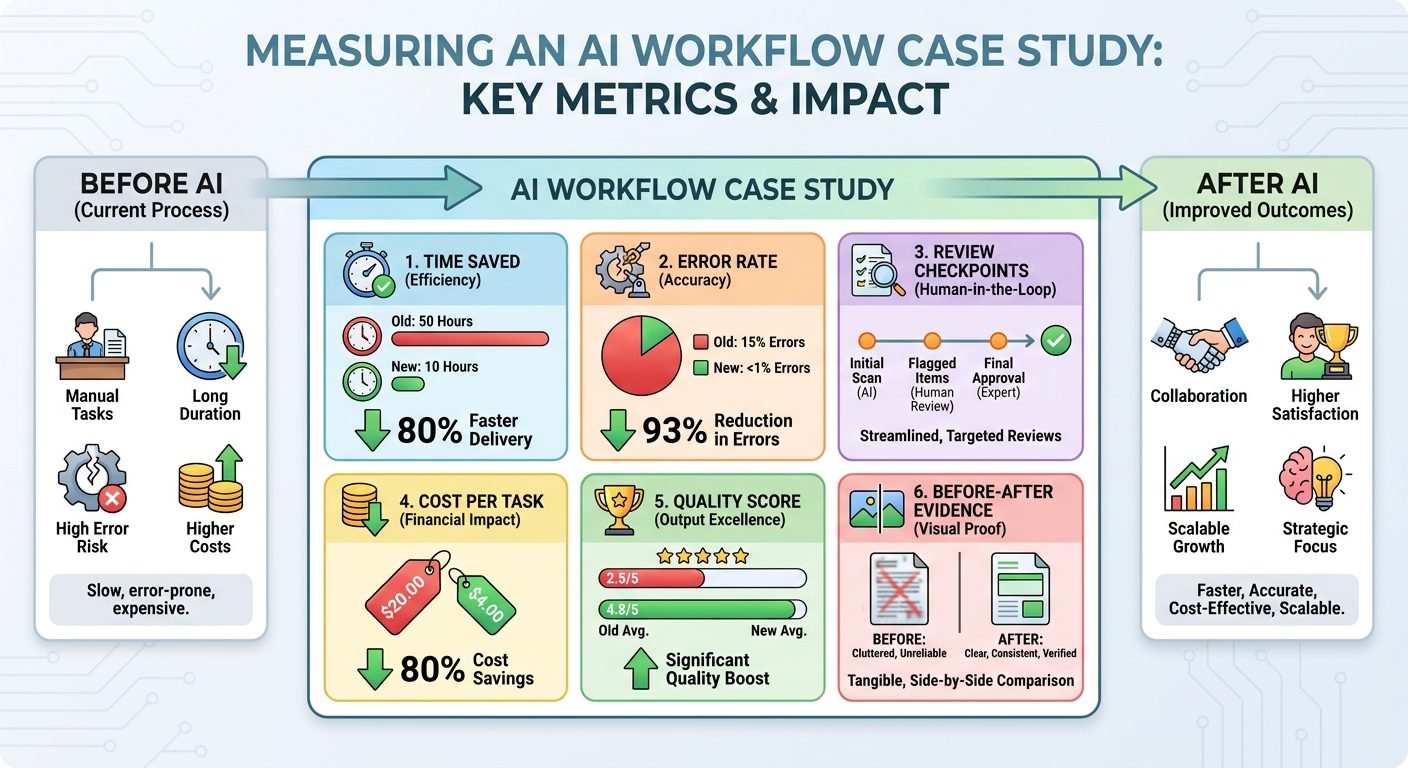
Your portfolio page should make the evidence easy to scan. Hiring managers do not have time to decode a long essay before they understand the result. Put the core proof near the top: problem, workflow, metrics, safeguards, and artifact. Then include details below for readers who want to inspect the method.
A strong evidence dashboard might include a one-sentence problem statement, a workflow diagram, a before-after metric card, a quality review card, a risk-control card, and links to the artifact. The artifact can be a sanitized spreadsheet, a prompt log, a rubric, a sample output, a GitHub repository, a Loom walkthrough, a Notion page, or a PDF case study. The format matters less than the clarity of the evidence.
If your project uses private or sensitive data, never publish the raw data. Use synthetic data, anonymized excerpts, or a recreated sample. Employers will not reward you for leaking information. In fact, a portfolio that explains how you protected privacy is often stronger than one that shows too much. Human-AI workflow skills include judgment about what not to share.
Three Portfolio Examples With Metrics
Example one: AI-assisted research brief. The task is to turn five source links into a one-page briefing note. Baseline measurement: manually reading, extracting, and summarizing takes 95 minutes for a sample topic. AI-assisted workflow: use a model to draft source notes, then manually verify every factual claim against the original source. Metrics: draft time reduced to 48 minutes, unsupported claims caught during review, final brief scored against a completeness rubric, and source links included for audit. The strongest part of this case study is not the speed claim. It is the verification workflow.
Example two: support-ticket triage. The task is to classify incoming messages into categories and urgency levels. Baseline measurement: manual tagging of 50 sample tickets with a simple rubric. AI-assisted workflow: model proposes category and urgency, human reviews edge cases, and uncertain tickets are routed to a manual queue. Metrics: percentage of tickets requiring correction, common misclassification patterns, average review time per ticket, and a clear escalation rule. This case study shows that the candidate understands automation boundaries.
Example three: resume tailoring workflow. The task is to adapt a resume summary and project section for different job descriptions without inventing experience. Baseline measurement: manual tailoring takes 45 minutes per job description. AI-assisted workflow: extract job requirements, map only truthful matching evidence from a portfolio database, draft wording, and run a hallucination check against the source resume. Metrics: draft time, number of unsupported claims removed, clarity score from a peer reviewer, and final checklist completion. This case study is career-relevant because it combines productivity with ethics.
Notice that none of these examples rely on a shiny tool demo. The tool is useful, but the portfolio proof comes from task design, review discipline, and measured improvement. That is the point employers care about.
Weak vs Strong AI Portfolio Evidence
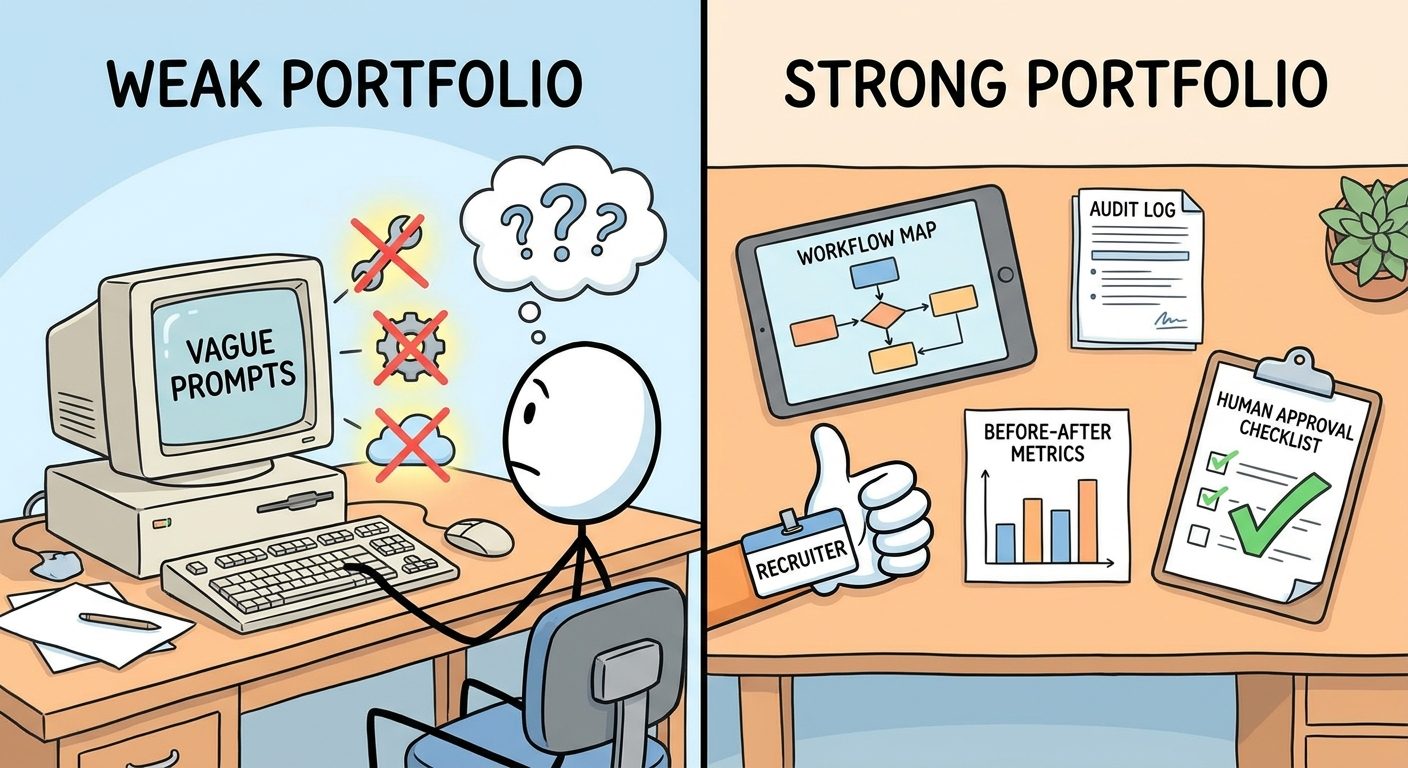
Many AI portfolios look impressive at first glance but collapse when someone asks for details. A weak portfolio says, “I built an AI automation.” A strong portfolio says, “I improved this workflow, measured these parts, found these failure modes, and kept these human controls.” The difference is not design polish. The difference is evidence.
Weak evidence includes vague screenshots, tool logos, copied prompt packs, claims without baselines, and polished outputs with no explanation of review. Strong evidence includes the original problem, workflow map, test data, before-after comparison, human review notes, failure examples, and a realistic next step. Strong portfolios show work in a way that another person could repeat or audit.
The best portfolio pages also include a “what I would improve next” section. This may feel counterintuitive because job seekers want to sound confident. But thoughtful limitations are a signal of competence. They show you can evaluate your own work. A manager is more likely to trust someone who says, “This prototype worked on synthetic data, but production use would need privacy review, monitoring, and a larger test set,” than someone who says, “This solves the whole problem.”
How to Turn Metrics Into Resume Bullets
Once you have portfolio metrics, resume bullets become easier. The formula is: improved a workflow, using a specific human-AI method, measured by a specific outcome, with a control or quality signal. For example: “Designed an AI-assisted research briefing workflow that reduced first-draft preparation time in a five-task sample while adding source verification and a hallucination checklist.” That bullet is much stronger than “Used AI tools for research.”
Another example: “Built a support-ticket triage prototype with human review for uncertain cases, measuring classification corrections, review time, and escalation patterns across a synthetic ticket dataset.” This bullet does not claim production impact. It claims a credible portfolio experiment. That is appropriate for students, career switchers, and early professionals.
For experienced professionals, connect metrics to business context. A better bullet might say: “Redesigned the weekly reporting workflow by using AI for draft synthesis and human review for claims, reducing preparation time while improving source traceability.” If you have real workplace numbers and permission to share them, include them. If not, describe the method and keep sensitive details private.
Avoid resume bullets that sound like prompt engineering theater. “Expert in ChatGPT prompts” is weaker than “Created a repeatable human-reviewed workflow for summarizing customer feedback with documented error checks.” The second bullet describes a transferable skill. It remains valuable even when the model changes.
Common Mistakes When Measuring AI Workflow Skills
Mistake one is measuring only speed. Speed matters, but speed without quality is risky. AI can produce confident wrong answers faster than a human can produce careful work. Always pair time saved with at least one quality or review metric.
Mistake two is hiding the human role. Some people think an AI project looks stronger if the machine appears to do everything. In real workplaces, the opposite is often true. Employers want to know what the human owns: judgment, approval, exception handling, source verification, and stakeholder communication.
Mistake three is using private data carelessly. A portfolio project should not expose customer names, internal documents, proprietary workflows, or confidential prompts. If you are adapting a workplace project, get permission or recreate the structure with synthetic examples.
Mistake four is claiming universal results from a tiny test. A five-task sample can be useful, but it does not prove enterprise readiness. Say what the sample shows and what it does not show. This makes your case study more credible.
Mistake five is forgetting the artifact. A metric is more persuasive when connected to something visible: a table, workflow map, checklist, prompt log, review rubric, or sample output. Give the reader something to inspect.
How This Supports Your Human-AI Workflow Skills Portfolio
This article is intentionally narrower than the source pillar article. The pillar explains the larger career strategy: building human-AI workflow skills, choosing portfolio projects, packaging evidence, avoiding weak AI claims, and translating work into career proof. This cluster article focuses only on measurement. Read the full pillar guide here: Human-AI Workflow Skills: Build a Career Portfolio Employers Can Trust.
Use both together. Start with the pillar to choose the right kind of workflow project. Then use this metrics guide to decide what evidence to collect. A strong portfolio case study usually needs both: a meaningful workflow and trustworthy measurement. One without the other is incomplete.
Sources and Evidence Signals Used
This guide uses three kinds of evidence. First, site analytics: Singularity Journey GA4 data shows reader activity on career, workflow, portfolio, and AI agent articles; Search Console data shows early impressions around agent and AI automation content, with portfolio pages already appearing in search. Second, credible labor-market and AI adoption sources: the World Economic Forum Future of Jobs Report describes employer focus on technology, skills transformation, and reskilling; Microsoft WorkLab emphasizes AI at work, agents, and human agency; Stanford HAI’s AI Index provides broader context on AI adoption and capability trends. Third, editorial gap analysis: many AI career pages recommend projects but do not provide a measurement system for proving workflow value.
Treat all benchmark numbers in your own portfolio carefully. Reports can explain the market context, but your case study should use your own measured workflow evidence. Do not borrow statistics from a report and pretend they prove your personal project worked. Use reports to explain why the skill matters; use your own metrics to prove what you did.
Conclusion: Make Your AI Portfolio Auditable
The future-proof career signal is not that you know today’s most popular AI tool. It is that you can turn a messy task into a safer, faster, more useful workflow and explain the evidence clearly. AI workflow portfolio metrics help you do that. They make your work auditable.
If you are building your first AI career case study, start small. Pick one workflow, measure the baseline, add AI assistance, keep a human review step, record what changed, and publish a clean artifact. Do not chase a dramatic claim. Chase a trustworthy one. A modest, well-measured case study can say more about your readiness than a flashy demo with no controls.
Your next step: choose one portfolio project from the pillar guide, then create a simple metrics table before you build. Decide what you will measure before the AI enters the workflow. That habit alone will separate your portfolio from most generic AI career advice.
Sources and References
- World Economic Forum: Future of Jobs Report
- Microsoft WorkLab: AI at work and human agency research
- Stanford HAI AI Index
- NIST AI Risk Management Framework
External sources provide labor-market and responsible AI context. Portfolio results should still come from your own measured workflow evidence.
FAQ: AI Workflow Portfolio Metrics
What are AI workflow portfolio metrics?
AI workflow portfolio metrics are measurable proof points that show how an AI-assisted workflow changed a task, including time, quality, review, cost, risk controls, and business value.
Which metric matters most for an AI career portfolio?
No single metric is enough. Pair one efficiency metric, such as cycle time, with one quality metric and one human-control metric, such as review coverage or escalation rules.
Can I use synthetic data in an AI portfolio project?
Yes. Synthetic or anonymized data is often safer than real workplace data. Explain that the dataset is synthetic and focus on the workflow design, review process, and measurement method.
How many tasks should I measure in a portfolio case study?
Use enough comparable tasks to make the result believable. Even five to ten small samples can be useful for a portfolio if you are transparent about limits and avoid overclaiming.
Should I include AI tool names in my portfolio?
Include tool names when relevant, but do not make them the main proof. Employers care more about the workflow, judgment, controls, and measured result than the brand of tool.
How do I avoid exaggerating AI productivity gains?
Define a clear baseline, compare similar tasks, report limitations, include review time, and avoid broad claims that your small test does not support.
What should I link from this article next?
The best next step is the source pillar article on human-AI workflow skills, because it explains how to package these metrics into a broader career portfolio.
