
AI Resume Skills: How to Show Human-AI Workflow Experience Employers Trust
AI skills on a resume are easy to list and hard to prove. This guide shows how to turn everyday AI tool use into credible work evidence: workflow maps, measurable outcomes, portfolio artifacts, interview stories, and resume bullets that hiring managers can actually trust.
AI Resume Skills: Quick Answer
AI resume skills should not read like a shopping list of tools. A strong AI resume shows that you can use AI to improve a real workflow while still applying human judgment. The best evidence combines five parts: the work problem, the AI role, the human review step, the measurable result, and the artifact that proves it happened.
A weak resume says: “Used ChatGPT, Claude, Gemini, and automation tools.” A stronger resume says: “Redesigned customer-support triage prompts, built a human-review checklist, reduced repeat drafting time, and documented failure cases in a reusable workflow guide.” The second version tells an employer what changed, how AI was used, where the human stayed accountable, and why the work mattered.
This article is for students, career switchers, analysts, marketers, operations staff, developers, product people, recruiters, designers, and managers who need to explain AI experience without pretending to be machine-learning researchers. You do not need to claim you “built AI” if you did not. You need to show that you can work with AI responsibly and produce better outcomes.
Why AI Skills on a Resume Need Proof, Not Hype
The labor market is already moving from “AI curiosity” to “AI operating skill.” The World Economic Forum’s Future of Jobs research says its employer survey brings together more than 1,000 leading employers representing over 14 million workers across 22 industry clusters and 55 economies. That kind of employer-level signal matters because it shows AI skills are not only a tech-industry topic. They are becoming part of how many organizations think about productivity, task redesign, and future workforce planning.
Microsoft’s Work Trend Index hub frames the current shift around AI at work, frontier firms, agents, and human agency. Anthropic’s Economic Index tracks AI’s effects on the economy and is updated as usage patterns change. You do not need to memorize every report. The useful takeaway is simpler: AI is no longer just a tool people mention in side projects. It is becoming a work pattern that hiring teams will try to identify, test, and verify.
That creates a new resume problem. If everyone writes “AI tools” in a skills section, the phrase becomes almost meaningless. Hiring managers will look for evidence: Did you improve a workflow? Did you know when not to automate? Did you protect confidential data? Did you check outputs? Did you measure the result? Did you produce a reusable artifact that other people can understand?
Analytics from Singularity Journey point in the same direction. Recent GA4 data shows reader interest around AI agent controls, AI career moat, automation engineer roadmaps, and portfolio pages. Search Console visibility is still early, but the site’s AI automation portfolio page has begun appearing in search around competitive career-intent queries. That suggests a clear content gap: readers need the bridge between portfolio projects and resume language. They need to know how to translate proof into hiring signals.
This is why the article you are reading focuses on resume credibility. It is not enough to say you “used AI to be more productive.” That statement is too broad. A useful AI resume tells a small, verifiable story: here was the workflow, here was the bottleneck, here was the AI-assisted method, here was the human quality bar, and here was the result.
The Five AI Resume Skills Employers Can Actually Evaluate
AI work is not one skill. It is a bundle of related behaviors. If you only list tools, you hide the real value. If you split your AI experience into skill groups, the employer can understand what you can do and where you fit.
Notice what is missing from that list: “knows every AI tool.” Tool familiarity helps, but it decays quickly. A candidate who says “I can use Tool X” may become outdated when the tool changes. A candidate who says “I can map a workflow, choose where AI belongs, build a review loop, and measure outcomes” is describing a durable capability.
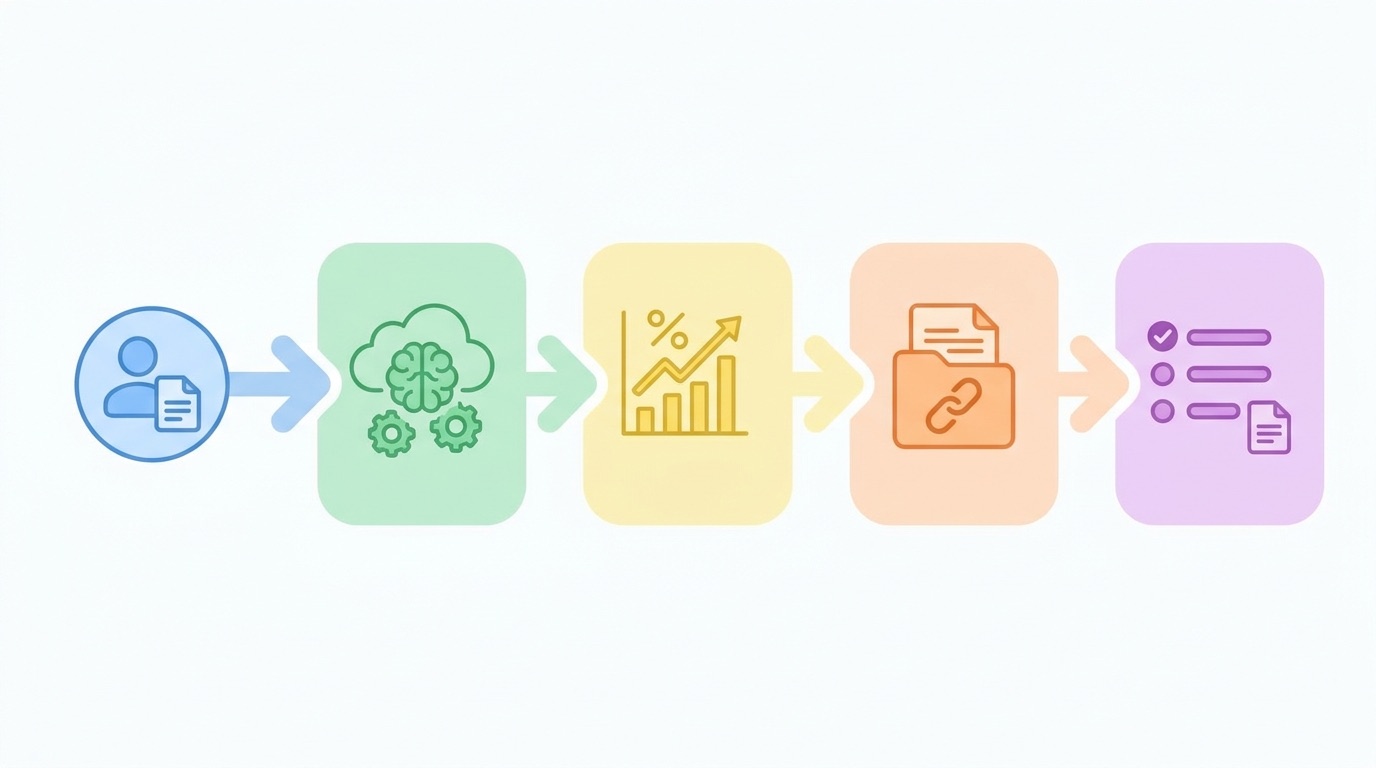
For most non-ML roles, these skills are more relevant than neural-network theory. A marketer needs to show AI-assisted campaign research and human brand review. An analyst needs to show data-cleaning support and validation. A recruiter needs to show better sourcing workflows and bias-aware review. A support lead needs to show triage, escalation, and quality control. A developer needs to show AI-assisted debugging, tests, traces, and code review rather than copy-pasted code.
If you are building your first AI career proof, start with one workflow you already understand. Do not chase a flashy project that looks impressive but proves little about your real work. A practical workflow with honest evidence beats a dramatic demo with no measurable result.
The Resume Bullet Formula for AI Work
The easiest way to write credible AI resume bullets is to use a five-part formula:
| Part | Question it answers | Example phrase |
|---|---|---|
| Task | What work problem did you improve? | Monthly sales-report drafting, support-ticket triage, onboarding documentation, test-case generation. |
| AI role | How did AI help? | Used AI to summarize inputs, generate first drafts, classify cases, create test scenarios, or compare options. |
| Human control | How did you stay accountable? | Reviewed outputs against source documents, used approval checkpoints, validated facts, or tested edge cases. |
| Outcome | What improved? | Reduced drafting time, improved consistency, cut rework, created reusable templates, shortened review cycles. |
| Proof | What artifact shows it? | Workflow map, prompt library, checklist, before/after example, case study, dashboard, or documentation page. |
Here is the pattern in plain English: “Improved [workflow] by using [AI method] with [human review guardrail], resulting in [outcome], documented in [artifact].” That structure is useful because it prevents vague claims. It forces you to connect AI to work value.
Weak vs strong resume bullets
| Weak | Stronger |
|---|---|
| Used ChatGPT for marketing content. | Built an AI-assisted content brief workflow that generated draft outlines from customer questions, then reviewed claims against source pages before handoff to writers. |
| Experienced with AI automation. | Mapped a repetitive reporting workflow, identified low-risk AI-assisted drafting steps, and created a review checklist for human approval before stakeholder delivery. |
| Prompt engineering skills. | Created reusable prompts with role, input, source, constraint, and output-format sections to standardize research summaries across weekly team updates. |
| Used AI for coding. | Used AI coding assistance to propose test cases and explain failing traces, then manually reviewed diffs and validated behavior with project tests. |
| AI productivity tools. | Created a personal AI workflow library for meeting summaries, task extraction, and follow-up drafts while excluding confidential customer data. |
You do not need to invent metrics. If you have real numbers, use them. If you do not, describe the artifact and scope honestly. “Created a reusable checklist adopted by a three-person team” is better than “increased productivity by 80%” if you cannot prove that number. Unsupported statistics weaken trust.
What Counts as Proof of AI Skill?
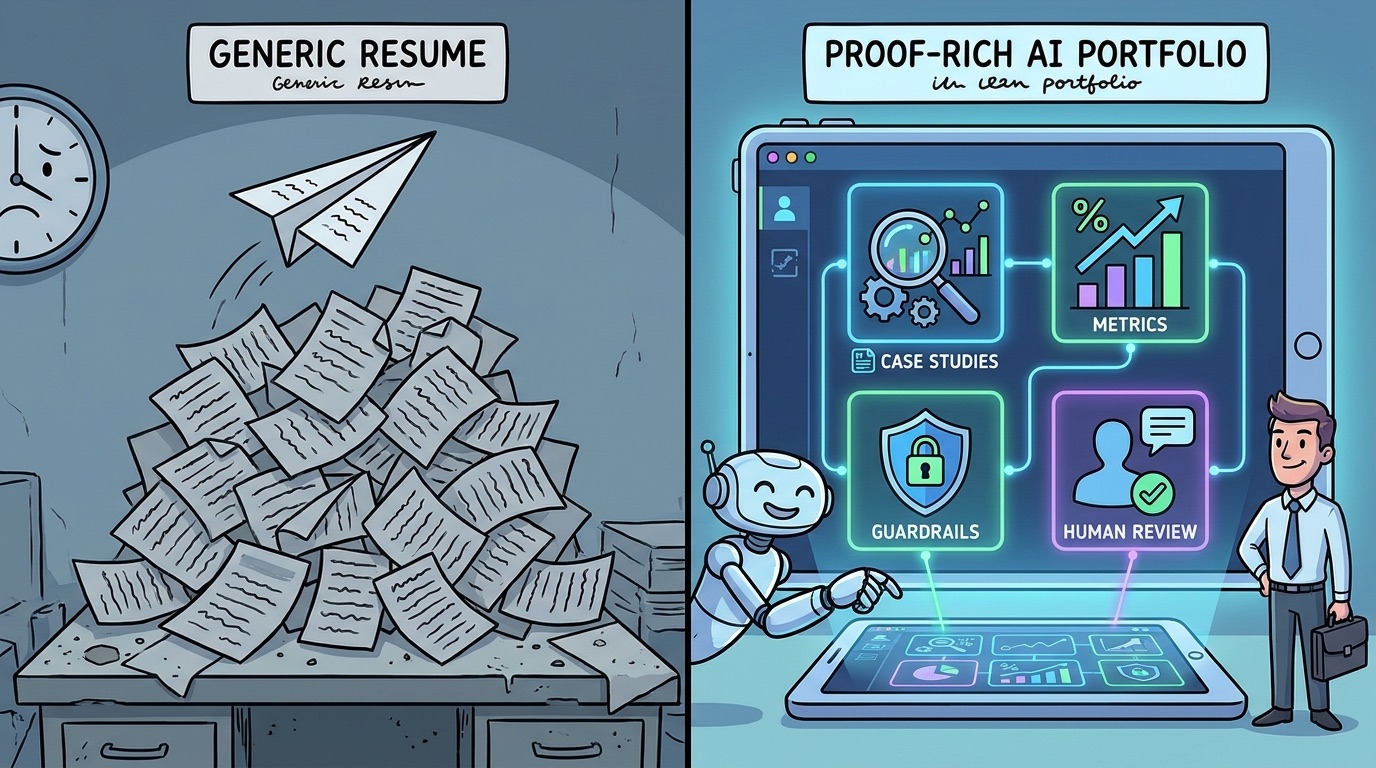
Proof does not have to be a polished software product. For career purposes, proof is any artifact that lets a hiring manager see how you think, how you use AI, and how you prevent bad output from becoming real-world damage. The artifact should make your judgment visible.
Strong proof artifacts
- A workflow map showing where AI assists and where humans approve.
- A prompt library with input rules, review rules, and examples.
- A before/after case study that explains what improved.
- A quality checklist for AI-generated research, code, designs, or writing.
- A small automation with logs, fallback behavior, and manual override.
- A portfolio page explaining the business problem, tradeoffs, and result.
Weak proof artifacts
- A screenshot of a chatbot answer with no context.
- A list of AI tools with no project attached.
- A generic certificate that does not show applied work.
- A demo that cannot explain risks or limitations.
- A claim that AI “did everything” without human review.
- A confidential work example that should not be shared publicly.
The best portfolio proof answers a simple question: if someone else had to repeat your workflow tomorrow, could they understand the steps, the review criteria, and the risk boundaries? If yes, your AI skill is becoming transferable. If no, it may still be personal experimentation rather than job-ready capability.
This is where internal career work on Singularity Journey connects together. If you have not built proof yet, start with AI Portfolio Projects That Prove You Can Work With Agents. If you have a project but need structure, use AI Portfolio Case Study Template: Show Agent Workflow Skills Employers Can Trust. If your work is more operational, use AI Workflow Mapping Template to turn daily work into a visible case study.
AI Resume Skill Examples by Role
Different jobs need different AI signals. A resume for a designer should not sound like a developer resume. A resume for a support lead should not pretend to be an ML engineer. Use the examples below as patterns, not scripts. Rewrite them with your actual tools, artifacts, and outcomes.
Marketing and content
Marketing candidates can show AI skill through research briefs, audience analysis, content repurposing, tone control, and claim verification. A strong bullet might say: “Built an AI-assisted content-research workflow that grouped customer questions, generated outline options, and required source checks before publication briefs were approved.” This proves more than “used AI for content,” because it includes workflow, judgment, and quality control.
Operations and administration
Operations work often contains repeatable workflows, handoffs, and documentation gaps. A strong bullet might say: “Mapped recurring admin requests, used AI to draft standardized response templates, and created an escalation checklist for cases requiring human approval.” The key is to show that you did not automate sensitive decisions blindly.
Customer support
Support teams can use AI for triage, summarization, knowledge-base drafts, and response consistency. A strong bullet might say: “Designed an AI-assisted ticket-summary process that highlighted customer issue, attempted fixes, sentiment, and escalation risk before agent review.” If you measured handle-time reduction or rework reduction, include it only if you can support the number.
Sales and customer success
Sales AI skills should focus on research, follow-up quality, account planning, and customer context rather than spam automation. A strong bullet might say: “Created AI-assisted account-preparation briefs using public company information and CRM notes, with manual review for accuracy before customer calls.” This signals responsibility, not reckless outreach.
Data and business analysis
Analysts can show AI skill through data cleaning support, SQL explanation, dashboard narratives, anomaly review, and stakeholder summaries. A strong bullet might say: “Used AI to draft plain-language explanations of dashboard changes, then validated each claim against source metrics before stakeholder distribution.” The human validation step is the trust signal.
Product and project management
Product and project roles can use AI to summarize feedback, draft requirements, identify risks, and generate decision options. A strong bullet might say: “Synthesized customer feedback with AI-assisted clustering, reviewed themes manually, and converted validated patterns into a prioritized product-discovery brief.” That makes the AI role useful but not magical.
Software development
Developers should show AI coding skill through tests, code review, debugging, trace analysis, and documentation. A strong bullet might say: “Used AI coding assistance to propose edge-case tests and explain failing traces, then reviewed generated diffs and validated changes with automated tests.” If you work with agents, connect this to context engineering for AI agents and AI agent evaluation frameworks.
Common AI Resume Mistakes That Hurt Trust
The biggest mistake is exaggeration. AI is exciting, but hiring managers are becoming more skeptical. If your resume sounds like a keynote slide, it may raise doubts instead of confidence. Avoid phrases like “expert in all AI tools,” “automated entire department,” or “built autonomous agent systems” unless you can clearly prove the claim.
Mistake 1: Listing too many tools
A long tool list looks less impressive when there is no work attached to it. Choose the tools that matter for your role, then connect each one to a workflow. “Claude for research synthesis, ChatGPT for draft alternatives, Gemini for document comparison, Zapier for low-risk handoffs” is more useful than a giant stack of logos.
Mistake 2: Hiding the human review step
If your resume implies AI output went straight to customers, codebases, reports, or campaigns with no review, the employer may worry about risk. Show your approval rule. Did you check facts? Did you compare output to policy? Did you run tests? Did you protect confidential data? Did a manager approve the result?
Mistake 3: Claiming confidential work publicly
AI portfolios can accidentally leak private material. Redact names, replace real data with synthetic examples, and describe the workflow without exposing customers, code, prompts, credentials, or business-sensitive decisions. Responsible sharing is itself an AI skill.
Mistake 4: Using fake metrics
Do not invent productivity percentages. If you have no measurement, say what you created: “Built a reusable template,” “documented a workflow,” “tested three prompt variants,” or “created a review checklist.” Honest scope builds more trust than fake precision.
Mistake 5: Treating AI as a replacement for domain skill
AI experience is strongest when paired with subject knowledge. A finance analyst still needs finance judgment. A marketer still needs audience judgment. A developer still needs engineering judgment. Your resume should show that AI amplified your domain skill, not replaced your responsibility.
How to Talk About AI Skills in Interviews
Resume bullets get you noticed. Interview stories get you trusted. Prepare at least two AI workflow stories before applying for roles where AI skill matters. The story should be specific enough that the interviewer can picture your work.
Use a simple interview structure: problem, workflow, AI contribution, human judgment, result, limitation. The limitation is important. Employers trust candidates who can explain where AI failed, what they checked, and what they would improve next. A candidate who says “the AI did everything perfectly” sounds inexperienced.
For example: “Our team was spending too much time turning meeting notes into client follow-ups. I tested an AI-assisted summary prompt using only non-confidential notes. The model drafted action items and email options, but I found it sometimes softened deadlines. I added a review checklist for dates, owners, and commitments. The final workflow made follow-ups more consistent, and I documented the prompt and checklist so teammates could reuse it.”
That story shows tool use, judgment, risk awareness, iteration, and documentation. It is stronger than naming a model.
A Practical Plan to Upgrade Your AI Resume
If your resume currently has one vague AI line, do not rewrite everything at once. Build proof in layers. First, choose one real workflow from your current job, studies, freelance work, volunteer work, or personal project. The workflow should be repetitive enough for AI assistance and safe enough to discuss publicly after redaction.
Second, document the current process. What triggers the work? What inputs are used? What output is expected? Who approves it? What mistakes matter? Third, add AI only where it helps. Use it for summarization, drafting, comparison, classification, brainstorming, code explanation, or test generation. Avoid handing over high-stakes decisions.
Fourth, create a review checklist. This can be short: verify sources, check confidential data, compare against requirements, test output, review tone, confirm deadlines, log edge cases. Fifth, capture the result. If you can measure time, quality, adoption, or rework, do it. If not, record the artifact: template, checklist, workflow diagram, sample output, or case study.
Finally, turn the proof into resume language. Use one bullet in your experience section and one line in your skills section. The skills line might say: “AI workflow design, prompt/context writing, human review checklists, AI-assisted research synthesis, and portfolio documentation.” The experience bullet should show the actual workflow and result.
If you are trying to build a broader career moat, connect this resume work with AI Career Moat. If you need a full learning path, use the AI Skills Roadmap. The resume is not the destination. It is the compressed proof of the work you have learned to do.
Sources and References
- World Economic Forum: The Future of Jobs Report 2025
- Microsoft Work Trend Index
- Anthropic Economic Index
- AI Portfolio Projects That Prove You Can Work With Agents
- AI Portfolio Case Study Template
Career advice should be adapted to your role, location, industry, and actual evidence. Do not claim confidential work, unsupported metrics, or technical responsibilities you cannot explain.
FAQ: AI Resume Skills
What are the best AI skills to put on a resume?
The strongest AI resume skills are workflow diagnosis, prompt and context design, human review, automation judgment, measurement, documentation, and safe use of AI tools. Tool names are useful only when tied to real work.
Should I list ChatGPT or Claude on my resume?
List them only if they are relevant to the role and connected to a workflow. A tool name alone is weak. A workflow example showing how you used the tool responsibly is stronger.
How do I prove AI experience without a technical job?
Choose a real workflow from your work or studies, document the before-and-after process, show where AI helped, add a human-review checklist, and publish a redacted case study or portfolio artifact.
What should I avoid saying about AI skills?
Avoid unsupported productivity numbers, vague “AI expert” claims, confidential examples, and statements that imply AI made high-stakes decisions without human review.
Do AI certificates help?
Certificates can help signal learning, but they are weaker than applied proof. A small case study with workflow, review criteria, and results usually says more than a generic certificate.
How many AI resume bullets should I include?
Use one to three strong bullets depending on the role. Quality matters more than volume. Each bullet should connect AI use to a specific workflow, result, and responsibility.
Can students show AI resume skills?
Yes. Students can build proof through research summaries, study workflows, portfolio projects, case studies, automation experiments, or club operations, as long as they document process and review steps honestly.
How do I describe AI skills in an interview?
Use a story with six parts: problem, workflow, AI contribution, human judgment, result, and limitation. Be ready to explain what the AI got wrong and how you checked it.
