
AI Agent Infrastructure Stack Explained: The Layers Enterprises Need to Scale Agents Safely
An AI agent infrastructure stack is the complete operating system around an agent—not only the model. This guide maps the layers that turn a convincing demo into a reliable service: outcomes, models, context, runtime, tools, identity, policy, observability, evaluation, lifecycle, and human control.

AI Agent Infrastructure Stack: The Quick Answer
The phrase AI agent infrastructure stack describes the technical and organizational layers that let an agent perceive context, reason, call tools, change real systems, recover from failures, and produce evidence that people can inspect. The model is one component. The stack is everything that makes the model’s behavior useful, bounded, observable, and supportable.
This distinction matters because agent failures rarely stay inside a chat window. An agent can read stale memory, choose the wrong tool, inherit excessive permissions, repeat a side effect, exceed a budget, or complete the wrong business objective while producing fluent text. Production infrastructure reduces those risks by turning vague autonomy into explicit contracts: what the agent may know, what it may do, which identity it uses, what evidence it records, when it must stop, and who owns the outcome.
The practical recommendation is not to buy every tool labeled “AgentOps.” Start with the failure boundary. A read-only internal research assistant needs a smaller stack than an agent that changes customer records, deploys code, or sends money. Build the minimum controls that make the selected workflow safe, then add central platforms when the number of agents, teams, data domains, and audit obligations make local controls inconsistent.
Why the AI Agent Stack Is Becoming a Strategic Architecture
The infrastructure question has moved from theory to operating pressure. The McKinsey State of AI survey reported that 40% of respondents at organizations with more than $1 billion in annual revenue were scaling AI agents, up from 27% in the previous survey. Smaller organizations were flatter at 22%. The same report found that agentic coding tools were already influencing software purchasing and internal development decisions. Those numbers do not mean every company has mature autonomous workers; they show that agent workloads are becoming material enough to force platform choices.
The counterweight is equally important. The Stanford AI Index Report found that scaled use remained in the single digits for nearly all business functions, even while experimentation and pilots expanded. Technology companies showed comparatively higher scaled use in software engineering, IT, and service operations, but broad adoption remained uneven. In other words, the market contains both acceleration and immaturity. That is exactly when architecture matters: many teams are moving beyond demos before shared operating practices have stabilized.
Cloud platforms are responding in remarkably similar ways. AWS Prescriptive Guidance treats production agents as layered systems with orchestration, discoverability, security, observability, and governance spanning the architecture. Google Cloud’s agent governance documentation emphasizes agent identity, gateways, registries, runtime policies, and network-level observability. Microsoft’s Cloud Adoption Framework recommends a centralized governance layer covering ownership, identity, lifecycle, access, security, and continuous monitoring.
The products differ, but the architectural direction is converging. An agent estate needs an inventory, a trustworthy identity, controlled routes to data and tools, evidence of what happened, policy decisions that can be enforced at runtime, and a way to update or retire agents without losing accountability. That convergence is the trend. The winning stack will not necessarily contain the most services. It will connect those responsibilities without leaving silent gaps between teams.
What Belongs in an Enterprise AI Agent Architecture?
A useful stack map starts with responsibility rather than vendor categories. Each layer should have an input, an output, an owner, a failure signal, and an intervention. If a team cannot name those five things, the layer is probably a collection of products rather than an operating capability.
| Layer | Question it answers | Minimum capability | Evidence it should produce |
|---|---|---|---|
| 1. Outcome and ownership | What job is the agent accountable for? | Named owner, workflow boundary, success and stop conditions | Task result, owner, business KPI, escalation record |
| 2. Intelligence and context | What information can the agent reason over? | Model policy, instructions, task state, retrieval and memory rules | Model/version, context sources, freshness and provenance |
| 3. Runtime and orchestration | How does work progress and recover? | State machine, queues, retries, idempotency and timeouts | Step state, retry reason, checkpoint and terminal status |
| 4. Tools, data and protocols | Which systems can the agent reach? | Typed tools, validation, data boundaries and safe connectors | Tool call, arguments, result, side effect and data lineage |
| 5. Identity, policy and approval | Who is acting, with whose authority? | Scoped identity, authorization, policy enforcement and approval gates | Principal, permission, policy decision, approver and expiry |
| 6. Observability and evaluation | Did the agent behave correctly? | Traces, logs, metrics, datasets, rubrics and regression tests | Trace, score, failure class, drift alert and review outcome |
| 7. Lifecycle and operations | How is the agent governed over time? | Registry, versions, release controls, budgets, incidents and retirement | Inventory record, change history, cost, incident and decommission proof |
These layers are not a strict software dependency diagram. A small team may implement several capabilities in one service, while a regulated enterprise may separate them across platforms and control planes. The model is useful because it prevents a familiar mistake: calling a tracing tool “the agent stack” or calling an orchestration framework “governance.” Tracing can show a tool call. Governance decides whether the call should be allowed. Evaluation estimates whether the result is good. Operations determines who responds when it is not.
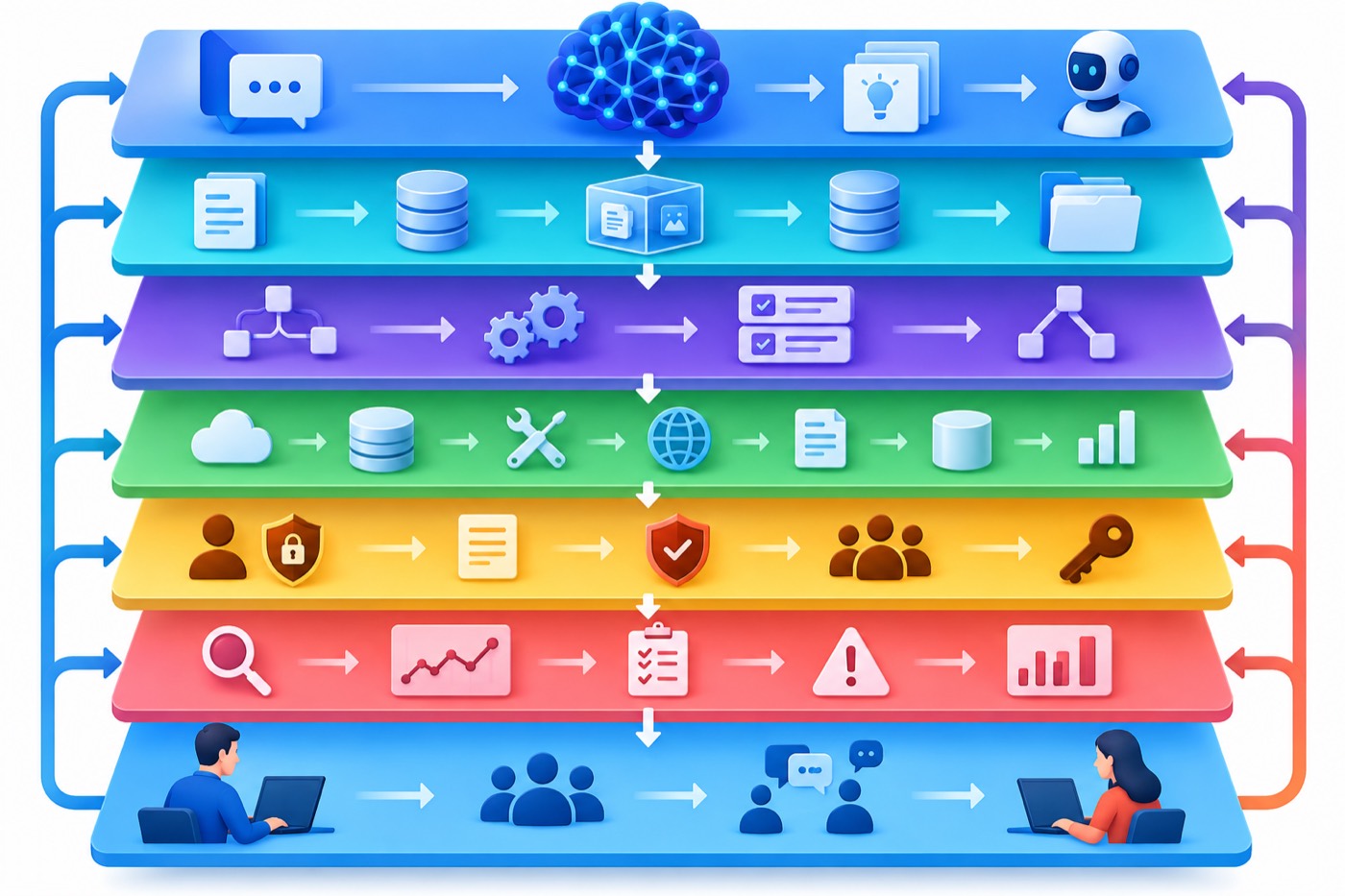
A production agent is a feedback system: runtime evidence must flow back into evaluation, policy, context, and human operations.
The Seven Layers of the AI Agent Infrastructure Stack
Layer 1: outcomes, ownership, and workflow boundaries
The first layer is easy to skip because it does not look technical. It is also the layer that prevents the most expensive confusion. An agent needs a bounded job: reconcile a category of invoices, prepare a support case, draft a change plan, investigate a test failure, or answer questions from an approved knowledge base. “Help employees” is not a production objective. It does not define completion, acceptable evidence, failure cost, or authority.
Name one accountable owner for the workflow, not merely the model endpoint. That owner decides what success means, which errors are tolerable, and when the workflow should be suspended. The owner also decides whether automation is the right intervention. Some processes are unstable because the human procedure is inconsistent, the source data is weak, or different departments disagree about policy. An agent will scale that ambiguity rather than resolve it.
Write success and stop conditions before tool selection. Success might require a completed record with cited evidence and a human acceptance decision. Stop conditions might include missing source data, conflicting policy, a cost threshold, an unsupported file type, or a high-impact action. Singularity Journey’s guide to agentic AI stop conditions explains how time, cost, action, and uncertainty limits keep loops from turning into incidents.
Layer 2: models, instructions, context, retrieval, and memory
This layer supplies the agent’s working intelligence. It includes model selection, system instructions, task state, conversation history, retrieved documents, structured business data, and durable memory. The important design question is not “How large is the context window?” It is “Which evidence is relevant, current, authorized, and sufficient for this decision?”
Model routing can reduce cost and risk by matching capability to task. A smaller model can classify requests, a stronger model can plan an exception, and a deterministic rule can validate a parameter. Do not use a language model for checks that ordinary software can perform reliably. Keep instructions versioned, retrieve sources with provenance, and separate temporary task state from long-term memory. The practical patterns are covered in context engineering for AI agents.
Memory requires deletion, correction, and freshness—not only storage. A remembered preference can be useful; a remembered permission can be dangerous after the user changes roles. Durable memory should record where a fact came from, when it was observed, how it can be superseded, and which workflows may retrieve it. When evidence is stale or contradictory, the agent should lower confidence, seek fresh context, or escalate.
Layer 3: runtime, orchestration, and durable execution
The runtime converts a model response into a controlled process. It holds state, schedules steps, calls tools, applies timeouts, waits for approvals, and resumes after failure. A chat loop can demonstrate an idea; a durable runtime makes the work recoverable. That difference becomes visible when a network call times out after a record has already changed or when a human approval arrives hours after the process started.
Represent important workflows as explicit states rather than an invisible chain of prompts. Use idempotency keys for side-effecting operations, bounded retries for transient failures, checkpoints for long tasks, and compensation or rollback where reversal is possible. Every loop needs a budget and a terminal condition. Every external action needs a correlation identifier that connects intent, policy, execution, and outcome.
A production release path should include evaluation gates, canary exposure, monitoring, and rollback. The AI agent deployment pipeline and canary rollout checklist provide deeper implementation patterns. The key architectural principle is simple: the runtime should make partial progress visible and recoverable rather than pretending every agent task is one atomic request.
Layer 4: tools, data, connectors, and interoperability protocols
Tools are the agent’s hands. They convert suggestions into effects: search a database, update a ticket, send a message, run code, or call a service. Each tool should have a narrow purpose, typed inputs, validation, clear error behavior, an authorization boundary, and an audit record. Broad tools such as “run any SQL” or “call any URL” make demos flexible and incidents difficult to contain.
Protocols such as MCP can standardize discovery and invocation, while agent-to-agent protocols can standardize delegation and communication. Standards reduce integration friction; they do not remove the need for trust decisions. A discovered tool still needs an owner, risk tier, approved data scope, authentication method, version policy, and behavior when its response is untrusted. Treat protocol messages as inputs, not permission.
Separate read, propose, and write capabilities where possible. An agent can gather evidence and prepare a proposed action using low-risk tools, then pass the action through policy or human review before execution. This separation creates safer defaults and better evidence. The site’s MCP tool risk tiers offer a practical framework for classifying read, write, and destructive actions.
Layer 5: identity, authorization, policy, and human approval
An agent should not become a disguised superuser. Give it a first-class workload identity, record the initiating user or service, and preserve delegated authority through every tool call. Authentication answers which principal is present. Authorization answers whether that principal may take this action on this resource under these conditions. The policy decision should be enforceable outside the model because a fluent model explanation is not an access-control mechanism.
Scope permissions to the smallest practical surface. Prefer short-lived credentials, per-tool permissions, tenant-aware boundaries, allowlisted parameters, spend limits, and explicit handling of sensitive data. The agent identity should have an owner and lifecycle. When the agent is retired or transferred, its permissions, secrets, scheduled tasks, and integrations must change with it.
Human approval belongs at consequence boundaries, not on every step. Approvals are most valuable when the action is irreversible, financially material, externally visible, legally sensitive, or outside well-tested policy. A good approval shows the proposed action, evidence, uncertainty, affected resources, alternatives, and rollback path. A weak approval asks a busy person to click “allow” without context. See human-in-the-loop approval patterns for workflow designs that preserve speed without turning oversight into theater.
Layer 6: observability, evaluation, and evidence
Observability and evaluation answer different questions. Observability reconstructs what happened: prompts, model calls, tool calls, latency, tokens, errors, policy decisions, approvals, and side effects. Evaluation estimates whether the behavior was good: task completion, groundedness, policy compliance, tool selection, safety, efficiency, and user acceptance. You need both. A perfect trace of a bad outcome is still a bad outcome; a score without a trace is difficult to diagnose.
Instrument the path from user intent to business effect. A trace should connect the initiating request, agent and version, model and instruction version, retrieved evidence, tool calls, policy decisions, approval events, and final outcome. Avoid indiscriminate logging of secrets or sensitive content. Redact deliberately, restrict access, and set retention according to the investigation and compliance need.
Build evaluation datasets from real workflow shapes, including normal cases, ambiguous cases, adversarial inputs, tool failures, stale data, repeated actions, and recovery scenarios. Use deterministic checks where possible and model-based judges where human-like interpretation is needed. Calibrate judges against human review. Track failures by category rather than relying on one average score. The guide to AI agent observability, the OpenTelemetry tracing guide, and the article on agent evaluation metrics go deeper on these practices.
Layer 7: registry, lifecycle, release, cost, and incident operations
As the number of agents grows, local documentation stops being an inventory. A registry should identify each agent, owner, purpose, version, runtime, tool access, data classification, risk tier, evaluation status, last review, and retirement state. Discovery helps reuse; governance prevents an abandoned agent from retaining live authority. This lifecycle layer is where isolated projects become an agent estate.
Release management should treat prompts, models, tools, memory schemas, policies, and evaluators as versioned dependencies. A model change can alter tool choices. A connector change can alter data semantics. A policy change can block a previously valid path. Change records should connect the artifact version to evaluation evidence, approval, rollout, live telemetry, and rollback. That is why agent change management is a cross-stack concern, not a prompt-management feature.
Cost operations belong here too. Track cost per successful task rather than tokens alone. Include model use, retrieval, tools, infrastructure, review time, failure recovery, and downstream rework. An inexpensive run that creates bad records can be more costly than a slower run with strong controls. Incidents need an owner, containment switch, preserved evidence, user communication rule, and post-incident update to tests and policies.
A Three-Stage Maturity Model for Agentic AI Infrastructure
The right stack is proportional to consequence and scale. Small teams often overreact in one of two directions: they ship a prompt loop with shared credentials, or they attempt to recreate an enterprise control plane before proving the workflow. A maturity model creates a safer middle path.
| Stage | Typical situation | Required controls | Do not add yet | Promotion evidence |
|---|---|---|---|---|
| 1. Bounded prototype | One owner, read-only or sandboxed task, low consequence | Named objective, isolated credentials, basic trace, test set, time and cost limit | Enterprise registry, multi-platform policy fabric, complex agent swarms | Repeatable task success, known failure classes, clear user value |
| 2. Production workflow | Real users, write actions, multiple dependencies, support obligation | Durable runtime, scoped identity, approval gates, versioned releases, alerts, rollback, incident owner | Central platform features unrelated to the workflow | Stable success rate, acceptable review burden, recoverable failures, positive unit economics |
| 3. Governed agent estate | Many agents, teams, vendors, data domains, and regulatory duties | Registry, shared policy, lifecycle reviews, cross-platform evidence, risk tiers, budget controls, standardized telemetry | One giant agent or one universal policy for every risk class | High inventory coverage, consistent controls, measurable value, fast containment and retirement |
Promotion should be earned with evidence. A prototype moves to production because it succeeds on representative tasks, fails in understood ways, and has a credible owner—not because the demo impressed an executive. A production workflow moves into a shared platform because repetition creates operating burden: teams duplicate identity patterns, policies drift, telemetry becomes inconsistent, or security cannot answer how many agents exist.
This stage logic aligns with the site’s enterprise AI agent readiness checklist and its analysis of moving agentic AI from pilots to production. Infrastructure is not maturity by itself. Maturity is the ability to explain a system, measure its behavior, change it safely, and stop it when conditions change.
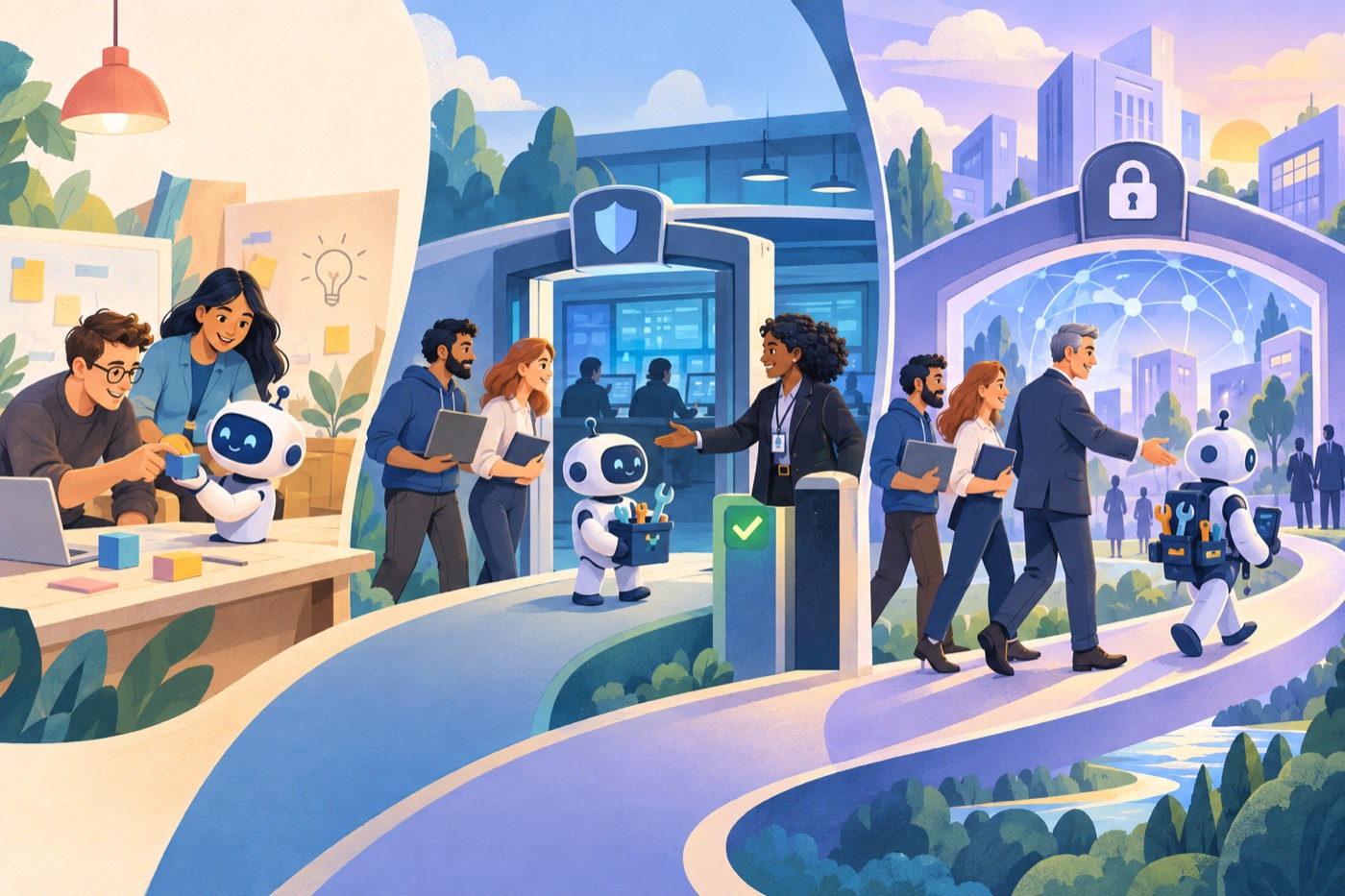
Move from prototype to production to a governed estate by adding controls at real consequence boundaries—not by collecting platform features.
Build, Buy, or Integrate the Agent Infrastructure Stack?
Most organizations will integrate. They will use managed models, an orchestration framework or service, existing identity and security systems, observability infrastructure, and selected agent-specific capabilities. The strategic decision is which contracts must remain portable and which operating responsibilities can be delegated.
| Decision | Build when | Buy or use managed service when | Keep portable |
|---|---|---|---|
| Runtime and orchestration | Workflow semantics are a competitive advantage or require unusual recovery behavior | Standard queues, checkpoints, scheduling, and scaling satisfy the workload | State model, task contract, event schema, idempotency rules |
| Context and memory | Domain retrieval, freshness, or evidence ranking is core differentiation | Common search and storage patterns meet quality and privacy needs | Source provenance, memory schema, deletion and correction policy |
| Identity and policy | Rarely from scratch; extend existing security architecture | Enterprise identity, policy, secret, and gateway services already exist | Principal model, permission scopes, policy decision record |
| Observability | Specialized business traces or privacy constraints require custom capture | Existing telemetry platform supports traces, metrics, access, and retention | Trace identifiers, event semantics, export path, redaction rules |
| Evaluation | Task-specific rubrics and datasets define product quality | Managed runners and generic evaluators reduce execution burden | Datasets, rubrics, thresholds, judge calibration, failure taxonomy |
| Registry and control plane | Multi-cloud requirements or unique governance create a real platform product | Agent count, compliance, and vendor diversity justify central tooling | Inventory export, ownership records, policy evidence, retirement process |
Good reasons to consolidate
- Teams repeat identity, registry, tracing, or policy work.
- Security cannot inventory agent access across platforms.
- Audit evidence requires manual assembly.
- Shared release and evaluation standards reduce incidents.
- Central buying creates measurable cost or support advantages.
Warning signs of premature platforming
- The organization has no validated production workflow.
- The platform is chosen before the action and risk model.
- One vendor’s object model becomes the business architecture.
- Teams measure features deployed rather than outcomes improved.
- The control plane adds approvals without better evidence.
Evaluate managed stacks by exportability and enforcement, not by screenshot count. Can you export traces and inventory? Can policy block a call before execution? Can you map an action to an agent and initiating user? Can you keep evaluation datasets if you move? Can you retire an agent and prove its access is gone? The answers determine whether the platform is infrastructure or another interface layered over hidden dependencies.
The Operating Model Matters as Much as the Technology
An agent crosses organizational boundaries: product defines the job, platform runs the service, data teams govern sources, security controls authority, legal and risk interpret obligations, and operations respond when behavior changes. If each group owns a slice but nobody owns the end-to-end outcome, the stack will have controls without accountability.
Use a risk tier to decide review depth. A read-only summarizer over public material can use lightweight review. An agent that changes account status, publishes externally, or controls infrastructure deserves stronger identity, policy, evaluation, approval, and incident controls. A single organization-wide checklist may be easy to administer, but it often overburdens low-risk work and underspecifies high-risk work.
The NIST AI Risk Management Framework is useful because it treats governance, mapping, measurement, and management as a continuous cycle. That logic fits agent operations: govern responsibility, map the workflow and affected parties, measure behavior and risk, then manage controls and incidents. Singularity Journey’s practical NIST AI RMF guide shows how to translate those functions into operating routines.
Metrics That Show Whether the Agent Stack Is Working
Infrastructure metrics should connect technical behavior to user and business outcomes. Uptime is necessary but insufficient. A perfectly available agent can consistently choose the wrong tool. A high task-success score can hide expensive human review. A low token bill can hide downstream correction work.
| Metric family | Examples | What it reveals | Common trap |
|---|---|---|---|
| Outcome | Task completion, accepted resolution, cycle-time reduction, value per case | Whether the workflow improves the real job | Counting agent runs as value |
| Quality | Groundedness, policy adherence, correct tool selection, user acceptance | Whether outputs and actions meet the task contract | One average score hides severe failure classes |
| Reliability | Successful recovery, duplicate-action rate, timeout rate, rollback success | Whether the runtime handles imperfect conditions | Measuring only API uptime |
| Control | Managed identity coverage, denied unsafe actions, approval quality, inventory coverage | Whether authority and governance are enforceable | Celebrating more approvals rather than better decisions |
| Operations | Mean time to detect, diagnose, contain, and recover; change failure rate | Whether teams can run and change the service safely | Dashboards without alert owners |
| Economics | Cost per accepted task, review minutes, rework, infrastructure and tool spend | Whether automation is sustainable | Optimizing tokens while ignoring labor and error cost |
Give each production agent a small scorecard with baselines, targets, and an owner. If a metric cannot trigger a decision, it may not belong on the operational dashboard. For example, an increase in approval rejection rate could trigger prompt or policy review. A rise in duplicate-action near misses could halt rollout. A drop in accepted resolution rate could initiate evaluation against recent cases.
Track coverage as well as performance. What share of live agents is registered? What share uses managed identity? Which write tools lack idempotency? Which releases lack regression evidence? Which agents have not been reviewed within policy? Coverage metrics expose the unobserved surface where “shadow agents” and stale permissions accumulate.
Interactive AI Agent Stack Planner
Use this decision helper to identify the next infrastructure priorities for a specific workflow. It is not a compliance assessment. It converts four architectural facts—action impact, data sensitivity, user scale, and autonomy—into a practical starting recommendation.
The result should start a design review, not end one. Two workflows with the same score can require different controls because reversibility, affected people, geographic scope, and legal duties differ. The value of the planner is forcing the team to discuss consequence before choosing a framework.
A Practical 90-Day Implementation Roadmap
- Days 1–15: choose one bounded workflow. Map the current human process, data sources, decisions, exceptions, and consequences. Name the workflow owner. Define success, unacceptable failure, stop conditions, and the highest-impact action. Decide what remains human.
- Days 16–30: build the evidence path. Create representative test cases before expanding tools. Add correlation identifiers, structured events, model and prompt versions, retrieval provenance, tool results, and redaction. Establish a baseline for task success, review burden, latency, and cost.
- Days 31–45: constrain authority. Give the agent a distinct identity, narrow permissions, separate read and write tools, validate parameters, add timeouts and budgets, and place approvals at consequence boundaries. Remove shared administrative credentials.
- Days 46–60: make execution durable. Add explicit state, idempotency, bounded retries, checkpoints, compensation, and terminal statuses. Test tool failures, stale context, conflicting policy, repeated requests, and approval delays.
- Days 61–75: release with evidence. Run offline evaluations, security review, and a canary rollout. Set alert thresholds, an incident owner, a containment switch, rollback criteria, and a review cadence. Compare live cases with the evaluation set.
- Days 76–90: decide whether to scale. Review outcome value, failure classes, human workload, cost per accepted task, and control coverage. Scale only if the economics and reliability are credible. If multiple teams repeat the same infrastructure, define shared platform contracts and registry requirements.
Common architecture mistakes
- Starting with a framework comparison: frameworks change faster than the workflow’s authority and evidence requirements.
- Treating traces as governance: a trace records behavior; it does not necessarily prevent unauthorized behavior.
- Using human approval as a universal safety net: approvals without context create fatigue and rubber-stamping.
- Giving the agent the user’s full credentials: this hides the actual actor and expands blast radius.
- Logging everything: indiscriminate telemetry can leak secrets and sensitive data.
- Testing happy paths only: production reliability depends on ambiguous inputs, tool failures, partial progress, and recovery.
- Building a central platform too early: shared infrastructure should solve repeated operating pain, not imitate a vendor diagram.
- Ignoring retirement: abandoned agents, secrets, jobs, memories, and permissions create a durable attack surface.
What to Watch as the Agent Infrastructure Market Evolves
First, watch whether agent identity becomes interoperable across clouds, SaaS platforms, and enterprise directories. A useful identity must survive delegation: the system should know which user initiated the task, which agent acted, what authority was delegated, and which tool enforced the decision. Proprietary identity features can improve local security while making cross-platform evidence harder to assemble.
Second, watch protocol governance. MCP and agent communication standards will make tools and agents easier to connect, but discovery will increase the importance of registry quality, provenance, compatibility, permission scopes, and supply-chain controls. The winning ecosystem will pair interoperability with explicit trust and lifecycle metadata.
Third, watch the merger of observability and evaluation. Traces are becoming datasets; production failures are becoming regression cases; policy decisions are becoming measurable events. Mature systems will close the loop: evidence from live operation will update evaluations, and evaluation results will control release and runtime policy.
Fourth, watch procurement shift from “Which model is best?” to “Which operating layer do we want to own?” Models will remain important, but enterprise differentiation will increasingly depend on context quality, workflow design, recovery, governance, and evidence. A portable task contract and evaluation set can preserve choice even when the runtime or model vendor changes.
Finally, watch whether companies publish outcome evidence rather than agent counts. A thousand registered agents is inventory, not value. The useful questions are how many complete bounded work successfully, how much review they require, what failures they create, whether controls are consistently applied, and whether the economics remain positive after rework and operations.
Final Insight: The Stack Is a System of Contracts
The AI agent infrastructure stack is best understood as a system of contracts. The outcome contract says what success means. The context contract says which evidence may influence a decision. The runtime contract says how work progresses and recovers. The tool contract says what can change. The identity and policy contract says who may authorize that change. The evidence contract says how behavior is reconstructed and judged. The lifecycle contract says how the system evolves and ends.
That framing avoids both hype and paralysis. You do not need a giant platform to test a low-risk workflow. You do need clear boundaries, isolated authority, representative tests, and usable evidence. As consequence and scale increase, add durable execution, policy enforcement, centralized inventory, consistent telemetry, lifecycle reviews, and incident operations.
The architecture succeeds when people can answer five questions quickly: What job does this agent own? What can it access and change? Why was this action allowed? How do we know the result was good? How do we stop, recover, or retire it? If the stack cannot answer those questions, another agent framework will not fix the foundation.
Continue the Singularity Journey
FAQ: AI Agent Infrastructure Stack
What is an AI agent infrastructure stack?
It is the set of technical and organizational capabilities that lets an agent perform bounded work reliably. It includes the business objective, models and context, runtime orchestration, tools and data, identity and policy, observability and evaluation, and lifecycle operations. The stack turns model behavior into a service that can be controlled, measured, changed, and retired.
How is an agent stack different from a normal LLM application stack?
An agent stack must manage delegated action and multi-step state. A normal LLM application may generate text and return it. An agent may select tools, change records, wait for approvals, retry work, and operate across systems. That adds requirements for identity, authorization, idempotency, checkpoints, policy enforcement, audit evidence, recovery, and explicit stop conditions.
Which layers are essential for a small production AI agent?
At minimum, define a bounded outcome and owner, use controlled context, run with isolated scoped credentials, constrain tools, record a structured trace, test representative and failure cases, set time and cost limits, and provide a human escalation path. Add durable state, release gates, alerts, rollback, and incident ownership before the agent performs consequential write actions.
Does every company need a dedicated AI agent control plane?
No. A dedicated control plane becomes valuable when many teams and platforms create repeated inventory, identity, policy, telemetry, lifecycle, and audit problems. A team with one bounded agent can use existing identity, workflow, deployment, and monitoring systems. Centralization should solve recurring operating inconsistency, not act as a maturity badge.
Where do MCP and agent-to-agent protocols fit?
They fit mainly in the tools, data, discovery, and delegation parts of the stack. Protocols standardize how components describe and call one another, but they do not decide trust. Each connection still needs identity, authorization, data boundaries, validation, policy, evidence, ownership, versioning, and retirement.
What is the difference between AI agent observability and evaluation?
Observability reconstructs what happened through traces, logs, metrics, tool calls, policy decisions, and side effects. Evaluation judges whether the behavior met quality, safety, policy, efficiency, and task requirements. Observability helps diagnose; evaluation helps decide whether behavior is acceptable. Production systems need both connected through common identifiers and versions.
Should teams build or buy agent infrastructure?
Most teams should integrate. Build task-specific workflow logic, context quality, and evaluation assets when they create differentiation. Reuse established identity, secrets, policy, telemetry, and deployment capabilities. Buy managed services when operating burden and scale justify them, but keep task contracts, evidence schemas, datasets, rubrics, and inventory exportable.
What metrics matter most for production agents?
Track accepted task completion, failure categories, correct tool use, policy compliance, duplicate actions, recovery success, human review burden, cost per accepted task, mean time to contain incidents, and control coverage such as managed identity and registry completeness. Choose a small scorecard whose thresholds trigger specific owner actions.
What should a team implement first?
Start with one bounded workflow, its owner, success criteria, consequence boundary, representative test set, isolated identity, narrow tools, and evidence path. Add durability, approval, policy, release, and incident controls before expanding autonomy. Only then decide which repeated capabilities belong in a shared platform.
