
A production AI agent needs more than a clever prompt. It needs a release pipeline that proves quality, captures traces, limits blast radius, catches regressions, and gives humans a fast way to stop or roll back risky behavior.
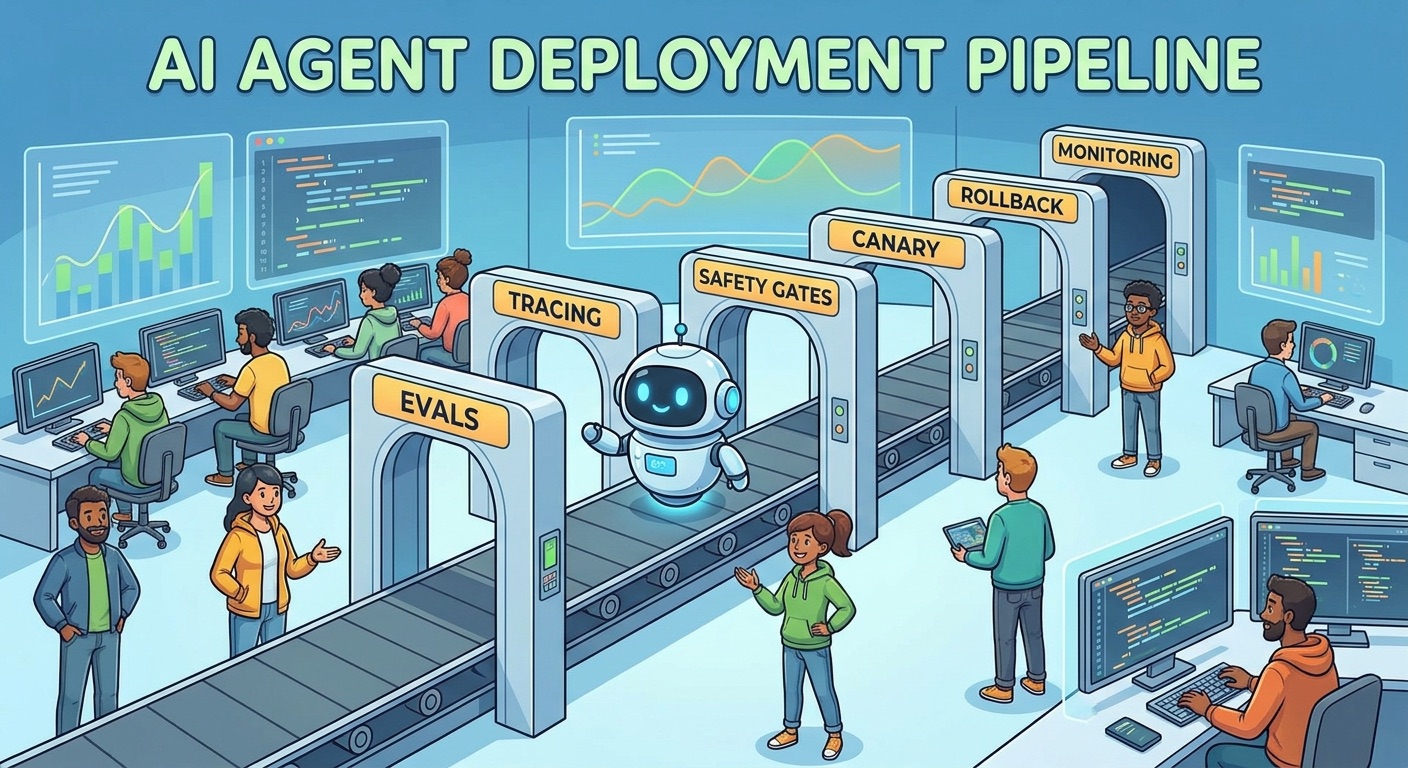
AI Agent Deployment Pipeline: The Quick Answer
An AI agent deployment pipeline is a controlled path that moves an agent from prototype to production through evidence-based gates. Instead of asking “does the demo work?”, the pipeline asks a stronger question: “do we have enough proof to let this agent act for real users, with real tools, real data, real costs, and real failure modes?”
A practical pipeline includes a clear task boundary, a golden dataset, offline evaluations, trace instrumentation, safety checks, staging tests, human review, canary rollout, online evaluations, incident monitoring, and rollback rules. Each stage should produce evidence. If the evidence is weak, the agent should not advance. If production behavior drifts, the pipeline should tighten access, trigger human review, or roll the agent back to a safer version.
This topic fits the Dev Zone because developers are now moving from agent experiments to operational systems. Singularity Journey analytics show repeated reader engagement with agent observability, debugging, evaluation metrics, OpenTelemetry tracing, human approval, and guardrail content. Search Console data is still sparse, so this article is designed as a topical authority pillar: a single practical map that connects the existing Dev Zone cluster into a complete production release workflow.
Why AI Agents Need a Different Deployment Mindset
Traditional software deployment already has risk: bugs, downtime, bad migrations, security regressions, slow pages, and unhappy users. AI agents add another layer because they do not only return deterministic output. They reason probabilistically, call tools, retrieve context, follow instructions, summarize messy information, and sometimes take actions. The same input can lead to different intermediate steps. A model upgrade can change behavior without any application code changing. A prompt that worked in a demo can fail when a user provides ambiguous context, adversarial text, or unexpected data.
That is why “deploying an agent” is not just uploading code. You are deploying a small decision-making system. The system may decide which tool to call, which record to update, which document to trust, which user request to refuse, when to ask for approval, and how to recover from an error. Even when the agent is not fully autonomous, it can still influence high-stakes workflows by drafting customer replies, routing tickets, generating code, summarizing contracts, or recommending operational actions.
The common failure pattern is predictable. A team builds a promising demo. The demo succeeds on five handpicked examples. Everyone gets excited. The agent is connected to a real workflow. Then production reveals the missing cases: malformed inputs, slow APIs, stale retrieval, duplicate tool calls, unclear approvals, token-cost spikes, hallucinated citations, and users who ask for things the designer never imagined. Without traces, the team cannot explain what happened. Without evals, the team cannot prove a fix works. Without rollout controls, every user becomes part of the experiment.
Official and reputable sources point in the same direction. LangSmith describes traces as records of what agents did and emphasizes using traces for debugging, quality monitoring, and building evaluation datasets. Arize Phoenix describes traces that capture model calls, retrieval, tool use, and custom logic, then connects those traces to evaluations. OpenAI’s evaluation guidance frames evals as a way to test model outputs against expected criteria and iterate. OpenTelemetry’s GenAI semantic conventions show that the broader observability ecosystem is standardizing model and agent telemetry. DORA’s monitoring and observability capability reinforces the older DevOps lesson: production systems need tooling that helps teams understand and debug real behavior.
The AI Agent Deployment Pipeline
A useful pipeline is not complicated for its own sake. It is a sequence of decisions that reduce uncertainty. Every stage answers a different question: should we build this agent, does the core behavior work, can we explain failures, is it safe enough for staging, is it safe enough for a small user group, and can we roll back if reality disagrees with the test suite?
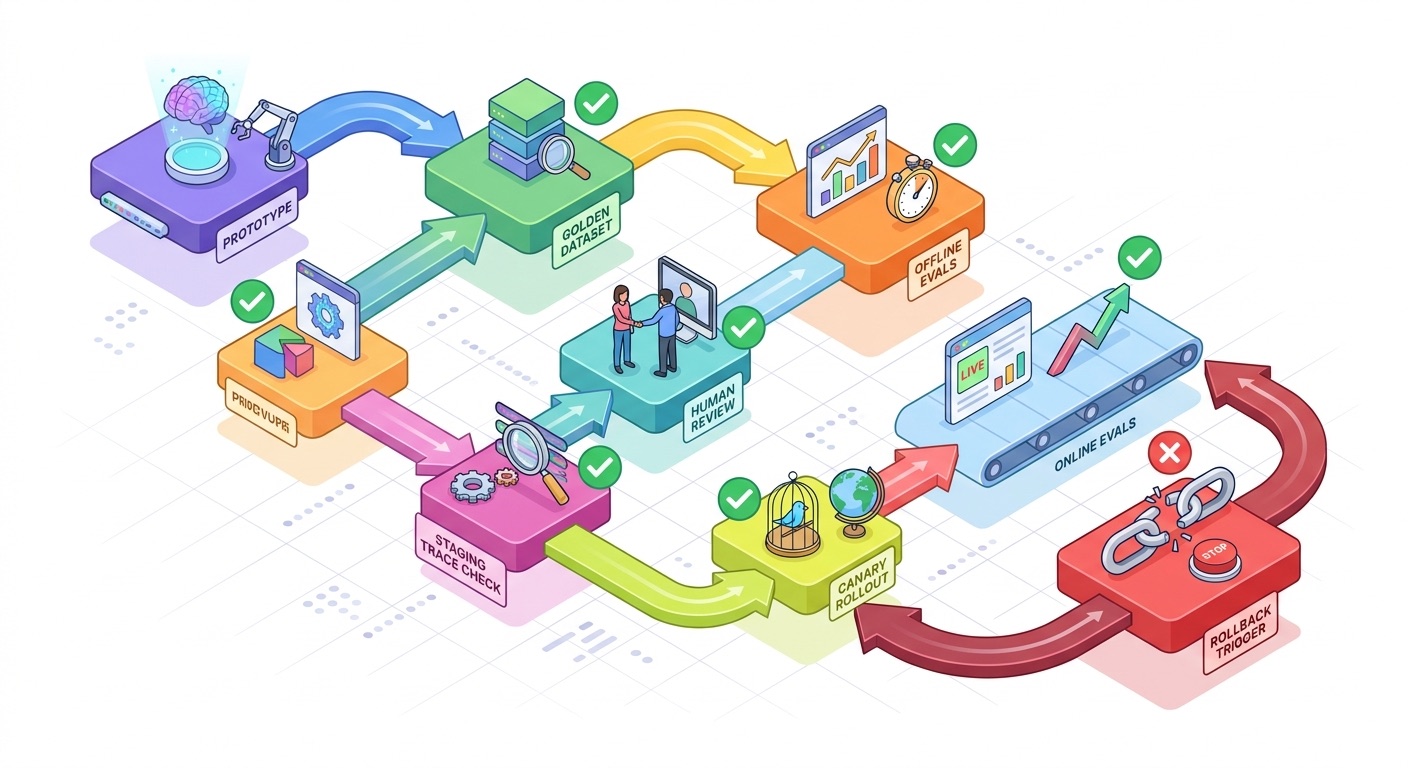
Stage 1: Define the task boundary
Before writing prompts or choosing a framework, define what the agent is allowed to do. A good boundary includes the user goal, permitted tools, data sources, prohibited actions, approval requirements, output format, and success criteria. “Handle support tickets” is too vague. “Classify incoming support tickets, suggest a response, cite the relevant knowledge-base article, and request human approval before sending” is deployable. The second version gives you something to test, trace, and govern.
Stage 2: Build a golden dataset
A golden dataset is a curated set of inputs, expected outputs, edge cases, and failure scenarios. It should include normal cases, ambiguous cases, known historical failures, adversarial cases, tool-error cases, retrieval-miss cases, and examples where the correct behavior is to refuse or ask for a human. Small teams can start with twenty to fifty examples. Larger teams should keep expanding the dataset with production traces. The key is not dataset size alone; it is whether the examples represent the real ways the agent can succeed and fail.
Stage 3: Run offline evaluations
Offline evals run before real users are exposed. They should check task success, factual grounding, policy compliance, tool-call correctness, output format, latency, cost, and safe refusal behavior. Some checks can be deterministic code rules. Some need human review. Some can use LLM-as-judge scoring, but judge prompts should be tested and calibrated because an evaluator model can also be wrong. The goal is not to create one magical score. The goal is to catch regressions and make release decisions visible.
Stage 4: Instrument traces before staging
Tracing should be installed before staging, not after the first incident. Each run should record the user input, model calls, retrieved context, tool calls, tool responses, intermediate decisions, guardrail events, approvals, final output, latency, token usage, cost, errors, and version metadata. Sensitive data should be handled carefully: redact what should not be stored, restrict access to logs, and avoid treating observability as an excuse to collect everything forever. If a team cannot inspect an agent run step by step, it is not ready for broad deployment.
Stage 5: Use staging like a rehearsal, not a checkbox
Staging should mirror production conditions as closely as practical. Use realistic permissions, realistic retrieval indexes, realistic rate limits, and realistic downstream tool behavior. Many agent failures appear only when multiple pieces interact: a retriever returns stale context, the model chooses the wrong tool, the tool times out, the retry policy creates duplicate actions, and the final answer hides the uncertainty. A staging rehearsal should test those chains, not just a happy-path prompt.
Stage 6: Canary release to a narrow audience
A canary release exposes the agent to a small, controlled slice of usage. The canary may be internal users, one customer segment, a low-risk workflow, or a read-only version of the agent. During canary, the team should watch online evals, trace samples, human feedback, cost, latency, tool errors, retrieval quality, refusal patterns, and user overrides. A canary is only useful if it can stop. If no one has authority to pause the rollout, it is not a canary; it is just a quiet launch.
Stage 7: Production monitoring and feedback loop
After launch, traces should feed the next evaluation cycle. Every serious failure should become a new test case. Every surprising success should teach the team what users actually need. Every rollback should update release gates. This is how an agent deployment pipeline becomes a learning system. The goal is not to eliminate every possible failure before launch. That is impossible. The goal is to make failures visible, bounded, reversible, and increasingly less likely over time.
How Evals and Traces Work Together
Evals and traces are often discussed separately, but production agents need both. An eval is a test: it asks whether the agent meets a criterion on a known input or a live interaction. A trace is a record: it shows what the agent did internally to reach its output. Evals can tell you that a run failed. Traces help explain why. Traces can reveal a strange tool call. Evals can turn that strange case into a regression test that prevents the same failure from returning later.
For example, imagine an agent that helps engineers triage incidents. An offline eval might ask the agent to classify severity, cite evidence, propose next steps, and avoid taking destructive actions. The eval can score whether the output matches the expected severity and includes required fields. But if the agent fails, the trace is what reveals whether it retrieved the wrong runbook, ignored a monitoring alert, called a tool with bad parameters, or hallucinated an explanation. Without the trace, the team only sees the final answer. With the trace, the team can fix the relevant layer.
This trace-to-eval loop is one of the most important practices for agent teams. Production creates examples that no designer anticipated. Some are harmless. Some are embarrassing. Some are dangerous. A mature team reviews sampled traces, labels meaningful failures, adds them to the golden dataset, updates rubrics, and then reruns offline evals before the next release. The dataset becomes a memory of production reality.
Do not reduce evals to a single pass/fail score. A useful system has multiple evaluators. Code-based checks can validate JSON format, required citations, tool schemas, latency budgets, and forbidden actions. Human reviewers can judge tone, judgment, and workflow fit. LLM-based evaluators can score summaries, grounding, or policy compliance at scale, but should be audited because judge models may reward fluent wrong answers. Online evaluations can monitor live traffic for quality signals, but should avoid exposing sensitive user data unnecessarily.
Release Gates for Production AI Agents
A release gate is a decision point. It says what evidence must exist before the agent moves forward. Release gates protect the team from optimism. They also make deployment less political because the decision is not simply whether the demo felt impressive. The team can look at evidence: eval results, trace samples, incident simulations, human review, cost estimates, security review, and rollback readiness.
| Gate | Evidence required | Common failure that blocks release |
|---|---|---|
| Scope gate | Clear task boundary, allowed tools, prohibited actions, owner, user segment, and risk level. | The agent has vague authority or no clear human owner. |
| Dataset gate | Golden examples, edge cases, expected outputs, refusal cases, and known historical failures. | The test set only includes happy-path examples. |
| Offline eval gate | Versioned eval results for quality, grounding, format, safety, tool use, latency, and cost. | The agent passes examples manually but fails repeatable tests. |
| Trace gate | Step-by-step traces for model calls, retrieval, tools, approvals, errors, and metadata. | The team cannot explain why the agent produced an output. |
| Safety gate | Prompt-injection checks, data-leakage checks, permission review, refusal behavior, and approval paths. | The agent can access or act on data beyond its intended scope. |
| Staging gate | Realistic dry runs with production-like tools, rate limits, permissions, and failure simulations. | The agent only works in a simplified local environment. |
| Canary gate | Narrow rollout plan, live dashboards, sampled trace review, user feedback, and stop authority. | No one can pause the release when quality drops. |
| Rollback gate | Documented triggers, previous safe version, feature flags, communication plan, and incident owner. | The team can detect a bad release but cannot reverse it quickly. |
These gates are intentionally practical. A small startup does not need a hundred-page governance document to use them. It can start with a release checklist, a versioned eval file, trace capture, feature flags, and a named human approver. A larger enterprise may need formal change approval, security review, compliance signoff, and dedicated incident response. The principle is the same: no production agent should advance without evidence appropriate to its risk level.
Designing a Canary Rollout for an AI Agent
A canary rollout is a controlled experiment in production. It should be small enough to limit harm and real enough to reveal behavior that staging missed. For AI agents, a good canary is usually defined by risk, not only by traffic percentage. A read-only summarization agent can often handle a broader canary than an agent that sends emails, updates CRM records, changes infrastructure, or executes financial actions.
Start by choosing the safest initial operating mode. If the final vision is an autonomous agent, the first canary may still be suggestion-only. If the final system will call tools, the first canary may allow tool previews but require human approval for execution. If the agent will serve customers, the first canary may run internally on archived examples or operate only for a small group of trained users. The rollout should earn autonomy rather than receive it by default.
During canary, monitor four kinds of signals. First, outcome quality: did the agent solve the task, cite sources, follow format, and avoid hallucination? Second, operational health: latency, tool error rate, timeouts, retries, and cost. Third, safety behavior: refusals, prompt-injection attempts, policy violations, data exposure, and approval escalations. Fourth, human experience: overrides, user corrections, frustration signals, and trust-damaging surprises. A canary that only watches latency is not sufficient for agents.
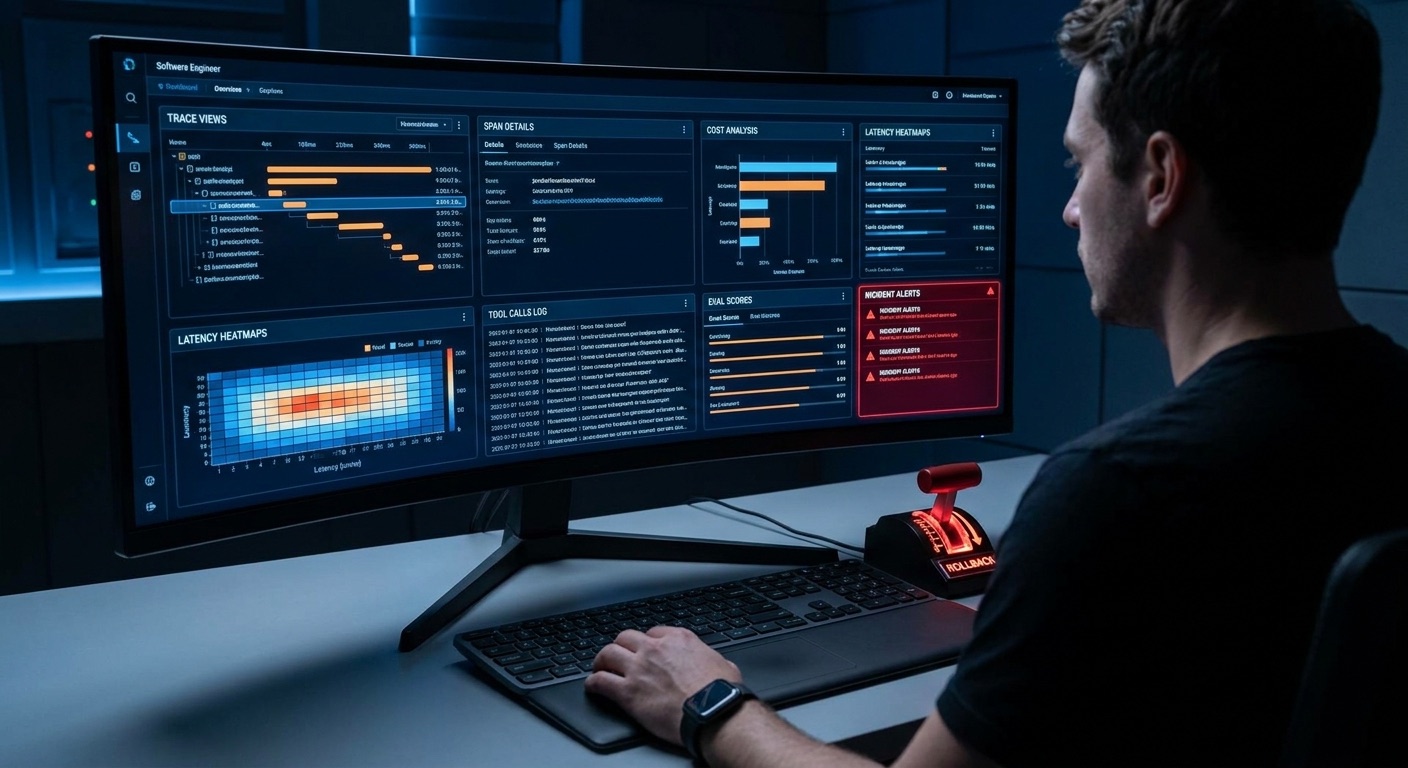
Canary review should be frequent at the beginning. Sample traces manually. Read failed runs in detail. Compare online behavior against offline eval expectations. Look for silent failures where the final answer seems polished but the reasoning path used weak evidence or unnecessary tools. If the team finds repeated failures, do not patch blindly in production. Add the cases to the dataset, reproduce the issue, fix the relevant layer, rerun evals, and then resume rollout.
Rollback Triggers: When to Stop an AI Agent Release
Rollback triggers should be defined before launch. If the team waits until an incident happens, the decision becomes emotional. People argue about whether the failure is severe, whether the demo still looks good, whether users will notice, and whether the release should continue. Clear triggers reduce that confusion. They do not replace human judgment, but they create a default action when risk increases.
| Signal | What it may mean | Recommended response |
|---|---|---|
| Repeated wrong tool calls | The agent is choosing actions that do not match user intent or workflow rules. | Pause action execution, switch to suggestion-only, inspect traces, and update tool-selection evals. |
| Grounding or citation failures | The agent is answering without reliable support or misusing retrieved context. | Roll back retrieval/prompt changes, require source display, and add failed traces to the dataset. |
| Policy or safety violations | Refusal behavior, guardrails, or permissions are not working under real use. | Restrict access immediately, escalate to the owner, and rerun adversarial tests before relaunch. |
| Cost or latency spikes | The agent is looping, over-retrieving, calling tools too often, or using expensive model paths. | Throttle traffic, cap tool calls, inspect spans, and revert the release if the pattern persists. |
| High human override rate | Reviewers do not trust the agent or the agent is misaligned with workflow reality. | Keep canary small, collect reviewer labels, revise eval rubrics, and delay expansion. |
| Data exposure or permission mismatch | The agent can see or reveal information outside its intended scope. | Stop the release, revoke excessive permissions, audit logs, and require security review. |
| Incident owner unavailable | The team cannot respond fast enough if the canary fails. | Do not expand rollout until ownership and escalation coverage are clear. |
Rollback does not have to mean deleting the agent. Often the safer response is to reduce autonomy. Move from automatic action to human approval. Move from broad users to internal users. Move from write access to read-only. Move from real-time operation to queued review. A good pipeline gives the team multiple safety positions rather than one all-or-nothing switch.
Metrics to Track Before and After Deployment
Agent metrics should combine software reliability with AI-specific quality. Traditional metrics such as uptime, latency, error rate, and throughput still matter. But they are not enough. An agent can be fast, available, and wrong. It can have low infrastructure error rates while quietly choosing poor tools. It can satisfy a superficial judge while frustrating human reviewers. The metric set should reflect the work the agent is trusted to perform.
| Metric family | Examples | Why it matters |
|---|---|---|
| Task success | Completion rate, correct classification, accepted suggestions, solved tickets, successful handoffs. | Measures whether the agent is useful for the actual workflow. |
| Grounding quality | Citation accuracy, retrieved-document relevance, unsupported-claim rate, answer-source alignment. | Reduces confident wrong answers and improves reviewer trust. |
| Tool behavior | Wrong tool rate, failed tool calls, duplicate calls, parameter errors, retry loops. | Captures agent-specific risk that normal chatbot metrics miss. |
| Safety and policy | Refusal accuracy, prompt-injection detection, data-leak events, approval escalations. | Shows whether guardrails work under realistic conditions. |
| Human oversight | Override rate, approval time, reviewer disagreement, escalation quality, audit completeness. | Measures whether humans can meaningfully supervise the system. |
| Reliability | Latency, availability, timeout rate, dependency errors, recovery success. | Keeps the agent operational inside real software constraints. |
| Cost | Tokens per run, cost per successful task, tool-call cost, unnecessary model upgrades. | Prevents impressive demos from becoming expensive production surprises. |
Set thresholds according to risk. A brainstorming assistant can tolerate more mistakes than an agent that updates billing records. A developer assistant that suggests code can operate with different controls than an agent that merges code automatically. The key is to decide what quality means for the workflow, then make the pipeline enforce it.
A Simple Reference Architecture
A production-ready deployment architecture can be simple. The user request enters through an application layer. A policy layer checks permissions and task boundaries. The agent planner decides whether to answer, retrieve, ask for clarification, call a tool, or escalate to a human. Retrieval and tools run through wrappers that log inputs, outputs, errors, and latency. Guardrails check unsafe requests and unsafe outputs. A human approval layer reviews high-risk actions. A trace collector records the run. An evaluation service scores sampled or selected runs. Dashboards show live quality and reliability. Feature flags control canary percentage and autonomy level. Incident playbooks define rollback actions.
The important design choice is separation of concerns. Do not bury permissions inside a prompt. Do not hide tool execution inside unlogged helper functions. Do not rely on a single final answer as your only record. Each layer should produce observable evidence. If the agent retrieves a document, record which document. If it calls a tool, record the tool name and parameters. If it asks for approval, record what the reviewer saw. If it refuses a request, record the policy category. If it fails, record where the chain broke.
This architecture also supports safer iteration. If evals show weak citations, improve retrieval and grounding. If traces show duplicate tool calls, fix tool idempotency and retry logic. If human reviewers keep overriding tone, refine the output rubric. If latency spikes, inspect spans and model choices. If prompt injection works, strengthen boundary checks and add adversarial examples. Without architecture-level observability, every fix becomes guesswork.
AI Agent Deployment Checklist
If you only implement three things, start with a golden dataset, trace capture, and rollback triggers. The golden dataset prevents repeated regressions. Traces explain real failures. Rollback triggers keep a bad release from expanding. Everything else becomes easier once those three foundations exist.
Internal Reading Path on Singularity Journey
This deployment pipeline connects several existing Dev Zone and AI safety guides. Read these next if you want to build the pieces in more detail:
- AI Agent Observability: How to Trace, Evaluate, and Debug Production Agents
- OpenTelemetry for AI Agent Tracing: A Practical Trace Design Guide
- AI Agent Evaluation Metrics: What to Measure Before Production Agents Scale
- AI Agent Test Cases: How to Build Golden Datasets, Rubrics, and Failure Scenarios
- Human Approval Gates for AI Agents: A Practical Workflow Design Guide
- AI Agent Debugging Runbook: Triage Tool, Context, Memory, and Latency Failures
Conclusion: Ship Agents With Evidence, Not Hope
The fastest way to create fragile AI automation is to treat a successful demo as a production release. AI agents need a stricter path. They need scoped authority, test cases, evals, traces, staging rehearsals, canaries, online monitoring, human review, and rollback rules. That may sound heavy, but it is lighter than explaining an invisible failure after the agent has already affected customers, data, or operations.
The practical mindset is simple: ship agents with evidence, not hope. Every release should make the agent more observable, more testable, and easier to stop. Every incident should improve the dataset. Every expansion of autonomy should be earned by measured behavior. If teams build that discipline early, AI agents can become useful production systems instead of unpredictable black boxes wearing a friendly chat interface.
For developers, this is also a career advantage. The next wave of AI engineering will not be only about prompting models. It will be about designing systems where models, tools, data, approvals, traces, and evaluations work together. The teams that learn to deploy agents responsibly will move faster because they will trust their release process. The teams that skip the pipeline will move fast until the first serious failure teaches them why the pipeline mattered.
Sources and References
- OpenAI Agents SDK: Tracing
- OpenAI: Working with evals
- LangSmith Observability documentation
- LangSmith Evaluation documentation
- Arize Phoenix documentation
- OpenTelemetry Generative AI semantic conventions
- Google Cloud / DORA DevOps capabilities
- IBM: What is AI observability?
Source links were checked directly. Unrelated, shortened, suspicious, or low-quality links were not included.
FAQ: AI Agent Deployment Pipeline
What is an AI agent deployment pipeline?
An AI agent deployment pipeline is a staged release process that moves an agent from prototype to production through task scoping, datasets, evals, traces, staging, canary rollout, monitoring, human approvals, and rollback rules.
What should be tested before deploying an AI agent?
Test task success, grounding, output format, tool-call correctness, prompt-injection resistance, refusal behavior, latency, cost, retries, duplicate actions, permissions, and human approval paths.
How do evals and traces work together?
Evals score whether the agent behaved correctly. Traces show how the agent reached the result, including model calls, retrieval, tools, approvals, and errors. Production traces should become future eval cases.
When should an AI agent deployment be rolled back?
Rollback when repeated wrong tool calls, policy violations, data exposure, grounding failures, cost spikes, latency issues, high human override rates, or unowned incidents exceed the thresholds defined before launch.
Do small teams need agent observability?
Yes. Small teams can start with simple traces, a small golden dataset, manual review, and feature flags. The point is not enterprise ceremony; it is being able to explain failures and stop bad releases quickly.
Is a canary rollout enough to make an AI agent safe?
No. A canary limits blast radius, but it must be combined with evals, trace review, safety checks, rollback authority, and a feedback loop that turns production failures into new tests.
Can LLM-as-judge replace human review?
No. LLM-based evaluators can scale review for some criteria, but high-risk workflows still need human judgment, calibrated rubrics, sampled audits, and deterministic checks where possible.
