
NIST AI Risk Management Framework Explained: How Govern, Map, Measure, and Manage Work Together
The NIST AI RMF becomes useful when it stops being a poster and starts operating as a repeatable loop: set accountability, understand context, test what matters, act on the evidence, and keep watching the system after release.
The NIST AI RMF in One Practical Answer
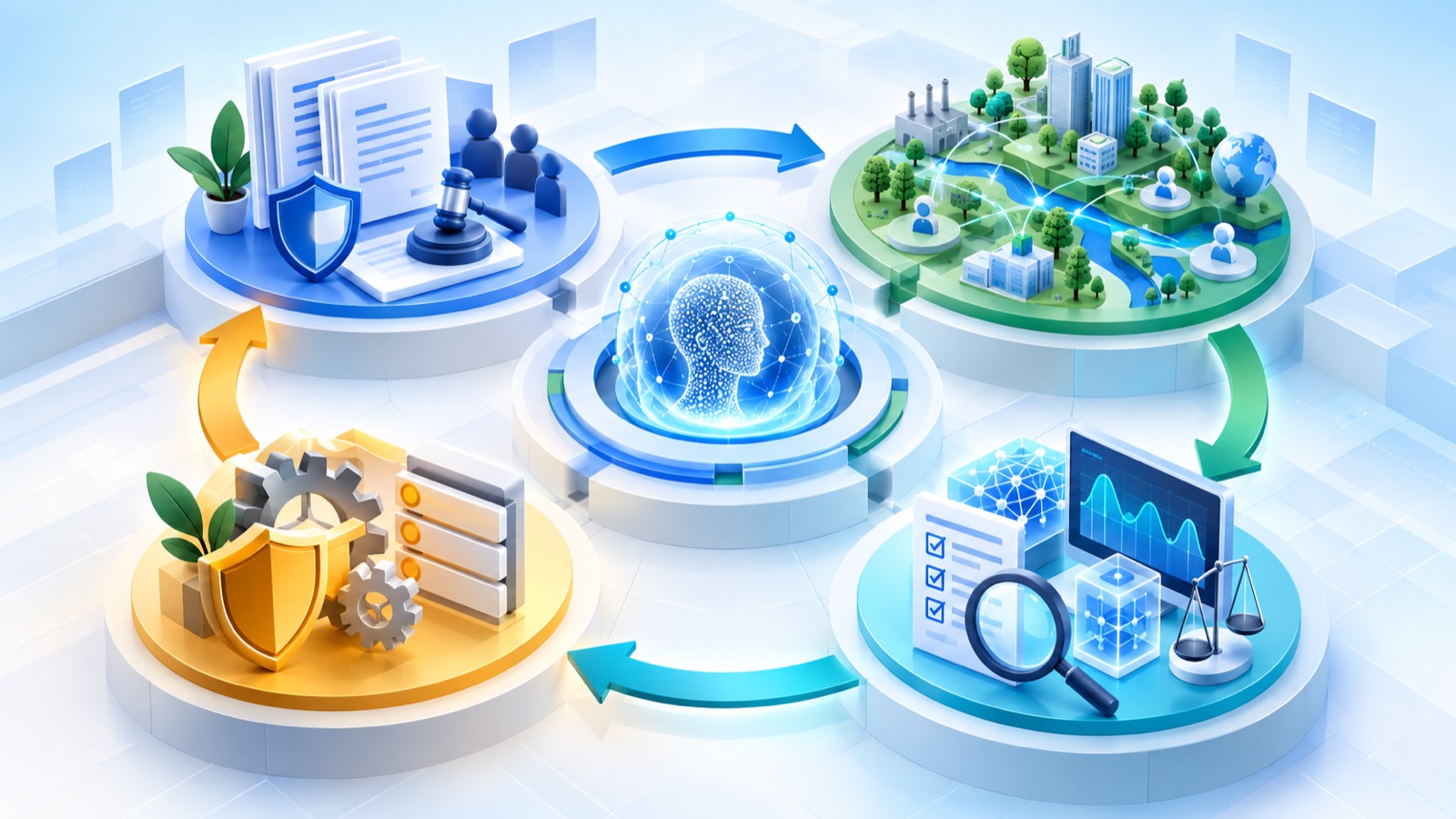
The NIST AI Risk Management Framework is a voluntary framework for helping organizations identify, assess, prioritize, and manage risks from artificial intelligence. Its core is organized around four functions: Govern, Map, Measure, and Manage. These functions are not four boxes to check once. Govern supplies the culture, policies, roles, and accountability that influence everything else. Map establishes the system’s context and the people it can affect. Measure produces evidence about performance, trustworthiness, limitations, and uncertainty. Manage uses that evidence to prioritize risks, choose responses, monitor outcomes, and decide whether the AI system should proceed, change, pause, or retire.
The simplest way to apply the framework is to turn each function into a decision-producing workflow. Govern should produce named owners, policy boundaries, documentation rules, and escalation routes. Map should produce a documented use case, impact analysis, stakeholder view, and risk hypotheses. Measure should produce test results, metrics, limitations, and evidence quality. Manage should produce treatment decisions, acceptance criteria, response plans, monitoring thresholds, and accountable sign-off.
This approach keeps the AI RMF from becoming paperwork detached from product work. It also avoids a second mistake: treating the framework as a certification standard. NIST describes the AI RMF as voluntary, rights-preserving, non-sector-specific, and use-case agnostic. It can support internal governance, procurement, product development, audits, and conversations with customers or regulators, but merely saying “aligned with NIST” does not prove that a particular AI system is safe, lawful, accurate, or appropriate.
What the NIST AI Risk Management Framework Is—and Is Not
The framework exists because AI risk is broader than model accuracy. An AI system may perform well on a benchmark and still create harm through poor deployment context, insecure integrations, inaccessible user experiences, opaque decisions, privacy failures, or automation that shifts risk onto people with little power. The AI RMF therefore asks organizations to look at technical properties alongside organizational processes, human behavior, intended use, reasonably foreseeable misuse, and real-world impact.
NIST’s AI RMF resources describe a flexible framework that organizations can adapt to their role, sector, resources, and risk tolerance. The framework does not prescribe one universal control set. A small internal summarization tool and an AI system involved in employment, finance, health, education, security, or critical infrastructure should not receive identical treatment. The framework gives teams a common vocabulary and structure, while the organization must decide how much evidence and control a particular context demands.
It is also not a one-time compliance checklist. NIST’s AI RMF Playbook offers suggested actions, but explicitly positions those suggestions as voluntary rather than a checklist. Teams can choose actions that fit their situation, document why those actions are appropriate, and adapt as systems and risks change. That flexibility is valuable, but it creates responsibility: an organization cannot outsource judgment to the framework.
A useful mental model is that the AI RMF is a management architecture. It helps connect executive policy to product decisions and product evidence back to executive accountability. The framework becomes real only when roles, artifacts, reviews, and monitoring are integrated into delivery workflows. If governance lives in one document while engineering, procurement, security, legal, and business teams make disconnected decisions, the organization may appear mature while remaining unable to explain why a risky system was approved.
How the Four AI RMF Functions Work Together
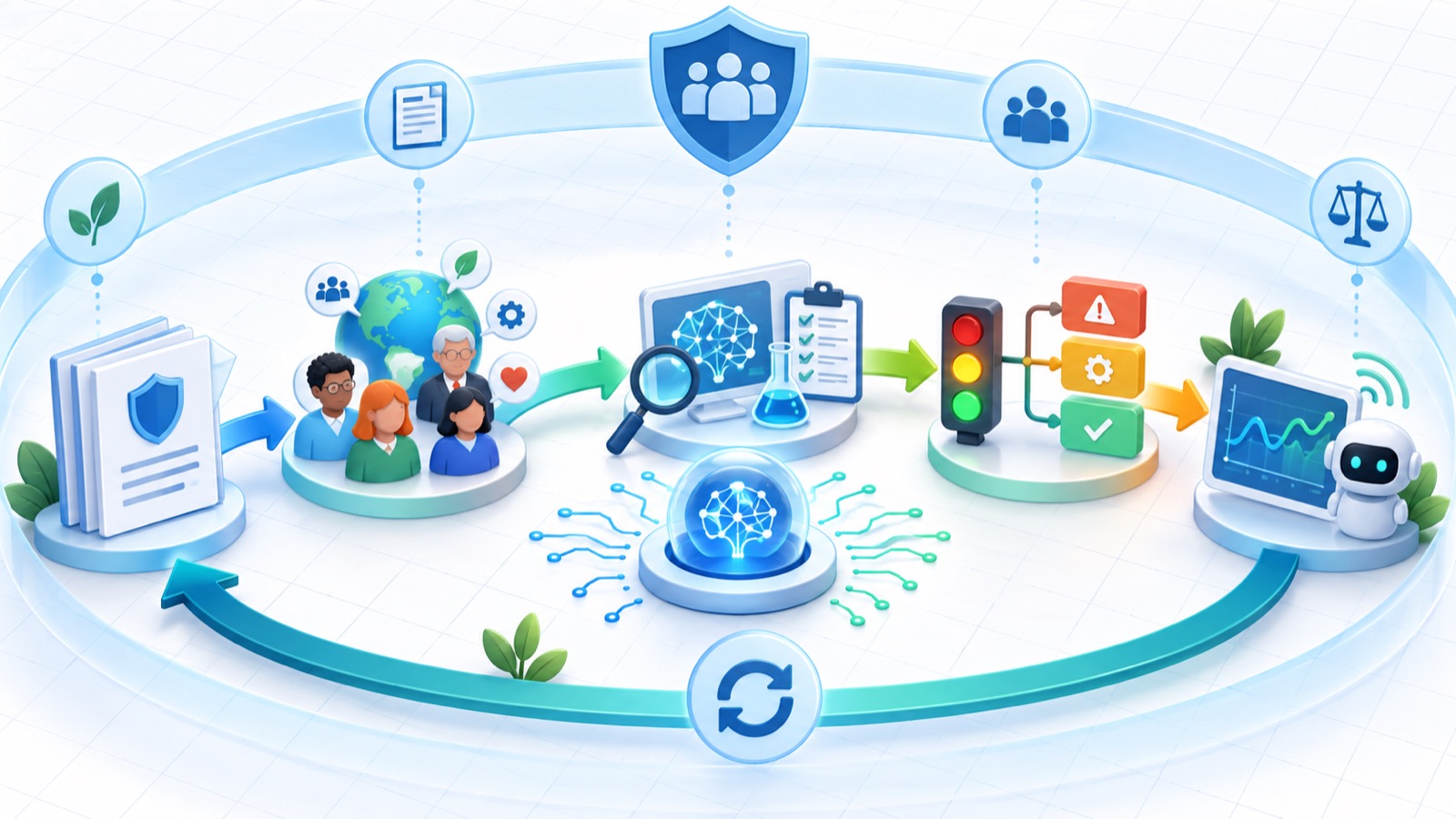
The order is helpful for teaching, but the work is not linear. Govern is cross-cutting. Map, Measure, and Manage inform one another continuously. A measurement failure may reveal that the use context was poorly mapped. A production incident may require a new metric. A new data source may change privacy, security, or bias risks. A policy change may alter the organization’s risk tolerance. A model or vendor update can invalidate earlier evidence. The loop needs explicit triggers so the team knows when reassessment is required.
| Function | Question it must answer | Minimum useful artifact | Decision enabled |
|---|---|---|---|
| Govern | Who is accountable, and under which rules? | Ownership map, policy boundaries, approval matrix, issue escalation route. | Whether the organization can responsibly evaluate and operate the system. |
| Map | What is the system doing, for whom, and in what context? | Use-case brief, data and dependency map, stakeholder and impact analysis. | Which risks and benefits matter enough to evaluate. |
| Measure | What does credible evidence show? | Evaluation plan, test results, limitations, uncertainty, evidence provenance. | Whether performance and trustworthiness meet defined thresholds. |
| Manage | Which risks will we accept, reduce, transfer, avoid, or monitor? | Risk register, treatment plan, launch conditions, monitoring and incident plan. | Whether to proceed, restrict, remediate, pause, or retire. |
Govern: Build the Operating System for AI Accountability
Govern is the foundation and the connective tissue. It covers the policies, processes, roles, responsibilities, culture, and organizational structures that shape how AI risk is handled. Because it is cross-cutting, Govern should not be treated as a kickoff task that disappears after approval. It should influence how systems are purchased, designed, tested, deployed, monitored, changed, and retired.
Start with ownership. Every AI system needs a business owner who is responsible for the outcome, a technical owner who understands how the system works, a data owner who can answer questions about sources and access, and a risk decision owner who can accept or reject residual risk. Depending on the use case, privacy, security, legal, accessibility, safety, compliance, and domain experts may also need defined roles. “The AI team” is not a sufficient owner because it hides who can make a launch decision and who answers when harm occurs.
Next, define risk appetite and prohibited uses in operational language. A statement such as “we use AI responsibly” cannot guide an engineer or reviewer. A useful policy says which decisions cannot be fully automated, which data classes cannot enter a model, which actions require human approval, which systems require independent evaluation, how users must be informed, and which incident thresholds trigger escalation. The policy should distinguish low-consequence assistance from high-consequence decisions rather than forcing every tool through the same process.
Govern also sets documentation expectations. Teams should know which artifacts are required for each risk tier: system description, model and vendor information, data lineage, evaluation results, human-oversight design, privacy analysis, security review, accessibility review, risk register, deployment decision, incident plan, and change history. Documentation should be proportionate, but it must be good enough for another qualified person to reconstruct the decision.
Govern deliverables that actually help teams
- An AI system inventory with owner, purpose, status, vendor, users, data classes, and risk tier.
- A responsibility matrix showing who proposes, reviews, approves, operates, monitors, and can stop each system.
- Clear rules for human approval, user notice, contestability, data access, model changes, and third-party dependencies.
- A standard risk-intake form and a lightweight route for genuinely low-risk experiments.
- An exception process with an expiration date, compensating controls, and an accountable approver.
- Training that is specific to roles, including product managers, engineers, procurement, reviewers, support staff, and executives.
Map: Understand the System in Its Real Context
Map prevents teams from evaluating an imaginary system. Models do not create risk in isolation; deployed systems interact with people, institutions, interfaces, data, business processes, incentives, and other software. Mapping asks what the system is intended to do, who benefits, who carries risk, what assumptions must remain true, and what can happen when the system is wrong, misunderstood, misused, or used outside its intended setting.
Write the use case narrowly. “Use AI in customer support” is too broad. “Draft answers to billing questions for trained agents using the current policy library, with citations and mandatory human approval” is testable. It tells the team who uses the output, which knowledge source matters, which action is allowed, and where human oversight sits. If the use case expands to automatic refunds or account changes, the context and consequence change, so the risk assessment must change too.
Map the full system boundary. Identify the model, prompts, retrieval sources, tools, APIs, plugins, identity permissions, user interface, logging, monitoring, human reviewers, upstream data producers, and downstream actions. Third-party models and data sources remain part of the organization’s risk surface even when the organization cannot inspect them directly. A vendor assurance report can support the analysis, but it does not replace testing in the actual deployment context.
Stakeholder mapping should extend beyond the buyer and primary user. A hiring assistant affects applicants. A classroom tool affects students and teachers. A fraud model can affect customers whose transactions are challenged. A workplace monitoring system may affect employees who did not choose it. Teams should identify people who can be harmed, people who may have difficulty contesting an outcome, and communities whose experiences may not appear in the development data.
Turn mapped context into testable risk hypotheses
A risk statement is more useful when it links a cause, an event, an affected party, and a consequence. Instead of writing “hallucination risk,” write: “If the support assistant retrieves an obsolete refund policy, it may draft an incorrect denial that a rushed reviewer approves, causing customer harm and regulatory exposure.” That statement points toward controls: source freshness, versioning, citations, reviewer prompts, sampling, and escalation for disputed cases.
Mapping should include expected benefits too. Risk management is not only harm prevention. It is decision quality under uncertainty. Document the intended improvement—faster resolution, better accessibility, lower error rates, more consistent service, earlier threat detection—and the baseline against which it will be measured. A system that introduces modest risk without delivering the expected benefit may not be worth operating.
| Map question | Evidence to collect | Common blind spot |
|---|---|---|
| What decision or task is supported? | Workflow diagram, allowed actions, prohibited actions, escalation points. | Describing the model rather than the actual workflow. |
| Who uses and who experiences the system? | User groups, affected groups, accessibility needs, power relationships. | Counting only direct users as stakeholders. |
| What data and tools are involved? | Data lineage, freshness, consent, permissions, APIs, third-party services. | Ignoring retrieved content and tool outputs. |
| What happens when it fails? | Misuse cases, failure modes, severity, reversibility, detectability. | Testing average cases while ignoring rare, severe outcomes. |
| What benefit justifies operation? | Baseline metric, target outcome, distribution of benefits and burdens. | Assuming adoption or output volume equals value. |
Measure: Produce Evidence That Matches the Risk
Measure converts concerns into evidence. It asks whether the system’s relevant characteristics have been evaluated using appropriate methods and whether the remaining uncertainty is understood. NIST’s trustworthy AI characteristics include validity and reliability, safety, security and resilience, accountability and transparency, explainability and interpretability, privacy enhancement, and fairness with harmful bias managed. Not every characteristic has equal weight in every use case, but the team should explain its priorities.
Begin with an evaluation plan derived from the mapped context. A general-purpose benchmark may be useful background, yet it rarely answers whether the deployed system is safe enough for a specific workflow. Build test sets from representative tasks, difficult cases, historical incidents, policy boundaries, adversarial inputs, accessibility scenarios, and cases affecting different stakeholder groups. Keep a protected holdout set so optimization does not turn the test into a rehearsal.
Use multiple measurement layers. Component tests examine retrieval, classification, model output, tool selection, or permission enforcement. End-to-end tests examine the complete workflow, including user interface and human review. Red-team exercises look for misuse, prompt injection, data leakage, bypasses, or unsafe actions. Production monitoring checks whether the system behaves differently after launch because users, data, models, integrations, or incentives changed.
Metrics should have thresholds and decision meaning. “Accuracy: 91%” is incomplete without the dataset, error categories, confidence interval, subgroup performance, baseline, and consequence of the remaining errors. For a drafting assistant, human acceptance and edit burden may matter more than exact-match accuracy. For a tool-using agent, unauthorized-action rate, recovery from tool failure, and correct escalation can be crucial. For a high-impact classifier, false-positive and false-negative costs may differ dramatically.
Measure uncertainty, not only performance
AI evaluations are samples, not guarantees. Data may not represent future use. Human labels may disagree. A model may perform differently after an update. Rare harms may not appear in a small test. The evidence package should state known limitations, unknowns, test coverage, evaluation independence, and conditions under which results may stop being valid. Honest uncertainty supports better decisions than a single polished score.
Human oversight must be measured too. A human-in-the-loop label can create false comfort if reviewers are rushed, over-trusting, poorly trained, or unable to detect the system’s errors. Test whether reviewers notice seeded mistakes, understand explanations, have enough time, can override the system, and know when to escalate. Track automation bias, disagreement rates, review time, and whether the interface makes uncertainty visible.
| Evidence area | Example measures | Decision question |
|---|---|---|
| Task performance | Success rate, error severity, completeness, calibration, groundedness. | Does it perform the intended task well enough? |
| Robustness and security | Prompt-injection success, tool misuse, data leakage, failure recovery. | Can expected attacks or disruptions break critical controls? |
| Fairness and access | Subgroup error rates, accessibility testing, burden distribution. | Are harms or benefits distributed in an unacceptable way? |
| Human oversight | Override rate, error detection, review time, escalation accuracy. | Can people meaningfully supervise the system? |
| Operational reliability | Latency, availability, stale-source rate, cost, drift, incident frequency. | Will the system remain dependable in production? |
Manage: Prioritize, Treat, Monitor, and Decide
Manage turns understanding and measurement into action. Risks should be prioritized by impact, likelihood, detectability, reversibility, affected population, and the organization’s ability to respond. A low-frequency event may still deserve urgent treatment if its consequence is severe or irreversible. A common, mild error may deserve treatment because it compounds across millions of uses. Numbers can inform prioritization, but a single universal risk score should not erase important differences.
For each material risk, choose a response. Avoid the risk by not using AI for the task. Reduce it with technical, procedural, or human controls. Transfer part of it through contracts or insurance without pretending accountability disappears. Accept residual risk when the expected benefit, evidence, and safeguards justify it. Record the rationale, approver, conditions, and review date. Risk acceptance should be a conscious decision, not whatever remains after the launch deadline.
Controls should be traceable to the risk they address. Retrieval citations may reduce unsupported-answer risk. Least-privilege permissions may reduce unauthorized actions. Rate limits and spending caps may contain runaway agents. Human approval may reduce consequential-action risk. An appeal process may reduce harm from incorrect decisions. Monitoring thresholds may reduce time to detection. Each control should have an owner and evidence that it works.
Manage also includes the launch decision. Teams can approve, approve with conditions, restrict to a smaller population, require remediation, delay, or reject deployment. The decision record should connect mapped context, measured evidence, residual risks, compensating controls, and expected benefit. This produces an auditable explanation instead of a vague statement that stakeholders were “comfortable.”
After launch, monitoring closes the loop. Watch performance, subgroup effects, complaints, overrides, incidents, data drift, model changes, vendor changes, cost, security signals, and user behavior. Define trigger events for reassessment: new use cases, new tools, higher autonomy, sensitive data access, model replacement, major prompt changes, expanded geography, new regulations, material incidents, or evidence that an assumption no longer holds.
Worked Example: Applying the Cycle to a Customer-Support AI Agent
Imagine an enterprise wants an AI agent to help customer-support staff answer billing questions. The agent retrieves approved policy, reviews the customer’s account context, drafts a response, and may recommend a refund. It cannot send messages or change accounts without human approval. This bounded example shows how the functions reinforce one another.
Govern the authority
The organization names a support operations owner, technical owner, data owner, and risk approver. Policy states that the agent may access only assigned customer records, must cite the policy version used, cannot approve refunds, and must escalate identity, fraud, hardship, or legal complaints. Reviewers receive training and have a visible way to report failures. The system is registered in the AI inventory, and model or retrieval changes require regression testing.
Map the context
The team maps customers, agents, supervisors, privacy staff, billing specialists, and people using assistive technology. It documents data sources, account permissions, policy ownership, multilingual needs, peak-load conditions, and downstream actions. Risk hypotheses include outdated policy retrieval, exposure of another customer’s data, incorrect denial of a refund, manipulative tone, poor performance for nonstandard language, and reviewer over-reliance.
Measure the system and oversight
The evaluation set contains common questions, ambiguous requests, conflicting policies, adversarial prompts, sensitive-data traps, multilingual conversations, and historical escalations. The team measures citation correctness, factual accuracy, policy compliance, privacy leakage, draft acceptance, edit burden, escalation accuracy, latency, and subgroup performance. Reviewers are tested with seeded errors to learn whether the oversight design works in practice.
Manage the residual risk
The system launches to a small trained group in draft-only mode. The organization requires high citation correctness, zero cross-customer data exposure in testing, strong escalation performance, and acceptable review burden. Production monitoring samples drafts, tracks complaints and overrides, and alerts on missing citations or retrieval from obsolete policy. If the agent gains permission to issue low-value credits later, that authority expansion triggers remapping, new security tests, new thresholds, and fresh approval.
The example shows why the functions cannot be isolated. Governance defines the refund boundary. Mapping identifies incorrect denials as a material harm. Measurement tests the relevant cases. Management decides the launch mode and monitoring threshold. Production evidence may reveal a new failure, which changes policy, context, testing, or controls.
Use Current and Target Profiles to Turn Gaps Into a Plan
NIST describes profiles as a way to apply the framework to a particular setting. A Current Profile describes how the organization is addressing AI risk now. A Target Profile describes the desired state. The gap between them becomes a prioritized improvement plan. This is more useful than declaring the whole organization “NIST aligned,” because capability often varies by business unit, use case, or risk tier.
Build profiles around outcomes, not document volume. For example, the Current Profile may show that all AI systems have business owners but only high-risk systems have independent testing; incidents are reported informally; vendor changes are not consistently tracked; and human-review effectiveness is rarely measured. The Target Profile may require an inventory with change alerts, risk-tiered evaluation, a formal incident route, reviewer testing, and quarterly reassessment for consequential systems.
Prioritize gaps based on exposure and dependency. If the organization cannot inventory active AI systems, improving model documentation may be premature because teams do not know what is operating. If high-consequence systems lack clear owners, ownership comes before fine-grained metrics. If evaluations exist but do not influence decisions, strengthen decision gates before buying another testing platform.
| Capability | Current state example | Target state example | Practical next step |
|---|---|---|---|
| Inventory | Teams self-report major systems annually. | Living inventory covers vendors, models, owners, data, use, status, and risk tier. | Connect procurement and architecture review to registration. |
| Evaluation | Teams use vendor benchmarks and a few demos. | Risk-based, context-specific tests with thresholds and limitations. | Create a shared evaluation template and protected test set. |
| Human oversight | “Human review” is stated but not designed. | Review criteria, time, authority, override, escalation, and effectiveness are tested. | Measure seeded-error detection and review burden. |
| Change control | Model updates arrive without consistent reassessment. | Material changes trigger regression tests and risk review. | Define change classes and required evidence. |
| Incident response | Problems travel through ordinary support queues. | AI-specific severity, containment, notification, learning, and recurrence controls. | Run a tabletop exercise using a realistic failure. |
Interactive Starting-Point Selector
The four functions operate together, but one function often reveals the immediate bottleneck. Use this selector as a conversation starter, not as a compliance score.
Apply the Generative AI Profile Without Replacing the Core
Generative AI introduces distinctive risks such as confabulation, harmful content, privacy leakage, information integrity problems, intellectual-property concerns, dangerous capability, misuse, and complex value-chain dependencies. NIST published NIST AI 600-1, the Generative AI Profile, as a companion resource to the AI RMF. The profile adds risk detail and suggested actions for organizations that design, develop, deploy, evaluate, or use generative systems.
Use the profile as a lens, not a substitute for mapping the actual system. A text assistant connected to internal documents has different exposure from an image generator, a public chatbot, a coding agent with repository access, or an autonomous research system with browser and payment tools. Generative capability may create common risk themes, while permissions, users, data, domain, and downstream authority determine consequence.
For a generative AI system, strengthen evidence provenance. Record which model and version was tested, system prompts, retrieval configuration, tools, safety settings, evaluation data, graders, and the conditions of the test. Because hosted models can change, define how vendor updates are detected and which regression tests must run. If the system uses generated output to train another model or populate a knowledge base, track that feedback path because errors can become durable.
Agentic systems require special attention to action. A model that drafts an incorrect recommendation creates one kind of risk; a tool-using agent that executes the recommendation can create immediate operational impact. Map each tool, credential, permission, spending limit, rate limit, approval gate, rollback path, and forbidden action. Measure whether the agent chooses the correct tool, respects boundaries, handles failures, and escalates uncertainty. Manage autonomy as a privilege earned through evidence, not a default feature.

Use Crosswalks Carefully: Alignment Is Not Equivalence
Organizations rarely start with an empty governance system. Security teams may use the NIST Cybersecurity Framework. Risk teams may use enterprise risk management. Privacy teams may have impact assessments. Quality teams may use ISO management systems. NIST’s AI RMF crosswalk resources can help teams identify relationships with standards and frameworks such as ISO/IEC 42001, ISO/IEC 23894, and other assurance approaches.
A crosswalk is a translation aid, not proof of equivalence. Two frameworks may address governance or monitoring at different levels of detail, with different scopes and evidence expectations. Map existing controls to AI RMF outcomes, identify partial coverage, and document gaps. Reuse evidence when it genuinely supports both requirements, but do not rename a security review as an AI impact assessment if it never examined affected people, human oversight, fairness, validity, or misuse.
The strongest operating model creates a common evidence layer. System inventories, data lineage, test results, incident records, approvals, monitoring dashboards, and change history can support multiple internal and external obligations. This reduces duplicate work while preserving the distinct questions each discipline asks.
A 30–60–90 Day AI RMF Implementation Roadmap
Days 1–30: establish scope, owners, and a real pilot
Select one meaningful AI system rather than attempting enterprise-wide perfection. Confirm the business outcome, users, affected groups, model and vendor, data sources, tools, decision authority, and current status. Name accountable owners. Gather existing policies and evidence. Create a basic inventory record and map the end-to-end workflow. Write a small set of concrete risk hypotheses and choose the most material ones for evaluation.
At the organization level, define a provisional risk-tiering method and minimum approval path. Make it clear which uses are prohibited or require escalation. Establish a working group with people who can make decisions, not only discuss them. Agree that the pilot will produce reusable templates: system card, risk map, evaluation plan, decision record, and monitoring plan.
Days 31–60: test the evidence and decision process
Build evaluations from the mapped risks. Include expected inputs, edge cases, misuse, security tests, stakeholder-relevant scenarios, and human-review effectiveness. Set thresholds before seeing final results where practical. Record limitations and evidence provenance. Identify controls and test whether they work. If important evidence is missing, restrict the deployment instead of turning uncertainty into a green status.
Draft the Current Profile based on what the organization can demonstrate today. Describe the Target Profile for this risk tier. The gap list should become an implementation backlog with owners and due dates. Run a decision meeting in which participants explicitly choose to approve, conditionally approve, remediate, restrict, or stop the pilot. Record dissent and unresolved uncertainty.
Days 61–90: operationalize monitoring and scale the pattern
Launch only within approved limits. Connect production monitoring to the risks and thresholds defined earlier. Establish incident severity, containment, notification, investigation, and learning steps. Run a tabletop exercise. Define which product, model, data, permission, vendor, geographic, or policy changes trigger reassessment. Schedule the next review based on risk, not convenience.
Then improve the shared process. Remove unnecessary steps for low-risk uses and strengthen weak gates for high-risk uses. Train teams on the artifacts and decisions they own. Expand the inventory. Reuse the pilot’s templates with another system in a different context to expose hidden assumptions. Measure governance performance: time to review, quality of evidence, overdue actions, incidents, repeat findings, and whether risk decisions are understandable.
Common AI RMF Mistakes and How to Correct Them
1. Treating the categories as a checklist
A checklist can show that an activity occurred, but not whether it produced useful evidence or changed a decision. Require an output and a decision link for each activity. A stakeholder workshop should update the context map or risk hypotheses. A red-team exercise should change controls, acceptance, monitoring, or documented residual risk.
2. Starting with a universal numeric score
Multiplying likelihood and impact can create false precision. Severity, scale, reversibility, detectability, affected rights, uncertainty, and stakeholder power may not fit one number. Use structured ratings to prioritize, preserve the reasoning behind them, and escalate risks that are severe even when frequency is uncertain.
3. Accepting vendor claims as deployment evidence
Vendor documentation is an input. Your prompts, data, tools, interface, users, reviewers, and operating environment create additional risk. Test the system in your context and document what cannot be independently verified. Contract for change notification, incident communication, data handling, access controls, and evidence where the risk justifies it.
4. Calling any review “human oversight”
Oversight must be meaningful. Reviewers need time, information, authority, competence, and a usable escalation route. If people rubber-stamp outputs or cannot recognize errors, the control exists only on paper. Measure review effectiveness and redesign the interface when people are systematically over-relying on the system.
5. Ending risk work at launch
AI systems, data, users, and environments change. Monitor assumptions and controls, not only uptime. Define change triggers, keep evaluation sets current, learn from complaints and near misses, and make it easy to restrict or stop the system. Risk management without post-deployment feedback is an incomplete loop.
6. Optimizing for documentation instead of accountability
Large evidence packages can still hide unclear ownership. Every material risk, control, test, exception, and monitoring threshold should have a named role. The goal is not more pages. It is the ability to explain who made the decision, why it was reasonable, what evidence supported it, and what would cause the decision to change.
The Minimum Viable AI RMF Evidence Pack
A practical evidence pack can be compact if it is connected. Start with a system card describing purpose, owners, users, affected parties, architecture, models, data, tools, limitations, and status. Add the context and impact map. Maintain a risk register that links each risk to evidence, controls, residual risk, owner, decision, and monitoring. Attach the evaluation plan and results, including test provenance and known limitations.
Include a decision record that states the approved use, boundaries, conditions, residual risks, approvers, dissent, and review trigger. Add the human-oversight design, production monitoring plan, incident response route, and change history. For third-party systems, include relevant contracts, model cards, audit reports, data terms, security information, and unresolved assurance gaps.
This evidence pack supports more than governance. Product teams gain clearer requirements. Engineers gain testable acceptance criteria. Procurement gains better vendor questions. Support teams gain escalation routes. Executives gain traceability. Customers and auditors receive a coherent explanation instead of disconnected policy statements.
| Artifact | Primary owner | When updated |
|---|---|---|
| System card and architecture | Product and technical owners | Material model, data, tool, permission, user, or purpose change. |
| Context and impact map | Product owner with domain and stakeholder input | New use, population, geography, decision, or foreseeable harm. |
| Evaluation package | Evaluation or assurance owner | Change trigger, scheduled review, incident, drift, or new failure mode. |
| Risk register and treatments | Risk decision owner | New evidence, changed control, incident, exception, or residual-risk decision. |
| Launch and change decision | Accountable approver | Initial launch and every material expansion or restriction. |
| Monitoring and incident record | Operations owner | Continuously, with periodic review and post-incident learning. |
Continue Building Your AI Governance System
- AI Risk Register: NIST AI RMF Checklist — convert risk statements into owned treatment and review records.
- AI Safety Frameworks: NIST AI RMF, ISO, and the EU AI Act — understand how major approaches differ.
- Frontier AI Evaluation Evidence Package — organize claims, tests, uncertainty, and deployment decisions.
- Human-in-the-Loop AI Agents — design approval gates that remain meaningful.
- Enterprise AI Agent Governance — connect policy to tool permissions, oversight, and production operations.
- AI Hallucination Evaluation Checklist — build context-specific evidence for generated answers.
Primary Sources
- NIST AI Risk Management Framework overview — official framework hub and current revision information.
- NIST AI RMF Core — relationship among Govern, Map, Measure, and Manage.
- NIST AI RMF Playbook — voluntary suggested actions for applying the functions.
- NIST trustworthy AI characteristics — characteristics considered across the framework.
- NIST AI RMF Profiles — current and target profiles for context-specific application.
- NIST AI 600-1 Generative AI Profile — companion guidance for generative AI risks.
- NIST AI RMF Crosswalks — mappings to related standards and frameworks.
- NIST AI RMF use cases — contributed implementation examples; NIST notes that inclusion is not endorsement or validation.
Research note: NIST states that AI RMF 1.0 is under revision. This guide focuses on the durable operating logic of the four functions and links to NIST’s current source pages so readers can check updates. Live Search Console data showed an existing impression for a specific NIST AI RMF risk-register query, supporting the need for a broader implementation guide. Direct Reddit research was attempted but blocked by the service, so no Reddit claims are presented as evidence.
Frequently Asked Questions
What are the four functions of the NIST AI RMF?
The four functions are Govern, Map, Measure, and Manage. Govern establishes accountability and organizational conditions. Map defines the system context, stakeholders, benefits, and risks. Measure produces evidence about performance and trustworthiness. Manage prioritizes risks, applies treatments, makes deployment decisions, and monitors outcomes.
Is the NIST AI Risk Management Framework mandatory?
The NIST AI RMF is a voluntary framework. Laws, contracts, procurement requirements, or sector rules may create separate obligations. Organizations should obtain appropriate legal and compliance advice rather than assuming framework use alone satisfies those obligations.
Is NIST AI RMF certification available?
The framework itself is not a certification scheme. Organizations can document how their practices map to its outcomes, but a claim of alignment should explain scope, evidence, gaps, and decision criteria instead of implying that NIST certified the system.
Do the functions run in order?
They can be introduced in the order Govern, Map, Measure, and Manage, but real implementation is iterative. Govern is cross-cutting, while new measurements, incidents, context changes, or management decisions can send the team back to another function.
What is the difference between Map and Measure?
Map determines what the system is, where it operates, who it affects, and which risks and benefits matter. Measure evaluates those priorities with tests, metrics, observations, and uncertainty analysis. Measuring before mapping often produces impressive evidence that is irrelevant to the actual use case.
How should a small organization start?
Choose one real system, name an accountable owner, describe the use and boundaries, map the most important stakeholders and failure modes, test the highest-priority risks, document a launch decision, and define monitoring triggers. Keep the evidence proportionate while preserving traceability.
How does the Generative AI Profile relate to the AI RMF?
NIST AI 600-1 is a companion profile that helps organizations apply the AI RMF to generative AI. It adds risk detail and suggested actions, but the core cycle and the need to understand the actual deployment context remain.
Can a vendor’s NIST alignment claim replace internal assessment?
No. Vendor evidence can help, but the deploying organization still controls or influences the use case, users, data, prompts, tools, interface, permissions, human oversight, and downstream actions. Those deployment-specific factors require assessment.
What should trigger reassessment?
Material changes to the model, data, tools, permissions, autonomy, users, geography, decision impact, vendor, policy, or threat environment should trigger review. Incidents, drift, complaints, new research, or evidence that an assumption failed should also trigger reassessment.
What is the most important AI RMF artifact?
No single artifact is sufficient, but the decision-linked risk register is especially useful when it connects context, evidence, controls, residual risk, accountable owners, approval conditions, monitoring, and review triggers.
