
AI Agent Registry Checklist: How to Inventory, Govern, and Retire Agents
An AI agent registry should be more than a spreadsheet of names. This guide shows how to build a living system of record that connects every agent to an owner, purpose, identity, permissions, evidence, review decision, containment path, and retirement state.

AI Agent Registry Checklist: The Quick Answer
An AI agent registry checklist is the minimum set of records and decisions an organization needs to identify, govern, review, suspend, and retire agents. The registry should answer seven questions without a scavenger hunt: What is the agent for? Who is accountable? Which identity does it use? What data, tools, and actions can it reach? Which evidence shows it is fit to operate? When must it be reviewed? How can it be stopped and fully decommissioned?
A basic inventory answers only “what exists.” An actionable registry also supports decisions. It lets a release gate confirm that an agent has an owner and current evaluation evidence. It lets an access review compare approved permissions with observed tool use. It lets an incident responder find the correct identity, runtime, owner, kill path, and affected resources. It lets a lifecycle process revoke credentials and integrations when the agent is retired.
This is a focused companion to Singularity Journey’s AI agent infrastructure stack. That pillar maps the full stack from outcomes and context through runtime, tools, identity, evidence, and lifecycle operations. Here, we go deep on one narrow layer: the operational registry that keeps those responsibilities connected as the agent estate grows.
Why an AI Agent Registry Becomes Necessary
Agents spread differently from ordinary enterprise applications. A team may deploy a customer-support assistant in a managed platform, run a coding agent in a repository, connect an MCP server to an employee copilot, schedule a research workflow, or embed an agent inside a SaaS product. Each deployment can look small in isolation. Together they create an estate of nonhuman actors with changing access, models, tools, memory, and business consequences.
Cloud vendors now treat registries and agent identity as first-class infrastructure. Google Cloud describes its Agent Registry as a centralized catalog for agents, MCP servers, tools, skills, publishers, and endpoints. Microsoft’s guidance emphasizes centralized discovery, ownership, access, lifecycle, and the ability to disable agent identities. NIST’s draft concept paper on software and AI agent identity and authorization asks how organizations should identify agents, bind them to human delegation, manage keys, enforce least privilege, log actions, and revoke authority. These sources differ in product scope, but they converge on a simple problem: an organization cannot govern an actor it cannot reliably name, locate, and connect to authority.
The strongest reason to build a registry is not compliance theater. It is operating speed. During a routine review, the registry reduces time spent finding owners and reconstructing access. During an incident, it shortens the path from a suspicious action to containment. During a platform migration, it shows which agents depend on a model, tool, protocol, or credential. During retirement, it prevents an abandoned workflow from leaving live tokens, schedules, queues, webhooks, or data stores behind.
Analytics from Singularity Journey also point toward practical operational content. Recent traffic clusters around human approval patterns, deployment pipelines, observability, NIST risk management, and agent checklists. The lesson is not that every reader wants another abstract governance framework. Readers are looking for artifacts they can use: fields, owners, gates, review questions, and failure responses. A registry is the connective artifact between those articles.
Define What Counts as an Agent Before You Inventory It
Registry projects often fail at the first boundary: nobody agrees on what belongs in scope. If “agent” means only systems marketed with that label, the inventory will miss custom workflows, embedded copilots, scheduled model-driven jobs, and automations that select tools. If “agent” means every program that calls a model, the registry may become too noisy to govern.
A useful operational definition is consequence-based. Register a system when it uses a model or agentic component to select, sequence, recommend, or execute actions that affect shared data, users, money, infrastructure, external communications, or business decisions. A read-only assistant over public documentation may receive a lightweight record. A system that changes customer accounts, deploys code, or sends messages should receive a deeper record and stronger review. The registry can support multiple record depths without pretending every agent has the same risk.
Include these agent shapes
- Interactive agents that act for signed-in users, including copilots with delegated access.
- Unattended agents that run under workload or application identities on schedules, events, or queues.
- Embedded agents inside products or internal applications, even when users never see an “agent” interface.
- Multi-agent systems, recording both the orchestrator and independently acting sub-agents when they hold separate authority.
- Agent-connected MCP servers, gateways, or tool brokers when they create a reusable action surface.
- Externally supplied agents that can reach organizational resources, even if another company operates the runtime.
- Experimental agents that touch real organizational data or credentials, because “prototype” does not erase consequence.
Do not confuse an agent record with a component catalog
The registry should link to models, tools, datasets, policies, evaluations, and endpoints, but it does not need to replace every existing system of record. Keep the CMDB for infrastructure, the identity directory for principals, the API catalog for services, the model catalog for approved models, and the observability platform for traces. The agent registry should join those records around an accountable unit of behavior.
That distinction prevents the registry from becoming an impossible data warehouse. Store identifiers and decision-relevant summaries, then link to authoritative sources. For example, record the workload identity ID, approved role set, and last access review result; do not copy every IAM policy document into a spreadsheet cell. Record the evaluation suite and current release result; do not embed thousands of test cases. The registry is an operational index, not a duplicate of every platform.
The 18 Fields Every Actionable AI Agent Registry Needs
The exact schema will vary by risk and organization, but an effective record must connect business accountability, technical identity, authority, runtime evidence, and lifecycle decisions. The following fields are deliberately specific enough to test. “Has access to CRM” is not specific enough. “May read cases in tenant A through tool version 3; may draft but not send replies” is a governable boundary.
| Field | What to record | Decision it supports |
|---|---|---|
| 1. Stable agent ID | A unique identifier that survives display-name changes and connects releases, traces, identities, and incidents. | Attribution and reconciliation. |
| 2. Name and description | A human-readable name plus one precise sentence describing the bounded job. | Discovery and scope review. |
| 3. Business purpose | The user or business outcome, why an agent is appropriate, and the process it changes. | Value and necessity review. |
| 4. Accountable sponsor | The person who owns the business decision to operate, renew, suspend, or retire the agent. | Governance accountability. |
| 5. Technical owner | The team responsible for code, configuration, deployment, monitoring, and incident response. | Operational response. |
| 6. Lifecycle state | Proposed, sandbox, approved, canary, production, suspended, retiring, or retired. | Allowed activity by stage. |
| 7. Risk and impact tier | Consequence of wrong actions, affected users, reversibility, data sensitivity, and external visibility. | Review depth and control strength. |
| 8. Runtime and endpoints | Where the agent runs, how it is invoked, environments, regions, queues, schedules, and public endpoints. | Discovery and containment. |
| 9. Agent identity | Workload, application, managed, or purpose-built agent identity IDs and credential method. | Authentication and revocation. |
| 10. Initiating principal | Whether actions are user-delegated, application-only, service-triggered, or initiated by another agent. | Delegation and accountability. |
| 11. Tools and action scopes | Approved tools, operations, resource scopes, tenants, parameter constraints, and read/write separation. | Least privilege and policy. |
| 12. Data boundaries | Allowed sources, classifications, residency, retention, prohibited data, and output destinations. | Privacy and data governance. |
| 13. Models and instructions | Model routes, instruction versions, retrieval configuration, memory stores, and change owners. | Change impact analysis. |
| 14. Approval and policy gates | Actions requiring deterministic policy, human approval, step-up authentication, or dual control. | Consequence management. |
| 15. Evaluation evidence | Test suite, failure scenarios, thresholds, last result, exceptions, approver, and expiry. | Promotion and continued operation. |
| 16. Observability and audit links | Trace location, policy-decision logs, redaction rules, retention, dashboards, and correlation IDs. | Investigation and assurance. |
| 17. Stop and recovery path | How to pause execution, revoke credentials, disable triggers, roll back releases, and notify owners. | Incident containment. |
| 18. Review and retirement | Last review, next review, renewal criteria, dependencies, decommission checklist, and closure evidence. | Lifecycle hygiene. |
The fields also reveal where teams commonly collapse distinct ideas. The agent identity is not the sponsor. The initiating user is not the runtime. A model’s capability is not permission. A tool listing is not an authorization policy. A passing evaluation is not a permanent license to operate. Keeping those concepts separate makes the record longer, but it makes review and incident response dramatically clearer.
Turn the AI Agent Inventory Into a Lifecycle
An inventory becomes a registry when records change operational outcomes. The simplest method is to define lifecycle states with entry criteria, permitted behavior, required evidence, and an explicit exit. An agent should never be “in production” merely because someone found a live endpoint. Its state should tell people what the organization has actually authorized.
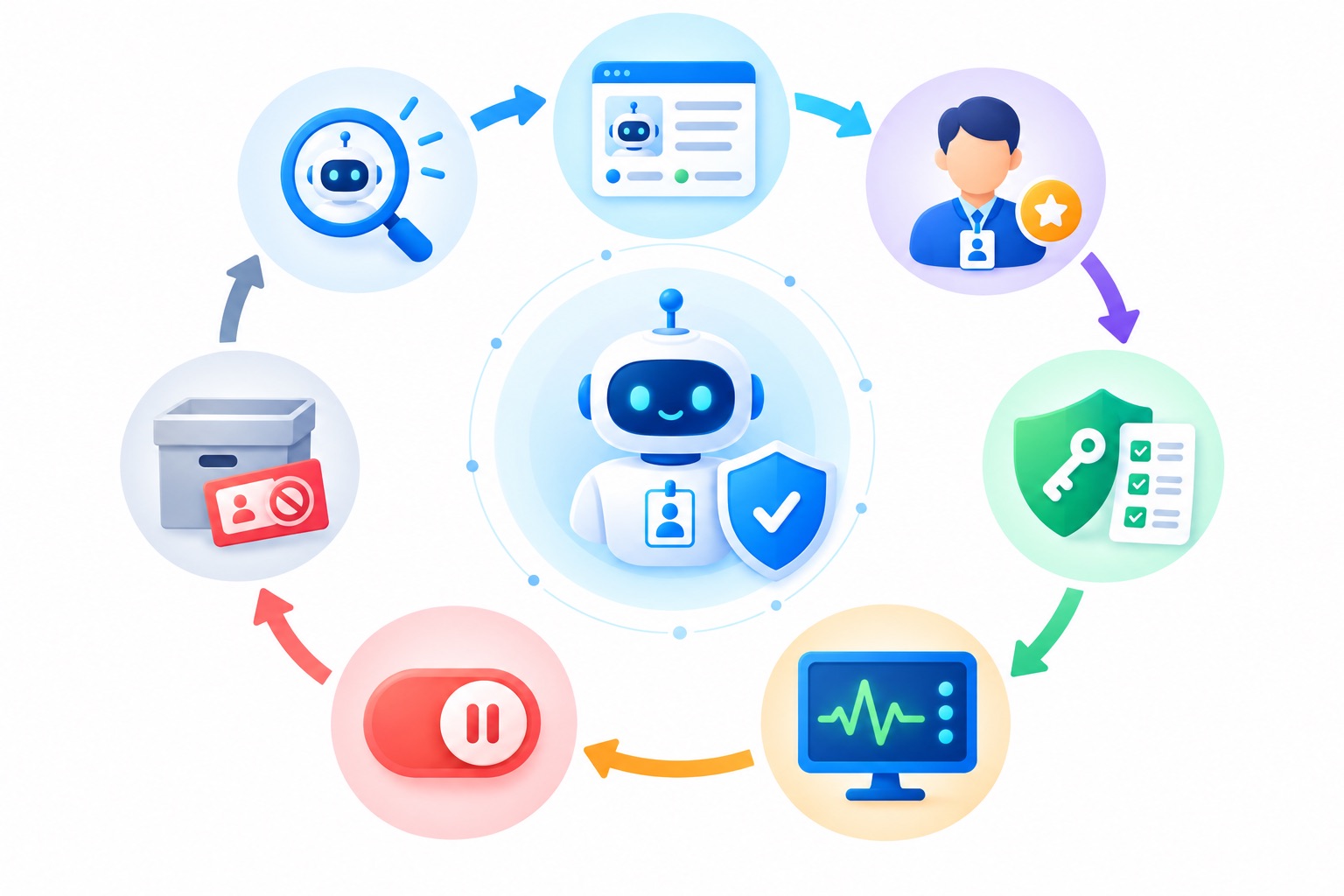
1. Discovered
A scanner, platform export, procurement review, repository search, network observation, or employee disclosure reveals a possible agent. Create a provisional record immediately. Do not wait until every field is known. Record the discovery source, observed endpoint or identity, likely owner, and whether the system is active. High-impact unknowns should trigger containment or restricted access while ownership is resolved.
2. Proposed or sandboxed
The team defines purpose, users, data, tools, owner, identity pattern, and success criteria. Sandbox agents should use synthetic or explicitly approved data and isolated credentials. “Not production” should be a technical property, not a label. A sandbox identity must not quietly retain production roles because setup was convenient.
3. Ready for review
The registry links architecture, threat model, privacy review when relevant, evaluation evidence, runbook, policy rules, approval design, and rollback plan. Review depth should follow risk. A low-risk research assistant may pass with a compact checklist. A payment, employment, health, security, or infrastructure agent needs domain review and stronger evidence.
4. Canary or limited production
The agent operates for a bounded group, tenant, workflow, resource set, or action type. The registry records canary scope, start date, owner, metrics, stop thresholds, and expansion criteria. Pair this with the site’s AI agent canary rollout checklist. Promotion should require evidence from real workflow shapes, not merely elapsed time.
5. Production
The agent has approved authority, monitored behavior, incident ownership, current evidence, and scheduled reviews. Production does not mean static. Prompts, models, tools, permissions, policies, and data sources change. Significant changes should create a review event, while minor changes follow an approved release path with regression evidence.
6. Suspended
Suspension is a reversible containment state. It should disable execution or sensitive authority while preserving evidence for investigation. The registry must distinguish a disabled user interface from an actually contained agent. Confirm that schedules, queues, background jobs, API tokens, delegated grants, sub-agents, and webhooks can no longer produce consequential actions.
7. Retiring and retired
Retirement is a sequence, not a status dropdown. Stop new work, drain or cancel in-flight tasks, notify dependent teams, revoke credentials and grants, remove triggers and discovery entries, archive required evidence, dispose of data according to policy, transfer any durable business records, and verify that the agent cannot act. The retired record remains for audit and learning but should not retain live authority.
Connect the Registry to Real Controls
A registry that depends on people remembering to update it will drift. The solution is not necessarily an expensive agent-governance platform. The solution is to connect important fields to systems that already observe reality and to make registry state part of release and access decisions.
Gate deployment on a valid record
A CI/CD or platform policy can require a stable agent ID, accountable owner, lifecycle state, risk tier, runtime identity, approved tool scope, evaluation result, and stop path before production deployment. The gate should validate identifiers and freshness, not only check that fields are non-empty. An evaluation result from an obsolete agent version should not satisfy the release.
Reconcile identity and permissions
Compare approved identity and action scopes with the identity provider, cloud IAM, secrets manager, gateway, and downstream applications. Flag broad roles, unmanaged keys, cross-tenant access, expired sponsors, and permissions that are not exercised. Microsoft’s agent identity guidance warns against collapsing users, applications, workloads, agents, tools, and resources into one shared secret or privileged service account. Google Cloud similarly distinguishes general workload identities from lifecycle-bound agent identities. The registry should preserve those distinctions.
Reconcile declared tools with observed calls
Use traces or gateway logs to compare the tool catalog in the record with actual behavior. An undeclared tool call is a review event. A declared tool never used for months may be removable. A write operation observed under a read-only purpose is a policy failure even if the credential technically allowed it. Singularity Journey’s MCP tool risk tiers can help classify actions by consequence.
Carry the agent ID through evidence
The stable ID should appear in deployment metadata, workload identity attributes where supported, trace context, policy decisions, evaluation runs, change records, cost records, and incident tickets. This join is more valuable than another descriptive dashboard. It lets reviewers move from a registry record to what the agent actually did and from a suspicious action back to the registered owner and approved scope.
Make review event-driven
Calendar reviews are useful but insufficient. Trigger review when the owner leaves, the risk tier changes, a new data class or tool is added, permissions expand, the model or instruction behavior changes materially, the agent crosses a tenant or region boundary, a policy exception is granted, evaluation performance drops, or an incident occurs. Event-driven review keeps the registry aligned with the moments when authority changes.
Test the stop path
A recorded kill switch is not enough. Test whether suspension stops new actions, blocks queued work, invalidates short-lived and cached credentials, halts delegated chains, and alerts the right owner. Record the test result and recovery procedure. For broader runtime limits, see the guide to agentic AI stop conditions.
How to Build the First Registry Without Overengineering
Start with the smallest structure that can support decisions. A spreadsheet can be appropriate for the first ten agents if it has controlled fields, named owners, version history, review dates, and links to authoritative evidence. A database or governance platform becomes useful when automatic discovery, multiple platforms, approval workflows, policy integration, or audit volume make manual reconciliation unreliable.

Week 1: establish scope and identifiers
Define the operational agent boundary, lifecycle states, risk tiers, required fields, and record owner. Choose a stable identifier format that does not encode mutable details such as team name or model vendor. Identify authoritative systems for identity, deployment, tools, evaluations, and telemetry. Publish one rule: any agent touching real organizational data or actions must have at least a provisional record.
Weeks 2–3: discover and triage
Collect platform exports, cloud identities, repository configuration, API gateway clients, scheduled jobs, MCP endpoints, model API usage, procurement records, and team disclosures. Merge likely duplicates carefully. Prioritize unknown systems with write access, sensitive data, public endpoints, standing credentials, or no identifiable owner. Do not stall because discovery is incomplete; record uncertainty explicitly and assign resolution dates.
Weeks 4–5: enrich the high-risk records
For the highest-impact agents, validate owner, purpose, identity, permissions, data, tools, approval gates, evidence, stop path, and lifecycle status. Compare the record against actual IAM and observed calls. Create a short corrective backlog for overbroad permissions, missing telemetry, stale evaluations, and untested suspension paths.
Weeks 6–8: connect release and access reviews
Add a registry check to the deployment path. Require changes that expand data or action authority to update the record and receive the appropriate review. Feed identity access reviews from registry ownership and purpose. A reviewer should see not just a role name but the job the agent performs, the actions that role enables, and the evidence that the authority remains necessary.
Weeks 9–12: automate reconciliation and retirement
Pull facts from platforms on a schedule or through events: active endpoints, identity status, roles, last-seen activity, deployed version, evaluation freshness, open incidents, and cost. Flag differences rather than silently overwriting approved values. Run a retirement drill on one low-risk agent to prove that disabling the interface, revoking access, clearing schedules, preserving evidence, and closing the record work end to end.
A simple machine-readable record
A structured record makes validation easier than free-form cells. The example below is intentionally vendor-neutral. Sensitive identifiers should live in protected systems, while the registry stores approved references and non-secret metadata.
{
  "agent_id": "agt_customer_case_triage_01",
  "purpose": "Classify support cases and draft routing recommendations",
  "sponsor": "support-operations",
  "technical_owner": "customer-platform",
  "state": "canary",
  "risk_tier": "moderate",
  "identity_ref": "iam://workloads/agent-case-triage",
  "authority": {
    "read": ["cases:assigned-tenant"],
    "propose": ["case:route", "case:priority"],
    "write": []
  },
  "evaluation_ref": "eval://case-triage/v12",
  "trace_ref": "obs://agent/agt_customer_case_triage_01",
  "suspend_ref": "runbook://agents/case-triage/contain",
  "next_review": "policy-defined-date"
}
The important property is not the JSON syntax. It is that every value can be tested. The identity reference resolves. The approved authority can be compared with policy and observed calls. The evaluation corresponds to the deployed version. The trace can be queried by the stable ID. The suspension runbook identifies an executable control.
Interactive AI Agent Registry Readiness Checker
Use this lightweight check on one production agent. It is not a compliance assessment; it reveals whether the record can support common operating decisions.
Common AI Agent Registry Mistakes
Recording the platform but not the authority
“Built in platform X” does not tell a reviewer what the agent can change. Record tools, operations, resources, tenants, and policy boundaries. Authority is the central risk surface.
Using the creator as the permanent owner
The person who created an experiment may change roles or leave. Assign a business sponsor and a technical owning team, then trigger review when those relationships change. Ownership must survive employee movement.
Treating a service account as the agent record
One service identity may host multiple agents, and one agent may use multiple downstream identities. Model the relationship explicitly. A credential proves an actor authenticated; it does not explain the agent’s purpose, delegated user, requested action, or governing policy.
Copying declared configuration without observing behavior
Documentation says what should happen. Traces, policy logs, and downstream records show what did happen. Reconcile both. The gap between approved and observed behavior is often the most valuable registry signal.
Registering agents but ignoring MCP servers and reusable tools
A shared tool surface can expand many agents at once. Link agents to the MCP servers, gateways, tools, skills, and endpoints they can discover or invoke. When a tool changes, the registry should identify affected agents and required regression tests.
Using one review cadence for every risk
Low-risk read-only agents and consequential write agents should not receive identical review. Set cadence and evidence depth by impact, reversibility, data sensitivity, autonomy, and exposure. Also review on change events rather than waiting for the calendar.
Calling “disabled” retired
A disabled interface may leave scheduled tasks, queues, credentials, tokens, webhooks, data stores, and discovery records active. Retirement requires verified revocation and dependency cleanup. Preserve the historical record, but prove that live authority is gone.
Buying a registry before defining decisions
Tools can automate discovery and workflow, but they cannot decide which facts your organization needs to approve, monitor, contain, or retire an agent. Define the operating questions first. Then evaluate platforms by integration, exportability, reconciliation, enforcement hooks, and the quality of their lifecycle model.
What the Evidence Says—and What Is Still Emerging
The evidence base is strong enough to justify action but still early enough to require humility. NIST’s NCCoE concept paper is a draft exploration, not a finished implementation standard. Its value is the problem map: identification, authentication, authorization, delegation, logging, data-flow provenance, prompt injection mitigation, and lifecycle questions. It points to established building blocks including OAuth, OpenID Connect, SPIFFE/SPIRE, SCIM, attribute-based access control, and zero-trust guidance.
Google Cloud’s Agent Registry documentation shows how the registry concept is becoming a product capability spanning agents, MCP servers, endpoints, skills, revisions, and publishers. Microsoft Entra’s security guidance for AI emphasizes agent identities, discovery, sponsors, ownership, lifecycle, access review, and the ability to disable categories of agents. Amazon Bedrock AgentCore Identity focuses on workload identity, credential management, inbound authentication, and access to AWS and third-party services.
These platforms should not be treated as interchangeable standards or endorsements. They are evidence of convergence around operational responsibilities. The durable design principle is to preserve a portable registry schema and stable agent IDs while linking to platform-specific identities, endpoints, policies, and evidence. That reduces the risk that a governance record disappears when a team moves clouds, changes orchestration frameworks, or replaces a registry product.
Community discussions add a different kind of signal. Practitioners repeatedly ask how to inventory agents across teams, how to know which identity an action used, how to keep a registry current, how to handle sub-agent delegation, and whether a spreadsheet is enough. Those discussions are not proof of a technical claim, but they expose the hidden intent behind the search: people do not merely want a catalog. They want a reliable answer to “who can do what, why is it allowed, and how do we stop it?”
Final Action Plan: Make the Registry Earn Trust
Begin with one consequential agent, not a platform procurement. Give it a stable ID. Name the sponsor and technical owner. State its job in one sentence. Record the runtime identity, initiating principal, data boundary, tools, operations, approvals, evidence, stop path, and review triggers. Then test whether each field helps someone make or execute a decision.
Next, reconcile the record against reality. Does the identity provider show the same principal and scopes? Do traces show only approved tools and destinations? Does the evaluation result match the deployed version? Can the operations team suspend the agent and prove that queued or delegated work stopped? Can the owner explain why the agent still needs each permission?
Finally, repeat the exercise across the estate, prioritizing write access, sensitive data, external effects, standing credentials, and missing owners. Automate discovery and reconciliation where manual work becomes unreliable. Keep the schema portable. A registry succeeds when it shortens review and response, not when it maximizes the number of columns.
FAQ: AI Agent Registry Checklist
What is an AI agent registry?
An AI agent registry is a governed system of record for agents and their operational relationships. It identifies each agent’s purpose, accountable owners, lifecycle state, runtime identity, initiating principal, tool and data authority, evaluation evidence, observability links, review requirements, stop path, and retirement status. Unlike a simple inventory, it supports authorization, monitoring, change, containment, and decommissioning decisions.
How is an AI agent registry different from a CMDB?
A CMDB usually tracks infrastructure and service relationships. An agent registry focuses on an agent as an accountable actor: what goal it pursues, whose authority it uses, which actions it may take, what evidence supports operation, and how its lifecycle is governed. The two should link rather than duplicate each other. Runtime services remain in the CMDB; the agent record joins those services to identity, authority, evidence, and ownership.
Can we start an agent registry in a spreadsheet?
Yes. A controlled spreadsheet can work for a small estate if fields are structured, ownership is clear, changes are recorded, review dates are enforced, and entries link to authoritative systems. Move to a database or platform when discovery, scale, integrations, policy gates, or reconciliation make manual maintenance unreliable. The important step is defining actionable fields and lifecycle decisions before choosing software.
Should every chatbot be registered?
Use a consequence-based boundary. Register systems that use models or agentic components to select, recommend, sequence, or execute actions affecting shared data, users, money, infrastructure, external communication, or business decisions. A simple public-information chatbot may need only a lightweight record, while a tool-using agent with credentials and write access needs a full record and stronger controls.
Who should own an AI agent record?
Separate business and technical accountability. A business sponsor owns the decision to operate, renew, suspend, or retire the agent. A technical owner runs the code, configuration, deployment, monitoring, and incident response. Security, risk, privacy, and domain reviewers may approve parts of the record, but they should not become substitute owners for the business outcome.
What should trigger an agent registry review?
Use both scheduled and event-driven review. Trigger review when ownership changes, permissions expand, new tools or data classes are added, a model or instruction changes materially, the agent crosses a tenant or region boundary, evaluation performance declines, an exception is granted, an incident occurs, or the agent becomes inactive. These events matter because they change authority, behavior, or accountability.
How do you verify that an AI agent is truly retired?
Prove that the agent cannot act. Disable execution, cancel schedules and queued work, revoke identities and delegated grants, remove secrets and webhooks, unregister discovery endpoints, close integrations, handle retained data according to policy, and check for downstream dependencies. Preserve required evidence and the historical record, then record who verified closure and when.
Does an agent registry replace runtime policy enforcement?
No. The registry records approved purpose, authority, and evidence; runtime enforcement decides whether an action is allowed at the moment of execution. Connect the two so policy can use stable agent identity, lifecycle state, risk tier, delegation context, resource, action, and current conditions. A registry without enforcement can reveal risk but cannot stop an action.
