
Agentic AI Adoption: How Companies Move From Pilots to Production
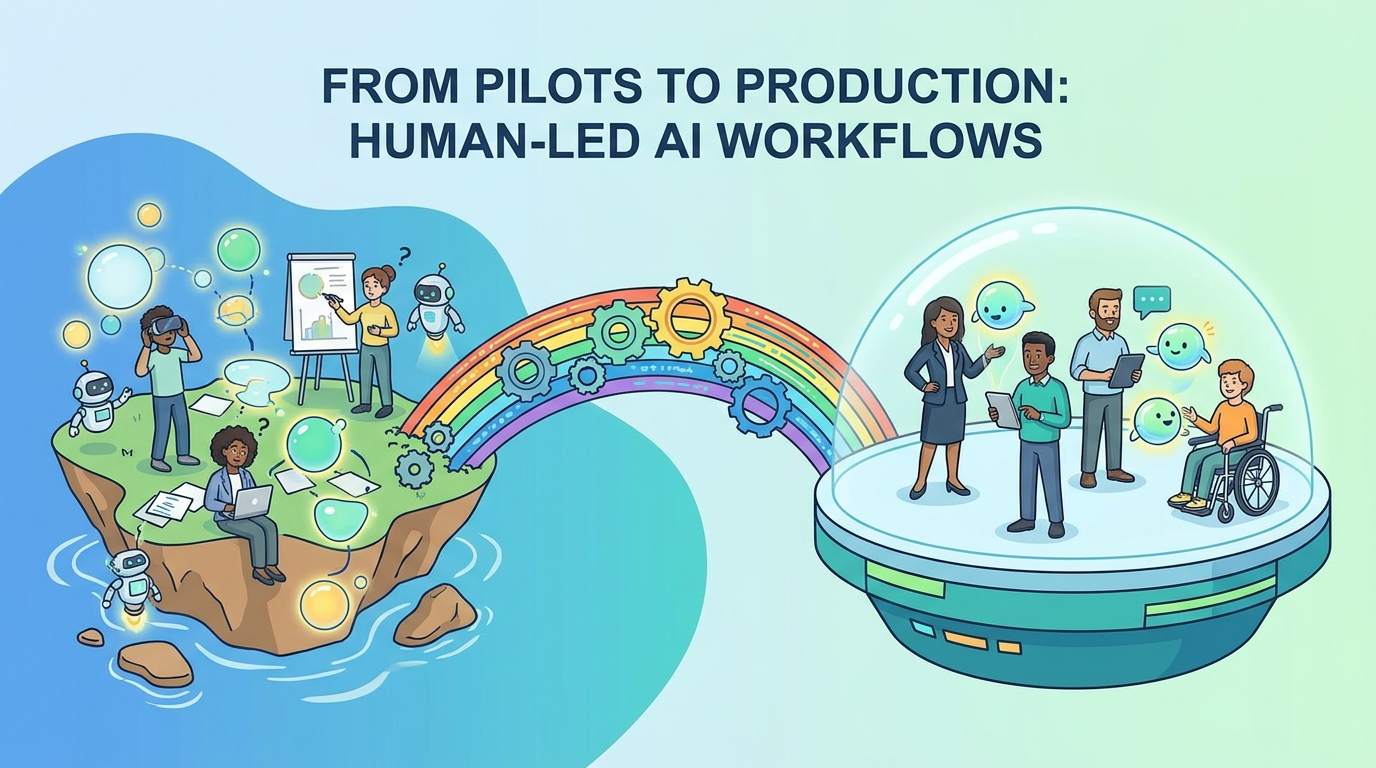
Agentic AI adoption is no longer a question of whether a company can run a clever demo. The real test is whether teams can turn AI agents into reliable, measured, human-led workflows without creating new risk, tool sprawl, or expensive automation theater.
Agentic AI Adoption: The Quick Answer
Agentic AI adoption means moving from isolated experiments with AI agents to repeatable business workflows where software can plan, use tools, follow policies, ask for human approval, produce auditable work, and improve through measurement. It is not the same as giving every team a chatbot. It is an operating model for deciding which tasks deserve autonomy, which tasks need review, and which tasks should stay human.
The companies that make progress usually do three things well. First, they choose bounded workflows instead of vague ambitions. Second, they treat data access, identity, permissions, evaluation, and monitoring as product requirements, not as afterthoughts. Third, they keep humans visibly in charge of goals, approvals, escalation, and accountability. The winners are not the teams that automate the most tasks fastest. They are the teams that learn where AI agents are reliable enough to save time and where human judgment remains the safety layer.
This guide explains why many pilots stall, what a practical adoption model looks like, how to score use cases, what governance must exist before scale, and which metrics show whether agentic AI is creating value. It uses live Singularity Journey analytics, sparse but real Search Console data, and credible external sources including Microsoft Work Trend Index research, the World Economic Forum Future of Jobs report, NIST AI RMF, Stanford HAI AI Index, and OpenAI safety materials. Where a source was blocked, promotional, unverifiable, or unrelated, it was excluded rather than forced into the article.
Why Agentic AI Pilots Stall Before Production
Most organizations can create an impressive AI agent demo. A sales operations team can build an agent that drafts follow-up emails. A support team can build an agent that summarizes tickets. A finance team can build an agent that checks invoices against policy. A developer team can build an agent that triages bugs. The hard part starts after the demo: permissions, reliability, cost, evaluation, user trust, integration depth, and accountability.
Pilots stall when the use case is framed as “try agents” instead of “improve this workflow by this measurable amount.” Without a specific workflow, the team cannot decide which tools the agent needs, which data it may access, what output quality is acceptable, who approves risky actions, how errors are detected, and when the workflow should fall back to a human. Vague pilots produce vague results, and vague results rarely survive procurement, security review, or leadership scrutiny.
Another common failure is tool-first adoption. A platform demo makes agentic AI look like a feature purchase: buy an agent builder, connect applications, and watch the productivity arrive. Real adoption is slower because enterprise workflows contain exceptions. The agent might need to understand policy, customer context, legal constraints, data freshness, identity boundaries, and the difference between “draft this” and “send this.” Without those details, automation creates more review work than it removes.
Data readiness is also underestimated. AI agents are only as useful as the information and tools they can safely use. If documents are stale, permissions are messy, customer records conflict, or business rules live in someone’s memory, the agent will either make weak recommendations or require constant human correction. That is not a model failure alone. It is a workflow design failure.
Finally, pilots stall because evaluation is missing. A team may say an agent “works” because it handled a few examples, but production needs richer proof. Can it handle edge cases? Does it cite sources? Does it refuse unsafe actions? Does it ask for approval at the right time? Does it recover from tool errors? Does it improve cycle time without reducing quality? If those questions are not answered early, the pilot turns into a confidence problem.
The Production Adoption Model: From Assistant to Accountable Workflow
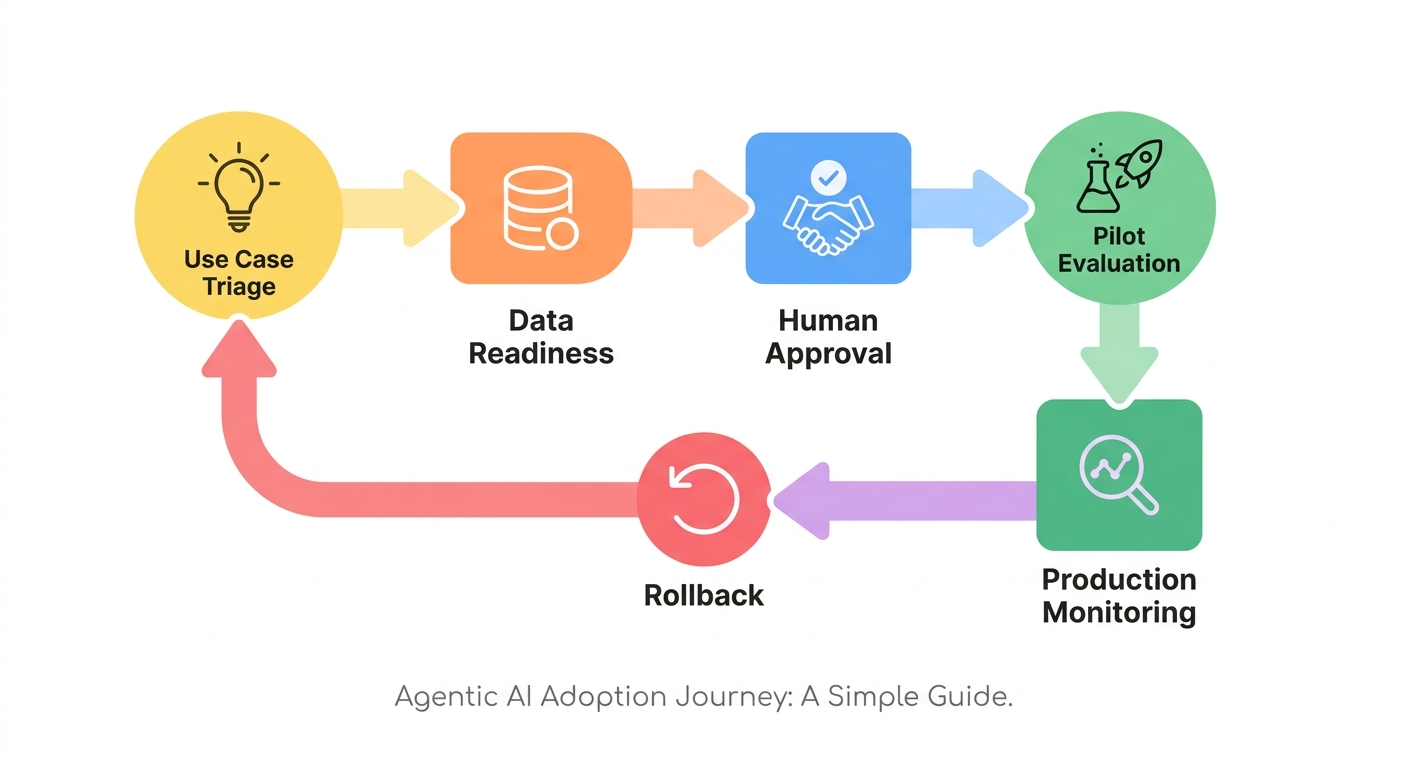
A practical agentic AI adoption model has five stages: assist, recommend, draft, execute with approval, and execute within guardrails. These stages matter because they prevent teams from jumping directly from a chatbot to unsupervised automation. Each stage increases autonomy only after the previous stage proves value and reliability.
| Stage | What the agent does | Human role | Good first examples |
|---|---|---|---|
| Assist | Summarizes, explains, searches, or organizes information. | Reviews and decides everything. | Meeting summaries, ticket clustering, document Q&A. |
| Recommend | Suggests next steps, priorities, or decisions. | Chooses whether to act. | Lead prioritization, incident triage, renewal risk notes. |
| Draft | Creates content, plans, code, replies, or reports. | Edits and approves before use. | Support replies, sales briefs, test cases, policy summaries. |
| Execute with approval | Uses tools but pauses before consequential actions. | Approves sends, updates, purchases, deletes, or escalations. | CRM updates, refund recommendations, deployment plans. |
| Execute within guardrails | Completes low-risk actions under defined limits. | Monitors exceptions and audits performance. | Status tagging, low-risk routing, routine data enrichment. |
This model makes autonomy a design decision. A support agent may draft responses for months before it is allowed to send low-risk replies. A coding agent may propose changes and run tests, but require human approval before merging. A finance agent may check policy and prepare exceptions, but never approve payment. The point is not to slow everything down. The point is to match autonomy to consequence.
Microsoft’s Work Trend Index describes a future where organizations blend humans and AI agents into new operating patterns, with human judgment remaining central. That framing is useful because it avoids the false choice between full automation and no automation. Agentic AI adoption is best understood as workflow redesign. Humans set goals, define boundaries, approve risk, and interpret tradeoffs. Agents handle repeatable analysis, drafting, retrieval, orchestration, and monitoring where the task is suitable.
The World Economic Forum’s Future of Jobs research also reinforces that technology adoption changes tasks, skills, and organizational design, not only tool menus. Even when AI creates productivity gains, companies still need reskilling, process redesign, and manager capability. A team cannot “install” agentic AI adoption. It has to practice it.
How to Choose Agentic AI Use Cases That Can Survive Production
The best early use cases share a pattern: high repetition, clear input data, visible quality checks, moderate business value, low irreversible risk, and a human owner who already understands the workflow. The worst early use cases are broad, politically sensitive, data-poor, high-risk, or hard to evaluate.
Start with use cases where the cost of a wrong draft is low and the benefit of a better draft is obvious. Customer support summarization, sales account research, internal knowledge retrieval, bug triage, test generation, policy lookup, procurement request preparation, and marketing operations briefs can all be reasonable candidates. They are not automatically safe, but they have manageable shapes.
A helpful question is: “Could a careful intern assist with this if they had the right instructions, access, and review?” If the answer is yes, an AI agent may be a candidate. If the task requires authority, professional license, high-stakes accountability, or deep tacit judgment, use the agent as an assistant or recommendation layer first.
Agentic AI Production Readiness Scorecard
Use this scorecard before scaling a pilot. It is intentionally practical. If a team cannot answer these questions, it is not ready to call the agent production-grade.
| Readiness area | Question to answer | Production evidence |
|---|---|---|
| Workflow scope | What exact task does the agent own? | Written workflow map, exclusions, owner, success criteria. |
| Data quality | Can the agent access trusted, current information? | Approved data sources, freshness rules, permission boundaries. |
| Tool permissions | Which actions can the agent take? | Least-privilege tool list, approval gates, audit logs. |
| Evaluation | How do we know outputs are good? | Test set, human review rubric, pass/fail thresholds. |
| Risk controls | What happens when the agent is uncertain or wrong? | Escalation path, refusal behavior, rollback process. |
| Cost visibility | Can usage and value be measured together? | Usage reports, cost per completed workflow, budget alerts. |
| User trust | Do users know what the agent did and why? | Source citations, activity history, plain-language explanations. |
The scorecard also helps leaders avoid a common trap: judging agentic AI only by model quality. Model quality matters, but production failures often come from weak process design. A strong model with poor permissions can create risk. A strong model with messy data can create confident nonsense. A strong model with no evaluation can create stories instead of evidence. Production adoption is a system problem.
Governance for Agentic AI: Keep Humans in Charge Without Killing Speed
Governance should not mean endless committees for every prompt. It should mean clear rules that let safe work move quickly while risky work gets review. NIST’s AI Risk Management Framework is useful here because it frames risk management through governing, mapping, measuring, and managing. That vocabulary maps well to agentic AI: govern the operating rules, map the workflow and stakeholders, measure behavior and impact, and manage incidents or changes over time.
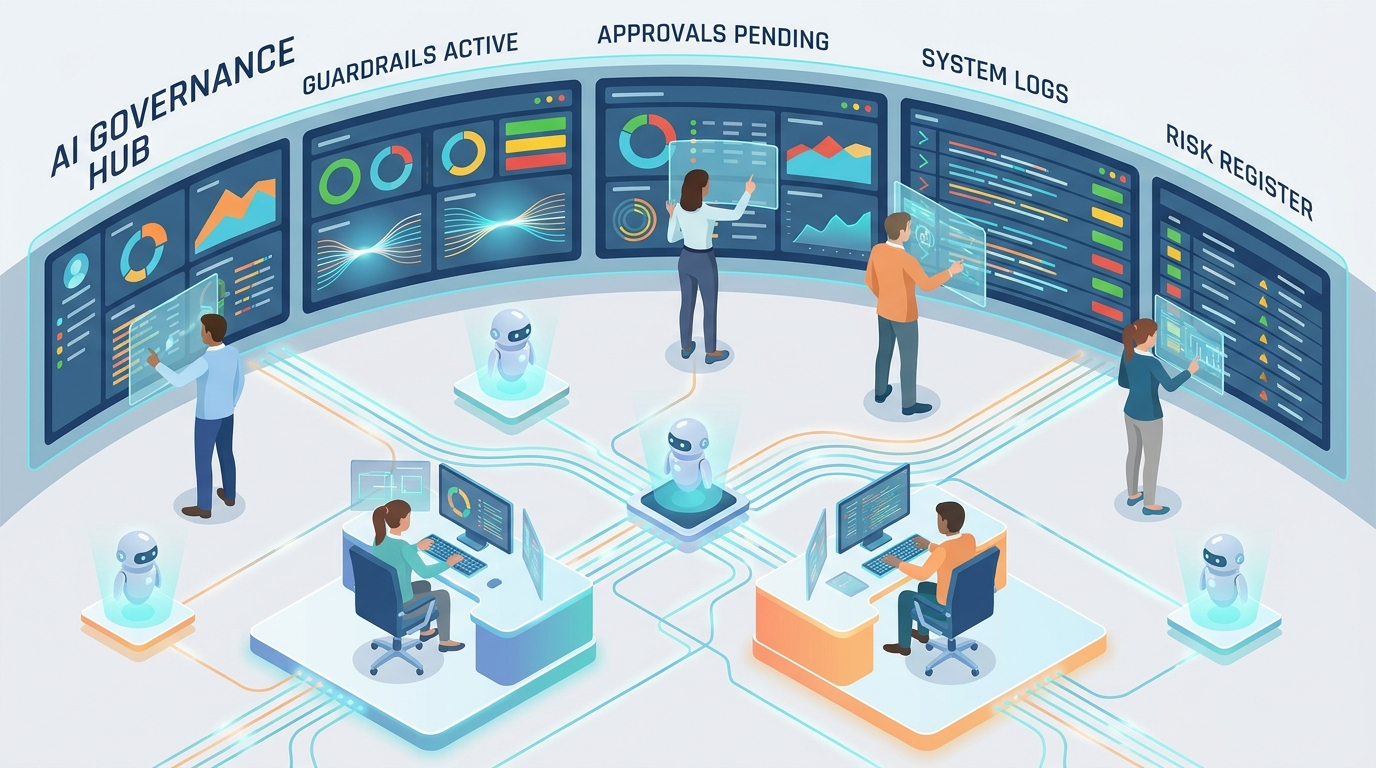
For AI agents, governance needs to be practical at the workflow layer. A policy document is not enough. Teams need controls inside the agent system: permission scopes, tool allowlists, logging, retrieval boundaries, approval steps, testing datasets, evaluation rubrics, and escalation paths. A human should be able to answer: what did the agent see, what did it decide, what did it do, and who approved it?
Governance that helps adoption
- Pre-approved low-risk workflows with clear limits.
- Human approval only at meaningful decision points.
- Audit logs that make review faster, not slower.
- Shared templates for use-case intake and evaluation.
- Simple model of autonomy levels across teams.
Governance that blocks adoption
- One generic approval process for every AI experiment.
- No distinction between drafting and consequential action.
- Security review after the pilot is already built.
- No ownership for data freshness or permission cleanup.
- Policy language that teams cannot translate into product controls.
OpenAI’s public safety materials emphasize teaching, testing, learning from feedback, and continuing to improve safeguards. That lifecycle is relevant beyond any one provider. Agentic AI systems should be treated as changing systems. A workflow that was safe at pilot scale may behave differently when more users, more tools, more documents, or higher-value decisions are involved. Governance must include monitoring and change management, not only launch approval.
The Metrics That Prove Agentic AI Adoption Is Working
Agentic AI adoption needs metrics that combine productivity, quality, risk, user experience, and cost. If a team measures only output volume, it may reward low-quality automation. If it measures only risk, it may never ship. If it measures only user excitement, it may miss hidden review burden. A balanced scorecard is better.
| Metric category | What to measure | Why it matters |
|---|---|---|
| Productivity | Cycle time, backlog reduction, time saved per completed workflow. | Shows whether the agent removes real friction. |
| Quality | Human edit rate, error rate, acceptance rate, source accuracy. | Prevents “faster but worse” automation. |
| Risk | Escalations, refusals, policy violations, rollback incidents. | Shows whether safeguards are working. |
| Adoption | Repeat users, opt-out rate, trust score, training completion. | Reveals whether people actually want the workflow. |
| Economics | Cost per task, review time saved, tool spend, infrastructure usage. | Connects agent usage to business value. |
| Learning | New edge cases found, prompt or policy updates, test-set expansion. | Turns pilot lessons into a stronger system. |
One useful metric is “review burden.” Many AI pilots look successful because the agent generates more output, but humans quietly spend more time checking, correcting, and explaining that output. Review burden measures the time and difficulty of supervising the agent. If the burden is high, the workflow may still be useful, but it should stay in draft mode until the system improves.
Another useful metric is “safe automation rate.” This is the percentage of workflow steps the agent can complete without human correction while staying inside policy boundaries. It is better than a vague autonomy score because it ties autonomy to a real workflow. A support-routing agent might reach a high safe automation rate quickly. A financial approval agent may never need to reach full autonomy to be valuable.
For Singularity Journey’s own content strategy, this topic fits because existing analytics show interest in AI agents, human oversight, agent deployment, hallucination evaluation, and enterprise readiness. Search Console data is still sparse, but it shows several AI-agent pages ranking near positions four to six with limited impressions. That suggests the site has topical seeds around agent systems even if broader organic discovery is early. This article strengthens the Trends & Insights layer by connecting those technical and safety pieces to enterprise adoption.
A Practical Roadmap for Moving From Pilot to Production
Use this roadmap when a leader asks, “What do we do next?” It is intentionally not tied to a calendar year or a hype cycle. Teams move at different speeds depending on data maturity, regulation, integration complexity, and leadership appetite. The sequence matters more than the date.
Phase 1: Pick one workflow with a measurable pain
Start with a workflow where people already complain about manual repetition, slow handoffs, duplicate research, poor triage, or inconsistent drafting. Write the baseline before you introduce the agent. How long does the task take? How many errors occur? What does a good output look like? Who reviews it?
Phase 2: Design the agent as a controlled participant
Define the agent’s role in one sentence. Then define what it cannot do. Give it trusted sources, limited tools, and clear rules for uncertainty. If the workflow is customer-facing or consequential, require human approval before any external action. The agent should be a participant in the workflow, not an invisible shortcut.
Phase 3: Build evaluation before expansion
Create test cases from real examples, including edge cases and failures. Grade outputs with a human rubric. Track citations, refusal behavior, tool errors, and correction patterns. If the pilot cannot be evaluated, it cannot be improved. If it cannot be improved, it should not scale.
Phase 4: Run a supervised pilot with clear stop rules
Give the pilot a narrow audience and a defined review period. Stop rules are as important as success metrics. Stop if the agent accesses the wrong data, repeatedly misses policy boundaries, creates excessive review burden, or fails high-priority edge cases. A stopped pilot is not a failure if it reveals process debt early.
Phase 5: Add monitoring, ownership, and change control
Before production, assign an owner for the workflow, the data sources, the evaluation set, and incident response. Decide how model changes, prompt changes, tool changes, and policy changes are reviewed. Agentic AI adoption is not a one-time launch. It is an operating capability.
Phase 6: Scale patterns, not chaos
When the first workflow works, do not simply copy the agent everywhere. Copy the intake template, scoring model, approval pattern, evaluation process, and logging approach. The reusable asset is the operating model. The agent itself should still be customized for each workflow.
Examples of Good Agentic AI Adoption Patterns
Consider a support team using an agent to summarize complex tickets. In assistant mode, the agent reads the ticket history, extracts the customer problem, identifies relevant policy, and drafts a recommended reply. The human support specialist checks tone, facts, and policy before sending. Over time, the team measures edit rate, escalation rate, and customer satisfaction. If the agent performs well on low-risk ticket types, the team may allow automatic tagging or routing while keeping reply sending under human approval.
Now consider an engineering team using an AI agent for bug triage. The agent reads the issue, searches logs, links related incidents, proposes likely components, and drafts a reproduction checklist. It can run tests in a safe environment, but it cannot merge code or change production settings. The team measures time to first useful diagnosis, false routing rate, and developer acceptance. This can create value without pretending the agent is a senior engineer.
A marketing operations team might use an agent to prepare campaign briefs. The agent gathers product notes, previous campaign performance, approved messaging, and audience segments. It drafts a brief and flags missing inputs. The human marketer owns positioning and final judgment. This is a strong pattern because the agent reduces research and formatting time while the human retains brand, legal, and strategic responsibility.
A risky pattern would be an agent that automatically negotiates contract terms, approves refunds above policy, changes security permissions, deletes customer records, or sends legally sensitive messages without review. Those workflows may someday include more automation, but they require stronger controls, testing, and accountability than a first wave of adoption usually has.
The Mindset Shift Leaders Should Make
Agentic AI adoption works best when leaders stop asking, “How many agents can we deploy?” and start asking, “Which decisions, handoffs, and repetitive steps can become more reliable with a supervised agent in the loop?” That question keeps the work grounded. It encourages teams to improve processes before adding autonomy, to document what good judgment looks like, and to invest in measurement instead of relying on demo energy. It also protects employees from chaotic tool rollouts by making the human role explicit: humans define goals, handle exceptions, approve consequential actions, and improve the system as new edge cases appear.
The deeper trend is not autonomous software replacing every workflow overnight. The deeper trend is organizational learning. Companies that treat agents as governed teammates inside narrow workflows will learn faster than companies that treat agents as magic workers. That learning advantage compounds.
Related Singularity Journey Guides
- AI Agent Autonomy Levels — a practical model for matching autonomy to human oversight.
- Human-in-the-Loop AI Agents — approval patterns for safe autonomy.
- Enterprise AI Agent Readiness Checklist — which workflows are safe to automate first.
- AI Agent Observability — how to trace, evaluate, and debug production agents.
- AI Hallucination Evaluation Checklist — testing answers before users trust them.
- AI Safety Levels Explained — how tiered risk thinking supports deployment decisions.
Sources and References
- Microsoft Work Trend Index: The Frontier Firm
- World Economic Forum: Future of Jobs Report
- NIST AI Risk Management Framework
- Stanford HAI AI Index Report
- OpenAI Safety and Responsibility
Source note: links were included only when they were relevant and from identifiable organizations. Blocked, broken, low-quality, promotional, or unverifiable links were not used as citations.
FAQ: Agentic AI Adoption
What is agentic AI adoption?
Agentic AI adoption is the process of turning AI agents from experiments into reliable business workflows with scope, permissions, evaluation, human oversight, monitoring, and measurable value.
Why do agentic AI pilots fail?
They often fail because the workflow is vague, the data is messy, permissions are unclear, evaluation is missing, or the agent creates more human review work than it saves.
What is the safest first agentic AI use case?
The safest first use case is usually a bounded, low-risk workflow where the agent drafts, summarizes, routes, or recommends while a human remains responsible for final action.
How should companies measure AI agent success?
Measure cycle time, quality, human edit rate, source accuracy, escalation rate, policy violations, user adoption, review burden, and cost per completed workflow.
Does agentic AI replace employees?
Agentic AI changes task design before it replaces whole jobs. The most realistic near-term pattern is human-led teams using agents for retrieval, drafting, triage, monitoring, and repeatable orchestration.
What governance does agentic AI need?
It needs least-privilege tool access, approval gates, audit logs, evaluation datasets, data ownership, incident response, and clear rules for when the agent must escalate to a human.
When can an AI agent act without human approval?
Only when the action is low-risk, reversible, well-scoped, measurable, and covered by explicit guardrails. Consequential actions should keep human approval.
What is the difference between generative AI adoption and agentic AI adoption?
Generative AI adoption often focuses on creating content or answers. Agentic AI adoption focuses on systems that can plan steps, use tools, interact with workflows, and take bounded action under supervision.
