
Enterprise AI Agent Readiness Checklist: Which Workflows Are Safe to Automate First
Enterprise AI agents become valuable when they are matched to the right workflow. This practical checklist helps leaders separate safe first pilots from high-risk automation traps, using evidence, governance, observability, approval gates, and measurable business value.
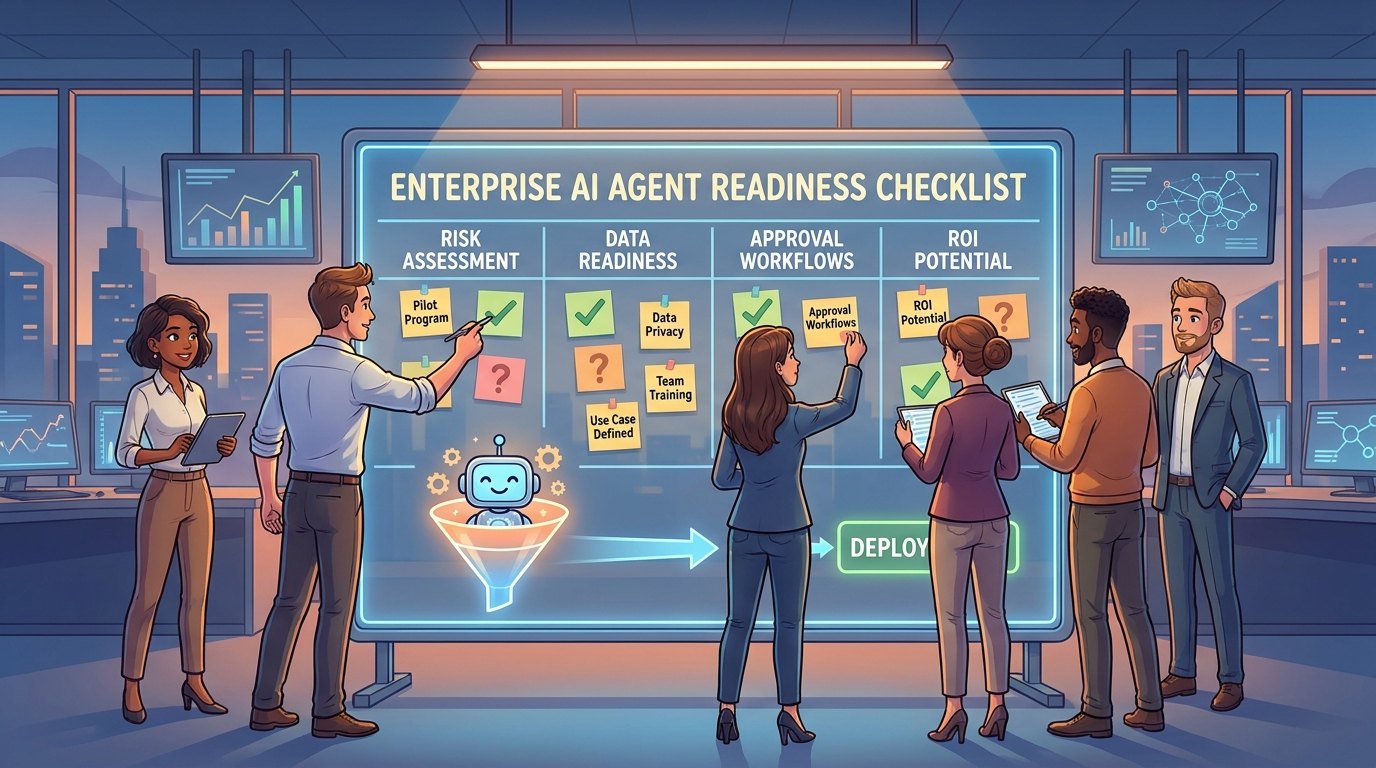
Enterprise AI Agent Readiness: Quick Answer
An enterprise AI agent readiness checklist is a structured way to decide whether a workflow is ready for an AI agent before the organization gives that agent tools, data access, customer context, or permission to act. The point is not to slow down experimentation. The point is to avoid choosing a flashy workflow that looks impressive in a demo but becomes unsafe, unmeasurable, or impossible to govern once real employees and customers depend on it.
The safest first workflows usually share six traits: the task is repetitive but not trivial, the desired outcome is easy to define, the data needed by the agent is accessible and permissioned, mistakes can be detected quickly, a human can approve sensitive steps, and the business value can be measured within a short pilot window. Workflows that touch regulated decisions, irreversible payments, legal commitments, security permissions, medical guidance, or customer trust should not be the first target unless strong governance and expert review already exist.
This cluster article supports the Singularity Journey pillar Enterprise AI Agents: The Workflow Layer Trend Reshaping Business Automation. The pillar explains why agents are becoming a workflow layer. This article narrows the question: once a company believes the trend is real, how should it choose the first workflow to automate safely?
Why Workflow Readiness Matters More Than Agent Hype
Most enterprise AI agent failures start before the model produces a single answer. They start when a team chooses the wrong workflow. A leadership team sees a polished demo, imagines broad automation, and asks an agent to handle a process that is actually full of exceptions, hidden approvals, messy data, undocumented edge cases, and political ownership issues. The model may be capable, but the operating environment is not ready.
That is why readiness is a better first question than capability. IBM describes agentic AI as systems that can reason, use tools, and pursue goals. Salesforce emphasizes that autonomous does not mean uncontrolled because agents still need bounded rules and guardrails. Anthropic’s engineering guidance draws a useful line between workflows, where the system follows predefined code paths, and agents, where the model dynamically directs tool use. Those distinctions matter in enterprise settings because each added unit of autonomy increases the need for evaluation, observability, access control, and human escalation.
The readiness problem is also visible in workplace research. Microsoft’s Work Trend Index frames agents as part of a broader change in how organizations coordinate work. That is useful, but it also implies a practical burden: companies need new work design, not only new software licenses. NIST’s AI Risk Management Framework reinforces the same pattern from a risk perspective: AI systems need governance, measurement, management, and context-specific risk mapping. An enterprise agent is not just an assistant; it is a small operational actor inside a business process.
For Singularity Journey readers, this is where the enterprise agent conversation becomes serious. Broad posts about agents often stop at definitions, examples, and benefits. A real deployment team needs a triage method. Which workflow should go first? Which workflow needs cleanup before automation? Which workflow is too risky for an early agent? This checklist fills that gap.
The Enterprise AI Agent Readiness Checklist
Use this checklist before approving an AI agent pilot. A workflow does not need a perfect score, but weak answers should change the pilot design. If several answers are weak at once, the workflow is probably not ready for agentic automation yet.
The checklist becomes more powerful when each item is connected to an operational owner. Data access belongs to system owners and security. Escalation belongs to process owners. Evaluation belongs to product, operations, and subject-matter experts. Observability belongs to engineering or platform teams. Legal and risk teams should not appear only at the end; they should help define the boundaries before a pilot begins.
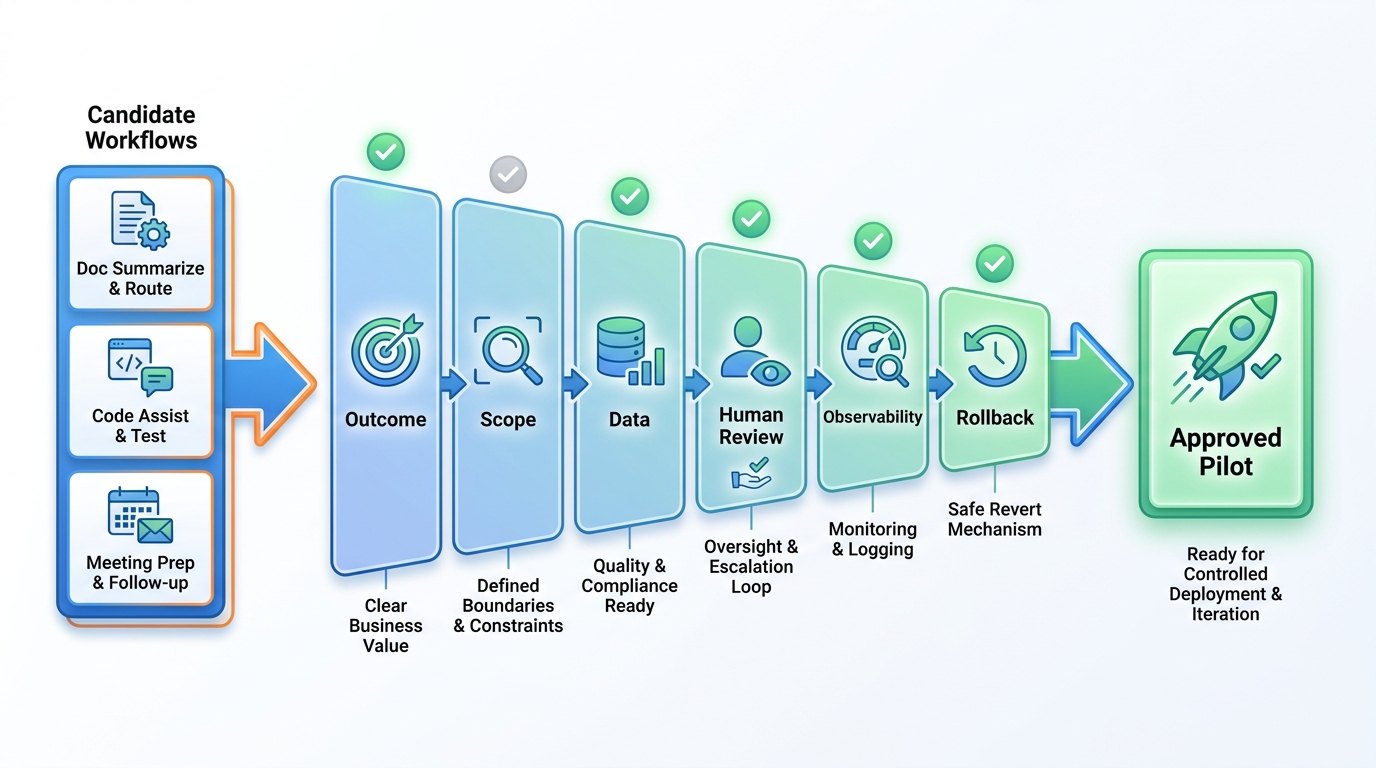
The fastest disqualifiers
Some workflows should be removed from the first-pilot list quickly. If the workflow has no stable owner, no baseline performance data, unclear data rights, high regulatory exposure, no rollback path, or no human who can judge output quality, it is not a good first workflow. This does not mean it can never use AI agents. It means the organization should fix the operating model first.
The strongest first-pilot signals
The best early candidates often live in internal operations: support triage, sales research, compliance evidence collection, knowledge-base maintenance, incident summaries, procurement intake, employee-service routing, and draft preparation for expert review. These workflows can save time, show value quickly, and build the governance muscle needed for more ambitious automation later.
A Simple Workflow Readiness Scorecard
Score each dimension from 1 to 5. A score of 1 means the workflow is not ready. A score of 5 means the workflow is well-defined, controlled, measurable, and suitable for a limited pilot. The total does not replace judgment, but it creates a shared language across business, engineering, security, and legal teams.
| Readiness dimension | What a strong score looks like | What a weak score reveals |
|---|---|---|
| Outcome clarity | The team can define success, failure, and acceptable output quality before launch. | The agent is being asked to “improve productivity” without a measurable result. |
| Process stability | The workflow follows a repeatable path with documented exceptions and escalation rules. | The process changes by person, team, customer, or informal habit. |
| Data readiness | Data is permissioned, current, structured enough to retrieve, and governed by access rules. | The agent would rely on stale exports, unclear ownership, or overbroad permissions. |
| Action risk | Early actions are draft-only, reversible, sandboxed, or human-approved. | The agent could trigger payments, access changes, customer promises, or compliance impact. |
| Evaluation path | Experts can review samples, compare against baselines, and identify recurring failure modes. | No one knows how to judge whether the agent did a good job. |
| Observability | Prompts, tool calls, retrieval sources, outputs, approvals, and errors are traceable. | The team would only see final answers, not how the agent reached them. |
| Business value | Time saved, cycle-time reduction, backlog reduction, quality lift, or cost avoidance can be measured. | The pilot depends on vague excitement rather than an operational metric. |
The widget is intentionally simple. The goal is not mathematical precision. The goal is to make hidden risk visible before a team spends weeks building an agent around a workflow that cannot be trusted in production.
Workflow Examples: Ready, Almost Ready, and Not Ready
Readiness becomes clearer through examples. The same AI agent architecture can be safe in one workflow and reckless in another because the surrounding process changes the risk.
Ready: internal support-ticket triage
An internal IT or employee-service queue is often a strong candidate. The agent can classify tickets, suggest priority, find related knowledge-base pages, draft a response, and route to the right team. The action is visible, reversible, and easy to sample for quality. A human can approve replies before they reach employees. Metrics such as first-response time, routing accuracy, backlog age, and deflection rate are available within a short pilot window.
Almost ready: sales account research
Sales research can be valuable, but it needs data boundaries. An agent that summarizes account notes, public company pages, CRM history, and previous interactions can save time. The risk appears when the agent invents claims, uses outdated context, or recommends outreach based on sensitive data. Make the pilot draft-only, cite sources, separate public and internal evidence, and require sellers to approve messages.
Almost ready: compliance evidence collection
Evidence collection is repetitive and painful, which makes it tempting. It can work well if the agent only gathers artifacts, maps them to controls, and creates a review packet. It becomes risky if the agent asserts compliance, edits policy language, or decides that a control is satisfied without expert approval. Keep the agent as an evidence assistant, not a compliance authority.
Not ready: autonomous customer refunds
Refunds touch money, policy, customer trust, fraud risk, and precedent. A first pilot should not allow an agent to autonomously issue refunds across broad cases. A safer version is a refund recommendation assistant that collects order history, policy snippets, customer context, and similar cases for a human reviewer. The human remains accountable for the final action.
Not ready: privileged access changes
Security permissions are high-impact. An agent should not receive broad authority to grant access because errors can create privacy, compliance, and security failures. A safer pilot might summarize access requests, check policy requirements, and flag missing approvals while a human or existing identity workflow performs the actual permission change.
The Controls Every First AI Agent Workflow Needs
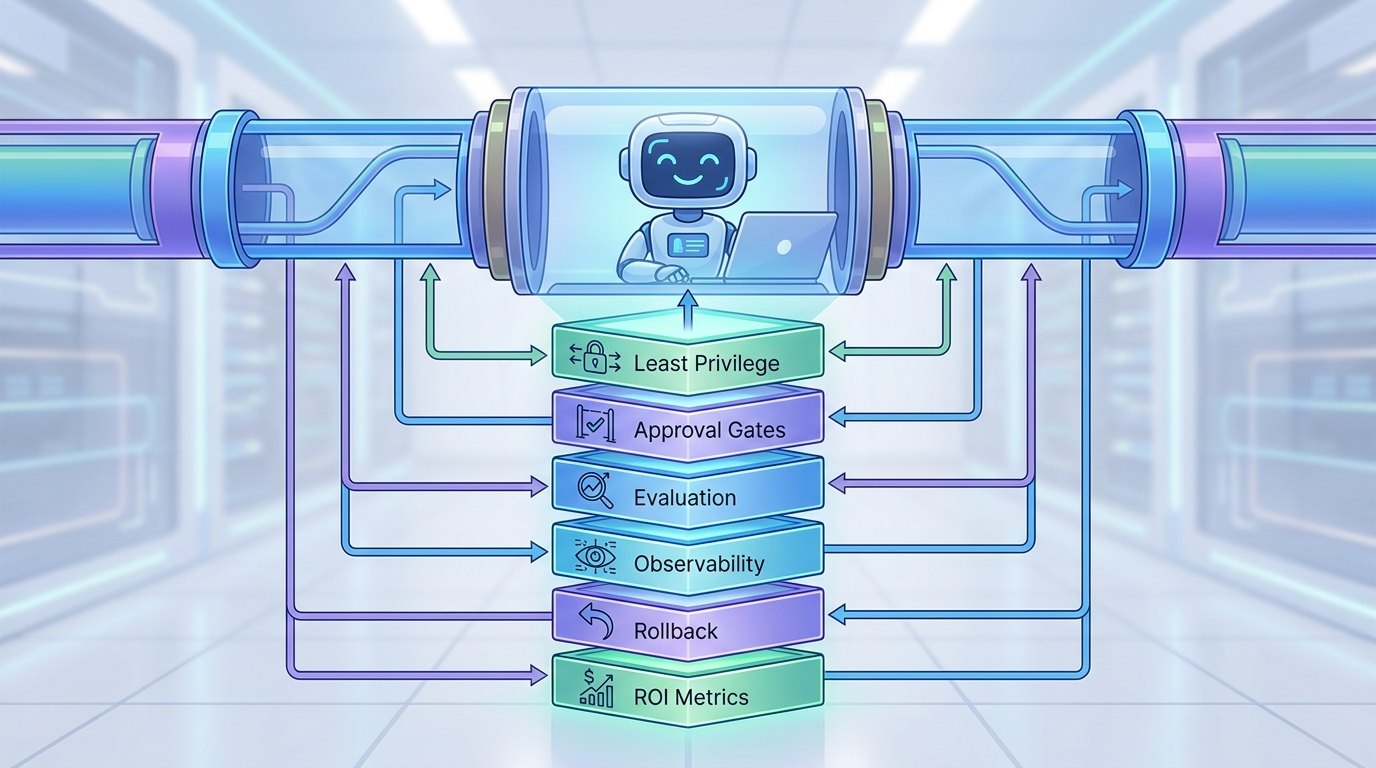
A good readiness checklist does not end with topic selection. The chosen workflow still needs controls that match its risk level. These controls connect directly to other Singularity Journey cluster articles on human approval gates for AI agents, AI agent evaluation metrics, AI agent observability, and prompt injection guardrails.
Controls that make pilots safer
- Draft-only mode for customer-facing, legal, financial, and compliance-sensitive outputs.
- Least-privilege tool access with explicit allowlists for systems and actions.
- Human approval gates for irreversible, external, or high-impact decisions.
- Trace logs that capture tool calls, retrieved sources, approvals, and final outputs.
- Evaluation sets based on real historical cases, not only happy-path demos.
- Rollback and incident-response rules before launch.
Warning signs to fix first
- The agent needs broad admin permissions to be useful.
- The workflow owner cannot explain what good output looks like.
- The only metric is “people like it.”
- Employees plan to copy sensitive data into prompts manually.
- There is no escalation path for ambiguous or adversarial cases.
- The team cannot inspect why the agent made a recommendation.
NIST’s AI Risk Management Framework is helpful here because it pushes teams to govern, map, measure, and manage risk in context. The same agent capability can be low-risk in a draft-preparation workflow and high-risk in a regulated decision workflow. Controls should follow context, not hype.
A Practical Pilot Plan for the First Enterprise AI Agent Workflow
Once a workflow passes the readiness screen, keep the first pilot intentionally narrow. The organization is not only testing the model. It is testing operating rules, ownership, data access, review habits, evaluation, and employee trust.
Week one: map the workflow and baseline
Document the current process, common exceptions, handoffs, systems touched, average cycle time, backlog pressure, error patterns, and review rules. Choose the smallest workflow slice that can show value. If the baseline is unknown, collect it before claiming the agent improved anything.
Week two: design the agent boundary
Decide what the agent can see, what it can draft, what it can recommend, and what it cannot do. Create an escalation list. Define blocked actions. Write example instructions for sensitive cases. If the agent uses retrieval, decide which sources are authoritative and how stale content will be handled.
Week three: evaluate before live use
Run the agent against historical examples and synthetic edge cases. Compare outputs with human decisions. Look for hallucinated policy, missing context, overconfident answers, unsafe tool calls, privacy leakage, and poor escalation behavior. Use those findings to adjust prompts, retrieval, tool permissions, and approval gates.
Week four: launch with a human-in-the-loop pilot
Let a small group use the agent in draft or recommendation mode. Track time saved, acceptance rate, edit distance, escalation rate, user satisfaction, error severity, and reviewer feedback. Do not expand because the demo looks good. Expand only when the evidence shows the workflow is safer, faster, or more reliable with the agent than without it.
After the pilot: decide whether to scale, redesign, or stop
A mature organization is willing to stop a weak agent pilot. Stopping is not failure if the pilot reveals missing data, unclear ownership, or unmanaged risk. That information is valuable. It tells the company what must be fixed before broader automation is possible.
Why This Cluster Topic Supports the Pillar
The source pillar argues that enterprise AI agents are becoming a workflow layer for business automation. This article creates a supporting long-tail page for readers who are already convinced enough to ask the next operational question: which workflow should we automate first?
Recent Singularity Journey analytics support that direction. GA4 data for the last complete 28-day window showed active engagement around AI agent observability, human approval, guardrails, workflow, ROI, and related DEV ZONE and SINGULARITY PATH pages. Search Console data remains sparse because the site is young, but it shows early visibility for agentic AI and enterprise AI agent control-plane pages. That combination suggests a cluster strategy built around practical agent deployment questions rather than generic AI definitions.
The data gap is also clear. Many public pages define AI agents or discuss broad enterprise transformation. Fewer provide a practical readiness matrix that combines workflow selection, risk scoring, data access, human approval, observability, and ROI measurement. This article is designed to be a linkable checklist that readers can use before building or buying an enterprise AI agent.
How to Use the Checklist When Buying an Agent Platform
The same readiness checklist also helps when the organization is evaluating vendors. A polished product demo can hide whether the company itself has the process maturity to use the platform safely. Before procurement asks only about model quality, integrations, or license price, ask how the platform supports least-privilege access, approval queues, trace exports, evaluation datasets, incident review, and workflow-specific policy controls.
A useful buying question is: “Can this platform help us say no to the wrong workflow?” Strong enterprise agent products should make boundaries easier to enforce, not only make agents easier to launch. They should let teams restrict tools by role, test prompts against historical cases, capture source citations, review failed runs, and separate draft recommendations from approved actions. If a platform encourages broad autonomy before the workflow has a measurable owner and review path, treat that as a risk signal.
This procurement lens prevents a common mistake: buying an agent platform as if software alone creates readiness. Readiness is shared between the platform, the data environment, the workflow owner, the reviewers, and the governance process. The checklist gives all of those groups a common language before money, permissions, and executive expectations are committed.
Keep Learning on Singularity Journey
- Enterprise AI Agents: The Workflow Layer Trend Reshaping Business Automation — the source pillar for this cluster.
- Human Approval Gates for AI Agents — when agents should ask before acting.
- AI Agent Evaluation Metrics — what to measure before production agents scale.
- AI Agent Observability — how to trace, evaluate, and debug production agents.
- AI Agent ROI Scorecard — prove value beyond novelty.
- Prompt Injection Guardrails for AI Agents — reduce tool and data misuse risk.
Sources and References
- NIST AI Risk Management Framework
- Microsoft Work Trend Index
- Anthropic: Building Effective Agents
- IBM: What is Agentic AI?
- Salesforce: What Are AI Agents?
External sources were used for definitions, risk framing, and agent design context. The checklist and scorecard are editorial synthesis for Singularity Journey readers.
FAQ: Enterprise AI Agent Readiness
What is an enterprise AI agent readiness checklist?
It is a structured review used before launching an AI agent into a business workflow. It checks outcome clarity, data readiness, permissions, action risk, evaluation, observability, human approval, and measurable value.
Which enterprise workflow should use an AI agent first?
Start with a bounded internal workflow that has clear value, reversible actions, permissioned data, known exceptions, and a human review path. Support triage, research summaries, evidence collection, and draft preparation are often safer than financial, legal, security, or regulated decisions.
What workflows are not safe first AI agent pilots?
Avoid broad workflows with unclear ownership, sensitive permissions, irreversible actions, customer-impacting decisions, regulated outcomes, or no practical way to evaluate output quality.
How do you measure AI agent readiness?
Score the workflow on outcome clarity, process stability, data readiness, action risk, evaluation path, observability, and business value. Low scores should narrow the pilot or block launch until the gap is fixed.
Do enterprise AI agents need human approval?
Yes for sensitive, irreversible, external, regulated, financial, legal, security, or customer-trust actions. Early pilots should usually keep agents in draft, recommendation, or human-approved modes.
How does this article support the enterprise AI agents pillar?
The pillar explains the workflow-layer trend. This cluster article focuses on the narrower long-tail problem of choosing safe first workflows and building a readiness checklist before deployment.
