
Frontier AI Evaluations Explained: How Safety Tests Shape Deployment Decisions
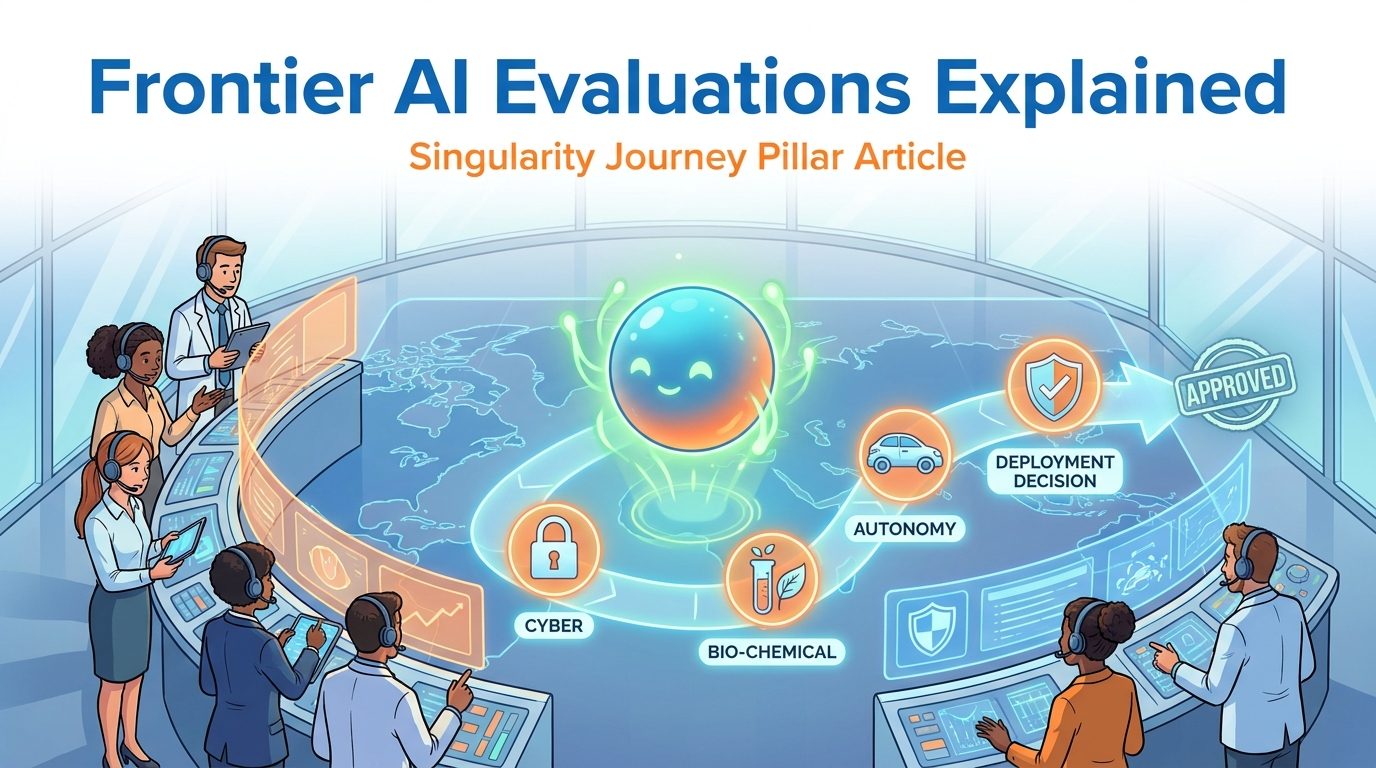
Frontier AI evaluations are how labs, governments, and independent researchers turn fast-moving model capability into evidence: what the system can do, where it may cause severe harm, what safeguards are needed, and when deployment should slow down.
Frontier AI Evaluations: The Quick Answer
Frontier AI evaluations are structured tests used to understand whether the most capable AI systems can create serious real-world risks before those systems are widely deployed. They are not ordinary product tests and they are not the same as academic leaderboards. A good frontier evaluation asks harder questions: Can the model help a user perform dangerous cyber activity? Can it meaningfully assist biological or chemical misuse? Can it operate with long-range autonomy? Can it hide capability, bypass safeguards, or manipulate a workflow? Can mitigations reduce the risk enough for a release decision?
The important point is that an evaluation does not magically prove an AI model is safe. It creates evidence for a governance decision. That evidence may support deployment, limited access, stronger monitoring, delayed release, additional red teaming, model changes, or a refusal to deploy a capability at all. The strongest frontier AI safety programs treat evaluation as a loop: define risk, test capability, measure safeguards, decide, monitor incidents, and update the test suite as models and misuse patterns change.
For Singularity Journey readers, this topic matters because the path toward more autonomous AI will not be decided only by benchmark scores. It will be shaped by how well institutions measure dangerous capabilities, disclose uncertainty, set thresholds, and maintain human authority over deployment decisions. Evaluation is one of the places where technical AI progress becomes social governance.
Why Frontier AI Evaluations Matter on the Singularity Path
Every generation of AI models forces a sharper version of the same question: how much capability can society absorb before oversight becomes too slow? Earlier AI systems mostly created content, classified data, or helped with narrow tasks. Frontier models increasingly reason across long context, use tools, write code, summarize research, plan steps, and operate as agents inside workflows. That does not make them conscious or magically all-powerful, but it does change the safety problem. A system that can follow multi-step instructions, use external tools, and persuade or assist users is different from a static chatbot.
This is why frontier evaluation has become a central topic for AI labs and policy institutions. Google DeepMind’s Frontier Safety Framework describes protocols for identifying future capabilities that could cause severe harm and putting mechanisms in place to detect and mitigate them. OpenAI’s Preparedness Framework focuses on tracking and preparing for advanced capabilities that could introduce risks of severe harm, with categories such as biological and chemical capabilities, cybersecurity, and AI self-improvement. Anthropic’s Responsible Scaling Policy ties model deployment to risk levels and required safeguards. NIST’s AI Risk Management Framework gives a broader governance vocabulary around mapping, measuring, managing, and governing AI risk.
Those frameworks differ in details, but they share a common intuition: frontier AI risk cannot be managed by vibes. It needs thresholds, tests, documentation, escalation paths, and people with authority to say “not yet.” The reason this matters for the singularity conversation is simple. If AI systems continue to become more capable and more agentic, the main bottleneck may not be raw intelligence. It may be whether our evaluation and governance systems can keep pace with capability jumps.
Analytics from Singularity Journey also support this direction. In the last 28 complete days, GA4 showed 239 page views and strong engagement from social traffic, while the site’s visible top pages included AI safety levels, guardrails, hallucination evaluation, agent observability, human approval, and agent autonomy. Search Console data is still sparse, with no meaningful ranking-distance query set in positions 4–20, so the article opportunity is not a quick CTR tweak. It is a topical authority move: build a serious SINGULARITY PATH pillar that links together the site’s safety, oversight, autonomy, and evaluation cluster.
How Frontier AI Evaluations Work
A frontier AI evaluation starts with a threat model, not with a leaderboard. The team first asks what kind of harm matters, who could cause it, what level of model assistance would materially change risk, and what evidence would be convincing. For example, a cybersecurity evaluation should not merely ask whether a model knows security vocabulary. It should test whether the model can help execute realistic steps that lower the skill barrier for harmful activity. A biological risk evaluation should not simply check whether a model can recite public facts. It should examine whether the model can combine, troubleshoot, or operationalize information in a way that changes real-world misuse risk.
After the threat model, evaluators design tasks. These tasks may be automated benchmark-style prompts, expert-built challenges, red-team scenarios, agent tasks, or controlled simulations. The best tasks are difficult enough to detect meaningful capability, realistic enough to map to a real risk, and constrained enough to avoid generating unsafe details. Evaluators then run the model under defined conditions and score not only whether it got the answer right, but whether it demonstrated dangerous capability, strategic behavior, persistence, tool-use skill, or willingness to violate policy.
The next step is mitigation testing. This is where many weak evaluations stop too early. A capability finding by itself does not answer the deployment question. The real decision is whether safeguards sufficiently reduce the risk. Safeguards may include refusal behavior, classifier checks, rate limits, staged access, monitoring, human approval, model weight security, sandboxing, tool restrictions, audit logs, user verification, and incident response plans. Evaluation should test the model with safeguards on, not only in an unconstrained lab condition.
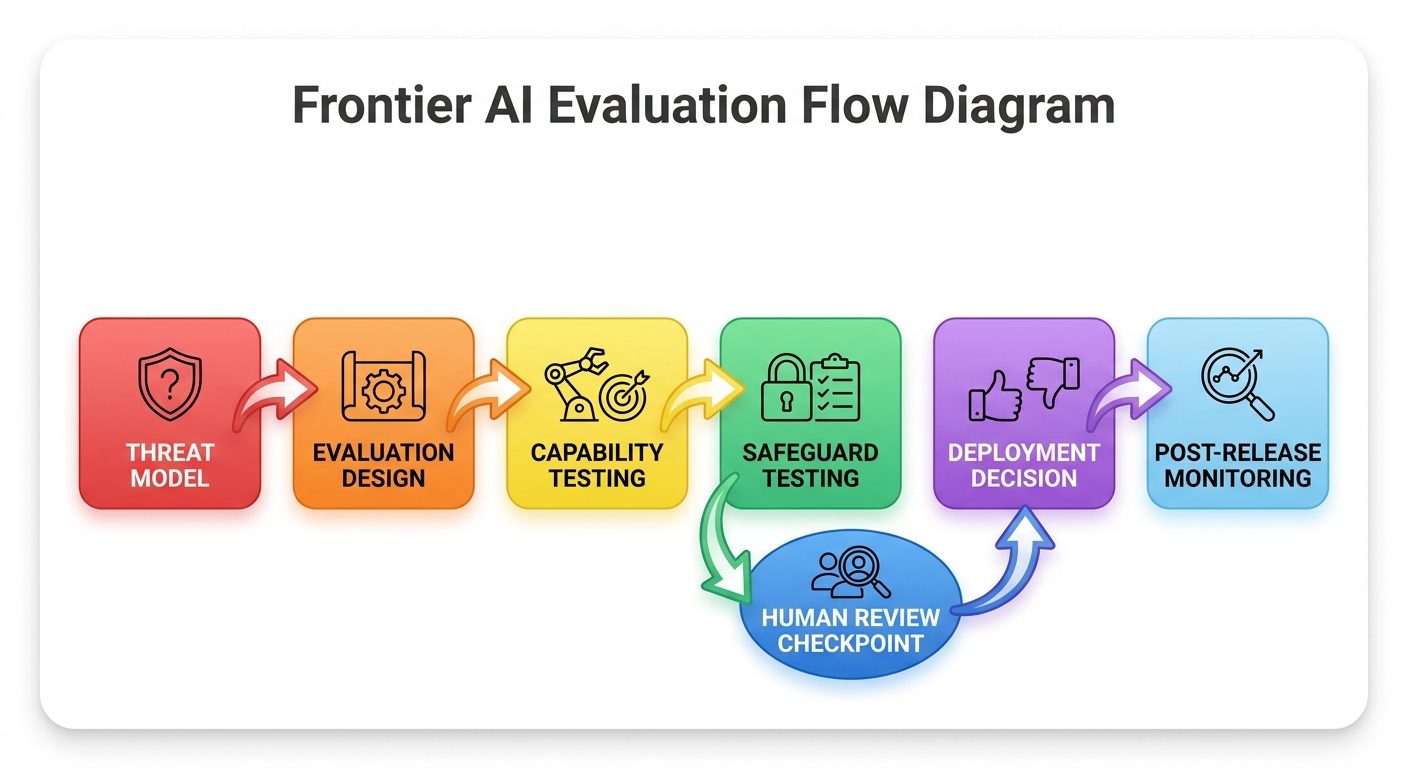
Finally, the result should lead to a decision. That decision might be green, yellow, or red, but it should not be vague. A responsible process says what evidence was found, what uncertainty remains, what mitigations are required, who reviewed the result, and what monitoring will happen after release. This is why frontier evaluations belong in governance, not only research. They give decision-makers a common language for action.
Major Frontier AI Safety Frameworks Compared
The current frontier safety landscape is not one universal standard. It is a set of partially overlapping frameworks from labs, governments, and independent researchers. That can be confusing for readers because the terms sound similar: preparedness levels, critical capability levels, responsible scaling, safety levels, risk management, model cards, system cards, red-team reports, and evals. The easiest way to understand them is to ask what each framework is trying to govern.
| Framework or source | Core idea | What readers should take from it |
|---|---|---|
| Google DeepMind Frontier Safety Framework | Identify future AI capabilities that could cause severe harm and create protocols to detect and mitigate them before they become dangerous. | Useful for understanding capability thresholds, early-warning evaluations, and deployment mitigations. |
| OpenAI Preparedness Framework | Track advanced capabilities that could lead to severe harm, classify high-risk areas, and require safeguards before deployment or development continues at critical levels. | Useful for understanding categories such as cyber, biological/chemical, self-improvement, long-range autonomy, sandbagging, and safeguard undermining. |
| Anthropic Responsible Scaling Policy | Connect model capability and risk levels to safety, security, and deployment requirements, with public risk reports and ongoing updates. | Useful for seeing how a lab can tie increasingly capable models to explicit operational commitments. |
| NIST AI Risk Management Framework | Provide a broader risk-management vocabulary for AI systems: govern, map, measure, and manage. | Useful for organizations that need a general governance structure around AI risk rather than a frontier-lab-only policy. |
| METR time-horizon research | Measure how long and complex tasks AI agents can complete, especially in software and reasoning domains. | Useful for tracking autonomy as a practical capability, not just raw benchmark score. |
The frameworks are not interchangeable. A government risk framework will not tell you exactly when a specific frontier lab should stop training a model. A lab’s deployment policy may not answer every public-accountability question. A research benchmark may reveal capability trends without prescribing governance. But together they show the shape of the emerging field: identify risks early, measure them repeatedly, connect thresholds to controls, and disclose enough information for external scrutiny.
What Frontier AI Evaluations Actually Measure
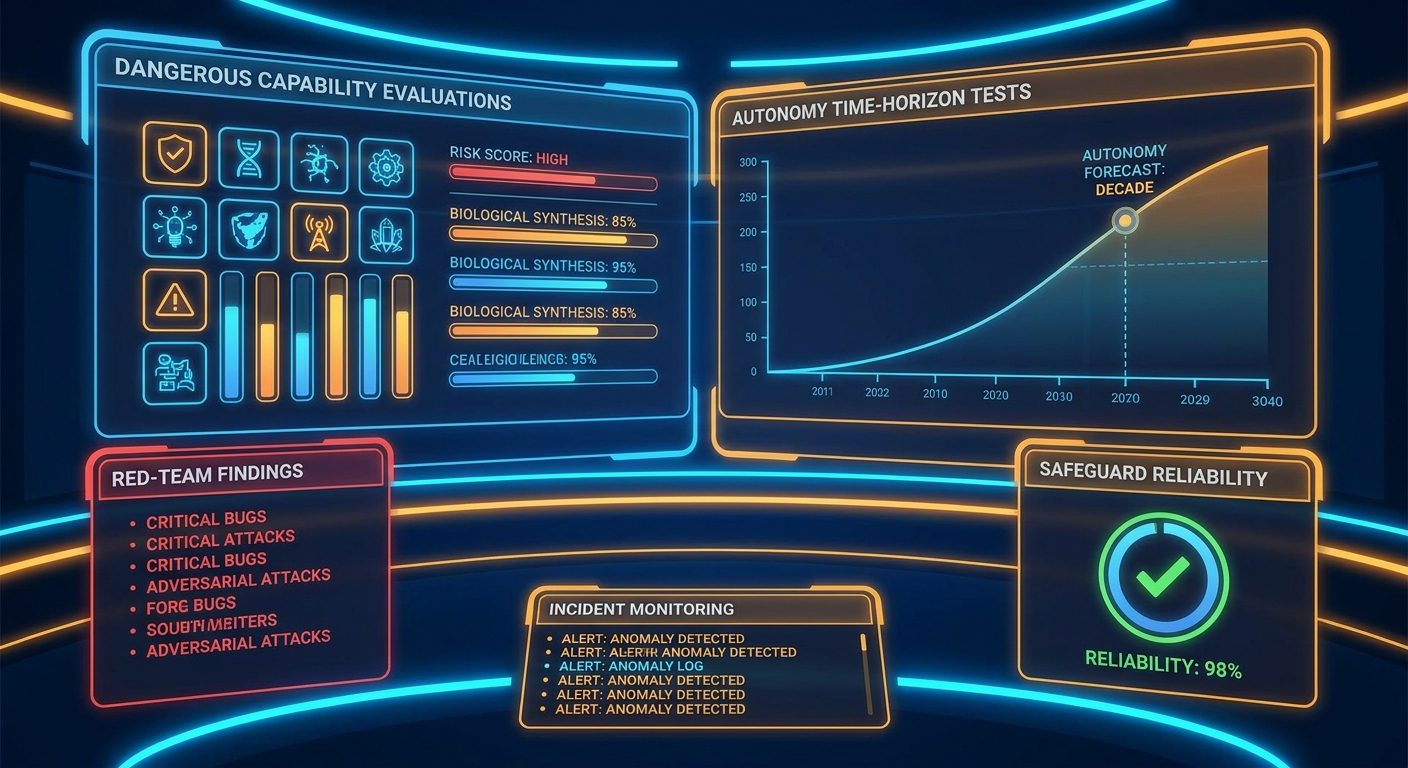
Frontier AI evaluations are strongest when they measure multiple signals instead of a single score. A single benchmark can be gamed, overfit, misunderstood, or disconnected from real-world harm. A stronger evaluation portfolio looks at dangerous capability, misuse pathways, autonomy, robustness, safeguard reliability, and post-deployment incidents. The question is not “what is the model’s IQ?” The question is “what can this system help people or agents do under realistic conditions?”
Autonomy deserves special attention because it links AI safety to the broader singularity path. A model that answers a dangerous question is one kind of risk. A model that can pursue a long objective through many steps, use tools, debug obstacles, and adapt to feedback is another. METR’s work on measuring the length of tasks AI agents can complete is important because it reframes capability as real-world persistence. Even if a model is imperfect at any individual step, improved task horizon can make it more useful and more risky at the same time.
This is also where human approval matters. If a system can only suggest an action and a trained person must review it, the risk is different from a system that can execute actions automatically. Singularity Journey has covered this in related articles on human approval for AI agents, AI agent autonomy levels, and AI guardrails. Frontier evaluations should not treat deployment as a yes/no switch; they should ask what level of autonomy, access, and oversight is appropriate for the evidence.
The Evaluation-to-Deployment Decision Matrix
Readers often ask a practical question: what happens after a frontier model performs well or badly on a safety evaluation? The answer should not be a press release. It should be a matrix. The same evaluation result can lead to different decisions depending on severity, uncertainty, safeguards, user access, monitoring, and reversibility. A model showing a concerning capability in a sealed lab test may still be safe to use in a narrow internal research context. The same capability in a public tool with broad tool access may require delay or restriction.
| Evaluation finding | Reasonable deployment response | What good governance requires |
|---|---|---|
| No material dangerous capability found, low uncertainty | Proceed with normal staged deployment. | Document test coverage, monitor incidents, and repeat evaluations as the model or product changes. |
| Capability is emerging but safeguards appear effective | Limited deployment with monitoring, rate limits, and escalation triggers. | Test safeguards under realistic adversarial pressure and define rollback conditions. |
| High-risk capability found and safeguards are uncertain | Delay broad release; restrict access to trusted settings or internal research. | Require senior review, stronger mitigations, external input where appropriate, and retesting. |
| Critical capability found that could introduce severe harm | Do not deploy broadly; consider pausing development or access expansion until risk is sufficiently minimized. | Use formal governance authority, security controls, independent scrutiny, and clear accountability. |
| Post-release incidents reveal unexpected misuse | Tighten access, update policy and classifiers, communicate changes, and rerun relevant evaluations. | Treat incidents as evidence, not public-relations noise. |
This decision matrix is where evaluation becomes useful to normal readers. It shows why “the model passed safety tests” is too vague. Which tests? Against which threat model? Under what access conditions? With which safeguards? Who reviewed the result? What happens if incidents appear after launch? These are the questions that separate serious safety evaluation from safety theater.
The Limits of Frontier AI Evaluations
Frontier evaluations are necessary, but they are not magic. The first limitation is coverage. No test suite can cover every possible use, every language, every tool combination, every jailbreak, every future user strategy, or every downstream integration. A model can pass a set of evaluations and still fail in a new context. This is especially true when models are connected to external tools, private data, code execution, robotics, browsing, or business workflows that were not present in the original evaluation.
The second limitation is measurement validity. An evaluation can measure the wrong thing, use unrealistic tasks, accidentally leak training examples, or reward superficial behavior. If the task does not map to a real threat model, a high score may create false confidence. If the task is too sanitized, it may miss practical misuse. If the task is too dangerous, it can create information hazards. Good evaluation design is a balance between realism and safety.
The third limitation is incentives. Labs want to ship products, governments want usable standards, and users want powerful tools. If evaluation results are private, selectively disclosed, or hard to interpret, the public may have to trust the same institution that benefits from deployment. That does not mean lab-led evaluation is worthless. It means independent research, external review, incident reporting, and clear governance commitments matter.
The fourth limitation is time. AI systems change quickly. A model update, new tool integration, new prompt style, new access policy, or new adversarial technique can invalidate old evaluation assumptions. This is why evaluation should be continuous. A one-time pre-release test is not enough for frontier systems that keep changing after launch.
A Reader Checklist for Interpreting AI Safety Evaluation Claims
When a company, government, or research group says an AI model was evaluated for safety, use this checklist before trusting the conclusion. It works for model cards, system cards, policy updates, blog posts, and public risk reports.
If a safety claim fails most of these checks, treat it carefully. It may still be useful, but it should not carry much authority. The strongest claims are modest, specific, and connected to action. “We ran frontier evaluations” is weak. “We tested these high-risk capabilities, found this level of evidence, added these mitigations, restricted this access, and will retest under these conditions” is much stronger.
How Enterprises Should Use Frontier Evaluation Thinking
Most companies are not training frontier models, but they can still use frontier evaluation thinking. The mistake is to assume that safety evaluation only belongs inside major AI labs. Any organization that connects powerful models to private data, customer workflows, code repositories, financial actions, support queues, or operational tools needs a smaller version of the same discipline. The question becomes: what can this system do in our environment, what harm could occur if it behaves badly, and what human controls must exist before we trust it with more autonomy?
A practical enterprise approach starts with workflow classification. Low-risk workflows, such as summarizing public documentation or drafting internal notes, may need basic quality review. Medium-risk workflows, such as customer support triage or code suggestions, need logging, sampling, escalation, and clear ownership. High-risk workflows, such as actions that affect money, security, legal obligations, health, hiring, or infrastructure, need stronger approval gates and adversarial testing before automation expands. This mirrors frontier safety logic without pretending every company has a frontier-lab research team.
Enterprises should also separate model evaluation from system evaluation. A model may be acceptable in isolation but risky when connected to retrieval, plugins, tools, memory, permissions, and background execution. That is why AI governance teams should test complete workflows, not just prompts. They should inspect traces, failure cases, refusal behavior, data exposure, human handoff quality, and recovery procedures. A safe demo is not the same as a safe production system.
The biggest lesson from frontier AI evaluations is cultural: do not wait for a public incident before defining thresholds. Decide in advance what evidence would trigger restricted access, rollback, manual review, or executive escalation. When teams define those thresholds early, safety becomes an operating system rather than an after-the-fact apology.
Internal Reading Path on Singularity Journey
This article is designed as a pillar for the site’s SINGULARITY PATH safety cluster. To go deeper, read these related guides:
- AI Safety Levels Explained — a useful companion for understanding tiered risk language.
- AI Hallucination Evaluation Checklist — practical quality testing before users trust model outputs.
- RAG Hallucinations Explained — why source grounding reduces but does not eliminate answer risk.
- AI Agent Observability — how tracing and logs support accountability after deployment.
- Enterprise AI Agent Readiness Checklist — how organizations choose safer automation candidates.
Conclusion: Evaluations Are the Safety Layer Between Capability and Power
Frontier AI evaluations matter because capability without evaluation becomes guesswork. As models become stronger, more autonomous, and more deeply connected to tools, society needs better ways to decide when to deploy, restrict, pause, or redesign them. The serious version of AI safety is not panic and it is not blind acceleration. It is disciplined measurement, honest uncertainty, meaningful safeguards, and humans with authority to act on the evidence.
The best way to think about frontier AI evaluations is as a safety layer between capability and power. Capability asks what the system can do. Power asks what the system is allowed to do in the world. Evaluation is the process that should connect the two. If evaluation is weak, deployment decisions become marketing. If evaluation is strong, it gives labs, policymakers, enterprises, and the public a better chance to steer the singularity path instead of merely reacting to it.
Sources and References
- Google DeepMind: Introducing the Frontier Safety Framework
- OpenAI: Our updated Preparedness Framework
- Anthropic: Responsible Scaling Policy
- NIST: AI Risk Management Framework
- METR: Measuring AI Ability to Complete Long Software Tasks
Source links were selected from official lab, government, and research-organization pages. Suspicious, unrelated, promotional, or low-quality links were excluded.
FAQ: Frontier AI Evaluations
What are frontier AI evaluations?
Frontier AI evaluations are structured tests for the most capable AI systems. They examine whether a model shows dangerous capabilities, risky autonomy, safeguard weaknesses, or other evidence that should affect deployment decisions.
Are frontier AI evaluations the same as normal AI benchmarks?
No. Normal benchmarks often measure performance on tasks such as coding, math, language, or knowledge. Frontier safety evaluations focus on risk-relevant capability, misuse potential, safeguard reliability, autonomy, and governance thresholds.
Can an evaluation prove an AI model is safe?
No. Evaluations can provide evidence that informs risk management, but they cannot prove that all future behavior is safe. They must be combined with safeguards, monitoring, incident response, external review, and repeated testing.
What dangerous capabilities are usually evaluated?
Common areas include cybersecurity misuse, biological or chemical assistance, long-range autonomy, AI self-improvement, safeguard undermining, deception, sandbagging, manipulation, and other severe-harm pathways identified by a threat model.
How do evaluation results affect deployment?
Results can support normal release, staged access, rate limits, stronger monitoring, human approval requirements, delayed deployment, external review, or refusal to deploy a capability until safeguards improve.
Who should perform frontier AI evaluations?
AI labs must evaluate their own systems, but independent researchers, government institutes, external experts, auditors, and incident-reporting bodies also matter because public trust is weaker when all evidence comes from the deploying organization.
Why does autonomy matter in frontier AI safety?
Autonomy matters because a model that can plan and execute long tasks with tools may create different risks from a model that only answers isolated questions. Longer task horizons can increase both usefulness and misuse potential.
