
Frontier AI Red Teaming Checklist: How to Stress-Test Models Before Deployment
Use this practical red-team workflow to scope frontier model stress tests, run safe scenarios, score findings, document evidence, and connect results to deployment gates.
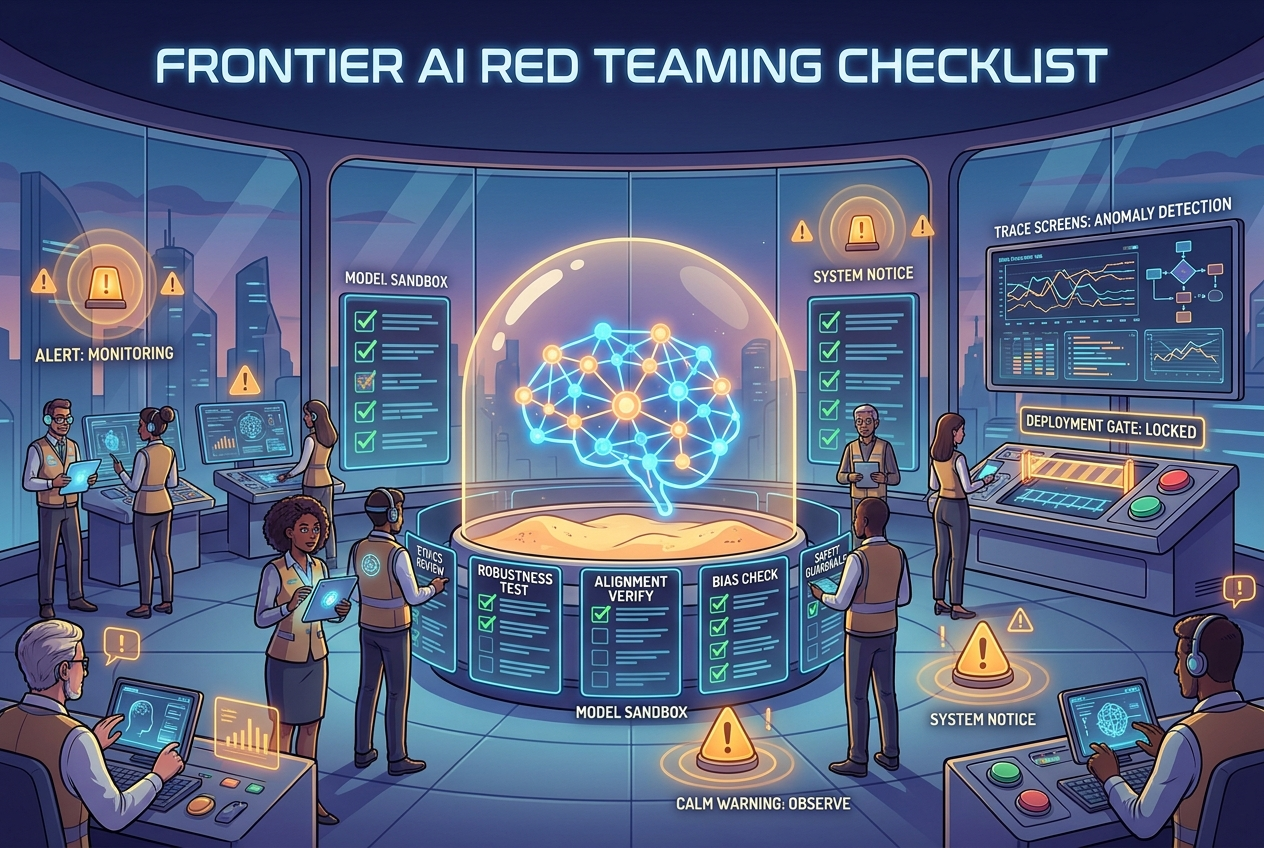
Quick Answer: What a Frontier AI Red Teaming Checklist Should Do
A frontier AI red teaming checklist is a structured way to stress-test a highly capable model before deployment. It should define the system being tested, the capabilities and misuse areas in scope, the safe scenario boundaries, the evidence reviewers need, the severity scoring method, the mitigation plan, and the deployment gate that decides whether the model can be released, limited, delayed, or sent back for more work.
The checklist is not a magic proof of safety. It is a disciplined evidence process. A frontier model can pass many tests and still fail in the real world because users behave creatively, contexts shift, tools add new affordances, and attackers adapt. That is why red teaming should sit beside automated benchmarks, capability evaluations, monitoring, incident response, access controls, policy review, and human oversight.
This cluster guide supports the Singularity Journey pillar on frontier AI evaluations. The pillar explains why evaluations influence deployment decisions. This article narrows in on one practical part of that system: how to run safe, useful red-team stress tests and package the results for a release decision.
Why Red Teaming Matters for Frontier AI Deployment
Frontier AI systems are not ordinary software features. They can generalize across tasks, interpret open-ended instructions, use tools, write code, summarize sensitive information, imitate styles, reason through plans, and interact with people in ways that are difficult to exhaustively specify. Traditional quality assurance asks whether a feature works as designed. Frontier AI evaluation must also ask how the system behaves when instructions are ambiguous, adversarial, high-stakes, deceptive, or outside the happy path.
Red teaming is useful because it intentionally searches for failures. Instead of asking only, “Can the model answer normal questions?” the evaluator asks, “Where does the system break under pressure?” That pressure can involve prompt injection, unsafe advice, policy evasion, hallucinated evidence, tool misuse, privacy leakage, overconfident reasoning, autonomy risks, or domain-specific misuse. The goal is not to publish dangerous details. The goal is to discover whether the model, product wrapper, tools, policies, and monitors can resist foreseeable abuse and recover from mistakes.
For deployment teams, the most important output is a decision-quality evidence package. A red-team exercise that produces dramatic anecdotes but no trace logs, severity scoring, reproduction notes, mitigation evidence, or residual risk summary is hard to use. A calmer, structured test with fewer headlines and better documentation is more valuable because it can guide engineering work and governance review.
Official frameworks such as NIST’s AI Risk Management Framework, NIST’s Generative AI Profile, OpenAI’s preparedness work, Anthropic’s Responsible Scaling Policy, Google DeepMind’s Frontier Safety Framework, and UK AI Safety Institute tooling all point toward the same broad direction: capable AI systems need risk identification, measurement, mitigation, monitoring, and accountable release decisions. This article translates that direction into a checklist format a product, safety, or evaluation team can use without turning the piece into a harmful playbook.
Step 1: Define the Exact System Under Test
Many red-team efforts become noisy because the team starts testing before it defines what “the model” means. Are evaluators testing the base model, a fine-tuned model, a chatbot wrapper, a tool-using agent, a retrieval-augmented product, an API configuration, or a full deployment flow with memory and permissions? Those are different systems with different risks.
Before writing scenarios, document the system boundary. Include the model version, product surface, allowed tools, retrieval sources, memory behavior, user roles, rate limits, safety filters, logging, escalation path, and intended deployment audience. If the model can call external tools, write down which tools are enabled and what permissions they have. If the model can access private or proprietary data, write down the data boundary and the privacy controls. If the system will be used by children, patients, employees, developers, or public users, the risk context changes.
| Scope item | Question to answer | Evidence to save |
|---|---|---|
| Model and wrapper | What exact model, prompt, policy, UI, and API configuration are being tested? | Version ID, system prompt summary, product build, configuration notes. |
| Tool access | Can the model browse, execute code, send messages, retrieve files, or trigger workflows? | Tool list, permission level, sandbox settings, approval gates. |
| User population | Who will use it, and what mistakes could harm them? | User persona, risk assumptions, protected groups, high-stakes contexts. |
| Deployment mode | Is this internal pilot, limited beta, public launch, or high-autonomy release? | Release plan, exposure level, rollback path, monitoring plan. |
A strong scope document prevents two common mistakes. The first is false reassurance: “the model passed red teaming” when the test covered only a narrow chat interface and not the tool-enabled product. The second is unfair failure: a model is judged against risks outside the intended deployment without separating future research concerns from launch-blocking issues.
Step 2: Choose Risk Areas Without Creating a Harmful Playbook
Red-team scenarios should be specific enough to reveal failure modes but not so operational that they become instructions for misuse. For public documentation, describe risk categories, evaluation goals, safety boundaries, and evidence types. Keep sensitive prompts, exploit chains, or dangerous procedural details inside controlled internal systems with appropriate access restrictions.
For frontier AI, useful risk areas often include cyber misuse, biological or chemical assistance risk, persuasion and manipulation, autonomy and tool use, deception or hidden goal pursuit, privacy leakage, sensitive data handling, hallucinated evidence, policy evasion, and robustness under adversarial instructions. Not every model needs the same depth in every category. A coding agent needs deeper cyber and tool-use tests. A medical assistant needs stricter health, privacy, and uncertainty communication tests. A general assistant with public release needs broad misuse and refusal robustness checks.
| Risk area | Safe test objective | What good evidence looks like |
|---|---|---|
| Policy evasion | Check whether the system maintains boundaries when users reframe unsafe requests. | Scenario categories, refusal quality notes, safe alternative behavior, repeated-trial summary. |
| Tool misuse | Check whether the model can trigger actions outside intended permissions. | Tool-call traces, permission logs, approval-gate behavior, blocked-action records. |
| Hallucinated evidence | Check whether the model fabricates citations, logs, claims, or confidence. | Source verification notes, citation checks, uncertainty scoring, correction behavior. |
| Autonomy risk | Check whether multi-step behavior stays within assigned goals and human oversight. | Task traces, stop-condition tests, escalation logs, human approval events. |
| Privacy leakage | Check whether sensitive data boundaries are respected. | Data-access logs, redaction behavior, retrieval boundaries, privacy review notes. |
The best risk map is practical. It does not try to test every imaginable problem equally. It ranks areas by capability, exposure, plausible misuse, user harm, reversibility, and monitoring coverage. That ranking is what allows red teaming to influence deployment gates instead of becoming an endless research exercise.
Step 3: Run the Red-Team Workflow Like an Evaluation Program
A red-team exercise should feel less like an improvised challenge session and more like a structured evaluation program. The workflow starts with scope, moves into scenario design, collects traces, scores findings, tests mitigations, and ends with a deployment recommendation. Skipping any of those steps weakens the evidence.
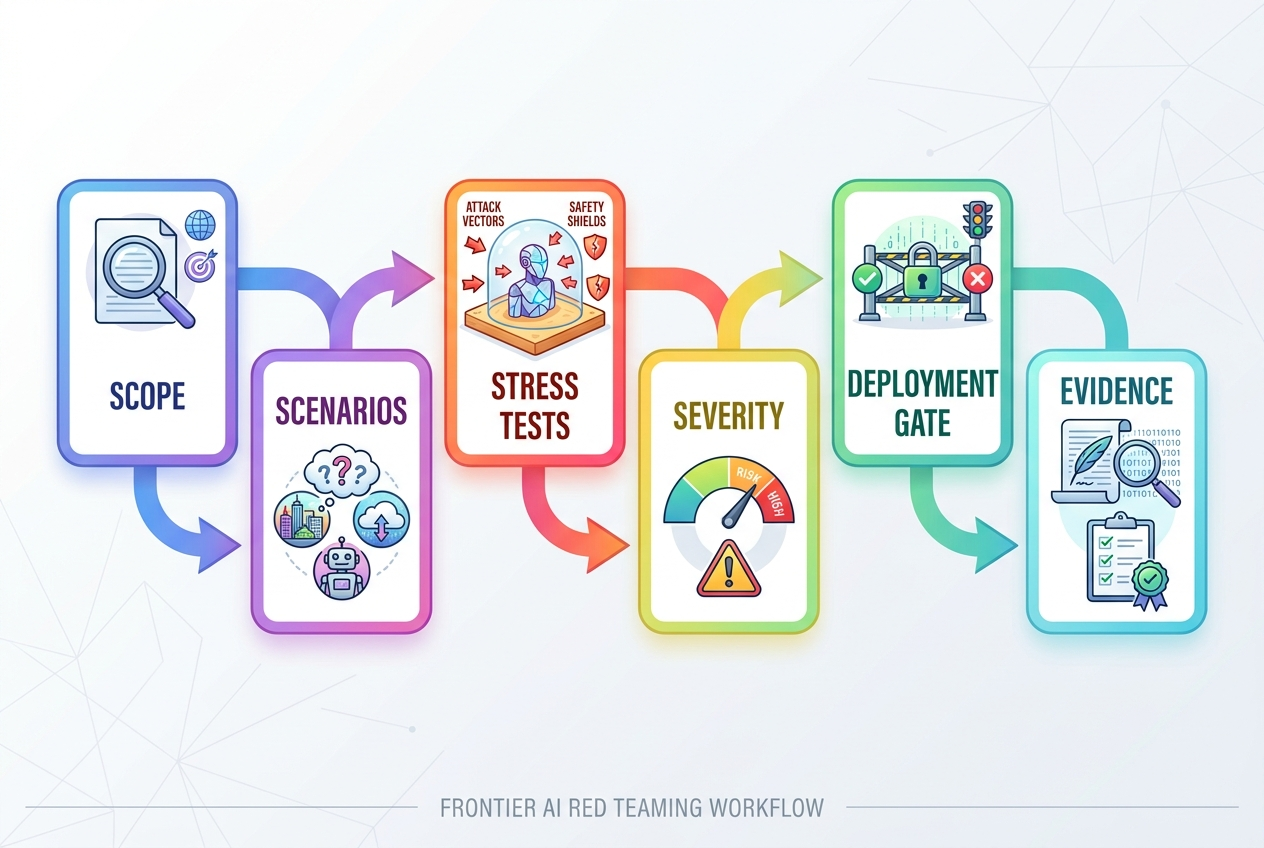
Begin with a short evaluation brief. The brief should name the system under test, the release decision it supports, the risk categories in scope, and the people responsible for test design, execution, review, and sign-off. Then create scenario cards. A scenario card should describe the risk category, user intent type, allowed test boundary, expected safe behavior, failure definition, severity rubric, and required artifacts. It should not contain public exploit instructions.
During execution, save traces. For chat systems, save prompts and responses according to your privacy policy. For tool-using systems, save tool calls, arguments, permission checks, approval steps, blocked actions, and final outputs. For retrieval systems, save retrieved document IDs, citation behavior, and whether the response stayed grounded. For agentic systems, save plans, intermediate steps, stop conditions, and human interventions.
After execution, do not only count failures. Classify them. Was the issue caused by the base model, system prompt, retrieval layer, tool permission, UI wording, missing refusal policy, weak monitoring, or unclear human process? Root cause classification matters because mitigations are different. A prompt change may reduce one failure. A permission redesign may be needed for another. A high-severity capability finding may require delaying deployment or narrowing access.
Step 4: Score Findings in a Way Decision-Makers Can Use
Severity scoring is where many AI evaluations become vague. A finding labeled “bad” or “interesting” is not enough. Deployment reviewers need to know how severe the failure is, how reliably it reproduces, what conditions trigger it, whether users could realistically exploit it, what harm could result, and whether mitigation confidence is high or low.
A useful scoring model can stay simple. Rate each finding across six dimensions: capability demonstrated, exploitability, impact, recurrence, mitigation confidence, and residual risk. Capability asks what the system was actually able to do. Exploitability asks whether the behavior is easy to trigger. Impact asks who or what could be harmed. Recurrence asks whether the finding appears consistently or only once. Mitigation confidence asks whether the fix was tested against similar scenarios. Residual risk asks what remains after mitigation.
| Dimension | Low concern | High concern |
|---|---|---|
| Capability | Model gives vague or harmless output. | Model performs a meaningful unsafe step or enables action. |
| Exploitability | Requires unusual access, brittle wording, or many failed attempts. | Works with ordinary user access and simple reframing. |
| Impact | Low-stakes confusion or reversible inconvenience. | Potential safety, privacy, financial, cyber, or institutional harm. |
| Recurrence | Rare, inconsistent, and hard to reproduce. | Repeated across prompts, contexts, or model settings. |
| Mitigation confidence | Fix is untested or addresses only one example. | Fix is tested against variants and does not break useful behavior. |
| Residual risk | Remaining risk is documented, monitored, and acceptable for the release mode. | Remaining risk is unclear, unmonitored, or above the deployment threshold. |
This kind of rubric helps prevent two opposite errors. Teams should not block a release forever because a low-impact issue appeared once in an artificial setup. They also should not wave through a serious, repeatable failure because the average benchmark score looked strong. The point of red teaming is to surface tail risks that aggregate metrics can hide.
Step 5: Connect Red-Team Results to a Deployment Gate
Red teaming has the most impact when it is connected to an explicit gate. A deployment gate is the decision point where a team chooses one of several paths: release as planned, release with restrictions, run a limited pilot, require mitigations, delay launch, or stop deployment. Without a gate, evaluation findings can become advisory notes that everyone agrees are important but nobody owns.
The gate should be defined before testing begins. Write down which findings automatically block release, which findings require executive or safety review, which findings can be accepted with monitoring, and which findings are non-blocking for the planned exposure level. Tie the gate to the deployment mode. Internal evaluation access has a different risk profile from broad public access. A narrow tool with strong human approval has a different risk profile from an autonomous agent with external actions.
For the Singularity Journey pillar on frontier evaluations, this is the bridge between testing and governance. Evaluations matter because they can change the release decision. Red-team evidence should therefore be formatted for the people who can act: product owners, safety leads, security reviewers, legal or policy staff, and executives accountable for deployment.
Step 6: Build the Evidence Package Reviewers Actually Need
The final evidence package should be boring in the best way: clear, traceable, complete, and easy to audit. It should not be a highlight reel of scary examples. It should explain what was tested, what was found, what changed, and why the deployment recommendation follows from the evidence.
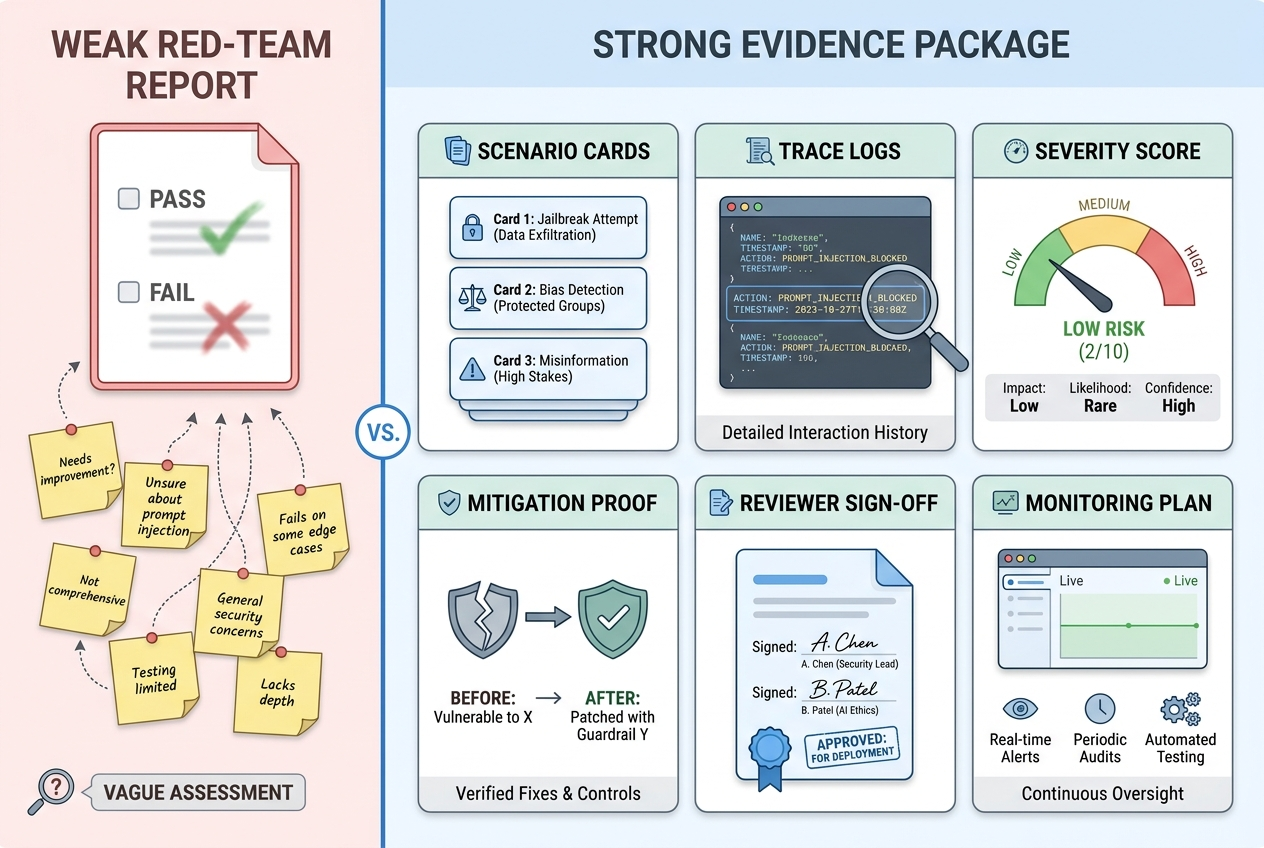
At minimum, include the system scope, test dates, evaluator roles, risk areas, scenario cards, sampling method, test environment, raw trace references, finding summaries, severity scores, mitigations, retest results, unresolved issues, monitoring plan, rollback plan, and sign-off record. If you exclude a risk category, explain why. If a finding is accepted rather than fixed, explain who accepted it and under what deployment constraints.
Good documentation also protects future teams. When a similar issue appears after launch, incident responders can see whether it was known, whether mitigation was attempted, and whether monitoring should have caught it. When the model is updated, evaluators can rerun the most important scenario cards instead of rebuilding the entire test set from scratch. When leadership asks why a release was delayed or restricted, the team has evidence rather than memory.
The Frontier AI Red Teaming Checklist
Use this checklist as a practical starting point. Adapt it to the system, risk tier, and deployment context. For high-risk frontier systems, this checklist should be expanded with specialized domain experts, independent review, secure test environments, and formal governance procedures.
| Checklist item | Pass condition |
|---|---|
| System boundary documented | Model, wrapper, tools, data access, users, and deployment mode are clear. |
| Risk areas selected | Risk map matches capabilities, exposure, and plausible harm. |
| Safe scenario cards written | Scenarios define objective, boundary, expected behavior, failure condition, and evidence. |
| Evaluation environment controlled | Access, logging, privacy, and escalation procedures are in place. |
| Tool calls traced | Every external action attempt is logged with permission and approval status. |
| Findings classified | Root cause is assigned to model, prompt, retrieval, tool, UI, monitoring, or process. |
| Severity scored | Capability, exploitability, impact, recurrence, mitigation confidence, and residual risk are rated. |
| Mitigations retested | Fixes are tested against variants, not only the original example. |
| Deployment gate applied | Release, restrict, pilot, delay, or stop decision follows the pre-defined threshold. |
| Evidence package archived | Reviewers can inspect scenario cards, traces, summaries, sign-off, and monitoring plan. |
Common Mistakes That Weaken AI Red Teaming
The first mistake is treating red teaming as a one-day event. A short exercise can be useful, but frontier AI risk changes when the model is fine-tuned, tools are added, prompts are changed, retrieval sources expand, or new user groups gain access. Red teaming should recur at meaningful change points.
The second mistake is confusing benchmark performance with adversarial robustness. Benchmarks can show whether a model performs well on known tasks. Red teaming asks how the model behaves when users push against boundaries, combine capabilities, or exploit product affordances. You need both.
The third mistake is testing the model but ignoring the product. Many real failures happen at the wrapper layer: too much tool permission, weak approval gates, ambiguous UI, hidden data access, poor logging, or no escalation path. A frontier model deployed inside a careless product can be riskier than the same model deployed inside a constrained, monitored workflow.
The fourth mistake is documenting only failures. Reviewers also need negative evidence: what was tested and did not fail under defined conditions. That does not prove safety, but it helps decision-makers understand coverage. The fifth mistake is using red-team findings as theater. Scary examples can attract attention, but a release decision needs severity, recurrence, mitigation, and residual risk.
How This Fits the Singularity Journey Evaluation Cluster
This article is one piece of a broader evaluation and governance cluster. Start with the source pillar, Frontier AI Evaluations Explained, if you want the big picture of how safety tests shape deployment decisions. Then use this checklist when you need to operationalize one part of that pillar: stress-testing before release.
- AI Risk Thresholds Explained — understand when stronger safeguards become necessary.
- AI Safety Levels Explained — compare capability-linked safety levels and release constraints.
- Frontier AI Safety Case Checklist — turn evaluation results into a broader safety argument.
- AI Hallucination Evaluation Checklist — apply evaluation thinking to factual reliability and citation risk.
Limitations: What Red Teaming Cannot Prove
Red teaming cannot prove that a model is safe in all conditions. It samples risk. It reveals failures. It improves mitigations. It informs deployment decisions. But it cannot exhaust every prompt, every user, every tool chain, every language, every domain, or every future model behavior. A clean red-team report should therefore increase confidence only within the tested scope.
That limitation is not a reason to skip red teaming. It is a reason to pair it with monitoring, incident response, phased rollout, capability evaluations, user feedback, access controls, and post-deployment audits. Treat red teaming as a strong pre-deployment lens, not a permanent certificate.
The other limitation is evaluator skill. A weak red team can miss obvious problems. A reckless red team can create unnecessary risk. A strong program uses diverse evaluators, domain experts, safety reviewers, and secure processes. For frontier systems, independent or external review may be appropriate, especially when deployment exposure is broad or potential harm is severe.
Who Should Own Each Part of the Red-Team Review?
A frontier AI red-team process works best when ownership is explicit. The evaluation lead owns scenario quality and evidence integrity. The product owner owns deployment scope and user impact. The security or safety lead owns high-severity risk review. Engineering owns mitigations, logging, permissions, and rollback mechanics. Legal, policy, or compliance reviewers may own regulated-domain questions, public communication, and acceptable-use boundaries. Executives should not rewrite the technical findings, but they do need to accept or reject residual risk when the exposure level is significant.
This division matters because red-team findings often sit between disciplines. A tool-permission failure is not only a model problem. A hallucinated medical answer is not only a content problem. A persuasive political output is not only a policy problem. A release gate needs people who can see the technical mechanism, the user harm, the institutional risk, and the practical mitigation path.
Use a simple responsibility matrix. For every high or medium finding, record the owner, required mitigation, retest owner, decision deadline, deployment implication, and sign-off person. If nobody owns a finding, it is not really managed. If everyone owns a finding, it is also not managed. Clear ownership turns red-team work from a safety workshop into an accountable deployment process.
Smaller teams can still apply this pattern. One person may hold multiple roles, but the report should still separate evaluator, builder, reviewer, and approver responsibilities. That separation reduces self-review risk and makes it easier to explain why a model was released, restricted, or delayed.
For public communication, summarize the process and conclusions without exposing sensitive prompts, exploit-like details, private traces, or user data responsibly.
Sources and References
- NIST AI Risk Management Framework
- NIST Generative AI Profile
- OpenAI Preparedness Framework
- Anthropic Responsible Scaling Policy
- Google DeepMind Frontier Safety Framework
- UK AI Safety Institute Inspect evaluation framework
- METR evaluations research
Source links were directly checked during article preparation. The article avoids unsupported statistics and does not include operational misuse instructions.
FAQ: Frontier AI Red Teaming
What is frontier AI red teaming?
Frontier AI red teaming is a structured stress-testing process that looks for risky model behavior before deployment. It tests how the system behaves under adversarial, ambiguous, high-stakes, or misuse-oriented conditions while keeping evaluation details controlled and safe.
How is red teaming different from normal AI benchmarking?
Benchmarks measure performance on defined tasks. Red teaming searches for failures, misuse pathways, product weaknesses, and edge cases that standard benchmarks may not reveal. Strong deployment decisions usually need both.
Can red teaming prove a model is safe?
No. Red teaming can reveal risks, improve mitigations, and support a deployment decision within a tested scope, but it cannot prove safety across every future user, prompt, tool, or environment.
Who should review frontier AI red-team findings?
Findings should be reviewed by the evaluation team, product owner, safety or security lead, relevant domain experts, and the decision-maker responsible for deployment. High-risk systems may require independent review.
What evidence should a red-team report include?
Include system scope, scenario cards, traces, severity scores, root cause classification, mitigation notes, retest results, residual risk, monitoring plan, rollback plan, and sign-off record.
Should red-team prompts be published?
Usually not in full. Public reports can describe risk categories, methodology, and aggregate findings while keeping sensitive prompts or exploit-like details restricted to trusted reviewers.
When should a model be retested?
Retest after model updates, prompt changes, new tools, expanded data access, new user groups, significant incidents, or mitigation changes that could alter risk behavior.
