
AI Safety Levels Explained: How ASL Tiers Turn Frontier AI Risk Into Safeguards
A plain-English guide to ASL tiers, responsible scaling, and the safeguards that should become stronger as frontier AI systems cross risk thresholds.
Quick Answer: What Are AI Safety Levels?
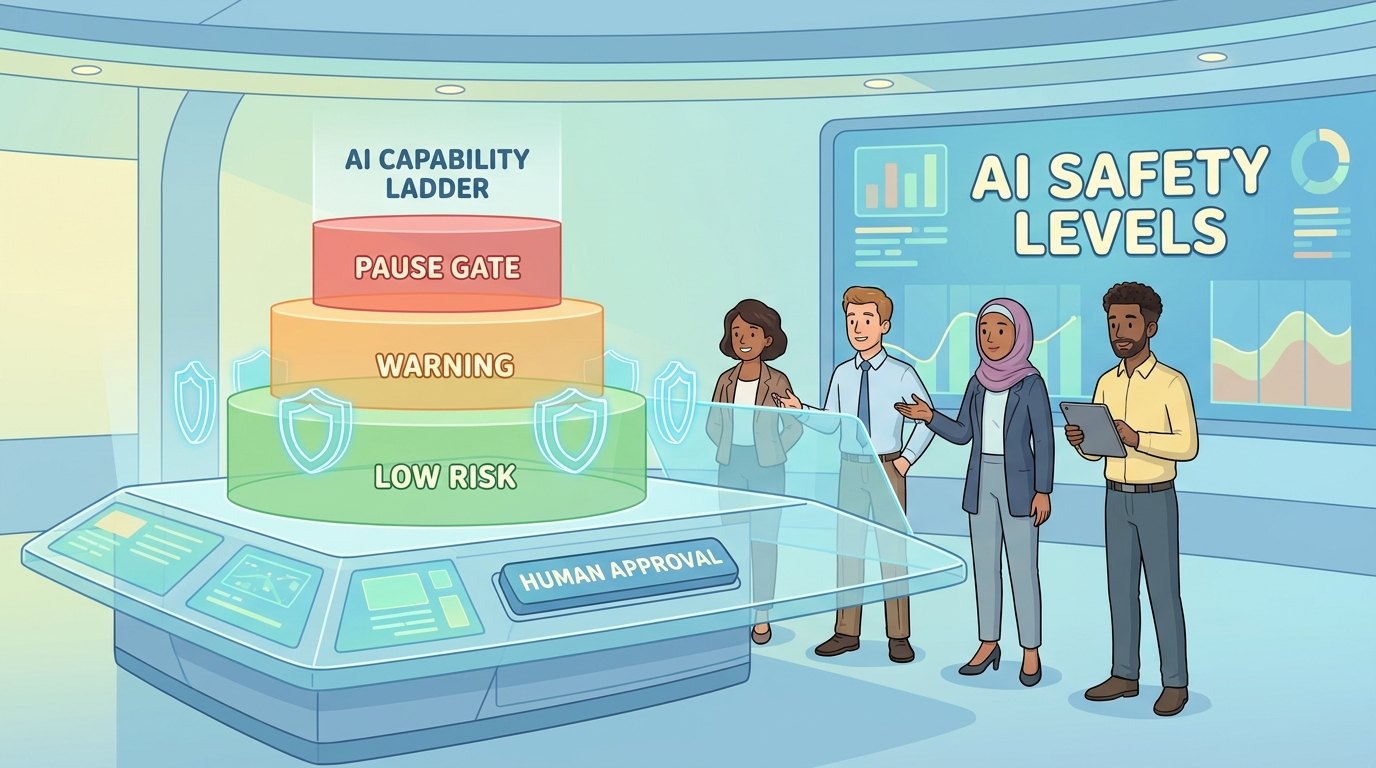
AI Safety Levels, often shortened to ASL tiers, are a way to connect the capability of a frontier AI system with the safeguards required before that system is trained further, deployed broadly, connected to powerful tools, or made available to more users. The idea is simple: if an AI model shows stronger or more dangerous capability, the lab should not keep using the same safety process as before. The required evidence, security, review, access limits, monitoring, and approval gates should become stronger too.
This article is a focused cluster guide for our pillar on AI risk thresholds. The pillar explains the broader concept: thresholds are decision points that say when frontier AI needs stronger safeguards. This article narrows the lens to one important implementation pattern: ASL-style tiering. Instead of treating frontier AI risk as a vague feeling, ASL tiers create a ladder. Each rung asks whether the system has crossed a capability or exposure threshold, then requires a more serious response.
The phrase is best known from Anthropic’s Responsible Scaling Policy, which uses AI Safety Levels as a framework for catastrophic-risk governance. Other organizations use different terms. OpenAI’s Preparedness Framework, for example, discusses High and Critical capability thresholds. NIST’s AI Risk Management Framework uses a broader govern-map-measure-manage structure. The names differ, but the operational question is similar: what evidence would force stronger controls before deployment?
ASL tiers are not a universal law, a guarantee of safety, or a replacement for regulation. They are a decision system. Used well, they make it harder for a lab or product team to move from impressive demo to broad release without proving that safeguards have kept up with capability.
Why ASL Tiers Matter for Frontier AI Risk Thresholds
Frontier AI creates a governance problem that normal software processes do not fully solve. A typical product update can be tested against expected features, known failure modes, and defined user actions. A highly capable AI system is different because it can generalize across domains, respond creatively to new prompts, use tools, write code, plan multi-step actions, summarize sensitive data, persuade users, or assist technical tasks that the product team did not explicitly script. That does not mean every frontier model is dangerous. It means the safety process must scale with capability.
ASL-style tiering gives teams a language for that scaling. If the system only shows ordinary limitations, ordinary controls may be enough. If it starts showing early signs of dangerous capability, the team should add deeper evaluations and tighter access. If it substantially increases catastrophic misuse risk or begins showing meaningful autonomy, the team should require stronger security, red teaming, operational restrictions, and possibly a pause before further scaling. The value is not the label itself. The value is the trigger-response relationship.
Without tiers, AI safety discussions often collapse into two unhelpful extremes. One side says, “The model has not caused a disaster, so continue.” The other says, “The model is powerful, so stop everything.” A tiered system offers a more practical middle path. It lets a team say, “This specific capability signal moves the system into a higher risk class, and this specific set of safeguards must now be proven.” That is a better conversation than either denial or panic.
For readers following the path toward more general AI, ASL tiers also help separate capability from deployment. A model may be risky in one context and manageable in another. A read-only assistant with strict refusal behavior is not the same as an autonomous agent with code execution, browser access, external APIs, email-sending permission, and weak monitoring. Risk grows when capability, access, autonomy, and scale combine. Good ASL systems account for that combination.
The data gap in many public explanations is that they describe ASL tiers as if they are just labels: ASL-1, ASL-2, ASL-3, and so on. That misses the point. The useful question is not “What badge does the model wear?” The useful question is “What is the strongest capability it demonstrated, how reliable is that evidence, what exposure will it have, and what controls become mandatory before more people can use it?”
The Four Parts of an ASL-Style Safety System
A strong ASL system has four parts: capability evidence, risk tier, required safeguard, and decision authority. If any part is missing, the system becomes too easy to game. A lab can claim it has levels, but if the levels do not require hard decisions, they are mostly branding.
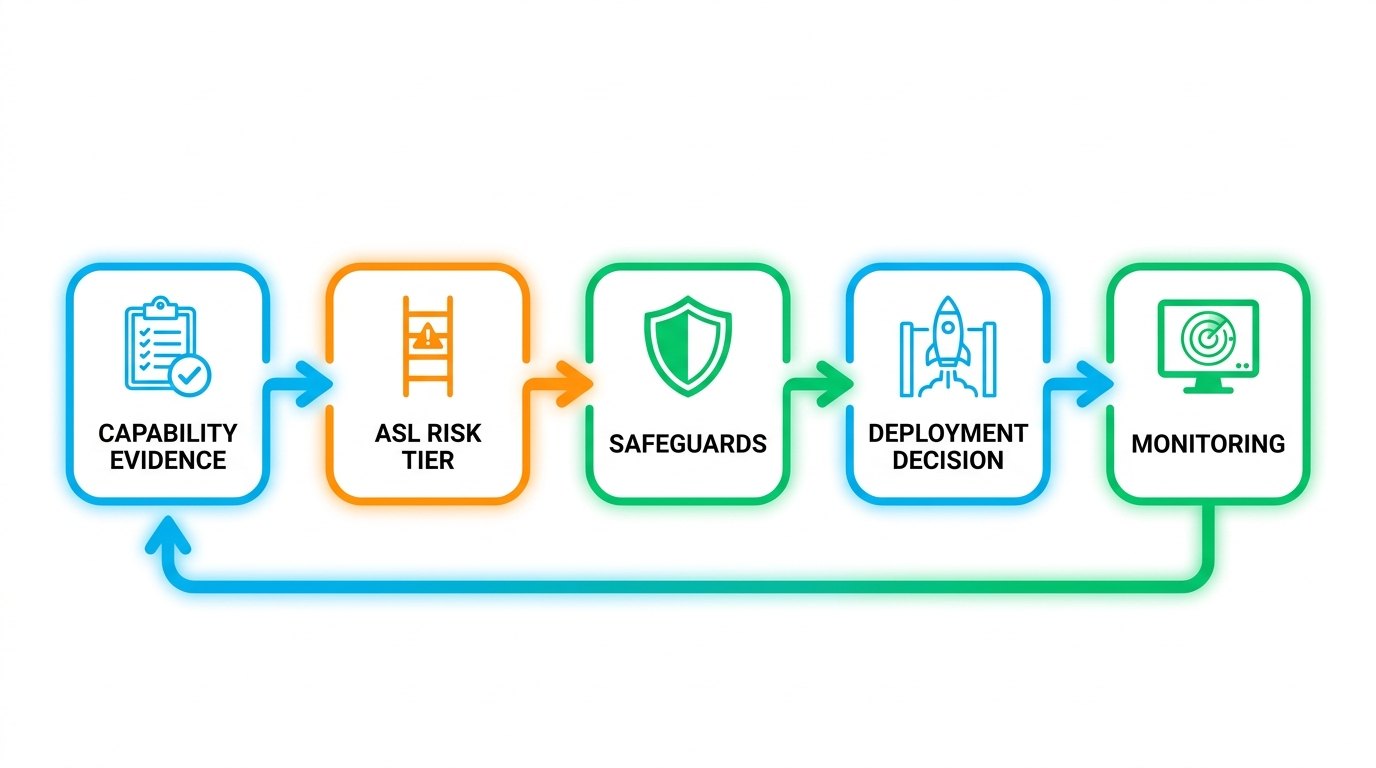
| Part | Question it answers | What good practice looks like |
|---|---|---|
| Capability evidence | What can the model actually do? | Benchmarks, adversarial evaluations, expert red teams, controlled task suites, tool-use tests, and deployment simulations. |
| Risk tier | How serious is the demonstrated capability in context? | A pre-defined tier that considers reliability, misuse potential, autonomy, access, and the severity of plausible harm. |
| Required safeguard | What must change before proceeding? | Access limits, stronger monitoring, security hardening, human approval, external review, staged rollout, or pause conditions. |
| Decision authority | Who can approve, delay, restrict, or stop deployment? | Named governance owners, escalation paths, documentation requirements, and override rules that are visible before launch pressure peaks. |
The first part, capability evidence, is where many weak safety systems fail. It is not enough to ask whether a model once produced an alarming answer. The team needs to know whether the capability is reliable, accessible to realistic users, useful to malicious actors, improved by tool access, and likely to survive safety training or refusal filters. A one-off output is not the same as a robust dangerous capability. But a repeatable harmful capability under realistic conditions deserves a stronger response than a public relations statement.
The second part, risk tier, converts evidence into classification. This is where the ASL ladder becomes useful. The tier should not be invented after the result appears. It should be defined in advance so the organization cannot quietly move the goalposts when a release is commercially important.
The third part, required safeguard, is the practical heart of the system. A higher level should require more than a meeting. It should change the release plan. That could mean narrower access, better logging, stronger model-weight security, external review, new evals, staged deployment, or a pause until mitigations are demonstrated.
The fourth part, decision authority, keeps the system from being symbolic. Someone must have the power to say no. Someone must be accountable for saying yes. Someone must document why the evidence was judged sufficient. Without authority and documentation, ASL tiers become advisory labels rather than governance controls.
ASL Tiers in Plain English
Different organizations may define tiers differently, and readers should always check the specific policy document rather than assuming one universal standard. Still, the basic ASL pattern can be explained in plain English. Lower tiers represent systems with no meaningful catastrophic-risk signal or only early signs that are not yet reliably useful for severe misuse. Higher tiers represent systems that could substantially increase catastrophic misuse risk, show more concerning autonomy, or require safeguards that are not optional.
| Plain-English tier | Typical meaning | Governance response |
|---|---|---|
| ASL-1 style | No meaningful catastrophic-risk capability in the relevant context. | Normal testing, documentation, product safety review, and standard abuse monitoring. |
| ASL-2 style | Early signs of dangerous capability may appear, but the system is not reliably enabling severe harm beyond accessible baselines. | Stronger evaluations, red-team learning, refusal behavior, monitoring, and preparation for higher-level controls. |
| ASL-3 style | The system could substantially increase catastrophic misuse risk or show low-level autonomous capability that changes the risk profile. | Strict safety and security standards, adversarial testing, access restrictions, stronger operational controls, and no broad deployment without demonstrated mitigations. |
| ASL-4+ style | The system may require assurance methods, containment, or governance mechanisms that are not routine today. | Pause gates, exceptional security, external scrutiny, high-confidence mitigations, and possibly no deployment until unresolved safety problems are solved. |
This table is intentionally simplified. It should not be read as legal advice or as a claim about any specific model’s current status. Its purpose is to help readers understand the shape of the governance ladder. The step from one tier to another is not supposed to be cosmetic. It should increase the burden of proof.
Anthropic’s public explanation of its Responsible Scaling Policy is useful because it makes this burden explicit. It describes ASL-3 as a level where stronger safety and security standards are required, including adversarial testing and a commitment not to deploy if meaningful catastrophic misuse risk remains under testing. That is exactly the kind of threshold logic serious readers should look for: if evidence reaches this seriousness, deployment conditions change.
OpenAI’s Preparedness Framework uses different tier language, but it reinforces the same principle. It describes tracked risk categories such as biological and chemical capabilities, cybersecurity capabilities, and AI self-improvement, and discusses High and Critical capability thresholds tied to safeguards before deployment. The common pattern is not the acronym. It is the movement from capability evidence to operational commitments.
NIST’s AI RMF fits differently. It is not an ASL ladder for frontier scaling. It is a broader risk-management framework that helps organizations govern, map, measure, and manage AI risk. For a company creating its own ASL-like release gates, NIST can provide a useful management vocabulary, while lab-specific policies define the frontier capability thresholds.
What Safeguards Should Increase at Higher AI Safety Levels?
A higher ASL tier should not simply mean “be more careful.” It should specify which safeguards become stronger. That is where the system becomes operational. The most important safeguard categories are access control, tool permissions, monitoring, security, evaluation depth, human approval, incident response, and external review.
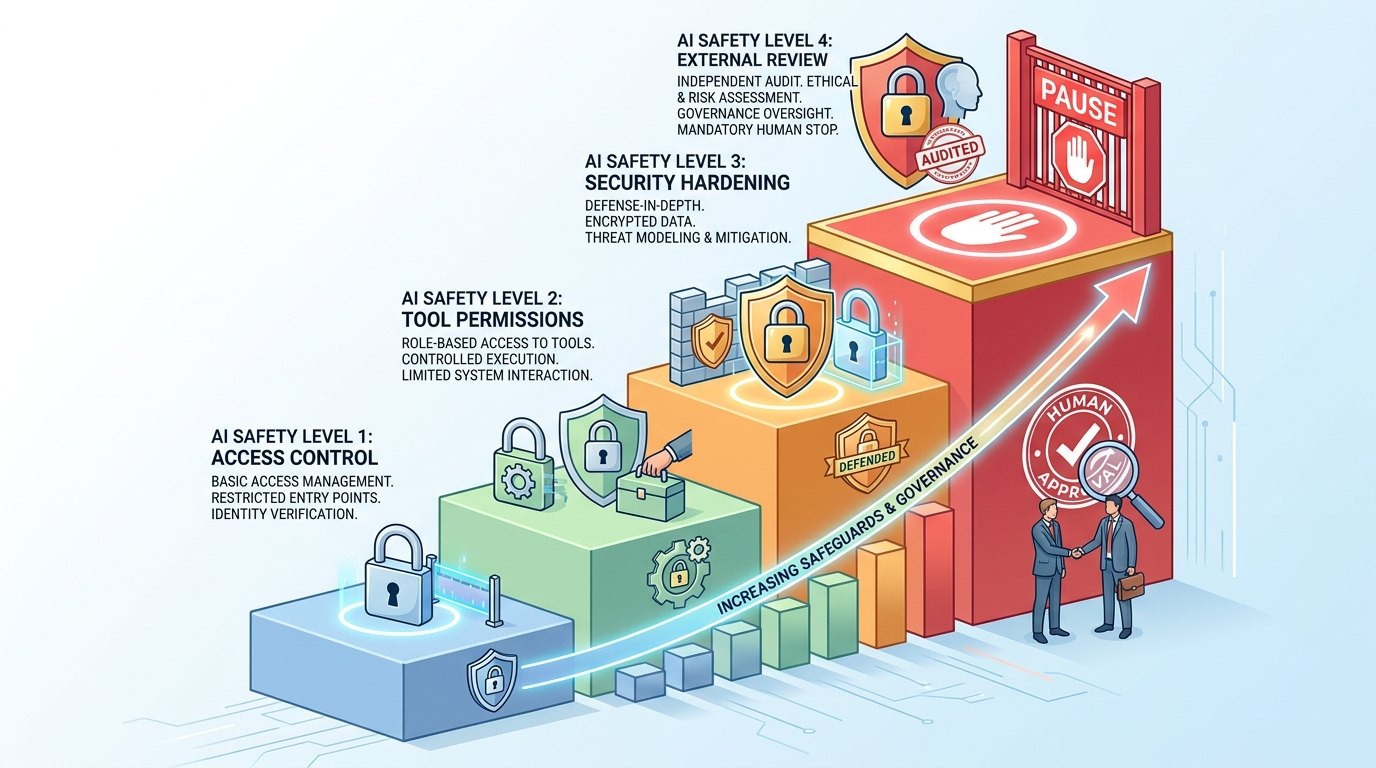
Access control is often underestimated. A capability that is manageable in a small evaluator group may become dangerous when exposed to millions of users. Rate limits, identity checks, enterprise contracts, trusted researcher programs, staged rollouts, and API restrictions are not just business settings. They are part of the safety posture.
Tool permissions are equally important. An AI model that can only answer questions is different from one that can run code, browse the web, send messages, edit databases, operate robots, or deploy software. The higher the ASL tier, the more tool access should be scoped, logged, sandboxed, and gated by human approval. This is where frontier AI governance connects directly to ordinary product design.
Security hardening becomes more important as capability rises because the model itself becomes a target. A dangerous capability does not need to be widely released to create risk if the weights, internal systems, or deployment credentials can be stolen. A serious ASL policy should treat cybersecurity, insider risk, supply-chain security, and model access as part of the safety case, not as separate back-office concerns.
Evaluation depth should also change. A normal product QA pass cannot answer whether a frontier model enables severe cyber misuse, biological assistance, autonomous replication, or long-horizon tool use. Higher tiers require domain experts, adversarial testing, realistic task design, and enough transparency for decision-makers to understand uncertainty.
Practical Examples of ASL Thinking
ASL tiers can sound abstract, so it helps to translate them into concrete examples. These are not claims about any specific system. They are examples of how the threshold logic works.
Example 1: A coding model moves from advice to action
A model that explains code vulnerabilities in general terms may be handled with normal safety controls and abuse monitoring. A model that reliably discovers exploitable vulnerabilities in realistic targets, writes working exploit chains, and can operate through a browser or shell raises a different question. The risk is no longer only what the model says. It is what the model can help a user do. An ASL-style response might restrict tool access, require stronger cyber evaluations, add monitoring for misuse patterns, and limit release until safeguards are proven.
Example 2: A research assistant improves dual-use guidance
A scientific assistant can be valuable for education and legitimate research. But if evaluations show that it meaningfully helps non-experts perform dangerous biological or chemical workflows beyond what they could do with ordinary search, the tier should change. Stronger controls might include domain-specific refusals, expert red teaming, restricted access for sensitive workflows, audit trails, and external review.
Example 3: An agent becomes more autonomous
A chatbot that waits for each prompt has one risk profile. An agent that plans over hours, calls tools, creates accounts, writes files, sends messages, and recovers from errors has another. If the system can pursue long-horizon tasks with limited supervision, an ASL-style policy should examine autonomy, monitorability, approval gates, and containment before allowing broader deployment.
Example 4: A model is safe in a pilot but risky at scale
A model may look acceptable in a trusted pilot where users are known, rate limits are strict, and monitoring is strong. The same model may be unacceptable for unrestricted public access. ASL thinking forces teams to evaluate the deployment context, not only the base model. Scale changes risk because it increases the number of attempts, the diversity of users, and the chance that edge cases become real incidents.
These examples show why ASL tiers support the broader idea of risk thresholds. The threshold is the evidence that says the risk class has changed. The ASL tier is the governance container that says what safeguards must change with it.
Common Mistakes When People Interpret AI Safety Levels
The first mistake is treating ASL as a universal public rating, like a nutrition label for models. It is not that simple. ASL terms come from specific organizational policies, and each policy must be read in its own context. A serious reader should ask how the organization defines the level, what evidence it uses, and what commitments follow.
The second mistake is assuming a higher level means a model should never exist. Higher risk does not automatically mean no research, no testing, or no beneficial use. It means the burden of proof rises. The system may need stronger safeguards, narrower access, more security, external evaluation, or a pause until controls catch up.
The third mistake is assuming a lower level means the system is harmless. Lower-risk systems can still create privacy, bias, misinformation, manipulation, reliability, copyright, or ordinary security problems. ASL policies often focus on catastrophic or frontier risks, not every harm a deployed AI product can cause. Product safety and frontier safety overlap, but they are not identical.
The fourth mistake is ignoring incentives. A company under launch pressure may be tempted to interpret thresholds generously. That is why pre-declared criteria, documentation, external review, and governance authority matter. The hardest safety decisions happen when evidence is ambiguous and commercial pressure is high.
The fifth mistake is confusing compliance with sufficient safety. Regulation can set obligations, but frontier capabilities can move faster than law. A model could meet current legal requirements while still deserving stronger voluntary safeguards under an ASL policy. Conversely, an internal ASL policy does not replace legal obligations. Responsible organizations need both.
A Reader Checklist for Evaluating ASL Claims
When a lab or company says it has a responsible scaling policy, preparedness framework, or AI Safety Level system, readers can ask practical questions. The goal is not to catch every technical detail. The goal is to see whether the policy would actually change behavior when capability increases.
| Question | Why it matters | Stronger answer |
|---|---|---|
| Are the tiers defined before the model is evaluated? | Pre-defined criteria reduce goalpost moving. | The policy explains capability thresholds, evidence standards, and escalation rules in advance. |
| What evidence can move a model to a higher level? | Vague tiers are easy to ignore. | Named evaluations, red-team findings, domain expert review, autonomy tests, and deployment simulations. |
| What safeguards become mandatory? | A level without consequences is decorative. | Access limits, stronger security, monitoring, approval gates, external review, or pause conditions. |
| Who can stop or delay deployment? | Authority determines whether the policy has power. | A named governance process with documented sign-off and escalation rights. |
| How is uncertainty handled? | Evaluations are imperfect. | The policy uses safety margins, staged rollout, continuous monitoring, and re-evaluation triggers. |
For builders of smaller AI systems, this checklist still applies. You may not need a formal ASL board, but you do need thresholds. If your AI agent can send emails, move money, change customer records, run code, access private files, or publish content, define what actions require approval, logging, rollback, and monitoring. Frontier AI governance and everyday AI product safety are different in scale, but they share a basic rule: more power needs more control.
Related Singularity Journey Guides
- AI Risk Thresholds Explained — the source pillar for this cluster article.
- Frontier AI Safety Case Checklist — what evidence should come before deployment.
- AI Capability Evaluations Explained — how frontier systems are tested before release.
- AGI Warning Signs — capability signals that serious readers should watch.
- AI Risk Register — a practical NIST AI RMF checklist.
Sources and References
- Anthropic: Responsible Scaling Policy
- OpenAI: Updated Preparedness Framework
- NIST AI Risk Management Framework
- METR: Model Evaluation and Threat Research
- UK AI Safety Institute / AI Security Institute
- EU Artificial Intelligence Act resource
External links were checked for relevance and credibility. Unrelated, unsafe, shortened, or unverified links were excluded.
FAQ: AI Safety Levels and ASL Tiers
What are AI Safety Levels?
AI Safety Levels are tiers that connect an AI system’s capability and risk profile with the safeguards required before further scaling or deployment. They are best understood as a governance ladder rather than a simple model rating.
Are ASL tiers the same as AI regulation?
No. ASL tiers usually refer to an organizational safety policy, while regulation refers to legal obligations. A serious AI governance program may need both internal risk thresholds and compliance with applicable law.
How do ASL tiers relate to AI risk thresholds?
A risk threshold is the evidence-based trigger. An ASL tier is one way to organize the response. When a model crosses a threshold, it may move into a higher tier that requires stronger safeguards.
What is ASL-3 in plain English?
In plain English, ASL-3-style risk means the system could substantially increase catastrophic misuse risk or show concerning autonomy, so stronger safety, security, evaluation, and deployment controls are required.
Can AI Safety Levels guarantee that a model is safe?
No. They make safety decisions more explicit and harder to ignore, but they cannot eliminate uncertainty. Evaluations can miss risks, and deployment context can change how a model behaves.
Who should decide when a model crosses an ASL threshold?
The decision should involve technical evaluators, safety researchers, security teams, governance leaders, and external reviewers when risks are severe. The more serious the threshold, the less credible a purely informal internal decision becomes.
Conclusion: ASL Tiers Make Safeguards Scale With Capability
AI Safety Levels matter because they turn frontier AI safety from a slogan into a decision system. They ask what the model can do, how reliable that capability is, who can access it, what tools it can use, and what safeguards must become stronger before the system moves forward. That is exactly the kind of structure needed as AI systems become more general, more autonomous, and more deeply connected to the world.
The best ASL-style policies will not be perfect. They will still face hard measurement problems, incentive problems, and uncertainty. But they create a better default than vague reassurance. They make it possible for researchers, policymakers, builders, and readers to ask the right question: did the safeguards scale as fast as the capability?
If you want the broader foundation, start with our guide to AI risk thresholds. If you want the evidence checklist that should come before deployment, read the frontier AI safety case guide next. Together, these articles form a practical cluster for understanding how serious AI governance moves from concern to controls.
