
Enterprise AI Agents: The Workflow Layer Trend Reshaping Business Automation
Enterprise AI agents are moving beyond demo chatbots. The real trend is a new workflow layer where software can understand goals, plan steps, use tools, ask for approval, and leave an audit trail. This guide explains what is changing, which workflows are ready, and what governance must exist before companies scale agentic AI.
Enterprise AI Agents: Quick Answer
Enterprise AI agents are AI systems designed to complete business tasks by combining reasoning, context, tools, data access, memory, and controlled action. A chatbot mostly responds. An agent can plan a sequence, call an API, check a database, draft a response, route an exception, create a ticket, or ask a human to approve the next step.
The important trend is not simply that agents are becoming smarter. The important trend is that companies are beginning to treat agents as a workflow layer: a controlled space between human intent and business systems where AI can coordinate work across apps, documents, processes, and teams. That layer can help with customer service, finance operations, software delivery, compliance research, sales operations, HR support, knowledge work, and internal automation. But it can also create new failure modes if leaders scale autonomy before evaluation, governance, and auditability are ready.
This article uses recent analytics from Singularity Journey, Search Console signals, and a fresh search-gap review. Our site already has topical strength around AI agents, evaluation, observability, human approval, ROI, and safety. The gap worth filling is a practical trend guide that connects those pieces into one enterprise operating model.
Why Enterprise AI Agents Are Becoming a Serious Trend
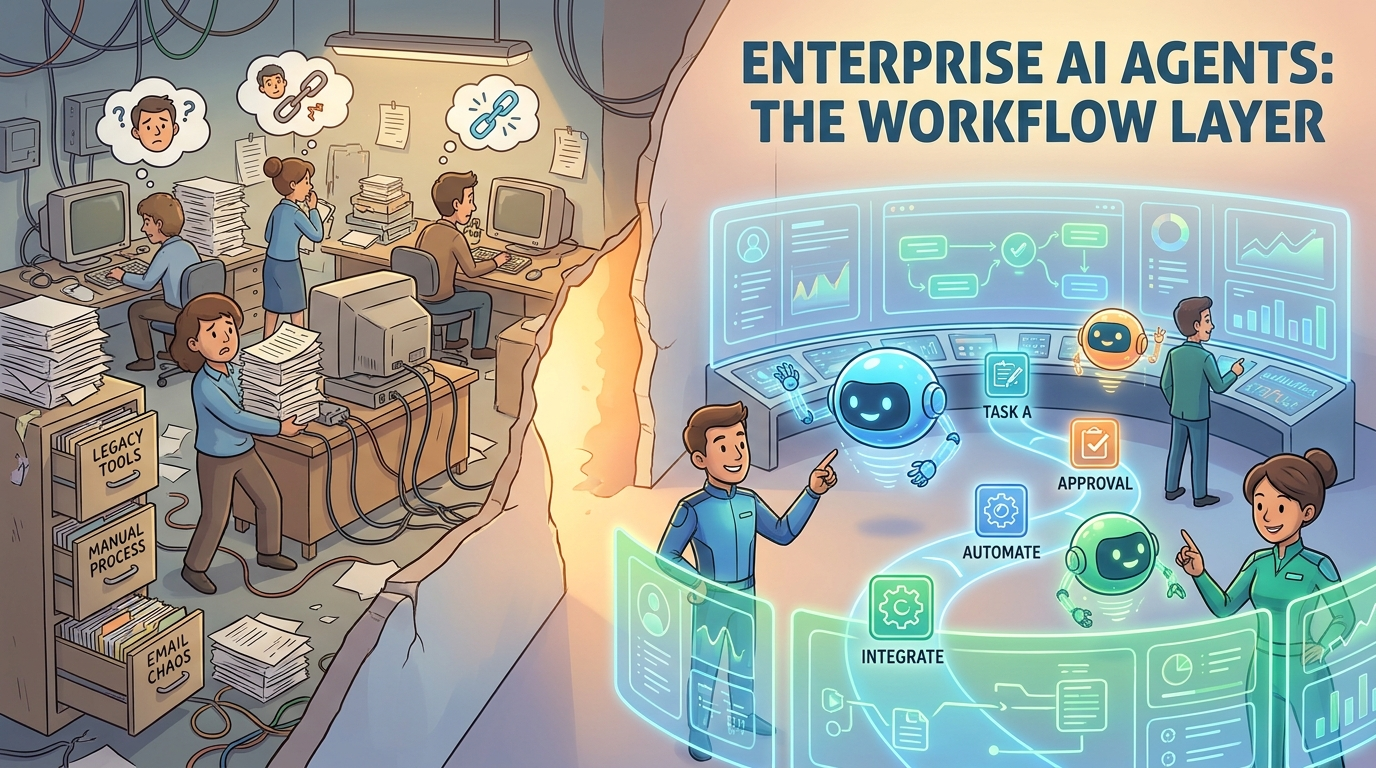
For the first wave of generative AI adoption, the default product shape was a chat box. Employees asked a model to summarize, brainstorm, rewrite, classify, or explain. That was useful, but it often remained outside the real workflow. Someone still copied text between systems, checked the source, created the task, opened the CRM, updated the spreadsheet, emailed the customer, and explained the status to a manager.
Enterprise AI agents change the product shape. Instead of making the worker move information between tools, the agent can sit closer to the flow of work. It can observe context, decide which tool is relevant, produce an intermediate plan, execute a safe step, pause for approval, and store the trace. In plain English, the agent becomes a junior operator inside the workflow rather than a clever text generator beside it.
Search results reflect this shift. Google Cloud frames agentic AI around complex semi-autonomous workflows. Databricks describes a transition from chatbots to agentic architectures, using signals from more than 20,000 organizations in its State of AI Agents material. Deloitte describes AI agents as autonomous reasoning engines that can understand context, plan workflows, connect to tools and data, execute actions, and adapt. These sources differ in product angle, but they point to the same direction: enterprises are asking AI to do work, not only talk about work.
There is also a practical reason the topic matters now: early AI enthusiasm is turning into ROI pressure. A proof of concept that delights a team for two weeks is no longer enough. Leaders want to know which workflows can move to production, which controls are mandatory, how incidents will be handled, what metrics prove value, and who is accountable when an agent makes a poor decision. The winning enterprise agents will not be the flashiest demos. They will be the systems that survive security review, process review, user adoption, cost review, and failure review.
What Makes an Enterprise AI Agent Different From a Chatbot?
A chatbot is usually conversation-first. It may answer questions, summarize documents, or generate content. An enterprise AI agent is task-first. It needs conversation, but it also needs access to structured context, tool permissions, workflow rules, error handling, and logging. The difference is easiest to see in the action loop.
| Capability | Chatbot pattern | Enterprise AI agent pattern |
|---|---|---|
| Goal handling | Responds to a prompt. | Breaks a business goal into steps and chooses a path. |
| Context | Uses the conversation and attached documents. | Uses approved data sources, memory, policies, task history, and system state. |
| Tools | May provide instructions for a human to follow. | Can call approved tools, APIs, databases, ticket systems, or workflow services. |
| Control | Relies heavily on user judgment in the chat. | Uses permission scopes, policy gates, human approvals, and audit logs. |
| Measurement | Measured by answer helpfulness. | Measured by task success, cost, latency, escalation rate, quality, and business outcome. |
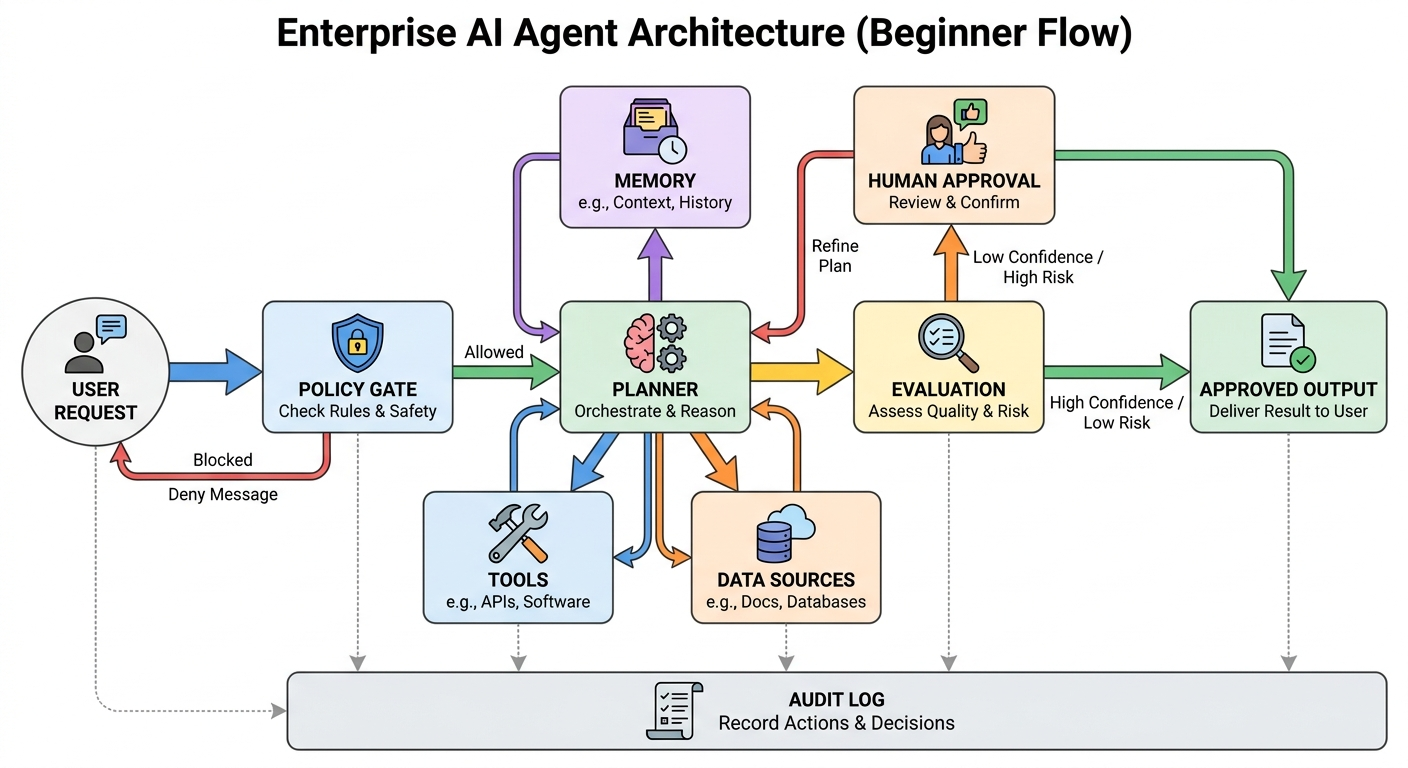
This distinction matters because companies often buy agentic AI with chatbot expectations. They expect a friendly interface, but production agents need infrastructure. A useful agent needs a planner, a tool layer, retrieval, guardrails, evaluation, observability, approvals, and rollback behavior. Without those pieces, the agent may look impressive in a demo while being too fragile for real operations.
RPA is another common comparison. Robotic process automation works best when the workflow is stable and rule-driven. Enterprise AI agents work best when there is more ambiguity: interpreting a request, reading unstructured text, mapping a goal to available tools, or deciding which exception should go to a person. In practice, the two can coexist. RPA can handle predictable steps. Agents can handle interpretation, orchestration, and exception routing, provided the permissions are narrow enough.
The Workflow Layer: The Real Shift Behind Agentic AI
The phrase “workflow layer” is useful because it avoids two extremes. One extreme says agents are just chatbots with extra tools. The other says agents are independent digital workers that should run entire businesses. Both are misleading. The practical middle is that agents become a layer where work is interpreted, routed, executed, checked, and escalated.
Imagine a customer sends a complex support request. A normal chatbot might answer with a generic policy. A workflow-layer agent can classify the issue, retrieve the customer’s plan, inspect recent orders, draft a response, open a refund request, check whether the refund is under the automatic approval limit, and ask a human to approve if the amount or risk is high. The agent does not need unlimited authority. It needs the right authority for the right step.
The same pattern applies to finance operations. An agent can read an invoice, match it to a purchase order, flag a mismatch, draft a vendor question, and send it to an accounts payable specialist. In software teams, an agent can triage failing tests, inspect logs, create a reproducible issue, and suggest a fix. In compliance, an agent can compare a policy update with internal controls and create review tasks for owners. These are not magical tasks. They are workflows with context, tools, actions, exceptions, and accountability.
The workflow layer has five parts. First, there is an intent surface where a human or system describes the desired outcome. Second, there is a planning layer that turns the intent into steps. Third, there is a tool layer that lets the agent read and act. Fourth, there is a control layer that checks policies, permissions, risk, and approvals. Fifth, there is an evidence layer that records what happened so the company can review, improve, and defend the system.
That model is why enterprise agents are strategic. They can reduce handoffs, shorten cycle time, and make hidden process steps visible. But they also force companies to confront process messiness. If the underlying workflow is unclear, the agent will not magically fix it. It will expose the ambiguity faster.
Which Enterprise Workflows Are Ready for AI Agents?
The best early workflows are not the most glamorous. They are the ones where the task is repetitive enough to measure, contextual enough for AI to help, low enough risk to recover from mistakes, and valuable enough that saved time matters. A good agent workflow should have clear inputs, clear success criteria, clear escalation rules, and a human owner.
| Workflow | Why it fits | Control needed |
|---|---|---|
| Customer support triage | High volume, repeated intent patterns, measurable resolution outcomes. | Approval for refunds, cancellations, sensitive cases, or policy exceptions. |
| Internal knowledge support | Employees waste time searching policies, docs, and procedures. | Source citations, freshness checks, and “I do not know” behavior. |
| Finance document processing | Invoices, receipts, purchase orders, and exceptions follow patterns. | Human approval for payment, vendor changes, and mismatches. |
| Sales operations | Agents can prepare account briefs, update CRM notes, and draft follow-ups. | Privacy controls, customer data boundaries, and message approval. |
| Software engineering triage | Agents can inspect logs, failing tests, dependency errors, and issue context. | Sandboxing, code review, test gates, and limited production access. |
| Compliance monitoring | Agents can compare policies, map controls, and generate review tasks. | Expert review, audit trail, citation quality, and jurisdiction boundaries. |
High-risk workflows need more caution. Medical decisions, loan approvals, legal conclusions, hiring decisions, security actions, and financial transactions should not be treated as normal automation just because an agent can produce confident text. These workflows may still benefit from agent assistance, but the agent should gather evidence, draft analysis, detect inconsistencies, and route to accountable humans rather than act independently.
This is where many trend articles are too vague. Saying “agents will transform every industry” is less useful than asking whether a specific step is reversible, measurable, auditable, bounded, and low enough risk for automation. Enterprise AI maturity is not a slogan. It is a queue of process decisions.
Enterprise AI Agent Readiness Matrix
Before a company scales enterprise AI agents, it should classify workflows by risk and readiness. The matrix below is designed for practical planning, not theoretical purity. If a workflow lands in the lower-right area, start with advisory assistance. If it lands in the upper-left area, it may be a strong candidate for controlled automation.
| Readiness signal | Green: automate with controls | Yellow: assist with approval | Red: do not automate yet |
|---|---|---|---|
| Task clarity | Steps and success criteria are documented. | Some exceptions are unclear. | People disagree on the workflow itself. |
| Data quality | Approved sources are current and structured enough. | Sources exist but conflict or need freshness checks. | Data is missing, private, unreliable, or poorly governed. |
| Action risk | Actions are reversible or low impact. | Actions affect customers, money, or compliance but can be reviewed. | Actions are high impact, irreversible, or legally sensitive. |
| Measurement | Quality, cost, time, escalation, and outcomes can be tracked. | Some metrics exist but need cleanup. | No reliable baseline or owner. |
| Human ownership | A team owns exceptions, review, and improvement. | Ownership is shared but not formalized. | No accountable business owner. |
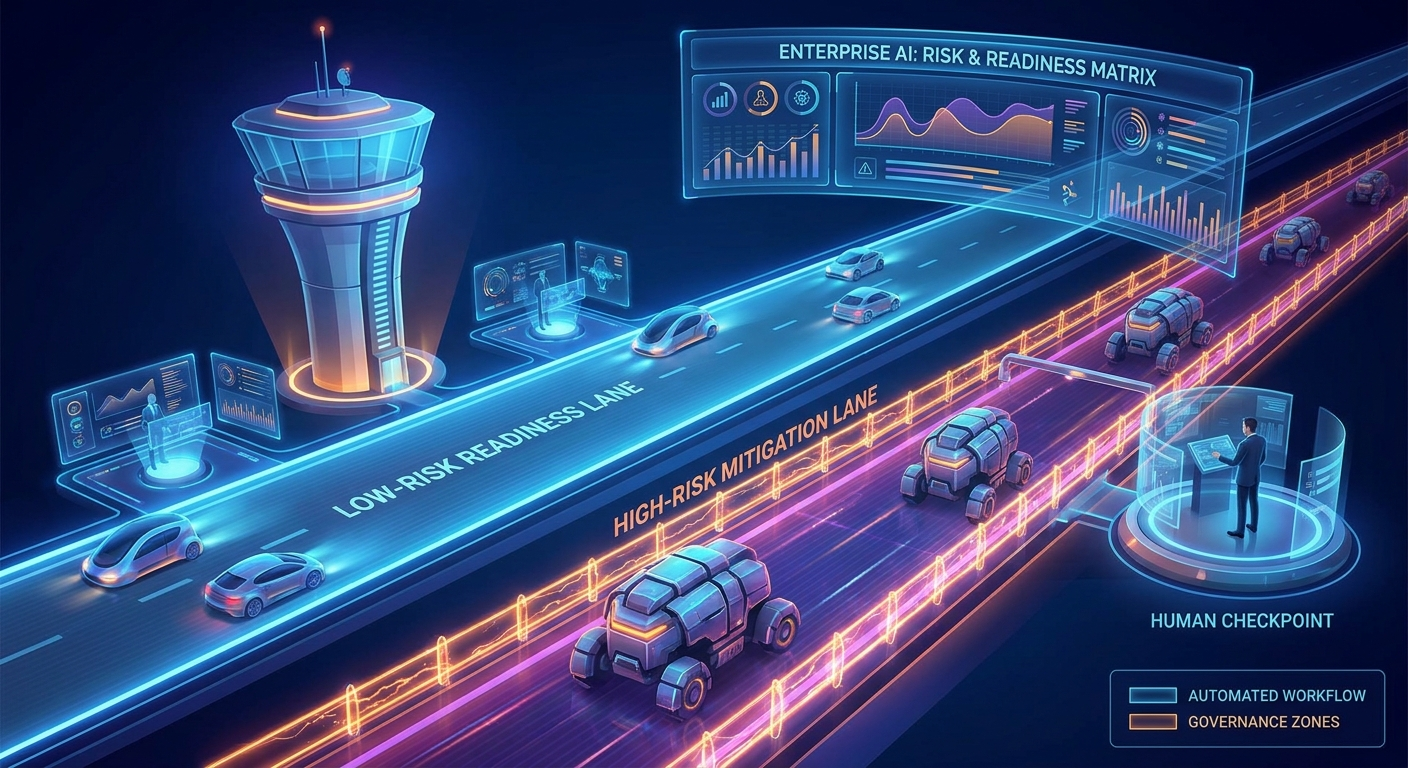
The hidden lesson is that agent readiness often has less to do with model capability than operating discipline. A medium-capability model with clean tools, narrow permissions, strong tests, and good human review may beat a frontier model connected to messy systems with vague goals. Enterprise buyers should therefore evaluate the whole agent system, not only the model label.
Governance: What Must Exist Before Agents Scale
Databricks emphasizes governance and evaluation as building blocks of production adoption, and that matches what practitioners see in real deployments. If a company cannot answer who approved an action, why an agent chose a tool, what data it used, and how often it escalates, then the agent is not production-ready. It is an experiment with a nice interface.
Agent governance should start with permission design. Every tool should have a purpose, scope, and risk level. Read access is not the same as write access. Drafting an email is not the same as sending it. Creating a ticket is not the same as closing it. Reading customer data is not the same as changing account status. Good systems make these boundaries explicit.
The second layer is human approval. Approval should not be a generic “ask a human sometimes” rule. It should be tied to thresholds: money amount, customer impact, regulatory sensitivity, confidence level, missing evidence, unusual pattern, protected attribute, security implication, or irreversible action. A well-designed approval gate teaches the organization which decisions are safe to automate and which ones require judgment.
The third layer is evaluation. Agents should be tested against realistic tasks, not only happy-path demos. Evaluation sets should include ambiguous requests, missing data, conflicting instructions, prompt injection attempts, tool failures, stale documents, policy exceptions, and edge cases. A production agent that only works when the world is clean will fail where enterprises most need help.
The fourth layer is observability. Leaders need traces, cost records, latency data, failure reasons, escalation reasons, and outcome quality. This connects directly with Singularity Journey’s guides on AI agent observability and AI agent evaluation metrics. Without observability, teams cannot know whether an agent is improving, drifting, or quietly creating risk.
Metrics That Prove an Enterprise AI Agent Is Worth Scaling
Executives often ask for ROI. Operators often ask whether the system is safe. Users ask whether it helps. A good measurement system needs all three views. If the agent saves time but creates rework, the ROI is fake. If it is safe but too slow, adoption will fade. If users like it but auditors cannot review it, production will stall.
| Metric | What it tells you | Why it matters |
|---|---|---|
| Task completion rate | How often the agent reaches the correct outcome. | Basic usefulness. |
| Escalation rate | How often the agent asks for human help. | Shows autonomy limits and risk sensitivity. |
| Correction rate | How often humans fix the agent’s output. | Reveals hidden rework. |
| Cycle-time reduction | How much faster the workflow completes. | Connects AI to business value. |
| Cost per completed task | Model, tool, infrastructure, and review cost. | Prevents impressive but uneconomic automation. |
| Incident rate | Policy breaches, wrong actions, privacy errors, or unsafe responses. | Protects trust and compliance. |
| User adoption | Whether employees actually keep using it. | Separates demo excitement from durable value. |
These metrics should be reviewed by a cross-functional group: business owner, technical owner, security or risk partner, and user representative. Agentic AI is not only an engineering project. It changes operating procedures, decision rights, and accountability.
For deeper ROI thinking, connect this article with AI Agent ROI Scorecard and Enterprise AI ROI Reckoning. Those pieces help turn the trend into a measurable business case.
A Practical Operating Model for Moving From Pilot to Production
The safest path is staged. Start with a workflow map. Identify one bounded process, one accountable owner, one data source, one tool set, and one measurable outcome. Then build an advisory version of the agent that recommends actions without executing them. Use that phase to collect examples, failure cases, user feedback, and evaluation data.
Next, move to supervised execution. The agent can prepare actions and route them for approval. This is where companies learn which approval thresholds are too strict, too loose, or poorly defined. Over time, low-risk steps can become automatic while high-risk steps remain human-approved. The goal is not maximum autonomy. The goal is the right autonomy at the right point in the workflow.
Finally, scale only when the system is boring in the best possible way. The agent should have predictable behavior, known failure modes, clear dashboards, an incident playbook, and a backlog of improvements. If every week brings a surprising new class of failure, the workflow is not ready for broad rollout.
What gets better
- Less manual handoff between tools and teams.
- Faster triage for repetitive knowledge workflows.
- Clearer visibility into process bottlenecks.
- Reusable evaluation and governance patterns.
- Better routing of routine work to machines and judgment work to humans.
What gets harder
- Permissions and data boundaries need real design.
- Cost can rise if agents run vague long tasks.
- Accountability is unclear without ownership rules.
- Security teams must test new prompt and tool risks.
- Organizations must maintain evaluations as processes change.
This is why enterprise AI agents are not simply another software category. They are a new coordination pattern. They sit between people, data, systems, and decisions. That makes them powerful. It also makes them organizationally sensitive.
Why This Pillar Topic Fits Singularity Journey
Singularity Journey’s recent analytics show that readers are engaging with AI agent explainers, safety levels, approval gates, observability, evaluation, and workflow skills. Search Console volume is still early, but existing pages already appear for agent-related queries and several agent pages have small-impression rankings. That suggests the site should continue building a connected authority cluster rather than chasing unrelated trend topics.
This article is designed as the TRENDS & INSIGHTS pillar that links the cluster together. It does not repeat a beginner definition of agents, a developer tutorial, or a narrow ROI scorecard. Instead, it explains the market movement: agents are becoming a workflow layer, and the winners will be teams that pair autonomy with controls. It links naturally to AI Agents Are Becoming the Workflow Layer, Human Approval Gates for AI Agents, How AI Agents Work, and Prompt Injection Guardrails for AI Agents.
Final Recommendation: Treat Agents as Governed Operators, Not Magic Workers
Enterprise AI agents are becoming important because they move AI from content generation into business execution. That is the opportunity. It is also the danger. A system that can act inside workflows must be designed with more care than a system that only writes text.
The practical recommendation is simple: choose one bounded workflow, define the owner, map the data, limit the tools, write approval thresholds, build evaluations, observe every run, and measure business outcomes. If the agent passes that test, expand gradually. If it fails, fix the workflow before increasing autonomy.
The future of enterprise AI will not be won by companies that deploy the most agents. It will be won by companies that know where agents belong, where humans must remain accountable, and how to turn every automated action into evidence that can be reviewed, trusted, and improved.
Keep Learning on Singularity Journey
- AI Agents Are Becoming the Workflow Layer — the strategic shift from passive software to action-taking systems.
- Human Approval Gates for AI Agents — how to design review checkpoints before agents act.
- AI Agent Evaluation Metrics — what to measure before production agents scale.
- AI Agent Observability — tracing, debugging, and monitoring production agents.
- AI Agent ROI Scorecard — prove whether enterprise agents are worth scaling.
- Prompt Injection Guardrails for AI Agents — beginner-friendly safety controls for tool-using agents.
Sources and References
- Google Cloud: AI agent trends report
- Databricks: Enterprise AI agent trends and State of AI Agents summary
- Deloitte: AI agents for business and agentic AI insights
- Anthropic Economic Index
- Stanford HAI: AI Index
Source links were checked for relevance and credibility. Low-quality, unverifiable, or promotional SERP results were excluded.
FAQ: Enterprise AI Agents
What are enterprise AI agents?
Enterprise AI agents are AI systems that use context, planning, tools, data access, and controls to complete business tasks. They are usually designed for bounded workflows rather than open-ended autonomy.
How are enterprise AI agents different from chatbots?
Chatbots mainly respond in conversation. Enterprise AI agents can plan steps, call approved tools, use business data, request approvals, and create an audit trail for actions.
Which workflows are best for enterprise AI agents?
Strong early candidates include customer support triage, internal knowledge support, finance document processing, sales operations, software triage, and compliance research. The best workflows are measurable, bounded, reversible, and owned by a clear team.
What is an AI agent control plane?
An AI agent control plane is the governance and operations layer that manages permissions, tools, policies, approvals, evaluations, monitoring, logs, and incident response for agents.
How should companies govern AI agents?
Companies should define scoped permissions, policy gates, human approval thresholds, evaluation tests, observability, incident processes, and business ownership before agents act in production.
What metrics prove an AI agent is ready for production?
Useful metrics include task completion rate, correction rate, escalation rate, cycle-time reduction, cost per completed task, latency, incident rate, user adoption, and business outcome quality.
Are enterprise AI agents safe?
They can be safe enough for specific workflows when permissions are narrow, data is governed, actions are reversible or approved, evaluations are realistic, and every run is logged. They are not safe when given broad authority without controls.
Will AI agents replace employees?
Most near-term enterprise agents are better understood as workflow operators that automate routine steps and route exceptions. They may change roles and reduce repetitive work, but high-impact judgment, accountability, and relationship work still need humans.
