
Enterprise AI ROI Reckoning: Why Agentic AI Needs Governance Before Scale
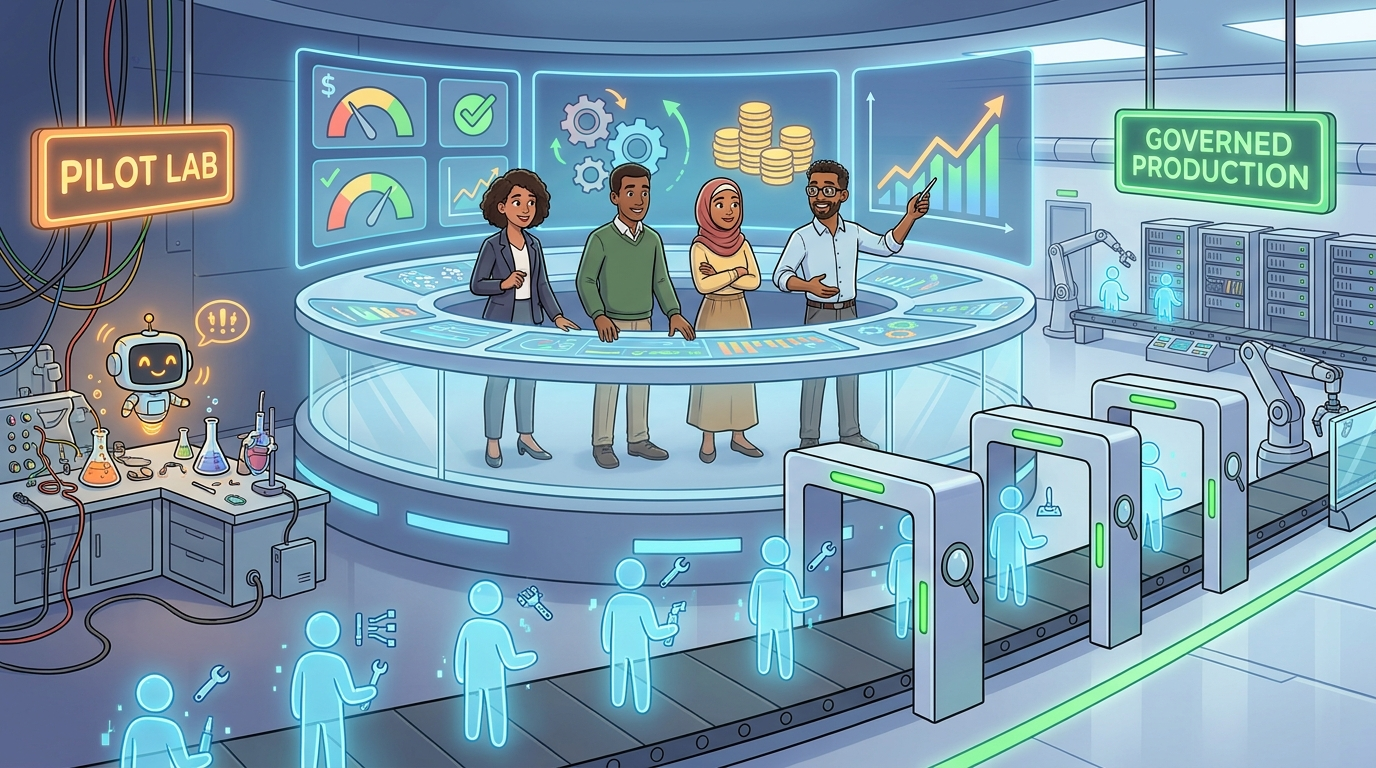
The next enterprise AI wave is not about launching more pilots. It is about proving which AI agents can deliver measurable business value with governance, observability, cost control, and human accountability built in.
Quick Answer: The Enterprise AI ROI Reckoning
Enterprise AI ROI is entering a harder, more useful phase. The question is no longer whether generative AI can produce demos, summaries, prototypes, or impressive agent conversations. The question is whether AI agents can complete valuable business work repeatedly, safely, measurably, and cheaply enough to justify production scale.
The early wave of enterprise AI rewarded speed. Teams launched copilots, internal chatbots, retrieval tools, agent prototypes, and workflow experiments. That was necessary learning. But the next wave rewards discipline: governed agents, clean data access, human approval rules, observability, cost tracking, evaluation, security, and a business scorecard that separates usage from value.
This is the trend leaders should understand now. The winners will not be the companies with the most AI pilots. They will be the companies that turn a smaller number of well-governed agent workflows into reliable operating capacity.
Why This Trend Matters Now
Enterprise AI has moved from presentation slides into operating systems. AI agents can read documents, call tools, retrieve records, draft responses, route cases, inspect code, summarize meetings, update tickets, prepare research, and coordinate multi-step work. That is a major change from simple chat because the model is no longer only producing an answer; it may be participating in a workflow.
That shift raises the standard for ROI. A chatbot can be judged by answer quality, adoption, and user satisfaction. An agent must be judged by task completion, cost per completed task, error rate, escalation rate, compliance posture, auditability, and the quality of the final business outcome. The more autonomy an agent receives, the more management discipline it needs.
Public market signals point in the same direction. Google Cloud’s ROI of AI material highlights enterprise interest in agentic AI and reports that early adopters are seeing positive returns when agents are connected to real workflows. Stanford’s AI Index tracks the broader acceleration of AI investment, capability, and deployment. McKinsey’s State of AI research has repeatedly shown organizations moving from experimentation toward workflow redesign. Gartner has warned that many agentic AI projects may be canceled if they remain expensive, poorly scoped, or insufficiently governed. The exact numbers vary by source and methodology, but the pattern is consistent: enthusiasm is high, and the operating bar is rising.
Singularity Journey analytics support this editorial angle. Recent GA4 data showed traffic concentrating around AI agent controls, evaluation frameworks, workflows, safety frameworks, and enterprise adoption. Search Console data is still early and sparse, which means the best SEO move is not chasing one tiny query. It is building a durable topic cluster around a reader problem that is likely to grow: how enterprises move agents from pilots to production without losing control.
The Pilot Trap: Why Demos Do Not Prove ROI
AI pilots are useful because they reduce uncertainty. They show what the model can do, what users want, and where the workflow might change. But pilots often hide the costs and risks that appear in production. A five-person demo does not reveal how the agent behaves across thousands of cases, messy permissions, changing data, user workarounds, compliance reviews, and edge-case failures.
The pilot trap happens when a team confuses “the agent worked in a controlled example” with “the agent is ready to become part of the operating model.” A demo can look magical because the task is narrow, the data is clean, the user is motivated, and the consequences are low. Production is different. Inputs are incomplete. Users ask unexpected questions. Source systems are inconsistent. Costs accumulate. Logs need review. Security teams ask who accessed what. Business teams ask whether the workflow actually saved money, reduced cycle time, improved quality, or increased revenue.
A serious AI ROI review asks uncomfortable questions. What percentage of tasks reached completion without human rescue? How often did the agent escalate correctly? What was the cost of failed runs? Did the agent reduce total work or merely move work into review queues? Did users trust it enough to change behavior? Did quality improve after deployment, or did teams spend more time checking outputs? Did the agent create audit trails that compliance teams could use?
This is why the current enterprise trend is not simply “more agents.” It is “more accountable agents.” Companies are learning that autonomy without control can create hidden work. A useful agent is not the one that sounds most human. It is the one that produces reliable outcomes inside clear boundaries.
The Enterprise AI ROI Stack
Enterprise AI ROI is not one metric. It is a stack of conditions. If one layer is weak, the final business case becomes fragile. Leaders should inspect the full stack before scaling an agent workflow.
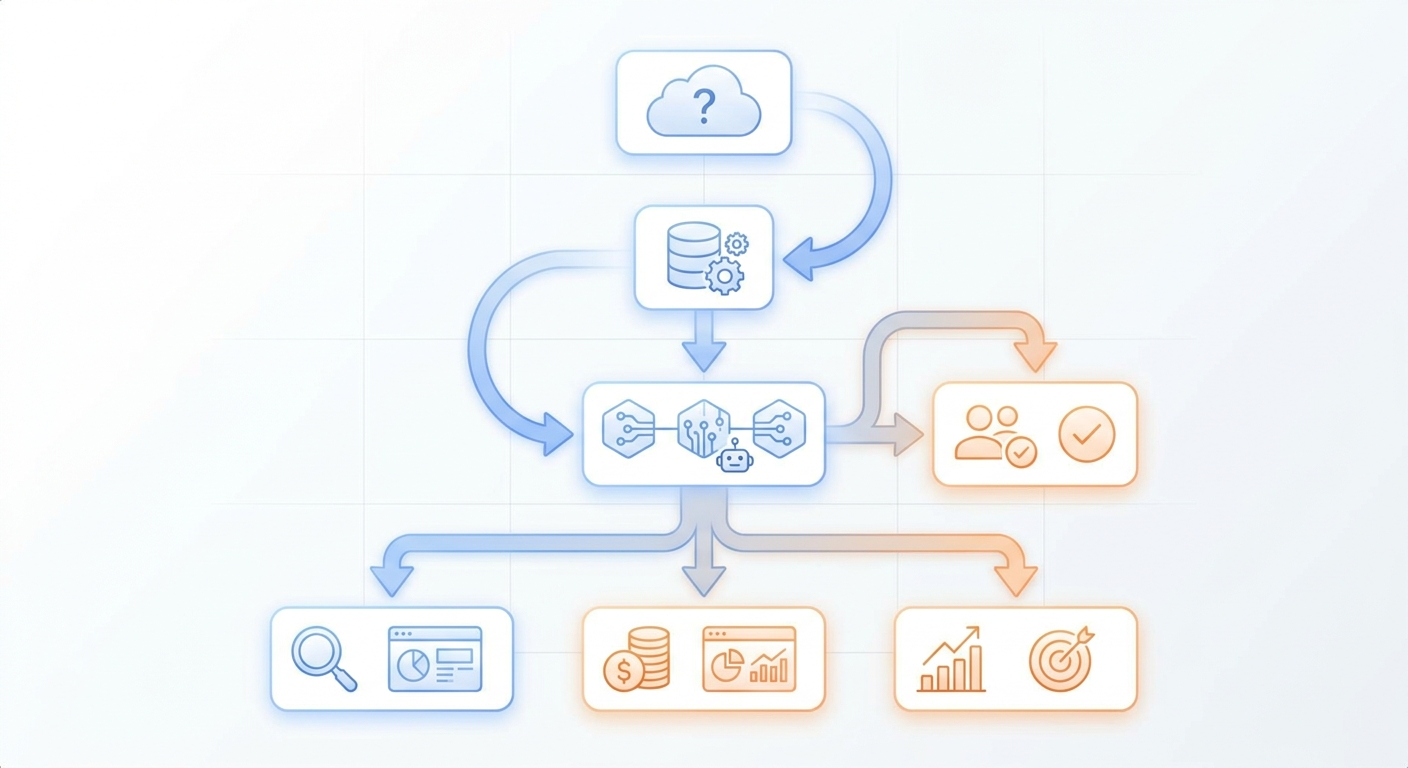
The stack matters because many failed AI initiatives are not model failures. They are workflow failures. The model may be capable, but the organization has not given it clear context, enough boundaries, a safe action surface, or a useful way to measure results. A company can spend months debating models while ignoring the approval rule that actually determines whether the workflow can go live.
A practical ROI review should therefore begin before procurement. Define the workflow. Map the current baseline. Estimate volume. Identify risk tiers. Decide which actions are read-only, which are reversible, which require human approval, and which are forbidden. Then choose the model, tool layer, and observability stack that fit the work.
Metrics That Separate AI Usage From AI Value
Usage is not value. A high number of prompts, chats, agent runs, or generated drafts may simply mean people are experimenting. Value appears when the organization can show a better outcome than the previous process.
| Metric | What it tells you | Why it matters |
|---|---|---|
| Task completion rate | How often the agent finishes the intended workflow correctly. | Prevents teams from celebrating partial automation that still creates human cleanup. |
| Escalation rate | How often the agent hands work to a human. | Healthy escalation is good; chaotic escalation signals poor scope or weak context. |
| Cost per completed task | Total model, tool, infrastructure, and review cost divided by successful outcomes. | Connects AI spending to economic reality rather than raw token consumption. |
| Cycle-time reduction | How much faster the workflow moves from request to approved output. | Useful for support, sales, finance, legal, HR, engineering, and operations workflows. |
| Quality and rework | Defect rate, review failures, customer corrections, or repeated revisions. | Ensures speed does not hide lower quality. |
| Incident and policy rate | Security, privacy, compliance, hallucination, or tool misuse events. | Shows whether the agent is safe enough to scale. |
| Adoption with retention | Whether users keep using the workflow after novelty fades. | Separates genuine usefulness from launch-week curiosity. |
The best AI ROI scorecards include both business and technical metrics. Business leaders need to see cost, speed, revenue, customer experience, and risk. Technical teams need to see latency, failed tool calls, retrieval quality, trace quality, model drift, and evaluation scores. Compliance teams need audit trails. Frontline users need to know when the agent is helping and when it is making work harder.
If your dashboard only shows adoption, you are not measuring ROI. If it only shows model performance, you are not measuring ROI. If it only shows cost savings, you may be hiding quality and risk. A serious scorecard makes tradeoffs visible.
Why Governance Is Becoming the ROI Multiplier
Governance often sounds like a brake. In agentic AI, it is closer to a steering system. Without governance, leaders hesitate to scale because they cannot answer basic questions: What can this agent access? What can it change? Who approved the action? What source did it use? What happened when it failed? How do we stop it? Which data did it expose? Which policy applies?
Good governance makes scaling easier because it creates confidence. A governed agent has an identity, defined permissions, limited tools, traceable actions, and escalation rules. It does not improvise across the enterprise. It operates inside a designed action space. That allows teams to increase volume without increasing anxiety at the same pace.
Google Cloud’s Gemini Enterprise documentation discusses governance concepts such as discovering, securing, and auditing agents and their infrastructure. The exact platform may differ by company, but the principles travel: agents need registries, gateways, identity, access control, monitoring, and policy enforcement. In plain language, the business needs to know which agents exist, what they are allowed to do, and how their actions are reviewed.
Governance also improves ROI because it reduces wasted runs. When context is clean, permissions are clear, and approvals are built into the workflow, agents spend less time wandering. They call fewer irrelevant tools, produce fewer unusable outputs, and require less human rescue. That is an economic benefit, not merely a compliance benefit.
From AI Pilot to Production Operating Model
Scaling AI agents requires a repeatable operating model. The old approach was: pick a tool, run a pilot, present results, and hope adoption spreads. The new approach should be: select a high-value workflow, set a baseline, design the control plane, test against real cases, measure the economics, and expand only when the agent proves it can operate safely.
Production-ready signs
- The workflow has clear input, output, owner, and approval rules.
- The agent uses permissioned sources and logs tool calls.
- Evaluation covers normal cases, edge cases, and failure modes.
- Cost per successful task is understood.
- Humans know when to trust, edit, reject, or escalate output.
- Security, compliance, and business owners agree on risk boundaries.
Scale-warning signs
- The only success metric is “people liked the demo.”
- The agent has broad access because permissions were easier that way.
- No one reviews failed runs or repeated retries.
- Costs are tracked at account level, not workflow level.
- The agent cannot explain its source or decision path.
- Users quietly return to the old process after launch.

The operating model should also include ownership. An agent workflow needs a business owner, technical owner, risk owner, and support path. If the agent breaks, who fixes it? If it makes a bad recommendation, who reviews it? If the model provider changes behavior, who revalidates the workflow? If the business process changes, who updates the prompt, retrieval rules, and evaluation set?
These questions may feel heavy, but they are normal production questions. Enterprises already ask similar things about software, cloud infrastructure, financial controls, customer support processes, and data pipelines. Agentic AI is joining that world. It cannot stay in the demo sandbox forever.
Which Enterprise AI Agent Use Cases Are Most Likely to Show ROI?
The strongest early use cases usually have five traits: high volume, clear boundaries, accessible context, reversible outputs, and measurable outcomes. They do not require perfect autonomy. In fact, many high-ROI workflows keep humans in the approval loop while AI handles preparation, routing, summarization, drafting, or comparison.
Customer support triage
Agents can summarize tickets, classify urgency, suggest knowledge-base articles, and prepare draft responses. ROI comes from faster routing, fewer repeated questions, and better handoffs. Governance matters because customers should not receive unchecked hallucinated answers or policy-violating promises.
Sales and account preparation
Agents can gather account context, summarize CRM history, draft call briefs, and identify follow-up opportunities. ROI comes from better preparation and less administrative work. Risk control matters because outreach should be accurate, respectful, and compliant with data-use rules.
Finance and procurement workflows
Agents can compare invoices, flag missing fields, draft approval notes, and route exceptions. ROI comes from cycle-time reduction and fewer manual checks. Human approval remains essential for payments, contract commitments, and policy exceptions.
Software engineering support
Agents can explain traces, propose tests, draft documentation, inspect pull requests, and perform bounded refactors. ROI comes from faster debugging and less repetitive work. Production readiness requires tests, diffs, code review, and traceability.
HR and internal knowledge
Agents can help employees find policies, draft onboarding answers, and route requests. ROI comes from reduced search time and better employee experience. Governance matters because HR data is sensitive and policy answers can affect people’s rights, benefits, and expectations.
The pattern is clear: agents create value when they sit inside a well-understood process. They struggle when asked to replace judgment across a vague business domain.
The Hidden Cost Problem: Why AI Agents Need Unit Economics
Enterprise AI cost is not just the subscription price. It includes model calls, context size, retrieval, tool execution, infrastructure, logging, human review, integration maintenance, vendor management, security review, and rework. A pilot may ignore many of these costs. Production cannot.
Agent loops are especially important. A single user request may trigger planning, retrieval, tool calls, code execution, reasoning, retries, verification, and final response generation. That can be worth it for a valuable task. It can be wasteful for a poorly scoped task. Leaders need to understand the cost per completed outcome, not merely the monthly platform bill.
Unit economics force better design. If the agent spends too much context on irrelevant documents, improve retrieval. If it retries the same failed tool call, add better error handling. If it escalates too often, refine scope or data readiness. If humans rewrite most outputs, improve prompts, examples, quality checks, or task selection. If costs are high but outcomes are valuable, reserve the workflow for premium cases rather than applying it everywhere.
This is where observability becomes financial infrastructure. Logs and traces are not only for debugging. They reveal where money and effort leak out of the workflow. A mature AI team can inspect a failed run and see whether the problem was missing data, weak instructions, tool error, model limitation, ambiguous user request, or bad escalation design.
A Practical Executive Action Plan
If you lead AI adoption, start with a portfolio view. List current AI pilots, their business owners, target workflows, active users, costs, data sources, risk tier, and production status. Many organizations discover they have more experiments than operating discipline. That is not a failure; it is the raw material for prioritization.
Next, choose three workflows for serious ROI review. Pick one customer-facing workflow, one internal productivity workflow, and one technical or operational workflow. For each, establish the current baseline: volume, cycle time, human effort, error rate, quality issues, customer or employee pain, and current cost. Then design the AI-assisted version and decide what evidence would prove it is better.
Third, build the control layer before expanding access. Define agent identity, permissions, retrieval sources, tool scopes, approval checkpoints, logs, evaluation sets, incident response, and shutdown rules. This may slow the launch, but it speeds trust. The goal is not to create bureaucracy. The goal is to prevent an impressive pilot from becoming an unmanaged risk.
Fourth, publish a scorecard. Keep it simple enough that executives, technical teams, and business owners can discuss the same facts. Include outcome value, cost per completed task, task completion rate, escalation quality, incident rate, user retention, and lessons learned. Review the scorecard monthly until the workflow is stable.
Finally, create internal links between AI initiatives. A support triage agent, sales research agent, finance approval agent, and engineering agent may share governance patterns. Reuse approval rules, evaluation templates, logging standards, and cost dashboards. Enterprise ROI compounds when teams stop reinventing controls for every pilot.
Keep Learning on Singularity Journey
- Enterprise AI Agent Adoption — what leaders should track before scaling agents.
- Enterprise AI Agent Metrics — practical measurements for production readiness.
- AI Agent Evaluation Framework — how to test traces, memory, tool calls, and behavior.
- AI Workflow Decision Matrix — when to use fixed steps, agents, or human approval.
- Enterprise AI Agent Governance Checklist — permissions, approvals, and audit logs.
- AI Agent Controls Explained — tools, memory, permissions, and human approval.
Sources and References
- Google Cloud: ROI of AI report
- Stanford HAI: AI Index
- McKinsey: The State of AI
- Gartner Newsroom: AI and agentic AI research announcements
- Google Cloud: Gemini Enterprise
This article synthesizes analytics, public research, SERP review, and editorial analysis. ROI claims should be validated against your own baseline, cost model, risk tier, and production data.
FAQ: Enterprise AI ROI and Agentic AI Governance
What is enterprise AI ROI?
Enterprise AI ROI is the measurable business return from AI use after accounting for cost, quality, risk, adoption, and operational effort. For AI agents, ROI should be measured by completed outcomes, not just usage.
Why do AI agent pilots fail to scale?
They often fail because the workflow is vague, data access is messy, permissions are too broad, costs are not tracked per task, and no one has defined human approval or incident response.
Which AI agent metrics matter most?
Track task completion rate, cost per completed task, escalation rate, quality/rework, cycle-time reduction, incident rate, and user retention after the novelty period.
Does governance slow down AI ROI?
Weak governance can slow experiments, but strong governance improves production ROI by reducing rework, risk, failed runs, and stakeholder hesitation.
What is the best first enterprise AI agent use case?
Choose a high-volume, bounded workflow with clear inputs, permissioned data, reversible outputs, measurable outcomes, and a natural human approval point.
How should leaders control AI agent costs?
Measure cost per successful task, monitor agent traces, limit context, reduce retries, scope tools carefully, and reserve expensive models or autonomous loops for high-value work.
