
AI Portfolio Metrics: How to Prove Your Projects Worked
A practical guide to choosing the right baselines, evidence cards, review signals, and outcome measures so your AI projects prove real career value instead of looking like generic demos.
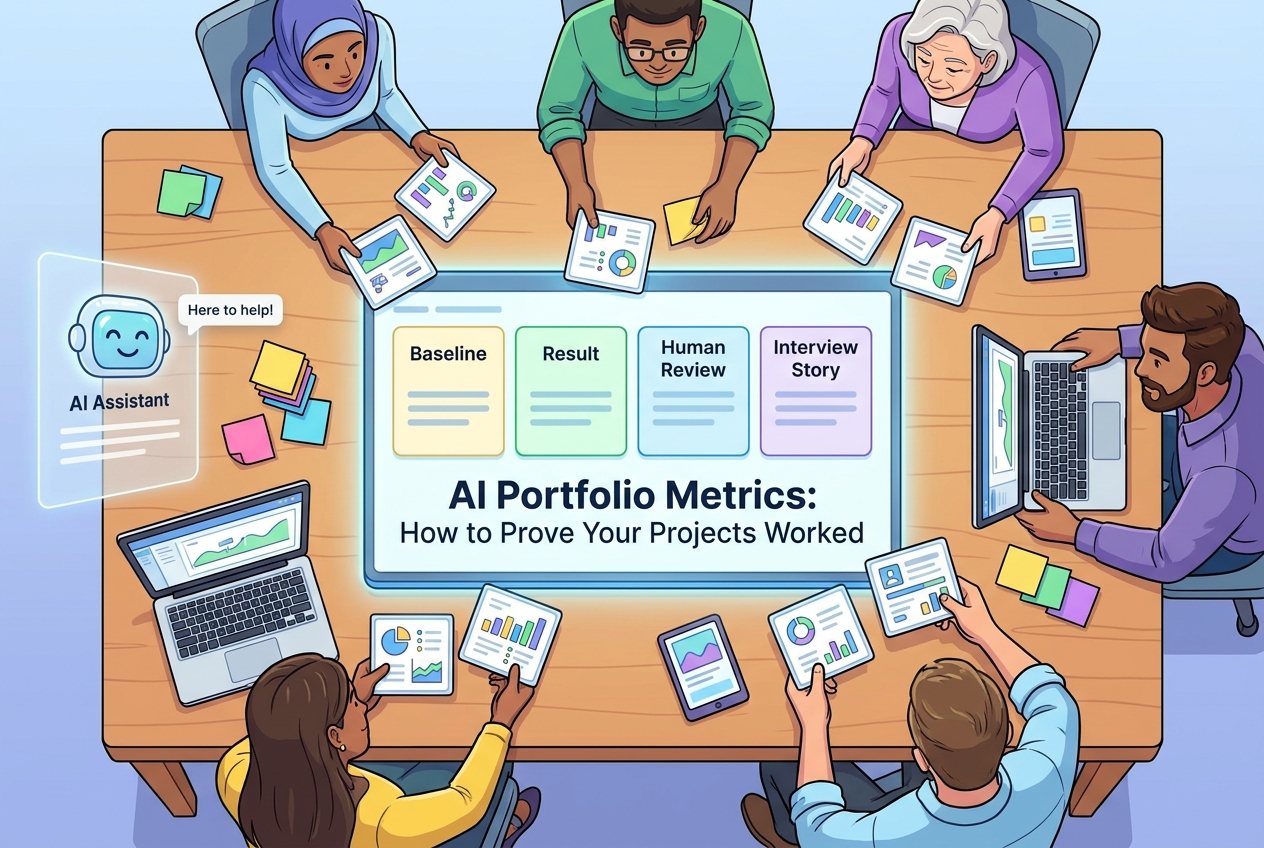
Quick Answer: What Are AI Portfolio Metrics?
AI portfolio metrics are the measurements, evidence artifacts, and review notes that show an AI project actually improved a workflow. They turn a portfolio from a gallery of demos into a proof system: what problem existed, what baseline you measured, what the AI workflow changed, how humans reviewed the output, what result improved, and what you learned when the first version failed.
This is a narrower companion to the pillar guide on the AI career proof system. That article explains why modern AI careers need skills, projects, metrics, and human judgment. This cluster article focuses on one practical question: once you have built an AI project, how do you measure it well enough that a hiring manager, client, or team lead can trust it?
The best metrics are not always complicated. A useful AI portfolio can measure time saved per task, output accuracy after human review, number of manual steps removed, source-checking quality, response consistency, handoff clarity, user satisfaction, risk reduction, or the percentage of outputs that needed correction. The key is choosing metrics that match the job you want and the workflow you claim to understand.
Why AI Projects Need Metrics, Not Just Screenshots
AI portfolio projects are easy to fake at the surface level. A clean landing page, a demo video, and a few generated outputs can look impressive even when the project has no measurable value. Employers know this. They have seen prompt wrappers, generic automations, and copied tutorials. What they need is not another claim that you “know AI.” They need evidence that you can apply AI safely and usefully inside a real workflow.
Labor-market research supports this shift. The World Economic Forum’s Future of Jobs work highlights how technological change is reshaping skills and roles across employers. Microsoft’s Work Trend Index frames AI and agents as part of a broader redesign of work, not just a tool upgrade. Anthropic’s Economic Index shows AI use leaning toward both augmentation and automation across real tasks. These signals point in the same direction: AI skill is becoming less about tool familiarity and more about judgment, workflow design, measurement, and accountability.
That is why screenshots are weak proof. A screenshot shows that something ran once. A metric shows whether it helped. A failure log shows whether you can diagnose problems. A baseline shows that you understood the original workflow before inserting AI. A review checklist shows that you know where humans should stay in control. Together, these signals make your project credible.
Think of this like product management for your own career. A product team would not launch an AI assistant and call it successful because it produced text. They would ask whether it reduced support time, improved first-response quality, lowered rework, increased customer satisfaction, or created unacceptable risk. Your portfolio should use the same logic at a smaller scale.
The Four-Layer AI Portfolio Metrics System
A strong AI portfolio metric system has four layers: baseline, output, human review, and business or workflow result. Most weak portfolios measure only the output layer. They show generated text, generated code, or generated summaries. Strong portfolios show the whole chain from problem to result.
This structure prevents a common mistake: treating model output as the final result. In serious AI work, model output is only a draft, recommendation, classification, plan, or action proposal. The real result happens after review, integration, and use. A hiring manager will trust you more if your portfolio acknowledges that distinction.
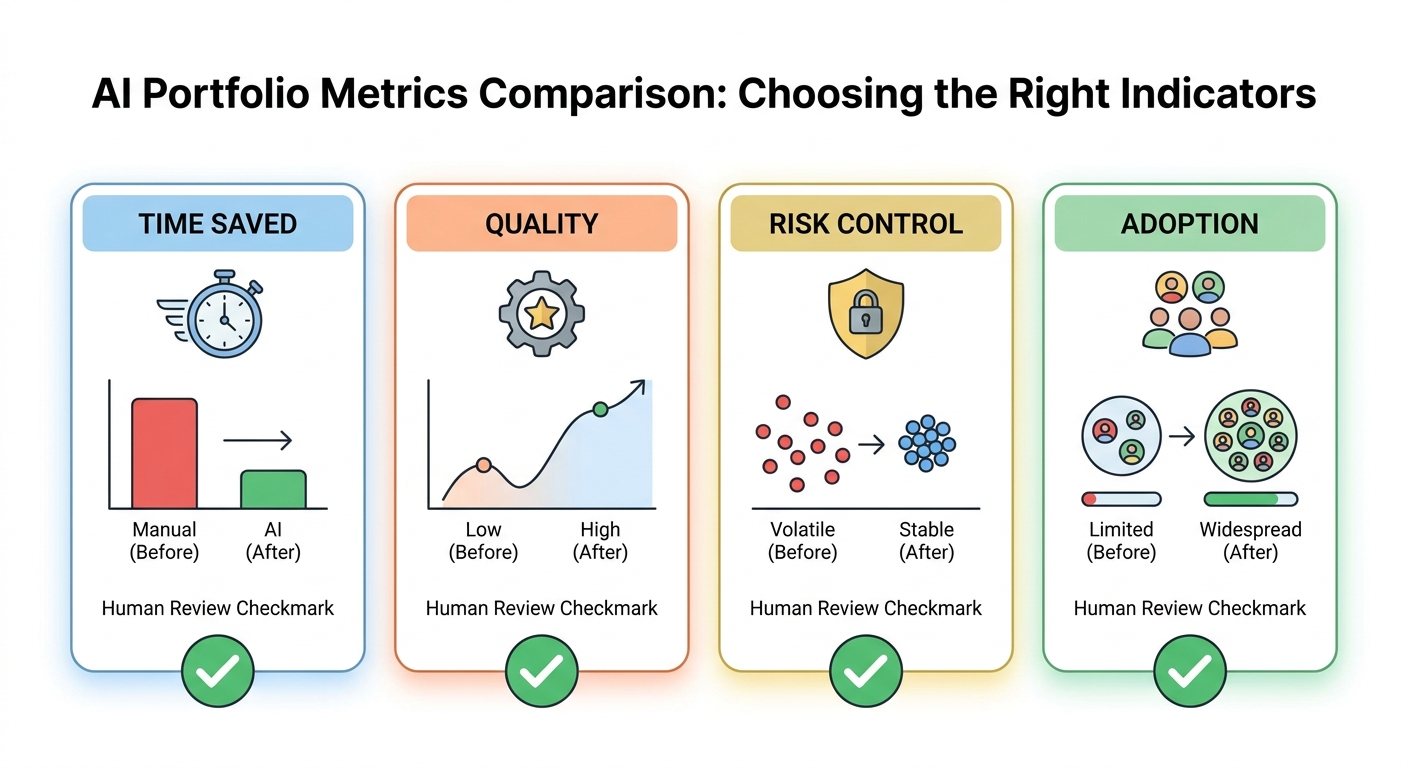
For example, if you build an AI resume screener, do not claim success because it ranked candidates. Measure whether its criteria were consistent, whether it surfaced false positives, whether a human reviewer agreed with the shortlist, and whether the process became fairer or faster. If you build a meeting-summary assistant, do not claim success because it wrote summaries. Measure missed decisions, action-item accuracy, follow-up completion, and the number of edits needed before sending.
How to Choose the Right Metrics for an AI Portfolio Project
The right metric depends on the workflow. A customer-support assistant should not be measured the same way as a research summarizer, coding agent, recruiter helper, or data-cleaning workflow. Start by naming the promise your project makes. Then choose metrics that prove or challenge that promise.
| Project promise | Useful metrics | Evidence to include |
|---|---|---|
| Save time | Minutes per task before and after, number of manual steps removed, cycle time | Before/after timer, workflow map, screen recording, task log |
| Improve quality | Error rate, completeness score, reviewer approval rate, correction count | QA checklist, sample outputs, annotated corrections |
| Reduce risk | Escalation rate, hallucination flags, unsafe-output count, approval-gate pass rate | Risk checklist, failure examples, guardrail notes |
| Increase consistency | Format compliance, tone consistency, policy adherence, variance across samples | Rubric, scored examples, template comparison |
| Support decisions | Source coverage, evidence quality, decision time, confidence rating | Source table, citations, decision memo, reviewer notes |
| Enable adoption | Repeat usage, user feedback, handoff clarity, onboarding time | User quotes, usage log, instructions, demo task |
Choose two or three metrics, not ten. A small set of well-explained measurements is more convincing than a dashboard full of vanity numbers. “Generated 500 answers” is a vanity metric unless you also show accuracy, usefulness, or saved time. “Reduced average draft time from 18 minutes to 7 minutes across 20 support replies, with 85% passing human review on the first edit” is much stronger.
If you cannot measure the perfect outcome, measure a proxy honestly. A student project may not have real users, but it can still measure task time, sample size, review quality, and failure modes. A career-switcher may not have company data, but they can use public datasets, simulated workflows, or personal productivity logs. The important part is transparency: explain what the metric proves and what it does not prove.
The AI Project Evidence Card Employers Can Scan Quickly
A portfolio page should not force readers to reverse-engineer your impact. Add a short evidence card near the top of each project. This card should summarize the measurable case for the project in plain language. It should be easy to scan in thirty seconds and deep enough to support interview questions.
This evidence card is especially useful because it connects metrics to judgment. Many candidates can say they used a model. Fewer can explain why they kept a human in the loop, how they selected a sample set, what the first failure taught them, and why the final metric matters for a business role. That is the signal employers are increasingly looking for.
Use concise numbers when possible. For example: “Tested on 40 sample tickets,” “reduced average draft time by 42%,” “human reviewer approved 31 of 40 first drafts,” “common failure: refund-policy edge cases,” or “added escalation rule for uncertain policy questions.” These numbers do not need to be enterprise-scale. They need to be honest, relevant, and connected to a real workflow.
Three Practical Examples of AI Portfolio Metrics
Example 1: Customer support response assistant
Weak version: “I built an AI customer support chatbot.” Strong version: “I built a draft assistant for support replies and measured whether it reduced writing time while preserving policy accuracy.” The baseline could be average time to draft a reply manually. Output metrics could include policy compliance and completeness. Human review metrics could include first-pass approval rate and correction categories. Result metrics could include time saved per ticket and fewer missed policy steps.
A good evidence card might say: “Across 30 simulated support tickets, manual drafting averaged 11 minutes. The AI-assisted workflow averaged 5 minutes after review. Twenty-four drafts passed the policy checklist on the first review. The main failure was overconfident refund language, so I added a rule that escalates uncertain refund cases to a human.” That statement shows skill, measurement, and judgment.
Example 2: Research brief with source verification
Weak version: “I used AI to summarize reports.” Strong version: “I built a research-brief workflow that extracts claims, checks sources, and separates verified facts from uncertain interpretation.” Baseline metrics could include time to produce a brief and number of source-checking steps. Output metrics could include citation coverage, unsupported-claim count, and source relevance. Human review metrics could include correction notes and rejected claims. Result metrics could include faster brief production with fewer unsupported statements.
This project is valuable for marketing, operations, policy, strategy, and analyst roles because it proves that you do not treat AI output as truth. It also aligns with the broader AI career proof system: employers need people who can use AI without outsourcing accountability.
Example 3: Meeting-to-action workflow
Weak version: “I made a meeting summarizer.” Strong version: “I built a meeting-to-action workflow and measured action-item accuracy, owner assignment, and follow-up clarity.” Baseline metrics could include number of missed action items in manual notes. Output metrics could include correct owner, deadline, and decision capture. Human review metrics could track edits before sharing. Result metrics could include faster follow-up and fewer unclear tasks.
This type of project works well for non-coding careers because it demonstrates workflow thinking. You are not trying to impress someone with model complexity. You are proving that you can identify a messy human process, insert AI carefully, and measure whether the process becomes clearer.
AI Portfolio Metrics to Avoid
Some metrics sound impressive but do not help your career proof. Avoid vanity metrics that count activity without showing value. Also avoid exaggerated claims that make your project look less trustworthy. A recruiter may not challenge every number, but a technical interviewer or manager will notice when the metric does not match the workflow.
Strong metrics
- Average task time before and after AI assistance.
- Reviewer approval rate across a defined sample.
- Correction categories and how you fixed them.
- Number of manual workflow steps removed.
- Accuracy against a clear rubric or checklist.
- Escalation rate for uncertain or risky outputs.
Weak metrics
- Number of prompts written.
- Number of outputs generated without quality review.
- “Used GPT” as a standalone achievement.
- Unverified productivity claims with no baseline.
- Big percentages from tiny or unclear samples.
- Claims that remove human judgment from risky work.
Be careful with percentages. “Improved productivity by 80%” sounds strong, but it may be misleading if it came from one task. A more credible statement is: “In a small 15-task test, the workflow reduced draft time from a median of 10 minutes to 6 minutes, but complex cases still required full human rewriting.” Honest nuance builds trust.
How to Turn Metrics Into Interview Stories
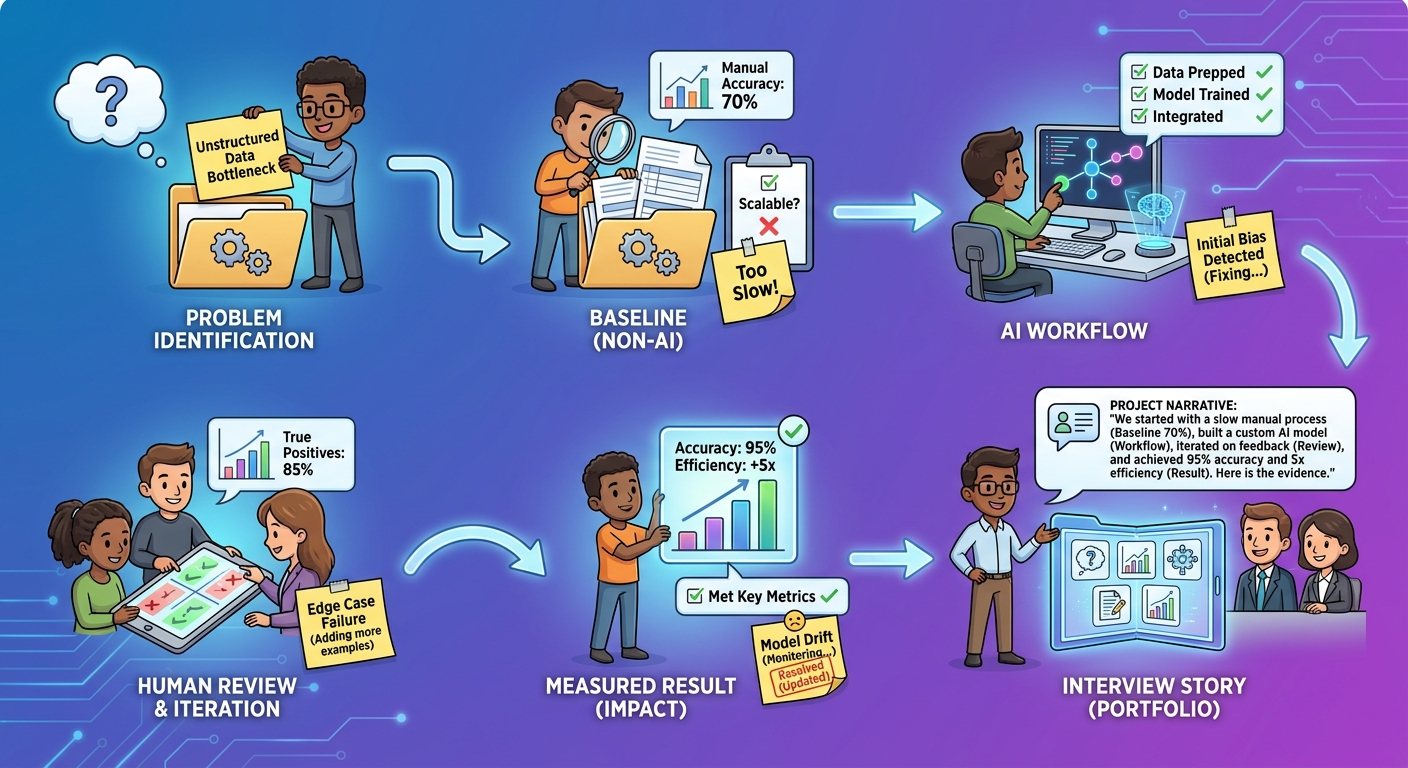
Metrics are not only for portfolio pages. They are interview material. A strong AI project story follows a simple arc: problem, baseline, intervention, measurement, failure, improvement, and lesson. This structure gives you a better answer than “I experimented with AI tools.” It shows that you can think like someone who owns outcomes.
Use this interview pattern: “I noticed X workflow was slow or inconsistent. Before using AI, I measured Y. I designed Z workflow where the AI handled one part and a human reviewed another part. I tested it on N examples. The result was A, but it failed in B cases. I changed C, and the final lesson was D.” This answer works because it proves both technical curiosity and mature judgment.
For career-switchers, the story may matter more than the code. If you are moving into operations, marketing, HR, research, customer success, education, or project management, employers may not expect a production-grade app. They will care whether you can identify a high-value workflow, communicate clearly, evaluate risk, and measure usefulness. AI portfolio metrics give you that language.
For developers, the metrics should include engineering evidence too: test results, latency, evaluation sets, observability notes, rollback plan, or human approval gates. Link this article with the site’s agent observability and evaluation coverage if your project involves autonomous workflows. A coding portfolio becomes stronger when it shows not only what the agent built, but how you traced, evaluated, and debugged it.
A Simple AI Portfolio Metrics Scorecard
Use the scorecard below before publishing a project. Give yourself one point for each item. A project does not need a perfect score, but anything under five probably needs more evidence before it becomes a centerpiece of your portfolio.
| Scorecard item | Question | Why it matters |
|---|---|---|
| Problem clarity | Can a reader understand the workflow problem in one sentence? | Employers trust projects attached to real problems. |
| Baseline | Did you measure the old workflow before AI? | Without a baseline, improvement is guesswork. |
| Relevant metric | Does the metric match the project promise? | Wrong metrics create fake confidence. |
| Human review | Did you show where a person checks or approves output? | Human judgment is a career moat. |
| Sample size | Did you test more than one cherry-picked example? | Small samples are fine if disclosed; cherry-picking is not. |
| Failure log | Did you document what went wrong? | Failure analysis proves maturity. |
| Before/after result | Can you state a measurable change? | Results make the project memorable. |
| Interview story | Can you explain the tradeoffs without reading notes? | Portfolio proof must survive conversation. |
If you want one practical next step, update your best AI project with this scorecard. Do not rebuild the whole project. Add a baseline, a small test set, a reviewer checklist, and a failure note. That alone can turn a generic demo into a stronger proof asset.
Keep Building Your AI Career Proof System
- AI Career Proof System — the source pillar article this guide supports.
- AI Automation Portfolio Projects — project ideas you can measure with this framework.
- Human-AI Workflow Skills — the workplace skills behind credible AI projects.
- AI Output Review Checklist — review habits that strengthen your evidence card.
- AI Agent Evaluation Metrics — deeper metrics for production agent projects.
Sources and References
- World Economic Forum: The Future of Jobs Report
- Microsoft Work Trend Index
- Anthropic Economic Index
- Stanford HAI AI Index Report
- LinkedIn Economic Graph: Future of Work Report, AI at Work
External sources were used for labor-market and AI adoption context. Project metrics in this article are practical examples, not universal benchmark claims.
FAQ: AI Portfolio Metrics
What are AI portfolio metrics?
AI portfolio metrics are measurements that show whether an AI project improved a workflow. Examples include time saved, error reduction, reviewer approval rate, source coverage, escalation rate, and correction count.
How many metrics should an AI portfolio project include?
Most projects need two or three strong metrics. Choose one baseline metric, one output or review metric, and one result metric. Too many metrics can distract from the project story.
What if I do not have real company data?
Use a transparent sample set, public data, simulated tasks, or personal workflow logs. Explain the limits clearly. Honest small-sample evidence is better than unsupported claims.
Are screenshots enough for an AI portfolio?
No. Screenshots show that a project exists, but they do not prove usefulness. Add a baseline, test sample, review checklist, result metric, and failure note.
What is the best AI portfolio metric for beginners?
Time saved is often easiest to measure, but pair it with quality review. A fast AI workflow is not useful if the output needs heavy correction or creates risk.
How do AI portfolio metrics help in interviews?
They give you a concrete story: the original problem, the baseline, the AI workflow, the human review point, the measured result, and what you improved after failure.
Should I include failures in my portfolio?
Yes, if you explain them professionally. A short failure log shows judgment, honesty, and iteration. It can make your project more credible than a polished demo with no caveats.
How does this support an AI career proof system?
The broader AI career proof system explains what to build and how to package your skills. AI portfolio metrics provide the evidence layer that makes those projects trustworthy.
Conclusion: Measure the Work, Not the Hype
An AI portfolio becomes powerful when it proves that you can improve a real workflow with measured judgment. The future-career advantage is not claiming that AI can do everything. It is showing that you know where AI helps, where it fails, where humans must stay accountable, and how to measure the difference.
Start with one project. Add a baseline. Test a small sample. Review the output. Document corrections. Summarize the measurable result. Then connect the project to the role you want. That is how a portfolio becomes more than a collection of demos. It becomes proof that you can use AI responsibly in the work employers actually need done.
