
AI Agent ROI Scorecard: Metrics That Prove Enterprise Agents Are Worth Scaling
A practical scorecard for deciding whether enterprise AI agents are ready to scale: measure completed outcomes, cost per task, quality, risk, adoption, and governance before expanding beyond the pilot.
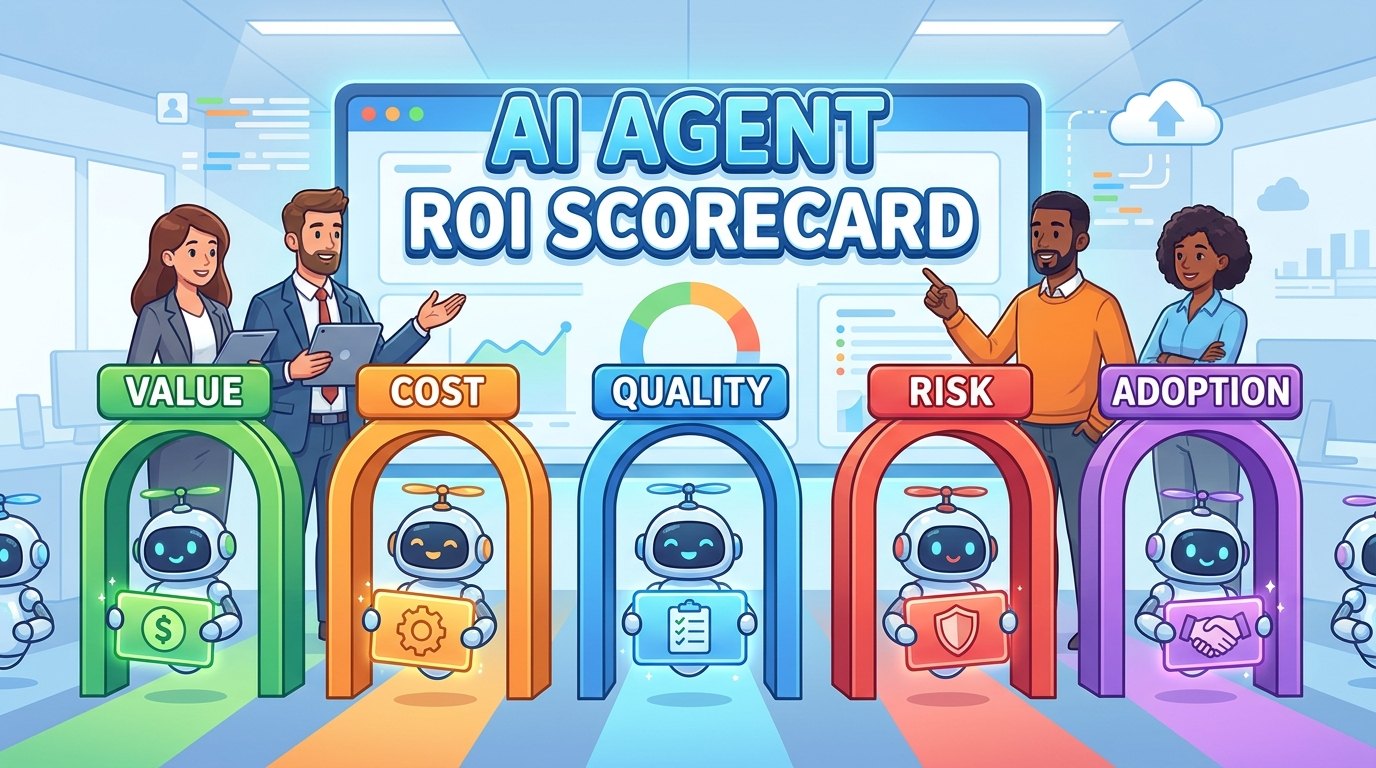
Quick Answer: What Is an AI Agent ROI Scorecard?
An AI agent ROI scorecard is a practical measurement system that tells leaders whether an enterprise AI agent is worth scaling, improving, limiting, or stopping. It connects the business result of an agent workflow with the operating evidence behind that result: task completion, cost per completed task, quality, risk, adoption, escalation, and governance readiness.
The scorecard matters because agentic AI can look productive before it is actually valuable. A team may celebrate thousands of prompts, impressive demos, generated drafts, or successful pilot sessions while still failing to prove that the workflow saves time, improves quality, reduces cost, increases revenue, or lowers risk. Raw usage is not ROI. A useful scorecard forces the organization to ask a harder question: did this agent produce a better outcome than the previous process after all costs, reviews, exceptions, and risks were counted?
This cluster article supports the broader pillar article Enterprise AI ROI Reckoning: Why Agentic AI Needs Governance Before Scale. The pillar explains why enterprise agent programs are moving from pilot excitement to governance discipline. This article narrows the topic into a reusable scorecard leaders can apply to one workflow at a time.
Why Enterprise AI Agents Need a Scorecard Before Scale
Enterprise AI agents are different from simple chat tools because they participate in workflows. They may retrieve data, summarize records, draft customer responses, inspect code, route tickets, call tools, update systems, prepare sales notes, or recommend decisions. That makes them more valuable than ordinary assistants, but it also makes them harder to evaluate. A chat response can be judged by helpfulness. A workflow agent must be judged by whether the whole process improved.
Many organizations start with pilots because pilots are the fastest way to learn. That is reasonable. The problem starts when the pilot becomes the proof. A pilot often uses friendly users, narrow examples, clean data, motivated reviewers, and low consequence tasks. Production introduces messy records, permission boundaries, ambiguous requests, compliance questions, support tickets, unhappy users, hidden cost, and edge cases that the demo never touched.
A scorecard prevents what many teams quietly experience: AI activity rising while business confidence stays flat. Leaders see adoption dashboards but cannot explain value. Teams run more agent experiments but cannot compare them. Finance sees subscription and model bills without unit economics. Risk teams ask for auditability after the workflow has already spread. Frontline users like some outputs but still rewrite most of them. The scorecard gives everyone a shared language before scale amplifies the mess.
The goal is not to make AI adoption bureaucratic. The goal is to make good agents easier to scale and weak agents easier to fix or stop. When a workflow has a baseline, owner, metric definitions, review cadence, thresholds, logs, and escalation rules, leaders can expand it with more confidence. Without that evidence, scaling becomes an act of faith.
The Six-Part AI Agent ROI Scorecard
A useful AI agent ROI scorecard should fit on one page, but it should represent the full operating reality of the workflow. The simplest model uses six sections: business outcome, completion, cost, quality, risk, and adoption. Each section answers a different question. Together, they show whether the agent is producing durable value or merely creating impressive motion.
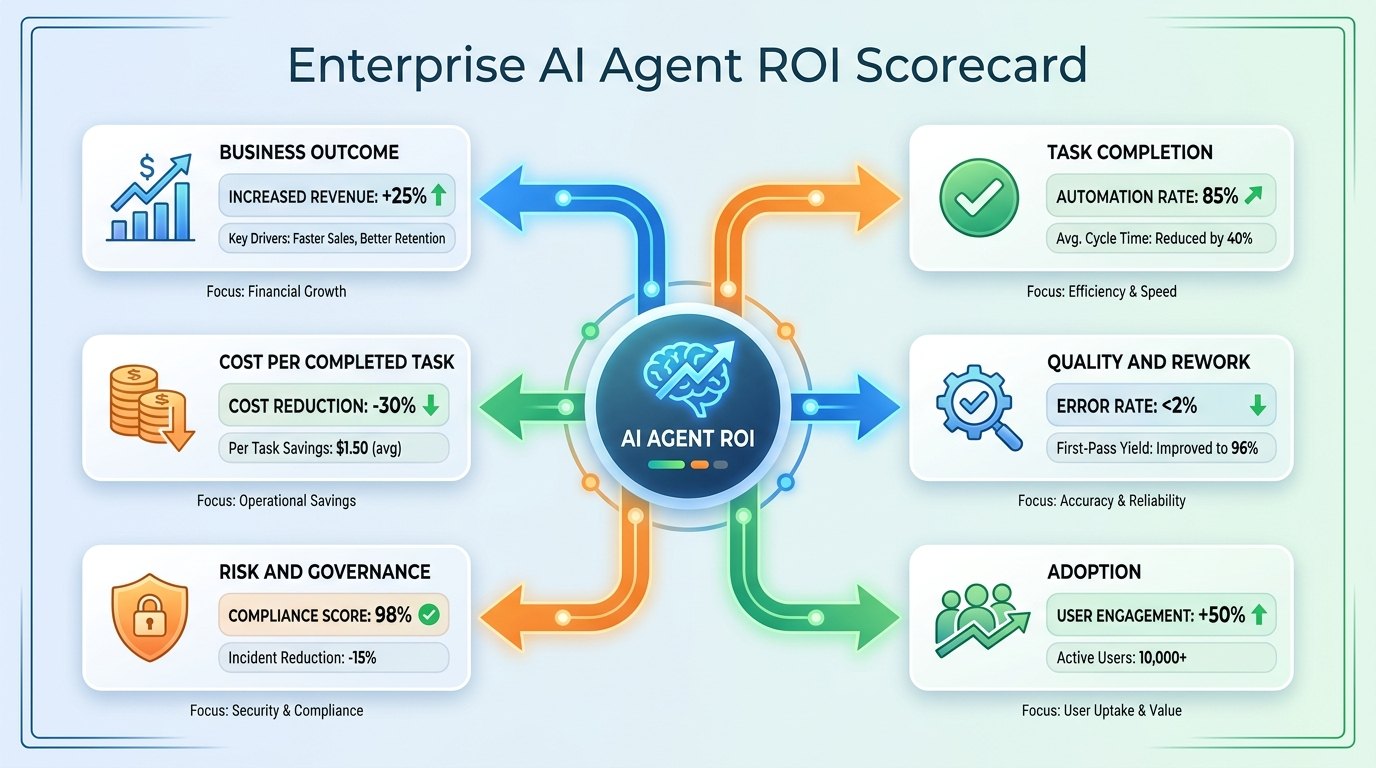
| Scorecard area | Question it answers | Example metric |
|---|---|---|
| Business outcome | Did the workflow improve something the business actually cares about? | Cycle-time reduction, revenue assisted, cases resolved, hours saved, error reduction. |
| Task completion | Can the agent finish the intended workflow correctly and repeatedly? | Successful completion rate, first-pass success, escalation rate, abandoned run rate. |
| Cost and unit economics | Is the value greater than the full cost of running and reviewing the agent? | Cost per completed task, cost per approved output, cost per avoided hour. |
| Quality | Does the agent improve or preserve output quality? | Reviewer acceptance rate, rework rate, defect rate, customer correction rate. |
| Risk and governance | Can the workflow be trusted, audited, limited, and stopped? | Policy incidents, unsafe tool attempts, missing trace rate, approval compliance. |
| Adoption and behavior change | Do users keep using it after novelty fades? | Repeat usage, active users by role, opt-out rate, manual fallback rate. |
The mistake is treating these areas as independent. They interact. A support agent may reduce handle time but increase rework. A coding agent may save engineering effort but create review risk. A sales research agent may boost preparation quality but cost too much if it retrieves excessive context for every account. A finance agent may complete tasks quickly but fail governance if it cannot show which source record supported a recommendation. ROI only becomes believable when the scorecard shows the tradeoffs.
Start With the Business Outcome, Not the Model
The first scorecard field should describe the workflow in plain business language. Avoid vague labels such as “AI productivity assistant” or “agentic automation.” Instead, name the job: triage inbound support tickets, prepare account research briefs, draft supplier-risk summaries, generate test cases for changed code, review invoice exceptions, or route HR policy questions. If the workflow cannot be named clearly, it cannot be measured clearly.
Next, define the current baseline. How long does the work take today? How many cases happen each week? Who performs the work? What is the current error rate? Where do delays occur? What does the work cost before AI? What quality problems are visible? What happens when the process fails? Baseline data does not need to be perfect, but it must be honest enough to compare against the agent-assisted process.
A strong business outcome metric is specific and observable. “Improve employee productivity” is too broad. “Reduce average internal policy-response time from two business days to four hours while maintaining legal-review acceptance above 90 percent” is measurable. “Use AI in customer support” is too vague. “Classify priority-one support tickets within five minutes and route them with less than three percent false-critical escalation” is useful.
The business outcome should also identify the value type. Some agents save labor hours. Some reduce cycle time. Some improve consistency. Some reduce risk. Some increase revenue by helping teams respond faster. Some improve employee or customer experience. A scorecard can include multiple value types, but one should be primary. If every benefit is primary, no benefit is primary.
Measure Task Completion, Escalation, and Failure Modes
Task completion rate is the first reality check for agentic AI. It asks how often the agent finishes the intended workflow correctly without unplanned human rescue. This does not mean the agent must be fully autonomous. Many high-value enterprise agents should include human approval. The key distinction is between designed human review and chaotic human rescue. Planned approval is governance. Unplanned cleanup is hidden cost.
Completion should be measured at the workflow level, not the prompt level. If a customer support agent summarizes a ticket correctly but routes it to the wrong queue, the workflow did not complete successfully. If a code agent edits the right file but breaks tests, the workflow is not complete. If a finance agent drafts an approval note but omits a required source field, the workflow still needs rescue.
Escalation rate is equally important. A low escalation rate is not automatically good. If the agent handles risky cases without asking for review, low escalation may signal danger. A high escalation rate is not automatically bad either. In a sensitive workflow, proper escalation may be the reason the agent can operate safely. The scorecard should define healthy escalation separately from failure escalation.
Track failure modes in categories. Missing data, bad retrieval, wrong tool call, unclear user request, model reasoning error, permission denial, policy block, timeout, and reviewer rejection are different problems. Treating them as one generic failure bucket hides the fix. If most failures come from missing data, improve source readiness. If failures come from ambiguous requests, improve intake forms. If failures come from unsafe tool attempts, tighten permissions and approval rules.
Calculate Cost per Completed Task
Cost per completed task is the metric that turns AI enthusiasm into unit economics. It should include more than the model bill. For an enterprise agent workflow, the real cost may include model tokens, orchestration, retrieval, vector storage, tool execution, SaaS subscriptions, infrastructure, logging, security review, human review, integration maintenance, and rework. A pilot may ignore some of these costs. A production scorecard should not.
The simple formula is: total workflow cost divided by successful completed outcomes. If an agent costs $500 to run in a month and produces 1,000 approved outputs, the apparent cost is $0.50 per approved output. But if reviewers spend 100 hours fixing those outputs, the true cost is higher. If 30 percent of runs fail and require manual redo, the cost per successful outcome rises. If the workflow saves highly paid specialist time or reduces revenue leakage, a higher cost per task may still be excellent. The number only makes sense beside value.
Use cost tiers when exact accounting is hard. A team can classify runs as low, medium, or high cost based on model choice, context size, number of tool calls, retry count, and review time. That is not perfect, but it is better than pretending all agent runs are equal. Over time, traces and platform reports should replace estimates with actual workflow-level cost data.
Cost metrics also improve design. If the agent sends too much context, retrieval needs pruning. If repeated retries drive cost, error handling needs work. If premium models are used for routine cases, create routing rules. If human review dominates cost, improve examples, validation, or scope. The scorecard should turn cost into a debugging signal, not a reason to panic.
Track Quality, Rework, and Reviewer Trust
Speed without quality is not ROI. Many AI workflows look successful because they create outputs quickly, but reviewers quietly rewrite those outputs. The scorecard should capture acceptance rate, rework rate, defect rate, customer correction rate, and reviewer confidence. The goal is not to remove humans from every step. The goal is to ensure human review becomes faster and more reliable, not heavier and more stressful.
Reviewer acceptance rate is a practical starting point. What percentage of agent outputs are accepted with no edits, minor edits, major edits, or rejection? This gives a clearer signal than thumbs-up feedback alone. Minor edits may be acceptable for a drafting workflow. Major edits may still be acceptable if the agent saved research time. Rejection is a warning sign if it happens often or in patterns.
Quality should be evaluated against task-specific rubrics. A sales account brief might be judged on source accuracy, relevance, recency, duplication, and next-action usefulness. A support response might be judged on policy compliance, empathy, factual accuracy, and resolution clarity. A code change might be judged on test pass rate, minimality, security impact, and maintainability. Generic quality scores are less useful than rubrics tied to the work.
Trust is a lagging indicator but a powerful one. If users keep checking every sentence because the agent often invents details, ROI suffers. If users bypass the agent because it creates awkward cleanup, adoption dashboards will eventually fall. If reviewers learn exactly where the agent is reliable and where it needs scrutiny, the workflow can become faster without becoming reckless.
Add Risk, Governance, and Auditability Metrics
Risk metrics are not separate from ROI. They protect ROI from being erased by incidents, compliance failures, data exposure, customer harm, or operational confusion. An enterprise AI agent should be measured by what it is allowed to access, what it is allowed to change, when it asks for approval, how its actions are logged, and how quickly it can be stopped.
Start with permission scope. Does the agent have read-only access, reversible write access, or high-impact action access? Does it operate under a user identity, service identity, or shared account? Can it access sensitive records? Can it call external tools? Can it send messages, update tickets, modify code, approve payments, or change customer data? The scorecard should not hide these details in architecture documents. They belong in the operating review.
Next, track trace completeness. A useful trace should show the request, sources used, tool calls, approvals, outputs, errors, and final decision. Missing traces are a governance defect. If the organization cannot reconstruct what happened, it cannot confidently scale the workflow. Observability is not only for engineers; it is evidence for business owners, auditors, compliance teams, and incident responders.
Risk metrics should include policy incidents, unsafe action attempts, privacy flags, hallucination events, approval bypasses, and rollback events. Do not wait for a major incident to start counting. Small signals reveal where the workflow is drifting. If an agent repeatedly tries to use a forbidden tool, that is design feedback. If users repeatedly paste sensitive data into the workflow, intake controls and training need improvement.
Measure Adoption After the Novelty Period
Adoption is useful, but only when interpreted carefully. A spike after launch may reflect curiosity, executive pressure, or internal promotion. Durable adoption means users return because the workflow helps them. The scorecard should distinguish first-time usage from repeat usage, active users from occasional testers, and workflow completion from casual exploration.
Retention by role is especially valuable. If managers like dashboards but frontline users avoid the agent, the workflow may not fit real work. If power users adopt it but new users struggle, onboarding or interface design may be the bottleneck. If adoption is high in one region or team but weak elsewhere, local process differences may matter more than model quality.
Manual fallback rate is one of the most honest adoption metrics. How often do users start with the agent but return to the old process? Why? The answer may reveal missing integrations, slow response time, poor source quality, confusing handoffs, or lack of trust. A workflow can have high trial usage and high fallback at the same time. That is not scale readiness.
Qualitative feedback still matters. Ask users where the agent saves time, where it creates work, when they trust it, when they ignore it, and what they wish it would ask before acting. Combine this with trace data. Users describe the pain; traces show the mechanism. Together, they create a better improvement plan than adoption numbers alone.
Set Scale, Improve, Hold, and Stop Thresholds
A scorecard becomes operational only when leaders define decisions in advance. Otherwise, every review becomes a debate. Create four decision bands: scale, improve, hold, and stop. Scale means the workflow has strong evidence and can expand to more users or cases. Improve means the use case is promising but needs targeted fixes. Hold means evidence is insufficient or risk is unresolved. Stop means the workflow is not worth continued investment in its current form.
| Decision | Typical evidence | Recommended action |
|---|---|---|
| Scale | Clear business improvement, stable quality, acceptable cost per completed task, healthy escalation, complete traces, user retention. | Expand volume gradually, keep monitoring, and reuse governance patterns. |
| Improve | Business value exists, but one or two metrics are weak, such as retrieval quality, rework, latency, or retry cost. | Fix the bottleneck, retest against the same baseline, and delay broad rollout. |
| Hold | Promising demo but incomplete baseline, unclear owner, missing traces, unresolved permissions, or weak measurement. | Do not expand. Complete the evidence package first. |
| Stop | No measurable value, high cleanup burden, unacceptable risk, low retention, or cost that exceeds plausible benefit. | Close the pilot, document lessons, and redirect resources to stronger workflows. |
Thresholds should be customized by risk tier. A low-risk internal summarization agent can tolerate more imperfection than an agent involved in finance approvals, legal interpretations, healthcare, hiring, security operations, or customer commitments. The scorecard should make risk tier visible so leaders do not apply the same scale rule to every workflow.
Do not make thresholds impossibly strict at the start. Early scorecards should drive learning. But do make them explicit. If a team cannot say what result would justify scale, it is not running a serious pilot. It is experimenting without a decision rule.
AI Agent ROI Scorecard Template
Use this lightweight template for each candidate workflow. It is intentionally plain because the best scorecard is the one teams actually maintain.
For example, a support triage agent might use average routing time as the primary ROI metric, with false escalation, customer correction, and policy incident rate as guardrails. A software engineering agent might use accepted test-generation coverage as the primary metric, with broken build rate, reviewer rewrite rate, and security findings as guardrails. A procurement agent might use exception-review cycle time as the primary metric, with payment accuracy and approval compliance as guardrails.
From Pilot Theater to Production ROI
Pilot theater happens when a team optimizes for the story instead of the operating evidence. The demo is polished. The example is cherry-picked. The agent appears autonomous. The slide says productivity improved. But there is no baseline, no workflow-level cost, no quality rubric, no audit trace, no risk tier, and no retention data. It feels like progress until someone asks whether the agent should actually scale.
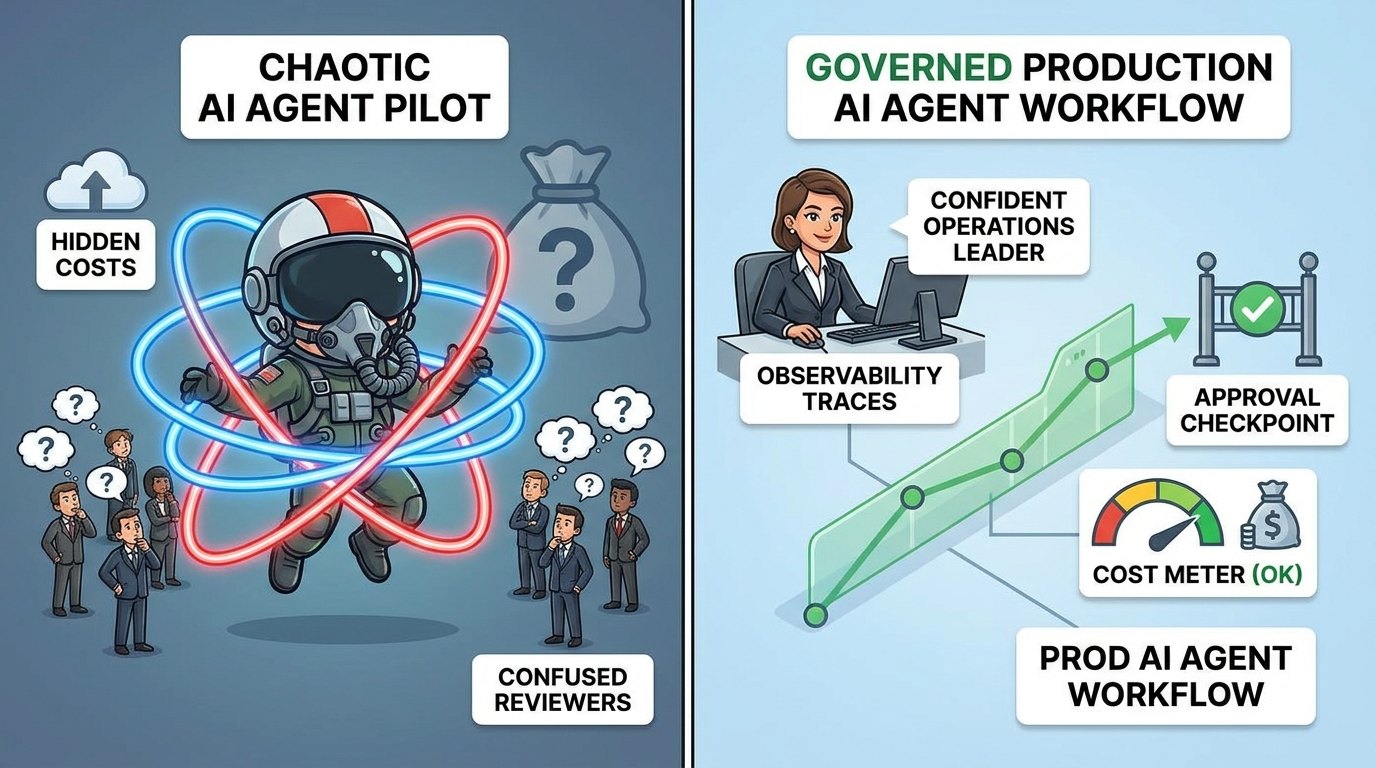
Production ROI looks less magical and more useful. The workflow is bounded. The agent has a defined role. The human approval point is known. The data sources are permissioned. The trace is complete. The cost per completed task is tracked. The quality rubric is reviewed. Failure modes are categorized. Leaders know what evidence would justify expansion. This discipline may look slower at first, but it prevents expensive confusion later.
The strongest teams will reuse scorecard patterns across workflows. Once a company has a good template for cost, completion, escalation, and trace review, every new agent starts from a stronger operating base. That is how ROI compounds: not by launching more disconnected pilots, but by turning governance and measurement into reusable infrastructure.
Keep Learning on Singularity Journey
- Enterprise AI ROI Reckoning — the source pillar for this cluster article.
- Enterprise AI Agent Metrics — practical production metrics for agent readiness.
- Enterprise AI Agent Adoption — what leaders should track before scaling agents.
- AI Agent Evaluation Framework — how to test tool calls, traces, memory, and behavior.
- Enterprise AI Agent Governance Checklist — permissions, approvals, and audit logs.
Sources and References
- Google Cloud: ROI of AI report
- Stanford HAI: AI Index
- McKinsey: The State of AI
- IBM: What are AI agents?
- Singularity Journey: Enterprise AI ROI Reckoning
This article uses Singularity Journey analytics, Search Console data, source-pillar review, public AI research pages, and editorial analysis. Validate ROI thresholds against your own workflow baseline and risk tier.
FAQ: AI Agent ROI Scorecards
What should be included in an AI agent ROI scorecard?
Include business outcome, task completion, cost per completed task, quality, risk, governance, adoption, baseline, owner, review cadence, and a scale-or-stop threshold.
How do you measure AI agent ROI?
Measure the improvement in a specific workflow against its baseline, then subtract or compare the full operating cost, including model usage, infrastructure, review time, rework, and governance effort.
What is the most important AI agent ROI metric?
For most enterprise workflows, cost per successful completed task is the most important economic metric, but it must be balanced with quality, risk, and business outcome metrics.
Why is raw AI usage not a good ROI metric?
Raw usage only shows activity. It does not prove that the agent completed useful work, saved time, improved quality, reduced risk, or changed user behavior in a durable way.
When is an AI agent ready to scale?
An agent is ready to scale when it shows measurable business improvement, stable quality, acceptable unit economics, complete traces, clear permissions, healthy escalation, and repeat adoption after the novelty period.
When should an AI agent pilot be stopped?
Stop or redesign a pilot when it creates high cleanup work, lacks measurable value, has unacceptable risk, cannot be audited, costs more than the plausible benefit, or users return to the old workflow.
