
Enterprise AI Agent Adoption: What Leaders Should Track Before Scaling Agents
Enterprise AI agent adoption is moving from demos into real workflows, but the hard question is no longer whether agents are interesting. It is whether an organization can measure, govern, evaluate, and safely scale delegated work.
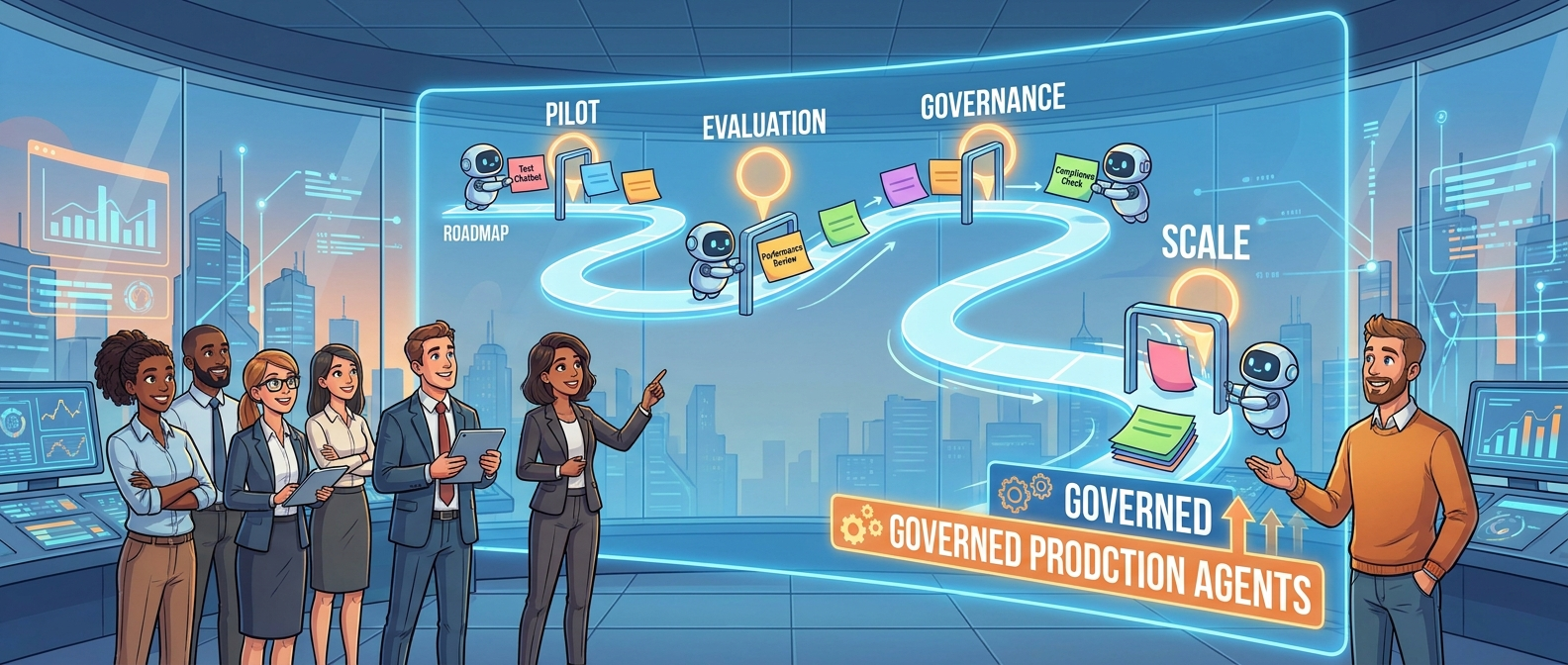
Enterprise AI Agent Adoption: Quick Answer for Leaders
Enterprise AI agent adoption means moving beyond isolated chatbot experiments toward AI systems that can plan steps, call tools, use company context, coordinate with other agents or workflows, and complete tasks under measurable human-approved constraints. The adoption story sounds simple: agents promise faster support, cleaner operations, better software delivery, and less manual coordination. The scaling reality is harder. Most organizations do not fail because the demo is unimpressive. They fail because the agent cannot be trusted, evaluated, traced, rolled back, or owned by a real business process.
The practical answer is this: do not scale agents because a vendor roadmap says autonomous work is the future. Scale agents when the workflow has a clear owner, a narrow task boundary, safe tool permissions, reliable evaluation data, observable traces, human escalation, cost visibility, and a rollback plan. Those controls are not bureaucracy. They are what turn a clever proof of concept into dependable operational capacity.
This guide is written for founders, operators, product leaders, engineering managers, transformation teams, and curious executives who want to understand the current agentic AI adoption wave without getting lost in hype. It uses live Singularity Journey analytics, Search Console signals, recent SERP research, and source-backed industry reports to frame a practical question: what should leaders track before scaling agents?
Why Enterprise AI Agent Adoption Is Accelerating Now
The shift toward AI agents is happening because generative AI moved from answering questions to coordinating work. A normal chatbot can summarize a policy or draft a message. An AI agent can read a ticket, search knowledge, update a record, call an API, request approval, create a follow-up task, and report what happened. That ability to combine reasoning, tools, memory, and workflow context is what makes agents attractive to enterprises.
Recent market signals support the shift. Databricks’ State of AI Agents report says enterprises are moving from single chatbots to multi-agent systems, and notes that multi-agent systems grew by 327% in less than four months on its platform. The same report highlights a crucial adoption lesson: organizations using evaluation tools get nearly 6x more AI projects into production, and those using AI governance get over 12x more projects into production. That is a strong signal that the bottleneck is not only model capability. It is operational readiness.
Capgemini’s Rise of agentic AI research also points to the gap between interest and maturity. The search result summary for that report showed only a small share of organizations deploying agents at scale, with more organizations in pilots or exploration. Treat that as directional rather than a universal benchmark: the important pattern is that agent exploration is broad, while governed scale is still scarce.
This difference between enthusiasm and maturity creates a search gap. Many web results answer “what are AI agents?” or “how many companies are adopting agentic AI?” Far fewer answer the operational question leaders face after the first successful pilot: what must be true before we let agents touch production workflows?
Singularity Journey’s own analytics support this topic choice. In the most recent 28-day period available to the automation run, the blog recorded 52 active users, 91 sessions, and 264 page views. The strongest article-level signals were around AI agents, evaluation, AI safety, MCP permissions, browser-agent approval, and future-career proof-of-work. Search Console data is still sparse and mostly early branded discovery, so this article is designed to strengthen topical authority around the cluster that already receives attention: agents plus governance, evaluation, and safe deployment.
The Enterprise AI Agent Adoption Maturity Ladder
A useful way to understand adoption is not “using agents” versus “not using agents.” The better model is a maturity ladder. Each stage changes what leaders should measure.
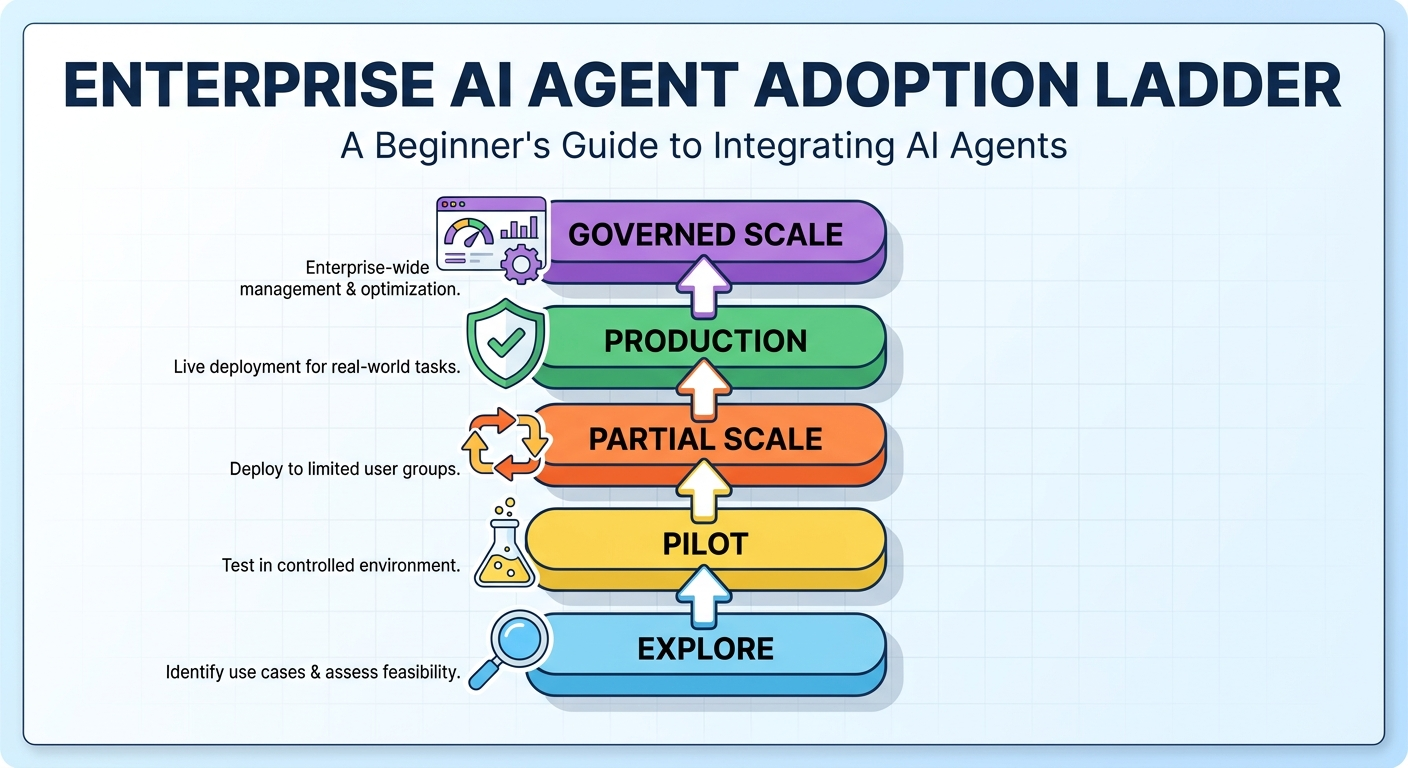
| Stage | What it looks like | Main leadership question | Exit criteria |
|---|---|---|---|
| Explore | Teams test agent demos, vendor tools, coding agents, support agents, or internal assistants. | Is there a real workflow pain, or are we chasing novelty? | Three to five candidate workflows with measurable business value. |
| Pilot | A bounded agent runs in a sandbox or low-risk workflow with close human review. | Can the agent complete the task reliably enough to justify deeper investment? | Clear task success metric, trace logs, failure categories, and human review process. |
| Partial scale | The agent assists a team or department, often with approvals before action. | Can we control variance across users, data, tools, and edge cases? | Evaluation suite, permission model, escalation path, and cost reporting. |
| Production | The agent is part of a live workflow, customer journey, employee tool, or engineering process. | Can we detect problems quickly and recover safely? | Monitoring, alerts, rollback, ownership, compliance review, and incident playbook. |
| Governed scale | Multiple agent workflows run across the enterprise with shared standards. | Can we scale without multiplying hidden risk? | Common policy, reusable evals, agent registry, audit trails, and executive dashboard. |
The maturity ladder prevents a common mistake: treating a successful pilot as proof that the organization is ready for production. A pilot proves the model can help under controlled conditions. Production proves the system can survive messy inputs, tool failures, policy changes, tired users, adversarial prompts, incomplete data, and accountability questions.
Which Enterprise AI Agent Use Cases Are Ready First?
The best first agent workflows are not always the most glamorous. They are usually repetitive, bounded, reviewable, and connected to existing systems of record. A support summarization agent may be a better first deployment than a fully autonomous sales negotiator. A coding-agent test fixer may be safer than an agent that can merge changes without review. A procurement intake assistant may be safer than an agent that approves vendor payments.
Riskier use cases share a pattern: the agent has broad authority, ambiguous goals, weak data boundaries, and direct external impact. That includes agents that can negotiate, approve spending, change production infrastructure, give regulated advice, or communicate with customers without review. These use cases may become viable, but they should come later on the maturity ladder.
The AI Agent Readiness Scorecard Leaders Should Use
Before scaling any enterprise AI agent, use a scorecard. The goal is not to slow the team down. It is to make the scale decision explicit. If a workflow cannot answer these questions, it is still a pilot, no matter how polished the demo looks.
| Readiness area | Question to answer | Green signal | Red flag |
|---|---|---|---|
| Workflow fit | Is the task bounded and valuable? | Clear inputs, outputs, owner, and success metric. | Vague goal such as “improve productivity” with no process boundary. |
| Data access | What context can the agent see? | Least-privilege access and documented data sources. | Broad access to sensitive systems because it is easier during setup. |
| Tool permissions | What can the agent do? | Read, draft, request approval, or act only within scoped tools. | Production write access without approval, expiration, or audit. |
| Evaluation | How do we know it works? | Golden tasks, regression tests, adversarial examples, and pass/fail thresholds. | Demo quality judged only by anecdotal user excitement. |
| Observability | Can we inspect failures? | Trace logs for prompts, retrieval, tool calls, approvals, and outputs. | Black-box behavior with no useful explanation after failure. |
| Human approval | When must a person intervene? | Clear thresholds for high-risk actions, uncertainty, and exceptions. | Humans review only after damage is done. |
| Cost control | What does a completed workflow cost? | Cost per task, model usage, retries, and failure cost tracked. | Agent loops, premium models, and hidden usage with no budget owner. |
| Security and compliance | What policies apply? | Threat model, prompt-injection controls, audit retention, and legal review where needed. | Agent connected to regulated or confidential systems without review. |
| Rollback | How do we stop or undo it? | Kill switch, versioned prompts, reversible actions, and incident owner. | No clear path to recover from bad actions. |
This scorecard is intentionally practical. It connects directly with topics Singularity Journey has already covered, including AI agent evaluation frameworks, trace debugging, browser-agent approval workflows, and MCP permission manifests. Those implementation details are not side topics. They are the machinery that makes enterprise adoption safe enough to scale.
What an Enterprise AI Agent Governance Dashboard Should Track
A governance dashboard should not be a vanity slide that says how many agent projects exist. It should show whether agents are completing valuable work safely. The most useful dashboard combines adoption, quality, risk, cost, and human oversight.
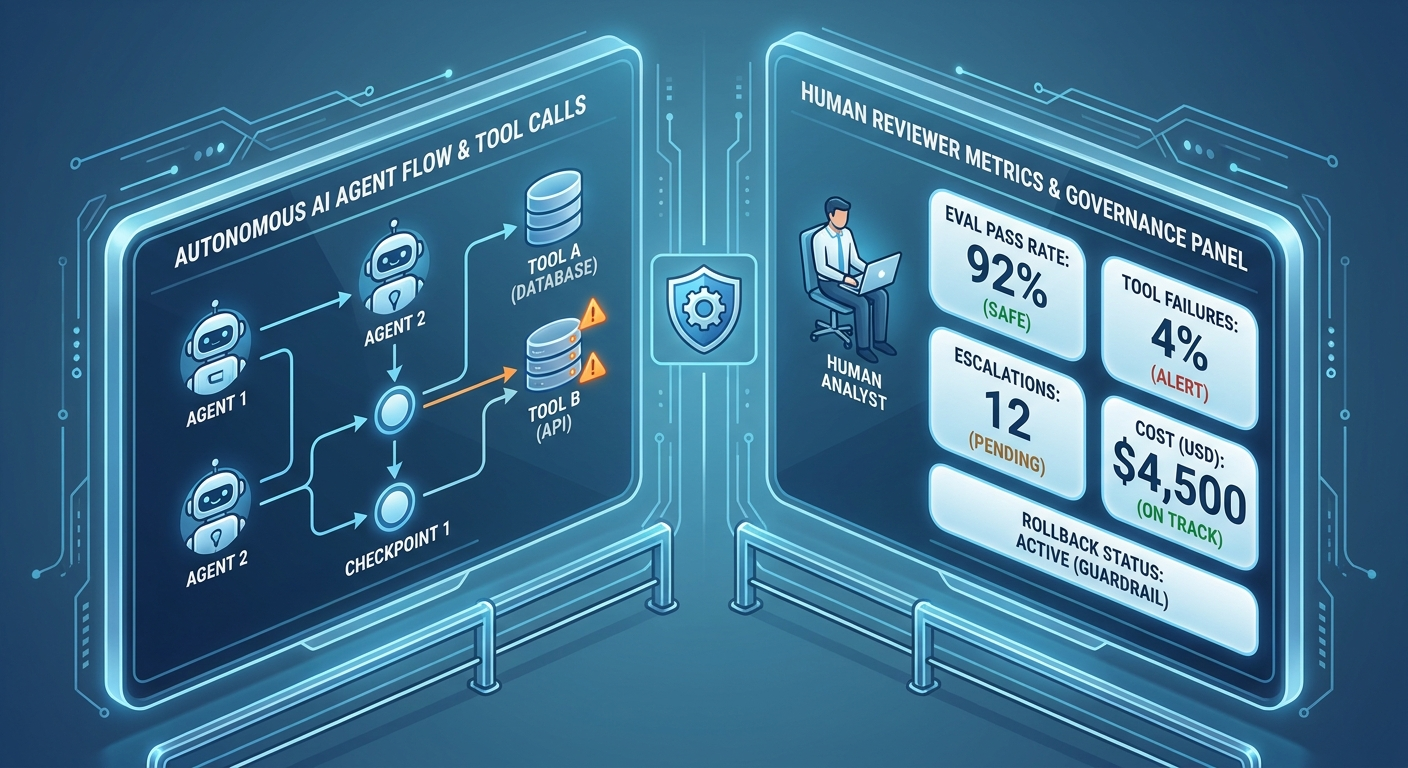
Metrics worth tracking
- Completed workflows by agent, team, and use case.
- Task success rate and evaluation pass rate.
- Tool-call failure rate and retry loops.
- Human approval rate, rejection rate, and escalation reason.
- Average cost per completed workflow.
- Time saved versus human-only baseline.
- Incidents, near misses, and rollback events.
- Data sources accessed and permission changes.
Metrics that can mislead
- Raw number of agents launched.
- Prompt volume without task outcomes.
- Model benchmark scores without workflow evaluation.
- Employee usage counts without quality or risk context.
- Cost savings estimated from demos rather than production logs.
- Customer satisfaction claims without controlled measurement.
Databricks’ finding about evaluation and governance is important here because it matches what experienced builders already know: the organizations that reach production are the ones that measure behavior. Anthropic’s engineering guidance makes a related point from the builder side: agents trade latency and cost for task performance, so teams should start with the simplest solution and add agentic complexity only when the task demands it. For leaders, that means the dashboard should show whether autonomy is earning its cost.
Common Mistakes That Stop AI Agent Pilots From Scaling
1. Confusing chatbot adoption with agent adoption
A chatbot answers. An agent acts. The moment the system can call tools, change data, or coordinate tasks, the governance burden changes. Leaders who treat agents as normal chatbots often miss permission, audit, and rollback requirements.
2. Scaling before evaluation exists
If the only evidence is “the demo worked,” the organization is not ready. Agents need test sets, failure categories, production traces, and regression checks. The goal is not perfect accuracy. The goal is predictable behavior with known failure modes.
3. Giving agents too many tools too early
Tool access is power. A broad tool set makes demos impressive but debugging harder. Start with the smallest tool surface that completes the workflow. Add permissions slowly, with expiration and approval rules.
4. Ignoring the human workflow
Human approval is not just a safety checkbox. It is part of the product experience. If approvals are too frequent, users ignore the agent. If approvals are too rare, risk rises. Good design defines when the agent should act, ask, or stop.
5. Not assigning ownership
Every production agent needs a business owner, a technical owner, and an incident owner. Without ownership, failures become everyone’s problem and no one’s responsibility.
6. Measuring productivity without measuring risk
Agents may save time while also creating hidden review burden, policy exceptions, or downstream cleanup. A mature adoption program measures both benefits and risk-adjusted operating cost.
A Practical Enterprise AI Agent Adoption Playbook
Use this playbook when moving from interest to implementation.
Step 1: Choose one painful, bounded workflow
Pick a workflow with real volume, clear inputs, and visible outcomes. Avoid choosing the most politically exciting use case. Choose the one where a safe agent can prove value quickly.
Step 2: Define autonomy levels
Create simple levels such as: read-only assistant, draft-only agent, approval-required agent, limited autonomous agent, and high-risk restricted agent. This helps executives discuss risk without getting buried in model details.
Step 3: Build the evaluation set before expansion
Collect examples of easy cases, edge cases, failure cases, policy-sensitive cases, and adversarial inputs. A useful evaluation set becomes the memory of what the organization learned during the pilot.
Step 4: Start with narrow tools and explicit permissions
If the agent needs CRM access, decide which fields it can read and which fields it can update. If it needs a browser, decide which sites and actions are allowed. If it writes code, require pull requests and tests.
Step 5: Observe every important step
Log retrieval, prompts, tool calls, approvals, outputs, user edits, and final outcomes. If you cannot trace a bad result, you cannot improve it reliably.
Step 6: Review weekly until behavior stabilizes
During early production, review failed tasks, rejected approvals, cost spikes, and user complaints weekly. Update prompts, tools, policy, and training data deliberately rather than reacting randomly.
Step 7: Scale standards, not one-off hacks
Once one agent works, extract reusable patterns: approval rules, eval templates, trace schema, permission manifests, incident playbooks, and onboarding docs. Enterprise adoption accelerates when teams reuse governance instead of reinventing it.
What This Trend Means for the Singularity Path
Enterprise AI agent adoption is not the singularity by itself. But it is one of the clearest near-term signs that AI is moving from passive generation to delegated action. When thousands of organizations connect models to tools, workflows, data, and decision loops, the social impact of AI changes. The question becomes less “can the model write a good answer?” and more “who controls the systems that act on model outputs?”
That is why AI safety and governance are not separate from business adoption. They are part of the adoption curve. A company that scales agents without oversight may create fragile automation. A company that refuses to use agents may fall behind competitors that learn how to delegate safely. The durable advantage belongs to organizations that combine ambition with instrumentation: they know where agents help, where humans must stay in control, and where autonomy should not be allowed yet.
For readers building their own understanding, continue with Singularity Journey’s guides to enterprise AI agents, AI risk registers, and AI proof-of-work portfolios. The same theme runs through all of them: the future belongs to people and teams who can turn AI capability into trustworthy systems.
Sources and References
- Databricks: State of AI Agents
- Capgemini: Rise of agentic AI
- Deloitte: Agentic AI enterprise adoption
- Anthropic: Building effective agents
- IBM Think: What are AI agents?
- OpenAI: Introducing Codex
- Salesforce: AI Agents
Research note: adoption statistics vary by survey population, platform, region, and definition of “agent.” Use cited statistics as directional signals and validate decisions with your own workflow data.
FAQ: Enterprise AI Agent Adoption
What is enterprise AI agent adoption?
Enterprise AI agent adoption is the process of using AI systems that can plan, use tools, access context, and complete business workflows under defined controls. It goes beyond simple chatbots because agents can take or prepare actions.
How are AI agents different from chatbots?
Chatbots mainly respond to user prompts. AI agents can pursue a goal through multiple steps, call tools, use memory or retrieval, request approvals, and update systems when permitted.
Why do many AI agent pilots fail to scale?
Common reasons include weak evaluation, broad tool permissions, unclear ownership, poor observability, missing rollback plans, uncertain cost, and no human approval design for high-risk actions.
What should leaders track before scaling AI agents?
Track task success rate, eval pass rate, tool-call failures, human approval and rejection rates, escalation reasons, cost per completed workflow, incidents, rollback events, and data access patterns.
Which AI agent use cases are safest to start with?
Start with bounded, reviewable workflows such as support triage, employee helpdesk routing, sales follow-up drafting, knowledge search, invoice exception review, and coding tasks that require pull-request review.
Do AI agents need human approval?
Yes for high-risk actions. Human approval is especially important when agents can change records, spend money, contact customers, alter code, access sensitive data, or make regulated decisions.
What is an AI agent governance dashboard?
It is a dashboard that shows whether agents are completing valuable work safely. It should include quality, risk, cost, evaluation, tool-call, approval, escalation, and incident metrics.
Should every enterprise workflow become agentic?
No. Some workflows are better served by simple automation, retrieval, forms, or single LLM calls. Use agents when flexibility, context, and multi-step tool use are worth the added cost and risk.
