
Enterprise AI Agent Metrics: What to Track Before Agents Reach Production
Enterprise AI agent metrics are the difference between a promising pilot and a production system leaders can trust. This guide turns agent readiness into a practical dashboard for success, risk, cost, human oversight, and rollback.
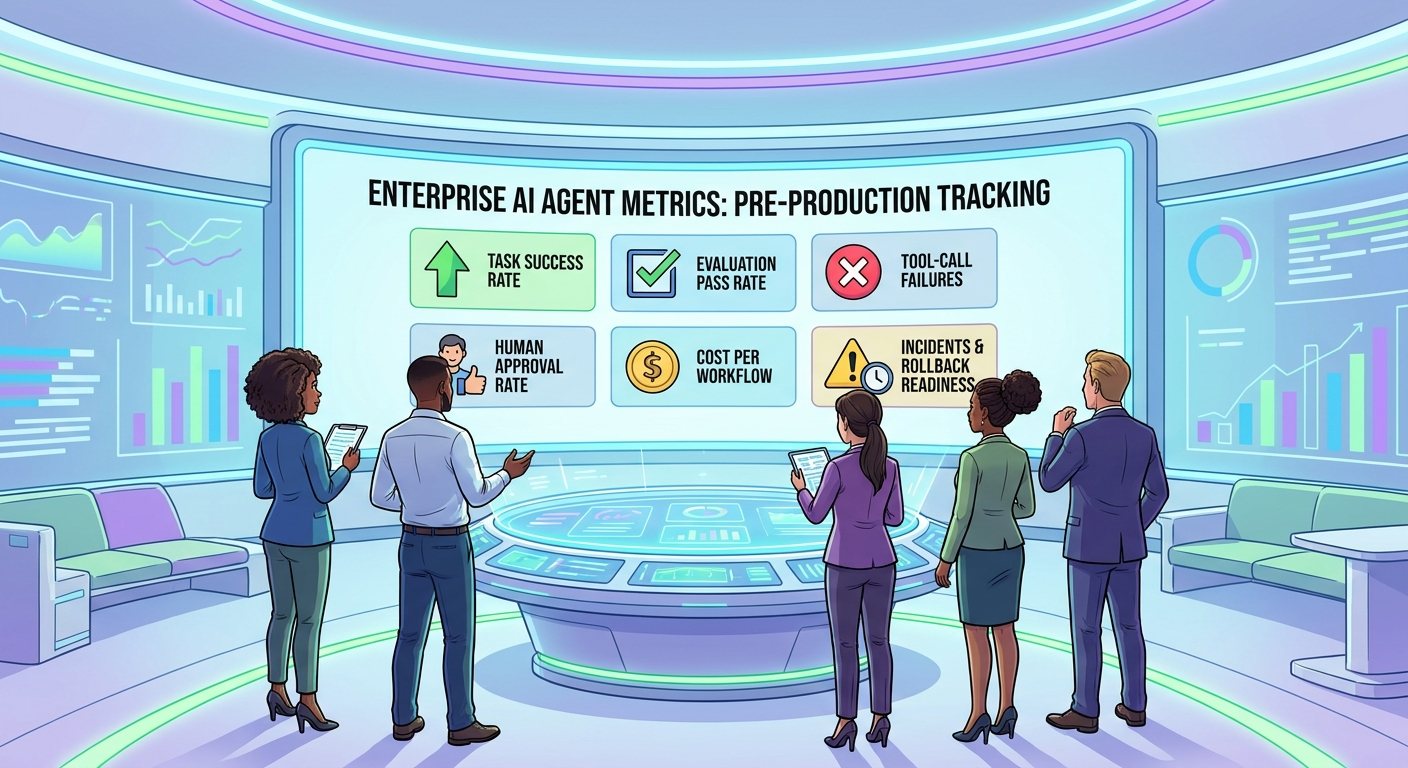
Enterprise AI Agent Metrics: Quick Answer
Enterprise AI agent metrics are the measurements leaders use to decide whether an AI agent is ready for production, safe to scale, and worth its operating cost. They should track more than usage. A useful dashboard measures task success, evaluation pass rate, tool-call reliability, trace completeness, human approval quality, escalation reasons, cost per completed workflow, incident rate, rollback readiness, and business impact.
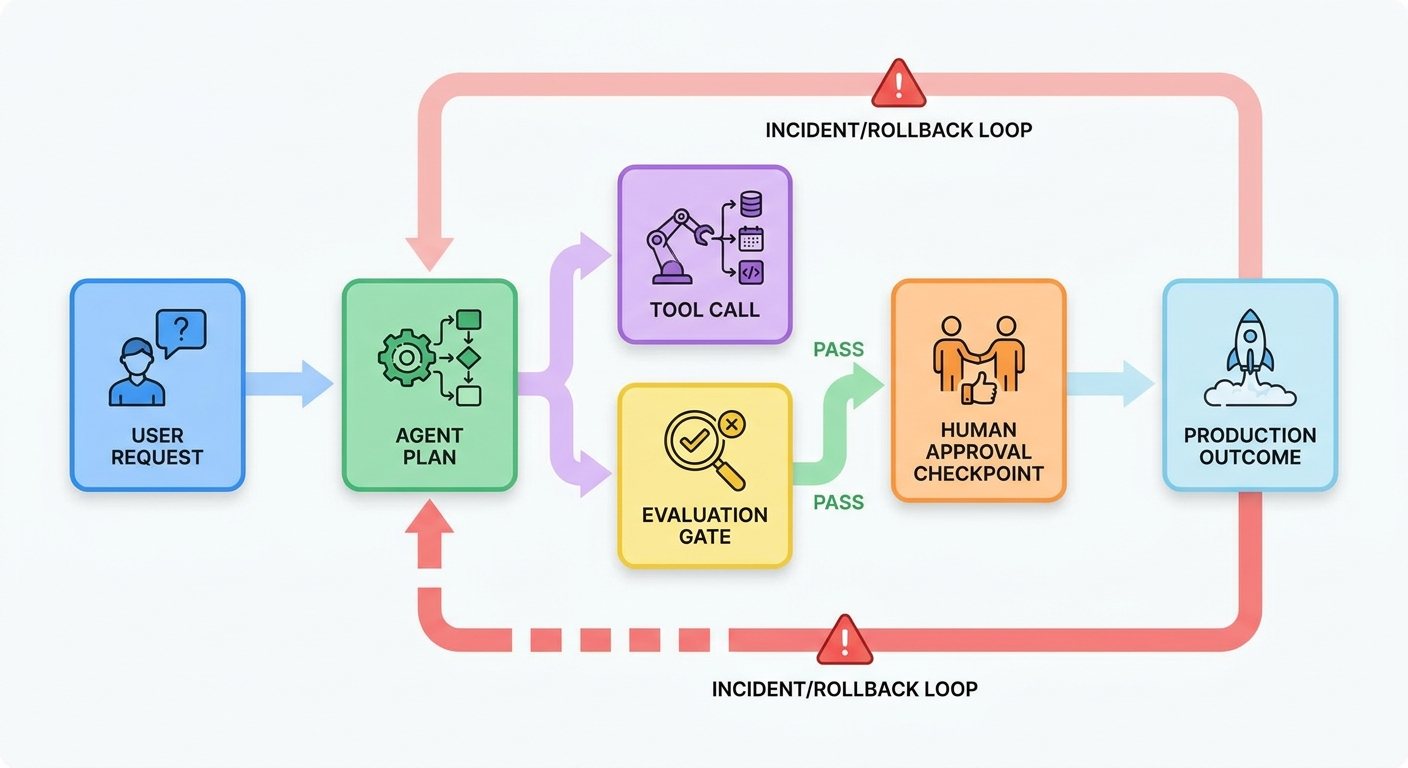
The most important shift is simple: do not measure an AI agent like a normal chatbot. Chatbots can often be judged by response quality, deflection rate, and user satisfaction. Agents need a wider measurement model because they can plan, call tools, change records, generate code, route work, draft customer responses, or trigger downstream actions. A production agent is not only a model answering questions. It is a workflow participant.
This article is a cluster guide for the broader Singularity Journey pillar, Enterprise AI Agent Adoption: What Leaders Should Track Before Scaling Agents. That pillar explains the adoption journey. This guide focuses on the narrower operational layer: exactly what to put on the metrics dashboard before agents move from pilot to production.
Why AI Agent Metrics Matter More Than Demo Quality
Enterprise AI agent demos are often impressive because the path is controlled. The user asks a clean question, the data source behaves, the tool call succeeds, and the agent produces a useful result. Production is different. Users provide incomplete instructions. APIs fail. Retrieved context is stale. A policy exception appears. The model chooses the wrong tool. The human reviewer approves too quickly. A retry loop consumes budget. A low-risk workflow slowly expands into a high-risk one.
That is why agent metrics must measure behavior under operating conditions, not just whether a demo looks smart. Databricks’ State of AI Agents report highlights a useful pattern: organizations using evaluation tools get far more AI projects into production, and organizations using governance get even more projects into production. Treat that as a directional signal rather than a universal law. The deeper lesson is that production success depends on evaluation and governance becoming part of the build process.
Anthropic’s engineering guidance makes a related point from the builder side: agentic systems often trade latency and cost for better task performance, and teams should start with the simplest solution that works. A leadership dashboard should make that tradeoff visible. If an agent adds cost, latency, approvals, and failure modes without improving workflow outcomes, it is not ready to scale. If the agent reliably completes bounded work, reduces human effort, and escalates safely, it may be a strong production candidate.
Search and analytics also support this article angle. Singularity Journey’s recent GA4 data shows page-level attention around enterprise AI agents, AI agent evaluation, trace debugging, MCP permissions, browser-agent approval workflows, and agent observability. Search Console data remains sparse, which suggests the site is still building organic authority. A focused metrics guide supports the newly published enterprise adoption pillar and creates a practical long-tail article that is more specific than another broad agent adoption overview.
The Production AI Agent Dashboard Leaders Should Build
A useful AI agent dashboard should combine five dimensions: outcome quality, operational reliability, human oversight, risk control, and economic value. If the dashboard only shows prompt volume or user adoption, it will create false confidence. High usage can mean the agent is useful. It can also mean users are stuck in repeated retries.
| Metric group | What it tells leaders | Example metric | Owner |
|---|---|---|---|
| Task outcome | Whether the agent completed valuable work, not just produced text. | Completed workflows, task success rate, first-pass completion rate. | Business process owner |
| Evaluation quality | Whether behavior is stable against known test cases. | Eval pass rate, regression failures, policy-case pass rate. | AI product or engineering owner |
| Tool reliability | Whether tools, APIs, and data connections work safely. | Tool-call success rate, retry loops, timeout rate, invalid tool selection. | Platform engineering |
| Human oversight | Whether people are reviewing the right moments. | Approval rate, rejection rate, escalation reason, reviewer edit distance. | Operations or risk owner |
| Cost and latency | Whether agent autonomy is worth the expense and waiting time. | Cost per completed workflow, tokens per success, median completion time. | Finance and technical owner |
| Risk and incidents | Whether failures are visible, reversible, and decreasing. | Incident rate, near misses, rollback events, policy violations. | Security, compliance, and incident owner |
| User impact | Whether the workflow is actually better for employees or customers. | Human time saved, satisfaction, reopened tasks, customer follow-up quality. | Product or department leader |
The dashboard should be tied to a specific workflow. “Customer support agent metrics” and “software bug-fix agent metrics” should not be collapsed into one generic agent number. A support agent may need metrics for policy accuracy, escalation, customer sentiment, and reopened tickets. A coding agent may need metrics for test pass rate, pull request review comments, build failures, and reverted changes. The shared pattern is the same, but the thresholds are workflow-specific.
Metric Formulas That Make Agent Readiness Concrete
Teams often say they want to “measure agent quality,” but quality is too vague. Use formulas that force the team to define the workflow boundary.
Task success rate
Formula: successful completed workflows divided by total attempted workflows. This should count only outcomes that meet the workflow definition, not tasks where the agent merely responded. For example, if a helpdesk agent triages 100 tickets but 20 require manual rework because the category or routing was wrong, the success rate is not 100%.
First-pass completion rate
Formula: workflows completed without retry, human correction, or tool rerun divided by total workflows. This matters because some agents eventually succeed after many loops. Eventual success can still be expensive, slow, and frustrating.
Evaluation pass rate
Formula: passed evaluation cases divided by total evaluation cases. Separate easy cases, edge cases, adversarial cases, policy-sensitive cases, and regression cases. A single blended score can hide dangerous weakness in high-risk scenarios.
Tool-call failure rate
Formula: failed tool calls divided by total tool calls. Track timeouts, authentication failures, invalid parameters, blocked permissions, and wrong-tool selection separately. A high tool-call failure rate may indicate bad tool design, unclear tool descriptions, weak input validation, or an agent being asked to do too much.
Escalation accuracy
Formula: correct escalations plus correct non-escalations divided by total decisions where escalation was possible. This metric is critical because an agent that escalates everything is safe but useless, while an agent that escalates nothing is fast but risky.
Cost per completed workflow
Formula: total model, tool, infrastructure, and review cost divided by successful completed workflows. Measure cost per success, not only cost per attempt. Failed attempts are part of the operating cost.
Rollback readiness
Formula: percentage of production actions that are traceable, reversible, or covered by a documented stop procedure. This is not a normal accuracy metric, but it is essential for production governance. If a bad agent action cannot be traced or undone, the workflow should remain limited.
Human Approval Metrics: The Most Overlooked Part of Agent Governance
Human approval is often described as a control, but it should also be measured as a workflow. If every action requires approval, the agent may become a slow form. If almost nothing requires approval, the organization may be hiding risk. The goal is not maximum approval or minimum approval. The goal is appropriate approval.
The best approval dashboards show trends by risk tier. Low-risk read-only tasks should not require the same approval pattern as write actions, financial actions, customer communication, production code changes, or access-control changes. This connects directly with Singularity Journey’s existing guides on human-in-the-loop AI agents, browser-agent approval workflows, and MCP permission manifests.
Cost and ROI Metrics for Enterprise AI Agents
Agent economics can be deceptive. A single workflow may involve model calls, retrieval, tool calls, retries, human review, logging, infrastructure, and incident response. If leaders only count subscription fees or model tokens, they will underestimate the real operating cost.

| Cost metric | Why it matters | How to interpret it |
|---|---|---|
| Cost per attempted workflow | Shows raw operating cost, including failures. | Useful for budget planning, but not enough for ROI. |
| Cost per successful workflow | Shows the real cost of useful output. | If this rises, failures or retries may be eating value. |
| Tokens per success | Shows whether context or output length is bloated. | High values may point to poor prompt design or oversized retrieval. |
| Retry cost | Shows how much budget is spent on loops. | Repeated retries are often a hidden agent tax. |
| Human review minutes | Shows whether the agent shifts work instead of reducing it. | If review time is high, redesign approval or improve output quality. |
| Incident cleanup cost | Shows the cost of failures after production. | Even rare incidents can dominate ROI for high-risk workflows. |
ROI should be calculated against a baseline. Compare the agent-assisted workflow with the previous human-only or automation-only workflow. The baseline should include time, error rate, throughput, customer impact, and risk. If the agent saves five minutes but creates two minutes of review and a new incident risk, the net gain may be smaller than the demo suggests.
A practical formula is: value created minus model/tool cost, infrastructure cost, human review cost, and risk-adjusted failure cost. This does not need to be perfect in the pilot phase. It does need to be explicit before production scale.
Observability Metrics: What You Need to Trace
AI agent observability is the ability to inspect what happened when an agent completed, failed, escalated, or misbehaved. Without traces, teams argue from anecdotes. With traces, teams can diagnose whether the problem was retrieval, prompt instructions, model reasoning, tool schema, permissions, data freshness, or human review.
At minimum, production agent traces should capture the user request, selected workflow, retrieved sources, model calls, tool calls, tool responses, approval checkpoints, final output, human edits, error messages, and final business outcome. Sensitive data should be protected according to policy, but the organization still needs enough evidence to debug behavior.
Observability metrics include trace completeness, missing-event rate, tool latency, retrieval hit quality, prompt version, policy version, and incident trace availability. A team that cannot reconstruct failures should not expand autonomy. For deeper implementation detail, read Singularity Journey’s AI agent observability guide and trace debugging article.
Review Cadence: How Often Leaders Should Check Agent Metrics
Metrics only matter if someone reviews them and changes decisions. During pilot, review weekly. During early production, review weekly or biweekly depending on risk. Once behavior stabilizes, review monthly with immediate alerts for incidents, cost spikes, and policy violations.
| Stage | Review cadence | Primary focus | Decision |
|---|---|---|---|
| Pilot | Weekly | Failure categories, eval gaps, user feedback, and tool reliability. | Improve, narrow scope, or stop. |
| Limited production | Weekly to biweekly | Incidents, approval quality, cost per success, and rollback readiness. | Hold, expand, or add controls. |
| Stable production | Monthly plus alerts | Trend drift, policy changes, model changes, and business impact. | Maintain, optimize, or re-evaluate. |
| High-risk workflows | Continuous monitoring plus formal review | Policy violations, external impact, sensitive data, and audit evidence. | Require executive or risk-owner approval for expansion. |
Every review should end with a decision. Do not let dashboards become passive reporting. The useful decisions are concrete: reduce tool permissions, add eval cases, change escalation thresholds, improve retrieval, lower model cost, add a kill switch, retrain reviewers, or keep the agent in pilot.
Common AI Agent Metrics Mistakes
Measuring adoption instead of outcomes
Prompt volume, active users, and number of deployed agents can look good while actual workflow quality remains poor. Use adoption metrics as context, not proof of value.
Blending all workflows into one score
A support agent, coding agent, finance agent, and research assistant have different risks. Aggregate dashboards are useful for executives, but production decisions need workflow-level metrics.
Ignoring failed attempts
If the dashboard only counts successful completions, it hides the cost of retries, abandoned sessions, escalations, and manual cleanup. Failed attempts are part of the real system.
Using model benchmarks as production readiness
Model benchmark scores can help with selection, but they do not prove that your agent works with your tools, data, users, policies, and edge cases.
Forgetting ownership
Each metric should have an owner. If no one owns tool-call failures, approval latency, cost spikes, or rollback readiness, the dashboard will not change behavior.
How to Set Thresholds Without Creating Fake Certainty
Thresholds are useful, but they should not pretend that every workflow has the same risk. A document-summary agent can tolerate more uncertainty than an agent that changes customer records. A coding agent that opens a pull request can be measured differently from an agent that deploys infrastructure. The practical approach is to set three levels for each metric: acceptable for pilot, acceptable for limited production, and acceptable for wider scale.
For example, a pilot might continue even when tool-call failures are common if the team is still improving schemas and permissions. Limited production should require stable tool behavior, clear escalation rules, and trace coverage for every important action. Wider scale should require evidence that failures are declining, costs are predictable, and rollback procedures have been tested. The threshold is not just a number. It is a commitment about what the organization will do when the number moves in the wrong direction.
Leaders should also watch metric combinations. A high task success rate with rising human edit distance may mean reviewers are quietly fixing poor outputs. A low incident rate with incomplete traces may mean incidents are invisible. A falling cost per workflow with higher rejection rates may mean the team made the model cheaper but less useful. Good governance comes from reading the dashboard as a system, not celebrating one green number.
The healthiest metric culture treats agent measurement as learning infrastructure. Every rejected approval, failed tool call, and rollback event should improve prompts, permissions, eval cases, documentation, or workflow design. That feedback loop is what lets enterprise agents mature safely instead of becoming a collection of impressive but fragile automations.
Sources and References
- Databricks: State of AI Agents
- Anthropic: Building Effective Agents
- Capgemini: Rise of agentic AI
- Deloitte: Agentic AI enterprise adoption
- IBM Think: What are AI agents?
- Salesforce: AI Agents
Research note: agent maturity, adoption, and ROI vary by workflow, industry, data quality, and risk tolerance. Use external reports as context, then validate decisions with your own traces and production metrics.
FAQ: Enterprise AI Agent Metrics
What are enterprise AI agent metrics?
Enterprise AI agent metrics are measurements used to evaluate agent readiness, reliability, safety, cost, and business value. They include task success, eval pass rate, tool-call failure rate, approval quality, cost per workflow, incidents, and rollback readiness.
Which AI agent metric matters most before production?
No single metric is enough. The most important combination is task success rate, evaluation pass rate, tool-call reliability, human approval quality, incident visibility, and cost per successful workflow.
How do you measure AI agent success rate?
Define the workflow outcome first, then divide successful completed workflows by total attempted workflows. Do not count a task as successful just because the model produced a response.
What is a good human approval rate for AI agents?
There is no universal good rate. Low-risk draft tasks may need little approval, while customer-facing, financial, security, or regulated actions may need strict review. Track approval rate together with rejection reasons and missed escalations.
How should leaders measure AI agent ROI?
Compare the agent-assisted workflow against the previous baseline. Include time saved, quality improvement, model and tool cost, human review time, retries, incident cleanup, and risk-adjusted failure cost.
What should an AI agent governance dashboard include?
It should include outcome metrics, evaluation metrics, tool-call reliability, approval and escalation metrics, cost metrics, incident and rollback metrics, user impact, and data-access visibility.
How often should AI agent metrics be reviewed?
Review weekly during pilots and early production. Move to monthly reviews only after behavior stabilizes, with immediate alerts for incidents, policy violations, cost spikes, and tool failures.
Can model benchmark scores replace agent evaluation?
No. Benchmarks can help choose a model, but production evaluation must test your workflow, tools, data, policies, users, and failure modes.
