
AI Proof-of-Work Portfolio: How to Show Employers You Can Work With AI
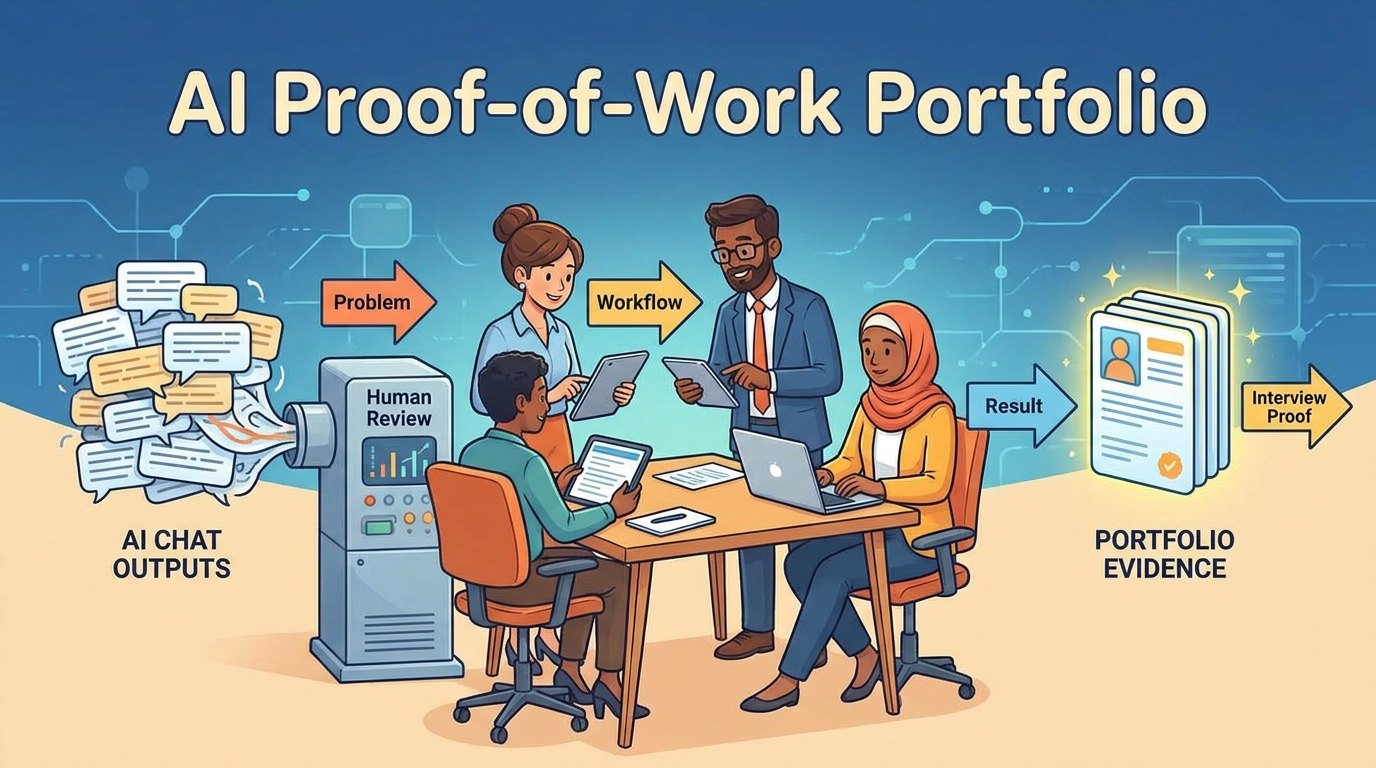
An AI proof-of-work portfolio turns vague AI confidence into visible evidence: workflow maps, redacted artifacts, review checklists, metrics, and interview stories that show you can use AI responsibly.
Quick Answer: What Is an AI Proof-of-Work Portfolio?
An AI proof-of-work portfolio is a small collection of evidence showing that you can use AI to improve real work, not just generate impressive-looking outputs. It documents the problem you solved, the baseline before AI, the workflow you designed, the tools or agents you used, the human review steps you applied, the result you achieved, and what you would improve next.
This article supports the broader AI Career Moat pillar. The pillar explains why durable career value comes from domain expertise, judgment, workflow design, trust, and portfolio proof. This cluster article zooms into one narrow question: how do you actually show that proof to employers, clients, managers, or collaborators?
A weak AI portfolio says, “I used an AI tool.” A strong AI proof-of-work portfolio says, “Here is the work problem, here is the AI-assisted process, here is how I checked it, and here is the useful outcome.” That distinction matters because basic AI usage is quickly becoming normal.
You do not need twenty projects. In many cases, three strong proof-of-work artifacts are better than ten shallow demos. A hiring manager does not need every prompt you have ever tried. They need enough evidence to trust your thinking. The best portfolio artifacts feel like miniature case studies: concise, specific, honest, and connected to real work.
Why AI Proof of Work Matters More Than AI Tool Claims
AI skill claims are cheap now. A resume line saying “proficient with ChatGPT” tells an employer very little. It does not show whether you understand the domain, whether you can identify a valuable use case, whether you can handle unreliable output, or whether you can explain the result to a human stakeholder. Proof of work closes that trust gap.
Labor-market research is moving in the same direction. The World Economic Forum’s Future of Jobs work highlights that employers expect major skill transformation as AI and information processing reshape work. Microsoft’s Work Trend Index frames the next stage around human-agent collaboration and work redesign, not merely one-off prompting. Anthropic’s Economic Index analyzes AI use at the task level, which is exactly how careers are changing: tasks inside jobs are being restructured before entire job titles disappear or appear.
The practical lesson is that your career evidence should also be task-level. Instead of saying “I know AI,” show a concrete task you improved. Instead of listing ten tools, show one workflow that moved from messy input to useful output. Instead of promising productivity, show a before-and-after baseline. This turns AI from a buzzword into a work sample.
Proof of work is also helpful because employers are rightly cautious. AI output can be wrong, biased, confidential, generic, legally risky, or brand-inappropriate. A good portfolio does not hide those risks. It shows how you controlled them. That honesty is an advantage.
What Counts as AI Portfolio Proof?
Not every AI project is proof. A proof artifact should make your thinking inspectable. It should show inputs, process, judgment, and outcome. The final deliverable matters, but the workflow matters more because that is what an employer or client is really buying.
| Portfolio element | Weak version | Strong proof-of-work version |
|---|---|---|
| Problem | “I made an AI report.” | “Weekly customer feedback took three hours to classify and often missed recurring complaints.” |
| AI use | “I used ChatGPT.” | “I used AI to group comments, draft summaries, and flag ambiguous items for human review.” |
| Human judgment | No review process shown. | A checklist verifies source quotes, sentiment labels, privacy, tone, and unsupported claims. |
| Evidence | Only a final screenshot. | Workflow diagram, redacted input sample, prompt excerpt, validation notes, and final output. |
| Outcome | “It was faster.” | “Reduced first-pass sorting time from roughly three hours to one hour while keeping manual review for edge cases.” |
A strong artifact does not need confidential company data. In fact, the best public portfolio pieces often use mock data, open datasets, personal projects, or heavily redacted examples. The goal is to demonstrate the method. If you can show the structure of your workflow without exposing private information, you demonstrate both skill and judgment.
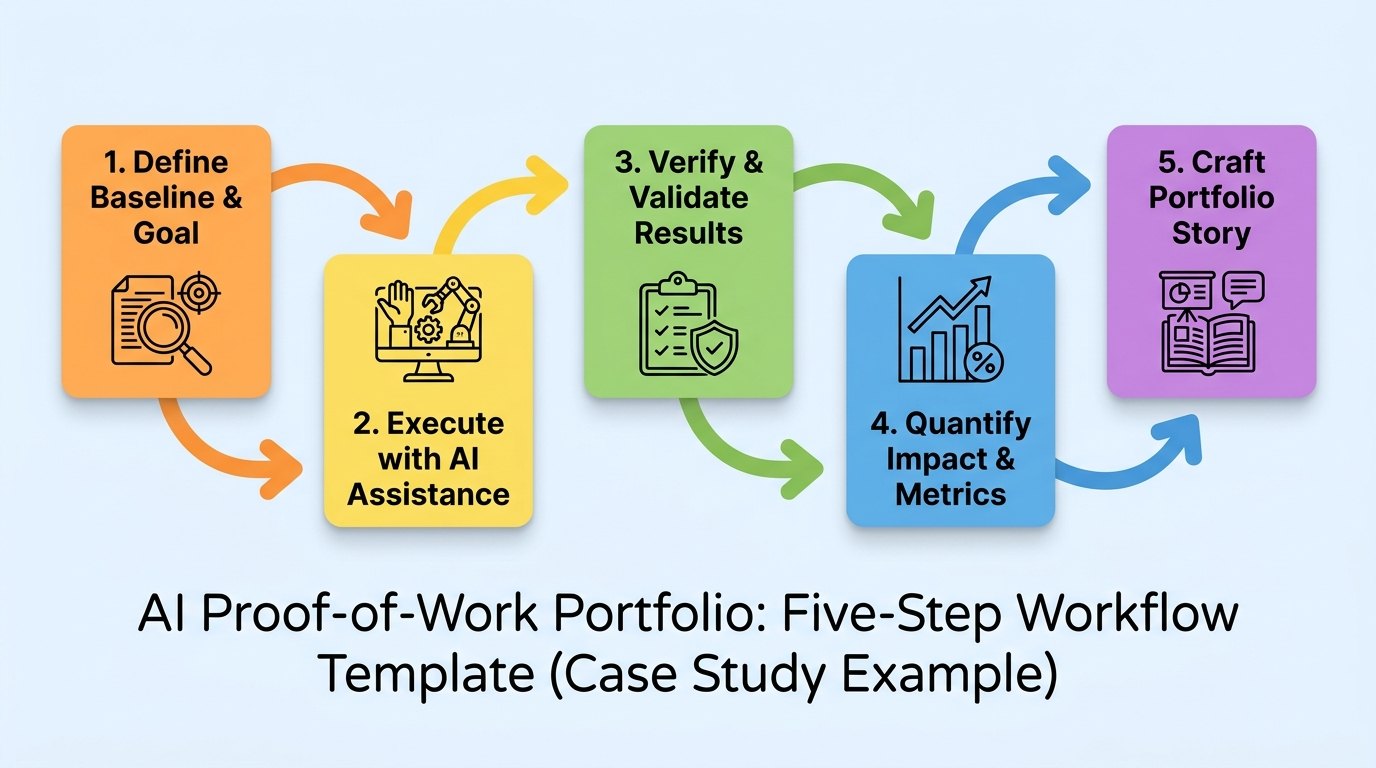
The AI Proof-of-Work Portfolio Template
Use this template for every portfolio case study. It is intentionally simple because the reader should understand your work quickly. A recruiter may scan it in one minute. A hiring manager may ask about it in an interview. A client may want to know whether you can repeat the process for their problem. The structure needs to serve all three.
First, title the artifact around the result. Do not call it “ChatGPT Experiment.” Use a result-focused title such as “AI-Assisted Customer Feedback Triage,” “Weekly Market Research Workflow With Source Verification,” or “Sales Call Summary Workflow for Account Managers.” The title should make the value obvious.
Second, define the work problem. Write two or three sentences explaining the recurring task, bottleneck, or decision. Include the audience and why the work mattered. If the problem was personal or simulated, label it clearly. Honesty is better than pretending a toy project was enterprise work.
Third, capture the baseline. Baseline evidence turns a portfolio from a story into proof. You can use approximate but honest measures: time spent, number of steps, error frequency, turnaround delay, number of manual checks, stakeholder complaints, or clarity issues. If you do not have hard numbers, use a qualitative baseline and say so.
Fourth, show the AI-assisted workflow. Explain where AI entered the process. Did it summarize interviews, classify tickets, draft first-pass copy, generate code tests, compare sources, or create a checklist? The best workflows do not hand everything to AI. They assign AI a bounded role and keep humans responsible for judgment.
Fifth, show the human review layer. Include the checklist you used to catch AI errors. For research, that may include source verification. For customer support, it may include tone and policy checks. For analysis, it may include outlier review. For code, it may include tests, linting, and security review.
Sixth, present the result. Show what changed: faster turnaround, clearer decisions, fewer missed steps, better consistency, improved documentation, higher stakeholder confidence, or a reusable operating procedure. Avoid fake precision. A modest, honest estimate is more credible than an invented ROI number.
Finally, explain limits and next iteration. Real professionals know the limits of their work. Add a short note on what you would improve next: better data, stakeholder testing, automation, audit logs, guardrails, or model comparison. That reflection shows learning velocity and maturity.
AI Proof-of-Work Examples by Role
The best topic for your portfolio depends on the work you want to do. Choose a workflow close to your target role. If you want an operations job, prove operations thinking. If you want a marketing role, prove research quality and judgment. If you want a developer role, prove implementation and validation. The closer the artifact is to the target job, the easier it is for someone to imagine hiring you.
For a non-coder operations portfolio, build an AI-assisted meeting-to-action workflow. The problem is that meeting notes are messy and action items get lost. The workflow uses AI to summarize notes, extract owners and deadlines, flag unresolved questions, and draft a follow-up message. The human review checklist checks whether every owner is real, every deadline was actually agreed, and sensitive comments are removed. The result is a cleaner handoff and a reusable SOP.
For a marketing portfolio, build a source-backed content research workflow. The problem is that first drafts often include unsupported claims. The workflow uses AI to cluster search intent, summarize credible sources, generate a brief, and create a claims table. Human review verifies every statistic against the original source. The final artifact includes the brief, the claims table, and a reflection on which claims were removed because they were weak.
For an analyst portfolio, build a weekly KPI anomaly explanation. The workflow uses AI to draft first-pass explanations for unusual changes, but the analyst verifies numbers manually and labels confidence levels. The evidence includes a dashboard screenshot with fake or public data, a review checklist, and a sample executive summary. The moat shown is not “AI wrote a summary.” The moat is judgment about which anomalies matter.
For a developer portfolio, build AI-assisted bug triage and test generation. Feed a failing test, stack trace, and relevant code into an AI coding assistant, ask for possible causes, then generate tests before accepting a fix. Evidence includes a GitHub repo, before-after failing and passing test output, a short decision log, and notes about what the AI got wrong. This supports developer trust better than a shiny demo app.
For a career switcher portfolio, use your previous domain as the moat. A teacher might build an AI-assisted lesson differentiation workflow. A finance professional might build a compliance checklist assistant using mock policy text. A healthcare worker might create patient education drafts with clinician review steps. The point is to turn previous domain knowledge into visible AI-enabled process design.
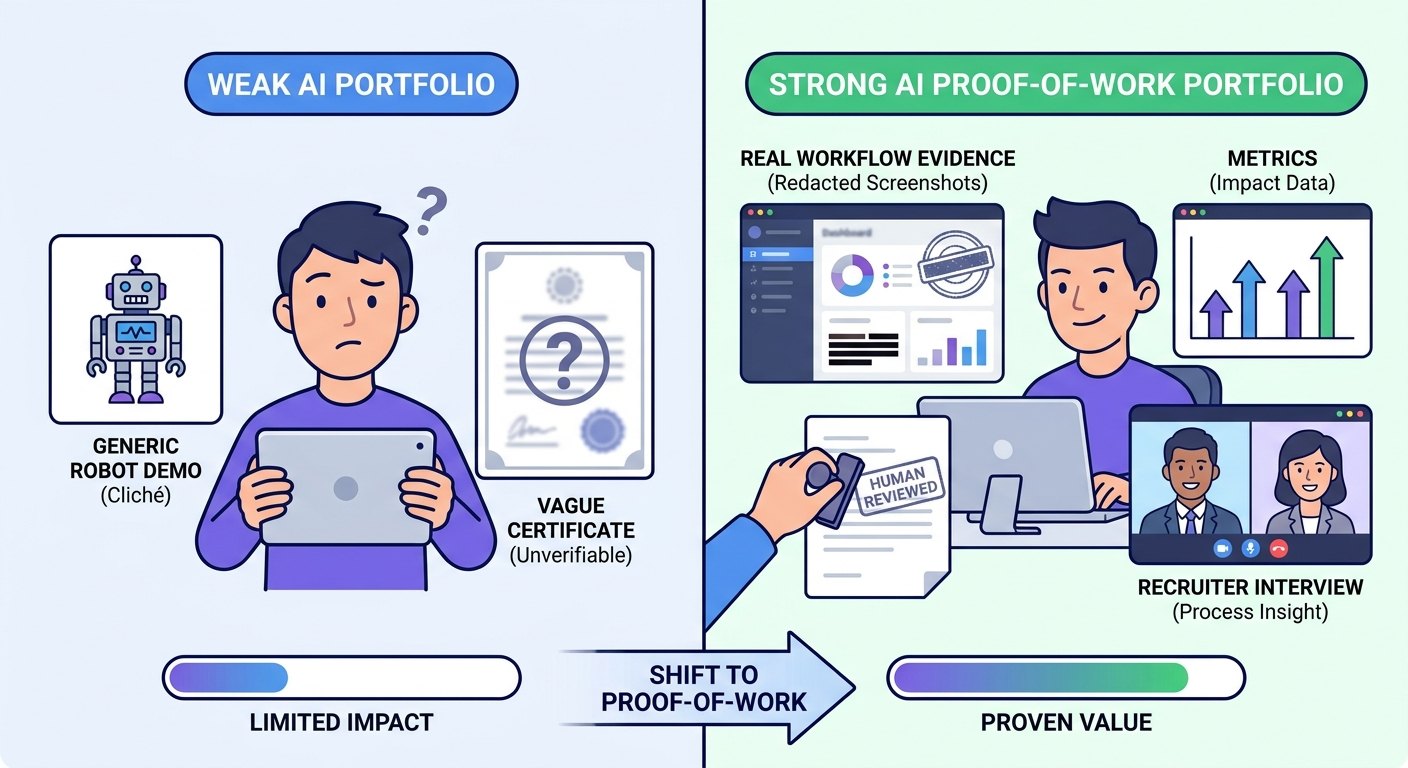
Proof Quality Rubric: Is Your AI Portfolio Actually Credible?
Use this rubric before sharing a portfolio piece. If the artifact scores low, improve the evidence before adding more projects. One strong project can carry more weight than many vague experiments.
| Criterion | Weak proof | Strong proof |
|---|---|---|
| Specificity | Generic AI demo with no real user or workflow. | Clear task, audience, constraints, and outcome. |
| Transferability | Depends on one trendy tool feature. | Shows a workflow pattern that could transfer across tools. |
| Human judgment | AI output accepted at face value. | Review steps, confidence labels, tests, or source checks are visible. |
| Evidence | Only a polished final output. | Includes workflow, inputs, checks, results, and reflection. |
| Business relevance | Interesting but disconnected from work value. | Solves a recognizable business, learning, support, analysis, or operations problem. |
| Ethics and privacy | Uses real private data casually. | Redacts, mocks, or uses public data responsibly. |
| Interview readiness | Hard to explain in plain language. | You can explain what you did, why it mattered, what failed, and what you learned. |
How to Build AI Proof of Work Without Leaking Private Data
Many useful AI workflows happen inside jobs, but that does not mean you can publish everything. Treat privacy and confidentiality as part of the proof. If you can show skill while protecting sensitive information, you demonstrate professional judgment.
Start by separating the method from the data. The method is often shareable: workflow steps, categories, decision criteria, review checklist, and lessons learned. The data may not be shareable: customer names, proprietary numbers, internal strategy, private documents, code, credentials, and screenshots. When in doubt, recreate the workflow with public or synthetic data.
Safe options include public datasets, open documents, mock scenarios, redacted examples, diagrams instead of screenshots, qualitative result ranges, and permission-based internal artifacts. Risky moves include uploading real customer records into public AI tools, publishing dashboards with identifiable details, sharing prompts that contain internal policy, or claiming exact business impact you cannot verify.
If you are early in your career and lack workplace examples, build from public problems. Analyze public reviews, open government data, public job postings, public help-center articles, open-source issues, or your own personal workflow. The evidence can still be strong if the process is realistic.
How to Use an AI Proof-of-Work Portfolio in Interviews
A portfolio is not only something people browse. It is an interview tool. The best portfolio pieces help you answer behavioral, technical, and strategic questions with evidence. When someone asks “How do you use AI at work?” you can walk through one case study instead of giving a generic answer.
Use a simple four-part interview story: problem, workflow, judgment, result. Start with the problem in human terms. Then explain which parts AI handled and which parts you kept under human control. Then describe what went wrong or what you had to verify. End with the result and the next improvement.
Do not oversell. A hiring manager can usually sense inflated claims. It is better to say, “This was a small personal workflow, but it shows how I structure AI-assisted work,” than to pretend a weekend project transformed a company. Credibility is part of the moat.
Prepare one short version and one deep version of each case study. The short version should fit into ninety seconds. The deep version should let you explain prompts, sources, review criteria, tradeoffs, and mistakes. If the interviewer is technical, show the workflow. If the interviewer is business-focused, show the outcome and the risk controls.
What Not to Put in an AI Proof-of-Work Portfolio
A good portfolio is selective. Leaving weak material out is part of the craft. Do not include every AI experiment you have tried, every prompt pack you downloaded, or every screenshot that looks futuristic. The strongest proof is focused enough that a busy reader can understand the work problem, the workflow, the judgment layer, and the result without hunting for meaning.
Avoid generic “AI art gallery” projects unless the target role is visual design and you can explain the creative brief, constraints, iteration process, and final selection criteria. Avoid chatbot clones unless the project shows a real domain, retrieval strategy, evaluation plan, privacy boundary, or operational use case. Avoid tool-tour projects that simply say you used ChatGPT, Claude, Gemini, Copilot, or an automation platform. Tools change quickly; transferable workflow judgment is the durable signal.
Also avoid making the portfolio sound more certain than the evidence allows. If the project used mock data, say so. If the metric is an estimate, label it. If you only tested the workflow on yourself, explain that it needs stakeholder validation. This honesty does not weaken the artifact. It makes the artifact more credible because real AI work always includes uncertainty, review, and iteration.
Finally, do not present AI output as if it required no human responsibility. The whole point of an AI career moat is that you become more valuable by knowing where AI helps and where human judgment still matters. Your portfolio should make that boundary visible. Show the handoff points. Show the checks. Show the decision you made after the model produced something imperfect. That is where employers see professional maturity.
Build the Rest of Your AI Career Moat
- AI Career Moat — the source pillar article for durable career strategy as AI agents improve.
- AI Workflow Portfolio — broader guide to proving you can work with AI agents.
- AI Workflow Mapping Template — map daily work before turning it into a portfolio artifact.
- AI Automation Portfolio Projects — project ideas that can become proof-of-work case studies.
- AI Skills Roadmap — build a career-ready AI skill stack.
Sources and Further Reading
- World Economic Forum: Future of Jobs Report
- Microsoft Work Trend Index
- Anthropic Economic Index
- Stanford HAI AI Index
This guide uses directional labor-market and AI-adoption signals. It avoids unsupported hiring guarantees because portfolio value depends on role, market, employer, and evidence quality.
FAQ: AI Proof-of-Work Portfolios
What is an AI proof-of-work portfolio?
It is a collection of case studies showing how you used AI to improve real work. Strong examples include the problem, baseline, workflow, human review, result, and lessons learned.
How many AI portfolio projects do I need?
Three strong artifacts are usually better than ten shallow demos. Aim for one workflow case study, one role-specific project, and one evidence-rich example that shows judgment.
Can non-coders build an AI proof-of-work portfolio?
Yes. Non-coders can document AI-assisted research, operations, customer support, teaching, marketing, analysis, project management, or process improvement workflows.
Should I include prompts in my portfolio?
Include short, sanitized excerpts only when they help explain your workflow. Do not publish private data, internal policies, credentials, customer information, or sensitive employer prompts.
What metrics should I use?
Useful metrics include time saved, reduced manual steps, faster turnaround, fewer missed checks, improved consistency, clearer documentation, or better stakeholder confidence. Use honest estimates when exact numbers are unavailable.
How do I avoid making my AI portfolio look generic?
Anchor each project in a real domain problem, show your human review process, include evidence, and explain tradeoffs. Generic tool demos are easy to copy; specific workflow judgment is harder to fake.
