
AGI Readiness Framework: How to Read the Signals Before AI Gets Too Powerful
AGI is not a date on a calendar. It is a readiness problem. This guide gives you a practical way to read capability signals, safety evidence, governance maturity, infrastructure trends, and human oversight before powerful AI systems move faster than institutions can understand them.
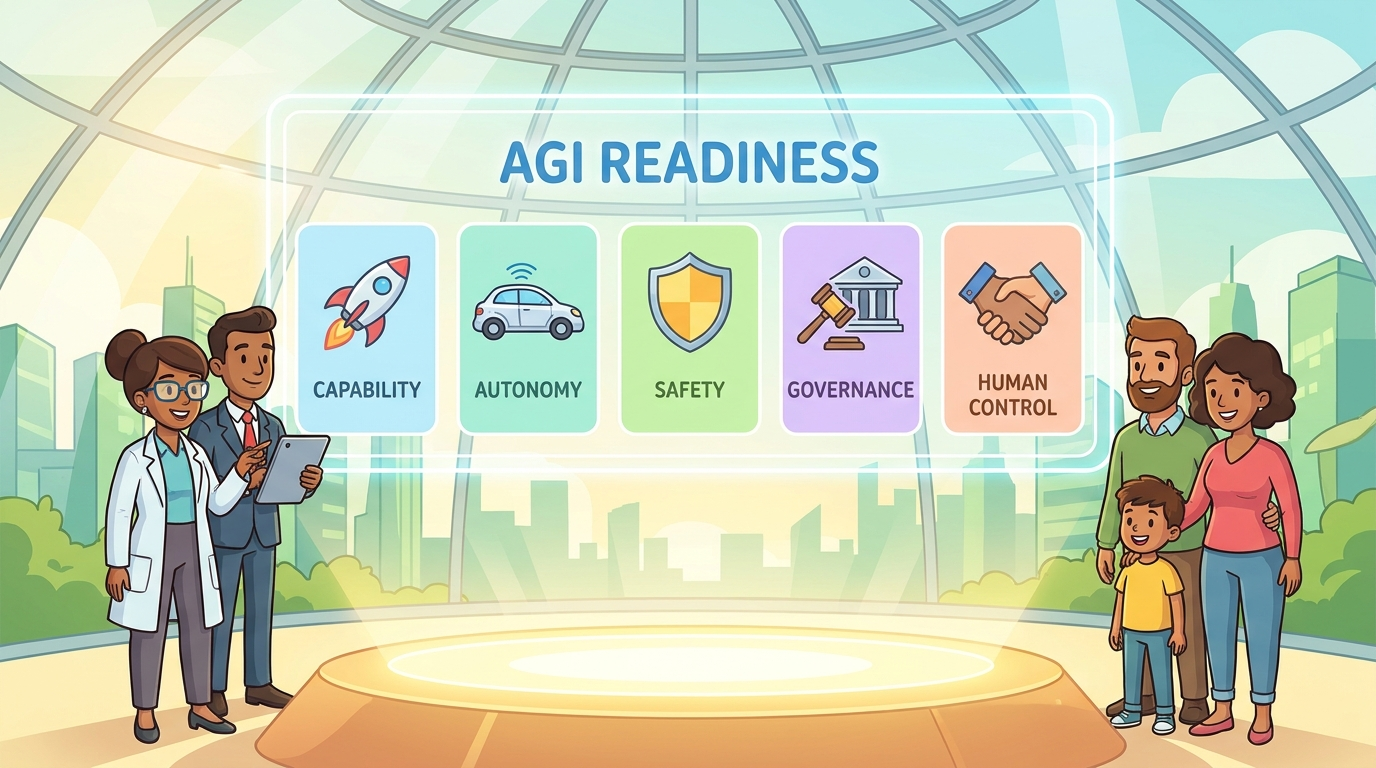
AGI Readiness: The Quick Answer
AGI readiness means asking whether society, labs, companies, regulators, and ordinary users are prepared for AI systems that can act across many domains with far more autonomy, reliability, and strategic usefulness than today’s chatbots. It is not the same as declaring that artificial general intelligence has arrived. It is a way to track the signals that would make future AI systems more consequential and harder to govern.
The useful question is not “What month will AGI appear?” The better question is: “Which evidence would tell us that AI systems are becoming general enough, autonomous enough, economically important enough, and risky enough that stronger governance is needed before deployment?” That question is more practical because predictions vary wildly, benchmark headlines age quickly, and marketing language often outruns careful evidence.
This article is designed for readers who want a grounded path through the noise. You do not need to be a machine-learning researcher. You do need to separate three ideas that are often blended together: capability, deployment readiness, and societal readiness. A model can be impressive but unreliable. It can be reliable in narrow tasks but unsafe for open-ended autonomy. It can be technically deployable while institutions remain unprepared to audit, pause, or recall it.
That distinction matters for Singularity Journey because our existing coverage already looks at AI safety frameworks, frontier AI safety cases, and AI risk registers based on NIST AI RMF. This pillar ties those ideas together into a single reader-friendly scorecard: what to watch, why it matters, and how to avoid both panic and complacency.
Why an AGI Readiness Framework Is Better Than an AGI Countdown
Countdowns are emotionally satisfying and analytically weak. They compress many uncertainties into one dramatic number. AGI readiness is different. It asks whether the surrounding evidence, controls, and institutions are keeping pace with frontier AI capability. That framing is less sensational, but it is much more useful.
Consider how powerful models are released today. Frontier labs no longer talk only about accuracy or helpfulness. They publish system cards, safety reports, preparedness frameworks, responsible scaling policies, model behavior evaluations, external red-team summaries, and governance commitments. Anthropic’s Responsible Scaling Policy describes AI Safety Levels that connect dangerous capabilities to stricter safety and security measures. Google DeepMind’s Frontier Safety Framework focuses on identifying future capabilities that could cause severe harm and putting protocols in place to detect and mitigate them. OpenAI’s safety materials emphasize teaching, testing, sharing feedback, and continuing safety work across deployment. NIST’s AI Risk Management Framework offers a broader operational language: govern, map, measure, and manage risk.
Those documents are not proof that everything is safe. They are signals that the industry understands a key point: once models become more capable, safety cannot be treated as a blog-post afterthought. The serious question is whether safety and governance mature as quickly as capability.
A readiness framework also helps readers avoid the opposite error: dismissing every AGI concern because today’s models still fail at simple tasks. Current systems can hallucinate, misunderstand context, follow brittle plans, and require human supervision. Those limitations are real. But a system can be imperfect and still economically disruptive, operationally useful, or dangerous in certain misuse scenarios. Readiness is about the slope of change and the quality of controls, not a binary label.
The AGI Readiness Scorecard
The fastest way to read AGI progress is to separate the signals into six buckets. Each bucket answers a different question. If only one bucket looks strong, you are probably seeing hype or a narrow breakthrough. If several buckets move together, the readiness conversation becomes more serious.
| Signal bucket | Question to ask | Why it matters | Weak evidence | Stronger evidence |
|---|---|---|---|---|
| Capability breadth | Can the system handle many kinds of tasks, not just one benchmark? | AGI implies generality across domains, modalities, tools, and contexts. | A cherry-picked demo or isolated leaderboard jump. | Consistent performance across diverse evaluations, real tasks, and adversarial tests. |
| Autonomy and agency | Can it plan, use tools, recover from mistakes, and pursue goals over time? | Autonomous systems create different risks than passive answer engines. | A scripted agent demo with heavy hidden scaffolding. | Transparent task traces, failure analysis, bounded tool permissions, and recovery metrics. |
| Reliability and calibration | Does it know when it does not know, and does it fail safely? | General usefulness requires trustworthy behavior under uncertainty. | High confidence answers in friendly tests. | Error rates, refusal behavior, uncertainty reporting, and independent evaluation. |
| Misuse and dangerous capability risk | Could the model meaningfully increase harmful capability for bad actors? | Frontier safety frameworks focus heavily on severe misuse and autonomous harm. | Generic claims that safeguards exist. | Red-team results, risk thresholds, mitigation plans, and deployment gates. |
| Infrastructure and scaling | Are compute, data, and training systems enabling another step change? | Infrastructure does not prove AGI, but it shapes the frontier’s capacity to scale. | Rumors about model size or data-center spending. | Transparent compute trends, energy constraints, chip supply data, and reproducible scaling analysis. |
| Governance maturity | Can humans audit, pause, restrict, and hold systems accountable? | Readiness depends on institutions, not only model quality. | Voluntary promises without operational detail. | Clear risk tiers, external audits, incident reporting, safety cases, and enforceable accountability. |
This scorecard deliberately mixes technical and institutional evidence. That is the point. A future model does not become socially safe merely because it scores well on tests. It also needs release gates, monitoring, security, policy, organizational discipline, and humans who retain real control. Conversely, governance documents are not enough if the underlying model is advancing faster than evaluators can understand.
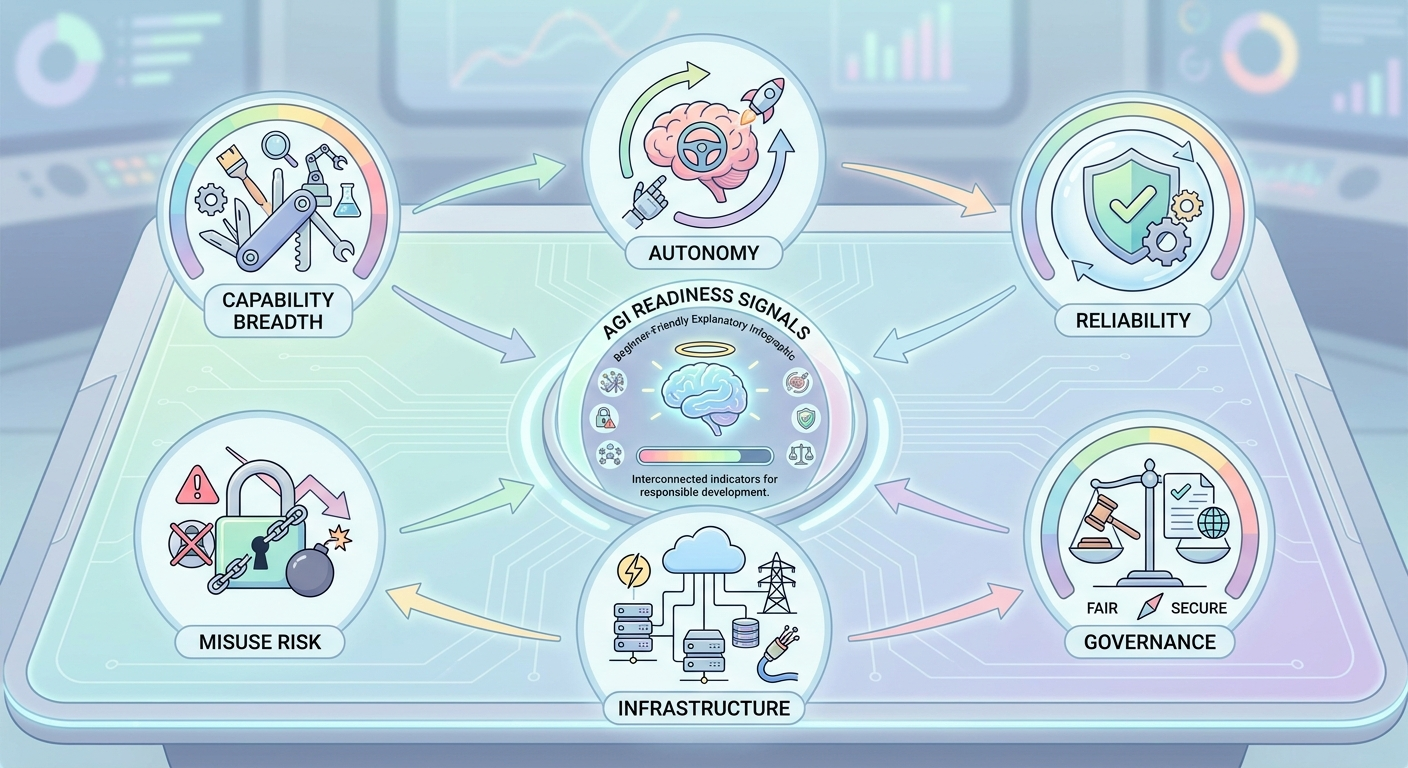
The Six Signals That Matter Most
1. Capability breadth across domains
A single benchmark result can be useful, but it should never carry the whole AGI conversation. Capability breadth means the system can transfer competence across writing, coding, reasoning, planning, tool use, visual understanding, data analysis, scientific tasks, and unfamiliar workflows. The most important evidence is not “Does the model do one thing impressively?” It is “Does performance remain strong when tasks vary, instructions are ambiguous, contexts are long, and success requires multiple steps?”
Readers should also look for benchmark saturation. When a benchmark becomes too familiar, models may appear more capable than they are in the wild. Stronger evidence comes from fresh evaluations, private test sets, real-world task suites, longitudinal reliability tracking, and independent replication. This is why frontier labs and external evaluators increasingly discuss evaluation design, not just scores.
2. Autonomy, planning, and tool use
Autonomy changes the risk profile. A model that answers a question is one thing. A model that plans a task, calls tools, browses files, executes code, sends messages, controls software, or negotiates with other systems is another. Agentic systems can create value because they reduce human effort. They also create risk because small errors can compound over steps.
For a practical explanation of agent behavior, see our guides on AI agent planning and AI agent tool use. In AGI readiness terms, the key questions are: Can the system form robust plans? Can it notice when the plan is failing? Can it ask for approval at the right time? Can it be restricted to safe tool scopes? Can humans understand why it took an action?
3. Reliability under uncertainty
General intelligence is not only about producing impressive answers. It is also about knowing when the situation is ambiguous, when evidence is missing, and when a human decision is required. Reliability includes factual accuracy, instruction following, resistance to prompt injection, stable behavior across contexts, and appropriate humility.
A readiness framework should treat reliability as a first-class signal because many failures happen in the gap between “the model can usually do it” and “the model can be trusted when the cost of a mistake is high.” The more a model is used in law, medicine, cybersecurity, finance, education, infrastructure, or government services, the more reliability becomes a public-safety issue rather than a product-quality complaint.
4. Dangerous capability and misuse risk
Frontier safety policies often focus on severe risks: cyber abuse, biological or chemical misuse, autonomous replication, deception, and other capabilities that could materially increase harm. Anthropic’s Responsible Scaling Policy uses AI Safety Levels to connect capability thresholds with stronger safety, security, and operational requirements. Google DeepMind’s Frontier Safety Framework similarly emphasizes future capabilities that could cause severe harm and the need to detect and mitigate them before they appear at dangerous levels.
For readers, the important lesson is that safety claims should be tied to thresholds. A vague statement like “we tested the model for safety” is weaker than a clear explanation of which risk categories were tested, what thresholds would block deployment, what mitigations are required, and who can challenge the result.
5. Infrastructure, compute, and scaling pressure
Compute is not intelligence, but it is part of the frontier. Larger GPU clusters, improved chips, more efficient training methods, synthetic data pipelines, and data-center investment all influence how quickly labs can train and serve more capable models. Epoch AI’s GPU cluster data is useful here because it tracks large hardware facilities and highlights how incomplete but important infrastructure visibility can be.
The mistake is to treat infrastructure as destiny. A giant cluster does not prove AGI is near. It does, however, tell us that the economic race is serious and that the ability to run larger experiments may continue improving. Readiness means asking whether safety evaluations, energy planning, security, and governance scale alongside compute.
6. Governance maturity and accountability
The final signal is institutional. Can a lab delay deployment if risk thresholds are crossed? Can external auditors review claims? Can regulators understand general-purpose AI obligations? Can users report harmful behavior? Can an incident be investigated and corrected? Can model access be restricted when necessary? Can an organization explain who is responsible when an AI system causes harm?
NIST’s AI RMF is helpful because it shifts the conversation from slogans to functions: govern, map, measure, and manage. The EU AI Act adds another layer through a risk-based regulatory approach and obligations for certain AI systems and general-purpose AI providers. These frameworks are imperfect and evolving, but they point toward a core readiness principle: powerful AI needs operational governance, not just trust in the model maker’s intentions.
Capability Readiness Is Not Deployment Readiness
One of the most common AGI mistakes is confusing “the model can do something” with “the model should be deployed to do it.” A capability demonstration is evidence that a system can perform under certain conditions. Deployment readiness requires more: reliability, monitoring, security, user controls, auditability, rollback procedures, and accountability.
| Layer | What it proves | What it does not prove |
|---|---|---|
| Demo | The system can produce a compelling result in a showcased scenario. | That it works reliably across messy real-world cases. |
| Benchmark | The system performs well on a defined evaluation set. | That the benchmark captures all important risks or tasks. |
| Red-team result | Specific failure modes were tested by adversarial evaluators. | That all future attacks or misuse paths are covered. |
| Safety case | The developer can present structured evidence for safe deployment. | That the evidence is complete, independent, or permanently valid. |
| Governance gate | An organization has a decision process before release. | That incentives will always favor caution under competition pressure. |
This is why “AGI readiness” must include deployment systems. A powerful model without logging, permissions, monitoring, and approval gates is not simply a more capable chatbot. It is a socio-technical system with consequences. The human control layer matters as much as the neural network.
Healthy readiness signals
- Clear risk thresholds before deployment.
- External evaluation for high-risk capabilities.
- Incident reporting and post-deployment monitoring.
- Human approval for consequential tool use.
- Security practices proportional to model capability.
Warning signs
- AGI claims based on one demo or benchmark.
- No public explanation of evaluation failures.
- Open-ended agent access without permission limits.
- Governance promises that lack enforcement details.
- Pressure to deploy first and evaluate later.
How Frontier Safety Frameworks Fit Into AGI Readiness
Safety frameworks are attempts to turn vague concern into operational rules. They do not eliminate risk, and they should not be treated as independent certification unless verified by appropriate reviewers. But they give readers vocabulary for asking sharper questions.
Anthropic’s Responsible Scaling Policy is especially useful because it introduces AI Safety Levels. The simplified idea is that stronger dangerous capabilities require stricter safety and security measures. If a model begins showing early signs of dangerous capability, the organization should raise the level of required safeguards. If capability advances faster than safeguards, scaling or deployment should pause until requirements are met. That logic is central to readiness: progress should unlock more safety work, not bypass it.
Google DeepMind’s Frontier Safety Framework uses a similar readiness mindset. It focuses on identifying capabilities that could cause severe harm and creating mechanisms to detect and mitigate them. OpenAI’s public safety materials emphasize ongoing teaching, testing, deployment safety, and feedback loops rather than a one-time safety check. NIST’s AI RMF is broader and more institution-oriented, giving organizations a practical structure for governing and managing AI risk.
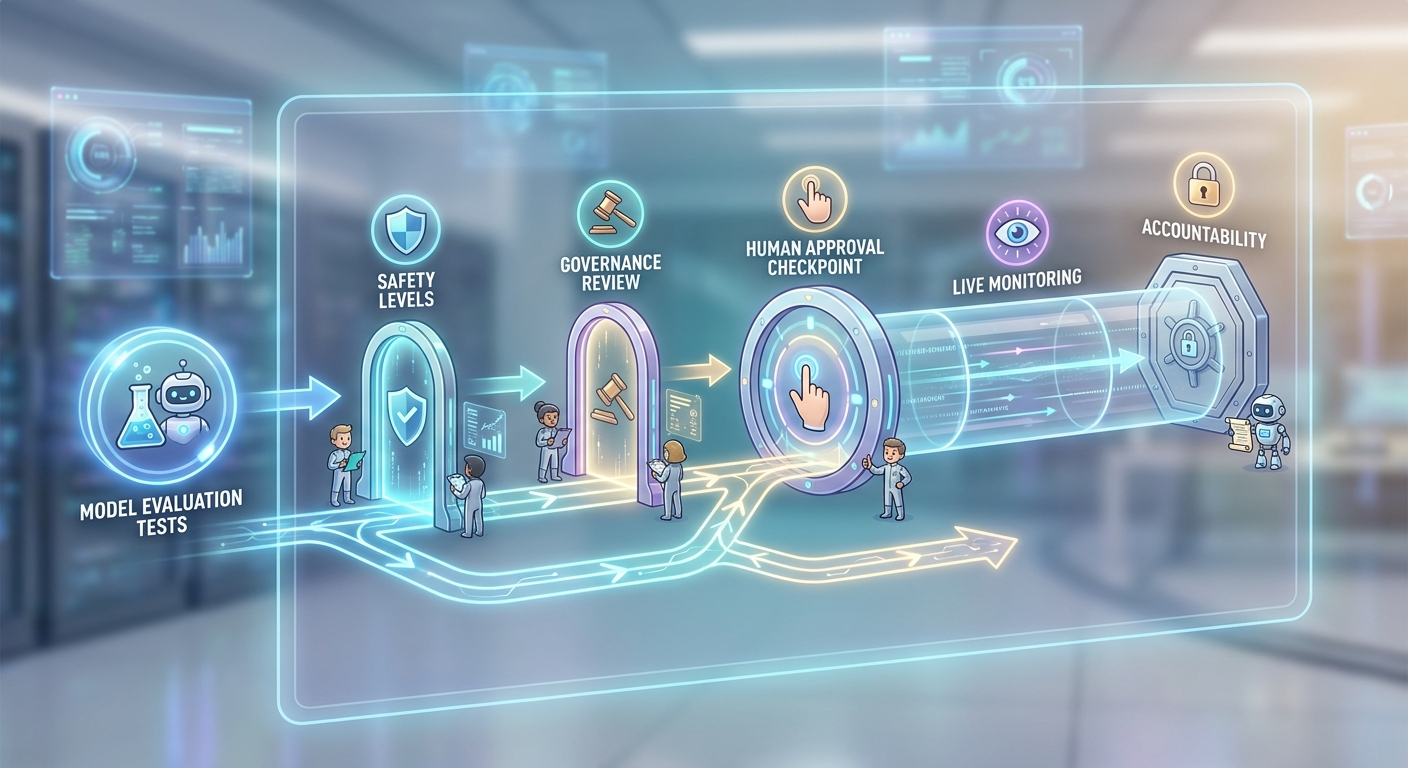
The common pattern is a shift from “Is the model impressive?” to “What evidence should be required before the model is trained further, released broadly, connected to tools, or trusted in high-stakes contexts?” That is a healthier public conversation.
The Governance Layer: What Humans Need Before Systems Get Stronger
AGI readiness is ultimately about human institutions. If frontier systems become more autonomous and general, the question is not only whether the model can reason. It is whether humans can still understand, limit, investigate, and correct the system’s behavior. The governance layer should include at least seven controls.
These controls do not require believing in a specific AGI timeline. They are good practice for increasingly capable AI systems today. They also scale toward the future: the more capable and autonomous the system, the more rigorous the control layer must become.
Interactive AGI Readiness Checker
Use this lightweight checker when you see a new model announcement, benchmark claim, or viral agent demo. It is not a scientific score. It is a thinking aid that helps you ask whether multiple readiness signals are present or whether the claim is mostly hype.
The strongest claims should survive this kind of questioning. If a release has broad capability, high autonomy, evidence of dangerous capability testing, and clear governance gates, it deserves serious attention. If it has only a shiny demo, slow down.
Common Mistakes When Reading AGI Signals
Mistake 1: Treating benchmark gains as destiny
Benchmarks are useful measurement tools, but they are not reality itself. Models can overfit public tasks, exploit shortcuts, or perform well in ways that do not transfer to messy environments. Ask what the benchmark measures, what it misses, and whether independent evaluators see the same pattern.
Mistake 2: Ignoring autonomy
A model that writes a good answer is not the same as a model that can run a business process, control tools, or pursue a multi-hour objective. Autonomy increases both usefulness and risk. AGI readiness should track tool access, permissions, planning depth, and human approval.
Mistake 3: Assuming safety documents equal safety
Safety frameworks are important, but they are not magic shields. The details matter: thresholds, tests, external review, enforcement, security, monitoring, and what happens when a model fails. Read them as evidence to inspect, not guarantees to accept uncritically.
Mistake 4: Dismissing all risk because current models fail
Current limitations are real, but they do not settle future readiness. Airplanes crashed before aviation became essential. Early software was unreliable before software ate the world. The relevant question is whether capability, deployment, and governance are improving together.
Mistake 5: Forgetting ordinary humans
AGI readiness is not just a lab problem. Teachers, workers, developers, voters, executives, regulators, journalists, and parents all need plain-language understanding. If only a small technical elite can interpret the risks, society is not ready.
One more practical habit helps: keep a personal watchlist. When a new frontier model appears, note what the developer disclosed, what independent evaluators confirmed, what failure modes remain, and what access limits apply. Revisit the notes after real users have tested the system. AGI readiness is not a single reading; it is repeated evidence review as capability, deployment, and governance evolve together.
Keep Learning on Singularity Journey
- AI Safety Frameworks Explained — how frontier labs create risk tiers and release gates.
- Frontier AI Safety Case — what evidence should support safe deployment claims.
- AI Risk Register: NIST AI RMF Checklist — practical risk management language for AI systems.
- AI Agent Controls Explained — tools, memory, permissions, and human approval.
- AI Agent Evaluation Framework — testing tool calls, traces, memory, and production behavior.
- How AI Agents Work — a beginner-friendly guide to tools, memory, planning, and control.
Sources and References
- Anthropic: Introducing the Responsible Scaling Policy
- OpenAI: Safety and responsibility
- Google DeepMind: Introducing the Frontier Safety Framework
- NIST: AI Risk Management Framework
- EU Artificial Intelligence Act: High-level summary
- Epoch AI: GPU cluster data
This article is an educational framework, not a prediction market, legal opinion, or safety certification. Frontier AI evidence changes quickly; verify source documents before making policy, investment, or deployment decisions.
FAQ: AGI Readiness and Frontier AI Signals
What is AGI readiness?
AGI readiness is the practice of evaluating whether technical capabilities, safety evidence, governance controls, and human institutions are prepared for AI systems that become more general, autonomous, and consequential.
Is AGI already here?
There is no universal agreement that AGI is here. Current frontier models are powerful but still fail in important ways. A readiness framework avoids binary claims and focuses on evidence signals.
What is the best signal that AI is moving closer to AGI?
No single signal is enough. The strongest evidence combines broad capability, autonomy, reliability, dangerous capability testing, infrastructure trends, and mature governance.
Are benchmarks useful for tracking AGI?
Yes, but only as part of a broader evidence picture. Benchmarks can be saturated, gamed, or too narrow. Fresh evaluations and real-world task performance matter more.
What is the difference between capability readiness and deployment readiness?
Capability readiness asks whether a system can do a task. Deployment readiness asks whether it can be released responsibly with monitoring, safeguards, accountability, and rollback options.
Why do AI safety frameworks matter?
They turn vague safety promises into more concrete thresholds, evaluations, mitigations, and release gates. They are not guarantees, but they provide evidence that can be inspected.
What should ordinary readers watch?
Watch for broad capability, tool-using autonomy, independent evaluations, safety case evidence, governance gates, and whether labs can pause or restrict systems when risk thresholds are crossed.
Does more compute mean AGI is near?
Not by itself. Compute is an enabling factor, not proof. It matters because it shapes what experiments labs can run, but it must be interpreted with capability and safety evidence.
How can policymakers use an AGI readiness framework?
They can use it to ask better questions about evaluation standards, incident reporting, external audits, critical infrastructure use, model access, and accountability for general-purpose AI systems.
