
AI Safety Frameworks Explained: How Frontier Labs Decide When Powerful AI Is Too Risky
A plain-English guide to AI safety frameworks: risk levels, evaluations, deployment gates, agent controls, and how powerful AI can be governed before it outruns human oversight.
Quick answer: what is an AI safety framework?
An AI safety framework is a structured way to decide whether an AI system is safe enough to build, test, deploy, expand, or stop. It turns broad concerns about powerful AI into a practical process: identify risks, evaluate capabilities, define thresholds, add safeguards, assign ownership, monitor real-world behavior, and pause or roll back when risk becomes unacceptable.
That may sound bureaucratic, but it matters because advanced AI systems are no longer just text generators in a browser. They can summarize private data, write code, call tools, operate software, guide decisions, automate workflows, and increasingly act through agents. The more capable the system becomes, the less useful it is to say “be careful” without a repeatable decision model.
This guide explains AI safety frameworks without assuming you are a policy expert. You will learn how frontier labs think about risk levels, how organizations can adapt the same ideas, and why agentic AI makes safety frameworks more urgent.
Why AI safety frameworks matter on the path to powerful AI
AI safety used to feel like a distant research debate. Today it is becoming an operational question. Teams are connecting AI models to company data, internal tools, codebases, browsers, customer support queues, financial workflows, and decision-support systems. That changes the risk profile.
A model that only drafts text can still make mistakes, but the blast radius is often limited to the user reading and editing the answer. A model connected to tools can create tickets, send messages, trigger workflows, change code, retrieve private records, or influence real-world decisions. A frontier model with stronger reasoning and autonomy may create risks that are harder to predict using ordinary software checklists.
That is why safety frameworks matter for SINGULARITY PATH. They are part of the bridge between “AI is getting more powerful” and “humans can still govern the systems we build.” The goal is not to freeze innovation. The goal is to make progress conditional on evidence, safeguards, and accountability.

Good safety frameworks are especially useful because they reduce vague arguments. Instead of asking, “Is this model scary?” a framework asks more precise questions:
- What capabilities has the model demonstrated?
- Can it meaningfully help with cyber abuse, biosecurity misuse, deception, manipulation, or autonomous tool use?
- What evaluations were run, and what did they miss?
- What safeguards are in place before deployment?
- Who can approve an exception?
- What monitoring exists after release?
- What happens if the system crosses a risk threshold?
Those questions do not eliminate uncertainty. They make uncertainty visible enough to manage.
AI safety framework vs AI ethics vs AI governance
People often use “AI safety,” “AI ethics,” and “AI governance” as if they mean the same thing. They overlap, but they are not identical.
| Term | Plain-English meaning | Main question | Example |
|---|---|---|---|
| AI ethics | Values and principles for responsible AI | What should we consider fair, respectful, transparent, and human-centered? | A principle that AI should not discriminate or deceive users |
| AI governance | Decision rights, policies, roles, and accountability | Who is allowed to build, approve, deploy, monitor, and stop AI systems? | An AI review board, risk owner, audit log, or model registry |
| AI safety framework | A practical process for identifying, evaluating, reducing, and gating risk | What evidence says this system is safe enough for this use? | Capability evaluations, risk thresholds, deployment gates, rollback rules |
| AI security | Protection from misuse, attacks, leakage, and system compromise | How can the system be attacked or abused? | Prompt injection defenses, tool permission limits, data access controls |
A mature organization needs all four. Ethics without governance becomes slogans. Governance without safety testing becomes paperwork. Safety testing without security misses adversarial behavior. Security without ethics can protect a system that should not have been deployed in the first place.
For frontier AI, this combination becomes even more important because the risk is not only “the model said something wrong.” The risk can involve autonomy, tool use, persuasion, harmful knowledge, cyber capability, information leakage, and decisions made at scale.
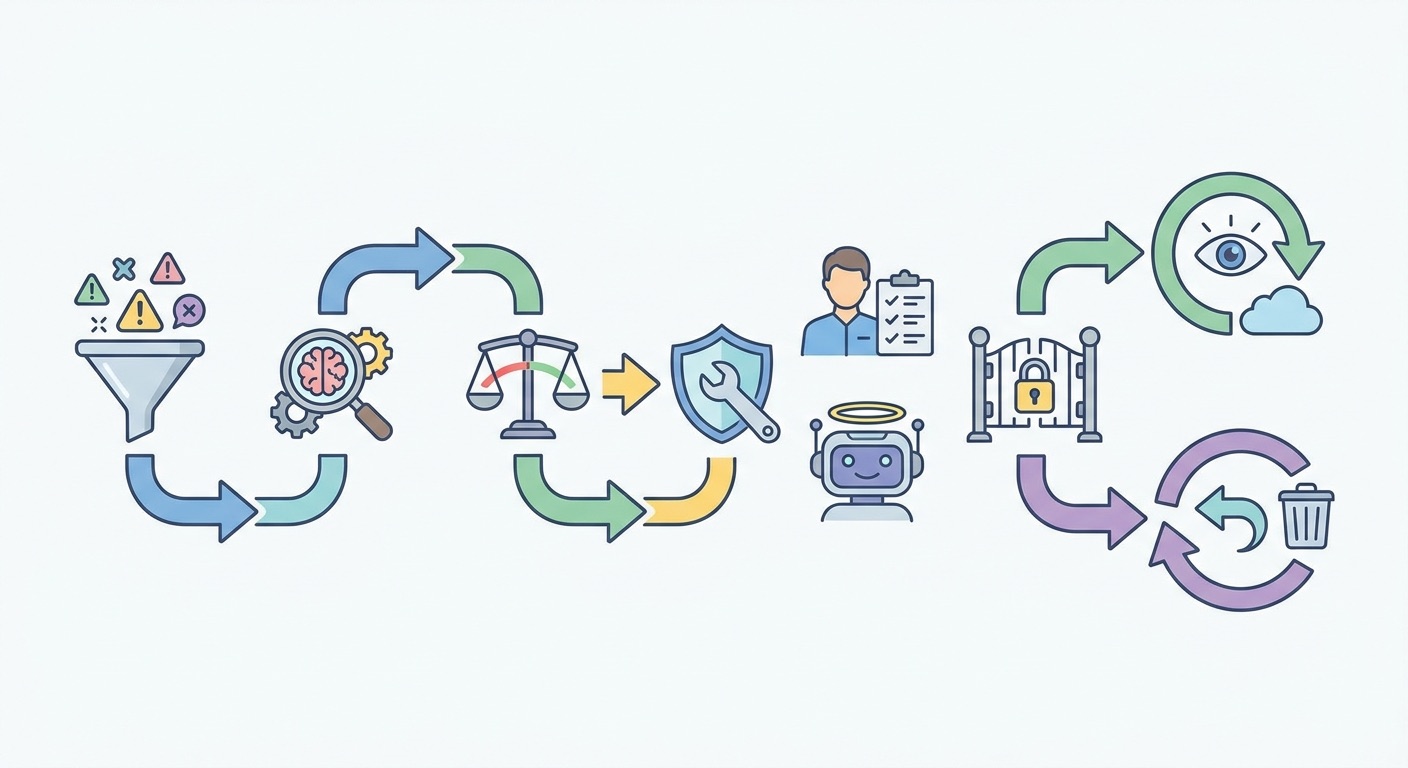
The basic loop: how AI safety frameworks work
Most serious AI safety frameworks follow a loop. Different organizations use different names, but the underlying pattern is similar.
1. Define the system and its use case
The first step is boring and essential: define what is being evaluated. Is this a general-purpose frontier model, a coding agent, a medical summarizer, a customer support bot, a browser agent, or an internal research assistant? Safety depends on use. The same model can be low-risk in one context and high-risk in another.
2. Identify hazards and misuse paths
The framework lists what could go wrong. For a frontier model, hazards might include cyber misuse, biological assistance, persuasion, autonomous replication, deception, or dangerous tool use. For a business agent, hazards might include leaking private data, taking unauthorized actions, following malicious instructions from webpages, or making decisions without human approval.
3. Run evaluations
Evaluations test whether the system can perform risky capabilities or fail in important ways. These can include red teaming, benchmark tasks, expert review, jailbreak tests, tool-use simulations, privacy tests, and scenario-based exercises. Evaluations should not be treated as perfect proof. They are evidence, not certainty.
4. Compare results against thresholds
A framework needs thresholds. If the model crosses a capability or risk threshold, extra safeguards are required. In lab-level frameworks, these thresholds may be tied to safety levels or preparedness categories. In company settings, they may be tied to data sensitivity, autonomy level, user impact, legal exposure, or financial risk.
5. Add mitigations
Mitigations are controls that reduce risk. They can include refusal policies, tool permission limits, rate limits, human approval gates, monitoring, sandboxing, retrieval restrictions, red-team fixes, incident response, and deployment scope limits.
6. Decide: deploy, restrict, pause, or stop
The decision should not be a vibes-based launch meeting. The framework should say who approves deployment, what evidence they review, and what conditions must be met. Some systems may launch to a small trusted group. Some may require restricted access. Some should be paused until mitigations improve.
7. Monitor after release
Safety is not finished at launch. Real users find new behaviors, attackers test boundaries, and use cases drift. Post-deployment monitoring, incident reporting, and rollback procedures are part of the framework.
Major AI safety frameworks and what they contribute
No single framework is enough for every use case. Official risk-management guidance, lab-specific frontier policies, security frameworks, and internal company controls each solve a different part of the puzzle.
| Framework or source | Best contribution | How to use it | Watch out for |
|---|---|---|---|
| NIST AI Risk Management Framework | General vocabulary for mapping, measuring, managing, and governing AI risk | Use it as a broad operating model for trustworthy AI risk processes | It is not a step-by-step product launch checklist by itself |
| Anthropic Responsible Scaling Policy | Capability-based safety levels for increasingly powerful AI systems | Use it as an example of risk thresholds and stronger safeguards as capability rises | It is a lab policy, not a universal law |
| OpenAI safety and preparedness materials | Emphasis on iterative testing, safeguards, and reducing harm in critical areas | Use it to understand how frontier labs communicate safety evaluation and deployment thinking | Public summaries may not reveal all internal evaluations |
| Google DeepMind Frontier Safety Framework | Frontier model evaluation and mitigation framing for severe risks | Use it as another example of model capability thresholds and safety mitigations | Details may evolve as frontier capabilities change |
| OWASP Top 10 for LLM Applications / GenAI Security Project | Application security risks such as prompt injection, data leakage, excessive agency, and insecure output handling | Use it for product and agent security reviews | Security controls must be paired with governance and user-impact review |
The practical lesson is that AI safety is layered. A frontier lab may focus on extreme capabilities and model release thresholds. A startup shipping an AI browser agent may focus on prompt injection, approval gates, and action limits. An enterprise may focus on data access, role-based permissions, audit logs, and compliance. These are different layers of the same safety stack.
A simple risk-level ladder for AI systems
To make safety decisions less abstract, it helps to classify AI systems by risk level. The exact labels can vary, but this ladder is a useful starting point.
| Risk level | System behavior | Examples | Minimum controls |
|---|---|---|---|
| Level 1: Advisory | AI gives suggestions, user remains fully in control | Brainstorming, summarization, writing help | Human review, source visibility, basic privacy rules |
| Level 2: Contextual | AI uses private or business context | Internal knowledge assistant, project helper | Access control, retrieval logging, data boundaries |
| Level 3: Tool-using | AI can call tools but actions are limited | Ticket routing, code assistant, analytics agent | Scoped permissions, sandboxing, approval for sensitive actions |
| Level 4: Semi-autonomous | AI can complete multi-step workflows with oversight | Browser workflow agent, support resolution agent | Human-in-the-loop gates, monitoring, rollback, incident response |
| Level 5: High-impact or frontier | AI may affect critical systems, security, health, finance, public safety, or severe misuse domains | Frontier model release, high-stakes decision support, powerful autonomous agents | Expert evaluation, red teaming, strict thresholds, leadership approval, external review where appropriate |
This ladder is not a replacement for legal, security, or domain-specific review. It is a thinking tool. The main point is that controls should increase as capability, autonomy, data sensitivity, and impact increase.
Frontier AI evaluations: what should be tested?
Frontier AI safety frameworks put a lot of weight on evaluations. The reason is simple: you cannot responsibly govern capabilities you have not tried to measure. But evaluation is harder than a normal software unit test. AI systems are flexible, probabilistic, and sensitive to context.
A strong evaluation plan usually covers multiple categories:
- Capability evaluations: What can the model do in domains like coding, cyber reasoning, scientific assistance, persuasion, planning, and tool use?
- Misuse evaluations: Could a malicious user use the system to cause harm more effectively?
- Autonomy evaluations: Can the system pursue goals across steps, use tools, recover from failure, or work around obstacles?
- Robustness evaluations: How does it behave under jailbreaks, prompt injection, adversarial examples, or ambiguous instructions?
- Privacy evaluations: Does it reveal sensitive data or infer private information inappropriately?
- Reliability evaluations: Does it hallucinate, overclaim, fabricate sources, or act without enough evidence?
- Human oversight evaluations: Does it know when to ask for approval, escalate uncertainty, or refuse unsafe actions?
For agents, autonomy evaluation is especially important. A model that answers a risky question is one problem. A model that can plan, browse, execute commands, and call APIs creates a different class of risk. The safety framework must evaluate the model plus the tools, memory, permissions, and environment around it.
Why AI agents make safety frameworks more urgent
Agentic AI compresses the distance between suggestion and action. A normal assistant may say, “Here is a draft email.” An agent may draft the email, select the recipient, attach a file, and ask to send it. A normal coding assistant may explain a bug. A coding agent may edit files, run tests, and open a pull request. A browser agent may read a webpage, click through a workflow, and submit a form.
This is useful. It is also why safety frameworks must include operational controls, not only model behavior rules.
Singularity Journey already covers parts of this control stack in AI Agent Controls Explained, Human Approval for AI Agents, and AI Agent Observability. The safety-framework layer connects those controls to a bigger governance question: when is this system safe enough to use at all?
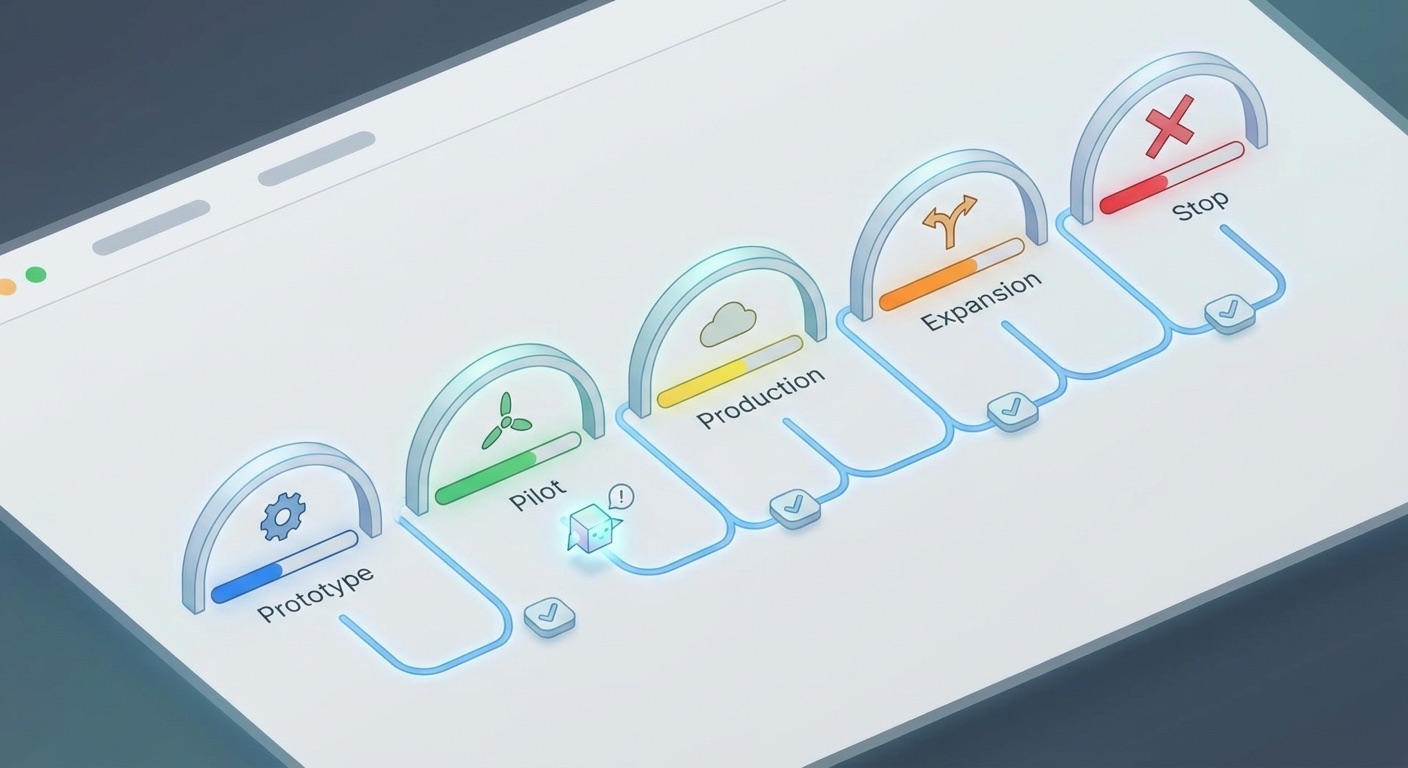
Deployment gates: the most useful idea in AI safety
If you remember one practical concept from this article, make it the deployment gate. A deployment gate is a decision point where a system must meet specific safety conditions before it moves forward.
For example, a team might set gates like these:
| Gate | Question | Evidence required | Possible decision |
|---|---|---|---|
| Prototype gate | Can we test this internally? | Use-case definition, data classification, initial hazard review | Allow internal sandbox only |
| Pilot gate | Can a limited group use it? | Evaluation results, access controls, logging, user instructions | Allow limited pilot with monitoring |
| Production gate | Can real users rely on it? | Red-team results, incident plan, human approval rules, rollback procedure | Deploy with defined scope |
| Expansion gate | Can it get more autonomy or tool access? | Post-launch metrics, failure analysis, updated risk review | Expand, restrict, or pause |
| Stop gate | Has risk exceeded tolerance? | Incident reports, threshold breach, new capability discovery | Disable feature or roll back |
Deployment gates are powerful because they make safety concrete. They convert “we should be responsible” into “this model cannot access production tools until these tests pass and these owners sign off.”
A practical AI safety framework for companies
You do not need to be a frontier lab to use safety-framework thinking. Any company deploying AI agents can create a practical version.
Step 1: Create an AI system inventory
List every AI system in use: chat assistants, internal copilots, customer-facing bots, coding agents, browser agents, analytics agents, document summarizers, and vendor tools. Include who owns each system, what data it touches, and what actions it can take.
Step 2: Classify risk by data, action, autonomy, and impact
A simple AI writing helper has a different risk profile from an agent that can refund customers, change database records, or send messages externally. Risk classification should consider data sensitivity, tool access, user population, legal exposure, and whether humans review outputs before action.
Step 3: Define evaluation requirements by risk level
Low-risk tools may need basic review. High-impact tools need scenario tests, security review, privacy review, red teaming, and human approval design. The evaluation burden should match the risk.
Step 4: Set minimum controls
Controls should include access management, logging, prompt injection defenses, retrieval boundaries, approval gates, monitoring, incident reporting, and deletion or rollback paths. If the system has memory, include memory inspection and correction.
Step 5: Assign owners
Every AI system needs an owner. “The model did it” is not accountability. Product, security, legal, compliance, data, and operations teams may all have roles, but someone must be responsible for the risk decision.
Step 6: Review after real-world use
AI systems drift because users invent new workflows. A safe pilot can become risky if teams connect new data, expand permissions, or rely on outputs for decisions the original review never considered. Schedule review points.
Common mistakes that make AI safety frameworks weak
Safety frameworks fail when they become performative. The goal is not to create a beautiful policy PDF that nobody uses. The goal is to change deployment decisions.
Mistake 1: Treating all AI systems the same
A public chatbot, an internal summarizer, a coding agent, and a frontier model release do not need the same controls. Over-controlling low-risk tools creates friction. Under-controlling high-risk tools creates danger. Risk tiers solve this.
Mistake 2: Evaluating the model but ignoring the environment
Many failures come from the system around the model: bad retrieval, excessive permissions, weak logging, hidden prompt injection, stale memory, or unclear escalation. Evaluate the full agent stack, not only the model output.
Mistake 3: Having no stop condition
A framework should define what happens when risk rises. If there is no threshold that can pause deployment, restrict access, or require new mitigations, the framework is only advice.
Mistake 4: Confusing confidence with evidence
AI teams often feel confident after impressive demos. Demos are not safety evidence. Evidence comes from documented tests, adversarial review, monitoring, incident analysis, and clear limitations.
Mistake 5: Forgetting users
Users need to understand when AI is assisting, what it can do, when a human reviewed the result, and how to report problems. Safety is partly technical and partly communicative.
The future: from voluntary frameworks to operational AI oversight
AI safety frameworks are still evolving. Frontier labs, governments, standards bodies, security communities, and enterprises are all developing different pieces. The direction is clear: as AI systems become more capable and agentic, safety expectations will become more operational.
We should expect more model evaluations, stronger incident reporting norms, clearer deployment thresholds, better audit tooling, and more pressure to show evidence before releasing high-impact systems. Some of this will come from regulation. Some will come from enterprise procurement. Some will come from public trust. And some will come from builders learning the hard way that powerful AI without controls creates expensive failures.
The best version of this future is not one where innovation stops. It is one where capability growth is matched by governance maturity. Every jump in autonomy should come with a jump in evaluation, visibility, and human control.
Final recommendation: make safety a launch requirement, not a cleanup task
AI safety frameworks are most useful when they are built into the product lifecycle early. If safety is added only after a model is trained, integrated, marketed, and launched, the organization has already made the hardest decisions without the right evidence.
For frontier labs, the challenge is deciding when a model’s capabilities require stronger safeguards or delayed deployment. For companies, the challenge is deciding which AI systems can access which data and tools. For builders, the challenge is designing agents that ask, log, limit, and stop instead of blindly acting.
A practical safety framework should answer five questions before deployment:
- What can this AI system do?
- What could go wrong?
- How did we test that risk?
- What controls reduce the risk?
- Who can approve, monitor, pause, or roll back the system?
If a team cannot answer those questions, the system is not ready for high-trust deployment. Powerful AI needs more than optimism. It needs gates, evidence, ownership, and the humility to stop when risk outruns understanding.
Keep learning on Singularity Journey
- AI Agent Alignment Explained — how to keep autonomous AI under human control.
- AGI Governance Frameworks Explained — broader institutional approaches to advanced AI.
- Human Approval for AI Agents — when agents should ask before acting.
- AI Agent Controls Explained — tools, permissions, memory, and approvals.
- AI Agent Observability — trace tool calls, context, and decisions.
- AI Agent Evaluation — reliability, cost, and risk testing before scale.
Sources and references
- NIST AI Risk Management Framework
- OWASP Top 10 for Large Language Model Applications / GenAI Security Project
- Anthropic Responsible Scaling Policy
- OpenAI Safety and Responsibility
- Google DeepMind Frontier Safety Framework
This article avoids unsupported statistics and treats public safety frameworks as evolving examples, not final universal standards.
FAQ: AI safety frameworks
What is an AI safety framework?
An AI safety framework is a structured process for identifying AI risks, evaluating capabilities, setting thresholds, adding safeguards, assigning accountability, and deciding whether a system should be deployed, restricted, paused, or stopped.
How is an AI safety framework different from AI ethics?
AI ethics focuses on values and principles. An AI safety framework turns risk into operational decisions: tests, thresholds, controls, owners, deployment gates, monitoring, and rollback.
What are frontier AI evaluations?
Frontier AI evaluations are tests used to understand whether highly capable models have risky abilities, such as advanced cyber reasoning, dangerous domain assistance, deception, autonomous planning, or misuse potential.
What is a deployment gate?
A deployment gate is a checkpoint that requires specific safety evidence and approvals before an AI system can move from prototype to pilot, production, expansion, or higher autonomy.
Who should use AI safety frameworks?
Frontier labs, enterprises, startups, AI agent builders, policymakers, and any team deploying AI systems with sensitive data, tool access, user impact, or high autonomy should use safety-framework thinking.
Can AI safety frameworks stop all AI risks?
No. They reduce and manage risk, but they cannot eliminate uncertainty. Their value is making risk visible, testable, accountable, and actionable before and after deployment.
