
AI Agent Sprawl: How to Inventory, Govern, and Retire Enterprise Agents
AI agents are multiplying across departments, platforms, and workflows faster than many organizations can name their owners, measure their value, or revoke their access. This guide turns AI agent sprawl into a manageable portfolio problem.
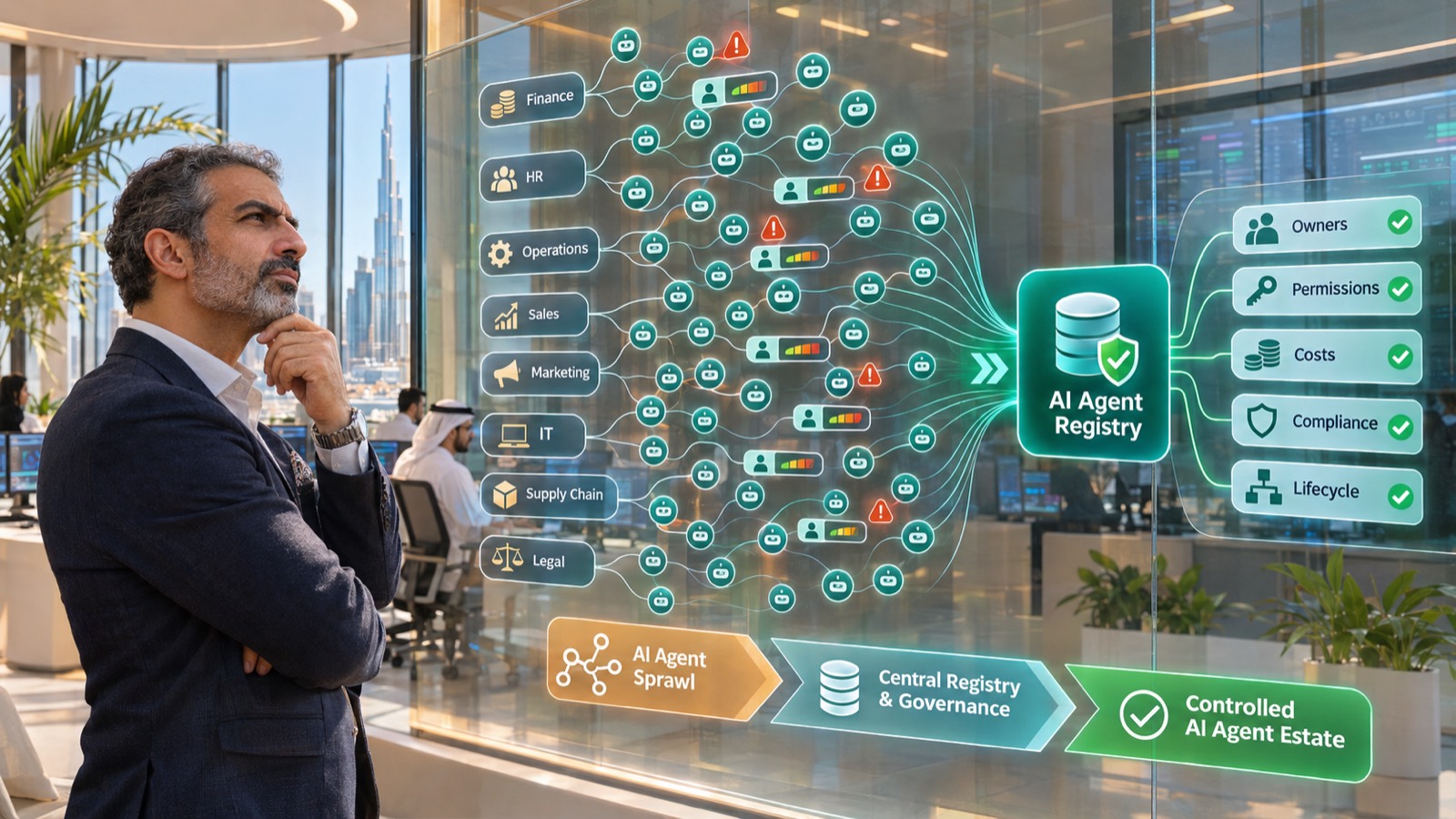
AI Agent Sprawl: The Quick Answer
AI agent sprawl is the uncontrolled growth of AI agents across an organization without a dependable way to discover them, identify who owns them, understand what they can access, measure whether they create value, or retire them safely.
The problem is not simply that a company has many agents. A large, well-run agent portfolio can be useful. Sprawl begins when the number and variety of agents grow faster than the organization's operating controls. A sales team creates a lead-research agent. Finance adds an invoice agent. Developers deploy coding agents. A software vendor quietly enables an embedded assistant. An employee connects a no-code agent to a shared drive. Each deployment may look reasonable in isolation, but the combined estate becomes difficult to see and govern.
The most practical response is to treat agents as a portfolio of action-capable systems, not as a loose collection of prompts. Every production or pilot agent needs a stable identity, a named human sponsor, a clear business purpose, an explicit authority boundary, measurable outcome evidence, a review date, and a tested retirement path. Those records must change when the agent changes. A spreadsheet created before an audit is not enough if permissions, tools, models, owners, or workflows have drifted since the last update.
This article explains why agent sprawl has become a serious enterprise trend, what the strongest current evidence actually says, and how to create a control loop that supports innovation without accepting invisible risk.
What Changed: AI Agents Became an Enterprise Population
Traditional automation was usually attached to a known application, service account, script, or integration. Ownership could still be messy, but the operating unit was relatively stable. AI agents change that pattern in three ways.
First, agents are becoming easier to create. Low-code builders, embedded software features, coding assistants, orchestration frameworks, and reusable skills let teams assemble an action-capable workflow quickly. Creation speed is useful, but it can exceed registration, security review, and procurement speed. That creates a predictable incentive to build outside the governed path.
Second, an agent is not only a model. It is a system made from instructions, models, tools, data sources, memory, credentials, policies, and human checkpoints. Microsoft describes agents as systems that can invoke tools, write data, trigger workflows, maintain state, and authenticate to downstream systems through managed, delegated, or distinct identities. This means that one named agent can represent many changing dependencies and several trust boundaries.
Third, agents are increasingly copied, composed, and embedded. A successful departmental agent may be cloned for another region. A vendor may ship a new agent inside software the company already licenses. One agent may call another agent, which then invokes a tool through a shared connector. The visible agent count can therefore understate the real number of identities, permission paths, and decision points.
This shift explains why the site's existing guides to enterprise AI agent governance, AI agent controls, and runtime governance attract sustained interest. Readers are moving beyond the question “What is an agent?” They now need to know how to operate a growing population of agents after the pilot phase.
Why AI Agent Sprawl Grows Even in Well-Managed Companies
Agent sprawl is often described as a governance failure, but that description is incomplete. Sprawl usually emerges from incentives that reward local speed while hiding enterprise-wide cost and risk.
Local value arrives before shared visibility
A team can often show a useful prototype in days. The benefits appear inside that team's workflow, while identity, security, compliance, procurement, observability, and cost consequences appear elsewhere. If central review takes weeks, people will search for a faster path. The solution is not only stricter enforcement. The governed path must be easier than the workaround.
Platforms create separate islands
Customer service, collaboration, development, analytics, and automation platforms may each maintain their own agent catalog. A company can therefore have five accurate platform inventories and still lack one enterprise view. This is especially dangerous when an agent's name, business purpose, identity, and connected tools are stored in different systems.
Successful pilots are copied without consolidation
A working agent is frequently duplicated rather than turned into a shared capability. Copies drift. One receives a stronger model, another gains write access, and a third retains an old prompt or credential. The company may believe it has one use case while it actually operates several variants with different risks.
Permissions accumulate more easily than they disappear
An agent gains access to a document store for one project, a CRM for another, and an email tool for a third. Later, its purpose narrows, but the old grants remain. Microsoft calls this overprivileged access and warns that agent permissions can persist after the original purpose changes. Permission creep is particularly hard to spot when the agent acts through a human account or a shared service identity.
Retirement has no owner
Building an agent has a visible sponsor. Turning one off rarely has the same momentum. A dormant agent may still retain credentials, subscriptions, memory, data, logs, scheduled jobs, and downstream webhooks. Without an explicit end date and offboarding procedure, the default state is continued existence.
What Current Evidence Says About the Agent Sprawl Trend
No single forecast should be treated as destiny, especially in a fast-moving market. However, several independent official sources point in the same direction: agent populations are growing, visibility is incomplete, lifecycle practices are immature, and identity is becoming a central control point.
| Source | Reported signal | What it means in practice |
|---|---|---|
| Gartner | Gartner reported that only 13 percent of organizations believed they had the right agent governance and forecast very large agent populations in major enterprises. | Manual review and informal ownership will not scale if even part of the forecast materializes. Inventory, identity, and lifecycle controls must be automated. |
| Dataiku and Harris Poll | In a survey of 685 CIOs, 84 percent said employees were creating agents and AI applications faster than IT could govern them, and 83 percent lacked standardized agent lifecycle management. | The primary gap is organizational, not only technical. Creation, measurement, and retirement practices need a shared operating model. |
| IBM | IBM reported that only 18 percent of organizations maintain a current and complete inventory of their AI agents. | A registry must be continuously refreshed and connected to identity, tools, purpose, and status. A static list is likely to be incomplete. |
| Microsoft Digital Defense Report | Microsoft identifies ungoverned proliferation, overprivileged access, and missing human accountability as key risks from agent identities. | Each agent needs a distinct identity and a sponsor whose responsibility transfers when people or teams change. |
| AWS | AWS describes duplication, cross-unit data conflicts, hidden aggregate cost, shadow proliferation, and fragmented compliance as recurring patterns. | Portfolio controls must include cost and duplication, not only security. A safe agent that produces no unique value can still be wasteful. |
These numbers come from vendor research, surveys, and forecasts with different methods. They should be read as directional evidence, not as one universal measurement. The consistent message is more important than any single percentage: organizations are gaining agents faster than they are gaining reliable knowledge about those agents.
Build a Minimum Viable AI Agent Inventory
An inventory is the foundation of agent control, but many inventories fail because they record what is easy to export rather than what is necessary to make decisions. A platform list may show an agent's name, creator, and date. It may not show whether the agent can write to a production database, which human delegated authority, how much it costs, or whether its owner has left the company.
A useful registry should answer six questions for every agent: What is it? Why does it exist? Who answers for it? What can it reach and change? What evidence shows it works? What happens when it should stop?
| Registry field | Minimum record | Why it matters |
|---|---|---|
| Stable identity | Unique agent ID, platform, environment, version, and identity type | Names can change or collide. A stable identifier connects deployment, access, logs, incidents, and retirement evidence. |
| Purpose and scope | One-sentence business outcome, included tasks, excluded tasks, and target users | Scope makes drift visible and helps reviewers distinguish a useful agent from a vague capability. |
| Human accountability | Business sponsor, technical owner, security contact, and succession rule | Someone must be able to explain, change, suspend, and retire the agent. |
| Authority | Data sources, tools, APIs, read/write/export rights, delegated users, secrets, and approval gates | Effective risk comes from reachable actions and data, not from the model name alone. |
| Dependencies | Models, prompts, skills, MCP servers, connectors, memory stores, sub-agents, and vendors | A safe top-level agent can inherit risk from a changed component or downstream service. |
| Evidence | Evaluation result, production outcome, incidents, overrides, usage, cost, and last review | Portfolio decisions require evidence of value and control effectiveness. |
| Lifecycle | Status, launch date, expiry date, next review, suspension method, and retirement proof | Temporary agents should not become permanent by accident. |
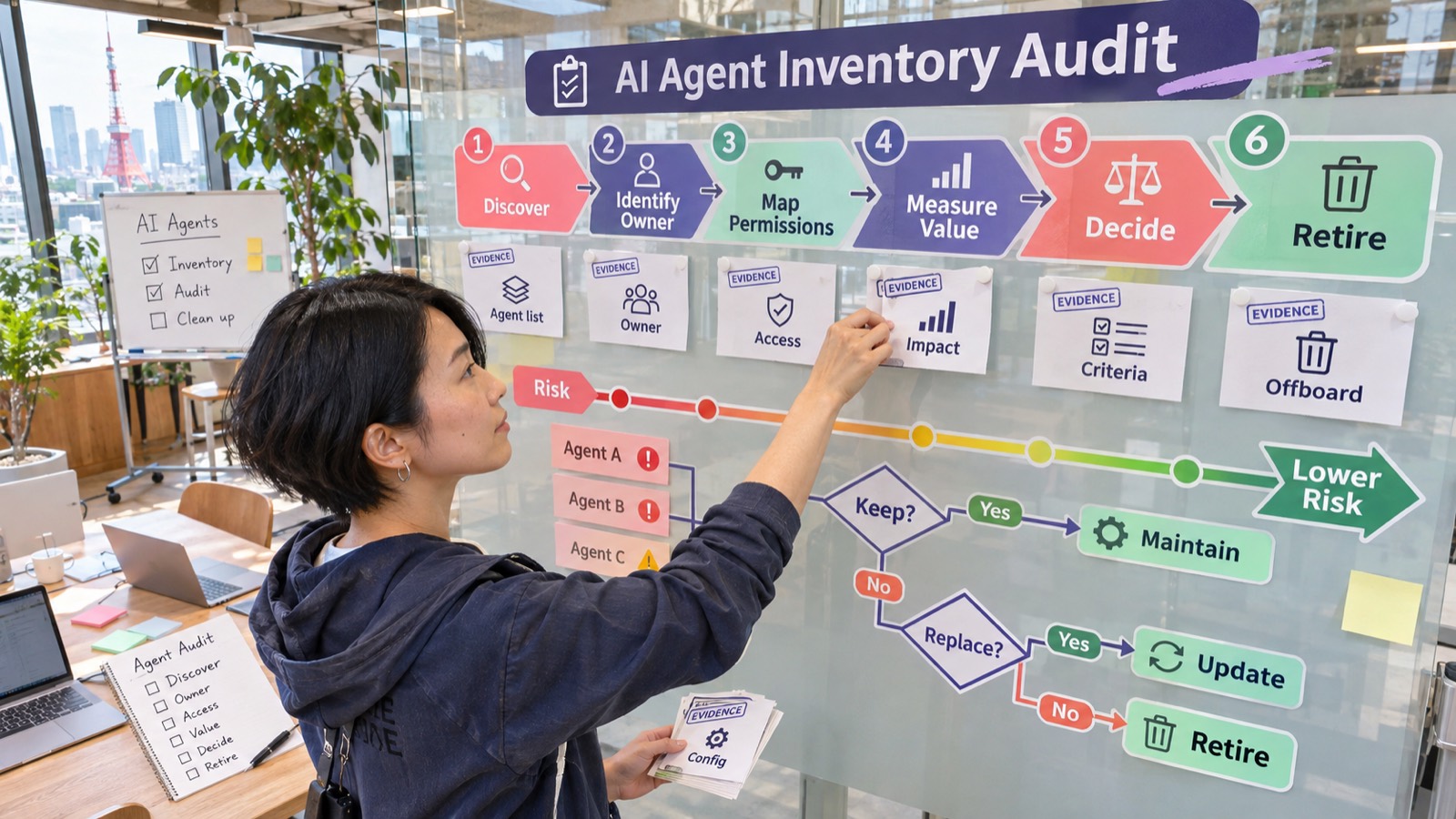
A useful inventory becomes a decision system only when discovery, ownership, permissions, value, and retirement evidence stay connected.
Discover from several control points
No single scanner will find every agent. Discovery should combine platform catalogs, cloud resources, identity directories, service accounts, OAuth grants, API gateways, secret stores, browser extensions, workflow tools, MCP servers, network activity, expense records, procurement systems, and team attestations. The objective is not perfect certainty on day one. The objective is a repeatable reconciliation process that records known blind spots.
Define what counts as an agent
Organizations frequently argue about whether a chatbot, scheduled workflow, recommendation service, or model-powered automation qualifies. Use a practical threshold: register a system when it can select actions, call tools, access nonpublic data, maintain consequential memory, trigger workflows, or change external state with limited case-by-case human control. Low-risk assistants can receive a lighter record, but excluding them entirely creates gaps when their capabilities expand.
Make registration part of creation
The registry should not depend on a quarterly survey. A governed platform should create or update a registry record when an agent identity is issued, a deployment is promoted, a new connector is added, or a risk-relevant configuration changes. Agents created outside the path should be discovered and routed into review. The long-term goal is to make the official path faster because it supplies reusable identity, logging, evaluation, and permission templates.
Turn the Registry Into Portfolio Decisions
An inventory without decisions becomes a spreadsheet cemetery. The registry should support four clear outcomes: scale, fix, merge, or retire. A temporary fifth state, suspend, is useful when evidence is missing or immediate risk must be contained.
Evaluate each agent on two dimensions. The value dimension includes outcome quality, time saved, adoption, reliability, unit cost, and strategic reuse. The risk dimension includes effective authority, data sensitivity, external impact, autonomy, reversibility, incident history, and evidence quality.

Portfolio governance treats consolidation and retirement as normal operating decisions, not as admissions that the original experiment failed.
| Decision | Use when | Required next step |
|---|---|---|
| Scale | The agent delivers a measurable outcome, has controlled authority, reliable evaluations, clear ownership, and reusable demand. | Standardize the capability, strengthen service levels, automate registration, and expand only within an explicit risk envelope. |
| Fix | The outcome is valuable, but permissions, reliability, cost, ownership, logging, or approval design is weak. | Restrict or suspend risky actions, assign remediation work, define acceptance tests, and set a decision deadline. |
| Merge | Several agents perform overlapping jobs or duplicate connectors, models, data pipelines, and support effort. | Create a shared capability or template while preserving necessary regional, legal, or data boundaries. |
| Retire | The agent is unused, redundant, obsolete, unowned, uneconomic, irreparable, or no longer aligned with policy. | Execute a verified decommissioning plan that revokes access, stops jobs, handles retained data, and preserves required evidence. |
| Suspend | Ownership, authority, evidence, or incident status is unknown and the agent can still cause meaningful impact. | Disable write or high-risk access first, investigate, then choose fix, merge, or retire. |
Measure verified outcomes, not activity
Token use, runs, messages, or tasks completed show activity. They do not prove value. An invoice agent creates value when it reduces verified processing time or error without shifting hidden review and correction work onto employees. A support agent creates value when resolved outcomes improve without increasing escalations, refunds, or compliance risk.
The site's guide to enterprise AI agent metrics explains how to combine outcome, reliability, cost, safety, and human-effort measures. For sprawl control, add two portfolio metrics: duplicate capability rate and retirement completion rate. These reveal whether the estate is becoming simpler or merely larger.
Treat “no owner” as a control failure
An agent without a current sponsor should not retain consequential authority. Ownership can change after reorganization, departure, vendor transition, or project closure. The registry needs a succession rule that automatically routes the agent to a new accountable person or reduces its privileges until reassignment.
Use Federated Governance Instead of One Giant Approval Queue
Central control of every low-risk agent can create the shadow behavior governance is meant to prevent. Complete decentralization creates inconsistent controls and fragmented evidence. A federated model separates enterprise minimums from local decision rights.
The central function owns definitions, registry standards, identity requirements, shared logging, risk taxonomy, minimum controls, cross-unit discovery, incident coordination, and audit evidence. Business units own purpose, day-to-day performance, local evaluation, cost, human workflow design, and timely lifecycle decisions. Security, privacy, legal, procurement, finance, and internal audit contribute controls where the agent's risk requires them.
| Risk tier | Typical example | Governance path |
|---|---|---|
| Tier 1: personal or advisory | Drafting, summarization, research assistance with no write access to shared systems | Approved platform, automatic registration, data rules, basic logging, local owner |
| Tier 2: team workflow | Internal agent that reads and writes within one controlled business process | Business-unit approval, scoped identity, evaluation, rollback, periodic review |
| Tier 3: cross-boundary | Agent that changes shared systems, crosses units, handles sensitive data, or calls other agents | Central standards, formal access review, stronger monitoring, incident plan, human checkpoints |
| Tier 4: consequential or external | Customer-facing decisions, regulated processes, high-value transactions, security operations, or irreversible actions | Formal governance, independent testing, continuous controls, explicit release authority, rapid suspension |
The boundary should depend on impact, not on which department built the agent. An experimental agent with write access to a shared production system may require more governance than a mature high-volume assistant that only drafts content for human approval.
A useful principle from AWS is to make the governed path faster. Give teams approved identity templates, connector patterns, test harnesses, logging, cost tags, and reusable approval rules. The central team should operate a paved road, not only a gate.
Governance also needs a runtime layer. Written rules cannot prevent every unsafe action if they are not enforced where the tool call, identity request, data access, or state change occurs. Connect the portfolio registry to runtime policy, observability, and incident response. The AI agent observability guide explains how traces and evidence support those controls.
Retire AI Agents With Evidence, Not a Delete Button
Retirement is the most neglected part of agent lifecycle management. Removing an agent from a user interface does not prove that it can no longer act. Credentials may remain valid. Scheduled jobs may continue. Webhooks may still receive events. Memories and data may persist. Sub-agents may still reference the retired capability. A copied version may continue elsewhere.
A verified retirement procedure should cover identity, execution, dependencies, data, evidence, and communication.
- Freeze change and record the final state. Capture the agent version, owner, purpose, connected systems, identities, permissions, open work, and reason for retirement.
- Stop new work. Disable schedules, event triggers, inbound queues, delegated sessions, and routes that can create new tasks.
- Revoke authority. Disable the agent identity, expire tokens, rotate shared secrets where necessary, remove OAuth grants, and close tool or data permissions.
- Resolve in-flight actions. Identify ambiguous or partially completed writes, reconcile them, and hand unresolved cases to a named owner.
- Handle memory and data. Apply retention, deletion, legal hold, privacy, and archival rules to prompts, outputs, embeddings, memory, logs, and cached files.
- Remove dependencies safely. Check whether other agents, workflows, dashboards, or users rely on the capability before deleting shared components.
- Preserve required evidence. Retain audit records, evaluation results, incident history, approvals, and decommissioning proof for the appropriate period.
- Verify from the outside. Attempt a controlled invocation, confirm credentials fail, confirm schedules are silent, and monitor for residual traffic.
- Update the registry. Mark the agent retired, link the evidence, record remaining data, and set a date for any final deletion.
Retirement should be reversible during a short quarantine period when business continuity requires it, but the system should not quietly reactivate itself. If the agent returns, treat that as a governed redeployment with a fresh owner, permission review, evaluation, and version record.
A 90-Day Plan to Regain Control of Agent Sprawl
Organizations do not need a perfect enterprise architecture before making progress. They need a sequence that reduces unknown authority quickly while building a sustainable operating model.
Days 1-30: define, discover, and contain
Define what counts as an agent and which environments are in scope. Establish the minimum registry fields. Pull initial records from major platforms, identity directories, workflow tools, secret stores, cloud accounts, and procurement data. Ask business units to attest to known agents and record known gaps. Assign a temporary owner to every consequential agent. Suspend write access for unowned high-risk agents where operationally safe. Identify shared accounts and long-lived credentials that prevent attribution.
Do not chase completeness at the expense of risk reduction. Prioritize agents that can write, delete, publish, purchase, grant access, deploy code, handle sensitive data, or affect external users.
Days 31-60: classify, measure, and remove obvious waste
Classify agents by authority, data sensitivity, reversibility, and external impact. Map effective authority for higher-risk agents. Add outcome, cost, usage, incident, and human-effort evidence. Search the registry for duplicate business purposes, shared connectors, and overlapping vendor capabilities. Retire obvious dormant agents and consolidate low-risk duplicates. Create standard owner, expiry, permission, logging, and evaluation templates.
Use this period to connect the registry with existing governance rather than inventing a parallel bureaucracy. Link agents to change management, identity governance, data classification, vendor risk, incident response, and financial ownership.
Days 61-90: automate the lifecycle
Integrate registration with agent creation and promotion. Trigger review when identity, permissions, tools, models, purpose, owner, autonomy, or data changes. Add expiry for temporary agents and short-lived authority. Build dashboards for unowned agents, stale reviews, unused permissions, duplicate capabilities, cost without outcomes, failed revocations, and retirement backlog. Test suspension and retirement on representative agents.
At day 90, leadership should be able to answer: How many agents do we know about? Which can change important state? Who owns each high-risk agent? Which agents duplicate one another? Which create verified value? How quickly can we suspend one? Can we prove that a retired agent no longer has authority?
Metrics That Show Whether Sprawl Is Improving
A governance program can create its own paperwork sprawl. Use a compact scorecard that measures control and portfolio health rather than the number of policies written.
Do not reward teams for maximizing registration count or minimizing incident count without context. A sudden increase in registered agents may mean discovery improved. A low incident count may mean monitoring is weak. Pair metrics so they cannot be easily gamed.
Interactive AI Agent Sprawl Risk Assessor
Use this lightweight decision helper for an agent or agent family. It does not replace a formal risk assessment. It identifies the first control priority based on visibility, authority, ownership, and value evidence.
What to Watch Next in Enterprise Agent Management
Agent management is moving toward the convergence of identity governance, application governance, observability, cost management, policy enforcement, and AI risk management. Microsoft, IBM, AWS, and other platforms are introducing purpose-built agent identity, registry, control-plane, and lifecycle capabilities. That direction is useful, but enterprises should resist the idea that one vendor console automatically becomes the truth for a multi-vendor estate.
Three developments deserve close attention. First, agent identities are becoming first-class objects with sponsors, metadata, access packages, and lifecycle controls. Second, permission decisions are moving closer to runtime so authority can be evaluated against task, context, risk, and current policy. Third, agent-to-agent interaction is creating delegation chains that require end-to-end attribution rather than a record of only the first human and final tool call.
Standards will matter, but operating discipline matters sooner. A company can start now by assigning stable identities, requiring owners, limiting effective authority, measuring verified outcomes, and proving retirement. Those practices remain useful even if platforms, protocols, and vendors change.
The most mature organizations will not be the ones with the fewest agents. They will be the ones that can explain why every important agent exists, what it is allowed to do, how its value is verified, what evidence it produces, and how quickly it can be changed or stopped.
Final Insight: Control the Portfolio, Not Just the Prompt
AI agent sprawl is a predictable result of decentralized innovation meeting weak enterprise visibility. It is not solved by a policy memo, a one-time inventory, or a dashboard that counts agents. It is solved by a continuous portfolio loop.
Discover agents from multiple control points. Give each a stable identity and accountable sponsor. Map effective authority rather than relying on a connector list. Measure verified outcomes and full operating cost. Choose deliberately among scale, fix, merge, suspend, and retire. Then verify that retirement actually removed authority and stopped execution.
This approach preserves room for experimentation because controls become proportional to impact. Low-risk agents can move through a paved self-service path. Cross-boundary and consequential agents receive stronger review, evidence, monitoring, and human control. Unowned or unproven agents do not keep powerful access by default.
For the wider control stack, continue with our guides to trustworthy AI agents, human-in-the-loop approval design, and AI agent accountability. Together, they connect fleet visibility to runtime control and human responsibility.
FAQ About AI Agent Sprawl
What is AI agent sprawl?
AI agent sprawl is the uncontrolled growth of agents across platforms, departments, and workflows without dependable inventory, ownership, permission, value, and lifecycle controls. A company can have many agents without sprawl if those agents remain visible, accountable, measured, and governable.
How is agent sprawl different from shadow AI?
Shadow AI refers to AI use outside approved or visible channels. Agent sprawl includes shadow agents, but it also includes approved agents that are duplicated, overprivileged, unowned, unmeasured, obsolete, or difficult to retire. Solving shadow AI discovery does not automatically solve lifecycle debt in approved platforms.
What belongs in an AI agent inventory?
At minimum, record a stable identity, purpose, scope, business sponsor, technical owner, identity type, permissions, tools, data sources, dependencies, model and prompt version, risk tier, evaluation evidence, outcome metrics, cost, lifecycle status, review date, expiry, suspension method, and retirement evidence.
Who should own an enterprise AI agent?
Use at least two ownership roles. A business sponsor answers for purpose, outcome, and acceptable use. A technical owner answers for configuration, operation, evidence, incident response, and decommissioning. Higher-risk agents may also need named security, privacy, compliance, or model-risk reviewers.
How often should AI agent permissions be reviewed?
Review on a risk-based schedule and after material changes. High-risk agents may need continuous monitoring and frequent recertification. Every agent should be reviewed when purpose, owner, model, tool, data source, user population, environment, autonomy, or permission changes. Temporary grants should expire automatically.
How do you know whether an AI agent creates value?
Measure a verified business outcome, not only activity. Combine quality, time saved, adoption, reliability, full cost, human review, correction effort, incidents, and user impact. If an agent runs often but does not improve a meaningful outcome after accounting for supervision and recovery, its value case is weak.
When should an AI agent be retired?
Retire an agent when it is unused, redundant, obsolete, unowned, uneconomic, no longer policy-aligned, or unable to meet control and reliability requirements. Retirement should revoke identities and permissions, stop triggers, reconcile in-flight actions, handle retained data, preserve evidence, and verify that no residual execution remains.
Can an AI agent control plane solve sprawl by itself?
No. A control plane can improve discovery, identity, policy, observability, and lifecycle automation, but it cannot decide business purpose, acceptable risk, outcome quality, ownership, or whether duplicate agents should be consolidated. Multi-vendor environments also require reconciliation across several sources of truth.
Should companies stop employees from building agents?
A blanket ban usually sacrifices useful experimentation and may push activity into less visible channels. A better model is risk-tiered self-service: provide approved tools and templates for low-risk work, require stronger controls for consequential agents, and make the governed path faster than the workaround.

