
AI Incident Reporting Explained: What Counts as a Serious Incident and What Happens Next
AI incident reporting is how organizations turn unusual model behavior, security failures, misuse, and real-world harm into evidence that can trigger containment, accountability, regulatory notice, and safer future systems. The difficult part is deciding what matters, what to preserve, who needs to know, and how to report uncertainty without hiding behind it.

AI Incident Reporting: The Quick Answer
AI incident reporting is the structured process for recording, assessing, escalating, and communicating events in which an AI model or AI-enabled system causes harm, creates a credible risk of harm, behaves outside its intended controls, or exposes a weakness that could recur at larger scale. A report is not simply a bug ticket. It connects technical evidence to decisions about containment, affected people, regulators, providers, public disclosure, and corrective action.
A serious incident can involve actual harm—such as injury, a major rights violation, material property damage, a security breach, or disruption of critical infrastructure. It can also involve a model failure that reveals a dangerous capability or loss of control even when the worst outcome was prevented. Exact legal definitions vary by jurisdiction and system type, so teams need two thresholds: a low threshold for internal tracking and a higher, clearly governed threshold for external reporting.
The strongest reporting programs treat near misses as learning opportunities, preserve enough evidence to reconstruct what happened, assign one accountable incident owner, separate containment from blame, and feed lessons back into evaluations, model access, deployment gates, monitoring, and governance. The goal is not paperwork. The goal is to prevent the same weak signal from becoming a larger failure. For an operating model focused specifically on close calls before confirmed harm, use our AI near-miss reporting workflow.
Why AI Incident Reporting Matters Now
General-purpose AI is moving from answering questions to taking actions. Models can write and execute code, use tools, browse external systems, assist scientific work, automate business processes, and operate as parts of multi-step agents. That makes traditional incident management necessary but incomplete. A database outage has a relatively familiar failure surface. An AI incident may involve probabilistic behavior, a hidden prompt injection, an unsafe tool call, a user deliberately bypassing safeguards, an unexpected capability, contaminated evaluation data, or a long chain of human and machine decisions.
The International AI Safety Report describes an “evidence dilemma”: capabilities move quickly, but evidence about emerging risks is slower, uneven, and difficult to interpret. Some harms have strong empirical evidence; others are studied through controlled evaluations, models, and theoretical analysis. Incident reporting is one of the bridges across that gap. It supplies operational evidence that laboratory testing cannot create on its own.
Regulators are also moving from broad principles toward reporting duties. The European Commission has published a template for serious incidents involving general-purpose AI models with systemic risk. Its guidance connects reporting with Article 55 of the EU AI Act and the safety-and-security chapter of the General-Purpose AI Code of Practice. The obligation is not universal for every model or every organization, but the direction is clear: advanced-model governance increasingly expects teams to track incidents, document corrective measures, and notify competent authorities when applicable.
Industry practice is evolving in parallel. The Frontier Model Forum emphasizes that information-sharing regimes must define their objectives, recipients, and governance. OpenAI’s Frontier Governance Framework includes model reporting, incident response, risk assessment, external expert input, and framework updates. These examples do not prove that any single approach is sufficient. They show that incident evidence is becoming part of the operating system for frontier AI governance.
Singularity Journey’s analytics reinforce this need. Recent GA4 data shows sustained interest in human approval, enterprise governance, NIST AI RMF, agent evaluation, and operational reliability. The site’s NIST AI Risk Management Framework explainer also produced meaningful engagement. Incident reporting is the next logical layer: it explains what happens when mapped risks and planned controls meet messy real-world behavior.
Event, Error, Near Miss, Incident, or Serious Incident?
Confusion starts with language. Teams often use “incident” for everything from an awkward chatbot response to a security compromise. That can make the reporting queue noisy, or it can make serious events disappear inside an ordinary support system. A practical taxonomy should be simple enough for frontline staff to use and precise enough for safety, legal, security, and leadership teams to make consistent decisions.
| Class | Plain-language meaning | Typical action | Example |
|---|---|---|---|
| Observation | An unusual output or behavior with no established control failure or credible harm pathway. | Log if useful, monitor for patterns, attach context. | A model gives an irrelevant answer that is caught immediately. |
| Defect or error | A reproducible quality or software problem within normal operational bounds. | Route to product or engineering; assess whether the defect affects safety controls. | A classifier mislabels a low-stakes document because a field mapping changed. |
| Near miss | A failure or dangerous condition that could have caused harm but was interrupted by a person, control, circumstance, or luck. | Preserve evidence, investigate, test recurrence, review controls. | An agent drafts a destructive database action, but an approval gate blocks execution. |
| AI incident | An AI-related event that causes harm, compromises a material control, or requires coordinated response. | Activate incident command, contain, notify internal stakeholders, assess external duties. | A deployed model exposes confidential records through an authorization flaw. |
| Serious incident | An incident meeting a legal, regulatory, or organizational threshold because of severe consequences, large scale, critical-system impact, rights harm, or systemic risk. | Executive and legal escalation, formal reporting where required, corrective measures, governed disclosure. | A model-enabled failure contributes to serious physical harm or major critical-infrastructure disruption. |
A near miss deserves more attention than its outcome suggests. If a control prevented harm, the organization should ask whether the control was designed for that scenario, whether it would work again, and whether the event exposed a capability or pathway that existing evaluations missed. Safety-critical industries learn from near misses because outcome luck is not the same as system safety.
At the same time, not every hallucination is a serious incident. Severity should remain proportional. A wrong restaurant recommendation, a fabricated citation in a school essay, and a false medical instruction may share a technical label—hallucination—but they differ radically in context, exposure, reversibility, and harm. Reporting starts with the system and deployment context, not with a model behavior in isolation.
A Practical AI Incident Severity Matrix
A useful severity model asks five questions: What happened? What harm occurred or could credibly occur? How much control was lost? How widely can the problem spread? How quickly can it be reversed? Teams should add data sensitivity, affected populations, legal triggers, critical infrastructure, and evidence confidence to fit their context.

| Level | Indicators | Governance response | Evidence priority |
|---|---|---|---|
| Level 1: Routine | No material harm, narrow scope, expected failure mode, easy recovery, controls intact. | Normal product process; trend monitoring. | Prompt/output, version, user context, reproducibility. |
| Level 2: Concerning | Near miss, repeated safeguard bypass, sensitive-domain error, or weak signal of a wider pattern. | Safety review; create test cases; consider temporary limits. | Full trace, guardrail decision, user journey, similar events. |
| Level 3: Significant | Material harm, security compromise, rights impact, unauthorized action, or substantial control failure. | Formal incident command; containment; legal and risk assessment. | Immutable logs, affected scope, identities, data lineage, corrective actions. |
| Level 4: Serious | Severe or widespread harm, critical infrastructure effect, death or serious health impact, major rights violation, or credible systemic-risk trigger. | Executive oversight; regulator and authority notification where required; controlled external communication. | Auditable evidence package, timeline, impact analysis, decision record, residual risk. |
| Level 5: Crisis | Ongoing or rapidly scaling harm, loss of meaningful control, cross-border consequences, or inability to contain with ordinary measures. | Crisis governance; emergency controls; multi-party coordination; continuous reassessment. | Live telemetry, verified chain of custody, independent review, authoritative situation reports. |
The matrix is deliberately not a legal checklist. It is a decision aid that helps teams escalate early while facts are still developing. An event can move up or down as evidence improves. A seemingly minor output may become serious when investigators discover widespread exposure. A dramatic anomaly may be downgraded when logs show it was isolated, sandboxed, and incapable of affecting users.
Risk thresholds should be defined before an incident. Singularity Journey’s guide to AI risk thresholds explains why teams need explicit points that trigger stronger safeguards or stop deployment. Incident severity should connect to those thresholds. Otherwise, an organization may have one framework for release decisions and a disconnected framework for real-world failures.
The AI Incident Reporting Lifecycle
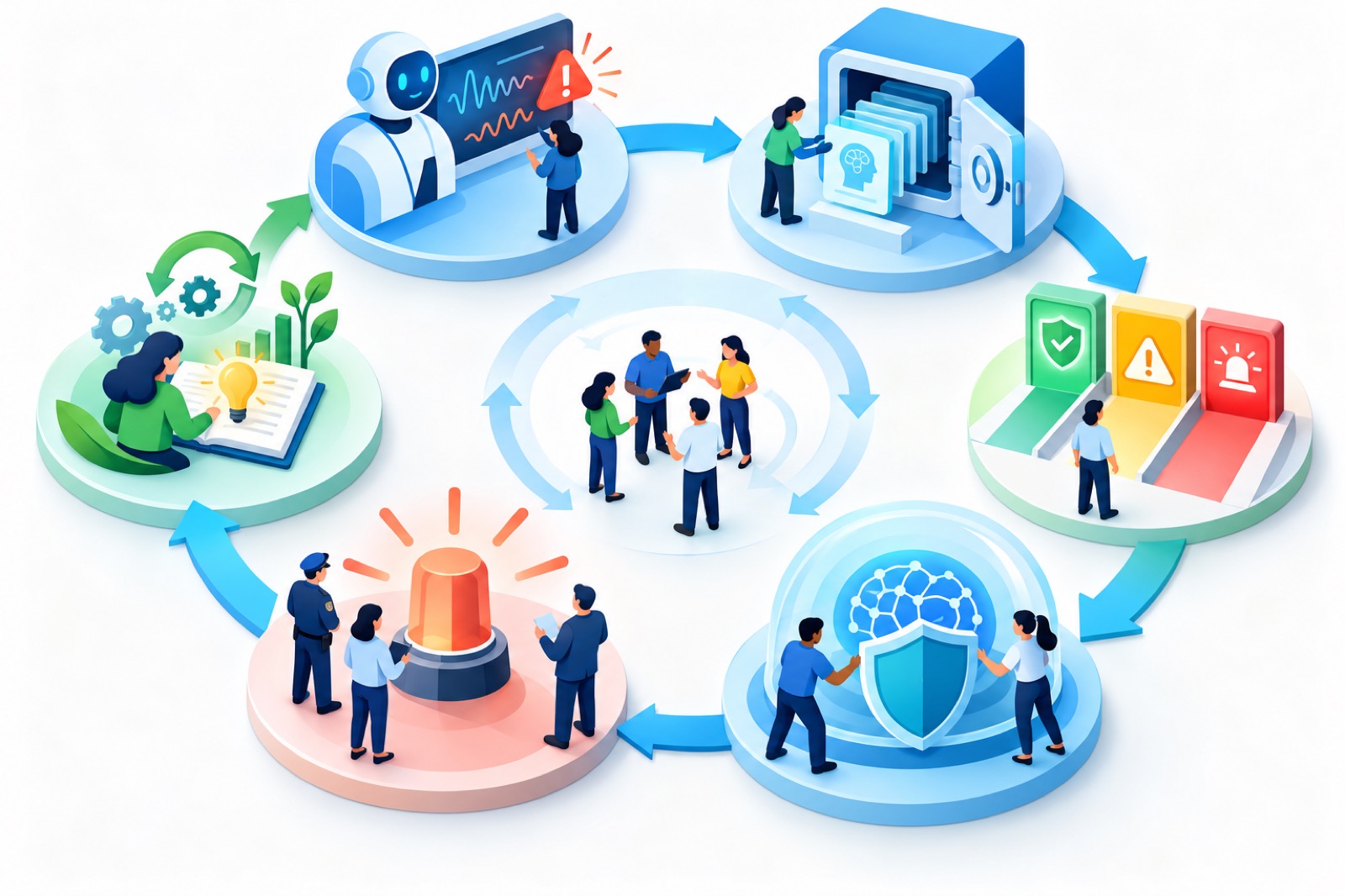
Reporting is one part of a larger lifecycle. If a team rushes to write a polished report before containing harm, it has the order wrong. If it contains the event but never records the evidence, it cannot learn. If it creates an internal report but never checks external obligations, it may fail affected users or regulators. The lifecycle below keeps those responsibilities connected.
1. Detect and open a record
Create an incident identifier as soon as a credible event is recognized. Record who noticed it, when it occurred, the system and version involved, the deployment context, the first observed effect, and the source of the alert. Do not wait for perfect certainty. Early records can be marked preliminary.
2. Preserve evidence
Protect prompts, outputs, tool calls, model and policy versions, retrieval context, identity and permission decisions, relevant logs, screenshots, user reports, and environment state. Preserve originals and work from copies. Record time zones and clock differences. In sensitive cases, legal or forensic teams may need to establish a formal chain of custody.
3. Triage severity and scope
Assess actual harm, credible potential harm, affected population, geographic reach, data sensitivity, system criticality, recurrence, reversibility, control effectiveness, and evidence confidence. Assign a temporary severity level and an owner with authority to escalate.
4. Contain without destroying the story
Limit access, disable a tool, revoke credentials, isolate a model version, pause a workflow, narrow a deployment, add human approval, or switch to a safer fallback. Keep a record of every containment decision and its rationale. Avoid emergency changes that overwrite the evidence needed to understand the incident.
5. Decide whom to notify
Notify internal response teams immediately according to severity. Then evaluate duties to providers, customers, affected individuals, insurers, regulators, sector authorities, law enforcement, partners, and the public. Share the minimum information each recipient needs, while updating reports as material facts change.
6. Investigate causes and contributing conditions
Look beyond the last model output. Examine system design, data, prompts, model behavior, tools, permissions, human decisions, incentives, monitoring, evaluation coverage, and organizational handoffs. AI incidents are often sociotechnical: the model may be one contributor inside a larger chain.
7. Correct, verify, and learn
Implement corrective measures, test them against the incident pathway, look for regressions, and decide when normal operation can resume. Convert the incident into evaluation cases and update risk registers, inventories, approval gates, monitoring rules, documentation, training, and governance thresholds.
This lifecycle should connect with a broader operational playbook. The AI agent incident response runbook covers detection, containment, recovery, and learning for tool-using workflows. Reporting adds a second question: beyond fixing the system, what evidence and notice are owed to other parties?
The Minimum Viable AI Incident Evidence Package
An AI incident report is only as useful as the evidence beneath it. Ordinary application logs may show an error code without explaining why a model chose a tool, what context it saw, which safety policy applied, or whether a human approved the action. Teams need evidence across the full AI system, while respecting privacy and security limits.
| Evidence group | What to capture | Why it matters |
|---|---|---|
| System identity | Model, version, provider, application, workflow, agent, environment, deployment region, owner. | Prevents investigators from analyzing the wrong configuration or assuming all versions behave alike. |
| Interaction trace | User request, system instructions, retrieved context, model outputs, tool calls, intermediate decisions, approvals, errors. | Reconstructs the sequence rather than judging one isolated response. |
| Access and identity | User and service identities, roles, permissions, tokens, approval decisions, policy checks. | Shows whether the system acted with appropriate authority and whether credentials were misused. |
| Data lineage | Input sources, document versions, sensitive fields, retrieval results, transformations, output destinations. | Supports privacy, confidentiality, provenance, and contamination analysis. |
| Safety controls | Guardrail versions, classifier scores, filters, sandbox state, rate limits, stop conditions, human checkpoints. | Shows which controls triggered, failed, were bypassed, or were never present. |
| Impact | Affected people and systems, duration, geography, financial or operational effect, rights impact, downstream propagation. | Supports severity, notification, remediation, and prioritization decisions. |
| Response timeline | Detection, escalation, containment, notifications, corrective actions, recovery, reopenings. | Makes decision latency and responsibility auditable. |
| Uncertainty | Unverified claims, missing logs, disputed causality, alternative hypotheses, confidence levels. | Prevents a preliminary narrative from hardening into false certainty. |
Evidence collection should be designed before deployment. If prompts are never logged, if tool calls cannot be traced, or if approval decisions leave no durable record, investigators cannot recreate the event later. The answer is not to store everything forever. It is to define risk-based retention that captures what is necessary, protects sensitive data, limits access, and supports deletion when retention is no longer justified.
An AI inventory makes this much easier. A mature registry records owners, versions, tools, data classes, risk tiers, evaluation status, and lifecycle state. When an incident occurs, investigators can immediately connect the event to the responsible system and controls. The AI agent registry checklist explains how to build that foundation.
Pre-deployment evaluation evidence also matters. An incident can reveal that a test was missing, a benchmark was poorly matched to reality, or a safeguard performed differently under operational pressure. Compare the event with your frontier AI evaluation evidence package and red-teaming checklist. The key question is not only “Why did the system fail?” but “Why did our assurance process fail to predict or contain this pathway?”
Interactive AI Incident Reportability Triage
This helper is a governance prompt, not a legal determination. Check every factor that is credibly present. A higher result means the event deserves faster escalation, stronger evidence preservation, and formal review of external reporting duties.
Notice that incomplete evidence adds concern rather than subtracting it. Teams sometimes delay escalation because they cannot yet prove that the model caused the harm. A better approach is to separate facts from hypotheses. Report what is known, label what is uncertain, state what is being investigated, and update the record as evidence changes.
Who Needs to Know About an AI Incident?
Information sharing is not all-or-nothing. A security researcher may need technical indicators. An affected person needs clear consequences and practical remedies. A regulator may need a structured report and corrective measures. The public may need a transparent summary without exploit details. Good governance matches information to purpose while keeping one authoritative incident record underneath.
| Recipient | What they need | Common mistake |
|---|---|---|
| Incident team | Detailed trace, system context, containment options, owners, live status. | Sending a polished summary that hides uncertainty or raw evidence. |
| Leadership and board | Severity, consequences, control status, decisions required, residual risk. | Overloading decision-makers with technical detail while omitting choices and trade-offs. |
| Model or tool provider | Reproducible evidence, version, affected features, exploit conditions, requested action. | Assuming the provider already sees the customer’s full workflow and downstream harm. |
| Affected users | What happened, what it means for them, what has been done, what they should do, how to get help. | Using vague safety language that does not explain practical consequences. |
| Regulators and authorities | Required facts, timeline, impact, corrective measures, updates, and legal entity information. | Waiting for every uncertainty to disappear before making time-sensitive notice. |
| Researchers and peers | Generalizable failure pattern, indicators, mitigations, and limits, with sensitive details controlled. | Sharing either too little to help or too much to safely disclose. |
| Public | Material facts, consequences, accountability, corrective action, and unresolved uncertainty. | Treating disclosure as reputation management instead of a trust and safety obligation. |
The Frontier Model Forum argues that a sharing regime should begin by defining its objective and the stakeholders who need access. That is a useful design principle. A report intended to coordinate emergency containment will differ from a public transparency report, a regulatory notice, or an anonymized contribution to an incident database.
Organizations should also support protected internal reporting. Frontline employees, contractors, evaluators, and users may see weak signals before leadership does. A reporting channel should allow good-faith escalation without retaliation, define confidentiality, protect against conflicts of interest, and give reporters feedback about what happened next. If the only route is through the team whose release decision is being questioned, important evidence may never reach an independent reviewer.
What good transparency enables
- Faster containment across organizations.
- Better evaluation sets and shared indicators.
- Accountability for corrective action.
- More realistic public understanding of AI risk.
What careless disclosure can harm
- Security, privacy, and active investigations.
- Affected people who are identifiable from details.
- Competitive or proprietary information unrelated to accountability.
- Trust, if preliminary claims are stated as settled fact.
How to Report What Is Known—and What Is Still Uncertain
AI incidents rarely arrive with a clean causal story. A harmful output may involve the base model, fine-tuning, retrieval, a third-party tool, a malicious user, missing permissions, weak interface design, rushed human approval, or a downstream system that acted on the output. Investigators should resist two shortcuts: blaming the model for everything, and declaring the model irrelevant because a human remained somewhere in the loop.
| Question | What may be known early | What may remain uncertain |
|---|---|---|
| What occurred? | Observed outputs, actions, timestamps, affected systems, immediate consequences. | Whether hidden state, external interference, or missing telemetry changed the sequence. |
| Why did it occur? | Specific control failures, permissions, prompts, or tool calls. | Relative contribution of model behavior, data, design, and human decisions. |
| Can it recur? | Whether investigators can reproduce part of the pathway. | How often it appears across models, contexts, users, or adversarial strategies. |
| How severe is it? | Confirmed harms and exposed assets. | Long-term effects, indirect impacts, unreported victims, or systemic propagation. |
| Do mitigations work? | Whether a patch blocks the known reproduction. | Whether attackers can adapt, whether utility is harmed, and whether new paths remain. |
The International AI Safety Report’s evidence-dilemma framing is useful here. Acting too early can lock in ineffective measures; waiting for conclusive evidence can leave society exposed. Incident governance should therefore support reversible, proportionate decisions. A team can temporarily narrow access, require additional approval, increase monitoring, or pause a high-risk capability while investigation continues. It does not need to claim certainty it does not have.
Confidence labels help. Each material statement can be marked confirmed, probable, plausible, disputed, or unknown, with an owner and next evidence step. This makes updates easier and protects the report from becoming a story that everyone repeats long after the facts change.
Turning Incident Reports Into Safer AI Systems
A closed incident is not necessarily a learned incident. Organizations often patch the immediate problem, hold a meeting, and move on. The deeper value comes from converting the event into durable changes across the system lifecycle.
- Add the incident pathway and close variants to evaluation suites.
- Update the AI inventory with new risks, controls, owners, and review dates.
- Revise risk thresholds and escalation triggers where ambiguity slowed action.
- Test whether containment and approval controls work under realistic pressure.
- Review access, credentials, tool permissions, and destructive-action boundaries.
- Measure detection time, escalation time, containment time, and recurrence.
- Share generalizable lessons with partners or authorities when it can reduce wider risk.
- Schedule a follow-up review to verify that corrective measures remain effective.
The learning loop should also update organizational governance. NIST AI RMF organizes work around Govern, Map, Measure, and Manage. An incident can reveal weakness in any of those functions: unclear accountability, an incomplete deployment map, poor measurements, or ineffective controls. Revisit the NIST AI RMF guide with the incident in hand. Framework language becomes much more useful when anchored to a real event.
Human approval deserves the same treatment. If an approver caught the problem, ask what evidence made the risk visible. If the approver missed it, ask whether the interface showed the right context and whether time pressure made meaningful review impossible. The human approval gates guide explains how to place review before actions where judgment and reversibility matter most.
Finally, make learning measurable. Track how many incident-derived tests were created, whether recurrence fell, whether detection improved, how long containment took, and whether controls were independently challenged. Avoid vanity metrics such as raw incident count without context. A rising count may mean the system is getting worse, or it may mean reporting culture and detection are improving. The interpretation needs evidence.
Common AI Incident Reporting Failures
Waiting for certainty
Teams delay opening a record until they can prove causality. By then, logs have rolled over, people have changed systems, and the event has spread. Open a preliminary record early and update it.
Treating every model error as a crisis
Overclassification overwhelms responders and trains teams to ignore alerts. Use proportional levels, but preserve patterns that may reveal a systemic issue.
Focusing only on the model
A model output is part of a sociotechnical chain. Tools, identity, permissions, UI, human approval, data quality, and incentives may be decisive contributors.
Separating response from reporting
The operations team contains the event while legal or governance writes a report from second-hand notes. Use a shared incident record and a common timeline, with access controls for sensitive material.
Destroying evidence during containment
Emergency changes overwrite logs or remove the configuration needed to reproduce the event. Build containment playbooks that preserve originals and document every change.
Publishing too early or too vaguely
A rushed public statement can expose victims or misstate causes. A vague statement can feel evasive. Publish verified material facts, clearly label uncertainty, explain corrective action, and commit to updates.
Closing without testing the fix
A policy update or prompt patch may block the known example while leaving the underlying pathway open. Retest adversarially, examine adjacent scenarios, and monitor production evidence.
How to Build an AI Incident Reporting Program
Start small enough to operate. A forty-page policy nobody uses is weaker than a one-page intake form connected to real ownership and escalation. The minimum program needs an intake channel, severity rules, an accountable incident lead, evidence-preservation procedures, notification maps, legal and sector mapping, corrective-action tracking, and a learning review.
Define scope
List the AI systems, models, agents, vendors, and high-consequence workflows covered by the program. Include internal model use where it can create material risk. Connect scope to the enterprise AI inventory instead of maintaining a separate spreadsheet that drifts.
Create two reporting thresholds
Set a low internal threshold so near misses and repeated weak signals are captured. Set governed external thresholds mapped to relevant law, contract, sector obligations, and organizational commitments. This reduces both silence and unnecessary formal reporting.
Assign authority before the event
Name the incident commander, safety lead, security lead, privacy counsel, legal owner, communications lead, system owner, and executive decision-maker. Define who can pause a deployment, revoke access, contact authorities, or approve public disclosure.
Design the evidence path
Ensure logs, model versions, prompts, tool traces, retrieval context, approval records, and configuration snapshots can be preserved. Test the process through exercises. If the team cannot reconstruct a simulated incident, it will not reconstruct a real one under pressure.
Practice with scenarios
Run tabletop exercises involving a near miss, privacy leak, unsafe autonomous action, safeguard bypass, third-party provider incident, and disputed causality. Ask what each team sees, what they can decide, and what information is missing.
Build independent challenge
High-severity incidents benefit from reviewers who were not responsible for the system or release decision. Independent challenge can surface motivated reasoning, conflicts of interest, and assumptions the delivery team no longer notices.
Report upward and outward
Create templates for internal situation reports, affected-user notices, provider reports, regulator reports, and public summaries. Reuse verified facts while tailoring detail and confidentiality to the recipient.
What Better AI Incident Reporting Could Change
Better reporting will not eliminate AI risk, and a high volume of reports will not automatically produce understanding. The value comes from comparability, evidence quality, protected sharing, and action. Common taxonomies can reveal recurring failure patterns. Stronger templates can improve the evidence available to regulators and researchers. Protected channels can surface problems earlier. Incident-derived evaluations can make future releases more realistic.
There are real tensions. Developers need to protect security-sensitive details and personal data. Regulators need enough information to see systemic patterns. Researchers need access to evidence that is often proprietary. The public needs accountability without sensationalism. Global systems operate across legal regimes that define incidents and timelines differently. A mature ecosystem will probably need layered disclosure: confidential detailed reporting to competent bodies, trusted information sharing among defenders, and public summaries that explain material risks and corrective action.
We should also be honest about limits. Incident databases reflect what people detect and choose to report. They undercount hidden harms and may overrepresent visible failures. Categories can create false confidence. Causal claims can change. A report can document controls without proving those controls work. Independent evaluation, whistleblower protection, audits, scientific research, and public scrutiny remain necessary.
The deeper significance is cultural. Advanced AI governance cannot rely only on pre-release promises. It needs institutions capable of noticing weak signals, stopping harmful trajectories, learning from operational evidence, and explaining decisions. Incident reporting is where accountability becomes concrete: a date, a system, an owner, an impact, a decision, a corrective action, and a record that someone else can examine.
A Reporting Culture Is a Safety Control
AI incident reporting works when people can raise concerns early, evidence survives the response, severity decisions are explicit, and leaders are willing to act before certainty becomes comfortable. It fails when reporting is treated as blame, compliance theater, or a communications problem to manage after the technical team has moved on.
For most organizations, the next step is practical: create a simple intake form, define the five severity levels, connect records to the AI inventory, assign an incident owner, list external reporting obligations, and run one tabletop exercise. Use the results to improve logging, approvals, evaluation coverage, and governance. Then repeat the exercise as systems gain new tools and autonomy.
The path toward more capable AI will include surprises. A credible safety program does not pretend otherwise. It builds the capacity to see those surprises, preserve the evidence, contain the harm, communicate responsibly, and learn faster than the risk evolves.
FAQ: AI Incident Reporting
What counts as a serious AI incident?
A serious AI incident is an AI-related event that crosses a legal, regulatory, or organizational threshold because of severe consequences, major rights or security impact, critical-system disruption, large scale, or credible systemic risk. The exact definition depends on jurisdiction and system type. Teams should assess both actual harm and credible potential harm, then map the event to applicable rules.
Is an AI near miss reportable?
A near miss should normally be reported internally even when no harm occurred. External reporting depends on applicable rules and commitments. Near misses are valuable because they reveal dangerous pathways, evaluation gaps, or controls that succeeded only under favorable circumstances.
Who should own AI incident reporting?
One accountable incident lead should coordinate the record and decisions, supported by the system owner, safety, security, privacy, legal, risk, communications, and leadership. High-severity events should have independent challenge and clear executive authority.
What evidence should be preserved?
Preserve model and system versions, prompts, outputs, retrieved context, tool calls, approvals, permissions, identities, data lineage, safety-control decisions, impact evidence, timestamps, containment actions, and uncertainty notes. Apply appropriate privacy, security, retention, and chain-of-custody controls.
How quickly should an AI incident be reported?
Internal escalation should begin as soon as a credible significant event is detected. External timelines vary, and some regimes require notice without undue delay or within specific windows. Organizations should pre-map applicable obligations and avoid waiting for perfect causality before seeking legal and regulatory guidance.
Should every AI incident be disclosed publicly?
No. Public disclosure should be proportionate to material impact, accountability needs, affected-user interests, legal requirements, security risks, privacy, and ongoing investigations. Some details belong in confidential regulatory or defender channels. Public summaries should still state material facts, uncertainty, and corrective actions when transparency is warranted.
How is incident reporting different from incident response?
Incident response contains harm, recovers systems, and restores safe operation. Incident reporting creates the durable evidence and communications needed for accountability, external notice, cross-team coordination, and learning. The two processes should share one authoritative timeline but serve different purposes.
Can incident reports prove an AI system is safe?
No. Reports provide evidence about failures, controls, and operational behavior, but absence of reported incidents does not prove absence of risk. Reporting should complement evaluations, red teaming, monitoring, audits, safety cases, human oversight, and independent research.
