
AI Risk Thresholds Explained: When Frontier AI Needs Stronger Safeguards
A practical guide to the decision gates that should trigger stronger AI safeguards: capability evaluations, risk tiers, deployment limits, external review, and pause conditions.
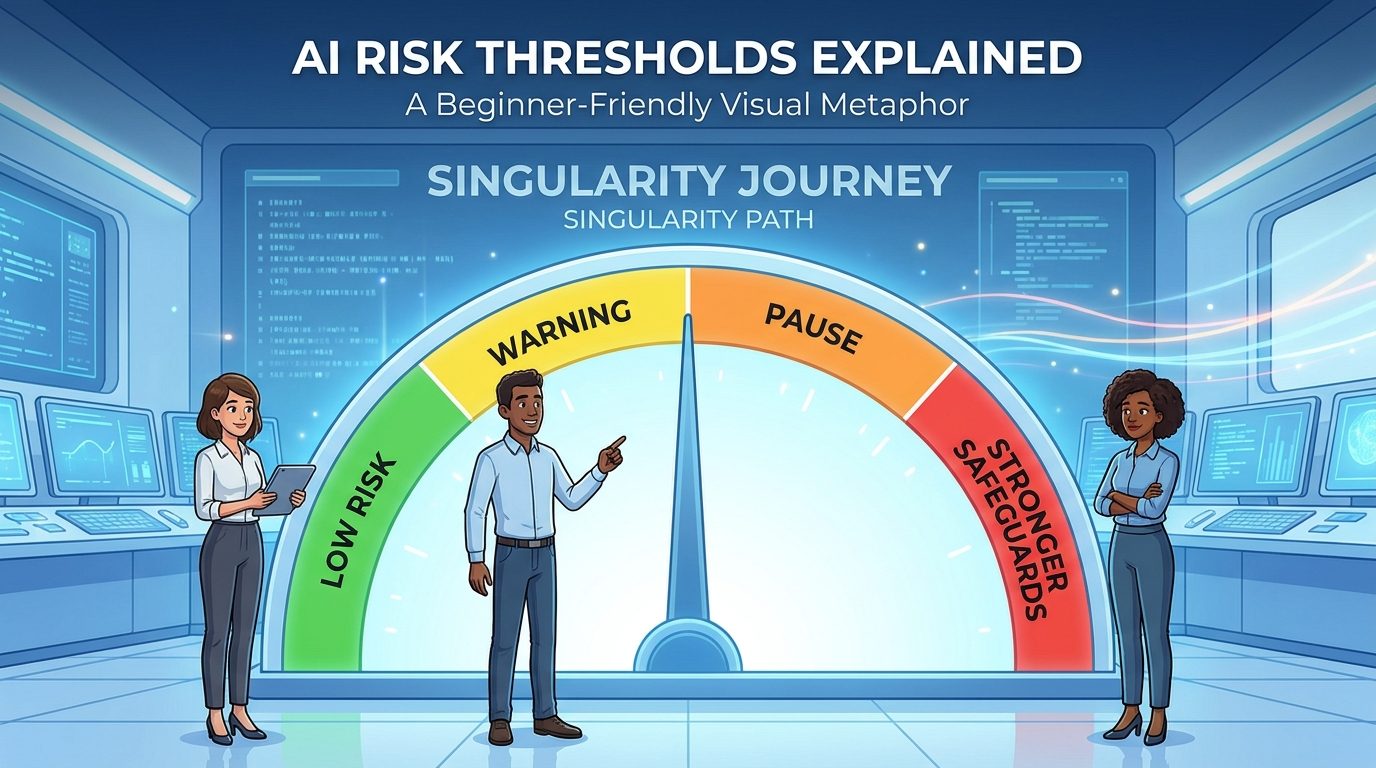
Quick Answer: What Are AI Risk Thresholds?
AI risk thresholds are decision points that tell a lab, company, regulator, or institution when an AI system has become capable or exposed enough to require stronger safeguards before it is trained further, deployed more widely, connected to tools, released to users, or allowed to operate with less human oversight. A threshold is not a magic number that proves a model is safe or dangerous. It is a governance trigger: if the model shows a certain capability, risk pattern, or deployment condition, the organization must slow down, measure more carefully, add controls, get outside review, limit access, or pause.
The idea matters because frontier AI systems are not ordinary apps. A normal software feature may create privacy, reliability, or security risk, but its behavior is usually bounded by code paths that engineers designed. Frontier AI can generalize across tasks, write code, persuade, plan, call tools, summarize sensitive information, assist scientific work, or automate workflows in ways that are harder to test exhaustively. As systems become more capable, vague promises like “we tested it” are not enough. People need to know what evidence would cause a stronger response.
A useful threshold model answers five practical questions: What capability are we watching for? How will we measure it? What level of evidence counts as crossing the threshold? What safeguard is required next? Who has authority to say the system can proceed? Without those answers, “AI safety” becomes a mood. With those answers, it becomes a decision process that can be reviewed, challenged, improved, and audited.
This SINGULARITY PATH pillar was selected because the last published Singularity Journey category was AI CORE, so the fixed sequence requires SINGULARITY PATH next. The topic also fits current site signals: recent analytics show engagement with AGI warning-sign and risk-register content, while Search Console data is still sparse enough that the best strategy is building clear topical authority around frontier AI safety, governance, and human control.
Why Thresholds Matter More as AI Becomes More Capable
The public conversation about advanced AI often swings between two weak extremes. One side treats every new model as just another software product. The other side treats every capability jump as proof of imminent catastrophe. Thresholds create a more useful middle path. They let teams say, “This specific signal would require this specific response,” instead of arguing from vibes.
That distinction is important because AI risk is not a single thing. A model can be risky because it enables harmful biological or chemical assistance, increases cybersecurity offense capability, helps automate deception, improves autonomous replication or self-improvement, lowers the cost of mass persuasion, handles sensitive personal data poorly, or acts through tools without enough human control. These risks do not all appear at the same time. They do not require the same tests. They do not require the same safeguards. A threshold system breaks the problem into categories that can be measured and governed.
Anthropic’s Responsible Scaling Policy uses AI Safety Levels to connect model capability and catastrophic-risk potential with stronger safety, security, and operational standards. OpenAI’s Preparedness Framework describes a process for measuring and preparing for severe-harm risks from frontier capabilities, including criteria for prioritizing risk categories. NIST’s AI Risk Management Framework gives organizations a broader language for governing, mapping, measuring, and managing AI risk. These are not identical systems, but they share a pattern: more capability plus more exposure should produce stronger controls.
The reason thresholds are especially useful for frontier AI is that waiting for real-world harm is too late. If a model meaningfully increases the ability to cause severe harm, the responsible moment to respond is before broad release, not after a postmortem. Thresholds move the conversation upstream. They ask what evidence should be collected before deployment, which safeguards must already be in place, and what would force the team to stop.
Thresholds also make governance less personality-dependent. In a weak process, a charismatic leader, anxious researcher, excited product manager, or impatient investor can dominate the decision. In a stronger process, pre-declared thresholds constrain the debate. People can still disagree about the evidence, but they are arguing against a written decision rule rather than a hidden instinct.
The Signals That Can Trigger an AI Risk Threshold
A threshold is only useful if it points to observable signals. “The model feels powerful” is not a signal. “The model can complete multi-step cyber exploitation tasks under controlled evaluation conditions” is closer. “The model can autonomously plan, use tools, recover from errors, and complete long-horizon tasks without human help” is another kind of signal. The more precise the signal, the easier it is to test and govern.
| Signal type | What it asks | Why it can change the risk level |
|---|---|---|
| Capability signal | Can the model do a task that was previously difficult, rare, or expert-only? | New capability can lower barriers for misuse or unsafe autonomy. |
| Reliability signal | Can it do the task repeatedly, not just once in a demo? | Reliable harmful capability is more serious than a fragile one-off result. |
| Access signal | Who can use the model, through what interface, and at what scale? | A risky capability becomes more dangerous when widely accessible. |
| Tool-use signal | Can the model act through browsers, code, APIs, files, or external systems? | Tool access turns advice into action and increases governance demands. |
| Autonomy signal | Can it plan over long horizons, recover from failures, and pursue subgoals? | Autonomy can reduce human visibility and make failures compound. |
| Irreversibility signal | Could the harm be difficult to undo once released? | Irreversible or fast-moving harm deserves a lower tolerance for uncertainty. |
The key is to combine capability with context. A model that can describe a dangerous process in abstract terms is different from a model that can provide reliable, actionable, optimized instructions to a novice. A model that can write a toy exploit in a sandbox is different from a system connected to live infrastructure. A model that drafts a persuasive message is different from one that can target, send, and optimize millions of messages. Thresholds should capture these differences rather than treating “can do X” as a flat yes-or-no question.
Risk thresholds should also include uncertainty. Evaluations are imperfect. Red teams can miss things. Benchmarks can be gamed. Models can behave differently when connected to tools, placed in workflows, or exposed to adversarial users. A mature threshold system does not pretend measurement is perfect; it builds in margins, escalation paths, and monitoring after deployment.
A Practical AI Risk Threshold Framework
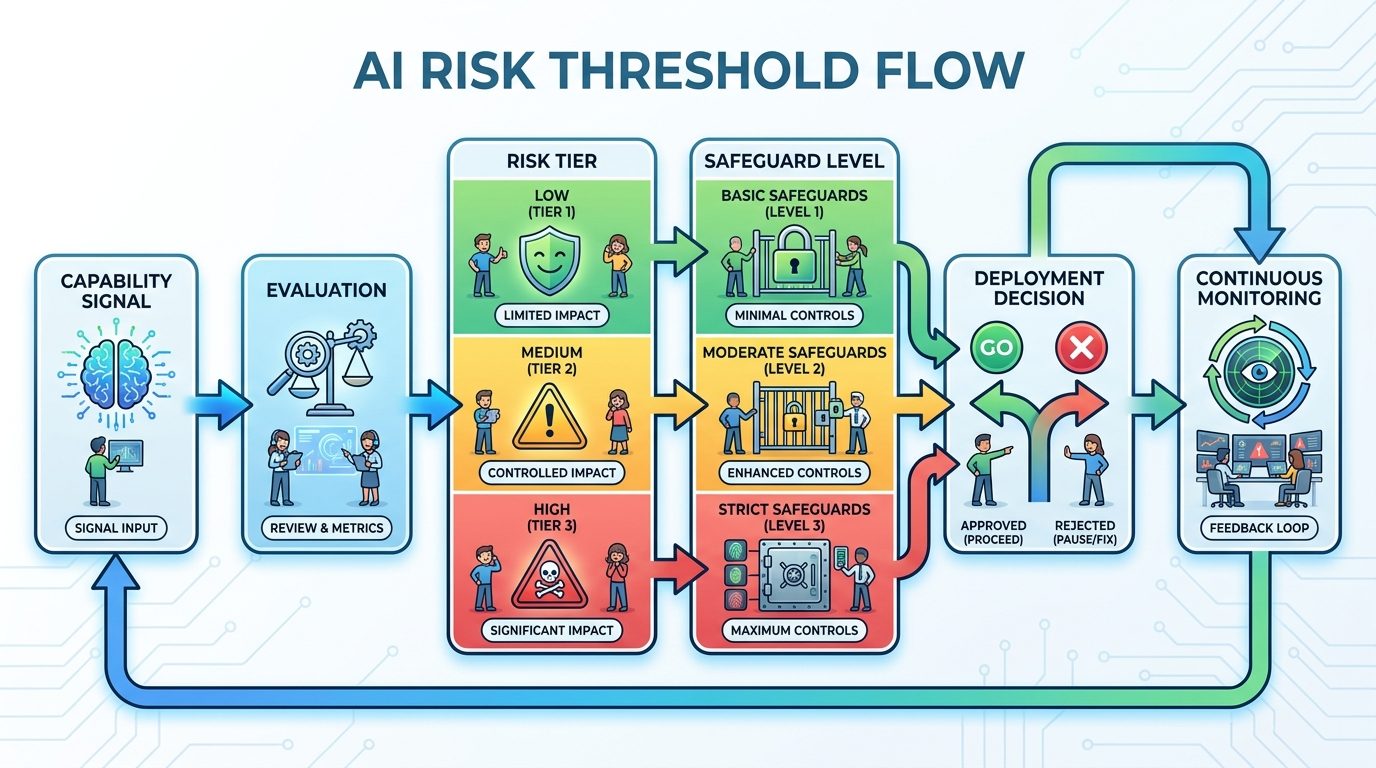
For readers who do not work inside a frontier lab, the simplest useful framework has six layers: define the domain, measure the capability, classify severity, choose safeguards, decide deployment scope, and monitor continuously. This structure works because it separates the evidence question from the action question. First ask what the system can do. Then ask what society, the lab, or the product team should do about it.
| Layer | Decision question | Example output |
|---|---|---|
| 1. Risk domain | Which class of harm or governance problem are we evaluating? | Cyber misuse, bio/chemical assistance, autonomous action, persuasion, privacy, critical infrastructure, self-improvement. |
| 2. Evaluation evidence | What tests, red-team exercises, expert reviews, or simulations show capability? | Benchmark results, adversarial testing, controlled task suites, external evaluator reports, incident traces. |
| 3. Threshold tier | How serious is the signal compared with pre-declared criteria? | Normal, heightened, high, severe, unacceptable without mitigation. |
| 4. Required safeguard | What must change before broader use? | Restricted access, stronger monitoring, tool limits, security hardening, human approval, external review, refusal training. |
| 5. Deployment decision | Can the model proceed, proceed with limits, or pause? | Limited pilot, staged rollout, no public release, research-only access, delayed training milestone. |
| 6. Ongoing monitoring | What evidence after release would reopen the decision? | Misuse reports, jailbreak patterns, tool-call failures, user feedback, new eval failures, capability jumps. |
This framework is intentionally plain. It does not require the reader to memorize every lab’s terminology. A company may call the tiers AI Safety Levels, preparedness categories, risk classes, or release gates. A regulator may use legal categories. A safety institute may use evaluation rubrics. The shared idea is that capability evidence should be connected to a stronger or weaker deployment decision.
The most important part is the pre-declared “if this, then that” link. If a model crosses a cyber threshold, what exactly happens? If an external evaluator finds a dangerous biological-assistance capability, who can overrule the launch plan? If a system begins completing longer autonomous tasks than expected, does the company reduce tool access, add human approval, or pause the rollout? If the answer is invented during the crisis, the threshold is too weak.
Risk Tiers: From Normal Controls to Pause Gates
Risk tiers help teams avoid both overreaction and underreaction. Not every model update needs a dramatic pause. Not every safety concern can be handled by a better terms-of-service page. A tiered system lets the response match the evidence.
A useful tier table should include more than a label. It should describe who owns the decision, which evidence is required, which safeguards are mandatory, and which deployment paths are forbidden. Without those details, risk tiers can become branding. With them, they become operational controls.
| Tier | Typical evidence | Minimum governance response |
|---|---|---|
| Normal | Expected model behavior, known failure modes, no dangerous capability signal under current tests. | Standard safety testing, abuse monitoring, documentation, model card or system card where appropriate. |
| Heightened | Early signs of risky capability, sensitive customer context, high-stakes workflow, or tool-enabled action. | Additional evals, red teaming, limited rollout, better observability, human approval for risky actions. |
| High | Reliable capability in a risky domain, significant autonomy, or potential for serious misuse if widely accessible. | Access limits, external expert review, stronger security, incident response plan, leadership sign-off. |
| Severe | Capability plausibly enables severe harm, irreversible harm, or loss of control under realistic conditions. | No broad deployment until mitigations are demonstrated; consider pause, containment, or independent assessment. |
This tiering approach is compatible with official frameworks without pretending to replace them. The article’s purpose is not to define a universal legal standard. It is to make the decision logic readable: stronger evidence of harmful capability should lead to stronger proof requirements before release.
Examples of Thresholds in Real Frontier AI Governance
Different organizations use different language, but several public sources show the threshold pattern. Anthropic’s Responsible Scaling Policy describes AI Safety Levels and says higher levels require stronger safety and security standards. Its examples include early dangerous capability signs, substantial increases in catastrophic misuse risk, and autonomous capabilities. OpenAI’s Preparedness Framework update describes tracked high-risk capability categories and criteria such as plausibility, measurability, severity, net-new risk, and instantaneous or irremediable harm. NIST’s AI RMF does not prescribe a frontier-lab release gate, but it provides a general risk-management structure around govern, map, measure, and manage functions.
The UK AI Safety Institute, now referenced through the UK government’s AI Security Institute pages, also reflects the evaluation-first approach. Its mission language emphasizes minimizing surprise from rapid AI advances, and its publications describe approaches to evaluating advanced systems. METR contributes another piece of the puzzle by studying model evaluation and threat research, including autonomous task-completion capability. The EU AI Act creates a legal context for AI governance and implementation, though a blog reader should distinguish law from voluntary lab policies and research evaluation practice.
These sources are not interchangeable. A company preparedness framework governs internal launch decisions. A government risk-management framework helps many organizations manage AI risk. A safety institute evaluates and researches advanced systems. A law creates obligations. A measurement lab studies capabilities. The data gap in much public content is that these are often mixed together. A clearer article should explain how they relate without flattening them.
What strong threshold systems do
- Define risk categories before launch pressure peaks.
- Connect specific evaluation results to specific safeguards.
- Escalate decisions when evidence becomes serious.
- Document why a model did or did not proceed.
- Monitor after deployment and reopen decisions when evidence changes.
What weak threshold systems do
- Use broad safety language with no decision trigger.
- Move goalposts after a risky capability appears.
- Rely only on internal optimism or public relations.
- Ignore tool access, autonomy, and deployment scale.
- Treat the absence of known incidents as proof of safety.
How Thresholds Change Deployment Decisions
Thresholds matter only if they change what happens next. If a model crosses a threshold and the launch plan remains identical, the threshold is decorative. A serious threshold can change release timing, access level, product surface, monitoring intensity, tool permissions, security controls, user eligibility, and the burden of proof placed on the team.
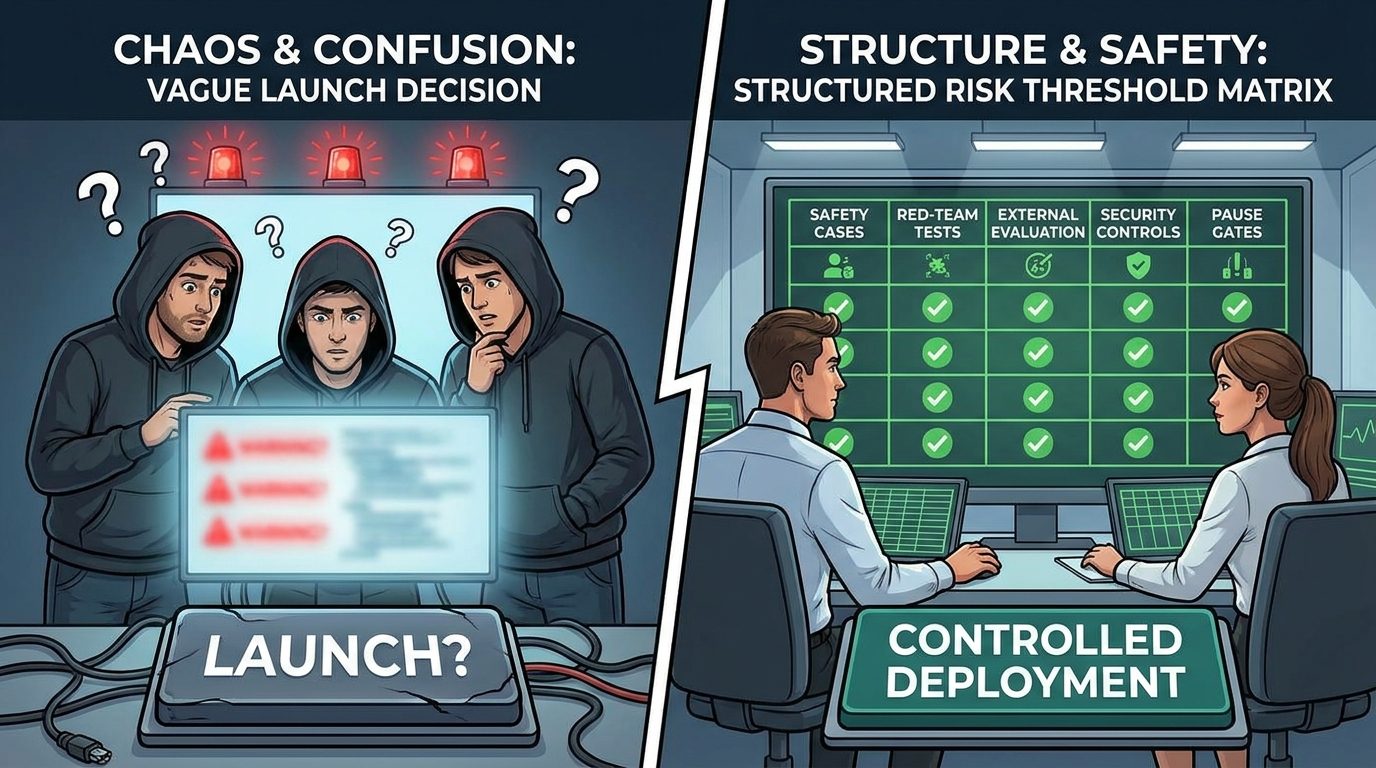
One common response is staged deployment. Instead of releasing a powerful model to everyone immediately, a lab may start with internal testing, trusted external evaluators, limited API access, selected enterprise partners, or constrained product modes. Staging reduces blast radius and gives the team time to observe misuse, jailbreak attempts, reliability problems, and unexpected capability patterns.
Another response is capability restriction. A system may be allowed to answer general questions but blocked from certain technical domains, tool actions, bulk operations, or sensitive workflows. For agentic systems, this can mean read-only tools before write tools, draft mode before execute mode, human approval before external communication, and audit trails for every high-risk action. The threshold does not have to block all use; it can block the riskiest form of use.
A third response is security hardening. If a model’s capability could increase catastrophic misuse or make it a high-value target, security around model weights, internal systems, deployment infrastructure, and staff access becomes part of the safety story. A model that is hard to misuse through the public interface may still create risk if stolen, fine-tuned, or deployed without controls.
The strongest response is a pause. A pause does not have to mean abandoning research forever. It can mean no public deployment until mitigations pass evaluation, no further scaling until safeguards catch up, no tool access until approval gates exist, or no release until external experts review the evidence. Pauses are politically and commercially hard, which is exactly why thresholds should be declared before they are needed.
Common Mistakes When People Talk About AI Risk Thresholds
The first mistake is treating thresholds as predictions. A threshold is not a prophecy about exactly what will happen. It is a decision rule under uncertainty. The question is not “Can we prove harm will occur?” The better question is “Is the evidence serious enough that proceeding without stronger safeguards would be irresponsible?”
The second mistake is searching for one universal number. Advanced AI risk is too multidimensional for a single score to carry the whole burden. Some risks depend on biology expertise, some on cyber capability, some on autonomy, some on scale, some on access, and some on social context. A simple numeric dashboard may help summarize evidence, but it should not replace domain-specific evaluation.
The third mistake is ignoring deployment context. The same model can have different risk profiles depending on who can use it, whether it has tools, whether outputs are monitored, whether users are authenticated, whether rate limits exist, and whether harmful requests are blocked. Capability matters, but exposure turns capability into real-world risk.
The fourth mistake is assuming internal review is always enough. Internal teams have context, but they also have incentives, blind spots, and launch pressure. External evaluators, red teams, independent researchers, government safety institutes, and public documentation can improve trust when the risk is high enough. Not every product update needs external review, but severe thresholds should make the case for it stronger.
The fifth mistake is confusing compliance with safety. A legal requirement may set a floor, not a ceiling. A company can comply with a rule and still make a poor deployment decision if the system crosses a serious capability threshold that the law does not yet capture. Responsible governance should treat law, internal policy, technical evaluation, and public accountability as complementary layers.
A Threshold Checklist for Readers, Policymakers, and Builders
Most readers are not setting policy inside a frontier lab. But anyone can use a threshold checklist to read AI announcements more critically. When a company announces a more capable model, do not ask only whether the demo is impressive. Ask what evidence would change the release plan.
| Question | Why it matters | What a stronger answer looks like |
|---|---|---|
| What risky capabilities were evaluated? | Generic testing can miss domain-specific danger. | Named categories such as cyber, bio/chemical, autonomy, persuasion, privacy, or tool misuse. |
| Who evaluated the model? | Internal testing alone may not catch everything. | Combination of internal teams, external experts, red teams, and independent or government evaluators where appropriate. |
| What threshold would trigger stronger controls? | Safety claims need decision rules. | Clear criteria tied to safeguards, access limits, monitoring, or pause gates. |
| How is deployment staged? | Broad release increases exposure quickly. | Limited rollout, access tiers, rate limits, monitoring, and incident response. |
| What happens after release? | Risk changes when real users interact with the system. | Continuous monitoring, abuse response, model updates, public documentation, and re-evaluation triggers. |
For builders, the threshold mindset also applies to smaller AI systems. If your agent can send email, change records, run code, access private data, browse websites, or publish content, define your own thresholds. A customer-support agent may need approval before refunds. A coding agent may need approval before destructive shell commands. A research agent may need source validation before publishing claims. The scale is different, but the governance pattern is similar.
For policymakers, thresholds provide a bridge between broad principles and operational accountability. Instead of only saying AI should be safe, policymakers can ask which capabilities require notice, evaluation, reporting, security controls, incident disclosure, or restrictions. The hard part is setting rules that are specific enough to matter but flexible enough to adapt as the science changes.
Related Singularity Journey Guides
- AGI Readiness Framework — how to read the signals before AI becomes too powerful.
- AGI Warning Signs — a practical checklist for frontier capability signals.
- AI Capability Evaluations Explained — how frontier systems are tested before release.
- AI Risk Register: NIST AI RMF Checklist — a practical risk-management structure.
- AI Guardrails Explained — how safeguards prevent mistakes, misuse, and runaway actions.
Sources and References
- Anthropic: Responsible Scaling Policy
- OpenAI: Updated Preparedness Framework
- NIST AI Risk Management Framework
- UK AI Safety Institute / AI Security Institute resources
- METR: Model Evaluation and Threat Research
- EU Artificial Intelligence Act resource
External references were checked for relevance and credibility. Broken or uncertain links were excluded from the final source list.
FAQ: AI Risk Thresholds
What is an AI risk threshold?
An AI risk threshold is a pre-defined decision point that says when a model’s capability, exposure, autonomy, or misuse potential requires stronger safeguards, deeper evaluation, restricted deployment, external review, or a pause.
Are AI risk thresholds the same as AI regulation?
No. Regulation can require certain controls, but thresholds can also exist inside company policies, safety frameworks, evaluation programs, product governance, or research protocols. Good governance often combines law, internal policy, technical evaluation, and public accountability.
Who should set AI risk thresholds?
Thresholds should involve technical experts, safety researchers, security teams, product leaders, legal and policy specialists, independent evaluators where appropriate, and public authorities for high-impact systems. The more severe the risk, the less credible a purely internal process becomes.
What happens when a model crosses a risk threshold?
The response should be defined before the threshold is crossed. It may include additional evaluations, limited access, stronger monitoring, tool restrictions, security hardening, human approval gates, external review, delayed deployment, or a pause.
Can thresholds eliminate AI risk?
No. Thresholds do not make AI risk disappear. They make risk decisions more explicit, evidence-based, reviewable, and harder to ignore when capability increases.
Why not wait until harm happens?
Some AI harms could be fast, scalable, or difficult to reverse. For frontier systems, the responsible moment to respond is often before broad deployment, especially when evaluations show plausible severe-harm capability.
Conclusion: Thresholds Turn AI Safety Into a Decision System
The strongest argument for AI risk thresholds is not that they solve every safety problem. They do something more basic and more necessary: they force powerful AI decisions into the open. They ask what evidence matters, what response follows, who owns the decision, and when the system must stop moving faster than its safeguards.
As AI systems become more capable, society will need more than impressive demos and reassuring statements. It will need evaluation evidence, staged releases, security controls, red-team findings, monitoring, human oversight, and pause gates that are clear enough to be trusted. Thresholds are the connective tissue between those pieces.
For readers tracking the path toward more general and autonomous AI, the key question is simple: when a lab says a system is safe enough to release, what threshold did it use, and what would have made it say no?
