
Autonomous AI Agents and Human Control: The Governance Blueprint for the Singularity Path
A practical governance blueprint for autonomous AI agents: authority limits, risk tiers, tool permissions, memory boundaries, approvals, audit logs, and escalation.
Quick answer: autonomous AI agents need a control system, not blind trust
Autonomous AI agents are AI systems that can pursue goals by planning steps, using tools, calling APIs, reading context, writing outputs, and sometimes taking actions across software. They are more powerful than ordinary chatbots because they can move from advice to execution. That is also why they need governance.
The practical question is not whether every AI agent should be banned or trusted. The useful question is: what level of autonomy is safe for this task, this tool, this data, this user, and this organization? A calendar-scheduling agent does not need the same controls as a finance agent. A read-only research agent does not need the same approval path as an agent that can send messages, modify customer records, deploy code, or transfer money.
This article gives you a governance blueprint for the Singularity Path: how to think about agent autonomy before it becomes invisible infrastructure inside companies, products, and daily life.
Why autonomous AI agents are a Singularity Path issue
AI agents matter because they shift AI from answering questions to shaping outcomes. A chatbot gives you a response. An autonomous agent can inspect files, choose tools, update a spreadsheet, open a support ticket, draft a pull request, summarize a customer history, schedule a meeting, or trigger a workflow. The more tools an agent can use, the more it starts to resemble a small digital worker embedded inside software.
That shift is exciting. It can remove repetitive work, speed up research, improve customer support, and help teams operate with less friction. But it also creates a new control problem. Traditional software follows fixed rules written by humans. AI agents operate through probabilistic reasoning, retrieved context, tool selection, and iterative planning. They may produce impressive results, but they can also misunderstand goals, overreach, use stale memory, follow bad instructions from untrusted content, or act before a human realizes the risk.
This is why autonomous agents belong on the Singularity Path. They are not artificial general intelligence by themselves, but they are a step toward more capable, stateful, tool-using AI systems. If society learns to govern agents well, we build habits that matter for more powerful systems later. If we normalize uncontrolled autonomy now, we create weak defaults at exactly the wrong layer.
Analytics from Singularity Journey also supports this direction. Recent GA4 data shows attention around enterprise AI agents, AI agent alignment, MCP security, observability, memory controls, and human approval. Search Console data is still sparse for the young site, but the ranking-distance signals around MCP and agent terms suggest that stronger governance pillars can support the existing cluster. The opportunity is clear: readers need a practical bridge between AI safety frameworks and real agent operations.
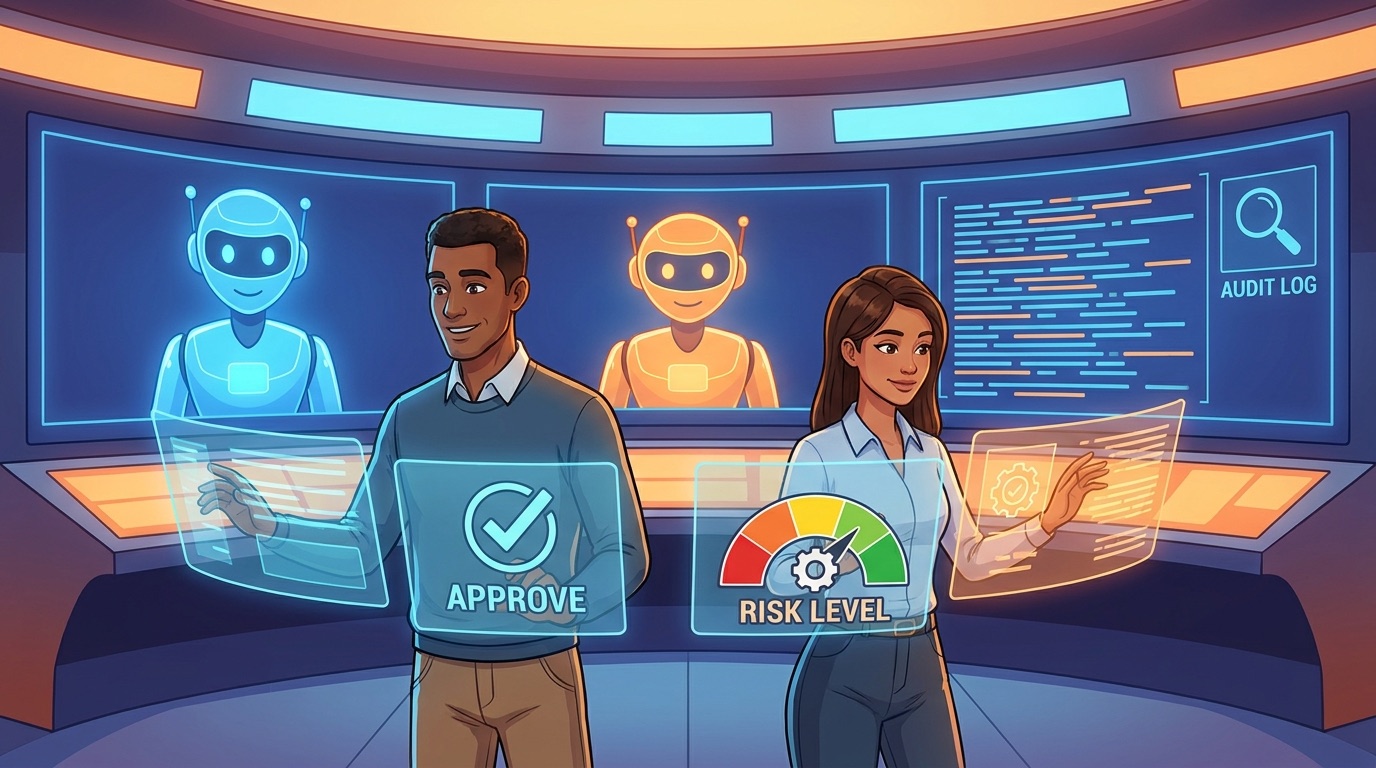
What counts as an autonomous AI agent?
An autonomous AI agent is not defined only by having a friendly chat interface. The important feature is delegated action. The system receives a goal, reasons about what to do, uses context, selects tools, and executes steps with some degree of independence.
Autonomy exists on a spectrum. A simple assistant that suggests a reply has low autonomy. An agent that drafts the reply and waits for approval has moderate autonomy. An agent that sends the reply, updates the CRM, schedules a follow-up, and changes the customer status has higher autonomy. The same model can be safe or dangerous depending on the tools connected to it and the authority granted to it.
| Level | Agent behavior | Example | Human control needed |
|---|---|---|---|
| Level 0: advice only | Answers or recommends, but cannot act | Explains a policy or drafts an outline | Normal review for accuracy |
| Level 1: draft with approval | Prepares an action for human confirmation | Drafts an email or pull request | Human approves before external effect |
| Level 2: bounded execution | Acts within narrow limits | Labels tickets or updates low-risk fields | Permissions, logs, rollback, sampling review |
| Level 3: multi-step workflow | Plans and executes across tools | Researches vendors, updates sheet, sends summary | Risk tiers, checkpoints, escalation, audits |
| Level 4: high-impact autonomy | Can affect money, rights, safety, production systems, or reputation | Approves loans, changes medical guidance, deploys code, transfers funds | Strict governance, human authority, testing, monitoring, legal review |
The mistake many teams make is treating agent autonomy as a product feature instead of an authority model. If an agent can act, someone has delegated power to it. Governance starts by naming that delegation clearly.
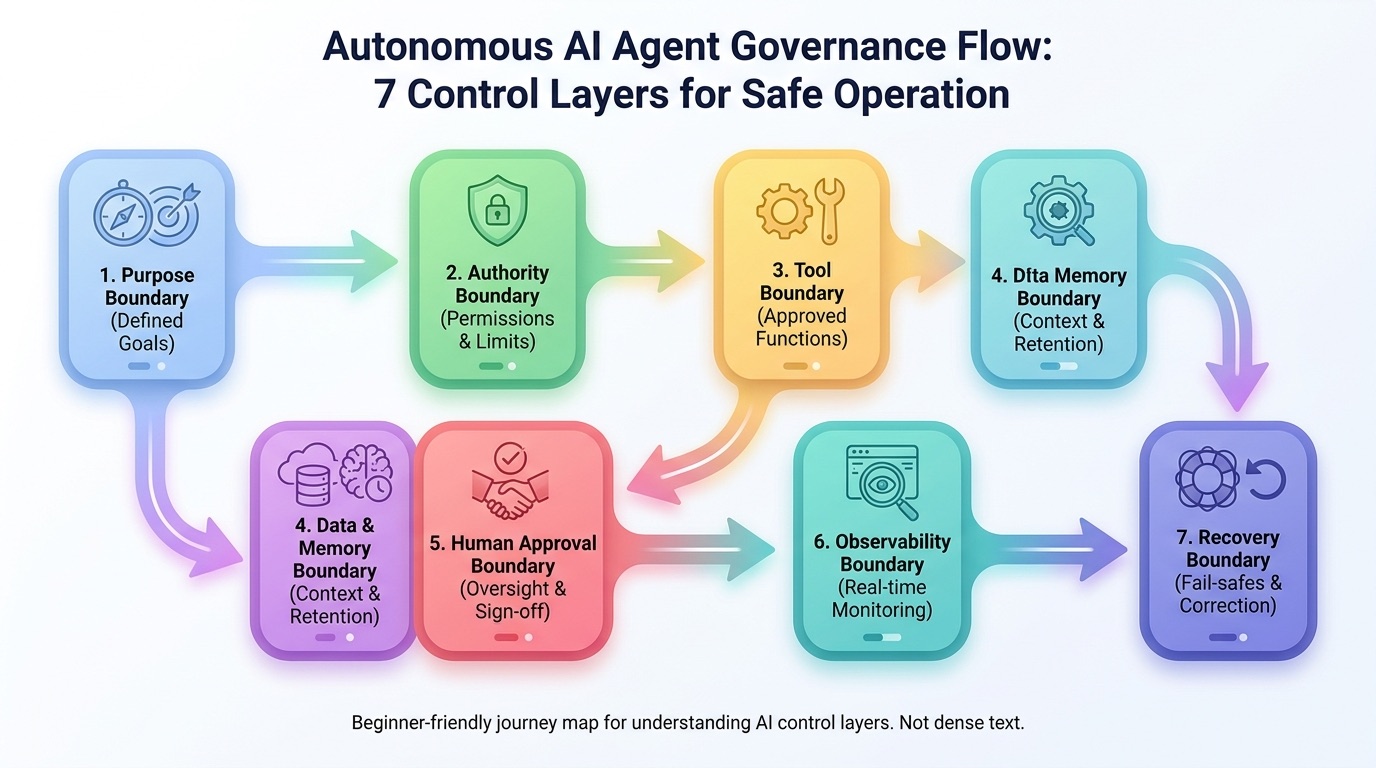
The governance blueprint: seven control layers
A useful governance blueprint has seven layers. Each layer answers a different question. Together, they create a practical system for keeping agents useful without giving them uncontrolled power.
1. Purpose boundary
What is the agent for? A safe agent has a narrow mission. “Help the support team summarize tickets” is governable. “Handle customers” is too vague. Purpose boundaries prevent an agent from expanding its own role through convenience.
2. Authority boundary
What is the agent allowed to decide? What must it ask about? Authority boundaries define the difference between recommendation, draft, low-risk action, and high-risk action. They should be written in operational language, not abstract values.
3. Tool boundary
Which tools can the agent use, with what scopes, for how long, and under whose identity? Tool access is where AI governance becomes concrete. A read-only analytics tool is very different from a database write tool. A local file search tool is different from a public-posting tool.
4. Data and memory boundary
What information can the agent see, remember, retrieve, and reuse? Memory makes agents more useful, but it can also preserve wrong, sensitive, or outdated information. Strong memory governance includes visibility, deletion, correction, retention limits, and source separation.
5. Human approval boundary
Which actions require explicit approval? Human-in-the-loop control should not be random. Approval should be triggered by risk: external communication, financial impact, legal exposure, production changes, sensitive data, uncertain confidence, or policy conflicts.
6. Observability boundary
Can humans reconstruct what the agent saw, decided, used, and changed? If not, the system is not governable. Logs, traces, tool-call records, memory references, and approval events are the black box recorder for agent operations.
7. Recovery boundary
What happens when the agent is wrong? Governance is incomplete without rollback, incident response, user notification, and escalation. The question is not whether failures will happen. The question is whether failure is contained.
Risk tiers for autonomous AI agents
Not every agent action deserves the same review. If every tiny action requires manual approval, the agent becomes useless. If no action requires approval, the system becomes reckless. Risk tiers solve this by matching controls to consequences.
| Risk tier | Examples | Default control | Escalation trigger |
|---|---|---|---|
| Read-only | Search docs, summarize public pages, inspect internal knowledge | Permissioned access and citations | Sensitive or restricted data appears |
| Draft-only | Draft email, draft policy summary, draft code change | Human review before sending or merging | Legal, financial, safety, or reputational content |
| Low-impact write | Add labels, update notes, create internal task | Bounded permissions, logs, sampling review | Bulk action, unusual pattern, low confidence |
| Medium-impact workflow | Update CRM stage, schedule meetings, trigger internal workflow | Checkpoints, rollback, approval for exceptions | Customer impact, private data, policy conflict |
| High-impact action | Send external commitments, deploy production code, approve payments, affect access or rights | Explicit human approval and audit trail | Always escalated unless pre-approved by strict policy |
| Prohibited action | Bypass security, hide logs, impersonate users, make final high-stakes decisions without review | Blocked by design | Incident response if attempted |
This risk-tier approach is compatible with broader frameworks such as the NIST AI Risk Management Framework and risk-based regulation like the EU AI Act. Those frameworks do not replace practical controls. They give teams a language for mapping, measuring, managing, and governing risk.
Human control is more than human-in-the-loop
Many teams say “we have human-in-the-loop” as if that solves governance. It does not. A tired human clicking approve on a vague summary is not meaningful oversight. Human control must be designed so the person can understand the decision, review the evidence, change the outcome, and stop the workflow.
Good human control has four properties. First, the human is placed before the irreversible action, not after it. Second, the system shows what matters: goal, proposed action, sources, tool calls, risk tier, confidence, and alternatives. Third, the reviewer has real authority to reject, edit, or escalate. Fourth, the review burden is realistic. If the agent generates too many approvals, people will rubber-stamp them.
For low-risk tasks, sampling review may be enough. For medium-risk tasks, checkpoints and exception review may work. For high-impact tasks, explicit approval should be mandatory. For prohibited tasks, the agent should not even have the tool access required to attempt them.
Tool permissions: where agent governance becomes real
Tool access is the most important control surface for autonomous agents. A language model without tools can still be wrong, but its direct impact is limited to words. A model with tools can affect systems. The risk changes immediately.
Modern agent architectures increasingly connect models to databases, browsers, calendars, code repositories, communication apps, payment systems, and internal APIs. Protocols and platforms that simplify tool access are useful because they make integration easier. They also make governance more urgent because each connector becomes a possible action path.
Permissions should be scoped by action type, data type, user role, time window, and environment. An agent may be allowed to read support tickets but not export them. It may be allowed to create a draft invoice but not send it. It may be allowed to open a pull request but not merge it. It may be allowed to run tests in staging but not deploy to production.
| Permission design question | Safer answer |
|---|---|
| Can the agent use all tools by default? | No. Start with least privilege. |
| Can read tools and write tools share the same policy? | No. Writes need stronger controls. |
| Should the agent act under a human's full identity? | Avoid broad impersonation. Use scoped service identities where possible. |
| Should tool access expire? | Yes for sensitive workflows and temporary tasks. |
| Should tool calls be logged? | Yes. Tool logs are essential for debugging and accountability. |
Memory and data boundaries
Autonomous agents become more capable when they remember. They can preserve user preferences, project rules, prior decisions, and task history. But memory also creates a second-order risk: the agent may carry forward bad context into future actions.
Memory governance should answer five questions. What can be remembered? Who can see it? How is it retrieved? How is it corrected? When is it deleted? If those questions are unclear, the agent may become personalized in ways that users cannot inspect or control.
Separate trusted memory from untrusted content. A user preference saved deliberately is different from a hidden instruction inside a webpage. A company policy document is different from a forum comment. A verified customer record is different from an AI-generated summary of that record. Agents need source labels and trust boundaries, not one giant bucket of context.
This is also where privacy and security meet. The OWASP GenAI Security Project highlights risks for LLM applications and agentic systems, including the kinds of vulnerabilities that become more serious when agents can retrieve data and use tools. Memory poisoning, prompt injection, excessive agency, sensitive information disclosure, and weak access controls are not abstract concerns. They are practical design failures that can be reduced with boundaries.
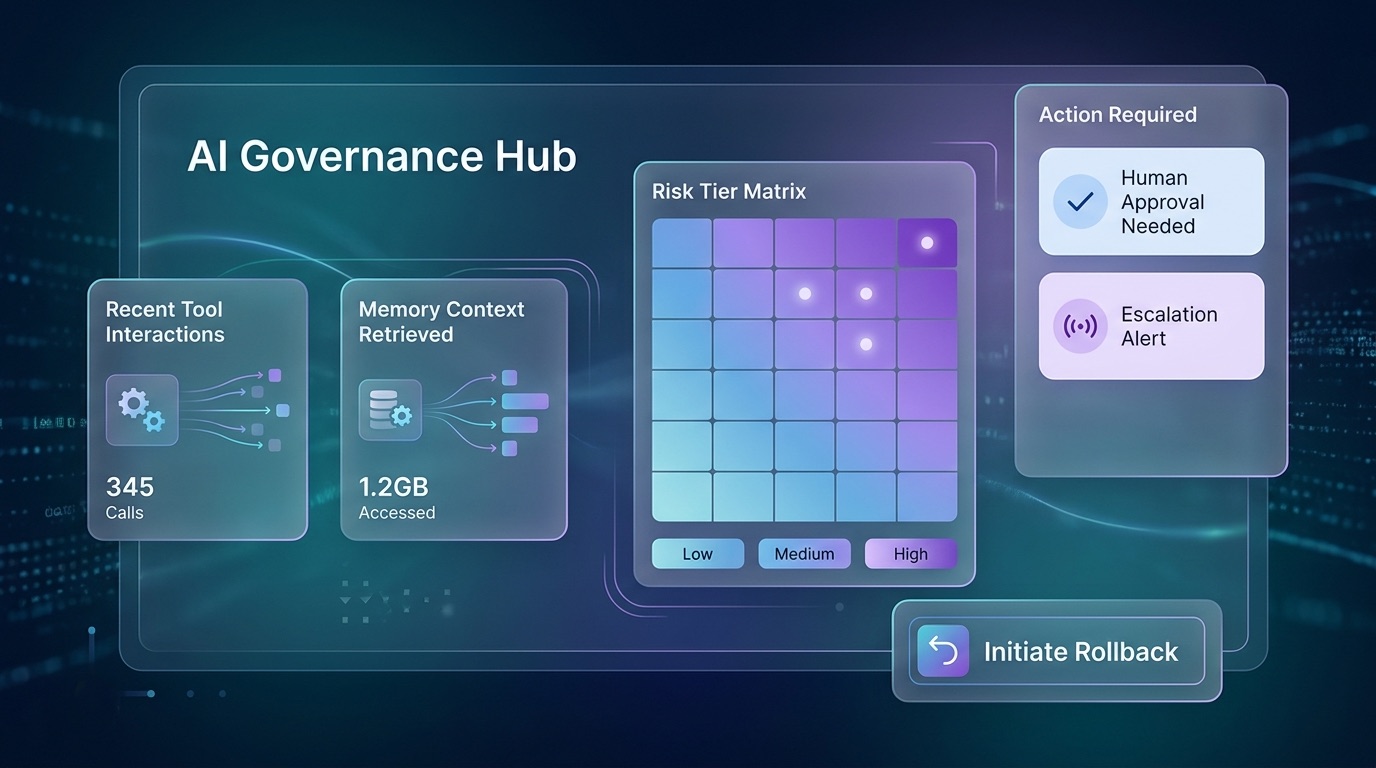
What should be logged for agent audits?
If an autonomous agent affects real systems, audit logs are not optional. Logs make it possible to debug failures, prove review, detect abuse, and improve the system. But logs must be useful. A folder full of raw transcripts is not enough.
| Audit field | Why it matters |
|---|---|
| Agent goal | Shows what the agent was asked to accomplish |
| User or system initiator | Identifies who delegated the task |
| Risk tier | Explains why a control path was chosen |
| Context and sources used | Shows what information influenced the agent |
| Memory retrieved | Reveals whether old context affected the decision |
| Tool calls | Records what systems were touched |
| Approvals and reviewers | Proves human control for sensitive actions |
| Final output or action | Captures what changed |
| Errors, retries, and rollbacks | Supports incident response and reliability improvement |
Strong observability turns agent governance from a policy document into an operational practice. It is the difference between “we hope the agent behaved” and “we can reconstruct what happened.”
How existing AI frameworks fit agent governance
You do not need to invent governance from scratch. Existing frameworks provide useful building blocks, but they must be translated into agent operations.
NIST AI Risk Management Framework
The NIST AI RMF is useful because it emphasizes governing, mapping, measuring, and managing AI risk. For agents, this means defining the context of use, identifying who can be harmed, measuring reliability and security, and managing risk through controls that can be monitored.
EU AI Act risk thinking
The EU AI Act uses a risk-based approach. Even if a specific agent does not fall into a regulated high-risk category, the mindset is valuable: the higher the potential impact on people, rights, safety, or access to services, the stronger the oversight should be.
ISO/IEC 42001 management-system thinking
AI management-system standards encourage organizations to manage AI with roles, policies, processes, documentation, and continuous improvement. For agents, this means governance cannot live only in a prompt. It must live in process design, access control, review cadence, and accountability.
OWASP GenAI security guidance
OWASP is especially relevant for builders because agent systems combine model behavior with application security. Prompt injection, excessive agency, sensitive data exposure, insecure plugins, and weak monitoring all become more serious when an agent has tools.
A practical rollout plan for autonomous AI agents
If you are introducing autonomous agents into a team, do not begin with the most powerful version. Begin with a controlled rollout.
Phase 1: read-only assistant
Start with summarization, search, classification, and advice. This tests relevance and usefulness without giving the agent write power. Measure accuracy, hallucination patterns, source quality, and user trust.
Phase 2: draft-only agent
Let the agent prepare work but require a human to approve it. This is ideal for emails, reports, code changes, support replies, research briefs, and workflow plans. Track how often humans edit, reject, or accept outputs.
Phase 3: bounded low-risk execution
Allow narrow writes that can be reversed. Examples include tagging tickets, creating internal tasks, formatting documents, or updating non-sensitive fields. Add audit logs and sampling review.
Phase 4: supervised multi-tool workflow
Let the agent coordinate across tools, but add checkpoints. The agent can gather context, draft actions, ask for approval at risk gates, and execute only within defined scopes.
Phase 5: high-impact workflow with strict controls
Only after evaluation should agents touch high-impact systems. Require formal risk review, testing, approval flows, monitoring, rollback plans, and legal or compliance input where appropriate.
This rollout keeps innovation moving while avoiding the false choice between “no agents” and “agents everywhere.”
Common governance anti-patterns
The fastest way to lose control is to treat agent governance as a prompt-writing problem. Prompts matter, but they are not enough.
Risky patterns
- Giving agents broad tool access before defining risk tiers.
- Relying on “ask if unsure” instead of explicit approval triggers.
- Letting agents remember sensitive details without review or deletion.
- Logging only final outputs, not tool calls and retrieved context.
- Using one governance policy for every task and department.
- Allowing external content to influence long-term memory without trust checks.
Better patterns
- Start with least privilege and expand only after evaluation.
- Define read, draft, write, and high-impact actions separately.
- Use visible memory with correction and deletion controls.
- Trace tool calls, approvals, memory use, and final actions.
- Review incidents and update procedures after failures.
- Design escalation paths before deploying agents to real workflows.
Autonomous AI agent governance checklist
Use this checklist before deploying an agent that can use tools or act across systems.
- Define the agent's purpose in one sentence.
- List every tool the agent can use.
- Separate read, draft, write, and destructive actions.
- Assign a risk tier to each action.
- Define which actions require human approval.
- Set memory rules: what can be saved, retrieved, corrected, and deleted.
- Use least-privilege permissions.
- Require citations or source references where factual accuracy matters.
- Log prompts, tool calls, retrieved memory, approvals, and final actions.
- Test prompt injection and memory poisoning scenarios.
- Create rollback and incident response procedures.
- Review performance and failures on a regular cadence.
What this means for the future of AI and human control
The future will not be defined only by smarter models. It will be defined by how those models are connected to tools, data, institutions, and human decisions. Autonomous agents are the bridge between model capability and real-world impact.
That bridge can be designed well. Agents can reduce busywork, support experts, improve accessibility, and help people manage complex information. But the same bridge can also create hidden automation, unclear accountability, and fragile dependence if agents operate without boundaries.
The most important governance principle is simple: capability should not automatically become authority. Just because an AI system can write an email, change a database, deploy code, or recommend a decision does not mean it should have permission to do so without review.
The Singularity Path is not about predicting a single dramatic moment. It is about noticing the step-by-step transfer of agency from humans to machines. Autonomous AI agents are one of those steps. The right response is neither panic nor blind acceleration. The right response is deliberate control.
Final recommendation: build control before autonomy scales
If your organization is experimenting with autonomous agents, build the control layer now. Do not wait until agents are embedded in every workflow. Retrofitting governance after people depend on automation is harder, slower, and politically messier.
Start small. Use read-only agents. Move to draft-only workflows. Add bounded execution. Log everything important. Create risk tiers. Make approvals meaningful. Give users memory controls. Test failures. Review incidents. Improve the system.
Autonomous AI agents can be genuinely useful. They can also become dangerous if authority expands faster than oversight. Human control is not a slogan. It is an architecture.
The organizations that get this right will not be the ones that simply deploy the most agents. They will be the ones that know exactly what their agents are allowed to do, why they are allowed to do it, how humans can intervene, and how the system learns from mistakes without hiding them.
Keep learning on Singularity Journey
- AI Agent Alignment Explained — how to keep autonomous systems aligned with human goals.
- Enterprise AI Agent Control Plane — a blueprint for permissions, audits, and operations.
- AI Agent Controls Explained — tools, memory, permissions, and human approval.
- Human Approval for AI Agents — when to ask, what to review, and how to escalate.
- AI Agent Observability — trace, evaluate, and debug production agents.
- MCP Tool Risk Tiers — classify read, write, and destructive agent actions.
Sources and references
- NIST AI Risk Management Framework
- EU AI Act high-level summary
- OWASP Top 10 for Large Language Model Applications and GenAI Security Project
- Anthropic: Introducing the Model Context Protocol
- ISO/IEC 42001 AI management system standard
This article uses public frameworks and operational reasoning rather than unsupported statistics. Governance requirements vary by jurisdiction, sector, and use case; high-impact deployments need legal, security, and compliance review.
FAQ: autonomous AI agents and human control
What are autonomous AI agents?
Autonomous AI agents are AI systems that can pursue goals by planning steps, using tools, retrieving context, and executing actions with some degree of independence. Their risk depends on what tools and authority they have.
Why do autonomous AI agents need governance?
They need governance because they can affect real systems. Without boundaries, an agent may misuse tools, expose data, follow bad instructions, act on stale memory, or create outcomes no human intended.
What is human-in-the-loop control?
Human-in-the-loop control means a human reviews or approves certain agent actions. It is most useful when approvals happen before irreversible actions and reviewers receive enough context to make a real decision.
How should AI agent permissions work?
Agent permissions should follow least privilege. Separate read, draft, write, destructive, and high-impact actions. Scope access by user, role, tool, data type, environment, and time window.
What should be logged for AI agent audits?
Important logs include the agent goal, initiator, risk tier, context used, memory retrieved, tool calls, approvals, final action, errors, retries, and rollback events.
Can autonomous AI agents be safely deployed?
They can be deployed more safely when autonomy is introduced gradually, risk tiers are clear, high-impact actions require human approval, tools are permissioned, memory is controlled, and observability is strong.
