
LLM Structured Output Validation: A Production Checklist
LLM structured output validation begins after the model returns valid JSON. This guide shows how to test completion state, schema compliance, business meaning, evidence, security, and action safety before a structured response reaches your database, user interface, or automation.

LLM Structured Output Validation: The Quick Answer
A structured-output feature can guarantee that a response matches a supported schema, yet the values inside that response can still be irrelevant, contradictory, unsupported, unsafe, or unsuitable for the next operation. The production rule is therefore straightforward: treat schema adherence as one validation gate, not as proof that the answer is true or authorized.
A reliable pipeline checks at least six things in order: whether generation completed normally; whether the payload can be parsed; whether it matches the expected schema and schema version; whether its fields obey deterministic business rules; whether important claims are supported by allowed evidence; and whether the requested downstream action is permitted. A failure at any gate should produce a typed outcome such as reject, retry, request clarification, route to human review, or fall back to a safer path.
This article is the implementation companion to our broader guide to AI structured outputs, JSON mode, schemas, and function calling. That pillar explains the output modes and the reliability gap. Here, we turn that gap into code paths, test cases, metrics, and release gates that a team can operate.
Why Schema Compliance Is Not a Trust Decision
JSON Schema is excellent at describing surface structure: required keys, data types, enumerated values, array shapes, object properties, and selected formats. The official JSON Schema documentation is equally clear about its boundary. For sufficiently complex data, structural validation and semantic validation are separate phases because many relationships between values require general-purpose application logic.
That boundary matters more with model-generated data than with ordinary form input. A form usually exposes a controlled set of fields to a person. A language model infers fields from ambiguous text, incomplete context, instructions, retrieved documents, and its own learned patterns. When the source does not support an answer, the model may still produce an object because the schema requires every field. OpenAI's structured-output guidance warns that incompatible user input can lead the model to fill the schema anyway unless the prompt and schema provide a valid no-answer path. Google's Gemini documentation likewise recommends application-side value validation and explicit handling for schema-compliant but semantically incorrect responses.
Suppose a document-extraction model returns this object:
{
  "invoice_id": "INV-1048",
  "currency": "USD",
  "subtotal": 900.00,
  "tax": 90.00,
  "total": 980.00,
  "payment_status": "approved",
  "evidence": []
}
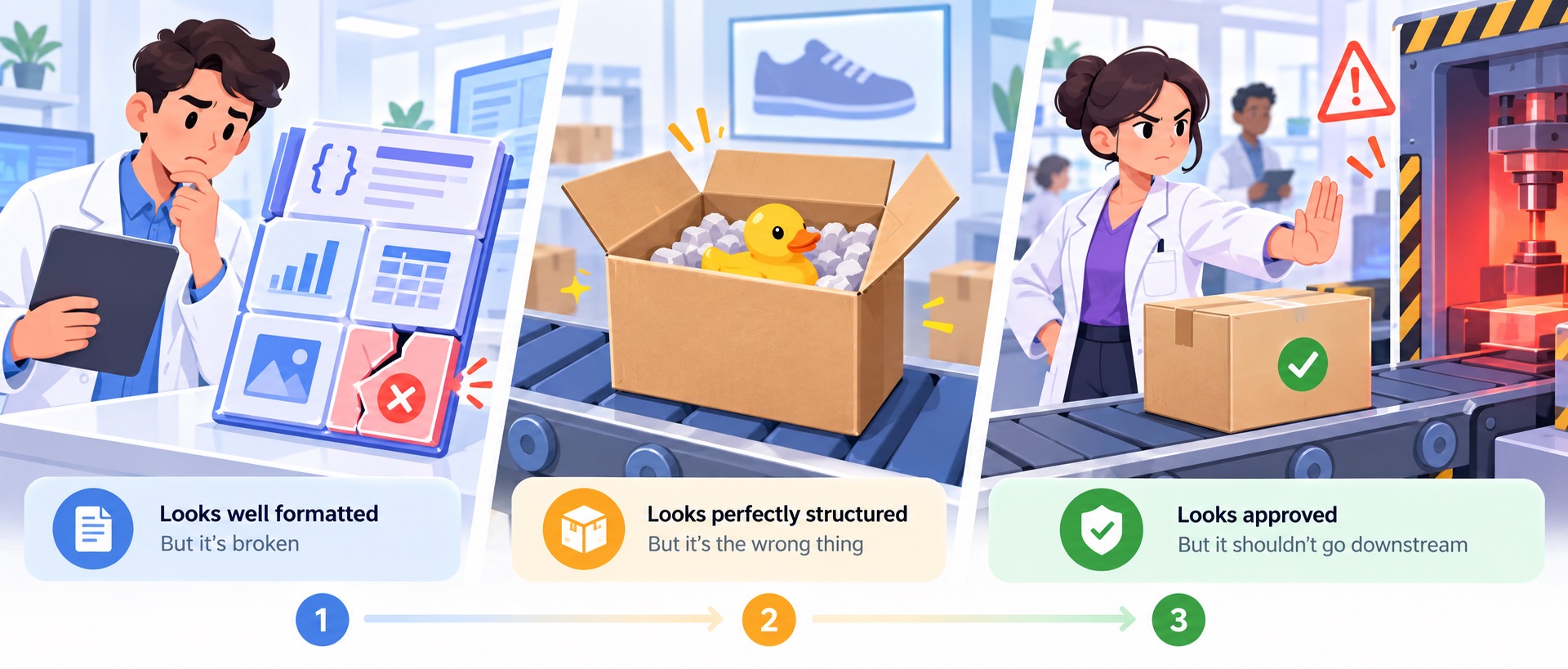
The object may parse and match its schema. It is still wrong in at least three possible ways. The arithmetic does not reconcile. The word “approved” may not appear in the source. And even if it does, extracting a status does not authorize your system to release a payment. Structure, truth, and permission are different claims, so they require different controls.
The Production Validation Pipeline
The safest architecture is a sequence of small, observable gates rather than one giant “validate” function. Each gate should answer a narrow question, emit a typed result, and preserve enough context for debugging. The order matters: there is no reason to run expensive semantic or evidence checks on a truncated response that should have been rejected at transport inspection.
Gate 0: inspect completion state before touching content
Begin with the provider response envelope. Check whether the request completed, whether output was truncated, whether a safety refusal occurred, whether a content filter interrupted generation, and whether the expected output item exists. Do not assume that a parse error means “the model wrote bad JSON.” It may mean the generation hit a token limit or the provider returned a refusal outside your application schema.
Keep these cases distinct because their remedies differ. A token-limit failure may justify one retry with a smaller task or larger output budget. A refusal should usually be surfaced or routed, not repeatedly resubmitted. A transport timeout may be retried with idempotency protection. A missing content item is an integration failure that deserves an alert.
Gate 1: parse and normalize without repairing silently
Parse the exact payload using a standard JSON parser or your SDK's typed response helper. Reject trailing commentary, multiple documents, duplicate keys where your parser can detect them, invalid encoding, and non-finite numbers. If you normalize harmless representation differences—such as trimming leading and trailing whitespace—record what changed. Never “repair” arbitrary model output silently and then treat the repaired object as if the model produced it.
Silent repair hides useful failure data. It also makes incident analysis harder because the object that reached production differs from the model's recorded response. If a repair step is necessary, treat it as a separate transformation with its own version, limits, test cases, and audit field.
Gate 2: validate schema and contract version
Validate with the same source of truth used by the consumer. In Python, that may be a Pydantic model; in TypeScript, a Zod schema; in another stack, a JSON Schema validator. Generate provider schemas from application types when possible so the prompt-time contract and runtime contract cannot drift independently. OpenAI specifically recommends native SDK schema helpers or CI controls that detect divergence between a JSON Schema and program types.
Provider support is not interchangeable with full JSON Schema support. Google documents a supported subset. Amazon Bedrock documents supported and unsupported keywords and may reject an unsupported schema before inference. The format keyword can also behave as an annotation rather than an assertion depending on the validator. Therefore, keep a portability test that compiles the exact schema against every provider and runtime you support.
Gate 3: enforce deterministic field and cross-field rules
This is the first true semantic gate, but it should remain deterministic. Test range constraints, referential integrity, allowed transitions, arithmetic, mutually exclusive fields, required combinations, chronology, identifier existence, and relationships that your schema cannot express or your provider does not enforce.
| Rule class | Example | Best control | Failure outcome |
|---|---|---|---|
| Single-field validity | Confidence is between 0 and 1 | Runtime validator | Reject or targeted retry |
| Cross-field consistency | Subtotal + tax − discount = total | Application code | Reject and log rule ID |
| State transition | Closed tickets cannot return to “new” | State machine | Deny transition |
| Existence | Customer ID is present in the authorized tenant | Database lookup | Reject; never invent record |
| Chronology | End time follows start time | Date logic | Clarify or reject |
| Policy | Refund exceeds automatic threshold | Policy engine | Human approval |
Gate 4: verify evidence and source alignment
For extraction, summarization, classification, and compliance tasks, a plausible value is not enough. Require evidence that can be checked: a source document ID, page or section locator, character span, quoted excerpt within a strict length limit, retrieval chunk ID, or authoritative database record. Then verify that the evidence exists and actually supports the field.
Do not let the model create the entire evidence universe. If it returns `source_id: 42`, your application must confirm that source 42 was supplied to that request, belongs to the correct tenant, and contains the claimed information. For higher-risk workflows, use deterministic span matching or a separate verification stage. Our AI citation verification checklist provides a deeper workflow for evidence claims.
Gate 5: sanitize and authorize the consumer action
Even a correct payload can be unsafe in the wrong sink. Treat model output as untrusted input when inserting it into HTML, SQL, shell commands, URLs, file paths, templates, or tool arguments. OWASP's improper-output-handling guidance recommends a zero-trust approach, context-aware encoding, parameterized queries, and monitoring rather than passing model text directly into interpreters.
Authorization must be independent of the model. A model may propose `action: "delete_user"`; it must not decide whether the current human, tenant, workflow, or service account is allowed to perform that action. Resolve permissions in trusted application code, limit arguments, show consequential actions for approval, and use idempotency keys where retries could duplicate side effects.

How to Design Validation Rules Without Building a Second Model
A common mistake is replacing one vague model judgment with another. For example, a team notices that schema-valid outputs can be wrong, so it asks a second model, “Is this correct?” That can be useful as a supplemental signal, but it is not a substitute for deterministic constraints, source checks, or authorization.
Start with rules that code can answer exactly. If an invoice total must reconcile within one cent, write that calculation. If a category must correspond to a tenant-specific configuration, query the configuration. If an effective date cannot precede a signed date, compare timestamps. Deterministic checks are fast, repeatable, auditable, and easy to test.
Represent uncertainty as data, not decoration
A free-form `confidence` number often looks scientific without being calibrated. Better schemas make uncertainty actionable. Include fields such as `status: extracted | ambiguous | unsupported`, `missing_fields`, `conflicts`, and `evidence`. Define exactly when the model should use each state. Your application can then route `ambiguous` to review and reject `unsupported` for automated action.
When confidence is useful, calibrate it against a labeled evaluation set and measure error by score band. Otherwise, treat it as a model-reported hint, not a probability. The same principle appears in our guide to AI agent evaluation metrics: a metric is only useful when it maps to a decision.
Give every rule an identity
Assign stable IDs such as `INV_TOTAL_001` or `CASE_EVIDENCE_004`. Emit the rule ID, field path, expected condition, observed value, and severity. Stable identifiers make dashboards, alerts, release notes, and regression tests much easier to manage than raw validation messages that change between library versions.
type ValidationIssue = {
  rule_id: string;
  stage: "transport" | "schema" | "domain" | "evidence" | "security" | "authorization";
  path?: string;
  severity: "warning" | "reject" | "human_review";
  observed?: unknown;
  message: string;
};
Separate warnings from gates
Not every anomaly should block the workflow. A missing optional description may deserve a warning. A nonexistent account ID must block. A low-risk label mismatch may trigger a bounded retry. An unsupported legal conclusion may require human review. Decide these outcomes before launch, not during an incident.
Build a Structured Output Test Suite That Measures Meaning
Unit tests for a parser are necessary but insufficient. Your evaluation corpus should represent the inputs your product actually receives, including easy cases, ambiguous cases, missing evidence, conflicting documents, adversarial instructions, long inputs, multilingual text, and values near important policy thresholds. The goal is not just to make every request return JSON. The goal is to discover when the system accepts a wrong object.
1. Golden cases
Golden cases pair a fixed input with an expected structured answer and evidence. They are useful for exact fields, enums, dates, identifiers, and arithmetic. Avoid asserting exact prose when several phrasings are acceptable. Instead, validate the semantic fields and stable evidence locations.
2. Negative cases
Negative cases define what the system must refuse to infer. Use documents without the requested fact, irrelevant inputs, contradictory sources, incomplete forms, unsupported languages, and prompts that demand a value even when no evidence exists. A good structured-output system needs an honest “unsupported” path, not merely a high schema-pass rate.
3. Boundary and mutation cases
Test values at thresholds, just below and above them, arrays with zero and maximum items, empty strings, unusual Unicode, time-zone boundaries, repeated identifiers, very large numbers, and optional fields toggled in different combinations. Mutate one fact at a time and verify that only the corresponding output changes. This catches brittle dependence on irrelevant wording.
4. Metamorphic cases
A metamorphic test changes the input in a way that should preserve or predictably alter the output. Reordering independent paragraphs should not change extracted totals. Adding irrelevant text should not change a classification. Replacing one customer ID should change the identifier but not invent new evidence. These tests find consistency failures without requiring a perfect answer for every open-ended field.
5. Adversarial output-handling cases
Include source text containing HTML, Markdown links, SQL fragments, shell syntax, file paths, script tags, prompt-injection instructions, and misleading “approved” statements. Verify that structured text remains data, is encoded for its destination, and cannot escalate into execution. Pair this with the prompt-injection guardrails guide when retrieved content or tool output can influence the model.
| Test layer | Primary question | Example metric | What a pass does not prove |
|---|---|---|---|
| Transport | Did generation complete? | Completed response rate | That content parses |
| Parse | Is there one valid JSON document? | Parse success rate | That fields match the contract |
| Schema | Does the object match types and required fields? | Schema pass rate | That values are correct |
| Domain | Do values obey business rules? | Rule pass rate by ID | That claims have evidence |
| Evidence | Are important fields supported? | Supported-field precision | That an action is authorized |
| Action | Is the operation permitted and safe? | Unauthorized action block rate | That users will find it useful |
If you need a foundation for fixtures, rubrics, and regression datasets, use our guide to AI agent test cases and golden datasets. The same discipline applies even when your application is not an agent: preserve inputs, expected outcomes, evidence, rule IDs, and known failure categories.
Retry, Repair, Clarify, or Reject?
Retries are useful when the failure is plausibly recoverable and the next attempt receives better information. They are wasteful when the system repeats the same prompt, same schema, same context, and same ambiguity. A production retry policy should be bounded, failure-aware, and safe for downstream effects.
| Failure | Preferred response | Retry guidance |
|---|---|---|
| Temporary transport error | Retry with backoff and idempotency key | Usually safe within a small budget |
| Output truncated by length | Reduce task, paginate, or increase output budget | One informed retry; do not repair a partial object blindly |
| Schema mismatch | Return exact validator errors to a targeted repair step | One or two bounded attempts |
| Business-rule conflict | Ask for clarification or re-extract from cited evidence | Retry only if new evidence or instructions are supplied |
| Unsupported answer | Return explicit unsupported state | Do not force a value |
| Safety refusal | Handle as refusal and explain appropriately | Do not loop around safety behavior |
| Unauthorized action | Deny or request approval | Never retry to obtain authorization |
Validator-guided repair can be effective for structural problems because the feedback is specific: a required field is missing, an enum is invalid, or a value has the wrong type. Keep the original payload, validator errors, repair attempt number, and final outcome. Do not allow the repair prompt to broaden the task or add facts that were absent from the source.
For consequential workflows, separate content repair from action execution. A corrected payload should return to the beginning of the validation pipeline. It should not jump directly to the side effect that failed. This prevents a retry from bypassing checks that the original object had passed only accidentally.
Security and Guardrails for Structured LLM Output
Structured output reduces one class of integration failure, but it can make dangerous data feel safer because the object looks typed and orderly. Security controls should assume that every string field may contain attacker-influenced content and every requested action may exceed the user's authority.
- Encode for the destination. HTML-encode content before rendering, use safe Markdown renderers, and never interpolate model text into executable JavaScript.
- Parameterize queries. Keep generated values separate from SQL commands; do not ask the model to compose an executable query when a typed query builder can express the operation.
- Allowlist tools and arguments. Resolve tool names, file roots, URL hosts, and action types against trusted configuration.
- Check tenant and object scope. A syntactically valid customer ID must still belong to the current tenant and permission context.
- Require approval for consequence. Payments, deletion, publication, credential changes, and external messages deserve explicit policy gates.
- Record provenance. Log model/version, prompt/template version, schema version, validation results, evidence IDs, and the actor who approved the final action.
- Redact secrets. Do not put sensitive values into validation errors that may be returned to the model or written to broad logs.
These controls echo a broader principle from agent systems: tool arguments are proposals, not permissions. If your structured output feeds an agent or workflow engine, also review AI agent tool context and schema design for argument boundaries, result contracts, and approvals.
Production Metrics for LLM Structured Output Validation
A single “valid output rate” conceals where reliability breaks. Measure the funnel by stage and by use case. A high schema-pass rate alongside a low domain-rule pass rate tells a different story from transport truncation. It may indicate poor task instructions, insufficient evidence, an overly permissive schema, or a model mismatch.
Also track retry rate, repair success rate, human-review rate, false acceptance rate on labeled samples, false rejection rate, failures by rule ID, latency added by each gate, cost per accepted output, and downstream incident count. Slice these metrics by model, model version, prompt version, schema version, input language, source type, and risk tier.
The most important metric is often false acceptance: the system accepted an object that should have been blocked. This is harder to measure than schema pass, so sample accepted outputs for human audit and maintain labeled regression cases from incidents. A low parse-error rate is comforting; a low false-acceptance rate is what protects the business.
Send structured validation events into the same tracing system used for model calls and tools. Our guide to AI agent observability explains how traces help connect inputs, model outputs, tool calls, costs, errors, and outcomes. For structured outputs, add the schema version, failed gate, rule IDs, retry count, and final disposition.
Interactive Release Gate Helper
Use this helper to choose a minimum validation posture. It is not a certification or risk assessment; it makes the article's decision logic concrete. The higher the consequence and the weaker the evidence, the more gates and human oversight you need.
A Reference Implementation Pattern
The following pseudocode emphasizes control flow rather than a specific provider. Notice that each stage returns a typed result, repaired output re-enters the pipeline, and authorization remains outside the model.
async function validateModelResult(envelope, context) {
  const completion = inspectCompletion(envelope);
  if (!completion.ok) return routeCompletionFailure(completion);

  const parsed = parseExactJson(completion.content);
  if (!parsed.ok) return maybeRepair("PARSE", parsed.issues, context);

  const contract = validateRuntimeSchema(parsed.value, context.schemaVersion);
  if (!contract.ok) return maybeRepair("SCHEMA", contract.issues, context);

  const domain = applyBusinessRules(contract.value, context);
  if (!domain.ok) return routeDomainFailure(domain, context);

  const evidence = verifyEvidence(domain.value, context.allowedSources);
  if (!evidence.ok) return routeEvidenceFailure(evidence, context);

  const safe = sanitizeForDestination(evidence.value, context.destination);
  const authorization = authorizeProposedAction(safe, context.principal);
  if (!authorization.ok) return denyOrRequestApproval(authorization);

  return { status: "accepted", value: safe, audit: buildAuditRecord() };
}
In a real system, some functions will be asynchronous and some validations will be use-case specific. Keep the orchestration stable while allowing rules to evolve. Version the schema, ruleset, prompt template, and decision policy separately so you can explain which combination produced an outcome.
Design the response contract to make failure normal. A production object should have a supported way to say that data is missing, ambiguous, conflicting, refused, or out of scope. Without those states, the model is pressured to populate required fields with guesses. The best validation pipeline cannot fully compensate for a schema that makes honesty impossible.
LLM Structured Output Production Checklist
Contract and schema
- Use one runtime source of truth for application types and provider schemas where possible.
- Pin and record the schema version for every request and accepted response.
- Test the exact schema against every provider and model path you support.
- Provide explicit `unsupported`, `ambiguous`, and refusal-compatible states.
- Keep descriptions precise and avoid a deeply nested contract that obscures meaning.
Validation and decisions
- Inspect completion status, refusals, filters, and truncation before parsing.
- Parse exactly; keep repair as a visible, auditable transformation.
- Run runtime schema validation even when the provider promises adherence.
- Apply deterministic field, cross-field, state, existence, and policy rules.
- Verify evidence IDs, source scope, and support for consequential claims.
- Encode for the destination and authorize actions independently of the model.
Testing, operations, and release
- Maintain golden, negative, boundary, mutation, metamorphic, and adversarial cases.
- Set a small retry budget with failure-specific instructions and idempotency.
- Measure acceptance by gate, not only JSON or schema success.
- Audit accepted outputs to estimate false acceptance.
- Trace model, prompt, schema, rule, evidence, retry, approval, and outcome versions.
- Define rollback, disable, and human-review paths before enabling side effects.
Common Mistakes to Avoid
“Strict mode means I can skip runtime validation”
Strict generation removes many structural failures, which is valuable. Runtime validation still protects against integration mistakes, schema drift, provider-path differences, accidental fallback to non-strict mode, and application-specific rules. It also creates consistent errors and metrics across providers.
“The model returned evidence, so the claim is grounded”
An evidence field is only a claim about evidence until your application verifies the source exists, was in scope, and supports the value. Treat evidence pointers as foreign keys that must resolve, not as decorative citations.
“One retry fixes reliability”
A retry can fix a missing field. It cannot create a fact absent from the source, grant authorization, reconcile conflicting documents, or make an unsafe sink safe. Classify failures before deciding whether a retry is meaningful.
“The validator score is the product-quality score”
Users care about correct and useful outcomes. Schema pass is an engineering metric, not a product verdict. Pair it with semantic accuracy, evidence support, false acceptance, task completion, latency, cost, review burden, and downstream incidents.
“Structured output neutralizes prompt injection”
A schema can constrain where attacker-controlled text appears, but that text may still contain dangerous instructions or payloads. Retrieval isolation, tool permissions, destination encoding, and action authorization remain necessary.
Final Takeaway: Validate the Decision, Not Just the JSON
Structured outputs make LLM applications easier to integrate because software can depend on a stable shape. That is a major reliability improvement. The shape is still only a contract for representation. It does not establish truth, evidence, authorization, or safety.
A production-ready system uses layers: inspect completion, parse exactly, validate the runtime contract, enforce deterministic business rules, verify evidence, sanitize for the consumer, and authorize consequential actions outside the model. It knows when to retry and when to stop. It measures failures by gate. It preserves provenance. And it provides honest states for ambiguity and missing information.
If you are still choosing between JSON mode, structured responses, and function calling, begin with the AI structured outputs pillar guide. If you already have typed responses in production, take the checklist above into your next design review and ask one uncomfortable question: What can pass our schema today that we would regret accepting tomorrow?
FAQ About LLM Structured Output Validation
Do structured outputs guarantee correct answers?
No. Structured outputs can guarantee adherence to a supported schema, but a schema-valid object can still contain incorrect, unsupported, contradictory, or unsafe values. Correctness needs domain rules, evidence checks, and task-specific evaluation.
Should I validate output again if the provider uses strict JSON Schema?
Yes. Runtime validation protects against schema drift, integration errors, provider differences, accidental non-strict fallbacks, and application rules that provider-level constrained generation does not enforce.
What is semantic validation for LLM output?
Semantic validation checks whether values make sense in the domain and agree with one another. Examples include reconciling totals, checking dates, confirming IDs exist, validating state transitions, and ensuring claims match the supplied evidence.
When should a validation failure trigger a retry?
Retry when the failure is recoverable and the next attempt receives useful new information, such as exact schema errors or a smaller task. Do not retry to manufacture missing evidence, bypass a refusal, obtain authorization, or resolve ambiguity without clarification.
How many retry attempts are reasonable?
For structural repair, one or two bounded attempts are often a practical ceiling. Set the budget by risk, cost, latency, and observed repair success. Every repaired payload should re-enter the full validation pipeline.
How do I validate evidence returned by an LLM?
Confirm that each source ID was supplied and allowed, that the referenced location exists, and that the cited span supports the field. For high-risk claims, use deterministic matching or an independent verification stage plus human review.
Can a confidence score replace validation?
No. A model-reported confidence score is not automatically calibrated. Use it only as a routing signal after testing it against labeled data, and never let it replace deterministic rules, source verification, or authorization.
Does JSON Schema validate formats such as dates and email addresses?
It depends on the validator and configuration. The JSON Schema documentation notes that `format` may operate as an annotation rather than an assertion. Test the behavior of your exact runtime and add application validation where needed.
What should I log for structured-output failures?
Log the model and version, prompt/template version, schema version, completion status, failed gate, rule IDs, field paths, retry count, evidence identifiers, final disposition, and approval actor. Redact sensitive content before it enters broad logs.
