
Frontier AI Evaluation Evidence Package: What Teams Should Document Before Deployment
A practical, audit-ready guide to the documents, findings, severity judgments, mitigations, approvals, and monitoring commitments teams should collect before a frontier AI deployment gate.
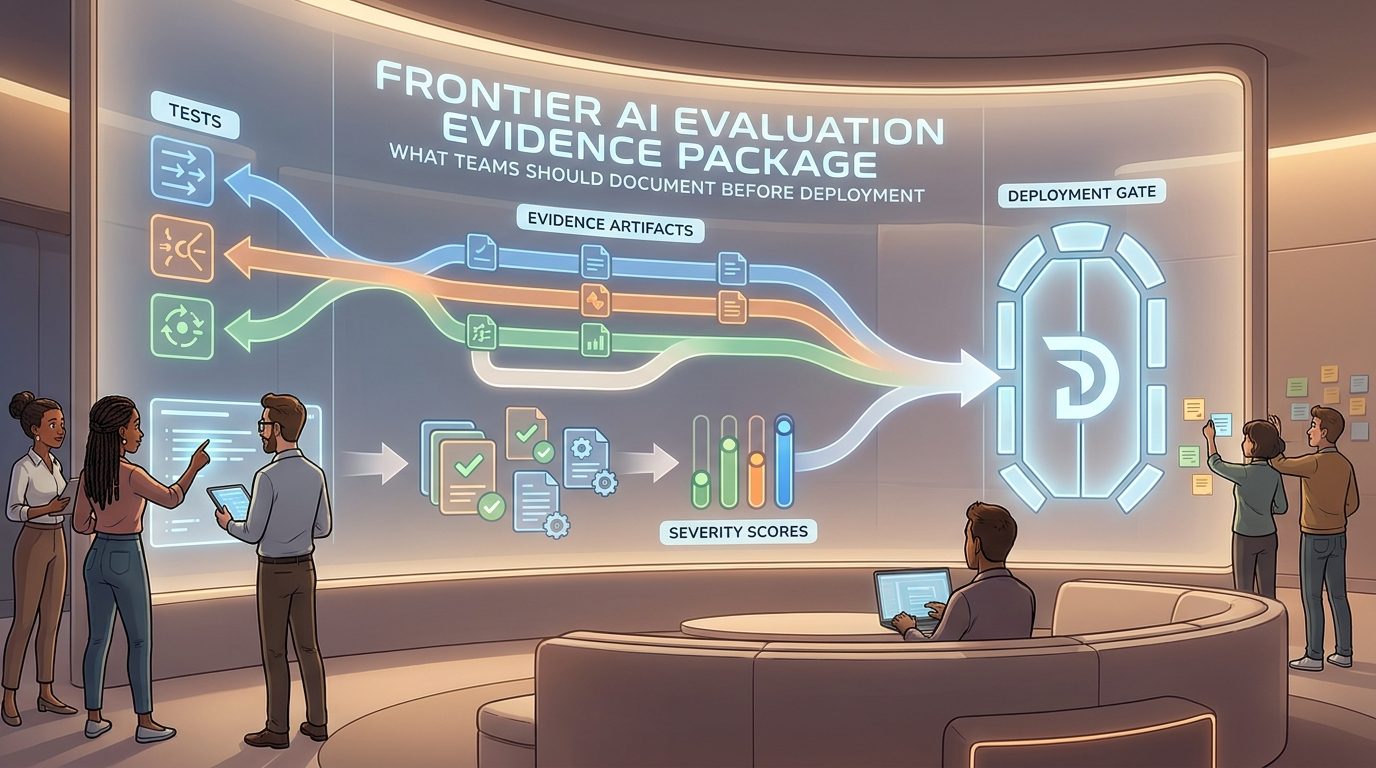
Quick Answer: What Is a Frontier AI Evaluation Evidence Package?
A frontier AI evaluation evidence package is the structured record a team uses to turn model safety tests into a deployment decision. It collects the scope of the evaluation, the tests performed, the red-team and benchmark findings, the severity judgments, the mitigations, the remaining uncertainty, the approval trail, and the monitoring commitments that must exist before a powerful AI system is released or expanded.
The source pillar article, Frontier AI Evaluations Explained: How Safety Tests Shape Deployment Decisions, explains why frontier AI evaluations matter for deployment decisions. This cluster article goes narrower: it focuses on the evidence bundle that should sit between “we ran evaluations” and “we are comfortable shipping this system.” That distinction matters because a passing benchmark, a red-team memo, or a single safety score is not enough. Teams need an auditable package that shows what was tested, what was not tested, who reviewed the findings, and why the release decision follows from the evidence.
This guide is written for product leaders, AI safety reviewers, security teams, governance owners, and builders who need a practical bridge between formal AI risk frameworks and day-to-day release work. It does not provide harmful misuse instructions, and it does not pretend that documentation proves a model is safe. A good evidence package improves judgment; it does not eliminate uncertainty.
Why Evidence Packaging Matters for Frontier AI Deployment
Frontier AI evaluations are becoming more central because advanced models and agentic systems can affect security, information integrity, autonomy, code execution, biological or chemical misuse risk, privacy, and high-stakes decision support. Evaluation work can include benchmarks, expert red teaming, policy checks, misuse-resistance tests, tool-use audits, autonomy probes, and post-mitigation retesting. But the deployment decision is only as good as the evidence that reaches the people making it.
A common failure mode is evidence fragmentation. The benchmark results live in one notebook. The red-team findings live in a private document. Product mitigations live in tickets. Security review comments live in another system. Leadership sees a summary slide that says the model is “acceptable” or “within threshold.” That may be convenient, but it is weak governance. If something goes wrong later, the team cannot easily reconstruct what was known, what was uncertain, and why the release was allowed.
A stronger process treats evaluation evidence like a release artifact. The evidence package does not need to be bureaucratic for its own sake. It should be concise enough to use, but complete enough to support review. The best package lets a reviewer answer five questions quickly: what system was evaluated, what risks were tested, what serious findings appeared, what mitigations were verified, and what decision was made with what residual risk.
The Core Evidence Package: What to Include
The exact format depends on the organization, model capability, deployment context, and legal obligations. Still, most useful frontier AI evaluation evidence packages contain the same building blocks. The package should explain the release being evaluated, list the evaluation methods, summarize material findings, connect findings to severity and thresholds, document mitigations, and preserve the approval trail.
| Evidence artifact | What it should answer | Why it matters |
|---|---|---|
| System and release scope | Which model, tool access, deployment mode, user group, geography, and release version are under review? | Prevents evidence from being reused for a different system than the one actually being shipped. |
| Risk hypothesis list | Which risk areas were considered: autonomy, cyber, deception, misuse, privacy, bias, reliability, or domain-specific harm? | Makes the evaluation plan explicit instead of relying on vague “safety testing.” |
| Evaluation method inventory | Which benchmarks, red-team exercises, expert reviews, policy tests, simulations, and monitoring probes were used? | Shows whether the evidence is broad enough for the deployment context. |
| Material findings summary | What findings could affect release, restrictions, mitigations, or monitoring? | Keeps reviewers focused on decision-relevant evidence rather than raw logs. |
| Severity and confidence notes | How severe is each finding, how confident is the team, and what uncertainty remains? | Separates weak signals from findings that should change the deployment gate. |
| Mitigation and retest record | What was fixed, limited, blocked, monitored, or escalated, and was the mitigation retested? | Prevents teams from treating proposed mitigations as verified mitigations. |
| Decision and sign-off trail | Who reviewed the package, what decision was made, and what conditions were attached? | Creates accountability and makes future audits possible. |
The package should avoid two extremes. A raw dump of every log is too noisy for a decision. A polished executive memo without underlying evidence is too thin for accountability. The useful middle ground is a decision record with links to the supporting artifacts.
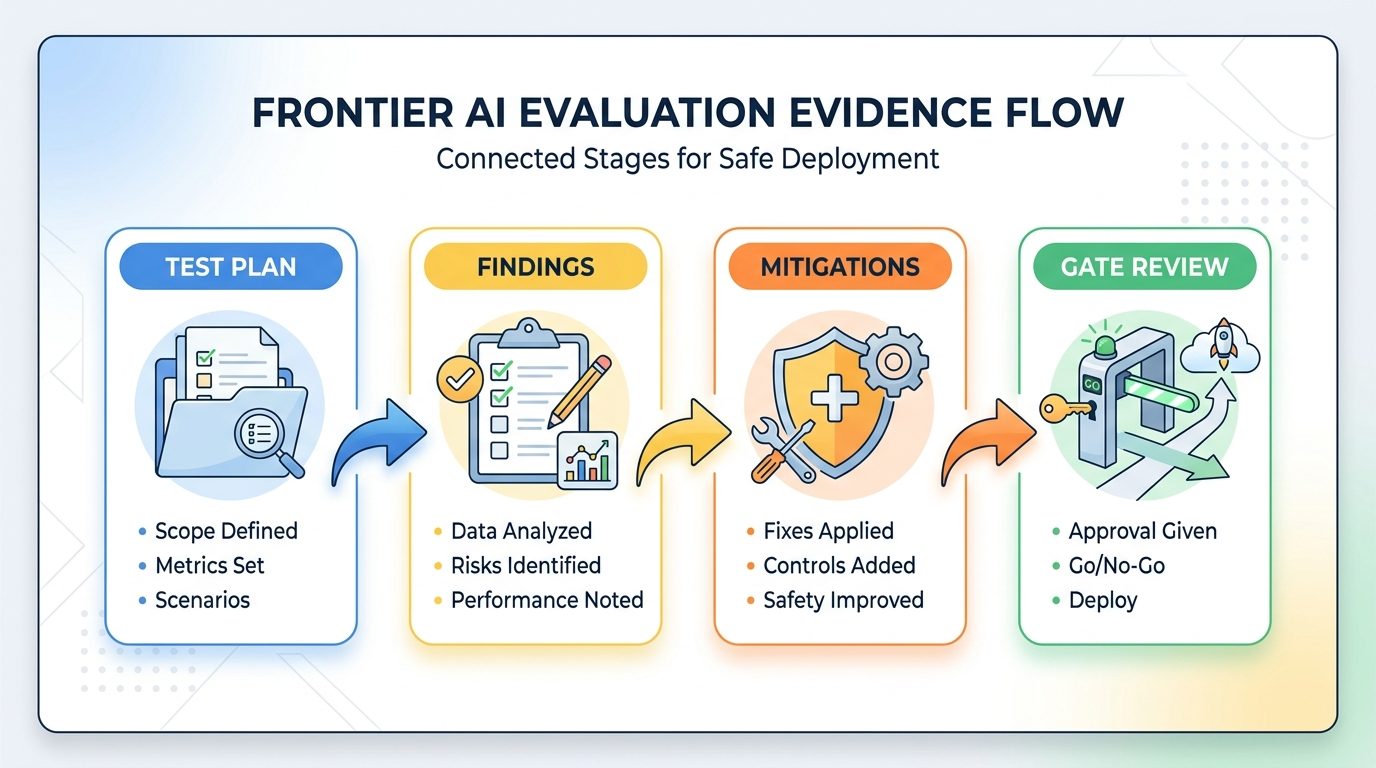
Start With Scope: Define the System Being Evaluated
The first section should define exactly what is being evaluated. This sounds basic, but it is one of the most important controls in frontier AI governance. A model can be safer in one deployment context and riskier in another. The same base model may behave differently when paired with tools, memory, retrieval, browsing, code execution, autonomous workflows, or enterprise data.
A good scope statement includes the model or system name, version, deployment channel, intended users, available tools, permission boundaries, data access, geographic or regulatory context, and planned rollout pattern. If the system is an agent, the scope should specify what actions it can take without approval, which actions require human confirmation, and what logs are retained.
The evidence package should also state what is outside scope. For example, an internal employee assistant test should not be reused as evidence for a public consumer deployment. A text-only evaluation should not be treated as evidence for a multimodal release. A sandboxed tool-use evaluation should not justify production tool access without additional review. Out-of-scope notes keep evidence honest.
Write Risk Hypotheses Before Choosing Tests
Evaluation work is stronger when it begins with risk hypotheses instead of a generic checklist. A risk hypothesis states what could go wrong, why the system might enable it, and what evidence would change the deployment decision. This is compatible with frameworks such as the NIST AI Risk Management Framework, preparedness frameworks, responsible scaling policies, and frontier safety frameworks, but it keeps the work practical.
For example, a team might ask whether the model can meaningfully assist cyber abuse, whether it can plan multi-step harmful actions, whether it can deceive evaluators during oversight, whether it produces unreliable medical or legal claims, whether it leaks sensitive data, or whether tool access allows unintended external actions. The evidence package should not include procedural harmful instructions. It should describe the risk category, the safe test objective, the high-level method, and the decision relevance.
Each risk hypothesis should have an owner. Ownership matters because evaluations often sit between AI research, safety, security, policy, legal, and product teams. Without ownership, findings become everyone’s concern and nobody’s blocker.
Document Evaluation Methods Without Creating a False Sense of Coverage
The method inventory should describe how evidence was collected. It may include automated benchmarks, manual expert review, red-team exercises, policy compliance tests, adversarial prompt suites, tool-use simulations, retrieval quality checks, system-card review, incident-history review, and post-mitigation retesting. The goal is not to make the package look long. The goal is to show why the chosen methods are appropriate for the release.
Every method should include date, owner, version, dataset or scenario category, limitations, and links to detailed records. If an evaluation uses an external benchmark, name the benchmark and explain what it can and cannot show. If it uses red teaming, describe the safe evaluation objective and the resulting finding category, not replicable misuse instructions. If it uses model-generated grading, say how graders were checked or sampled by humans.
This section is also where teams should be honest about coverage gaps. Maybe the evaluation did not cover a certain language, modality, domain, or tool. Maybe the red team had limited time. Maybe a benchmark is known to be saturated or easy for frontier systems. Those caveats are not embarrassing; they are exactly the kind of uncertainty deployment reviewers need to see.
Summarize Findings by Decision Relevance
A frontier AI evaluation evidence package should not bury reviewers in raw outputs. It should summarize findings by decision relevance. The useful question is not “did anything interesting happen?” The useful question is “which findings should affect deployment, restrictions, mitigations, monitoring, or user communication?”
Decision-relevant findings usually have one or more of these properties: they are reproducible, they affect high-impact users, they reveal a new capability, they bypass a guardrail, they expose sensitive data, they show unsafe tool behavior, they conflict with a declared risk threshold, or they remain unresolved after mitigation. Minor formatting issues and isolated low-impact oddities can be logged, but they should not crowd out serious findings.
A practical finding summary should include the risk area, short description, affected system scope, evidence source, severity, confidence, mitigation status, residual risk, and recommended gate action. This gives executives and release owners a clean path from evidence to decision without hiding uncertainty.
| Finding field | Good evidence-package wording | Weak wording to avoid |
|---|---|---|
| Severity | “High severity because the behavior is reproducible under approved test conditions and could affect external users.” | “Looks bad.” |
| Confidence | “Medium confidence; finding appeared in two test families but needs domain expert review.” | “Probably fine.” |
| Mitigation | “Tool permission narrowed, policy updated, retest passed for the original scenario, adjacent cases still open.” | “Fixed.” |
| Gate action | “Proceed only with limited rollout and additional monitoring until adjacent cases are resolved.” | “Ship?” |
Use Severity Scoring as a Decision Aid, Not a Magic Number
Severity scoring helps teams compare findings, but it should not become fake precision. A frontier AI system is complex, and not every risk fits neatly into a single numeric score. A better approach is to combine structured criteria with written judgment. The evidence package can use labels such as low, medium, high, and critical, but each label should be justified.
Useful scoring dimensions include capability demonstrated, ease of reproduction, potential impact, affected user group, guardrail bypass, tool access, exploitability, mitigation confidence, detection likelihood, and residual uncertainty. For agentic systems, teams should also consider autonomy level, persistence, external action capability, and whether human approval reliably interrupts risky behavior.
The key is connecting severity to deployment gates. A high-severity unresolved finding should not be treated the same as a low-severity UX issue. A medium finding with low mitigation confidence may deserve more caution than a high finding that has been fully mitigated and independently retested. The package should explain the reasoning.
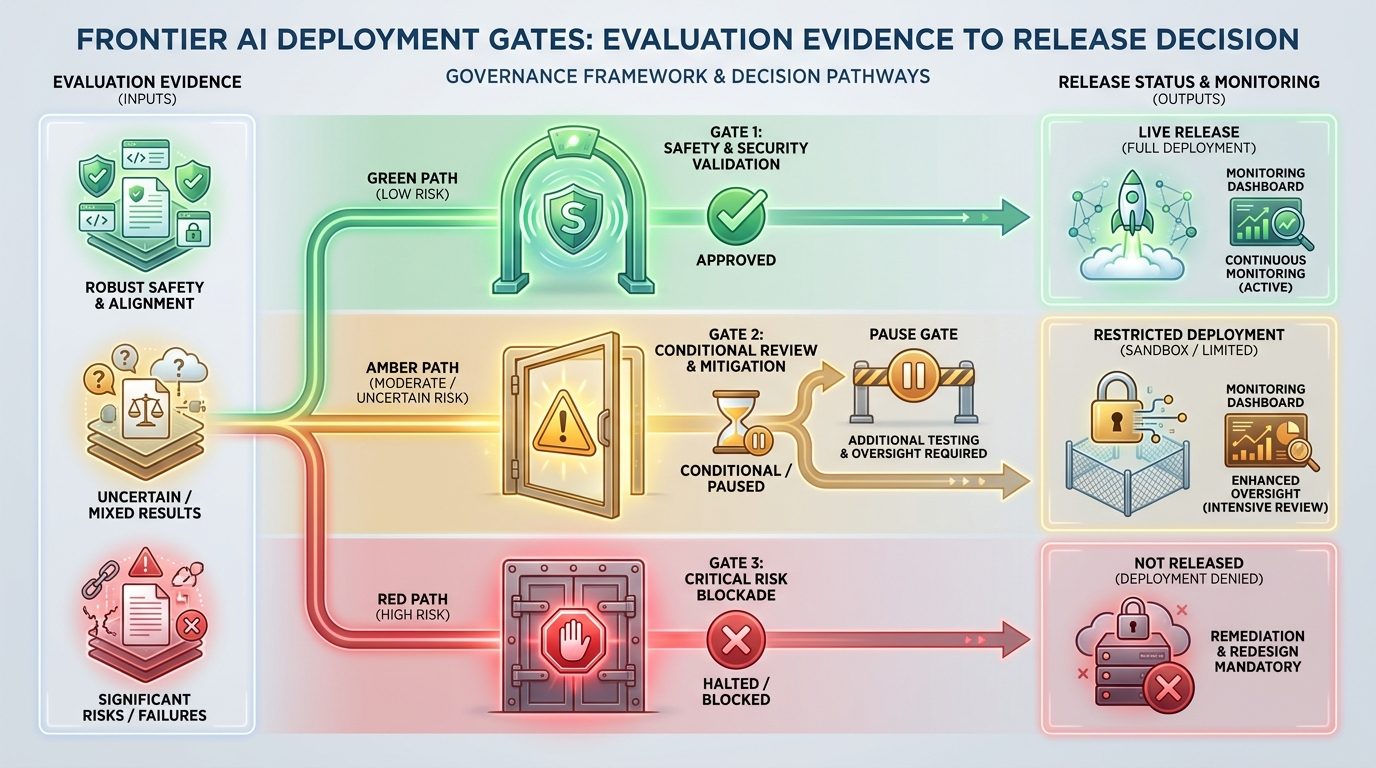
Separate Proposed Mitigations From Verified Mitigations
One of the most important parts of the package is the mitigation record. Teams often move too quickly from “we know what to do” to “the risk is handled.” A proposed mitigation is not the same as a verified mitigation. The evidence package should show what changed, who changed it, what test was rerun, whether the original issue disappeared, and whether related risks remain.
Mitigations can include model changes, system prompts, tool permission limits, retrieval constraints, policy updates, refusal behavior, rate limits, monitoring alerts, human approval gates, access restrictions, staged rollout, user education, or incident response preparation. Some mitigations reduce probability. Others reduce impact. Some merely improve detection. The evidence package should be clear about which type of mitigation is being claimed.
A strong mitigation record includes residual risk. If a system is released with known unresolved issues, the package should say why the release is still acceptable, what controls limit exposure, who accepted the risk, and what condition would trigger rollback or escalation. That is uncomfortable, but it is much safer than pretending no risk remains.
Assign Evidence Owners and Reviewers
Evidence packages work best when each artifact has an owner and a reviewer. The evaluator owns the test record. The product owner owns deployment scope and user impact. The security owner reviews abuse and tool-access risk. The policy or governance owner checks alignment with internal standards. Legal or compliance may be involved for regulated contexts. Leadership owns the final gate decision.
This does not mean every release needs a large committee. It means the evidence package should show who was accountable for each decision-relevant claim. When a reviewer asks “who verified this mitigation?” or “who accepted this residual risk?” the answer should be visible.
| Role | Evidence responsibility | Typical question |
|---|---|---|
| Evaluation lead | Methods, findings, limitations, retest evidence | Did the tests support the conclusions? |
| Product owner | Release scope, user exposure, rollout controls | Is this deployment context accurately described? |
| Security reviewer | Misuse, abuse, tool permissions, incident response | Can this system enable harmful actions or bypass controls? |
| Governance owner | Framework alignment, thresholds, approval record | Does the decision match policy and risk appetite? |
| Executive gate owner | Final release decision and risk acceptance | Are we willing to ship under these conditions? |
Make the Package Audit-Ready Without Making It Unusable
Audit-ready does not mean unreadable. The best evidence packages use a short decision memo backed by links to detailed artifacts. The memo explains the release scope, risk areas, findings, mitigations, residual risk, and decision. The linked artifacts preserve the detailed records: test plans, benchmark reports, red-team notes, issue tickets, mitigation diffs, monitoring plans, and approvals.
Teams should preserve dates, version identifiers, reviewer names or roles, and change history. If a model or system changes materially after evaluation, the package should either be updated or marked as no longer sufficient for the new release. This matters because frontier AI systems are not static. A model update, new tool, new data source, new user group, or changed autonomy level can invalidate earlier evidence.
The evidence package should also include monitoring commitments. Pre-deployment evaluations cannot catch everything. Post-deployment monitoring, incident response, user feedback, abuse reporting, and periodic re-evaluation are part of the safety case. If the team chooses to release with limited rollout, the package should state what signals will be watched and what threshold triggers rollback.
Common Mistakes That Weaken Evaluation Evidence
Strong evidence habits
- Define the exact release scope.
- Link findings to risk thresholds and deployment gates.
- Document limitations and uncertainty.
- Retest mitigations before claiming risk reduction.
- Preserve owner, reviewer, and decision records.
Weak evidence habits
- Using one benchmark as proof of broad safety.
- Summarizing red-team work without severity or mitigation status.
- Reusing evidence for a different deployment context.
- Hiding unresolved risks in vague language.
- Skipping post-release monitoring commitments.
The most dangerous mistake is treating evaluation as a box-checking exercise. A team can run many tests and still make a poor decision if the results are not connected to release conditions. Evidence matters because it changes what the team does: ship, restrict, delay, redesign, monitor, or escalate.
Frontier AI Evaluation Evidence Package Checklist
Use this checklist before a deployment gate review. It is intentionally practical rather than legalistic. Adapt it to your organization, risk level, and regulatory environment.
| Checklist item | Ready? |
|---|---|
| The system, model version, tool access, user group, and rollout scope are clearly defined. | Yes / No |
| Risk hypotheses are listed and mapped to evaluation methods. | Yes / No |
| Material findings are summarized with severity, confidence, and evidence links. | Yes / No |
| Mitigations are separated into proposed, implemented, and verified categories. | Yes / No |
| Residual risks and known limitations are explicit. | Yes / No |
| Owners and reviewers are named by role or accountable team. | Yes / No |
| The release decision is connected to thresholds, not vibes. | Yes / No |
| Post-deployment monitoring and rollback triggers are documented. | Yes / No |
| The package links back to detailed records without exposing sensitive misuse instructions. | Yes / No |
Example: What a Deployment Review Memo Could Look Like
A practical evidence package often begins with a one-page deployment review memo. The memo should be readable by someone who was not inside every evaluation meeting. It might start with a sentence such as: “This package evaluates version 4.2 of the customer-support agent for a limited enterprise rollout with retrieval access, ticket-drafting ability, and human approval required before external messages are sent.” That one sentence immediately gives reviewers the deployment scope, the autonomy boundary, and the user context.
The next paragraph should explain the decision being requested. For example, the team might ask for approval to run a limited rollout, expand an existing beta, enable a new tool, move from internal use to customer-facing use, or remove a human approval step. The evidence package should be built around that decision. If the decision is limited rollout, the evidence should show whether the limits are strong enough. If the decision is tool access, the evidence should focus heavily on permission boundaries, action logs, abuse paths, and rollback controls.
After that, the memo should summarize the top findings. A strong summary does not say “all tests passed.” It says something more specific: “No critical unresolved findings remain under the tested scope. Two high-severity findings were identified in tool-use simulations; both were mitigated through permission narrowing and retested. One medium-severity uncertainty remains for non-English prompts and will be handled through limited rollout, monitoring, and follow-up evaluation before expansion.” This style is much more useful because it preserves both confidence and caution.
The memo should close with conditions. Conditions turn evaluation into operational control. They might include a maximum user group, required monitoring dashboard, abuse escalation owner, rollback threshold, next review date, or rule that any new tool integration requires a fresh evidence update. If the release is approved, the package should make clear what was approved and what was not approved. This prevents later scope creep where a team quietly applies old evidence to a larger or riskier deployment.
How This Fits With AI Safety Frameworks
This evidence-package approach fits naturally with established AI governance work. The NIST AI Risk Management Framework emphasizes mapping, measuring, managing, and governing AI risk. A deployment evidence package is one practical way to show those activities happened for a particular release. Preparedness and responsible scaling frameworks often define risk levels, thresholds, and safeguards. The evidence package records whether the current system appears to stay within those limits and what controls exist if it does not.
The package is also useful for internal safety cases. A safety case is an argument supported by evidence. The evidence package supplies the evidence layer: test plans, findings, mitigations, reviewer judgments, and monitoring commitments. Without this layer, a safety case becomes a confident story with weak support. With it, reviewers can inspect the actual basis for the claim that a deployment is acceptable under defined conditions.
Teams should not copy frameworks mechanically. A small internal assistant does not need the same evidence burden as a highly capable frontier model with external tool access. But the structure scales. Low-risk systems can use a lighter package; higher-risk systems need more independent review, stronger records, stricter gates, and clearer escalation paths. The important point is proportionality: the evidence should match the capability, exposure, and harm potential of the system.
How This Supports the Frontier AI Evaluations Pillar
This article is a supporting cluster for Frontier AI Evaluations Explained: How Safety Tests Shape Deployment Decisions. The pillar explains the broader evaluation landscape. This guide zooms into the documentation layer that helps teams use evaluation results responsibly. Read the pillar first if you need the big picture; use this checklist when you need to prepare the actual evidence package for a release review.
- Frontier AI Evaluations Explained: How Safety Tests Shape Deployment Decisions — source pillar on frontier AI evaluations and deployment decisions.
- Frontier AI Red Teaming Checklist — practical stress-testing workflow that can feed this evidence package.
- AI Risk Thresholds Explained — how risk levels shape stronger safeguards.
- Frontier AI Safety Case Checklist — broader deployment evidence and argument structure.
Sources and References
- NIST AI Risk Management Framework
- Anthropic Responsible Scaling Policy
- Google DeepMind Frontier Safety Framework
- UK AI Safety Institute Inspect evaluations framework
- METR evaluations research
Links were validated for HTTPS access and relevance before inclusion. This article avoids shortened, suspicious, unrelated, or unverifiable sources.
FAQ: Frontier AI Evaluation Evidence Packages
What is a frontier AI evaluation evidence package?
It is the structured set of records that connects frontier AI safety tests to a deployment decision. It includes scope, methods, findings, severity judgments, mitigations, residual risk, approvals, and monitoring commitments.
How is it different from a red-team report?
A red-team report is one input. The evidence package is broader: it also includes benchmark results, scope, mitigations, retests, ownership, gate decisions, and post-release controls.
Can an evidence package prove a model is safe?
No. It can support a better deployment decision, expose uncertainty, and preserve accountability, but it cannot prove complete safety for an open-ended frontier AI system.
Who should own the evidence package?
Ownership should be shared by role: evaluation leads own test evidence, product owns release scope, security reviews misuse and tool risk, governance checks thresholds, and the gate owner accepts the final decision.
What is the biggest mistake teams make?
The biggest mistake is treating a benchmark pass or a short safety summary as enough evidence for deployment. The package should show limitations, unresolved risks, verified mitigations, and decision accountability.
