
AI Career Proof System: Skills, Projects, Metrics, and Human Judgment Employers Can Trust
AI career advice is everywhere, but most of it stops at tool lists and motivation. A stronger path is to build a proof system: a repeatable way to show what you can automate, how safely you work with AI agents, what outcomes improved, and where your human judgment made the difference.
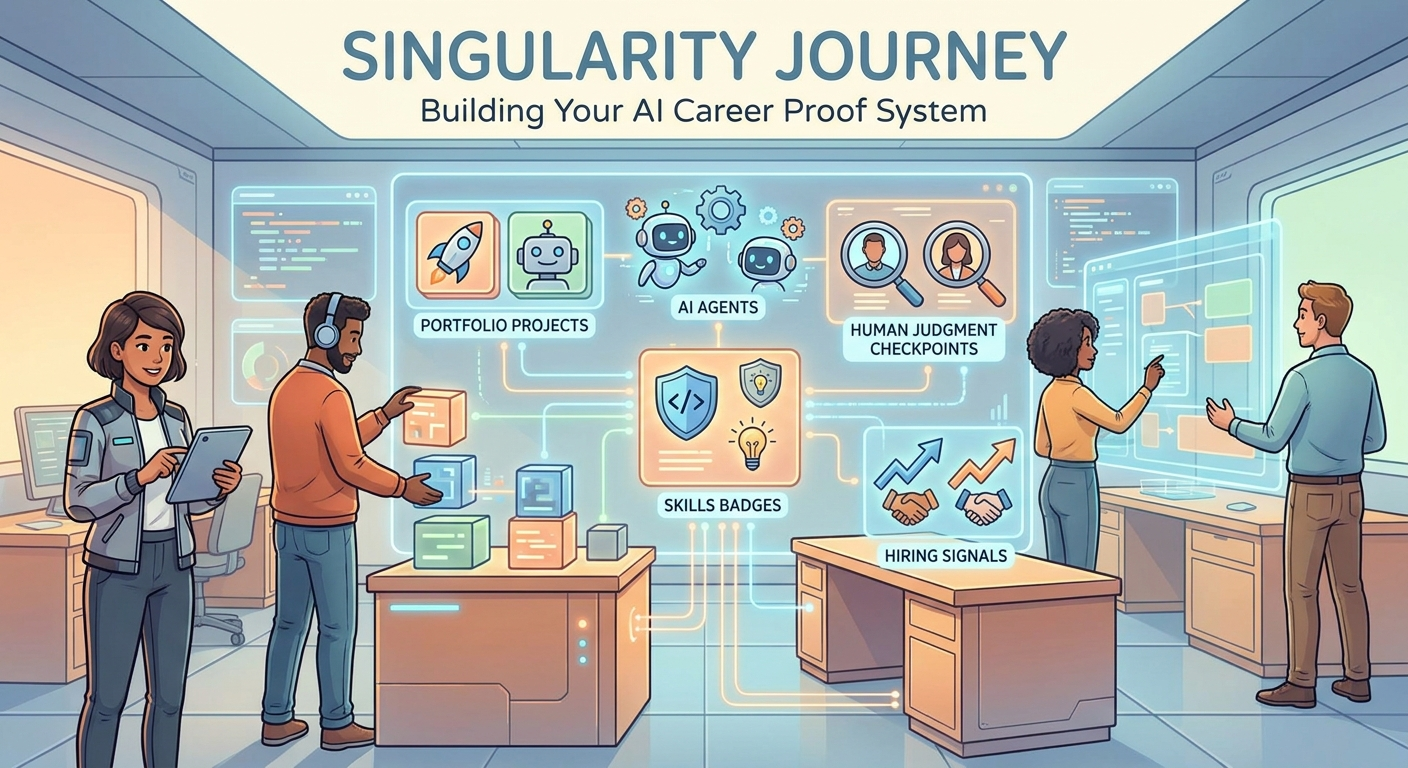
Quick Answer: What Is an AI Career Proof System?
An AI career proof system is a structured portfolio and work habit that turns AI skills into evidence. Instead of saying “I know prompt engineering” or “I use AI tools,” you show a small set of realistic projects, the workflow behind them, the measurable outcome, the risks you controlled, the human decisions you made, and the business context where the work would matter.
This matters because the AI job market is moving away from vague enthusiasm. Employers can see that many candidates have tried chatbots, generated code, built a toy automation, or added “AI” to a resume. What is harder to find is a person who can identify a real workflow, scope an AI assistant, measure whether it helped, catch failures, protect users, document tradeoffs, and explain the work clearly to non-technical stakeholders.
The primary keyword for this guide is AI career proof system. Related phrases include AI skills portfolio, AI workflow portfolio, AI career roadmap, AI automation portfolio, AI agent skills, AI portfolio projects, human AI workflow skills, and future-proof AI career. The article is designed for students, career switchers, analysts, developers, marketers, operations professionals, founders, and knowledge workers who want evidence-backed career progress rather than generic “learn AI” advice.
Why AI Careers Now Require Proof, Not Just Claims
Recent labour-market research points in the same direction: AI is changing tasks faster than job titles. The World Economic Forum’s Future of Jobs research notes that technological change, demographic shifts, economic uncertainty, and other forces are expected to reshape labour markets, with employers planning large-scale skill transformation. Anthropic’s Economic Index found that AI use is already visible across a wide range of occupations and leans slightly more toward augmentation than full automation in its observed Claude usage. Microsoft’s Work Trend Index frames the shift around agents and human agency: AI systems increasingly handle execution, while people need to direct, evaluate, and coordinate work.
Those signals do not mean every job becomes an AI job overnight. They mean the safest career strategy is to become visibly good at the tasks AI changes first: research, drafting, analysis, coding assistance, operations, documentation, customer workflows, reporting, QA, and coordination. The candidate who can show a before-and-after workflow has an advantage over the candidate who only lists tools.
The data gap in most AI career content is that it tells readers what to learn but not what to prove. It mentions “AI literacy,” “prompt engineering,” “automation,” or “agents,” yet often skips the evidence structure that makes a hiring manager believe the claim. Search results also tend to split into two weak extremes: inspirational career predictions on one side, and narrow tool tutorials on the other. A useful pillar article should bridge the two.
Singularity Journey’s own analytics support that direction. In the recent GA4 window, the site’s AI Career Moat, AI Automation Engineer Roadmap, AI Automation Portfolio Projects, and Human-AI Workflow Skills pages all appeared in top-page patterns. Search Console data is still sparse, but it shows discovery around “agent journey,” which suggests the site has a developing topical base around agents, workflows, and journey-style learning paths. A career pillar that connects agent workflows to employable proof is a natural internal-linking opportunity.
The Five-Part AI Career Proof System
A good proof system should be simple enough to maintain and strong enough to survive an interview. Use five layers: skill map, project evidence, outcome metrics, risk controls, and career story. If one layer is missing, the portfolio becomes less credible. A project without metrics feels like a demo. Metrics without risk controls feel naive. Risk controls without a story feel technical but hard to hire. A story without evidence feels like branding.
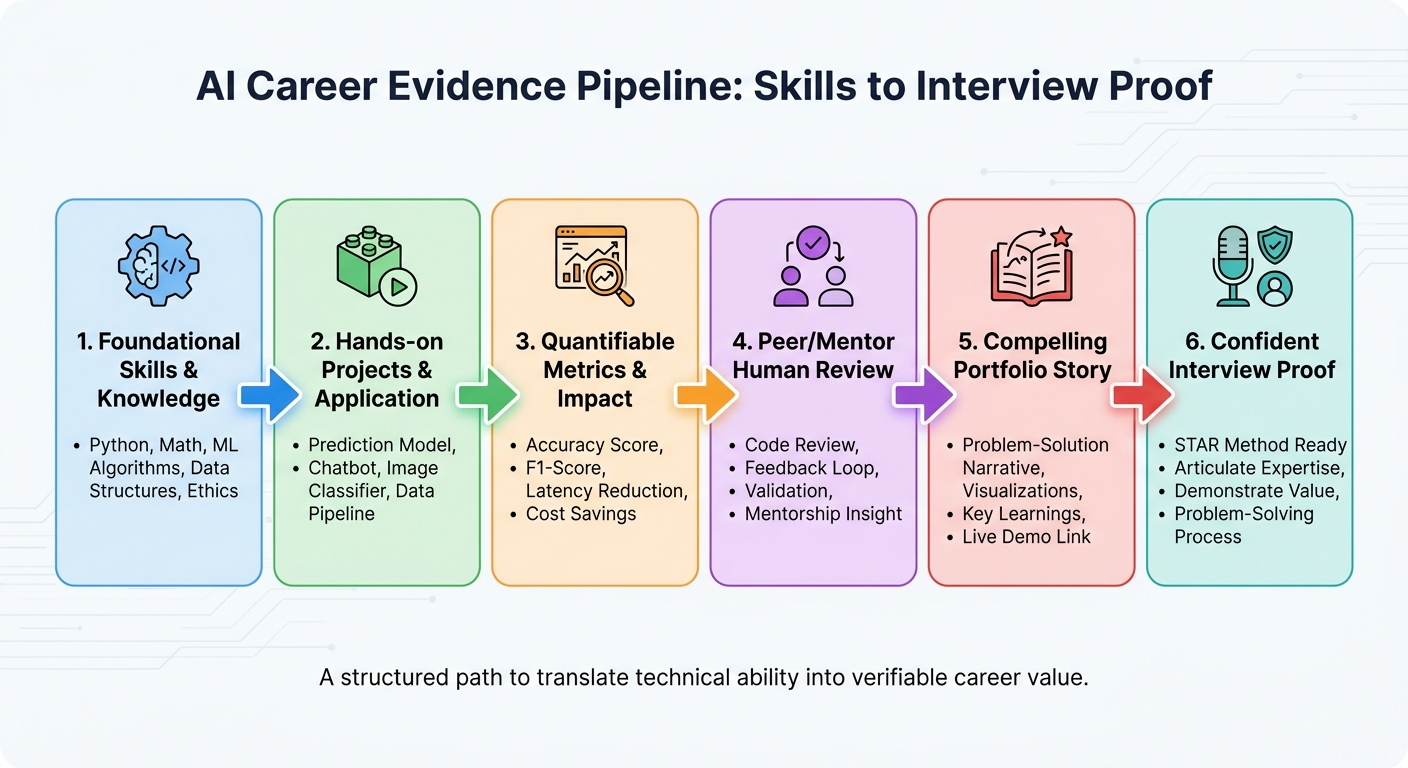
The update loop is the hidden layer. AI tools change quickly, so a static portfolio can age badly. Instead of presenting one old project as proof forever, keep a lightweight change log: what model or tool you used, what changed later, what you would improve, and what constraints mattered. This turns tool churn into a strength because it shows you can adapt without pretending every workflow is permanent.
The AI Skills Map Employers Can Actually Evaluate
Most AI skill lists are too broad. They say “learn AI,” “learn Python,” “learn prompt engineering,” and “understand automation.” That is not wrong, but it is not enough. A proof-based skill map separates skills into five categories that employers can inspect through projects.
| Skill category | What it means | How to prove it |
|---|---|---|
| AI tool fluency | You can use chatbots, copilots, agents, RAG tools, spreadsheets, notebooks, and workflow builders appropriately. | Show a workflow comparison, prompt evolution, tool choice rationale, and failure examples. |
| Domain judgment | You understand the real work context: sales, finance, HR, operations, engineering, education, healthcare, content, or support. | Use a realistic business problem with constraints, stakeholders, and acceptance criteria. |
| Data and evaluation | You can test outputs against examples, rubrics, datasets, or manual review criteria. | Include a mini evaluation table, pass/fail cases, error taxonomy, and quality threshold. |
| Automation design | You can connect steps into a reliable process without over-automating unsafe decisions. | Publish a workflow diagram, handoff points, approval gates, and retry or escalation rules. |
| Communication | You can explain AI-assisted work to non-technical stakeholders and make tradeoffs visible. | Write an executive summary, a user guide, a risk note, and an interview-ready project story. |
For developers, the skill map may include API design, agent memory, observability, evaluations, security, cost tracking, and deployment. For non-developers, it may include spreadsheet automation, research workflows, document analysis, workflow redesign, customer response drafting, and dashboard storytelling. The point is not to force everyone into the same role. The point is to make your version of AI fluency observable.
If you are technical, connect this guide to Singularity Journey’s AI agent observability, AI agent test cases, and AI agent evaluation metrics articles. If you are less technical, connect it to workflow redesign and human approval: what should AI draft, what should humans decide, and what evidence proves the system is helping?
Portfolio Projects That Prove AI Career Readiness
The best AI portfolio projects are neither toy demos nor giant fantasy platforms. They are small, realistic systems that solve a repeatable problem. A hiring manager should be able to understand the situation, see the workflow, inspect the output, and ask you what went wrong during testing. If you can answer that last question clearly, you are already ahead of many candidates.
Project 1: AI research brief with source verification
Build a workflow that turns a question into a structured research brief. Include source selection rules, blocked domains, citation checks, summary quality criteria, and a final decision memo. This is useful for analysts, marketers, founders, product managers, consultants, and students. The proof is not the generated summary. The proof is your verification process.
Project 2: Customer support response assistant
Create a small assistant that drafts replies from a policy document and flags cases needing human review. Show examples where the assistant should answer, ask for clarification, refuse, or escalate. Measure accuracy with a test set. This proves judgment, safety, and business usefulness.
Project 3: Meeting-to-action workflow
Turn meeting notes into decisions, action items, owners, deadlines, and risk flags. Add a human review checklist so the workflow does not invent commitments. This is excellent for operations, project management, and executive assistant roles.
Project 4: Data cleaning and insight report
Use AI to help clean a small dataset, generate hypotheses, and draft a report, but keep a clear separation between AI suggestions and verified analysis. Include before-and-after data quality notes, charts, and a short stakeholder summary. This proves that you do not confuse fluent text with truth.
Project 5: AI agent with approval gates
For technical readers, build a simple agent that can use tools but must ask for approval before external actions. Include logs, permissions, evaluation cases, and failure handling. Link it to principles from the human approval for AI agents guide. Employers increasingly need people who can make agents useful without making them reckless.
Project 6: Personal workflow ROI case study
Pick one repetitive task from your real life or work: weekly reporting, inbox triage, invoice checking, content repurposing, bug triage, lesson planning, or competitive research. Document baseline time, AI-assisted time, quality issues, and what still requires human review. This project is often more convincing than a flashy demo because it proves you can improve a real workflow.
Metrics: How to Prove an AI Project Worked
Metrics are where AI career proof becomes credible. You do not need enterprise-grade dashboards for every portfolio project, but you do need a small set of measurements that connect the work to value. A strong metric set includes productivity, quality, risk, and usability. If you only measure time saved, you may miss errors. If you only measure quality, you may miss whether the workflow is too slow to use. If you only measure adoption, you may reward convenience over safety.
| Metric type | Useful examples | What it proves |
|---|---|---|
| Productivity | Minutes saved per task, steps removed, turnaround time, volume handled. | The workflow has practical value, not just novelty. |
| Quality | Accuracy against test cases, reviewer score, error rate, completeness score. | The output is dependable enough to discuss seriously. |
| Risk | Escalation rate, hallucination catches, privacy checks, approval violations, unsafe outputs blocked. | You understand AI failure modes and human oversight. |
| Cost | Tool cost per run, token/credit usage, manual review time, maintenance effort. | You can judge whether automation is economically sensible. |
| User value | User rating, stakeholder feedback, reduced confusion, better decision speed. | The workflow helps people, not just systems. |
A portfolio metric does not have to be perfect. It has to be honest. If your workflow saved 30 minutes but made two important mistakes, say that. Explain how you detected the mistakes and what guardrail you added. That honesty is an EEAT signal for your career: experience, expertise, authority, and trust are demonstrated by the way you handle uncertainty.
Human Judgment Is the Career Moat
As AI agents become better at execution, human judgment becomes more important, not less. The person who can decide what should be automated, what should be reviewed, what should be escalated, and what should never be delegated is valuable across industries. This is why “AI will replace everyone” is a poor career model. A better model is task redesign: AI changes the mix of drafting, searching, coding, checking, communicating, and deciding.
Anthropic’s Economic Index is useful here because it distinguishes augmentation and automation patterns in real AI usage. Many valuable uses are collaborative: the human frames the task, AI generates or analyzes, and the human evaluates. That collaboration is exactly what your portfolio should reveal. Do not hide the human work. Make it visible.
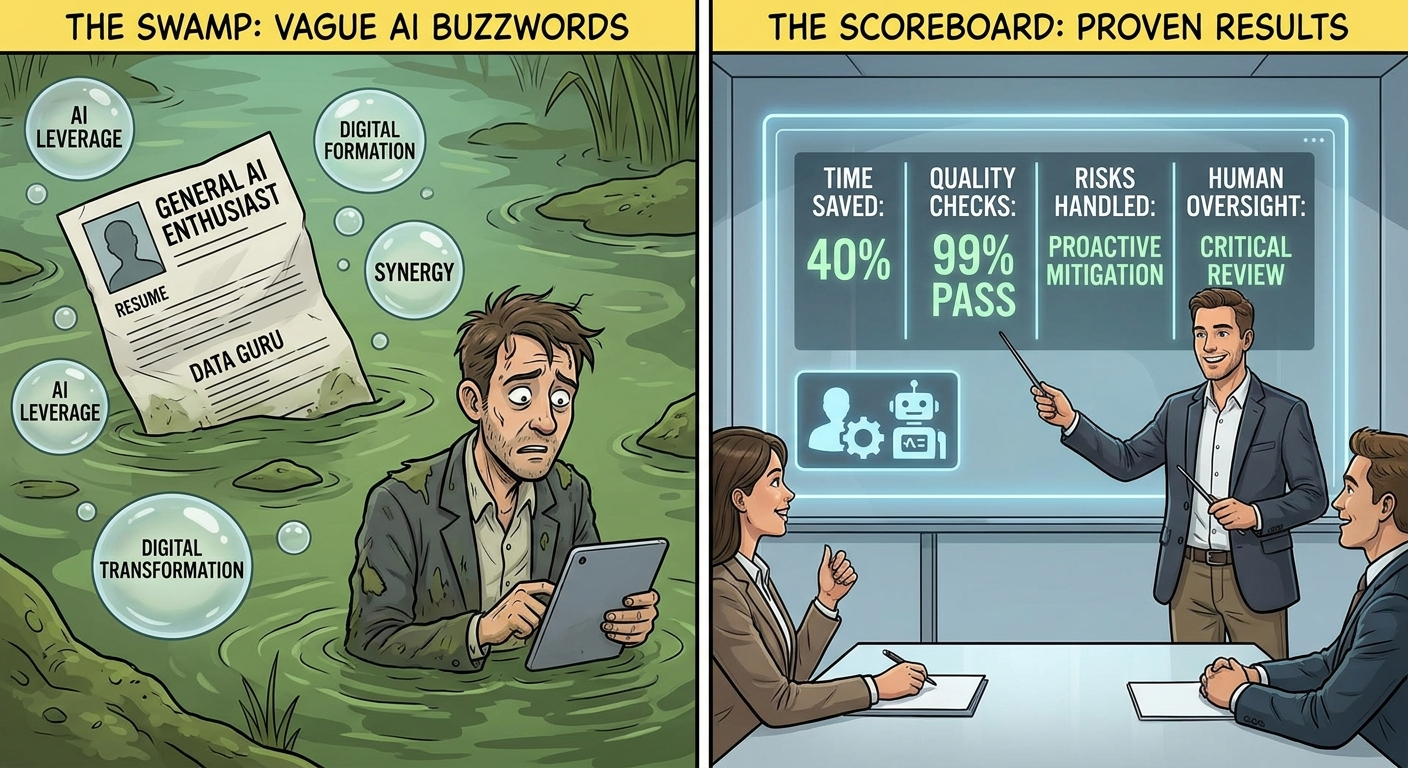
Strong proof signals
- Clear problem framing before tool selection.
- Evidence that AI outputs were checked.
- Defined approval gates for risky actions.
- Metrics that include both speed and quality.
- A project story that explains tradeoffs.
Weak proof signals
- Long lists of tools with no outcomes.
- Generic prompts copied from social media.
- No examples of failures or corrections.
- Claims of automation without risk boundaries.
- Portfolio screenshots that cannot be explained.
In interviews, the strongest answers often sound like this: “Here is the task I chose. Here is why AI was appropriate. Here is where I limited autonomy. Here is the test set I used. Here is the error I found. Here is what I changed. Here is what I would not automate yet.” That answer demonstrates maturity. It tells the employer you will not simply paste company data into random tools or ship unreviewed AI output.
A Practical Roadmap for Building Your AI Career Proof System
You can build a credible proof system without quitting your job, buying every tool, or becoming a machine-learning researcher. The key is sequencing. Start with one domain, one workflow, one project, and one metric. Then expand.
Phase 1: Pick your career lane
Choose a lane where AI intersects with work you either know or want to know. Examples include AI operations analyst, AI automation specialist, AI-assisted marketer, AI product analyst, AI support workflow designer, AI agent developer, AI governance coordinator, or AI-enabled data analyst. The role name matters less than the work pattern. Ask: what tasks would this person improve with AI?
Phase 2: Build a skill map
Write a one-page map of your current skills, target skills, and proof projects. Include domain knowledge, AI tools, data handling, automation, evaluation, and communication. Mark each skill as “learning,” “practiced,” or “proved.” Do not overstate. The map is for focus, not decoration.
Phase 3: Build one small project
Pick a workflow that can be explained in five minutes. Create inputs, process, outputs, evaluation, and risk notes. If you are a developer, use a repo and README. If you are non-technical, use a case study page, screenshots, sample documents, and a short video walkthrough. Make the project easy to inspect.
Phase 4: Add metrics and a failure log
Run the workflow on several examples. Track what improved and what failed. Add a “Known limitations” section. This is not a weakness; it is a signal that you understand responsible use. A realistic limitation section beats inflated claims.
Phase 5: Turn the project into an interview story
Use a simple structure: problem, baseline, AI-assisted workflow, controls, result, lesson. Practice explaining it without jargon. If you cannot explain the project to a non-technical manager, the project is not career-ready yet.
Phase 6: Repeat with a second project
Your first project proves you can finish. Your second project proves the skill transfers. Try a different workflow type: if the first project was research, make the second one automation; if the first was coding, make the second one evaluation or governance; if the first was content, make the second one analytics.
How to Package AI Career Proof for Resumes, LinkedIn, and Interviews
A proof system only helps your career if people can understand it quickly. Do not bury the best evidence in a long notebook, private folder, or vague resume bullet. Package each project as a short case study with a title, the business problem, the AI-assisted workflow, the human review step, the metric, and a short reflection. A recruiter should understand the project in one minute. A hiring manager should be able to inspect the detail in five minutes. A technical interviewer should be able to ask deeper questions about evaluation, data handling, and failure modes.
On a resume, translate projects into outcome bullets. Instead of writing “used ChatGPT for research,” write “built an AI-assisted research workflow with source checks, reviewer rubric, and a reusable brief template for competitive analysis.” Instead of “created AI automation,” write “designed a support-response assistant with policy grounding, escalation rules, and test cases for ambiguous customer requests.” The difference is not wordsmithing. It is credibility. The stronger bullet names the work pattern, the control mechanism, and the reason it matters.
On LinkedIn or a personal website, create a portfolio page with three parts. First, show a concise project card. Second, include a screenshot or diagram of the workflow. Third, add a “what I learned” note that explains one limitation. This limitation note is powerful because it proves you did not treat AI as magic. You tested it, found a boundary, and improved the system. That is exactly the kind of judgment employers need as AI becomes part of normal work.
In interviews, avoid sounding like an AI influencer. Sound like a practical operator. Use concrete sentences: “I chose this workflow because the task was repetitive but reviewable.” “I kept human approval for customer-impacting decisions.” “I measured time saved, but I also tracked errors.” “The first version failed on edge cases, so I added examples and escalation rules.” These answers show that you can work with AI inside real constraints.
If you are early in your career, your proof can come from simulated business cases, volunteer projects, open datasets, class assignments, or personal workflows. If you are experienced, use sanitized versions of real work problems and avoid exposing private company data. In both cases, the rule is the same: make the evidence specific, safe, and reviewable.
| Career surface | What to show | What to avoid |
|---|---|---|
| Resume | Outcome bullets with workflow, metric, and control mechanism. | Generic “AI tools” lists with no evidence. |
| Portfolio | Case studies, diagrams, sample outputs, evaluation notes, and limitations. | Only screenshots of polished chatbot answers. |
| Interview | Problem, workflow, risk, result, and lesson learned. | Overclaiming automation or hiding failures. |
| Short project writeups that teach a useful pattern. | Hype posts with no reproducible process. |
Finally, keep your proof system ethical. Do not upload confidential data into public tools for a portfolio. Do not imply that a toy demo is production-ready. Do not use misleading metrics. Trust is part of the skill. The future career advantage belongs to people who can make AI useful while protecting users, teams, and decision quality.
Internal Links: Keep Building Your AI Career Stack
- AI Career Moat — build durable skills as AI agents improve.
- AI Automation Engineer Roadmap — go deeper on automation roles, tools, and projects.
- AI Automation Portfolio Projects — use project examples as starting points.
- Human-AI Workflow Skills — learn how to show judgment in AI-assisted work.
- AI Output Review Checklist — prove you can review AI output responsibly.
- Human Approval for AI Agents — decide when an AI system must ask before acting.
- AI Agent Evaluation Metrics — measure quality before agent workflows scale.
Sources and Research Inputs
- World Economic Forum: The Future of Jobs Report — employer survey and labour-market transformation context.
- Anthropic Economic Index — observed AI usage patterns across occupations and task categories.
- Microsoft Work Trend Index — research on agents, human agency, and changing work patterns.
- Stanford HAI AI Index — broad AI capability, adoption, and societal context.
- Singularity Journey GA4 and Google Search Console, recent complete 28-day window ending August 13: top-page patterns, sparse query data, low-CTR opportunity review, and internal-linking review.
No unsafe, shortened, suspicious, or unrelated links were included. External references were limited to reputable institutional sources and official report hubs.
FAQ: AI Career Proof Systems
What is an AI career proof system?
An AI career proof system is a structured way to show AI skills through realistic projects, measurable outcomes, human review, risk controls, and interview-ready stories.
Is an AI portfolio better than listing AI tools on a resume?
Yes. Tool lists show exposure, but portfolio evidence shows capability. Employers can evaluate a project, ask about tradeoffs, and see whether you understand real workflow constraints.
What should beginners build first?
Start with one workflow you understand: a research brief, support assistant, meeting-to-action system, data report, or personal productivity automation. Keep it small and measurable.
Do I need to code to build AI career proof?
No. Coding helps for AI agent and automation roles, but non-coders can prove value through research workflows, spreadsheet automation, document analysis, process redesign, evaluation rubrics, and stakeholder communication.
What metrics should I include in an AI portfolio?
Use a balanced set: time saved, output quality, error rate, review effort, escalation rate, cost per run, and stakeholder usefulness. Label estimates clearly.
How do I show human judgment in AI work?
Document what AI was allowed to do, what required review, what errors you caught, what sources you verified, and what decisions you intentionally kept human.
How many AI portfolio projects do I need?
Two strong projects are better than ten shallow demos. Aim for one workflow project with metrics and one second project that proves your skills transfer to another task type.
What is the biggest mistake in AI career portfolios?
The biggest mistake is showing polished output without explaining the process, evaluation, risks, and human decisions. Employers need to know how you got the result and whether it can be trusted.
